SUPERCHARGE YOUR ONLINE VISIBILITY! CONTACT US AND LET’S ACHIEVE EXCELLENCE TOGETHER!
Search visibility is no longer measured only by organic rankings.
Customers now use Google AI Overviews, ChatGPT, Gemini, Microsoft Copilot, Perplexity, Bing and other conversational systems to research problems, compare providers, evaluate products and decide which brand to contact. These systems do not simply display a ranked list of pages. They collect information, interpret entities, retrieve passages, compare evidence and generate a consolidated response.
A company may rank well in conventional search and still be absent from AI-generated answers. Another company may be mentioned by an AI system but not cited. A third may receive citations but lose recommendation-oriented prompts to competitors with stronger authority, clearer service definitions or better source pages.
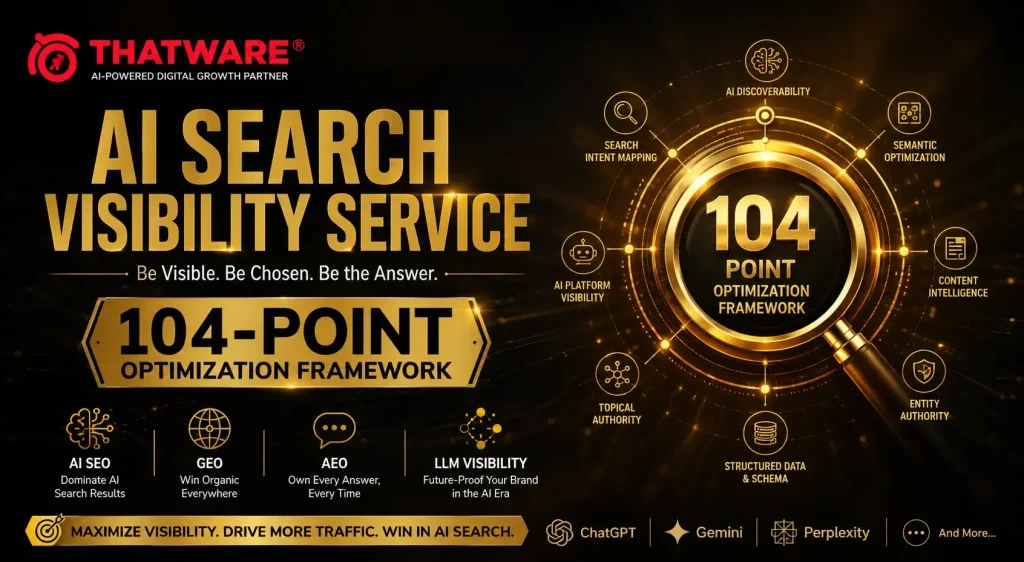
ThatWare’s AI search visibility services are designed to solve these broader visibility problems.
As an AI search visibility agency, ThatWare brings together prompt intelligence, citation analysis, Answer Engine Optimization, entity development, structured data, content engineering, crawler accessibility, RAG preparation, vector retrieval and brand authority.
Our role as an AI search visibility company is not limited to producing a one-time report. The framework creates a measurable operating system for discovering weaknesses, prioritizing fixes, validating changes and tracking results across search and AI platforms.
Organizations can work with an AI search visibility consultant to define target platforms, priority questions, high-value pages, competitors, entities, source requirements and conversion objectives.
What AI Search Visibility Means
AI search visibility measures whether a brand is:
- Mentioned in a generated answer
- Cited as a source
- Recommended as an option
- Compared with competitors
- Accurately described
- Connected with the correct service or category
- Excluded from a relevant response
- Replaced by a competitor
- Supported by an authoritative source
- Retrieved from the intended website page
Traditional SEO metrics remain useful, but they do not reveal the entire AI search journey. Rankings and impressions cannot show whether ChatGPT recommends the brand, whether Perplexity cites a directory instead of the service page or whether an AI Overview uses a competitor’s explanation.
ThatWare’s framework adds prompt-level, citation-level, entity-level and retrieval-level measurement to the established SEO process.
Why Businesses Need a Dedicated AI Search Strategy
AI systems depend on multiple signals:
- Page content
- Entity clarity
- Structured data
- Crawlability
- Source quality
- Internal links
- External citations
- Content freshness
- Semantic relevance
- User intent alignment
- Brand consistency
- Contextual authority
A fragmented website may provide all the necessary facts but fail to communicate them in a way that AI systems can retrieve confidently.
The ThatWare framework transforms the website into a connected answer environment where:
- Important questions have target pages
- Target pages contain direct answers
- Answers contain evidence
- Entities are clearly connected
- Schema reinforces visible content
- Internal links guide retrieval
- External sources support authority
- AI-facing files point to canonical information
- Visibility is tested repeatedly
- Every failed prompt generates a corrective action
How the Pricing Framework Should Be Applied
The 104 deliverables are not intended to be completed in a single month for every website.
The actual scope should depend on:
- Website size
- Number of services or products
- Number of locations
- Number of markets
- Existing authority
- Existing structured data
- Content maturity
- Technical condition
- Number of AI platforms being monitored
- Number of target prompts
- Regulatory sensitivity
- Development capacity
- Content approval requirements
A smaller website may begin with the visibility audit, answer optimization, schema, entity strengthening and tracking. A large enterprise may require a broader system involving RAG, vector feeds, AI-facing JSON files, multi-market prompt libraries, authority development and governance.
Complete ThatWare AI Search Service Coverage
AI Visibility Auditing and Strategic Planning
ThatWare’s AI visibility audit services examine whether the brand appears across relevant AI and search environments.
An AI brand visibility audit can record:
- Brand mentions
- Non-brand appearances
- Citations
- Recommendations
- Omissions
- Competitor preference
- Hallucinated information
- Source quality
- Intended target page
- Corrective action
An AI visibility baseline audit establishes the starting position before implementation. This baseline allows future improvements to be compared against the same prompt set, platforms and competitors.
For larger organizations, enterprise AI search visibility can include several business units, locations, countries, product categories, audience groups and approval workflows.
ThatWare’s AI search performance analysis combines search data, prompt tests, citation evidence, content quality and technical readiness. The findings are converted into an AI search visibility strategy with clear priorities, owners and success measures.
Brand Mentions, Appearance and Share of Voice
AI brand mention tracking measures how often the brand appears in generated responses.
AI brand appearance tracking separates branded prompts from non-branded category, service, comparison, and recommendation prompts.
AI brand visibility tracking records the platform, prompt, result, citation, competitor, and target page.
AI share of voice tracking compares the brand with selected competitors. The resulting AI answer share of voice shows which companies dominate important answer sets.
ThatWare’s competitor AI visibility analysis identifies why another company is mentioned or cited. The comparison may reveal stronger source pages, more complete answers, clearer entities, better structured data, or greater external authority.
AI recommendation tracking services measure whether the brand is merely mentioned or actively presented as a suitable choice.
An AI brand omission analysis investigates relevant prompts where the brand does not appear.
AI competitor benchmarking services create a consistent comparison methodology across prompts, platforms, categories, and time periods.
For businesses evaluating the investment required for ongoing monitoring and optimization, AI Search Visibility Pricing can be aligned with the number of AI platforms monitored, prompt sets tracked, competitors benchmarked, reporting frequency, and depth of visibility analysis required.
The resulting generative search share of voice gives decision-makers a clearer understanding of visibility inside AI-generated responses and helps them evaluate performance against their AI search visibility investment.
Citation and Source-Page Optimization
ThatWare’s AI citation optimization services improve the factors that make a page suitable for citation.
Our AI citation tracking services record which pages and third-party sources are selected by AI systems.
An AI citation gap analysis compares current sources with the sources the brand should ideally own.
AI citation source discovery identifies:
- Frequently cited competitors
- High-authority reference pages
- Directory sources
- News sources
- Review sources
- Official documentation
- Brand-owned pages
- Weak or inaccurate sources
AI answer source optimization strengthens the pages that should supply a generated answer.
Citation-ready content development creates definitions, data pages, expert resources, methodologies, glossaries and explanatory content that external publishers and AI systems can reference.
AI source page optimization combines direct answers, supporting evidence, entity signals, internal links, structured data and review information.
AI citation monitoring detects changes in source selection over time.
An AI answer citation strategy assigns priority questions to the best source pages and supporting external evidence.
ChatGPT citation optimization focuses on improving the clarity, usefulness and authority of pages that may support source-linked ChatGPT experiences.
Answer Engine Optimization and AI Content Engineering
ThatWare’s Answer Engine Optimization services improve eligibility for direct search and AI answers.
Our AEO audit services review questions, answer formats, schema, source pages, entities and authority.
Direct AI answer optimization creates self-contained blocks that respond immediately to the stated question.
AI answer extraction optimization improves the probability that the intended passage and page are selected.
AI-friendly content restructuring separates long pages into clearly labeled, independently understandable sections.
Answer-first content optimization places the direct answer before background information.
AI summary block creation provides a concise overview of the page.
AI key takeaway optimization identifies the most important points users and AI systems should retain.
AI question answer content formatting standardizes questions, concise answers, qualifiers, sources, internal links and calls to action.
Concise semantic response engineering limits each answer block to one primary intent, one key entity and one suitable next step.
Prompt and Conversational Search Intelligence
ThatWare’s AI prompt research services identify the questions and instructions people use when interacting with AI systems.
AI prompt pattern discovery groups prompts by recurring needs such as:
- Cost
- Comparison
- Suitability
- Location
- Reputation
- Process
- Risk
- Results
- Alternatives
- Recommendations
AI search intent analysis classifies prompts according to expected outcome, user readiness and answer format.
Prompt-style query mapping connects each prompt with an expected answer, source page, evidence requirement and risk level.
AI prompt visibility tracking monitors how the brand performs for the same prompt over time.
Conversational query optimization improves pages for natural-language questions.
ThatWare’s conversational search optimization services cover query discovery, question clustering, page mapping, content rewriting and visibility testing.
Question-to-page mapping services assign each important question to the page best suited to answer it.
High-intent question clustering separates educational questions from cost, comparison, selection and action-oriented questions.
Long-tail conversational query research captures detailed prompts that often reveal stronger commercial intent than short keywords.
Entity, Semantic and Knowledge Graph Services
ThatWare’s entity SEO services strengthen the people, companies, products, services, locations and concepts associated with the brand.
AI entity optimization services ensure that important entities are defined consistently across content, schema, profiles and external sources.
Brand entity profile optimization consolidates the canonical brand name, description, services, locations, leadership and sameAs references.
Entity relationship mapping services show how the brand connects with services, products, experts, audiences, use cases and locations.
Knowledge graph SEO services organize these relationships into a structured model.
Custom knowledge graph development creates a brand-specific graph supporting content, structured data, RAG and AI retrieval.
Entity-based content optimization places relevant entities together inside clear answer sections.
Topical entity optimization strengthens the brand’s connection with priority subjects.
Semantic relationship mapping guides content structure, internal links and schema relationships.
Entity-based JSON-LD implementation communicates these connections through machine-readable structured data.
Technical AI Discoverability and Retrieval
An AI crawler accessibility audit checks whether priority pages and assets are accessible, canonical and indexable.
ThatWare’s AI crawler optimization services improve technical discovery paths for approved content.
An AI discoverability audit reviews robots directives, sitemaps, canonical tags, structured data, internal links and AI-facing files.
AI search schema optimization aligns structured data with visible page content and entities.
AI search structured data services may include Organization, Service, Person, WebPage, BreadcrumbList, FAQPage and other appropriate types.
ThatWare’s RAG implementation services prepare approved content for retrieval-augmented AI systems.
Vector search optimization services improve semantic retrieval precision.
Vector embedding content optimization divides pages into well-formed chunks with suitable metadata.
AI retrieval path optimization connects questions, answer blocks, entities, links and canonical source pages.
LLM-ready website optimization brings these activities together so the website is easier for large language models to interpret, retrieve and summarize.
ThatWare’s Audit, Plan and Fix Methodology
Every deliverable should pass through the same controlled process.
Audit and Evidence
The audit records:
- Area reviewed
- Existing evidence
- Current gap
- Result or risk
- Priority level
- Recommended focus
Plan of Action
The implementation plan normally covers:
- Define the target queries, entities or assets.
- Run the relevant audit or test.
- Score the current result.
- Create or improve the required deliverable.
- Validate the output.
- Monitor results and report movement.
Before-and-After Fix Report
The fix report records:
- Current website state
- Exact issue
- Target implementation
- Corrective action
- Validation method
- Success metric
The 104-Point AI Search Visibility Framework
Phase One: Visibility, Citations and AI Answer Intelligence
1. AI Search Visibility Baseline Audit
Before
AI visibility may be discussed informally, but no repeatable baseline exists. The business cannot determine whether changes in mentions or citations are meaningful.
Plan of Action
Create a controlled prompt library for Google AI Overviews, ChatGPT, Gemini, Microsoft Copilot, Perplexity and other relevant systems. Record brand mentions, recommendations, citations, omissions, competing brands and source quality.
After
Every priority prompt has an expected answer, intended source, current result, competitor reference and risk classification.
Success Metric
Completed baseline for the agreed prompt set and measurable month-to-month change in mention, citation and recommendation rates.
2. Brand Appearance and Non-Appearance Tracking
Before
The brand may appear for direct branded searches but remain absent from non-brand service or category questions.
Plan of Action
Separate prompts into branded, non-branded, comparison, local, commercial and recommendation groups. Tag every result as appeared, cited, compared, omitted or displaced.
After
The business can see exactly where the brand appears, where it is missing and which signal may be responsible.
Success Metric
Higher appearance rate for relevant non-brand prompts and fewer unexplained omissions.
3. AI Answer Share-of-Voice Benchmarking
Before
Traditional competitor visibility is known, but competitor dominance inside AI answers is not quantified.
Plan of Action
Test equivalent prompts for the brand and selected competitors. Record appearance frequency, citation frequency, answer position and recommendation language.
After
A share-of-voice dashboard reveals which competitors dominate each question group and why.
Success Metric
Improved AI answer share of voice and fewer competitor-only responses.
4. AI Citation Source Discovery and Citation Gap Identification
Before
AI systems may cite directories, aggregators or competitors instead of the brand’s own pages.
Plan of Action
Collect cited URLs, classify source types, identify missing brand-owned sources and create priority citation-ready pages.
After
Every important citation opportunity is connected with an ideal source page and corrective action.
Success Metric
Increased direct citations to brand-owned pages and reduced dependence on indirect directory sources.
5. AI Search Intent and Prompt Pattern Discovery
Before
Keyword research exists, but AI prompts are not grouped by intent, context or expected answer format.
Plan of Action
Create prompt families covering education, cost, suitability, comparison, location, risk, results and action.
After
Prompt families guide page headings, Q&A modules, content blocks, comparisons and validation tests.
Success Metric
Complete prompt coverage for priority services and clearer mapping between prompt and target page.
6. Optimization of Content Blocks for Direct AI Answer Extraction
Before
AI systems must assemble an answer from several paragraphs or pages.
Plan of Action
Create one-question, one-answer modules with a concise response, supporting proof, relevant link and page-specific CTA.
After
Priority pages contain self-contained answer units that can be quoted or summarized without losing context.
Success Metric
Manual extraction tests consistently return the intended answer and URL.
7. Question-Answer Content Formatting for AI Search Surfaces
Before
Questions and answers vary in length, structure and placement.
Plan of Action
Standardize every item using a question, concise answer, qualifier, supporting link, CTA, source and schema status.
After
Q&A assets can be reused across pages, PAA modules, chatbots and structured data.
Success Metric
Higher Q&A reuse rate, fewer duplicate answers and cleaner schema candidates.
8. AI-Friendly Summary Blocks and Key-Takeaway Sections
Before
Page introductions provide context but do not isolate the most important information.
Plan of Action
Create summary blocks explaining the offer, audience, important facts, limitations and next step.
After
Every priority page opens with a compact, accurate and source-ready summary.
Success Metric
Improved AI summarization accuracy and stronger engagement from summary sections.
9. Featured Answer and Snippet Alignment for Conversational Search
Before
Content may rank, but it is not aligned with the structure of direct-answer results.
Plan of Action
Identify expected answer formats and create concise paragraphs, lists, tables or steps with specific page ownership.
After
Target answers use the structure most suitable for the query.
Success Metric
Improved extraction rate, PAA alignment and answer-section engagement.
10. AI-Generated Response Gap Correction Recommendations
Before
Incorrect or incomplete AI answers are observed without a corrective workflow.
Plan of Action
Map each failed output to a root cause such as page content, schema, internal links, citations, crawlability or authority.
After
Every answer gap creates a trackable correction task that can be retested against the same prompt.
Success Metric
Fewer inaccurate, incomplete or uncited answers after implementation.
Phase Two: Entities, Knowledge Graphs and Technical Discovery
11. Entity Profile Strengthening
Before
Brand, service, author and product information is distributed across different pages and profiles.
Plan of Action
Create canonical entity definitions, descriptions, credentials, identifiers, sameAs sources and relationships.
After
Core entities are defined once and represented consistently across content, schema and external profiles.
Success Metric
Improved entity recognition and fewer ambiguous or duplicate matches.
12. Knowledge Graph and Entity Relationship Enhancement
Before
Relationships are inferred from page proximity or navigation.
Plan of Action
Build a graph connecting brand, service, product, expert, audience, location, question and conversion path.
After
Important relationships are explicitly represented in content, links, structured data and retrieval assets.
Success Metric
Improved entity retrieval and more accurate service or product matching.
13. Brand Mention Optimization Across Authoritative Sources
Before
External mentions use inconsistent descriptions or point to weak destination pages.
Plan of Action
Standardize brand descriptions and prioritize relevant professional, industry, local and editorial sources.
After
Third-party profiles reinforce the same facts, services and category relationships used on the website.
Success Metric
Greater citation consistency and increased authoritative mentions.
14. AI Crawler-Readable Entity Summary Creation
Before
AI crawlers must infer important facts by processing full pages and external sources.
Plan of Action
Create concise entity summaries containing approved facts, canonical URLs, services, locations, experts and references.
After
AI-facing summaries point crawlers toward the correct sources and entity relationships.
Success Metric
Successful file retrieval and accurate reproduction of approved facts.
15. Schema and Structured Data Recommendations
Before
Structured data may be absent, incomplete, disconnected or inconsistent with visible content.
Plan of Action
Create a page-level schema plan, define entity IDs, recommend properties and establish validation requirements.
After
Every priority page has an accurate structured data specification tied to visible content.
Success Metric
Successful validation and reduced structured data gaps.
16. AI Crawler Accessibility Audit
Before
General SEO crawlability may be acceptable, but AI-facing accessibility is not verified.
Plan of Action
Check robots directives, canonical tags, status codes, sitemaps, internal links and AI-facing files.
After
Priority pages and assets have documented accessibility and recrawl status.
Success Metric
Zero blocked priority assets and clear crawl paths to target pages.
17. Robots.txt, Sitemap, Schema and Indexation Review
Before
Technical discovery signals are managed independently, creating a risk of conflicting instructions.
Plan of Action
Review robots permissions, XML sitemap membership, canonical URLs, schema deployment and index coverage together.
After
Discovery and indexation signals consistently guide systems to approved pages.
Success Metric
Priority URLs remain accessible, indexable and free from conflicting directives.
18. AI Answer Source Page Optimization and Crawl Path Improvement
Before
AI systems may cite the homepage or a directory instead of the page that best answers the question.
Plan of Action
Create source-page templates containing a direct summary, evidence, schema, internal links, review date and canonical reference.
After
Each intended source page has a clean crawl path and complete citation-ready structure.
Success Metric
More citations to intended pages and fewer generic homepage citations.
19. Internal Linking Improvements for AI Retrieval Paths
Before
Navigation exists, but contextual links do not fully connect questions, entities and answer pages.
Plan of Action
Add descriptive links between service pages, FAQs, categories, experts, locations and supporting resources.
After
Internal links function as retrieval paths from broad questions to specific answers.
Success Metric
Improved target-page retrieval and stronger page confidence.
20. Structured Content Hierarchy Optimization for AI Summarization
Before
Overview, proof, FAQs and CTAs may appear without a consistent hierarchy.
Plan of Action
Use one H1, clear H2 question or service sections, H3 supporting details and separate proof, FAQ and CTA areas.
After
The heading hierarchy identifies which section answers each question and why it is trustworthy.
Success Metric
Cleaner summaries and fewer incorrect section extractions.
Phase Three: Question Architecture and SERP Answer Formats
21. Question-Answer Opportunity Map
Before
Questions are not assigned to specific pages.
Plan of Action
Map each question by intent, value, target URL, answer format, evidence and CTA.
After
Every priority question has one primary page and defined supporting assets.
Success Metric
Question-to-page coverage and improved direct-answer visibility.
22. Conversational Query Opportunity Discovery
Before
Natural customer phrasing is not inventoried systematically.
Plan of Action
Mine search suggestions, forums, sales conversations, support records, PAA and AI prompts.
After
A conversational query library supports headings, FAQs, page briefs and prompt tests.
Success Metric
Growth in long-tail impressions and visits to mapped landing pages.
23. AI Answer Surface Gap Analysis
Before
Answers are dispersed across long sections.
Plan of Action
Identify missing or incomplete answer elements and add source-ready modules near the top of high-value pages.
After
Priority answer surfaces have concise responses supported by context and links.
Success Metric
Successful extraction tests for the priority question set.
24. Featured Snippet Competitor Mapping
Before
The business does not know which competitors control direct SERP answers.
Plan of Action
Record winning URLs, formats, headings, content length, schema and supporting evidence.
After
Every opportunity has a competitor benchmark and counter-content brief.
Success Metric
Completed target list and measurable snippet gains.
25. High-Intent Question Clustering
Before
Questions with different levels of readiness are mixed together.
Plan of Action
Group questions by education, risk, cost, comparison, selection and action.
After
Each cluster receives suitable evidence, answer depth and CTA.
Success Metric
Question-cluster coverage and CTA engagement by cluster.
26. FAQ Extraction Formatting
Before
FAQs are long, duplicated and difficult to reuse.
Plan of Action
Extract existing FAQs, remove duplicates, shorten the first response and move items to relevant pages.
After
Each FAQ follows an approved structure and has clear page ownership.
Success Metric
Higher approval rate and reduced duplication.
27. Listicle Answer Formatting
Before
List-oriented questions are answered through paragraphs.
Plan of Action
Convert suitable topics into ordered or unordered lists with concise explanations and links.
After
Pages contain extractable list modules aligned with user intent.
Success Metric
List-snippet coverage and engagement.
28. Table-Based Answer Optimization
Before
Users must read several paragraphs to compare options.
Plan of Action
Create accessible HTML tables covering features, suitability, process, limitations or next steps.
After
Comparison information becomes easier to understand and extract.
Success Metric
Table indexing, extraction success and comparison-query visibility.
29. Step-by-Step Response Structuring
Before
Process information is buried inside prose.
Plan of Action
Create numbered workflows with prerequisites, actions, warnings, links and completion CTA.
After
Users and AI systems can follow the process in a clear sequence.
Success Metric
Task-completion engagement and fewer support questions.
30. Featured Snippet Targeting
Before
Pages contain answers but delay the direct response.
Plan of Action
Place concise answers immediately below relevant question headings.
After
Target pages are formatted for paragraph, list, table or step-based snippets.
Success Metric
Improved snippet and PAA visibility.
31. People Also Ask Optimization
Before
PAA-style questions are concentrated on a general FAQ page.
Plan of Action
Distribute page-specific questions across service, product and category pages.
After
Questions appear where their intent and conversion value are strongest.
Success Metric
Page-specific PAA coverage and ranking observations.
32. AI Overview Optimization
Before
Pages lack a complete layout combining direct answers, evidence, entities and schema.
Plan of Action
Create AI Overview-ready versions of selected pages.
After
Each page contains concise facts, proof, FAQs, structured data and review information.
Success Metric
AI Overview source appearances and answer consistency.
33. Voice Search Answer Optimization
Before
No short spoken-answer modules are available.
Plan of Action
Create natural responses that can usually be spoken within 20 to 30 seconds.
After
Voice-ready sections answer the question, provide a qualifier and guide the next step.
Success Metric
Voice-answer accuracy and practical spoken length.
Phase Four: Structured Data, NLP and Content Engineering
34. FAQ Schema Deployment
Before
Visible FAQs lack eligible machine-readable representation.
Plan of Action
Deploy FAQPage JSON-LD where appropriate and ensure the markup matches visible content.
After
Eligible FAQs have validated structured data and clear page ownership.
Success Metric
Valid detection after recrawl and no content mismatch.
35. Speakable Schema Implementation
Before
Voice-oriented content is not identified for read-aloud use.
Plan of Action
Select short, public informational sections and apply speakable properties only where appropriate.
After
Suitable sections are marked without exposing sensitive or misleading content.
Success Metric
Successful validation and accurate spoken output.
36. HowTo Schema Integration
Before
Legitimate step-based workflows lack structured representation.
Plan of Action
Use HowTo only for suitable procedures, not unsupported or unsafe instructions.
After
Eligible workflows include structured steps, URLs and completion actions.
Success Metric
Validation status and workflow engagement.
37. Entity-Based JSON-LD Markup
Before
Entity relationships are left for search systems to infer.
Plan of Action
Create a connected graph linking organization, services, people, pages, locations and breadcrumbs.
After
Structured data explicitly communicates important relationships.
Success Metric
Valid graph coverage and fewer ambiguity issues.
38. AI-Friendly Content Restructuring
Before
Long pages combine several intents in the same sections.
Plan of Action
Separate summaries, service details, evidence, FAQs, comparisons and CTAs.
After
Each section can be understood independently.
Success Metric
Higher extraction pass rate and answer-section engagement.
39. Conversational Content Rewriting
Before
Content describes the company but does not answer customer questions directly.
Plan of Action
Rewrite headings and paragraphs using natural user phrasing.
After
Pages respond more clearly to conversational and prompt-style searches.
Success Metric
Improved long-tail visibility and engagement.
40. Answer-First Paragraph Optimization
Before
Background information appears before the answer.
Plan of Action
Lead every important section with a one or two sentence response.
After
Users and AI systems receive the answer immediately.
Success Metric
Snippet readability and extraction success.
41. Concise Semantic Response Engineering
Before
Individual answers contain several intents, entities or CTAs.
Plan of Action
Separate complex answers into focused semantic blocks.
After
Each block communicates one primary idea and one next step.
Success Metric
Improved clarity, length distribution and retrieval accuracy.
42. Contextual Schema Layering
Before
Schema types are isolated or selected without a page-level graph.
Plan of Action
Layer accurate Organization, Service, Person, WebPage, FAQ and breadcrumb entities.
After
Structured data forms a connected and contextually accurate graph.
Success Metric
Successful validation and reduced schema gaps.
43. Entity Extraction, TF-IDF and BERT-Based Content Scoring
Before
Content improvements rely primarily on editorial opinion.
Plan of Action
Extract entities, compare terminology and analyze semantic and intent coverage.
After
Each priority page receives a data-supported content scorecard.
Success Metric
Improved entity coverage and semantic relevance.
44. Vector Embeddings and AI-Assisted Content Restructuring
Before
Duplicate or generic content can dilute semantic retrieval.
Plan of Action
Create canonical chunks, remove duplication and apply intent and entity metadata.
After
Important passages are independently retrievable and mapped to canonical pages.
Success Metric
Improved top-k retrieval precision.
45. LSI Clustering and Sentence Scoring
Before
Keyword-rich pages are not evaluated for intent match or readability.
Plan of Action
Cluster related concepts and score sentences for purpose, clarity and relevance.
After
A dashboard identifies passages that should be shortened, moved or rewritten.
Success Metric
Improved readability and intent-match scores.
Phase Five: Entity Reinforcement and Topical Authority
46. Primary Entity Reinforcement
Before
The brand may be described inconsistently across pages and profiles.
Plan of Action
Standardize names, descriptions, categories, identifiers and sameAs references.
After
All owned and external assets reinforce the same primary entity.
Success Metric
Improved entity recognition consistency.
47. Semantic Relationship Mapping
Before
Relationships between entities are implied.
Plan of Action
Map brand, service, audience, expert, location and topic relationships.
After
Relationships are reflected in content, internal links and schema.
Success Metric
Stronger page matching and semantic relevance.
48. Topical Entity Association Optimization
Before
Relevant concepts are too far apart or not connected in the same answer block.
Plan of Action
Create concise co-occurrence sections linking the primary entity with related topics.
After
Priority pages provide complete topical context.
Success Metric
Improved entity association and answer accuracy.
49. Brand Entity Disambiguation
Before
Similar names, legacy descriptions or inconsistent profiles create uncertainty.
Plan of Action
Define the canonical entity and correct conflicting owned and third-party sources.
After
AI systems can distinguish the brand more reliably.
Success Metric
Fewer incorrect brand matches.
50. Custom Knowledge Graph Integrations and Prompt-Engineered Clusters
Before
Content exists as isolated pages.
Plan of Action
Build a custom graph supporting prompts, entities, topics, sources and target pages.
After
The graph supports content planning, retrieval, structured data and AI responses.
Success Metric
Knowledge graph coverage and prompt-answer accuracy.
51. NLP-Led Keyword Placement and Synonym Mapping
Before
Synonym use creates overlap or unclear page ownership.
Plan of Action
Create a controlled map of primary terms, natural variations and excluded terms.
After
Semantic breadth improves without unnecessary cannibalization.
Success Metric
Improved query coverage and cleaner page ownership.
52. Content Gap Analysis
Before
The website appears comprehensive but misses important questions and decisions.
Plan of Action
Compare the website against competitors, SERPs, AI answers and customer journeys.
After
Every validated gap has a target page, content format, priority and owner.
Success Metric
Number of high-priority gaps closed.
53. Custom Topical Maps
Before
Content is organized by navigation rather than authority structure.
Plan of Action
Create hubs, supporting pages, conversion pages and internal-link requirements.
After
Priority subjects have complete, connected ecosystems.
Success Metric
Cluster completion and internal-link coverage.
54. AI-Overview Optimized Pages
Before
Pages lack a standardized citation-ready layout.
Plan of Action
Add answer summaries, evidence, entities, FAQs, schema and review details.
After
Selected URLs become stronger source candidates.
Success Metric
AI Overview tests and citation observations.
55. Entity-Dense Authority Articles
Before
Blog content does not consistently strengthen commercial topics.
Plan of Action
Develop expert-reviewed articles with strong entity and service relationships.
After
Educational content reinforces topical and commercial authority.
Success Metric
Engagement, citations, links and assisted conversions.
56. E-E-A-T-Based Planning
Before
Expertise and evidence are separated from important claims.
Plan of Action
Add author information, reviewer details, credentials, sources and update dates.
After
Priority pages carry visible and verifiable trust signals.
Success Metric
Percentage of target pages with complete trust information.
57. Entity-Based Content Modeling
Before
Entities occur separately rather than in meaningful combinations.
Plan of Action
Model the entity combinations expected for each target intent.
After
Service, audience, need, location and proof appear together naturally.
Success Metric
Improved co-occurrence relevance.
58. AIO Content Flows
Before
Pages do not guide users from question to action consistently.
Plan of Action
Structure content as answer, suitability, process, evidence, objection handling and CTA.
After
Pages support both AI extraction and customer decision-making.
Success Metric
CTA engagement from answer-oriented sections.
Phase Six: RAG, Vector Retrieval and External Authority
59. RAG Implementation
Before
Approved website information is not available as a controlled retrieval source.
Plan of Action
Create canonical answers, chunks, metadata, sources, owners, dates and risk labels.
After
AI applications can retrieve verified information before generating a response.
Success Metric
Retrieval accuracy, freshness and reduced unsupported output.
60. Vector Engineering-Based Content Cluster Optimization
Before
Semantic search may retrieve duplicate, generic or outdated passages.
Plan of Action
Build a canonical chunk index and test it with representative questions.
After
The correct content appears more consistently in top retrieval results.
Success Metric
Top-k retrieval precision.
61. Tier 1 and Tier 2 Backlink Enhancement
Before
External authority is not organized by relevance, quality and target-page purpose.
Plan of Action
Classify current and prospective sources into controlled authority tiers.
After
Link equity is directed toward pages requiring topical and entity support.
Success Metric
Growth in relevant referring domains with low risk.
62. Digital PR, Curated Placements and Press Coverage
Before
Expertise is not packaged for publishers or journalists.
Plan of Action
Create expert profiles, quote banks, research assets and relevant media angles.
After
External sources have clear, credible reasons to reference the brand.
Success Metric
Earned mentions, links and referral engagement.
63. Entity Stacking, Contextual and Competitor Backlinks
Before
External profiles and references communicate inconsistent facts.
Plan of Action
Standardize entity descriptions and identify legitimate contextual opportunities.
After
Owned profiles and external sources reinforce the same brand and service associations.
Success Metric
Citation consistency and relevant authority growth.
64. Citation-Ready Reference Pages
Before
Publishers and AI systems must assemble facts from several pages.
Plan of Action
Create dedicated definition, data, methodology, glossary and expert reference pages.
After
The website contains transparent, sourceable resources.
Success Metric
External citations and AI source selection.
65. Link Acquisition Through Search Operators
Before
Prospecting is inconsistent.
Plan of Action
Build search operator combinations for resources, associations, editorial opportunities and expert contributions.
After
Qualified opportunities are recorded with relevance, contact and target page.
Success Metric
Prospect qualification and earned-placement rates.
66. Forum Participation, Guest Blogging and Link Equity Redistribution
Before
Community contributions are unplanned or overly promotional.
Plan of Action
Define approved platforms, topics, disclosure rules and destination pages.
After
Contributions add genuine value and support relevant authority pages.
Success Metric
Quality placements and referral engagement.
67. Programmatic Backlink Acquisition
Before
Automation may introduce irrelevant or risky sources.
Plan of Action
Use automation for discovery and data enrichment, while retaining human approval.
After
Every opportunity passes relevance, authority and risk controls.
Success Metric
Quality referring-domain growth without toxic link expansion.
Phase Seven: Query Expansion, Freshness and Validation
68. Long-Tail Conversational Query Expansion
Before
Core topics are not expanded into detailed questions.
Plan of Action
Generate variants by audience, location, use case, objection and readiness.
After
Each service has a complete conversational query family.
Success Metric
Long-tail visibility and assisted conversions.
69. Intent-Based Topic Coverage
Before
Content decisions rely mainly on search volume.
Plan of Action
Map topics across awareness, comparison, validation and action stages.
After
Content covers the entire customer journey.
Success Metric
Visibility and conversion by intent.
70. Multi-Format Answer Generation
Before
Every question receives a paragraph answer.
Plan of Action
Use definitions, lists, tables, steps, FAQs and summaries according to intent.
After
The answer format matches the question.
Success Metric
Extraction success by format.
71. Semantic Keyword Clustering
Before
Related phrases are targeted through competing pages.
Plan of Action
Cluster terms by meaning, intent, entity and destination.
After
Canonical pages cover connected query groups more effectively.
Success Metric
Reduced cannibalization and improved cluster visibility.
72. Content Freshness Monitoring
Before
Outdated information remains live until discovered manually.
Plan of Action
Assign owners, review dates, volatility levels and update frequencies.
After
Time-sensitive pages follow a documented review schedule.
Success Metric
Percentage of pages reviewed on time.
73. AI Answer Recency Updates
Before
AI systems may continue using outdated information.
Plan of Action
Update canonical sources, dates, internal references and supporting citations, then retest prompts.
After
Generated responses are more likely to reflect current information.
Success Metric
Reduction in stale answers.
74. Trend-Driven Content Refreshes
Before
Trend content remains disconnected from evergreen pages.
Plan of Action
Update permanent hubs and connect timely content with commercial resources.
After
Short-term interest strengthens long-term authority.
Success Metric
Incremental visibility and hub engagement.
75. Temporal Query Optimization
Before
Users cannot quickly determine whether information is current.
Plan of Action
Identify date-sensitive queries and add applicable periods, update dates and sources.
After
Pages provide clear recency context.
Success Metric
Improved time-modified query visibility.
76. AI Extraction Validation Testing
Before
No consistent test confirms whether systems retrieve the intended answer.
Plan of Action
Define expected answers and sources, run prompts and score the outputs.
After
Every tested query receives a pass, partial or fail status.
Success Metric
Correct-answer and correct-source rates.
77. Structured Data Error Auditing
Before
Errors and warnings are distributed across tools.
Plan of Action
Create a central register with severity, URL, owner and validation result.
After
Structured data issues follow a controlled resolution process.
Success Metric
Critical errors resolved and valid coverage increased.
78. SERP Answer Consistency Testing
Before
Snippets, PAA answers and landing pages may communicate different information.
Plan of Action
Compare all answer surfaces and correct the underlying source content.
After
The brand communicates consistent verified answers.
Success Metric
Answer consistency rate.
79. Mobile Voice Answer Verification
Before
Desktop content is assumed to work for spoken queries.
Plan of Action
Test pronunciation, duration, clarity and source accuracy on mobile interfaces.
After
Unclear answers are rewritten and validated.
Success Metric
Mobile voice test pass rate.
80. AI Visibility Tracking
Before
Reporting is limited to rankings and traffic.
Plan of Action
Track mentions, recommendations, citations, omissions, competitors and sources across a fixed prompt set.
After
AI visibility can be measured by platform, question, intent and page.
Success Metric
AI share of answer, mention rate and citation frequency.
Phase Eight: AI Discoverability Files and Machine-Readable Assets
81. Security.txt Setup
Before
Security contact and disclosure information may not be available through a standard file.
Plan of Action
Create a valid security.txt file containing approved security contact and policy information.
After
The website provides a standardized security reference.
Success Metric
Successful fetch and validation.
82. Conversational Query Ranking Reports
Before
Only short keyword positions are reported.
Plan of Action
Track natural-language questions, target pages, search features and AI visibility.
After
Reports show performance by question, intent and destination.
Success Metric
Conversational ranking and visibility movement.
83. AI.txt in the Well-Known Directory
Before
No documented AI-facing guidance file is present in the designated technical location.
Plan of Action
Create a file containing approved access guidance, canonical resources and update information.
After
The asset becomes an owned and monitored technical deliverable.
Success Metric
Successful retrieval and correct canonical references.
84. Semantic-Sitemap.xml Implementation
Before
The XML sitemap lists URLs without semantic relationships.
Plan of Action
Create a complementary semantic sitemap identifying content types, entities, topics and relationships.
After
Priority pages are represented within a meaningful content architecture.
Success Metric
Successful fetch and accurate page classification.
85. Vector-Feed.xml Creation
Before
No machine-readable feed exposes vector-ready content sources.
Plan of Action
Create a feed listing canonical chunks, URLs, entities, intents and update dates.
After
Retrieval systems have a controlled inventory of embedding-ready sources.
Success Metric
Successful feed validation and improved retrieval coverage.
86. AI-Manifesto.json Implementation
Before
The brand’s purpose, expertise and AI-facing principles are not summarized in a structured asset.
Plan of Action
Create a JSON file defining approved identity, mission, expertise, categories and canonical sources.
After
The website contains a governed brand and AI communication reference.
Success Metric
Successful retrieval and fact consistency.
87. Llms.txt Implementation
Before
Important website resources are not summarized in an LLM-oriented text file.
Plan of Action
Create a concise file referencing priority pages, services, policies and documentation.
After
Large language model crawlers can locate approved high-value sources more efficiently.
Success Metric
Successful fetch and accurate source references.
88. AI.txt Implementation
Before
AI-facing guidance is absent or disconnected from canonical content.
Plan of Action
Create an approved file containing content access, source and identity guidance.
After
The file becomes part of the website’s governed discovery layer.
Success Metric
Successful retrieval and reduced discovery gaps.
89. Entity-Identity Schema Deployment
Before
The canonical entity is not represented consistently through structured identity signals.
Plan of Action
Deploy organization, person, service, location and sameAs relationships.
After
Machine-readable identity aligns with visible content and external profiles.
Success Metric
Valid entity graph and reduced ambiguity.
90. AI-Index.json Implementation
Before
No structured index lists AI-relevant website assets.
Plan of Action
Create a JSON index containing canonical URLs, content types, entities, update dates and owners.
After
Approved resources are organized in a machine-readable directory.
Success Metric
Successful fetch and complete target-page coverage.
91. AI-Decision-Layer.json Implementation
Before
Decision-oriented content and conversion pathways are not exposed as a structured asset.
Plan of Action
Map questions, decision factors, evidence and recommended next steps.
After
The file represents how users move from question to informed action.
Success Metric
Correct canonical references and governed decision rules.
92. RAG-Index.json Implementation
Before
RAG-ready resources do not have a central machine-readable index.
Plan of Action
List chunks, source URLs, entities, dates, reviewers, risks and retrieval fields.
After
The RAG layer has a controlled source registry.
Success Metric
Successful retrieval and improved answer accuracy.
93. AI-Endpoints.json Implementation
Before
Machine-readable data or answer endpoints are not documented centrally.
Plan of Action
Create an approved endpoint inventory with purpose, access and update information.
After
AI-facing endpoints are discoverable and governed.
Success Metric
Successful access validation.
94. Reasoning-Map.json Implementation
Before
The relationship between questions, evidence and conclusions is not documented.
Plan of Action
Create a structured map connecting query classes, supporting sources and acceptable response logic.
After
Approved reasoning pathways are represented transparently.
Success Metric
Accurate query-to-source alignment.
95. Context-Engine.json Implementation
Before
Contextual boundaries are not represented in a central technical asset.
Plan of Action
Define services, audiences, markets, exclusions, entities and supporting context.
After
AI systems have a clearer reference for interpreting brand information.
Success Metric
Improved contextual answer accuracy.
96. Trust-Signals.json Implementation
Before
Credentials, reviews, policies and authority signals remain scattered.
Plan of Action
Create a structured register of approved trust evidence and canonical sources.
After
Trust information becomes easier to retrieve and validate.
Success Metric
Successful fetch and complete trust-source coverage.
97. Citation-Preferences.json Implementation
Before
No governed asset identifies preferred sources for important claims.
Plan of Action
Map claims, topics and questions to canonical reference pages.
After
The website maintains a structured citation preference layer.
Success Metric
Correct source mapping and fewer indirect citations.
98. AI-Signals.json Implementation
Before
AI-relevant entity, content, freshness and authority signals are not consolidated.
Plan of Action
Create a structured summary of approved signals and supporting URLs.
After
The file provides a central machine-readable signal inventory.
Success Metric
Successful retrieval and consistent references.
99. Activity-Stream.json Implementation
Before
Important content and entity updates are not available through a structured update stream.
Plan of Action
Document approved changes, dates, affected URLs and change types.
After
Systems can identify recent updates more efficiently.
Success Metric
Update completeness and successful fetch.
100. Llms-Full Implementation
Before
The standard LLM guidance file provides only limited summaries.
Plan of Action
Create a more comprehensive resource covering services, definitions, experts, policies, references and canonical URLs.
After
The website offers an expanded LLM-readable knowledge summary.
Success Metric
Complete coverage and factual consistency.
101. External-Citations.json
Before
External citations are not maintained in a structured registry.
Plan of Action
Record source, publisher, cited entity, destination page, date, relevance and status.
After
The brand has a governed external citation inventory.
Success Metric
Citation coverage and source quality.
102. External-Authority.json
Before
External authority signals are not consolidated.
Plan of Action
Create a structured record of trusted profiles, publications, associations, credentials and mentions.
After
External authority can be monitored and connected to relevant entities.
Success Metric
Authority-source completeness and consistency.
103. AI-Query-Map.json
Before
Prompts and questions are not connected with canonical answer pages in a technical file.
Plan of Action
Create a structured map containing query, intent, answer, source page, entity, CTA and review status.
After
The website maintains a machine-readable question-to-source system.
Success Metric
Successful fetch, correct canonical references and reduced discovery gaps.
104. Answer Primitives
Before
Core answer components are scattered through pages and cannot be reused consistently.
Plan of Action
Create controlled primitives such as definitions, eligibility statements, comparison facts, process steps, evidence blocks, safety notes and CTAs.
After
Pages, chatbots, RAG systems and AI-facing files can reuse approved answer components.
Success Metric
Higher answer consistency, easier content maintenance and improved retrieval accuracy.
Recommended Implementation Roadmap
Phase 1: Baseline and Visibility Intelligence
Complete:
- AI visibility baseline
- Brand appearance tracking
- Share-of-voice benchmarking
- Citation source discovery
- Prompt research
- Competitor analysis
Phase 2: Answer and Page Architecture
Complete:
- Question-to-page mapping
- Direct answer blocks
- Summary modules
- FAQs
- Lists
- Tables
- Process sections
- AI Overview layouts
Phase 3: Entity and Structured Data Foundation
Complete:
- Entity definitions
- Brand disambiguation
- Entity relationships
- Knowledge graph
- JSON-LD
- Schema validation
- Crawler accessibility
Phase 4: Retrieval and RAG Readiness
Complete:
- Content chunking
- Vector metadata
- RAG source pack
- Semantic retrieval testing
- Canonical answer library
- Retrieval path optimization
Phase 5: Citation and Authority Growth
Complete:
- Reference pages
- Digital PR
- Expert assets
- Relevant backlinks
- Third-party profile alignment
- Citation monitoring
Phase 6: AI-Facing Technical Assets
Complete:
- llms.txt
- ai.txt
- AI index
- RAG index
- Semantic sitemap
- Vector feed
- Trust and citation files
- AI query map
- Answer primitives
Phase 7: Continuous Validation
Complete:
- Recurring prompt tests
- AI visibility tracking
- Citation monitoring
- Freshness reviews
- Voice tests
- Structured data audits
- SERP consistency checks
Recommended Performance Dashboard
The reporting dashboard should include:
- Total prompts tested
- Brand appearance rate
- Brand omission rate
- AI mention rate
- AI recommendation rate
- Citation rate
- AI answer share of voice
- Correct-source rate
- Competitor-only answer rate
- Google AI Overview appearances
- ChatGPT source observations
- Perplexity citations
- Gemini visibility
- Copilot visibility
- Featured snippet visibility
- PAA visibility
- Question-to-page coverage
- Valid schema coverage
- Entity confidence
- RAG retrieval precision
- Voice-answer accuracy
- Freshness compliance
- Referring-domain growth
- Citation-ready page performance
- Conversion from answer sections
Build Visibility Where Customers Now Search
The next stage of organic visibility will be shaped by answers, citations, entities, prompts and machine-readable knowledge.
A website must do more than rank. It must explain the brand clearly, answer important questions, guide AI systems to the correct source, support claims with credible evidence and remain measurable across multiple search experiences.
ThatWare’s 104-point framework creates a structured path from fragmented website information to a connected, retrievable and citation-ready AI search ecosystem.