SUPERCHARGE YOUR ONLINE VISIBILITY! CONTACT US AND LET’S ACHIEVE EXCELLENCE TOGETHER!
Search is moving beyond conventional keyword rankings.
People now ask complete questions through ChatGPT, Gemini, Claude, Perplexity, Microsoft Copilot, Google AI Overviews and other conversational systems. These platforms interpret information, compare providers, retrieve supporting passages, summarize complex subjects and recommend possible solutions.
A website can perform well in conventional organic search and still remain difficult for a large language model to understand. Important answers may be hidden inside long sections. Several pages may communicate conflicting facts. Service descriptions may not connect clearly with the right audiences, locations, experts or use cases. Content may be readable to visitors but poorly structured for passage retrieval, embeddings, RAG systems or machine-generated summaries.
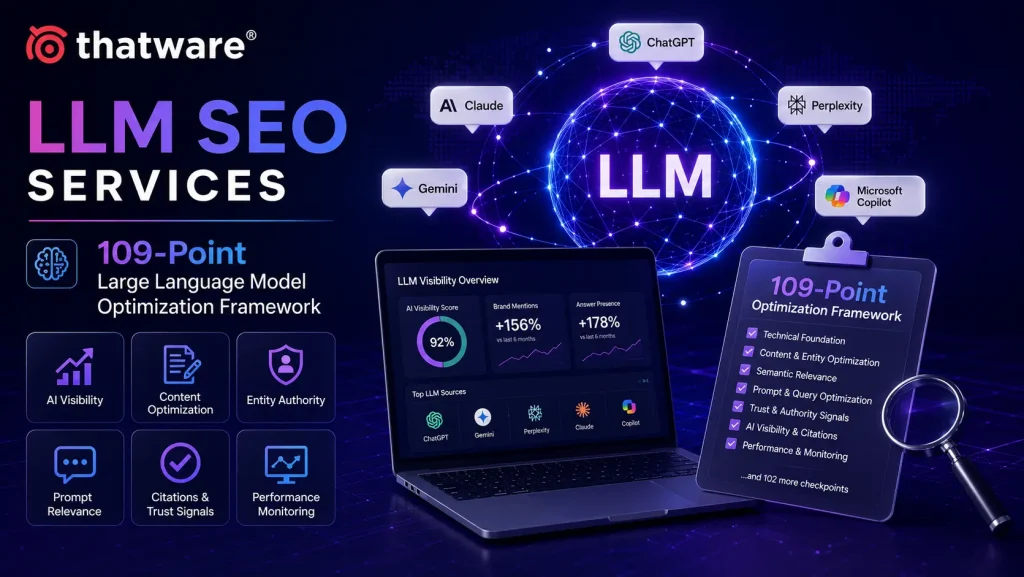
ThatWare’s current pricing page presents LLM SEO as a monthly service measured in USD. It already covers strategy, visibility auditing, prompt research, semantic content, AI-ready content, direct answers, entity building, structured data, RAG, vector feeds, semantic sitemaps, AI control files, citation signals, knowledge graphs, internal linking, trust and continuous reporting.
The framework below expands that existing service into a detailed 109-point operating model based on the uploaded chapter-specific audit presentation. The presentation applies a repeatable process to every deliverable: audit the existing assets, identify a chapter-specific gap, create the required implementation asset, restructure content for answer engines, connect supporting pages, validate risk and accuracy, and measure the result through a defined success metric.
The sample presentation contains site-specific healthcare findings. The content below adapts the same audit, plan, before-versus-after and measurement methodology for ThatWare’s LLM SEO pricing and service framework.
What Is LLM SEO?
LLM SEO is the process of making a brand, website and knowledge ecosystem easier for large language models to understand, retrieve, summarize, cite and recommend.
Traditional SEO usually focuses on crawling, indexing, rankings, backlinks and organic traffic. LLM SEO adds several additional layers:
- Passage-level retrieval
- Semantic chunk quality
- Entity relationships
- Source consistency
- Prompt-answer alignment
- Context-window efficiency
- Vector and embedding readiness
- Machine-readable knowledge assets
- Citation and trust signals
- AI response validation
- Hallucination resistance
- Cross-platform visibility
- AI content governance
The objective is not to manipulate an AI system. The objective is to make reliable business information clear, consistent, accessible and adequately supported.
What ThatWare’s Current LLM SEO Pricing Page Covers
The live ThatWare page explains that each LLM SEO campaign begins with a strategy and roadmap. It includes AI visibility analysis, natural-language prompt research, content gap analysis, semantic optimization, direct answer engineering, FAQ optimization, entity SEO, schema, RAG structuring, vector feeds, semantic sitemaps, AI TXT, llms.txt, AI manifesto development, citation optimization, knowledge graphs, internal links, trust enhancement and ongoing reporting.
The proposed 109-point framework adds deeper operational detail in five areas:
- Content readability and semantic engineering
- Retrieval, vector and RAG performance
- Machine-readable discovery and governance assets
- Authority, trust and answer-source development
- AI visibility measurement and probabilistic modelling
ThatWare’s Complete LLM SEO Service Coverage
Core LLM SEO Services
ThatWare provides LLM SEO services for organizations that want stronger visibility, understanding and source eligibility across large language model environments.
Our LLM optimization services combine content, technical, semantic, retrieval and authority work. As an LLM SEO company, ThatWare can audit existing assets, develop an implementation plan, create required deliverables and measure changes.
Organizations selecting an LLM SEO agency receive a coordinated framework rather than disconnected content edits. A dedicated LLM SEO consultant can define target AI systems, prompt groups, knowledge sources, service entities and conversion priorities.
The model also supports enterprise LLM optimization for larger websites with multiple markets, product lines, teams, languages or approval requirements.
Our large language model SEO services are designed to improve how AI systems interpret and retrieve important business information. This includes LLM search visibility services, LLM readiness audit services and complete LLM website optimization.
Retrieval, Vector and RAG Services
ThatWare’s AI retrieval optimization services identify whether AI systems can retrieve the correct information for priority questions.
An AI retrieval gap analysis compares the expected answer and source against the page, passage or external source currently being selected.
Our vector retrieval optimization services improve semantic content discovery, while passage-level retrieval engineering prepares self-contained answer units.
Semantic embedding optimization improves the alignment between query meaning and content meaning. Retrieval confidence optimization strengthens source clarity, metadata, entity context and supporting evidence.
An AI retrieval accuracy audit evaluates whether the correct answer and URL appear in controlled tests. RAG retrieval optimization prepares verified knowledge for retrieval-augmented generation environments.
ThatWare can also provide top-k retrieval testing services to measure whether the right source appears among the highest-ranked retrieved passages. AI retrieval frequency tracking monitors how regularly specific pages or content chunks are selected.
LLM-Readable Content Engineering
LLM-readable content optimization restructures pages so key passages are easier to identify and understand.
Chunk-ready content optimization prepares content blocks with independent meaning, while AI content chunking services establish logical boundaries, metadata and source references.
Token efficiency optimization removes repetition and low-value language without stripping away necessary context.
Context window optimization services help important information remain understandable when retrieved with a limited amount of surrounding text.
Retrieval-focused content formatting can include short definitions, answer-first paragraphs, tables, lists, steps, summaries and source notes.
AI summary block creation gives each priority page a concise, accurate overview.
Source-of-truth content engineering establishes canonical pages and approved explanations for important business facts.
Machine-readable content enhancement connects visible content with structured data and AI-facing knowledge assets.
Structured readability optimization improves headings, paragraph order, sentence clarity and answer extraction.
Semantic and Entity Services
ThatWare offers semantic coverage audit services to determine whether pages include the concepts and relationships expected for a target topic.
Semantic HTML optimization services improve the structural meaning of headings, navigation, lists, sections, tables, quotations and page landmarks.
Entity-linked schema implementation connects organizations, people, services, products, locations, web pages and related subjects.
Canonical entity mapping services define the preferred identity, description, attributes, identifiers and URLs for important entities.
Knowledge consistency optimization removes conflicting descriptions across pages and external profiles.
Relationship-based content structuring makes the connections between services, audiences, problems, experts and solutions explicit.
Topic hierarchy optimization organizes core categories, supporting subjects and subordinate concepts.
Entity-based content modeling defines which entities should occur together for each query or page type.
Semantic navigation optimization turns menus and internal links into clear topical and entity pathways.
Knowledge graph SEO services consolidate these relationships into a structured, reusable model.
AI Crawler and Discovery Services
AI crawler accessibility optimization reviews whether approved pages and machine-readable assets can be accessed appropriately.
ThatWare’s AI crawler audit services assess robots directives, canonical tags, sitemaps, response codes, rendering, structured data and internal links.
Our llms.txt implementation services organize important resources and source guidance in an LLM-oriented text file.
ai.txt implementation services create an owned AI-facing guidance layer based on the business’s approved information and policies.
Semantic sitemap implementation maps URLs to topics, entities, content types and relationships.
Vector feed XML creation creates a controlled inventory of content intended for semantic retrieval or embedding workflows.
AI index JSON implementation organizes important AI-readable website resources.
RAG index JSON implementation documents source chunks, entities, dates, owners and retrieval metadata.
AI endpoints JSON development maintains a structured directory of approved machine-readable endpoints.
LLM discovery file implementation coordinates these assets into a governed technical layer. Recognition and usage can vary between platforms, so each file should be treated as a testable owned asset rather than a guaranteed ranking mechanism.
Validation, Governance and Reporting
LLM response validation testing compares generated answers against approved source information.
AI hallucination resistance analysis identifies queries where unclear, incomplete or conflicting information may increase unsupported responses.
AI content governance services define ownership, approval, review dates, risk levels and escalation rules.
Semantic consistency management maintains aligned terminology, entities and facts across pages and files.
An AI policy alignment audit reviews whether content and AI-facing assets are consistent with business, legal, editorial and platform policies.
Retrieval compliance monitoring checks whether indexed knowledge remains approved, current and within the intended usage boundaries.
AI citation appearance monitoring records whether the brand or its pages are cited in relevant responses.
LLM visibility reporting measures mentions, citations, recommendations, exclusions and source selection.
Semantic performance dashboarding combines retrieval, entity, content, visibility and governance metrics.
ThatWare’s AI behavior experimentation services test how changes to content, entities, schema and authority affect output across controlled prompts.
Authority and Trust Services
Citation-ready reference page development creates definitions, research summaries, methodologies, glossaries and expert resources that can be verified and referenced.
LLM authority building services improve external corroboration around important brand and service entities.
AI trust signal optimization consolidates credentials, experience, reviews, citations, policies, case studies and authorship.
E-E-A-T optimization for LLMs places experience, expertise, authority and trust evidence near the claims that require it.
AI content risk assessment identifies sensitive, unsupported, outdated or ambiguous statements before deployment.
Custom AI and Strategic Intelligence Services
ThatWare’s custom GPT training services can organize approved knowledge, instructions, response boundaries and test prompts for custom assistants.
AI prompt training services provide repeatable prompt libraries for research, validation and team workflows.
AI search readiness consulting converts audit findings into a prioritized implementation roadmap.
AI mention probability analysis estimates which signals may influence brand inclusion across controlled query contexts.
AI recommendation probability optimization identifies content, evidence, authority and relevance factors that may improve recommendation readiness.
The Standard Audit, Plan and Fix Methodology
Every chapter in the framework should follow a consistent six-step method.
Audit the Existing State
Review relevant pages, files, structured data, external references, prompts and reporting assets. Document what already exists and whether it adequately satisfies the chapter objective.
Identify the Gap
State the exact missing, partial, inconsistent or risky condition. Avoid broad comments such as “content needs improvement.” The gap should identify the page, asset, relationship, source or process that must change.
Create the Deliverable
Define the specific implementation output. This may be a content module, workbook, JSON file, schema specification, query map, scorecard, dashboard, knowledge graph or governance register.
Rewrite or Reconfigure
Improve the content or technical asset according to the required format. Use clear headings, direct answers, logical chunks, reliable sources and appropriate internal links.
Validate Quality and Risk
Confirm factual accuracy, brand consistency, technical validity and policy alignment. High-risk pages should receive appropriate editorial, legal or subject-matter review.
Measure the Result
Record a baseline and define the success metric before implementation. Measurements may include top-k retrieval precision, citation frequency, entity confidence, answer accuracy, validation coverage or target-page conversion.
Before and After LLM SEO Implementation
Before Implementation
A website may contain substantial information, but important limitations often remain:
- Answers are embedded inside long paragraphs.
- Several pages offer conflicting descriptions.
- No canonical answer library exists.
- Content is not segmented for retrieval.
- Important passages lack source metadata.
- Entity relationships remain implicit.
- Schema is incomplete or disconnected.
- AI-facing files are absent or unmanaged.
- Prompts are tested inconsistently.
- Retrieval accuracy is unknown.
- AI citations are not tracked.
- High-risk claims lack governance.
- Content updates are not reflected in AI testing.
- Teams cannot quantify page or question confidence.
After Implementation
The website functions as a governed knowledge environment:
- Priority questions have assigned source pages.
- Each source page contains direct, supported answers.
- Content is segmented into retrievable chunks.
- Canonical facts and definitions are documented.
- Important entities are linked through content and schema.
- Technical files have owners and review dates.
- Retrieval is tested using repeatable prompt sets.
- Citation and mention visibility is monitored.
- High-risk statements have evidence and approval records.
- AI responses are compared against approved answers.
- Site improvements are managed through a prioritized backlog.
The Complete 109-Point LLM SEO Framework
The following deliverables are based on the uploaded presentation’s chapter list and its audit, implementation and before-versus-after structure.
Phase 1: LLM Readability, Content Structure and Retrieval Foundations
1. LLM Readability Assessment
Before: Priority pages may contain useful information but use long sections, vague headings and inconsistent answers. AI systems may retrieve generic passages.
Plan of action: Audit page blocks, calculate readability and semantic clarity, identify canonical answers, assign source URLs and create representative retrieval prompts.
After: Every priority page has clearly labeled, independently understandable content blocks.
Implementation output: LLM readability scorecard with page, section, issue, revised answer, entity tags and validation prompt.
Success metric: Higher correct-passage retrieval and fewer incomplete responses.
2. AI Retrieval Gap Analysis
Before: The organization does not know which questions retrieve the wrong page, weak passage or competitor source.
Plan of action: Define expected answers and expected source pages. Test each prompt, record actual retrieval and categorize the failure by content, technical, entity or authority cause.
After: Every failed query has a diagnosed cause and corrective action.
Implementation output: AI retrieval gap register.
Success metric: Increased correct-answer and correct-source rates.
3. Semantic Coverage Auditing
Before: Pages may use target keywords but omit important concepts, relationships or decision factors.
Plan of action: Extract primary and supporting entities, compare topic coverage against search results, competitors and approved subject requirements, then score each page.
After: Weak semantic areas are expanded without unnecessary repetition.
Implementation output: Semantic coverage scorecard.
Success metric: Greater entity coverage, topical completeness and extraction confidence.
4. Token Efficiency Evaluation
Before: Important facts compete with repetition, long introductions and low-value wording.
Plan of action: Identify duplicate statements, oversized passages and unnecessary qualifiers. Preserve essential context while reducing content that adds little meaning.
After: Core answers communicate the necessary information using fewer, clearer tokens.
Implementation output: Token-efficiency comparison report.
Success metric: Reduced content length without loss of retrieval accuracy or factual completeness.
5. Chunk-Ready Content Segmentation
Before: AI systems must retrieve large page sections containing several unrelated intents.
Plan of action: Divide pages into self-contained chunks by question, entity and purpose. Add unique headings, source URLs, content IDs and metadata.
After: Each chunk can be retrieved and understood independently.
Implementation output: Chunk inventory containing chunk ID, text, entity, intent, source and review date.
Success metric: Improved top-k retrieval precision.
6. Retrieval-Focused Content Formatting
Before: Pages are written mainly for continuous reading rather than semantic retrieval.
Plan of action: Use direct headings, concise opening answers, lists, tables, definitions, steps and supporting references.
After: Each priority question has a visible and extractable response.
Implementation output: Retrieval-focused page templates.
Success metric: Higher passage extraction and answer-block engagement.
7. AI Summary Block Creation
Before: Page summaries are missing, generic or disconnected from the central intent.
Plan of action: Create a concise block explaining what the page covers, who it is for, key facts, limitations and the recommended next step.
After: AI systems and visitors can understand the purpose of a page immediately.
Implementation output: Page-level AI summary modules.
Success metric: Improved summary accuracy and correct-page selection.
8. Context Window Optimization
Before: A retrieved passage may depend on facts stated far earlier or later on the page.
Plan of action: Add necessary local context, explicit entity names, short definitions and source references within or near each chunk.
After: Important passages remain understandable when retrieved with limited surrounding text.
Implementation output: Context-window optimization register.
Success metric: Higher standalone passage comprehension and fewer incomplete answers.
9. Semantic HTML Enhancement
Before: Visual formatting may not communicate structural meaning to machines.
Plan of action: Review heading order, sections, lists, tables, navigation, article landmarks, captions and accessible labels.
After: HTML structure accurately reflects page meaning and content hierarchy.
Implementation output: Semantic HTML specification by template and URL.
Success metric: Improved structural validation and cleaner machine parsing.
10. Entity-Linked Schema Deployment
Before: Structured data lists entities independently without clear relationships.
Plan of action: Define stable entity IDs and connect organization, services, people, locations, pages and content assets using applicable JSON-LD properties.
After: Important relationships are represented explicitly.
Implementation output: Entity-linked schema graph.
Success metric: Valid schema coverage and reduced entity ambiguity.
11. Relationship-Based Content Structuring
Before: Services, audiences, problems, experts and outcomes are described in separate areas.
Plan of action: Build sections that explain the relationship between each core entity and supporting entity.
After: Users and AI systems can identify who a service helps, what it addresses and how it connects to the brand.
Implementation output: Relationship-based content modules.
Success metric: Improved entity co-occurrence and query-page matching.
12. Topic Hierarchy Optimization
Before: Core services, subtopics and supporting resources may appear at the same structural level.
Plan of action: Define category, subcategory and supporting topic relationships. Align headings, URLs, breadcrumbs and internal links.
After: The site communicates a clear topical hierarchy.
Implementation output: Topic hierarchy map.
Success metric: Improved cluster coverage and reduced topical overlap.
13. Source-of-Truth Content Engineering
Before: The same fact may have several versions across service pages, FAQs and external profiles.
Plan of action: Select a canonical source for each important definition, service description, policy, claim and process.
After: All supporting pages reference the approved source or use consistent wording.
Implementation output: Source-of-truth register.
Success metric: Fewer factual conflicts and higher answer consistency.
14. Canonical Entity Mapping
Before: Brand, product, service or expert identities may use inconsistent names and URLs.
Plan of action: Record canonical name, alternate names, description, identifiers, category, sameAs sources and primary URL.
After: The same identity is reinforced across content, schema and technical assets.
Implementation output: Canonical entity database.
Success metric: Increased entity recognition consistency.
15. Knowledge Consistency Alignment
Before: Service descriptions, pricing details, locations or capabilities may conflict across pages.
Plan of action: Extract high-impact facts, compare all occurrences, approve canonical language and update inconsistencies.
After: Owned content communicates one verified version of each important fact.
Implementation output: Knowledge consistency register.
Success metric: Reduction in conflicting statements and inaccurate AI summaries.
16. Reference-Layer Optimization
Before: Claims may not point to the most authoritative supporting page or source.
Plan of action: Map definitions, statistics, service claims, frameworks and policies to approved references.
After: Important statements have a transparent verification path.
Implementation output: Reference-layer map.
Success metric: Increased verified claim coverage.
17. Machine-Readable Content Enhancement
Before: Valuable information exists only in prose and lacks machine-readable declarations.
Plan of action: Add suitable structured data, identifiers, metadata, feeds and indexes based on visible content.
After: Important knowledge is available in both human-readable and machine-readable formats.
Implementation output: Machine-readable asset register.
Success metric: Valid asset detection and content parity.
18. AI Crawler Accessibility Optimization
Before: Approved pages or files may be blocked, difficult to discover or inconsistent with canonical instructions.
Plan of action: Review robots rules, status codes, canonical tags, rendering, sitemap inclusion and file accessibility.
After: Approved assets have clear and monitored crawl paths.
Implementation output: AI crawler accessibility report.
Success metric: Zero unintended blocks across priority resources.
19. Semantic Navigation Refinement
Before: Navigation labels may be generic, while important relationships remain hidden several clicks deep.
Plan of action: Rename vague navigation items, improve contextual links and connect related topics by intent and entity.
After: Navigation communicates the website’s knowledge structure clearly.
Implementation output: Semantic navigation blueprint.
Success metric: Reduced click depth and improved discovery of target pages.
20. Structured Readability Improvements
Before: Pages use long paragraphs, inconsistent headings and mixed content formats.
Plan of action: Improve heading flow, paragraph length, list usage, table structure, definitions and transition language.
After: Information is easier to scan, extract and summarize.
Implementation output: Structured readability checklist and revised modules.
Success metric: Higher readability and answer extraction scores.
21. Emerging LLM Query Monitoring
Before: The prompt library remains static while user behavior changes.
Plan of action: Monitor new comparison, recommendation, problem-solving and platform-specific prompts.
After: New query opportunities enter the content and testing roadmap regularly.
Implementation output: Emerging query log.
Success metric: Percentage of qualified emerging prompts mapped to pages.
22. AI Behavior Experimentation
Before: Teams cannot determine which changes influenced an AI response.
Plan of action: Test controlled modifications to summaries, headings, schema, evidence, links and entity wording.
After: Results are compared against a fixed baseline before wider deployment.
Implementation output: AI experimentation register.
Success metric: Number of validated improvements adopted.
23. Prompt-Response Discovery Testing
Before: Important user prompts have not been systematically tested.
Plan of action: Create prompt sets by intent, platform, audience and journey stage. Record response, citation, source and competitor inclusion.
After: The business understands how AI systems currently represent the brand.
Implementation output: Prompt-response discovery report.
Success metric: Prompt coverage and documented corrective actions.
24. Retrieval Trend Opportunity Analysis
Before: Retrieval performance is reviewed only as a current-state result.
Plan of action: Compare retrieval behavior across periods and identify rising question types, sources, formats and entities.
After: Content planning responds to measurable retrieval trends.
Implementation output: Retrieval opportunity trend report.
Success metric: Trend opportunities converted into target-page improvements.
25. Content Gap Analysis
Before: Conventional keyword gaps may be known, but answer, evidence and context gaps remain undocumented.
Plan of action: Compare the site against customer questions, competitor pages, AI responses and decision journeys.
After: Every confirmed gap has a target page, format, owner and priority.
Implementation output: Validated content gap register.
Success metric: Percentage of high-priority gaps closed.
26. Custom Topical Maps
Before: Pages are organized mainly through navigation or publishing chronology.
Plan of action: Build hubs, supporting resources, conversion pages, entity relationships and internal link requirements.
After: Priority topics form complete knowledge ecosystems.
Implementation output: Custom topical map.
Success metric: Cluster completion and internal link coverage.
27. AI-Overview Optimized Pages
Before: Pages may answer a topic but lack concise summaries, evidence, clear entities and review information.
Plan of action: Create answer-first sections, supporting facts, relevant FAQs, trust signals and structured data.
After: Selected pages offer complete, source-ready answers.
Implementation output: AI Overview page framework.
Success metric: Improved extraction tests and source appearances.
Phase 2: Authority, Entity Modelling and Retrieval Engineering
28. Entity-Dense Authority Articles
Before: Blog content may generate impressions without strengthening core service authority.
Plan of action: Develop expert-reviewed articles containing relevant entities, definitions, relationships, examples and source references.
After: Educational content reinforces commercial and topical expertise.
Implementation output: Entity-dense content briefs and articles.
Success metric: Increased entity coverage, links and assisted conversions.
29. E-E-A-T-Based Planning
Before: Expertise and evidence are not consistently presented near important claims.
Plan of action: Map author, reviewer, credentials, experience, references, policies and review dates to priority pages.
After: High-value content carries visible trust evidence.
Implementation output: E-E-A-T implementation plan.
Success metric: Percentage of priority pages with complete trust elements.
30. Entity-Based Content Modelling to Improve Co-Occurrence Relevance
Before: Related entities appear across the site but not within the same meaningful context.
Plan of action: Define expected entity combinations for each query and page type.
After: Brand, service, audience, problem, location and evidence occur together naturally.
Implementation output: Entity co-occurrence model.
Success metric: Improved semantic relevance and entity association.
31. AIO Content Flows
Before: Information order may not follow the reasoning path of a user or AI system.
Plan of action: Structure pages as question, answer, suitability, process, proof, objection resolution and next action.
After: Content supports both extraction and conversion.
Implementation output: AIO page-flow templates.
Success metric: Better CTA engagement from answer-oriented sections.
32. Tier 1 and Tier 2 Backlinks, Referring Domains and IP Enhancement
Before: Link acquisition may focus on volume without sufficient topical or editorial controls.
Plan of action: Classify prospects by authority, relevance, editorial quality, risk and target-page purpose.
After: Authority is developed through a controlled mix of strong primary sources and supporting contextual sources.
Implementation output: Tiered authority roadmap.
Success metric: Relevant referring-domain growth with low toxic-link exposure.
33. Digital PR, Curated Placements, Niche Edits and Press Placements
Before: Internal expertise is not converted into publisher-ready assets.
Plan of action: Prepare expert profiles, quote banks, original insights, data assets and relevant media angles.
After: Reputable publishers have credible reasons to mention and cite the brand.
Implementation output: Digital PR campaign pack.
Success metric: Earned mentions, citations and referral engagement.
34. Google Entity Stacking, Contextual and Competitor Backlinks
Before: External profiles and mentions may use inconsistent brand descriptions.
Plan of action: Align owned profiles, relevant directories, contextual references and competitor backlink opportunities.
After: External sources reinforce consistent entity and service associations.
Implementation output: Entity-stack and contextual link register.
Success metric: Greater profile consistency and relevant authority.
35. Citation-Ready Reference Pages
Before: External writers must collect information from several pages.
Plan of action: Create transparent definition, methodology, research, glossary and expert reference resources.
After: The site offers clear pages that can be verified and cited.
Implementation output: Citation-ready resource center.
Success metric: External citation pickups and AI source appearances.
36. Link Acquisition Through Google Search Operators
Before: Prospect research is inconsistent and difficult to scale.
Plan of action: Create query combinations for associations, resource pages, editorial contributions, directories and expert opportunities.
After: Qualified opportunities are stored with relevance, contact details, target URL and risk status.
Implementation output: Search-operator prospecting workbook.
Success metric: Prospect qualification and placement rates.
37. Forum Participation, Guest Blogging and Link Equity Redistribution
Before: Community and guest-post activity may be disconnected from authority objectives.
Plan of action: Select appropriate platforms, define contribution standards and connect useful resources with relevant destination pages.
After: External contributions provide value and support priority topics.
Implementation output: Community and guest-content plan.
Success metric: Quality placements and relevant referral traffic.
38. Programmatic Backlink Acquisition
Before: Automated prospecting may introduce irrelevant or risky opportunities.
Plan of action: Use automation for discovery and enrichment, but retain manual approval for relevance, quality and outreach.
After: Every prospect passes defined thresholds.
Implementation output: Programmatic prospecting workflow.
Success metric: Scalable qualified prospects without growth in harmful links.
39. Vector Retrieval Optimization
Before: Semantic search may retrieve duplicate, broad or outdated sections.
Plan of action: Build canonical chunks, attach metadata and test representative prompts against the vector index.
After: The most relevant chunks rank higher in semantic retrieval.
Implementation output: Vector retrieval optimization pack.
Success metric: Higher precision at k.
40. Passage-Level Retrieval Engineering
Before: Page-level relevance does not guarantee that the correct passage will be selected.
Plan of action: Rewrite passage boundaries, headings, context and metadata around priority answers.
After: Important passages function as independent retrieval units.
Implementation output: Passage-level retrieval map.
Success metric: Correct-passage retrieval rate.
41. Semantic Embedding Alignment
Before: The vocabulary used in content may not align with the meaning expressed in user prompts.
Plan of action: Compare query and content embeddings, review weak matches and rewrite semantically distant passages.
After: Priority content aligns more closely with intended query meaning.
Implementation output: Embedding alignment report.
Success metric: Improved semantic similarity and retrieval ranking.
42. Retrieval Confidence Enhancement
Before: Several pages or passages may appear equally relevant.
Plan of action: Improve page ownership, canonical signals, entity clarity, metadata, evidence and internal links.
After: The intended source receives a stronger retrieval signal.
Implementation output: Retrieval confidence scorecard.
Success metric: Increased intended-source selection.
43. LLM Response Validation Testing
Before: Generated answers are reviewed informally without an expected-answer standard.
Plan of action: Define canonical answers, acceptable variations, mandatory facts and prohibited inaccuracies.
After: Each response receives a pass, partial or fail classification.
Implementation output: LLM response validation suite.
Success metric: Higher approved-answer accuracy.
44. Retrieval Accuracy Auditing
Before: Teams cannot quantify whether the retrieval layer selects correct sources.
Plan of action: Test a representative question set and record source precision, recall and relevance.
After: Retrieval weaknesses are measurable by topic, page and intent.
Implementation output: Retrieval accuracy audit.
Success metric: Improved precision and reduced irrelevant retrieval.
45. Hallucination Resistance Analysis
Before: Missing context, conflicting facts or unsupported claims may increase inaccurate responses.
Plan of action: Identify high-risk prompts, source gaps and ambiguous content. Add approved answers, boundaries and evidence.
After: High-risk subjects have stronger source control and escalation rules.
Implementation output: Hallucination risk register.
Success metric: Reduced unsupported statements in test responses.
46. Structured Semantic Integrity Checks
Before: Structured data, visible content and entity definitions may conflict.
Plan of action: Compare schema values, page text, feeds, indexes and external profiles.
After: Machine-readable and visible information communicates consistent meaning.
Implementation output: Semantic integrity checklist.
Success metric: Zero critical content-schema conflicts.
47. LLM Visibility Reporting
Before: Reports focus mainly on rankings, traffic and backlinks.
Plan of action: Track prompts, mentions, recommendations, citations, exclusions, source URLs and competitor appearances.
After: Visibility can be evaluated by platform, intent and target page.
Implementation output: LLM visibility report.
Success metric: Improvement in mention, citation and recommendation rates.
48. AI Retrieval Frequency Tracking
Before: The business does not know how often individual pages or chunks are selected.
Plan of action: Record retrieval events across controlled tests and available internal systems.
After: Frequently and rarely retrieved sources can be compared.
Implementation output: Retrieval frequency dashboard.
Success metric: Increased selection of priority sources.
49. Citation Appearance Monitoring
Before: Citations are observed manually and inconsistently.
Plan of action: Record platform, query, citation URL, page type, context, competitor and change over time.
After: Citation gains and losses become measurable.
Implementation output: Citation appearance tracker.
Success metric: Growth in relevant citations to preferred pages.
50. Semantic Performance Dashboarding
Before: Content, retrieval, entity and visibility results remain in separate reports.
Plan of action: Combine semantic coverage, chunk performance, retrieval precision, citations, confidence and implementation status.
After: Stakeholders receive a unified decision dashboard.
Implementation output: Semantic performance dashboard.
Success metric: Complete reporting coverage and faster corrective action.
51. AI Content Governance Protocols
Before: AI-facing content may be changed without clear approval or review ownership.
Plan of action: Define content owners, risk levels, approval steps, source requirements and review frequencies.
After: Updates follow a controlled governance process.
Implementation output: AI content governance policy.
Success metric: Percentage of controlled assets with assigned owners and dates.
52. Semantic Consistency Management
Before: Terminology and entity descriptions drift as teams publish new content.
Plan of action: Maintain controlled vocabulary, canonical definitions and automated or manual consistency checks.
After: New content aligns with approved language and relationships.
Implementation output: Semantic consistency register.
Success metric: Reduction in inconsistent terminology.
53. Retrieval Compliance Monitoring
Before: Retrieval indexes may contain outdated, restricted or unapproved content.
Plan of action: Audit source eligibility, access conditions, ownership, retention and update status.
After: Only approved sources remain within the controlled retrieval layer.
Implementation output: Retrieval compliance register.
Success metric: Zero unresolved high-risk source violations.
54. AI Policy Alignment Auditing
Before: AI-facing practices may not be assessed against internal policies and intended use.
Plan of action: Review files, source declarations, retrieval processes, content claims and custom AI instructions.
After: Each asset has a documented policy status and corrective action where required.
Implementation output: AI policy alignment report.
Success metric: Resolution of critical policy gaps.
Phase 3: Technical Discovery, Control Files and Machine-Readable Assets
55. Semantic-Sitemap.xml Implementation and Update
Before: A standard sitemap lists URLs without explaining topic or entity relationships.
Plan of action: Create a complementary semantic inventory with page type, entity, topic, priority and update date.
After: Priority resources are represented within a structured knowledge architecture.
Implementation output: Validated semantic sitemap.
Success metric: Complete target-URL coverage and successful parsing.
56. Vector-Feed.xml Creation
Before: No controlled feed identifies content intended for embedding or vector retrieval.
Plan of action: List canonical pages or chunks with identifiers, entities, topics, metadata and freshness fields.
After: Retrieval teams have a governed source inventory.
Implementation output: vector-feed.xml.
Success metric: Successful validation and complete vector-source coverage.
57. AI-Manifesto.json Implementation
Before: Brand identity, mission, services and preferred positioning are dispersed across pages.
Plan of action: Create a structured summary using verified facts and canonical source URLs.
After: The organization has an owned machine-readable identity reference.
Implementation output: ai-manifesto.json.
Success metric: Content consistency and successful technical retrieval.
58. Llms.txt Implementation
Before: Important LLM-oriented resources are not summarized in one accessible file.
Plan of action: Identify priority pages, documentation, policies and knowledge resources, then publish concise source guidance.
After: The site maintains an LLM-readable resource directory.
Implementation output: llms.txt.
Success metric: Successful fetch and accurate references.
59. AI.txt Implementation
Before: No owned file documents approved AI-facing identity, source or usage guidance.
Plan of action: Define the intended scope, canonical resources, attribution preferences and review process.
After: AI guidance is managed as a controlled website asset.
Implementation output: ai.txt.
Success metric: Successful retrieval and consistent canonical links.
60. Entity-Identity Schema Deployment
Before: Brand identity fields vary across pages and schema types.
Plan of action: Align organization, person, service, location and sameAs relationships using stable IDs.
After: Structured identity signals reinforce the same entity model.
Implementation output: Entity-identity JSON-LD graph.
Success metric: Valid graph coverage and fewer identity conflicts.
61. AI-Index.json Implementation
Before: AI-relevant pages and files do not have a central structured index.
Plan of action: List canonical URLs, content types, entities, owners, update dates and priority levels.
After: Approved AI resources are organized in one machine-readable directory.
Implementation output: ai-index.json.
Success metric: Complete target-resource coverage.
62. AI-Decision-Layer.json Implementation
Before: Questions, decision factors, evidence and actions are not connected in a structured asset.
Plan of action: Map common decisions to approved sources, qualifiers and next steps.
After: The organization maintains a controlled decision-support model.
Implementation output: ai-decision-layer.json.
Success metric: Valid query-to-decision-source mapping.
63. RAG-Index.json Implementation
Before: Retrieval-ready chunks lack a central index containing metadata and governance fields.
Plan of action: Record chunk IDs, source URLs, entities, dates, owners, risks and access status.
After: RAG resources have a governed source registry.
Implementation output: rag-index.json.
Success metric: Improved retrieval completeness and source traceability.
64. AI-Endpoints.json Implementation
Before: Machine-readable endpoints are undocumented or distributed across systems.
Plan of action: Create an approved endpoint inventory with purpose, format, access, owner and update schedule.
After: Internal teams can locate and govern approved endpoints.
Implementation output: ai-endpoints.json.
Success metric: Complete active-endpoint documentation.
65. Reasoning-Map.json Implementation
Before: The relationship between questions, evidence and approved conclusions is undocumented.
Plan of action: Map query classes to source requirements, limitations and accepted response logic.
After: Approved reasoning pathways become auditable.
Implementation output: reasoning-map.json.
Success metric: Increased query-to-evidence alignment.
66. Context-Engine.json Implementation
Before: Services, markets, audiences, boundaries and exclusions are stored in separate locations.
Plan of action: Define contextual variables and connect each one with approved source pages.
After: The brand maintains a structured context reference.
Implementation output: context-engine.json.
Success metric: Fewer context-related response errors.
67. Trust-Signals.json Implementation
Before: Awards, credentials, reviews, policies and evidence remain scattered.
Plan of action: Consolidate approved trust signals and canonical proof URLs.
After: Trust evidence is easier to retrieve and verify.
Implementation output: trust-signals.json.
Success metric: Complete verified trust-source coverage.
68. Citation-Preferences.json Implementation
Before: No structured record identifies preferred sources for important facts.
Plan of action: Map claims, topics and questions to canonical reference URLs.
After: Citation preferences are documented and governed.
Implementation output: citation-preferences.json.
Success metric: Improved preferred-source selection in internal systems and tests.
69. AI-Signals.json Implementation
Before: Entity, freshness, authority and content signals are not consolidated.
Plan of action: Create a structured inventory of approved signals with sources and ownership.
After: Teams have one reference for AI-relevant brand signals.
Implementation output: ai-signals.json.
Success metric: Complete signal documentation and consistency.
70. Activity-Stream.json Implementation
Before: Important updates are not recorded in a structured change stream.
Plan of action: Document changed URL, change type, date, owner and affected entities.
After: Systems and teams can identify recent knowledge updates.
Implementation output: activity-stream.json.
Success metric: Timely and complete change records.
71. Security.txt Implementation
Before: Security disclosure contacts and policies may not be available in a standardized location.
Plan of action: Publish approved contact and policy information using a validated file in the appropriate location.
After: Security communication is clear and maintained.
Implementation output: security.txt.
Success metric: Successful validation and current contact details.
Phase 4: Prompt Intelligence, Cognitive Architecture and Trust
72. Statistical Anchor Deployment
Before: Numerical claims may lack descriptive links to their supporting evidence.
Plan of action: Verify each statistic and attach a clear anchor to the original or approved reference.
After: Quantitative statements can be checked quickly.
Implementation output: Statistical anchor register.
Success metric: Percentage of statistics with valid evidence.
73. LSI Anchor Creation
Before: Internal anchors may repeat identical phrases or provide little context.
Plan of action: Develop natural, semantically varied anchor text aligned with the destination page.
After: Links communicate meaning without excessive repetition.
Implementation output: Semantic anchor library.
Success metric: Anchor diversity and destination relevance.
74. LLM Custom GPT Training
Before: Custom assistants use incomplete, inconsistent or unapproved knowledge.
Plan of action: Define knowledge scope, upload canonical information, set behavioral boundaries and create test cases.
After: The custom assistant generates more controlled and source-grounded responses.
Implementation output: Custom GPT knowledge and instruction pack.
Success metric: Higher approved-answer accuracy.
75. Prompt Training
Before: Teams test AI systems with inconsistent wording and undocumented assumptions.
Plan of action: Create reusable prompt templates for research, comparison, validation, local, commercial and recommendation intents.
After: Prompt tests can be repeated and compared reliably.
Implementation output: Prompt training library.
Success metric: Prompt coverage and test repeatability.
76. Cognitive Intent Intelligence Report
Before: Intent is categorized only as informational or transactional.
Plan of action: Analyze uncertainty, urgency, risk, comparison needs, proof seeking and readiness.
After: Content requirements align with the user’s decision state.
Implementation output: Cognitive intent report.
Success metric: Improved engagement by intent group.
77. Emotional Intent Vector Map
Before: Content addresses the subject but not the emotional motivation behind the query.
Plan of action: Map reassurance, confidence, urgency, fear reduction and proof requirements.
After: Tone, evidence and CTA align with emotional context.
Implementation output: Emotional Intent Vector Map.
Success metric: Emotional-intent coverage across priority journeys.
78. EIVM Cluster and Journey Stage Matrix
Before: Emotional intent and funnel stage are analyzed separately.
Plan of action: Connect each emotional cluster with awareness, evaluation, validation and action stages.
After: Each segment receives a suitable answer and conversion path.
Implementation output: EIVM journey-stage matrix.
Success metric: Complete cluster-stage coverage.
79. AI Logical Flow Path Modelling
Before: Information appears in an order that does not match user reasoning.
Plan of action: Map question, direct answer, evidence, qualification, objection handling and action.
After: Page flow supports comprehension and retrieval.
Implementation output: Logical flow blueprint.
Success metric: Improved flow completion and extraction order.
80. Content Gap Validation Report
Before: Proposed content gaps may duplicate existing information.
Plan of action: Verify each gap against live pages, AI responses, competitors and search results.
After: Gaps are classified as confirmed, partial, duplicate or unnecessary.
Implementation output: Validated gap report.
Success metric: Percentage of confirmed gaps resolved.
81. Persuasive Answer Sequencing Framework
Before: Claims and CTAs may appear before the user receives a satisfactory answer.
Plan of action: Sequence direct response, qualification, proof, objection resolution and action.
After: Content supports both clarity and persuasion.
Implementation output: Answer-sequencing templates.
Success metric: Higher CTA engagement after answer sections.
82. Cognitive Content Architecture Blueprint
Before: Navigation may reflect internal departments instead of customer decision patterns.
Plan of action: Organize pages around questions, needs, evidence, comparisons and next steps.
After: Site architecture mirrors customer reasoning.
Implementation output: Cognitive content architecture blueprint.
Success metric: Reduced journey friction and improved page discovery.
83. Brand Authority and Trust Signal Optimization Pack
Before: Credentials, evidence and brand proof are distributed inconsistently.
Plan of action: Verify and consolidate author profiles, awards, case studies, testimonials, certifications, reviews and policies.
After: Trust modules are available for consistent placement.
Implementation output: Brand authority and trust pack.
Success metric: Trust-signal coverage on target pages.
84. Cognitive Conversion Path Mapping
Before: Every visitor may receive the same CTA regardless of readiness.
Plan of action: Connect informational, comparison, validation and action queries with appropriate next steps.
After: Conversion choices match user intent and confidence.
Implementation output: Cognitive conversion path map.
Success metric: Improved conversion by journey stage.
Phase 5: Readiness, Confidence, Risk and Probabilistic Visibility
85. AI Search Readiness Optimization Backlog
Before: Recommendations are scattered across documents and teams.
Plan of action: Consolidate all tasks and assign impact, effort, dependency, owner, risk and status.
After: The campaign has one prioritized implementation queue.
Implementation output: AI readiness backlog.
Success metric: Backlog completion and measured impact.
86. Site Pages Audit
Before: Page quality and LLM readiness are evaluated inconsistently.
Plan of action: Audit every priority URL for intent, clarity, structure, entities, schema, trust, retrieval and conversion.
After: Each page has a status and improvement brief.
Implementation output: Site-page audit workbook.
Success metric: Percentage of priority pages remediated.
87. Question-to-Page Match Map
Before: Several URLs may answer the same question or no page may own it fully.
Plan of action: Score candidate pages for relevance, authority, answer quality and conversion suitability.
After: Each priority question has one primary source page.
Implementation output: Question-to-page map.
Success metric: Match coverage and reduced cannibalization.
88. AI Visibility Target Page List
Before: Optimization work is distributed too broadly.
Plan of action: Prioritize pages by commercial value, demand, current authority and AI opportunity.
After: Resources focus on a defined page portfolio.
Implementation output: AI visibility target-page list.
Success metric: Visibility improvement across selected URLs.
89. Trust and Schema Gap Register
Before: Trust and technical structured-data issues are stored separately.
Plan of action: Record missing authorship, credentials, evidence, schema, validation and freshness fields in one register.
After: Every critical gap has an owner and deadline.
Implementation output: Trust and schema gap register.
Success metric: Percentage of critical gaps closed.
90. Page Confidence Scores
Before: Teams cannot compare page readiness objectively.
Plan of action: Score clarity, semantic coverage, entities, schema, evidence, freshness, authority and conversion fit.
After: Pages can be prioritized according to measurable weakness.
Implementation output: Page confidence dashboard.
Success metric: Average confidence-score improvement.
91. Question-Page Confidence Scores
Before: A strong page may still be unsuitable for a particular question.
Plan of action: Score every question-page pair for relevance, completeness, evidence and intent match.
After: Weak pairs are improved or reassigned.
Implementation output: Question-page confidence matrix.
Success metric: Increased high-confidence pair coverage.
92. Best Page per Question Map
Before: Search and AI systems must choose among overlapping URLs.
Plan of action: Assign canonical page ownership and consolidate, redirect or differentiate competing content.
After: Every important question has one strongest source.
Implementation output: Best-page map.
Success metric: Increased correct-source retrieval.
93. FAQ Suggestion Pack
Before: FAQs are planned without consistent page ownership or evidence requirements.
Plan of action: Document proposed question, answer outline, target URL, source, reviewer, CTA and schema eligibility.
After: Teams have a governed FAQ implementation queue.
Implementation output: FAQ suggestion pack.
Success metric: Approved FAQs published and validated.
94. Schema Suggestion Pack
Before: Developers receive broad instructions to add schema without page-specific guidance.
Plan of action: Define URL, type, required properties, entity IDs, dependencies and validation method.
After: Structured-data work becomes precise and auditable.
Implementation output: Schema suggestion pack.
Success metric: Recommended schema implemented and validated.
95. Domain Comparison Scorecard
Before: Competitive analysis remains descriptive and subjective.
Plan of action: Compare domains using content depth, semantic structure, entities, schema, authority, trust and AI visibility.
After: Competitive advantages and weaknesses are quantified.
Implementation output: Domain comparison scorecard.
Success metric: Number of priority competitive gaps closed.
96. Drift by Question Heatmap
Before: Query-level decline is noticed only after broad performance falls.
Plan of action: Compare question performance across reporting periods and platforms.
After: Improving, stable and declining questions are visible immediately.
Implementation output: Question-drift heatmap.
Success metric: Faster detection and remediation of declines.
97. Comparative Prompt Test Pack
Before: Different platforms are tested using different questions and conditions.
Plan of action: Run equivalent prompts and record answers, citations, competitors, accuracy and sentiment.
After: Cross-platform performance can be compared fairly.
Implementation output: Comparative prompt test pack.
Success metric: Increased share of answer across target platforms.
98. Claim Evidence and Page Risk Model
Before: High-impact claims may lack traceable evidence or review.
Plan of action: Connect every claim with source, reviewer, risk level, expiry date and approved wording.
After: Sensitive statements are governed and auditable.
Implementation output: Claim evidence and risk register.
Success metric: Resolution of unsupported high-risk claims.
99. High-Risk Rewrite and Governance Backlog
Before: Sensitive pages may be edited without sufficient oversight.
Plan of action: Prioritize risk, assign approvers, define rewrite requirements and record publication history.
After: High-risk changes follow a controlled workflow.
Implementation output: High-risk governance backlog.
Success metric: Zero unreviewed critical changes.
100. Quantum Brand Baseline Simulation
Before: The organization lacks a quantified model of possible AI visibility states.
Plan of action: Combine prompt observations, entity coverage, source strength, content readiness and authority into a directional baseline.
After: Future tests can be compared with a consistent model.
Implementation output: Quantum brand baseline simulation.
Success metric: Baseline completed and updated consistently.
101. Brand-as-Probabilistic-State Framework
Before: The brand is treated as one fixed identity across all contexts.
Plan of action: Define variables such as service, audience, market, trust, modality, availability and evidence.
After: Different brand states can be mapped to relevant prompts and source pages.
Implementation output: Probabilistic brand-state framework.
Success metric: Context-state coverage.
102. AI-System Mapping
Before: One strategy is assumed to affect every AI system equally.
Plan of action: Map platform behavior, source preferences, citation patterns, dependencies and prompt characteristics.
After: Each system receives an appropriate test and optimization plan.
Implementation output: AI-system map.
Success metric: Platform-specific visibility improvement.
103. Core Category and Context Boundary Definition
Before: The brand may be associated with overly broad or incorrect categories.
Plan of action: Define primary category, supporting categories, excluded contexts, markets and use cases.
After: Content and schema reinforce accurate classification.
Implementation output: Category and context boundary document.
Success metric: Increased correct-category representation.
104. Competitive AI Landscape Scoping
Before: Traditional organic competitors are assumed to be the same as AI answer competitors.
Plan of action: Test category, service, comparison and recommendation prompts to identify actual AI competitors.
After: The campaign targets the brands and sources that dominate generated answers.
Implementation output: Competitive AI landscape report.
Success metric: Improved competitive share of answer.
105. AI Mention Probability Simulation
Before: Teams cannot compare the likely effect of proposed improvements.
Plan of action: Model content fit, authority, semantic clarity, schema, freshness and citation strength.
After: Scenarios provide directional estimates for prioritization.
Implementation output: Mention probability model.
Success metric: Alignment between predicted and observed mention changes.
106. AI Recommendation Probability Simulation
Before: The brand may be mentioned without being recommended.
Plan of action: Evaluate fit, evidence, differentiation, trust, availability and user context.
After: Recommendation weaknesses are connected with corrective actions.
Implementation output: Recommendation probability model.
Success metric: Increased recommendation frequency.
107. AI Exclusion Probability Mapping
Before: The brand is omitted from relevant responses without a diagnosed reason.
Plan of action: Analyze missing relevance, entity ambiguity, source weakness, low authority or insufficient evidence.
After: Every repeated exclusion pattern has a likely cause and remediation plan.
Implementation output: Exclusion probability map.
Success metric: Reduction in repeated exclusions.
108. Intent-Type Visibility Breakdown
Before: One overall visibility metric hides performance differences.
Plan of action: Separate informational, commercial, comparison, local, transactional and recommendation prompts.
After: Visibility can be managed according to business intent.
Implementation output: Intent-level visibility dashboard.
Success metric: Improvement within underperforming intent groups.
109. Contextual Visibility Distribution Modelling
Before: Average visibility hides weaknesses across markets, audiences, services and platforms.
Plan of action: Model results across contextual combinations and compare distribution rather than only average performance.
After: Strong and weak visibility contexts are displayed clearly.
Implementation output: Contextual visibility distribution model.
Success metric: Improvement in previously underrepresented contexts.
Recommended 12-Month Implementation Roadmap
Months 1 and 2: Baseline and Readiness Audit
Complete the LLM readability assessment, retrieval gap analysis, semantic audit, prompt discovery, entity audit, crawler audit, content gap analysis and initial visibility baseline.
Months 3 and 4: Content and Question Architecture
Complete chunk segmentation, retrieval formatting, summaries, question-to-page mapping, topic hierarchy, source-of-truth engineering and page confidence scoring.
Months 5 and 6: Entity and Structured Data Foundation
Implement canonical entity mapping, entity-linked schema, semantic HTML, knowledge consistency, semantic navigation and the schema suggestion pack.
Months 7 and 8: Vector, RAG and Technical Discovery
Implement vector optimization, passage engineering, RAG indexes, semantic sitemap, vector feed, llms.txt, ai.txt and applicable JSON assets.
Months 9 and 10: Authority and Trust Development
Create citation-ready pages, authority articles, expert assets, digital PR campaigns, high-quality link opportunities and trust-signal packs.
Months 11 and 12: Validation and Probabilistic Modelling
Run response validation, hallucination resistance analysis, comparative prompt testing, citation monitoring, visibility reporting and probability simulations.
Recommended Monthly LLM SEO Dashboard
The dashboard should include:
- Prompts tested
- Brand mention rate
- Citation rate
- Recommendation rate
- Exclusion rate
- Correct-source rate
- Correct-passage rate
- Retrieval precision at k
- Retrieval frequency by page
- Question-to-page coverage
- Page confidence scores
- Question-page confidence scores
- Schema validation
- Entity consistency
- Content freshness
- Hallucination-risk incidents
- Citation-ready resource performance
- Referring-domain growth
- AI Overview appearances
- ChatGPT visibility observations
- Gemini visibility observations
- Copilot visibility observations
- Perplexity citation observations
- High-risk governance status
- Backlog completion
- Conversion from optimized content modules
Build a Website That Large Language Models Can Understand, Retrieve and Trust
Future search visibility will depend on more than rankings.
Brands need clear source pages, consistent entities, retrievable content chunks, reliable evidence, machine-readable knowledge, strong authority and repeatable AI validation.
ThatWare’s 109-point framework provides a structured path from conventional website content to an LLM-ready knowledge ecosystem. It connects strategy, implementation, governance and measurement so that every improvement has a defined purpose, owner, output and success metric.