
SUPERCHARGE YOUR ONLINE VISIBILITY! CONTACT US AND LET’S ACHIEVE EXCELLENCE TOGETHER!
Search performance is rarely limited by a single keyword, page or technical issue.
A business may have strong content but weak conversion paths. It may rank for informational searches while remaining absent from commercial queries. Its website may attract traffic without guiding users toward the correct service. Competitors may identify emerging topics earlier, publish before demand peaks and strengthen their authority while the business continues reacting to historical data.
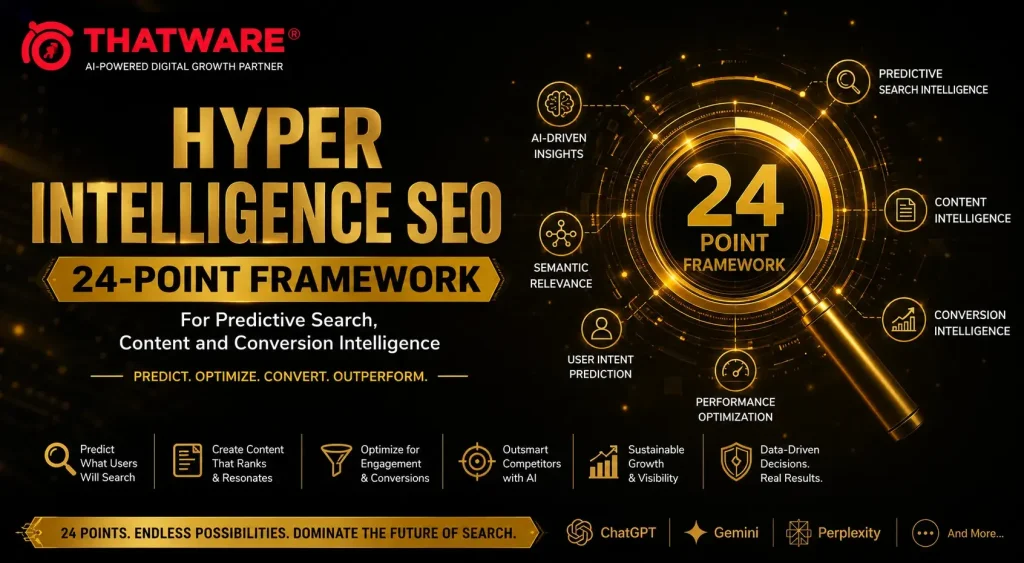
ThatWare’s Hyper Intelligence framework is designed to solve this wider problem.
It connects search behaviour, content performance, AI visibility, user intent, competitor movement, topical authority, audience needs and conversion outcomes within one predictive decision system.
Instead of asking only, “What happened last month?”, Hyper Intelligence asks:
- Which opportunities are likely to become valuable next?
- Which pages have the strongest growth potential?
- Which user questions remain unanswered?
- Which audience segments require different content?
- Which competitors are gaining visibility and why?
- Which content assets support revenue and authority?
- Where does the search-to-conversion journey break?
- Which repetitive SEO activities can be automated safely?
- Which opportunities should enter production now?
- Which topics should remain in a monitoring pipeline?
- What should be implemented next, by whom and for which measurable outcome?
The result is a structured intelligence layer that helps marketing, SEO, content, development and leadership teams make better decisions from connected evidence.
What Is Hyper Intelligence SEO?
Hyper Intelligence SEO is a predictive and cross-functional search optimization framework.
It evaluates the website not only as a set of pages, but as a connected system containing:
- Search queries
- User journeys
- Content clusters
- Brand and service entities
- AI answer opportunities
- Technical assets
- Internal links
- Landing-page experiences
- Conversion actions
- Competitor movements
- Audience segments
- Market trends
- Reporting and implementation workflows
The framework identifies signals from each area, combines them within a common opportunity model and converts the result into prioritized actions.
Hyper Intelligence is therefore not simply an audit. It is an ongoing intelligence, execution and validation system.
Why Businesses Need a Hyper Intelligence Framework
Traditional SEO reporting is largely historical. It explains which keywords moved, which pages received traffic and which technical issues were found.
That information remains useful, but it may not answer the questions that determine future growth:
- Is search demand increasing or declining?
- Is a competitor building a new content cluster?
- Is the audience’s decision process changing?
- Is a new AI answer format appearing?
- Does an informational article contribute to conversions?
- Is the content calendar aligned with revenue opportunities?
- Are important queries becoming more conversational?
- Are new topics appearing before reliable keyword-volume data becomes available?
- Is internal authority reaching the pages that matter commercially?
- Are editorial and technical teams working from the same priorities?
Hyper Intelligence brings those questions into the search strategy.
ThatWare’s Complete Hyper Intelligence Service Scope
Core Hyper Intelligence Strategy and Consulting
ThatWare provides Hyper Intelligence services for organizations seeking a predictive and evidence-led approach to search growth.
As a specialist Hyper Intelligence company, ThatWare combines search, content, entity, audience, competitor and conversion data within one strategic model.
A capable Hyper Intelligence agency should do more than generate reports. It should interpret multiple signals, prioritize the strongest opportunities and connect every recommendation with an owner, output and success metric.
A Hyper Intelligence consultant can work with internal SEO, content, marketing, development, sales and leadership teams to improve decision-making without replacing existing resources.
ThatWare’s Hyper Intelligence consulting services translate complex search and market evidence into practical implementation priorities.
Our Hyper Intelligence audit services establish a baseline across search visibility, content quality, customer journeys, entities, conversion paths, competitor movements and AI-readiness signals.
Large organizations can use enterprise Hyper Intelligence services across multiple websites, markets, divisions, product groups, languages and audience segments.
Hyper Intelligence strategy consulting determines which technical, content, intelligence, automation and conversion initiatives should begin first.
Hyper Intelligence website optimization applies those priorities across service pages, product pages, articles, FAQs, local pages, category structures and conversion journeys.
ThatWare’s Hyper Intelligence SEO services then monitor performance, update forecasts and refine the action plan as new data becomes available.
Search Opportunity and Digital Intelligence
ThatWare’s search intelligence services connect query data with content, users, competitors and business outcomes.
As an advanced search intelligence company, ThatWare evaluates how search behaviour changes across traditional search, answer interfaces, AI-assisted discovery and conversion pathways.
Our AI search intelligence services examine whether content is clear, extractable, relevant and authoritative enough to support AI-generated answers and recommendations.
Search opportunity audit services identify underperforming pages, missing topics, weak conversion pathways and unclaimed answer opportunities.
A digital opportunity intelligence audit expands this analysis across content, entities, user behaviour, market pressure and business value.
Cross-signal SEO opportunity analysis combines demand, ranking potential, content readiness, authority, conversion relevance and implementation difficulty.
Our search opportunity mapping services assign every qualified opportunity to a page, cluster, asset type, owner and target outcome.
SEO opportunity scoring services rank those opportunities through a consistent weighted model.
A search visibility opportunity analysis evaluates where the business can increase organic, answer-surface, local and AI visibility.
For larger websites, enterprise search opportunity intelligence helps leadership compare opportunities across divisions, regions, brands and service portfolios.
Cross-Channel Search, Content and Conversion Intelligence
Our cross-channel intelligence mapping services show how users move between search engines, AI systems, content assets, local profiles, landing pages and conversion actions.
Cross-channel SEO strategy services ensure that rankings, content, AI visibility and conversion goals are not managed as separate campaigns.
SEO and AI visibility intelligence compares organic performance with AI mentions, citations, summaries, answer inclusion and source-page behaviour.
Cross-channel search journey mapping defines how each query should lead to a suitable page and next action.
Content and conversion intelligence mapping connects educational, commercial and transactional assets with measurable conversion objectives.
Organic search funnel intelligence identifies how users progress from awareness and research to comparison and action.
AI search conversion intelligence examines whether users arriving through AI-assisted discovery reach an accurate, useful and conversion-ready source page.
Multi-channel search performance analysis compares performance across organic search, AI discovery, local visibility, referral sources and direct conversion routes.
Search content and conversion alignment ensures that page intent, content depth, CTA strength and user readiness work together.
ThatWare’s cross-channel visibility optimization services correct signal leakage, disconnected journeys and inconsistent next steps across channels.
For businesses evaluating advanced search intelligence solutions, Hyper Intelligence SEO Pricing can vary according to the scale of cross-channel analysis, AI visibility monitoring, competitor intelligence, content optimization, conversion mapping and reporting requirements. This allows organizations to align their investment with the complexity of their search ecosystem and measurable growth objectives.
Predictive Topic and Search-Demand Intelligence
Our predictive topic research services identify themes that may become valuable before competition peaks.
Predictive search demand analysis combines historical performance, seasonality, search behaviour, competitor activity and emerging questions.
Predictive content opportunity analysis determines which new or updated assets may support future visibility, authority and business growth.
Emerging topic detection services monitor weak signals that may not yet appear in conventional keyword reports.
Emerging search trend analysis studies changes in language, user concerns, content formats and market activity.
Early content opportunity mapping connects each validated trend with a recommended blog, service section, FAQ, local page, video or reference asset.
Our search demand forecasting services estimate when priority topics and clusters may require stronger support.
Keyword demand forecasting evaluates expected movement for individual search-term groups.
Topic demand forecasting services evaluate future demand at the wider subject or cluster level.
Seasonal search demand forecasting helps organizations prepare content, internal links, local pages and campaigns before recurring demand windows.
Predictive Keyword and Opportunity Modelling
ThatWare’s predictive keyword research services combine traditional keyword evidence with business value, trend direction and competitive pressure.
Predictive keyword prioritization determines which keyword groups should receive immediate, scheduled or monitored attention.
A predictive topic prioritization model ranks broader subjects using demand, strategic fit, conversion value, authority gaps and implementation effort.
AI keyword opportunity scoring helps process larger keyword sets while retaining transparent scoring criteria.
AI topic opportunity scoring evaluates topic-level opportunities across multiple content assets.
Predictive SEO opportunity modelling compares possible outcomes before resources are assigned.
Our keyword opportunity forecasting services identify likely short-term and long-term opportunities within each query family.
Search opportunity probability analysis estimates the relative likelihood that a recommended action will produce meaningful visibility or conversion movement.
AI-assisted SEO prioritization uses automation to support scoring, classification and detection while preserving human review.
The final predictive SEO opportunity pipeline keeps future opportunities staged, scored and ready for execution.
Competitive Search and Market Intelligence
ThatWare’s competitive search intelligence services examine more than competitor rankings.
Competitive intelligence graph development connects competitors with topics, entities, pages, SERP features, AI answers, authority signals and conversion strategies.
AI competitor intelligence analysis evaluates which competitors appear in AI-generated answers and which sources support them.
A competitor SERP gap analysis identifies result formats, content structures and page types currently owned by competing businesses.
An AI answer competitor gap analysis reveals questions for which competitors are mentioned, cited or recommended while the client is absent.
Market intelligence for SEO connects search observations with wider market behaviour, audience concerns and service demand.
Competitor movement tracking services monitor new pages, content changes, authority growth and category expansion.
SERP movement monitoring services record changes in organic results, map packs, directories, answer features, videos and AI summaries.
AI search competitor monitoring tracks competitor representation across selected AI systems and controlled prompt groups.
For larger campaigns, enterprise competitive visibility analysis compares competitors across markets, products, locations and audience segments.
Search Behaviour, Audience and Conversion Intelligence
Our search behavior intelligence services evaluate how users search, navigate, compare and act.
Customer journey intelligence mapping connects each audience’s initial question with the information, proof and action required at later stages.
Search intent journey mapping translates informational, comparison, commercial and transactional searches into suitable page paths.
Audience segment intelligence services identify how messaging, objections and calls to action should change for different customer groups.
Buying intent mapping services separate early research from decision and action-oriented behaviour.
Decision-layer mapping services identify the questions, objections, evidence and triggers influencing the final decision.
Content-to-conversion intelligence connects every educational asset with a relevant commercial or service pathway.
Conversion pathway optimization services reduce friction from the original query through landing page, proof, CTA, form and final action.
AI conversion intelligence services evaluate how AI-assisted discovery contributes to user engagement and conversion behaviour.
Predictive conversion opportunity analysis identifies pages and journeys where targeted improvements are likely to produce the strongest business impact.
The Hyper Intelligence Operating Model
The framework follows a continuous six-stage cycle.
1. Observe
Collect search, content, entity, audience, competitor, conversion and market signals.
2. Connect
Map relationships among queries, pages, users, clusters, channels, competitors and actions.
3. Score
Evaluate each gap or opportunity according to demand, business value, authority impact, urgency, effort and confidence.
4. Predict
Estimate demand windows, competitor risk and the probable value of different actions.
5. Execute
Convert intelligence into content updates, briefs, links, landing-page changes, workflow improvements and technical recommendations.
6. Validate
Compare the expected outcome with rankings, visibility, engagement, conversions and competitor movement.
The cycle then begins again with updated evidence.
Before and After Hyper Intelligence Implementation
Typical Position Before Implementation
Before Hyper Intelligence is introduced, organizations often have:
- Separate SEO, content and conversion reports
- Keyword lists without business-impact scoring
- Content calendars based on known topics
- Competitor reviews focused mainly on rankings
- No predictive demand model
- No cross-channel journey map
- Generic calls to action
- Informational content with no commercial pathway
- Multiple landing pages competing for similar intent
- Internal links added manually
- Repetitive audits and briefs created from scratch
- No central source of approved brand information
- No automated content or entity gap detection
- Historical reporting without predictive insight
- Future ideas stored in unprioritized lists
- No structured market movement report
- Recommendations without assigned owners
- Limited validation of completed fixes
Target Position After Implementation
After implementation, the organization should have:
- One cross-signal opportunity matrix
- Defined search, content and conversion relationships
- Predictive topic and keyword models
- Cluster-level demand forecasts
- Intent-specific landing-page ownership
- Audience segment maps
- Decision-layer content requirements
- Clear query-to-CTA pathways
- Business-impact content scoring
- AI-assisted brief generation
- Semantic internal-link recommendations
- Automated gap detection and quality checks
- A governed source-of-truth knowledge base
- A unified performance dashboard
- Monthly insight-to-action planning
- A rolling predictive opportunity pipeline
- Competitor and market movement reporting
- Assigned owners and validation metrics
- A continuous intelligence feedback loop
Audit, Plan of Action and Fix Reporting Method
Every deliverable in the framework should follow a consistent implementation method.
Audit and Result
The audit records:
- Asset, page, channel or signal reviewed
- Current evidence
- Existing strength
- Identified gap
- Business or visibility risk
- Current implementation status
- Affected pages or clusters
- Recommended focus
- Initial priority level
Plan of Action
The action plan defines:
- The exact task required
- The pages, assets or data affected
- The implementation owner
- The task priority
- Required dependencies
- Human review requirements
- Expected deliverable
- Validation method
- Target metric
- Review frequency
Fix Report
The fix report contains:
- Before state
- Recommended correction
- Implementation evidence
- After state
- Validation result
- KPI movement
- Remaining weakness
- Follow-up action
- Owner
- Next review date
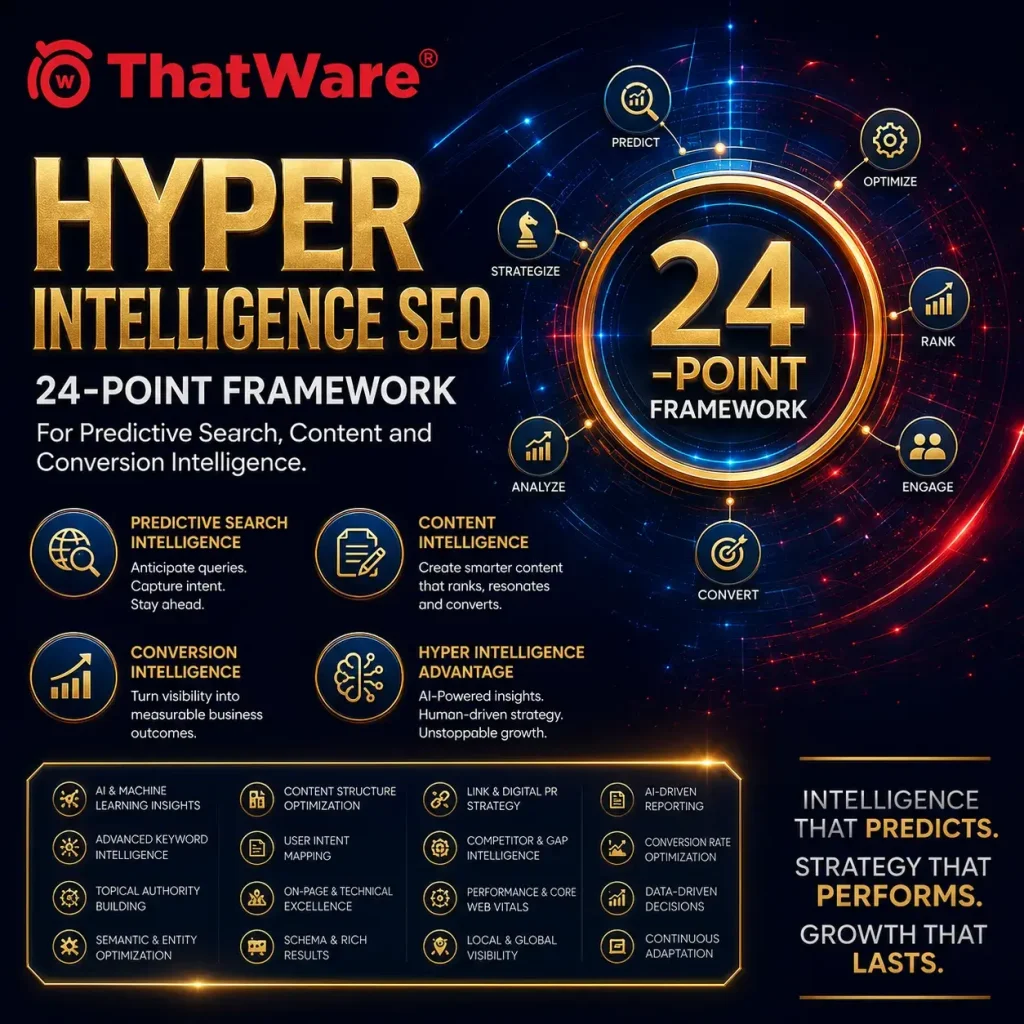
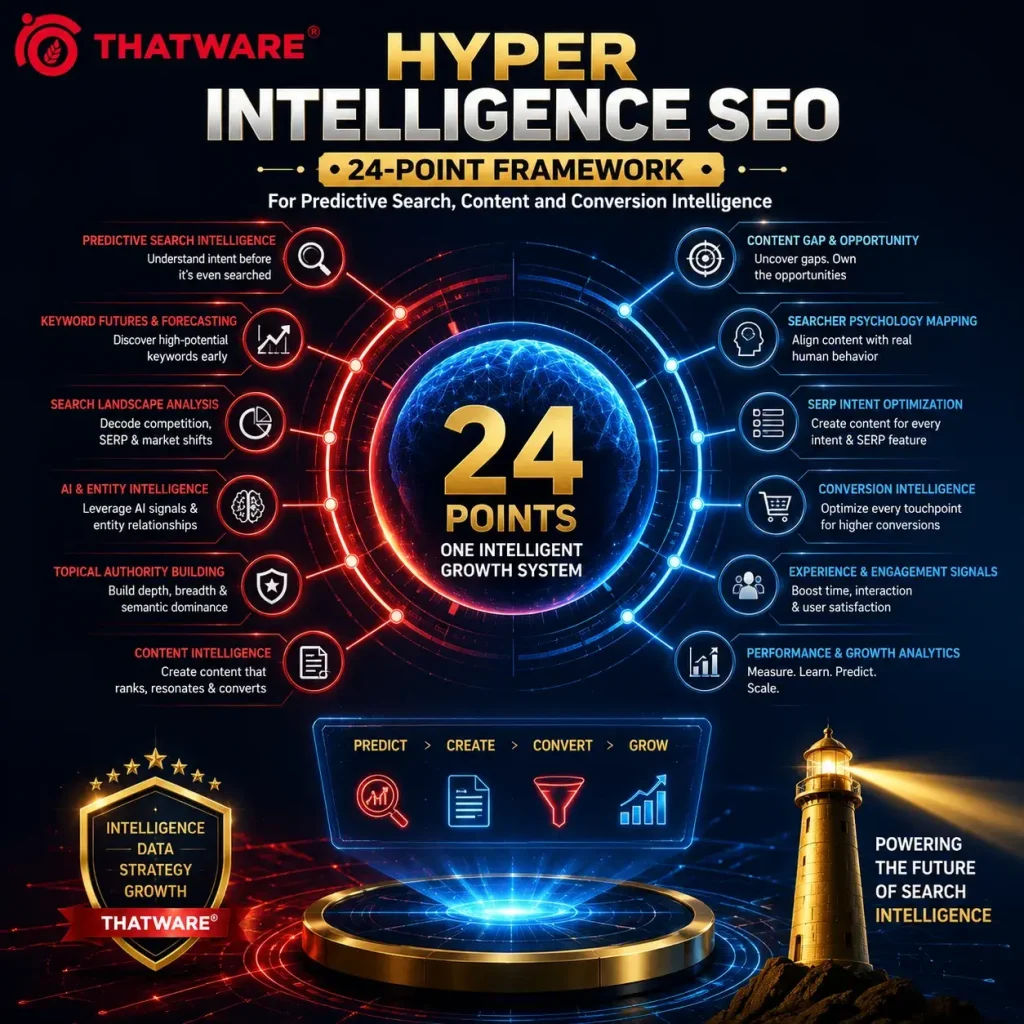
Complete 24-Point Hyper Intelligence Framework
The following framework incorporates every deliverable presented in the uploaded audit.
Phase One: Opportunity, Channel and Competitive Intelligence
1. Opportunity Audit Across Search, Content, Entities and Users
Before
Search opportunities are often reviewed through separate reports. Keyword opportunities may appear in one document, content gaps in another, conversion data in analytics and competitor insights in a monthly presentation.
This makes it difficult to compare opportunities objectively. A content gap with moderate search demand but strong conversion potential may be overlooked. A ranking opportunity may be prioritized even though the target page lacks authority, entity clarity or a suitable conversion path.
Plan of Action
- Build a complete inventory of commercial pages, content assets, FAQs, location pages and conversion destinations.
- Tag each asset by topic, audience, entity, search intent, channel role and conversion purpose.
- Add performance data, ranking proximity, demand, authority, content quality and CTA readiness.
- Record competitor ownership and AI-answer visibility.
- Identify missing pages, weak sections, conversion dead ends and content overlap.
- Score every opportunity using business value, visibility potential, topical contribution, effort and confidence.
- Convert qualified opportunities into an owned implementation queue.
After
The organization receives one opportunity matrix that connects:
- Search demand
- Content quality
- Entity coverage
- User need
- Competitor gap
- Conversion role
- Implementation effort
- Expected impact
- Priority
- Owner
Implementation Output
A Hyper Intelligence opportunity workbook containing URL, opportunity type, supporting evidence, weighted score, recommended fix, owner and status.
Success Metrics
- Percentage of priority URLs audited
- Number of qualified opportunities identified
- High-priority opportunity closure rate
- Visibility movement among optimized pages
- Conversion impact of completed opportunities
2. Cross-Channel Intelligence Map for SEO, AI and Conversion
Before
Users may enter the brand ecosystem through organic listings, AI-generated answers, articles, FAQs, local profiles, social links, directories or direct referrals.
These entry points may send users toward different pages and different calls to action. An informational article may have no next step. An AI citation may lead to a page that lacks context. A local result may lead to a generic page rather than a relevant location or service page.
Plan of Action
- Inventory every major acquisition and discovery channel.
- Define the user intent associated with each channel and entry point.
- Assign every priority page a channel role.
- Identify pages that support AI answers, organic discovery, comparison, local discovery or conversion.
- Map the preferred next step from every entry page.
- Identify signal leakage, dead ends and inconsistent CTA pathways.
- Create channel-specific measurement rules.
After
Every priority page has:
- A defined source channel
- An intended audience
- A user-intent class
- A content role
- An AI-answer role
- A primary CTA
- A supporting conversion path
- A performance metric
Implementation Output
A cross-channel intelligence map showing channel, query intent, landing page, answer role, CTA, next page and tracking requirement.
Success Metrics
- Priority pages with an assigned channel role
- Pages with one defined primary next step
- Reduced conversion dead ends
- Assisted conversions by channel
- Increased cross-channel visibility
3. Predictive Topic and Demand Signal Identification
Before
Editorial planning is commonly based on existing keyword volume, competitor content and known service topics.
This approach may identify established demand but miss early signals. By the time a topic appears clearly in standard tools, competitors may already have published and built authority.
Plan of Action
- Collect historical search and content performance.
- Monitor question growth, autosuggestions, People Also Ask patterns and AI prompts.
- Record customer-service, sales and intake themes.
- Map seasonal and event-driven demand.
- Track changing terminology and emerging audience concerns.
- Compare competitor publishing frequency and content freshness.
- Score early signals by strategic fit, credibility, demand potential and timing.
- Assign a recommended asset type and target publication window.
After
The business receives a topic radar containing:
- Emerging topic
- Signal source
- Trend direction
- Audience
- Relevant service or product
- Expected demand window
- Recommended asset
- Confidence level
- Review date
Implementation Output
A predictive topic signal sheet and rolling editorial radar.
Success Metrics
- Emerging topics identified before peak demand
- Percentage of validated topics published on time
- Early rankings and impressions
- First-mover coverage
- Accuracy of topic predictions
4. Competitive Intelligence Graph for SERP and AI Gaps
Before
Competitor analysis may contain ranking tables and backlink comparisons but fail to explain the relationships driving competitor visibility.
A competitor may own a topic because of stronger entity associations, local authority, question coverage, citations, structured answers or better conversion-focused landing pages.
Plan of Action
- Define direct, indirect, directory, marketplace and AI-visible competitor groups.
- Record competitor ownership across topics, queries and SERP features.
- Capture page structures, entities, schema, trust signals and answer formats.
- Identify competitor sources cited by AI systems.
- Map each competitor strength to the client page or cluster it affects.
- Separate content, authority, entity, technical and conversion gaps.
- Create tactical responses for each priority gap.
- Refresh the graph monthly.
After
The business has a connected competitive graph showing:
- Competitor
- Topic owned
- Page type
- SERP feature
- AI-answer presence
- Supporting entity
- Authority source
- Affected client URL
- Recommended counter-action
Implementation Output
A competitive intelligence graph and URL-level competitor response register.
Success Metrics
- Priority competitor gaps closed
- Improved share of SERP features
- Improved AI-answer representation
- Increased category visibility
- Reduced competitor advantage within target clusters
Phase Two: Search Behaviour, Prioritization and Opportunity Scoring
5. Search Behavior and Customer Journey Framework
Before
A website may serve several customer journeys without formally mapping them.
Users researching a problem, comparing providers, checking costs or preparing to act may all reach the same page. They may receive the same information and CTA even though their concerns and readiness are different.
Plan of Action
- Define the major audience journeys.
- Identify the initial search questions for each journey.
- Classify stages such as awareness, education, comparison, validation and action.
- Assign the best landing page to each stage.
- Record required information, reassurance, proof and objection handling.
- Map internal links and next-step pages.
- Define suitable CTAs for each stage.
- Track movement through the journey.
After
Every important customer journey has:
- Audience
- Entry query
- Search intent
- Journey stage
- Landing page
- Information requirement
- Proof requirement
- Next page
- CTA
- Conversion event
Implementation Output
A customer journey intelligence map and page-path specification.
Success Metrics
- Journey-stage coverage
- Reduction in dead-end pages
- CTA engagement by journey
- Assisted conversions
- Landing-page progression rate
6. Predictive Keyword and Topic Prioritization Model
Before
Keywords are often prioritized by search volume, current ranking or difficulty.
These measures do not fully account for business relevance, service capacity, commercial value, timing, topical authority or competitor movement.
Plan of Action
- Build the complete keyword and topic universe.
- Group terms by intent, entity, audience, location and funnel stage.
- Add demand direction and seasonality.
- Measure ranking gaps and competitor strength.
- Add business value and conversion relevance.
- Score topical authority contribution.
- Estimate asset and implementation requirements.
- Assign confidence and timing.
- Create monthly priority batches.
- Recalculate scores as conditions change.
After
Keywords and topics are prioritized through a transparent model rather than isolated metrics.
Implementation Output
A predictive keyword and topic model containing demand, trend, intent, value, authority, effort, confidence, asset type and execution month.
Success Metrics
- Visibility growth from prioritized clusters
- Percentage of high-score topics implemented
- Forecast accuracy
- Reduced time spent on low-impact terms
- Conversion contribution from priority topics
7. AI-Assisted Content Prioritization by Business Impact
Before
Content ideas may be valuable editorially but have no defined relationship with revenue, authority or conversion.
A strong article may generate traffic while failing to support a commercial page. An important service page may remain underdeveloped while resources are assigned to lower-impact topics.
Plan of Action
- Assign a business objective to every existing and proposed content asset.
- Score expected demand and conversion relevance.
- Evaluate whether the asset strengthens a priority topic cluster.
- Measure the entity or intent gap it closes.
- Assess internal-link and CTA opportunities.
- Estimate content effort and review requirements.
- Create an AI-assisted priority score.
- Review the final priority through human strategic judgment.
- Track actual results against the score.
After
The content backlog is ordered according to measurable contribution rather than topic availability.
Implementation Output
An AI-assisted content priority sheet with business impact, authority impact, conversion role, effort and recommended action.
Success Metrics
- High-impact content published first
- Increased service-page referrals from content
- Assisted conversion growth
- Topical authority improvement
- Accuracy of content-impact scoring
8. Revenue, Visibility and Topical Authority Scoring
Before
Technical, content, local, internal-link and conversion opportunities are difficult to compare because each uses different metrics.
Priority can therefore become subjective.
Plan of Action
- Define weighted scoring dimensions:
- Business or revenue relevance
- Search demand
- Ranking or visibility gap
- Topical authority contribution
- Conversion potential
- Urgency
- Implementation effort
- Evidence confidence
- Apply the model to existing pages, new assets and technical recommendations.
- Establish thresholds for urgent, high, medium and monitoring tiers.
- Review scores after implementation and performance changes.
- Compare projected impact with actual results.
After
Every opportunity has a comparable, transparent and reviewable score.
Implementation Output
A weighted opportunity scorecard and prioritization policy.
Success Metrics
- Percentage of roadmap tasks selected through scoring
- High-score opportunity completion
- Visibility growth by score tier
- Revenue or lead contribution
- Difference between projected and actual impact
Phase Three: Demand, Decision and Buying-Intent Intelligence
9. Emerging Trend Detection and Early Content Mapping
Before
Emerging topics are discovered informally through news, team observations or competitor publishing.
There may be no process for validating the trend, selecting the correct asset type or publishing before saturation.
Plan of Action
- Monitor rising questions, prompt patterns, industry discussions and customer concerns.
- Separate temporary noise from strategically relevant change.
- Classify trends by audience, topic, service, product, location or decision concern.
- Validate relevance, expertise and evidence availability.
- Select the correct content format.
- Assign a publication or update window.
- Add weak or uncertain trends to a monitoring list.
- Track competitor response.
After
Emerging topics move through a controlled process from detection to validation and production.
Implementation Output
An emerging trend map showing source, relevance, confidence, recommended asset, target page and timing.
Success Metrics
- Valid trends identified
- Content published before demand maturity
- First-mover rankings
- Competitor lead time
- Trend-to-asset conversion rate
10. Search Demand Forecasting for Priority Clusters
Before
Content clusters may be developed without a forecast showing when search demand is likely to rise.
Important updates can therefore be completed after the strongest opportunity window.
Plan of Action
- Define priority topic clusters.
- Collect historical impressions, clicks, rankings and conversions.
- Add seasonality, industry events, customer behaviour and competitor activity.
- Forecast demand by topic, market, location and audience.
- Identify which clusters need content, links, schema or landing-page support.
- Schedule work before the forecasted peak.
- Compare projected demand with actual performance.
- Refine the forecasting method.
After
Each cluster has a monthly demand outlook and a timed support plan.
Implementation Output
A cluster-level search demand forecast showing expected demand, confidence, required assets and action month.
Success Metrics
- Forecast accuracy
- Pre-peak implementation completion
- Visibility during forecasted demand windows
- Cluster traffic growth
- Conversion growth during peak periods
11. Decision-Layer Questions, Objections and Triggers
Before
Pages may explain a service or product without addressing the concerns that influence the final decision.
Answers about price, process, suitability, timing, risk, privacy, support and expected outcomes may be missing or located too far from the CTA.
Plan of Action
- Collect decision questions from search, sales, customer service and on-site behaviour.
- Classify objections by audience and offer.
- Assign each objection to the most relevant page.
- Define the answer and supporting evidence.
- Identify the trigger that moves the user forward.
- Select a suitable CTA based on readiness.
- Place proof and reassurance near conversion points.
- Measure the effect of the update.
After
Every high-intent landing page includes decision support aligned with the user’s likely concerns.
Implementation Output
A decision-layer map containing question, objection, response, proof, trigger, CTA and target URL.
Success Metrics
- Decision questions covered
- CTA interaction after updates
- Reduced exits near conversion sections
- Form-start rate
- Sales-quality improvement
12. Buying Intent Mapping Across Query Stages
Before
Informational, comparison and transactional searches may be targeted through the same page and content structure.
This can create mixed messaging, unclear page ownership and weak calls to action.
Plan of Action
- Group queries by learning, comparison, evaluation and transaction stages.
- Assign the correct page type to each group.
- Define content depth and answer requirements.
- Match CTA strength with user readiness.
- Add comparison sections where needed.
- Split or consolidate pages with conflicting intent.
- Review potential cannibalization.
- Track performance by buying-intent group.
After
Every important query has a page role, content requirement and CTA appropriate to its stage.
Implementation Output
A buying-intent map containing query group, stage, page, answer format, CTA and cannibalization note.
Success Metrics
- Query-to-page intent confidence
- Reduced cannibalization
- Improved rankings by intent stage
- Commercial-query engagement
- Transactional conversion rate
Phase Four: Conversion, Personalization and Content Intelligence
13. Conversion Pathway Optimization by Landing Page
Before
Several calls to action may compete on the same page. Users can be asked to call, book, request, email, download or visit an external platform without understanding which option is best.
Plan of Action
- Map priority queries to landing pages.
- Define one primary conversion objective for each page.
- Review supporting and external actions.
- Identify friction between the page, CTA, form and final destination.
- Add process clarity before high-commitment actions.
- Place relevant evidence near CTA blocks.
- Improve mobile conversion usability.
- Track CTA clicks, form starts, completions and assisted actions.
After
Every high-intent landing page has a clear query-to-action pathway.
Implementation Output
A landing-page conversion pathway map and friction-reduction plan.
Success Metrics
- Primary CTA click-through rate
- Form-start and completion rates
- Reduced CTA competition
- Assisted conversion growth
- Mobile conversion improvement
14. Audience Segment Intelligence for Personalization
Before
Pages may address several audiences through one general message.
Different users may have different objectives, concerns, terminology, evidence requirements and conversion preferences.
Plan of Action
- Define priority audience segments.
- Map each segment’s needs, concerns, language and decision factors.
- Connect segments with suitable products, services and resources.
- Define segment-specific proof requirements.
- Adjust examples, FAQs and CTA language.
- Create reusable personalization modules.
- Avoid unsupported assumptions or sensitive personal profiling.
- Measure engagement by segment-oriented page or content path.
After
Priority pages use clearer audience-specific information without compromising accuracy or trust.
Implementation Output
An audience segment intelligence map with needs, pages, content modules, proof and CTA guidance.
Success Metrics
- Segment coverage
- Engagement on personalized modules
- CTA interaction by segment
- Conversion-path completion
- Reduced mismatch between audience and page
15. Content-to-Conversion Intelligence Recommendations
Before
Educational pages may generate impressions and visits but fail to connect readers with a relevant next step.
Generic content endings can direct every reader to the same broad CTA, regardless of the page topic or user need.
Plan of Action
- Audit all blog, FAQ, video and resource-page conversion paths.
- Assign each content asset to a relevant product, service or commercial destination.
- Add context-specific bridge modules.
- Improve internal links to priority landing pages.
- Select CTA language suited to the content intent.
- Add proof or process information where necessary.
- Remove irrelevant or overly promotional conversion elements.
- Track assisted conversion contribution.
After
Every strategic content asset supports a defined user and business pathway.
Implementation Output
A content-to-conversion recommendation sheet containing source page, target page, bridge module, CTA and measurement plan.
Success Metrics
- Content assets with an assigned conversion role
- Click-through to commercial pages
- Assisted conversions
- Reduced exits from high-value informational pages
- Revenue or lead influence by content cluster
Phase Five: Workflow Automation, Content Systems and Knowledge Governance
16. AI SEO Workflow and Automation Roadmap
Before
Recurring SEO tasks may be completed manually with inconsistent formats and review standards.
Teams can spend significant time rebuilding crawls, briefs, gap reports, internal-link lists and dashboards.
Plan of Action
- Inventory recurring SEO, content, reporting and competitive tasks.
- Classify each task as:
- Fully automated
- AI-assisted with human review
- Manual specialist work
- Define required inputs and expected outputs.
- Establish quality, compliance and brand-review rules.
- Create implementation and validation stages.
- Assign workflow owners.
- Calculate expected time savings and risk.
- Prioritize automation according to value and reliability.
- Review performance monthly.
After
Repetitive work is standardized and accelerated while strategic and sensitive decisions remain under human control.
Implementation Output
An AI SEO automation roadmap with task, automation level, owner, inputs, outputs, review rules and success metrics.
Success Metrics
- Workflow completion time
- Hours saved
- Error reduction
- Human review pass rate
- Number of reliable workflows deployed
17. Automated Content Brief Generation
Before
Writers may receive a title, target keyword and word-count instruction without enough intelligence about audience, entities, competitors, conversion goals or internal links.
Plan of Action
- Define approved brief inputs.
- Import opportunity and demand scores.
- Add audience, intent and journey-stage information.
- Include competitor and content-gap findings.
- Define required entities, questions and examples.
- Specify structure, answer formats and proof.
- Recommend internal links and CTAs.
- Add brand, legal, clinical or editorial guardrails.
- Validate completed content against the brief.
After
Every priority content asset begins with a standardized, intelligence-backed brief.
Implementation Output
An automated content brief template and generated brief pack.
Success Metrics
- Priority content using an approved brief
- First-draft acceptance rate
- Revision reduction
- Content quality score
- Intent, entity and conversion coverage
18. AI-Based Internal Linking Recommendation Engine
Before
Internal links may be added manually or according to simple keyword matching.
This can overlook semantically relevant links, under-supported commercial pages and conversion pathways.
Plan of Action
- Export current links, page depth and orphan status.
- Extract topics, entities, intent and audience from each page.
- Score source-target relevance.
- Add authority and conversion value to the model.
- Recommend natural anchor text.
- Identify the correct placement section.
- Remove or revise irrelevant links.
- Track implementation and target-page impact.
After
Internal links strengthen topical clusters, user journeys and priority landing pages through a consistent relevance model.
Implementation Output
An AI internal-link recommendation table containing source, target, anchor, relationship, placement and priority.
Success Metrics
- Contextual links implemented
- Orphan pages reduced
- Crawl depth improvement
- Priority-page internal authority
- Assisted navigation and conversion growth
19. Automated Content, Entity and Intent Gap Detection
Before
Manual review can miss incomplete sections, unsupported statements, weak entity coverage, intent mismatch, formatting problems or leftover editorial instructions.
Plan of Action
- Define page-quality and editorial rules.
- Create required entity sets by page type.
- Define intent-specific answer requirements.
- Detect duplicate, incomplete or conflicting content.
- Flag unsupported or outdated statements.
- Identify weak CTA and conversion sections.
- Create owner-assigned fix tickets.
- Re-run checks after implementation.
- Track repeat errors and root causes.
After
Content, entity and intent issues are identified earlier and resolved through a governed workflow.
Implementation Output
An automated gap detection log with URL, issue, evidence, owner, priority, status and validation result.
Success Metrics
- Issues detected before publication
- Live-page issue reduction
- Gap closure time
- Repeat-error reduction
- Post-fix validation rate
20. Knowledge Base Structuring for AI SEO Execution
Before
Approved facts about services, products, people, locations, policies, CTAs and brand claims may be distributed across webpages, documents and team knowledge.
AI-assisted workflows can reproduce inconsistent or outdated information when no governed source exists.
Plan of Action
- Define knowledge tables and entity categories.
- Create concise approved statements.
- Assign canonical source URLs.
- Record allowed use cases.
- Add owner, reviewer, approval date and expiry date.
- Mark sensitive, restricted or conditional information.
- Connect the knowledge base with briefs, QA, links and schema workflows.
- Maintain a version history.
- Establish an update procedure.
After
AI-assisted SEO workflows use reviewed, traceable and current information.
Implementation Output
An AI-ready SEO knowledge base with entities, approved statements, sources, usage rules and review status.
Success Metrics
- Approved fact coverage
- Inconsistent statement reduction
- Brief-production speed
- Review efficiency
- Knowledge update compliance
Phase Six: Performance, Planning and Market Monitoring
21. Hyper-Intelligence Performance Dashboard
Before
Rankings, traffic, content activity, AI visibility, conversion data and competitor insights may appear in separate tools.
Stakeholders cannot easily connect completed work with performance outcomes.
Plan of Action
- Define executive and delivery-team dashboard views.
- Connect relevant data sources.
- Add opportunity, execution and outcome metrics.
- Report by page, cluster, channel, audience and market.
- Include forecast versus actual performance.
- Add competitor and market-movement indicators.
- Highlight risks and next actions.
- Refresh the dashboard on a controlled schedule.
After
The organization has one performance view connecting opportunities, implementation and results.
Implementation Output
A Hyper Intelligence dashboard containing opportunity, content, visibility, conversion, automation and competitive panels.
Success Metrics
- Dashboard data completeness
- Data refresh reliability
- Executive usage
- Decision turnaround time
- Number of actions linked to measurable outcomes
22. Monthly Intelligence Insights and Strategic Action Plan
Before
Monthly reports may summarize activity and performance but fail to turn new evidence into scheduled work.
Recommendations can remain general, unassigned or repeated month after month.
Plan of Action
- Summarize performance changes and new signals.
- Review forecast accuracy.
- Identify competitor and market movement.
- Update opportunity scores.
- Select the strongest next actions.
- Assign owners, due dates and dependencies.
- Define the required output and KPI.
- Close or roll forward previous actions.
- Record decisions and unresolved risks.
After
Every reporting cycle begins the next implementation cycle.
Implementation Output
A monthly strategic action plan containing insight, recommended action, target asset, owner, deadline, dependency, output and KPI.
Success Metrics
- Monthly action completion
- Reduction in generic recommendations
- High-priority task completion
- Performance response after implementation
- Fewer unresolved recurring issues
23. Predictive Opportunity Pipeline Report
Before
Future ideas may remain in spreadsheets, meeting notes and content lists without readiness, timing or ownership.
Strong opportunities may not enter production until competitors or demand have already moved.
Plan of Action
- Collect future ideas from demand, trends, customers, competitors and audits.
- Assign each opportunity a pipeline stage:
- Watch
- Validate
- Score
- Brief
- Produce
- Publish
- Optimize
- Add expected demand windows.
- Score business, visibility and authority value.
- Assess evidence and implementation readiness.
- Select the recommended asset type.
- Assign the next action and owner.
- Report movement monthly.
After
The organization maintains a rolling inventory of future opportunities that are prepared before they become urgent.
Implementation Output
A predictive opportunity pipeline with stage, score, timing, readiness, asset type and next action.
Success Metrics
- Pipeline velocity
- Opportunities promoted through stages
- On-time production
- Pre-demand publication
- Performance of forecasted opportunities
24. Market Intelligence and Competitor Movement Report
Before
Competitor changes may be reviewed only after a ranking or traffic loss becomes visible.
New pages, local expansion, answer-format changes and AI citations can remain unnoticed.
Plan of Action
- Monitor selected competitors and market categories.
- Track new and updated pages.
- Record SERP-feature changes.
- Monitor AI mentions, citations and recommendations.
- Track local, directory and marketplace movement.
- Identify affected client clusters.
- Classify the threat or opportunity.
- Recommend a tactical response.
- Measure response speed and visibility recovery.
After
Market changes are detected, interpreted and converted into timely actions.
Implementation Output
A monthly market intelligence report containing competitor movement, affected cluster, risk, opportunity and recommended response.
Success Metrics
- Competitor changes detected
- Average response time
- Threats converted into actions
- Recovered or improved visibility
- Competitive share movement
Recommended 12-Month Hyper Intelligence Roadmap
Months 1 and 2: Baseline and Opportunity Intelligence
Complete:
- Full opportunity audit
- Page and asset inventory
- Cross-channel intelligence map
- Initial competitor graph
- Search behaviour analysis
- Baseline opportunity scoring
- Conversion-path review
- Initial dashboard structure
Months 3 and 4: Predictive Search and Demand Modelling
Complete:
- Predictive keyword model
- Predictive topic model
- Emerging trend radar
- Cluster-level demand forecasting
- Seasonal opportunity calendar
- Forecast validation process
- First predictive content batch
Months 5 and 6: Journey and Decision Intelligence
Complete:
- Customer journey maps
- Buying-intent segmentation
- Decision-layer mapping
- Audience intelligence
- Landing-page conversion pathways
- CTA hierarchy
- Content-to-conversion bridges
Months 7 and 8: Automation and Content Intelligence
Complete:
- AI SEO workflow roadmap
- Automated content brief generation
- Internal-link recommendation system
- Automated gap detection
- Content-impact scoring
- Editorial and quality validation rules
Months 9 and 10: Knowledge and Execution Systems
Complete:
- AI-ready knowledge base
- Approved statement library
- Entity and content governance
- Workflow integration
- Source and version controls
- Improved dashboard automation
- Opportunity-pipeline staging
Months 11 and 12: Forecasting, Reporting and Continuous Improvement
Complete:
- Forecast-versus-actual review
- Market movement reporting
- Competitive visibility update
- Pipeline performance analysis
- Model-weight refinements
- Executive performance review
- Next-year strategic roadmap
Recommended Hyper Intelligence Dashboard
The dashboard should track:
- Total opportunities identified
- Opportunities by score tier
- High-priority fixes completed
- Forecast demand by cluster
- Forecast accuracy
- Emerging topics identified
- Early opportunities published
- Organic visibility
- AI visibility
- Featured-answer visibility
- Competitor share
- Cluster authority progress
- Page-level intent confidence
- Audience-segment coverage
- Decision-layer coverage
- CTA click-through rate
- Form starts
- Assisted conversions
- Content-to-service clicks
- Internal links implemented
- Orphan pages resolved
- Automated briefs generated
- QA issues detected
- QA issues closed
- Knowledge-base coverage
- Workflow time saved
- Opportunity pipeline velocity
- Competitor movements detected
- Market response time
- Monthly action completion
Recommended Package Positioning
The 24 deliverables form the complete Hyper Intelligence framework. They should not be presented as 24 disconnected monthly activities.
Package scope should be selected according to:
- Website scale
- Number of markets
- Number of priority clusters
- Content inventory
- Competitor intensity
- Conversion complexity
- Available data
- Internal implementation capacity
- Automation maturity
- Reporting requirements
A smaller campaign may begin with opportunity auditing, demand analysis, journey mapping and prioritization. An enterprise campaign may require simultaneous work across forecasting, automation, knowledge systems, multiple audience segments and competitor groups.
Turn Disconnected Search Data Into Predictive Growth Intelligence
A business does not need more isolated reports.
It needs a system that explains:
- What is happening
- Why it is happening
- What may happen next
- Which opportunity matters most
- Which page or asset should be improved
- Which audience should be addressed
- Which competitor movement requires a response
- Which action should be implemented
- Who should own that action
- How the result should be validated
ThatWare’s 24-point Hyper Intelligence framework transforms search, content, audience, competitor and conversion signals into a predictive implementation roadmap.