FILL OUT THE FORM BELOW & ALLOW US TO TAKE YOUR WORDPRESS DEVELOPMENT SERVICES TO A WHOLE NEW LEVEL!
A WordPress website should do more than publish pages. It should support your brand, generate business, deliver a smooth user experience, perform reliably across devices, and provide a strong technical foundation for search visibility and future growth.
ThatWare provides WordPress development services for businesses that need more than an off-the-shelf theme or a collection of plugins. We combine development, UX, technical SEO, information architecture, performance optimisation, security, integrations, and conversion thinking to build WordPress websites around real business requirements.
As a WordPress development company, we approach every project from both the user and technology perspective. Our WordPress developers work on the frontend and backend architecture while considering how the website will be crawled, indexed, understood, used, maintained, expanded, and eventually discovered through both traditional search and AI-powered search environments.
Whether you need a new corporate website, a high-converting service website, an ecommerce store, a complex content platform, a custom WordPress build, a website migration, or a complete redesign, our WordPress development agency can build a solution around your business rather than forcing your business into a pre-existing template.
Our WordPress development experts focus on creating websites that are technically sound, easy to manage, responsive, scalable, search-ready, and aligned with your commercial goals.
Need a WordPress website that is built for more than appearance?
Why Businesses Need More Than Standard WordPress Development
WordPress makes website publishing accessible, but building a genuinely effective business website requires considerably more than installing WordPress and selecting a theme.
A website can look excellent and still have:
- Poor page architecture
- Slow loading times
- Unnecessary plugins
- Bloated code
- Weak mobile performance
- Poor Core Web Vitals
- Difficult navigation
- Duplicate content
- Weak internal linking
- Security vulnerabilities
- Poor accessibility
- Inflexible templates
- Complicated maintenance requirements
- Limited scalability
- Weak conversion paths
- Poor technical SEO
- Inconsistent structured data
- Difficult third-party integrations
That is why our Professional WordPress development services are structured around the complete website lifecycle.
We consider what happens before development, during development, at launch, and after launch.
The objective is to create a website that can become a long-term digital asset instead of another short-term redesign project.
A WordPress Website Should Work for Three Audiences
Modern websites have to satisfy several audiences simultaneously.
| Audience | What They Need | What We Focus On |
| Visitors | Speed, clarity, usability and trust | UX, navigation, content structure and responsive design |
| Search engines | Crawlable, indexable and relevant content | Technical SEO, architecture, schema and internal linking |
| Business teams | Easy management and scalability | CMS usability, reusable components and administration |
| Developers | Clean, maintainable architecture | Code quality, modular development and documentation |
| AI systems | Clear entities, context and relationships | Semantic architecture, structured data and machine-readable content |
| Customers | Simple pathways to take action | Forms, CTAs, conversion flows and friction reduction |
| Marketing teams | Flexible content and landing pages | CMS structure, templates and scalable page systems |
This integrated approach is particularly important for businesses that intend to invest in SEO, AEO, GEO, content marketing, paid campaigns, ecommerce, or AI visibility after their website goes live.
A website should provide the infrastructure for those activities from the beginning.
Our WordPress Development Services
ThatWare offers a complete range of Custom WordPress development services covering strategy, architecture, design implementation, development, integrations, optimisation, migration, maintenance, and ongoing support.
Our services can be adapted to a new website, an existing WordPress installation, or a website that needs a complete technical rebuild.
1. Custom WordPress Development
Every business has different requirements.
A professional services company may need a sophisticated lead-generation website. An ecommerce company may require complex product architecture. A SaaS business may need integrations with CRM, analytics, marketing automation, and customer platforms.
Our Custom WordPress development approach begins with those requirements rather than starting with a predetermined theme.
We examine:
- Business objectives
- Target customers
- Website functionality
- Content requirements
- User journeys
- Existing website architecture
- SEO requirements
- Integration requirements
- Security considerations
- Performance expectations
- Future scalability
- Content management requirements
The result is a WordPress environment designed around the business.
What Custom Development Can Include
- Custom page templates
- Custom post types
- Custom taxonomies
- Custom fields
- Dynamic content systems
- Advanced search
- Filtering systems
- Membership functionality
- User dashboards
- Lead-generation systems
- API integrations
- CRM integrations
- Marketing automation integrations
- Analytics integrations
- Custom forms
- Location management
- Product catalogues
- Booking functionality
- Directory systems
- Multilingual structures
- Enterprise content architecture
We avoid unnecessary development where a reliable WordPress capability already exists, but we also avoid forcing a business requirement into a plugin or theme that was never designed to support it.
WordPress Website Development for Modern Businesses
Our WordPress website development services are designed for businesses that need a dependable website platform capable of supporting marketing, sales, content, SEO, and ongoing growth.
A website project typically involves much more than coding.
It requires decisions about:
- Information architecture
- Page hierarchy
- Content models
- Navigation
- Templates
- Responsive behaviour
- CMS functionality
- Performance
- Security
- Search visibility
- Integrations
- Analytics
- Conversion pathways
- Future expansion
Our WordPress website development company approach brings these elements together into one development strategy.
Website Development for Different Business Models
| Business Type | Typical WordPress Requirements |
| B2B company | Service architecture, lead generation, case studies, forms, CRM integration |
| Professional services | Authority-focused content, service pages, consultation forms and conversion paths |
| Startup | Flexible architecture, fast launch, scalable content and integrations |
| SaaS company | Product pages, documentation, integrations, lead generation and technical content |
| Ecommerce brand | Product catalogue, category architecture, checkout and payment functionality |
| Enterprise | Large content architecture, governance, integrations, multiple departments and scalability |
| Healthcare | Structured information, accessibility, trust signals and secure workflows |
| Education | Courses, resources, content libraries, registration and search |
| Publisher | Categories, authors, archives, search, structured content and performance |
| Local business | Service pages, location structures, forms, maps and local search support |
The development process is adjusted according to the actual requirements rather than treating every WordPress project as identical.
WordPress Web Development Services
Our WordPress web development services cover both the visible website experience and the underlying functionality required to operate it effectively.
The frontend should be intuitive and responsive.
The backend should be organised and maintainable.
The CMS should be practical for the people who manage content.
The architecture should allow the website to grow without becoming unnecessarily difficult to maintain.
Frontend Development
Frontend development can include:
- Responsive layouts
- Navigation systems
- Interactive elements
- Forms
- Content components
- Landing page systems
- Dynamic sections
- Animation where appropriate
- Mobile interfaces
- Accessibility improvements
- Cross-browser compatibility
Backend Development
Backend development can include:
- Custom post types
- Taxonomies
- Custom fields
- User roles
- Administrative workflows
- Database-related functionality
- API connections
- Dynamic content
- Custom plugin functionality
- Custom integrations
- Content management systems
We aim to keep the relationship between frontend experience and backend management straightforward.
A beautiful website becomes a burden if every small content change requires developer intervention.
WordPress CMS Development Services
WordPress is widely recognised as a content management system, but different organisations use the CMS in very different ways.
Our WordPress CMS development services focus on creating an administration environment that works for the people responsible for the website.
A content team may need to publish dozens of pages every month.
A corporate team may need approval workflows.
An ecommerce business may manage thousands of products.
A publisher may need author, category, archive, and editorial structures.
An enterprise organisation may have multiple teams managing different areas of the website.
Our WordPress CMS development company approach can create structured content systems that make these operations easier to manage.
CMS Development Can Include
- Custom content types
- Custom fields
- Editorial structures
- Content relationships
- Reusable components
- Custom dashboards
- User roles and permissions
- Content workflows
- Taxonomy structures
- Dynamic templates
- Media management improvements
- Search functionality
- Content filtering
- Structured data integration
The objective is not simply to add more functionality.
It is to create a CMS that makes the website easier to operate.
WordPress Theme Development Services
Themes influence much more than visual appearance.
A poorly constructed theme can introduce unnecessary code, restrict flexibility, create performance issues, and make future development difficult.
Our WordPress theme development services focus on creating themes around the website’s actual content structure and user experience.
Depending on the project, we can work with an existing framework, create a custom theme, or develop a tailored theme architecture.
Custom WordPress Theme Development
Our Custom WordPress theme development approach can include:
- Custom layouts
- Reusable design components
- Responsive templates
- Custom page structures
- Content-specific templates
- Header and footer systems
- Navigation systems
- Archive templates
- Single-content templates
- Landing page templates
- Custom typography systems
- Accessibility considerations
- Performance optimisation
- SEO-friendly markup
A custom theme can also reduce dependence on visual builders and unnecessary theme features that are not required by the business.
When Should You Consider a Custom Theme?
A custom theme may make sense when:
- Your brand requires a distinctive interface
- Existing themes impose design limitations
- Performance is a major priority
- You need highly specific templates
- Your content architecture is complex
- You want tighter control over code
- Your website needs long-term scalability
- You want to reduce unnecessary theme functionality
We assess the project before recommending custom development.
The objective is to choose the most appropriate architecture, not to make every project unnecessarily complex.
WordPress Plugin Development Services
Plugins can extend WordPress considerably, but every additional plugin also introduces another dependency into the website.
When existing solutions do not meet a specific business requirement, our WordPress plugin development services can provide custom functionality.
Our Custom WordPress plugin development can be used for:
- Business-specific workflows
- Custom forms
- API connections
- CRM integrations
- Data synchronisation
- Custom content management
- User dashboards
- Search functionality
- Product functionality
- Reporting systems
- Membership systems
- Automation
- Custom administrative tools
Why Build a Custom Plugin?
A custom plugin may be appropriate when a business needs functionality that:
- Does not exist in standard WordPress plugins
- Requires a unique workflow
- Must integrate with a proprietary system
- Needs specific data handling
- Requires custom administrative controls
- Needs long-term ownership of the functionality
We also consider maintainability.
A plugin should not solve one immediate requirement while creating five future problems.
WooCommerce Development Services
WordPress becomes a powerful ecommerce platform when paired with WooCommerce.
Our WooCommerce development services support businesses that need an ecommerce experience tailored to their products, customers, operational processes, and growth plans.
As a WooCommerce development company, we can support both new WooCommerce stores and existing ecommerce websites that require improvements.
WooCommerce Development Can Include
- Store development
- Product architecture
- Category structures
- Product templates
- Custom product fields
- Shopping cart optimisation
- Checkout optimisation
- Payment integrations
- Shipping integrations
- Tax configuration
- Inventory integration
- CRM integration
- ERP integration
- Marketing integrations
- Product filtering
- Search functionality
- Customer account functionality
- Performance optimisation
- Security improvements
- Ecommerce SEO architecture
The goal is to create a shopping experience that is easy to navigate and simple to manage.
WordPress Ecommerce Development
Effective ecommerce development starts with product discovery.
Customers should be able to:
- Find the right category
- Narrow their options
- Understand product differences
- Review important information
- Add products to the cart
- Complete checkout with minimal friction
- Receive confirmation and follow-up information
Our WordPress ecommerce development approach considers the complete customer journey.
Our WordPress ecommerce development services can include:
- Product catalogue architecture
- Category hierarchy
- Product filtering
- Search
- Product comparison
- Product variation systems
- Reviews
- Related products
- Cart optimisation
- Checkout optimisation
- Payment integration
- Shipping functionality
- Customer accounts
- Order management
- Analytics
- Conversion tracking
- Structured product data
- Ecommerce SEO
Ecommerce Architecture Matters
An ecommerce website can become difficult to manage when products, categories, filters, tags, attributes, and variations are not properly planned.
We therefore consider the underlying information architecture alongside the visual interface.
| Ecommerce Layer | Development Consideration |
| Products | Attributes, variations and product information |
| Categories | Logical hierarchy and discoverability |
| Filters | Usability and crawl considerations |
| Search | Relevance and user intent |
| Product pages | Information hierarchy and conversion |
| Cart | Clarity and ease of modification |
| Checkout | Reduced friction |
| Payments | Reliable payment processing |
| Shipping | Accurate delivery options |
| Analytics | Measurement and attribution |
| SEO | Crawlability, indexation and structured data |
| Performance | Page speed and mobile usability |
Enterprise WordPress Development
Large organisations have very different requirements from small business websites.
They may have multiple departments, markets, languages, product lines, locations, stakeholders, technology platforms, and content teams.
Our Enterprise WordPress development approach focuses on architecture that can support complexity without making the user experience unnecessarily complicated.
Enterprise projects may involve:
- Large content ecosystems
- Multiple websites
- Multisite environments
- International websites
- Multiple languages
- Multiple user roles
- Editorial governance
- Advanced permissions
- API integrations
- CRM integrations
- ERP integrations
- Marketing automation
- Analytics platforms
- Search systems
- Enterprise security requirements
- Performance optimisation
- Large-scale content migration
Enterprise Architecture Principles
For enterprise projects, we consider:
Scalability
The architecture should accommodate additional content, users, functionality, and integrations.
Governance
Different teams should be able to manage appropriate areas of the website without creating unnecessary risks.
Performance
Large websites need careful attention to code, caching, database queries, media, scripts, and third-party dependencies.
Security
Security should be considered throughout development rather than treated as a final checklist.
Maintainability
Future developers should be able to understand and work with the architecture.
Search visibility
Large websites require strong information architecture, internal linking, canonicalisation, redirects, structured data, and crawl management.
WordPress Migration Services
Moving an existing website to WordPress is not simply a matter of transferring files.
A migration can affect:
- URLs
- Organic rankings
- Backlinks
- Metadata
- Images
- Content
- Internal links
- Redirects
- Structured data
- Analytics
- Search indexing
- User accounts
- Product data
- Forms
- Integrations
Our WordPress migration services are designed to reduce unnecessary disruption during the transition.
Migration Process
| Stage | What We Address |
| Discovery | Existing website, platform and requirements |
| URL audit | Current URLs and important pages |
| Content mapping | Existing content to new structures |
| Architecture | New WordPress hierarchy |
| Data migration | Content and relevant data |
| Redirect mapping | Old URLs to new URLs |
| Technical setup | WordPress configuration |
| Design implementation | New interface and templates |
| SEO migration | Metadata, canonicals, schema and indexation |
| Testing | Functionality and responsive behaviour |
| Launch | Deployment and technical checks |
| Monitoring | Post-launch review and issue resolution |
Protecting Existing SEO Equity
One of the biggest mistakes in a website migration is treating the project as purely technical.
An existing website may already have:
- Ranking pages
- Backlinks
- Indexed URLs
- Brand searches
- Established content
- High-performing landing pages
- Historical authority
A migration should therefore account for the website’s existing search footprint.
We map important URLs, identify pages that should be retained or consolidated, implement redirects where necessary, and review technical SEO elements before and after launch.
WordPress Website Redesign Services
A website redesign should solve business problems, not simply change colours and typography.
Our WordPress website redesign services are suitable for businesses whose existing websites have become outdated, difficult to manage, slow, poorly structured, or ineffective at converting visitors.
Common redesign triggers include:
- Outdated interface
- Poor mobile experience
- Slow performance
- Difficult navigation
- Weak conversion rates
- Inconsistent branding
- Poor content architecture
- Technical SEO problems
- Plugin dependency
- Theme limitations
- Difficult CMS management
- Security concerns
- Poor ecommerce experience
- Lack of scalability
Redesign Without Losing Valuable Assets
A redesign does not automatically mean starting from zero.
We assess what should be retained before recommending what should change.
That can include:
- High-performing URLs
- Existing content
- Backlinks
- Metadata
- Structured data
- Internal links
- Existing integrations
- Valuable landing pages
- Search visibility
- Conversion pathways
This creates a more controlled transition.
WordPress Developers Focused on Performance
Website performance affects both users and business outcomes.
A slow website can create friction before a visitor even reads the first paragraph.
Our WordPress developers consider performance throughout development rather than waiting until launch.
Performance Optimisation Can Include
- Image compression
- Modern image formats
- Lazy loading
- Script optimisation
- CSS optimisation
- Code reduction
- Caching
- Browser caching
- Server configuration
- Database optimisation
- Plugin review
- Font optimisation
- Third-party script management
- Mobile optimisation
- Core Web Vitals improvements
We also review unnecessary functionality.
Sometimes the simplest performance improvement is removing code or plugins that the website does not need.
WordPress Development Experts for SEO-Ready Websites
A WordPress website should provide a strong technical foundation for search visibility.
Our WordPress development experts consider SEO during architecture and development instead of treating it as a post-launch activity.
Technical SEO Considerations
Our development process can address:
- Crawlability
- Indexability
- URL structures
- Canonical tags
- XML sitemaps
- Robots directives
- Internal linking
- Breadcrumbs
- Heading structures
- Metadata
- Structured data
- Image optimisation
- Mobile usability
- Page performance
- Redirects
- Duplicate content
- Pagination
- Taxonomy management
Why Development and SEO Should Work Together
Technical SEO often depends on development decisions.
For example, a poor URL architecture may create unnecessary duplicate pages.
An inappropriate plugin may generate hundreds of low-value URLs.
A badly configured theme may create poor HTML structures.
An inefficient database query can affect page performance.
A migration without redirect planning can damage existing visibility.
That is why development and SEO should be treated as connected disciplines.
Semantic WordPress Architecture
Modern search systems increasingly interpret websites through topics, entities, relationships, context, and intent.
A website should therefore have a logical structure that helps people and machines understand what the business offers.
ThatWare applies semantic thinking to WordPress architecture.
Semantic Architecture Can Include
- Topic clusters
- Service relationships
- Category structures
- Entity relationships
- Contextual internal linking
- Structured data
- Content hierarchies
- Breadcrumb structures
- Author information
- Organisation information
- Product relationships
- Location relationships
For example, a website offering multiple digital marketing services should not present those services as unrelated pages.
The architecture should make the relationship between the company, services, industries, locations, supporting resources, case studies, and expertise clear.
This can improve both usability and machine understanding.
WordPress Development for AI Search Visibility
Search behaviour is changing.
Users increasingly ask AI systems for recommendations, explanations, comparisons, vendors, products, and services.
That means website development should account for how information is interpreted by systems beyond traditional search engines.
Our approach to WordPress development can support:
- Clear entity identification
- Structured information
- Semantic content relationships
- Machine-readable markup
- Consistent organisation information
- Service definitions
- Author and expertise signals
- Structured product information
- Contextual internal linking
- Strong information architecture
The objective is not to claim that technical development alone guarantees inclusion in AI-generated answers.
It does not.
However, a technically clear, semantically organised, authoritative website provides a stronger foundation for search engines and AI systems to understand the business.
WordPress Security and Stability
Security should be considered throughout a WordPress project.
Our development approach can include:
- Secure configuration
- Role and permission management
- Plugin review
- Theme review
- Update planning
- Form protection
- Authentication considerations
- Backup planning
- Secure API handling
- Malware prevention considerations
- Vulnerability management
- Access control
Security requirements vary according to the website.
A simple brochure website and a complex ecommerce platform should not necessarily have identical security architectures.
We assess the risk profile and technical requirements of each project.
WordPress Maintenance Services
Launching a website is not the end of development.
WordPress, themes, plugins, integrations, hosting environments, browsers, and security requirements continue to evolve.
Our WordPress maintenance services help businesses keep their websites reliable after launch.
Maintenance can include:
- WordPress updates
- Plugin updates
- Theme updates
- Security reviews
- Backup monitoring
- Performance checks
- Broken-link checks
- Form testing
- Compatibility testing
- Database optimisation
- Technical troubleshooting
- Content-related development support
- Minor functionality updates
- Website health reviews
Why Ongoing Maintenance Matters
Without proper maintenance, a website can gradually accumulate technical problems.
Plugins may become outdated.
Integrations may stop working.
Scripts may conflict.
Pages may become slower.
Security risks may increase.
Forms may fail.
A website that was excellent at launch can therefore deteriorate without appropriate ongoing care.
WordPress Support Services
Some businesses have an internal marketing team but no dedicated WordPress development team.
Others have developers but need specialist support for specific problems.
Our WordPress support services can provide technical assistance without requiring a complete redevelopment project.
Support requirements can include:
- Troubleshooting
- Bug fixes
- Plugin conflicts
- Theme issues
- Performance problems
- Broken forms
- Integration problems
- Website errors
- Content implementation
- Template changes
- Technical SEO fixes
- Security-related issues
- Migration support
- Development consultation
Support can be structured around individual requirements or ongoing website needs.
WordPress Development for Conversion
A technically excellent website still needs to generate business value.
Development decisions can influence conversion.
A form that is difficult to use can reduce enquiries.
A confusing navigation system can prevent visitors from finding services.
A slow checkout can increase abandonment.
A poorly structured product page can make purchasing difficult.
Our WordPress projects therefore consider conversion alongside technology.
Conversion-Focused Development
We can build:
- Clear CTA structures
- Lead-generation forms
- Consultation booking pathways
- Product discovery systems
- Simplified checkout experiences
- Landing page templates
- Trust sections
- Testimonial components
- Case study systems
- Contact workflows
- CRM integrations
- Analytics and conversion tracking
The website should make the next step obvious.
WordPress Integrations and API Development
Most modern websites operate as part of a wider technology ecosystem.
Your WordPress website may need to communicate with:
- CRM platforms
- Marketing automation platforms
- Payment systems
- ERP systems
- Inventory systems
- Email platforms
- Analytics platforms
- Customer support systems
- Booking systems
- Membership platforms
- External databases
- Internal business applications
We can develop integrations that allow WordPress to exchange information with external systems through appropriate APIs and integration methods.
Integration Planning
Before implementing an integration, we consider:
- What information needs to move?
- Which system is the source of truth?
- How frequently should information synchronise?
- What happens when an API fails?
- What data needs validation?
- What authentication method is required?
- What should happen when records are duplicated?
- How will the integration be monitored?
This reduces the risk of building an integration that works under normal conditions but fails when real operational complexity appears.
WordPress Website Architecture
A successful website begins with a clear architecture.
Before building pages, we consider how those pages relate to one another.
A typical structure may include:
Home
→ Services
→ Individual Service Pages
→ Industries
→ Case Studies
→ About
→ Resources
→ Blog
→ Contact
For an ecommerce website:
Home
→ Categories
→ Subcategories
→ Products
→ Product Attributes
→ Guides
→ Reviews
→ Support
The exact structure depends on the business.
Architecture Principles
We focus on:
- Logical hierarchy
- Short and understandable pathways
- Consistent URL structures
- Strong internal linking
- Clear navigation
- Search intent alignment
- Content relationships
- Scalability
Good architecture helps users find information and gives search systems clearer signals about how information is organised.
WordPress Development Process
Our development process is structured to reduce surprises and create a clear path from requirements to launch.
Step 1: Discovery
We start by understanding the business.
This includes:
- Business objectives
- Target audience
- Website goals
- Existing technology
- Functional requirements
- Content requirements
- SEO requirements
- Integrations
- Performance expectations
- Future plans
Step 2: Technical Assessment
For an existing website, we review:
- Current platform
- Theme
- Plugins
- Hosting
- URLs
- Content
- Performance
- Technical SEO
- Integrations
- Security considerations
Step 3: Information Architecture
We define:
- Navigation
- Page hierarchy
- URL structure
- Content types
- Categories
- Internal linking
- User journeys
Step 4: UX and UI Planning
We establish how users will move through the website.
This can include:
- Wireframes
- Page layouts
- Navigation
- Content hierarchy
- CTAs
- Responsive behaviour
- Component systems
Step 5: WordPress Development
Our WordPress developers implement the approved architecture.
Depending on the project, this can include:
- Theme development
- Plugin development
- Custom templates
- CMS configuration
- Integrations
- Ecommerce functionality
- Forms
- APIs
- Dynamic content
Step 6: SEO and Technical Implementation
Before launch, we review:
- Metadata
- URLs
- Indexation
- Canonicals
- Sitemaps
- Structured data
- Internal linking
- Heading structures
- Performance
- Mobile usability
Step 7: Testing
We test:
- Desktop
- Mobile
- Tablet
- Major browsers
- Forms
- Navigation
- Integrations
- Ecommerce functionality
- Search
- User permissions
- Performance
Step 8: Launch
Launch involves more than making the website publicly accessible.
We also check:
- DNS
- SSL
- Redirects
- Indexation settings
- Analytics
- Search Console
- Forms
- Tracking
- Backups
- Performance
Step 9: Post-Launch Support
After launch, we monitor the website and address technical issues that emerge.
This can transition into ongoing WordPress maintenance services or WordPress support services, depending on the business requirement.
What Makes Our WordPress Development Approach Different?
There are many WordPress developers and agencies.
The difference is rarely the ability to install WordPress.
The difference is how the website is planned and engineered.
We Think Beyond the Theme
A theme is only one part of the website.
We consider the complete ecosystem.
We Consider Search During Development
SEO should not be bolted onto a website after the architecture is finished.
Technical foundations matter.
We Consider AI Discoverability
Semantic architecture and machine-readable information are increasingly important in modern digital discovery.
We Consider Business Outcomes
The website should support leads, sales, customer education, brand trust, or another measurable business objective.
We Consider Future Growth
A website should not become impossible to expand after the first few months.
We Consider the People Managing the Website
The CMS should be practical for marketing and content teams.
WordPress Development Services: What We Can Build
| Project Type | Typical Development Requirements |
| Corporate Website | Custom templates, CMS, service architecture, integrations |
| B2B Website | Lead generation, case studies, CRM, conversion systems |
| Ecommerce Website | WooCommerce, products, categories, checkout, payments |
| Enterprise Website | Scalable architecture, governance, integrations |
| SaaS Website | Product architecture, integrations, resources and lead generation |
| Publishing Platform | Authors, categories, archives, search and content workflows |
| Directory Website | Listings, filters, profiles and search |
| Membership Website | Accounts, permissions, protected content and dashboards |
| Educational Website | Courses, resources, registration and content |
| Healthcare Website | Structured information, accessibility and secure workflows |
| Local Business Website | Services, locations, forms and local search support |
| Redesign Project | UX, architecture, performance and technical improvements |
| Migration Project | Content migration, redirects, SEO preservation and testing |
WordPress Development vs Template-Based Website Building
Template-based website building can be appropriate for certain small projects.
It can also create limitations when business requirements become more complex.
| Factor | Template-Based Approach | Custom WordPress Development |
| Initial setup | Usually fast | Requires planning |
| Design flexibility | Limited by template | High |
| Functionality | Theme/plugin dependent | Tailored to requirements |
| Performance control | Can be limited | Greater control |
| CMS structure | Often generic | Customisable |
| Scalability | Depends on architecture | Planned for growth |
| Integrations | May require plugins | Can be custom-built |
| SEO architecture | Depends on implementation | Designed deliberately |
| Maintenance | Can become plugin-heavy | Can be streamlined |
| Brand differentiation | Often limited | Strong |
| Long-term control | Varies | Greater |
The right choice depends on the project.
Our role is to determine where standard WordPress capabilities are sufficient and where custom development provides a meaningful advantage.
WordPress Development and Technical SEO
A website can have excellent content and still underperform if technical implementation prevents search engines from understanding or accessing it effectively.
Our development process can support SEO through:
Crawlability
Search engine crawlers need efficient pathways through the website.
Indexability
Important pages should be accessible for indexing, while low-value or unnecessary URLs should be managed appropriately.
URL Architecture
URLs should be logical, consistent, and aligned with the website structure.
Internal Linking
Important pages should receive contextual links from relevant content.
Structured Data
Relevant schema can help communicate information about organisations, products, services, articles, breadcrumbs, and other supported entities.
Performance
Fast, stable pages improve the user experience and provide a stronger technical foundation.
Mobile Experience
The website should work properly across the devices used by customers.
WordPress and AI-Ready Website Architecture
AI search does not replace conventional website development.
It changes what a strong website needs to communicate.
A business website should make its identity, services, expertise, products, locations, relationships, and supporting information clear.
For example, a service page should clearly communicate:
- What the service is
- Who provides it
- Who it is for
- What it includes
- How it works
- What problems it solves
- What makes the provider relevant
- What evidence supports the claims
- How the visitor can take the next step
This is useful for humans as well as machines.
ThatWare can incorporate semantic structures, structured data, entity relationships, contextual linking, and clear content hierarchies into WordPress development projects.
WordPress Development for Different Website Sizes
Small Business Websites
Small businesses typically need:
- Clear service presentation
- Contact functionality
- Mobile responsiveness
- Local visibility
- Fast loading
- Easy CMS management
- Basic integrations
- Strong conversion pathways
We avoid unnecessary complexity while providing room for future growth.
Mid-Market Websites
Growing businesses may require:
- Multiple services
- Content marketing
- Case studies
- Lead-generation systems
- CRM integration
- Marketing automation
- Multiple landing pages
- Advanced analytics
The architecture needs to accommodate increasing content and marketing activity.
Enterprise Websites
Enterprise organisations often require:
- Large content structures
- Multiple departments
- Multiple markets
- Complex integrations
- Governance
- Security
- Advanced permissions
- Scalable infrastructure
The architecture needs to support complexity without compromising usability.
WordPress for Content-Led Businesses
WordPress is particularly useful for organisations that rely heavily on content.
That can include:
- Publishers
- Media companies
- Consultants
- Education businesses
- Research organisations
- Technology companies
- Professional service firms
- Ecommerce brands
- B2B organisations
For these websites, the CMS is not simply an administrative interface.
It is part of the business’s content infrastructure.
We can create content systems that support:
- Articles
- Guides
- Resources
- Case studies
- White papers
- Authors
- Categories
- Topics
- Industries
- Locations
- Services
- Products
These relationships can then be reflected in navigation, templates, internal links, taxonomies, and structured data.
WordPress Website Developers for Long-Term Projects
A website often changes significantly after launch.
New services are added.
New products are introduced.
New markets are entered.
Marketing campaigns require new landing pages.
The content library grows.
Third-party systems change.
Customer behaviour changes.
This is why our WordPress website developers consider maintainability from the beginning.
We aim to create reusable structures rather than repeatedly rebuilding similar components.
For example, instead of creating ten completely separate service-page templates, a website can use a structured service template with flexible fields and reusable components.
This gives the marketing team consistency while allowing the content itself to remain unique.
Working With Existing WordPress Websites
You do not always need a new website.
Sometimes the right answer is to improve what already exists.
We can assess an existing WordPress website and determine whether the current architecture can be improved.
Areas we can review include:
- Theme
- Plugins
- Hosting
- Performance
- Database
- Code
- Content
- Templates
- SEO
- Security
- Integrations
- Mobile experience
Depending on the findings, we may recommend:
- Targeted fixes
- Theme improvements
- Plugin replacement
- Custom development
- Performance optimisation
- Partial redesign
- Full redesign
- Migration
- Rebuild
The recommendation should be based on the website’s actual condition.
WordPress Plugin and Theme Audits
Plugin and theme quality can significantly affect a WordPress website.
Installing more plugins is not automatically better.
A website may have multiple plugins performing overlapping functions.
This can create:
- Performance issues
- Compatibility conflicts
- Security concerns
- Maintenance overhead
- Unnecessary database activity
- Difficult troubleshooting
We can review the existing environment and determine which components are necessary, replaceable, outdated, or better handled through custom development.
WordPress Development for Website Speed
Performance optimisation is not a single task.
It is the combined result of:
- Hosting
- Theme architecture
- Plugins
- Images
- Fonts
- Scripts
- CSS
- Database
- Caching
- Third-party services
- Server configuration
Our approach looks at the entire chain.
Performance Checklist
| Area | What We Review |
| Images | Size, compression and loading behaviour |
| CSS | Unnecessary code and delivery |
| JavaScript | Scripts, dependencies and execution |
| Fonts | Number, formats and loading |
| Plugins | Necessity and performance impact |
| Database | Queries, revisions and optimisation |
| Caching | Page and browser caching |
| Hosting | Server resources and configuration |
| Third parties | External scripts and services |
| Mobile | Performance under mobile conditions |
The objective is a website that feels responsive to real users, not simply a website that scores well in an isolated test.
WordPress Accessibility
A professional website should be usable by as many people as reasonably possible.
Accessibility considerations can include:
- Keyboard navigation
- Semantic HTML
- Form labels
- Heading hierarchy
- Alternative text
- Colour contrast
- Focus states
- Accessible navigation
- Screen-reader considerations
- Error messaging
Accessibility is not just a technical consideration.
It is part of creating a more usable website.
WordPress Website Development and Analytics
Development should make measurement possible.
Depending on the project, we can support integration with analytics and measurement systems to understand:
- Traffic
- Engagement
- Form submissions
- Ecommerce activity
- User journeys
- Landing-page performance
- Conversion events
- Campaign performance
Tracking should be planned carefully.
Collecting large amounts of data is not useful if the business cannot use it to make decisions.
WordPress Development for Lead Generation
For service businesses, the website often exists primarily to generate qualified enquiries.
Our development approach can support multiple conversion paths.
For example:
Organic Search
→ Service Page
→ Supporting Content
→ Case Study
→ Enquiry
Or:
Paid Campaign
→ Landing Page
→ Offer
→ Form
→ CRM
→ Sales Follow-Up
Or:
AI/Search Discovery
→ Informational Page
→ Service Page
→ Proof/Case Study
→ Consultation
The website architecture should make these journeys possible without creating unnecessary friction.
WordPress Development for Ecommerce Growth
For ecommerce websites, the customer journey is more complex.
A visitor may enter through a product page, category page, search result, comparison page, blog post, campaign landing page, or external recommendation.
The architecture should allow customers to move naturally between discovery and purchase.
Our ecommerce development approach can connect:
Content
→ Category
→ Product
→ Cart
→ Checkout
→ Purchase
Supporting content can also connect back to relevant products.
This creates a more useful website ecosystem rather than treating product pages and content pages as separate worlds.
WordPress Content Architecture
A strong CMS should support the website’s content strategy.
Instead of creating every page as an isolated object, we can structure content around relationships.
For example:
Service
→ Industry
→ Use Case
→ Case Study
→ Resource
→ Related Service
This can make it easier for users to discover relevant information.
It can also support stronger internal linking and semantic relationships.
WordPress Development for International Websites
Businesses operating across multiple countries may need more than translation.
They may require:
- Multiple languages
- Country-specific pages
- Location structures
- Currency handling
- Local content
- International SEO
- Regional navigation
- Hreflang implementation
- Country-specific forms
- Local integrations
The technical architecture should make regional expansion manageable.
A website that works for one market should not require a complete rebuild when the business enters another.
WordPress Multisite and Multi-Brand Structures
Some organisations operate several websites or brands.
Depending on requirements, WordPress multisite or another structured architecture may be considered.
Potential use cases include:
- Multiple regional websites
- Educational institutions
- Franchise businesses
- Multiple business divisions
- Brand portfolios
- Location-based websites
The appropriate architecture depends on governance, content sharing, design requirements, technical independence, and administrative needs.
WordPress Development Quality Assurance
Before launch, a website should be tested beyond the homepage.
We can test:
Functionality
- Navigation
- Forms
- Search
- Buttons
- Dynamic components
- User accounts
- Ecommerce
Responsive Behaviour
- Mobile
- Tablet
- Desktop
- Large screens
Browser Compatibility
- Major browsers
- Different operating systems
- Common device types
SEO
- Indexability
- URLs
- Metadata
- Canonicals
- Sitemaps
- Structured data
- Internal links
- Redirects
Performance
- Page loading
- Images
- Scripts
- CSS
- Caching
- Mobile performance
Security
- User permissions
- Forms
- Authentication
- Plugins
- Theme components
- Access points
Testing reduces the chance of discovering important problems after launch.
Our WordPress Technology Approach
The exact technology stack depends on the project.
We avoid forcing every website into the same development model.
The solution may involve:
- WordPress
- WooCommerce
- Custom themes
- Custom plugins
- APIs
- JavaScript
- PHP
- HTML
- CSS
- Structured data
- Analytics
- CRM integrations
- Payment integrations
- Search systems
The important question is not which technology sounds most advanced.
The important question is whether the technology is appropriate for the business requirement.
How Much Customisation Does Your WordPress Website Need?
Not every website needs complete custom development.
| Requirement | Possible Approach |
| Simple brochure website | Standard WordPress configuration |
| Branded business website | Custom theme/components |
| Complex service website | Custom architecture and templates |
| Ecommerce store | WooCommerce + custom functionality |
| Unique workflow | Custom plugin |
| Complex integration | API development |
| Large organisation | Enterprise architecture |
| Existing outdated website | Redesign or rebuild |
| Existing non-WordPress website | Migration |
| High-growth website | Scalable custom architecture |
We assess the requirements before determining the development model.
This can help control unnecessary cost and technical complexity.
Case Study: Transforming an Ecommerce Brand with Custom WordPress Development
The Challenge
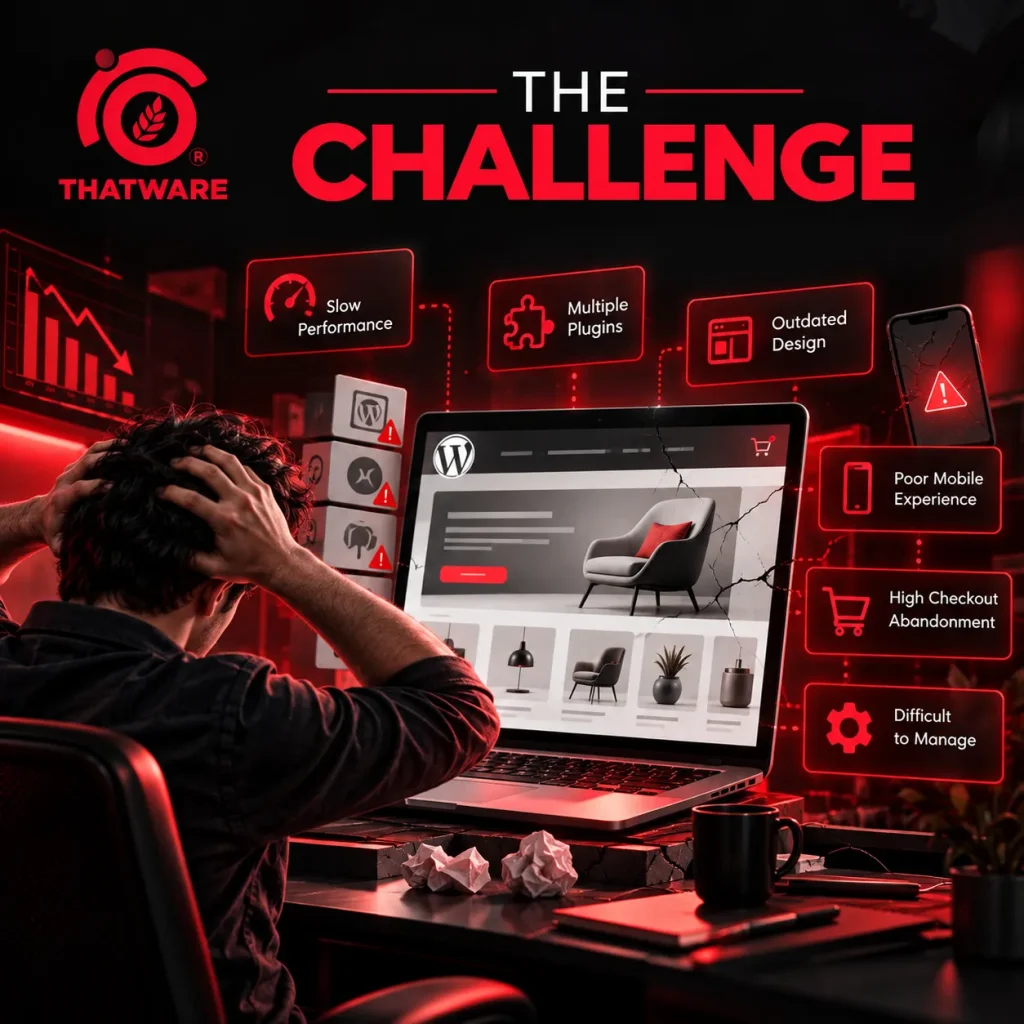
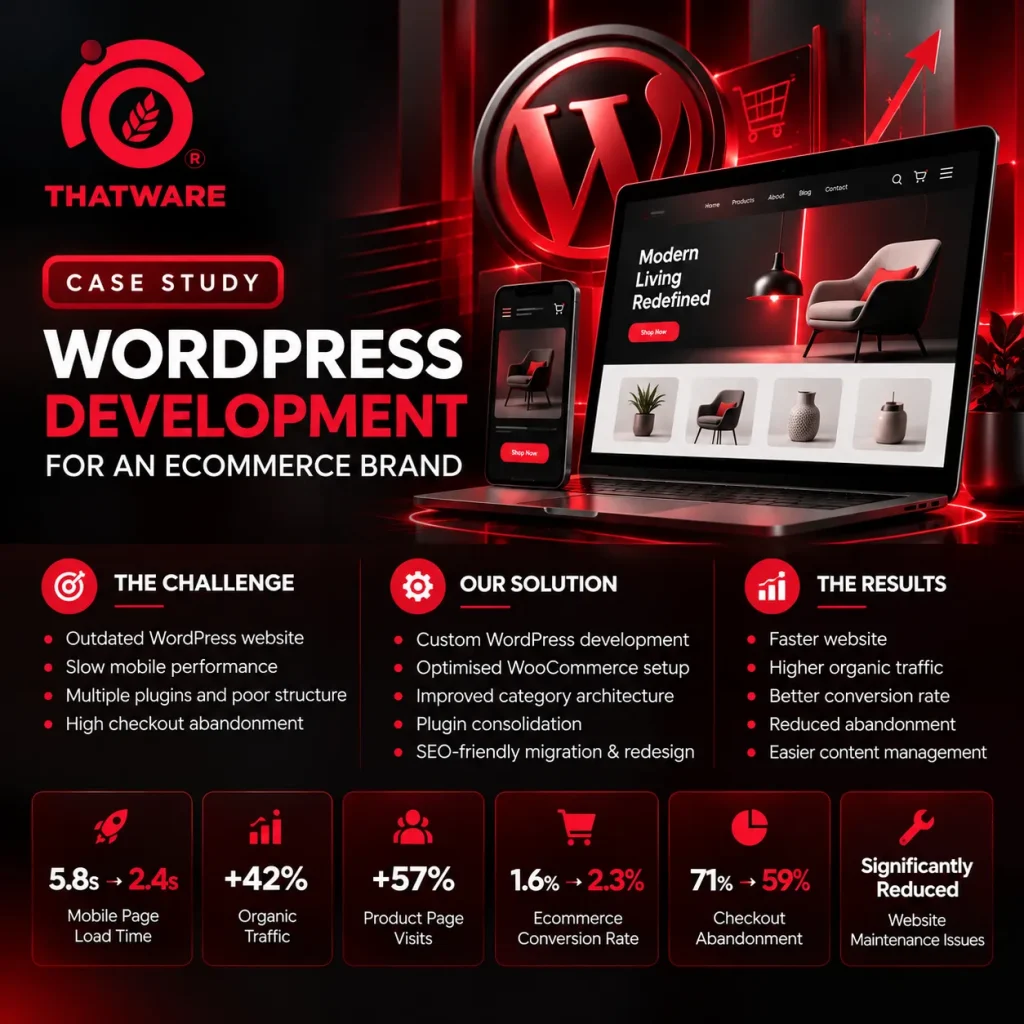
A growing UK-based home and lifestyle brand approached ThatWare with an outdated WordPress website that was becoming difficult to manage. The website relied on multiple plugins, had inconsistent page templates, slow mobile performance, and a complicated checkout journey.
The company wanted to retain its existing organic visibility while creating a faster, more flexible ecommerce platform that could support its expanding product catalogue.
The Approach
ThatWare began with a technical and UX audit of the existing website. We reviewed its information architecture, URLs, product categories, plugins, templates, performance, internal linking, and conversion paths.
We then developed a new WordPress and WooCommerce architecture around the brand’s requirements.
The project included Custom WordPress development, custom product templates, improved category architecture, streamlined navigation, responsive development, plugin consolidation, and checkout improvements.
We also implemented technical SEO considerations throughout the build, including URL mapping, redirects, structured data, internal linking, metadata migration, and improved page hierarchy.
The new architecture was designed so the internal marketing team could add products, create landing pages, and update content without relying on developers for routine changes.
The Results
Within six months of launching the new platform, the business recorded measurable improvements across several areas:
| Metric | Before | After 6 Months |
| Mobile page load time | 5.8 sec | 2.4 sec |
| Organic traffic | Baseline | 0.42 |
| Organic product-page visits | Baseline | 0.57 |
| Ecommerce conversion rate | 1.60% | 2.30% |
| Checkout abandonment | 71% | 59% |
| Website maintenance issues | High | Significantly reduced |
The project gave the brand a more scalable WordPress foundation while improving usability, performance, search visibility, and ecommerce conversion.
The result was not simply a redesigned website. It was a WordPress platform built to support the company’s next stage of growth.
Why Choose ThatWare for WordPress Development?
Choosing a WordPress development company is not simply about finding someone who can build a website.
The right partner should understand how development interacts with design, content, SEO, performance, analytics, conversion, and business strategy.
ThatWare brings these disciplines together.
Development Meets Search
We understand that website architecture influences technical SEO.
Development Meets AI Visibility
We consider semantic structure and machine readability as part of modern website architecture.
Development Meets Conversion
We build pathways that help visitors take meaningful actions.
Development Meets Performance
We consider speed throughout development.
Development Meets Scalability
We plan for future growth rather than only the initial launch.
Development Meets Marketing
We create CMS structures that allow marketing teams to publish, optimise, and expand content.
Development Meets Business Strategy
The website is built around the role it needs to play in the organisation.
Our WordPress Development Framework
We can structure projects around six core layers.
| Layer | Focus |
| Strategy | Business goals, audience and requirements |
| Experience | UX, navigation, conversion and interface |
| Architecture | Content, URLs, templates and relationships |
| Development | WordPress, themes, plugins and integrations |
| Visibility | SEO, semantic structure and structured data |
| Growth | Performance, maintenance, analytics and scalability |
This creates a more complete development process.
A website should not be considered finished simply because it is live.
It should be capable of supporting the business after launch.
WordPress Development Deliverables
Depending on project scope, deliverables may include:
- WordPress installation
- Technical configuration
- Custom theme
- Custom templates
- Custom plugins
- CMS configuration
- Content migration
- WooCommerce setup
- Ecommerce functionality
- API integrations
- CRM integration
- Analytics integration
- Technical SEO implementation
- Structured data
- Responsive development
- Performance optimisation
- Security configuration
- Testing
- Launch support
- Documentation
- Maintenance
- Ongoing support
The exact deliverables are defined according to project requirements.
WordPress Development Project Checklist
Before development begins, we recommend establishing clear answers to the following.
Business
- What does the website need to achieve?
- Who are the primary audiences?
- What actions should visitors take?
- Which services or products are most important?
Content
- What content already exists?
- What content needs to be created?
- What content should be migrated?
- What new content structures are required?
Technology
- Which integrations are required?
- What existing systems need to connect?
- What user roles are needed?
- What functionality must be custom-built?
SEO
- Which existing URLs receive traffic?
- What pages have backlinks?
- Which pages currently rank?
- What redirects are required?
- What structured data is relevant?
Performance
- What are the current performance problems?
- What hosting environment is being used?
- Which plugins affect performance?
- What are the mobile requirements?
Growth
- Will new services be added?
- Will new markets be added?
- Will content volume increase?
- Will ecommerce be introduced?
- Will additional integrations be needed?
Answering these questions early can prevent expensive architectural changes later.
Common WordPress Development Problems We Solve
The Website Is Slow
We investigate themes, plugins, scripts, images, database behaviour, caching, hosting, and third-party resources.
The Website Is Difficult to Manage
We can restructure templates, fields, content types, and administrative workflows.
The Website Looks Good but Does Not Convert
We review navigation, information hierarchy, CTA placement, forms, content structure, and user journeys.
The Website Has Too Many Plugins
We audit the plugin environment and identify opportunities to consolidate or replace functionality.
The Website Is Hard to Scale
We assess the architecture and determine whether templates, content types, taxonomies, or custom functionality need restructuring.
The Website Has SEO Problems
We review technical architecture, URLs, indexation, internal linking, metadata, structured data, and performance.
The Existing Website Needs a Complete Redesign
We combine UX, architecture, technical development, and SEO considerations into the redesign.
The Business Is Moving to WordPress
We plan the migration around content, URLs, redirects, functionality, SEO, and launch.
WordPress Development Services: Our Core Capabilities
| Service | What It Covers | Best For |
| Custom WordPress Development | Tailored website functionality and architecture | Businesses with unique requirements |
| WordPress Website Development | Complete website builds | New business websites |
| WordPress Web Development | Frontend and backend development | Custom functionality |
| WordPress CMS Development | Structured content management | Content-heavy websites |
| Theme Development | Custom presentation layer | Distinctive branded websites |
| Plugin Development | Custom functionality | Unique workflows |
| WooCommerce Development | Ecommerce functionality | Online stores |
| Enterprise Development | Scalable architecture | Large organisations |
| Migration | Platform and website migration | Businesses changing platforms |
| Redesign | Existing website transformation | Outdated or underperforming websites |
| Maintenance | Ongoing technical management | Existing WordPress websites |
| Support | Troubleshooting and improvements | Businesses needing ongoing assistance |
Build a WordPress Website That Can Grow With Your Business
A website should not be designed only for the day it launches.
It should be designed for what the business will need six months, one year, and several years later.
New services may be added.
New products may launch.
New markets may open.
Content may expand.
Traffic may increase.
Integrations may become necessary.
Customer expectations may change.
Search behaviour may evolve.
Your website architecture should be capable of responding to those changes.
That is the principle behind our approach to WordPress development.
We combine technical development with UX, search architecture, performance, conversion, semantic organisation, and AI discoverability to create websites that function as long-term business assets.
Ready to Build a Better WordPress Website?
Whether you are launching a new website, replacing an outdated platform, improving an existing WordPress installation, developing an ecommerce store, or building an enterprise-level digital platform, the development approach matters.
The right architecture can make the website easier to manage.
The right technical foundation can improve performance.
The right information structure can make content easier to discover.
The right UX can reduce friction.
The right SEO foundation can support organic visibility.
The right semantic structure can improve machine understanding.
And the right development strategy can make future growth easier.
ThatWare brings these considerations together through a unified WordPress development approach.
Tell us what you want your website to achieve, and our team can help define the technology, architecture, functionality, and development roadmap required to get there.
Start Your WordPress Development Project
Looking for a WordPress development company that understands development, SEO, UX, performance and AI-driven discovery?