FILL OUT THE FORM BELOW & ALLOW US TO TAKE YOUR SAAS DEVELOPMENT SERVICES TO A WHOLE NEW LEVEL!
Building a SaaS product is not simply a software development project.
You are creating a product that needs to attract users, deliver value quickly, handle subscriptions, protect customer data, scale with demand, integrate with other technologies and continue evolving after launch.
ThatWare provides SaaS development services for startups, growing software businesses and enterprises that want to build secure, scalable and commercially viable cloud-based products.
As a modern SaaS development company, we combine product strategy, UX, software engineering, cloud architecture, integrations, security and long-term product development within one connected framework.
Whether you are validating a new SaaS idea, rebuilding an existing product or expanding an established platform, we develop around the users and business model behind the technology.
Build a SaaS product designed to launch, scale and keep improving.
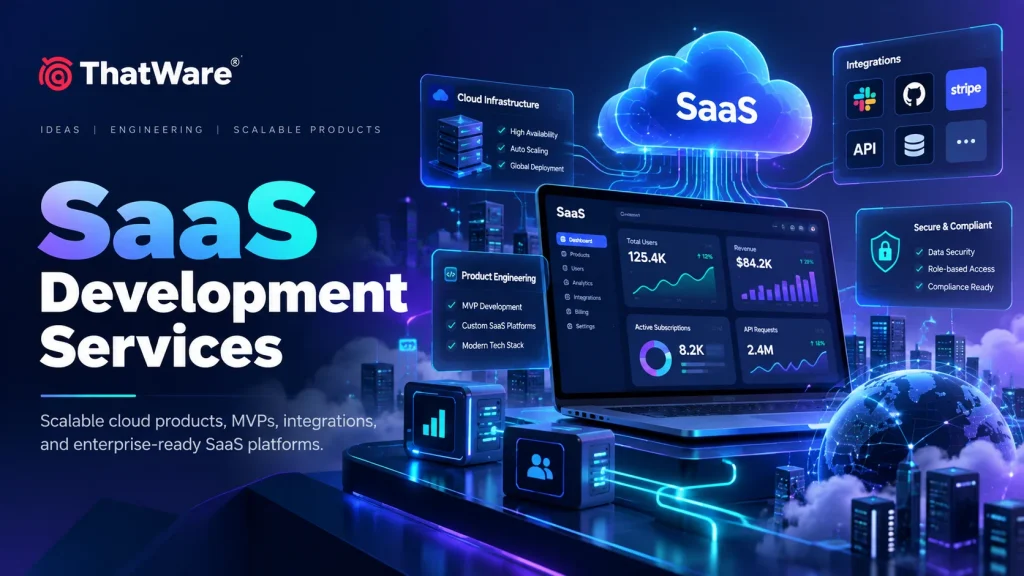
A SaaS Development Agency Focused on Products, Not Just Features
Software-as-a-Service development involves more than writing code against a feature list.
A successful SaaS product needs to answer broader questions:
- Who is the target customer?
- What problem does the product solve?
- Why should users pay for it?
- What is included in the MVP?
- How will customers onboard?
- How will plans and subscriptions work?
- What integrations will users expect?
- How will data be secured?
- What happens when usage grows?
- Which metrics indicate product success?
- How will the platform evolve after launch?
As a SaaS development agency, ThatWare considers these questions before unnecessary functionality is built.
Technology matters.
Product-market fit matters more.
Our role is to connect both.
SaaS Application Development
Modern SaaS products are applications first.
Users expect to sign in, complete tasks, access personalised information and move through workflows without thinking about the complexity underneath.
Our approach to SaaS application development focuses on how customers actually use the product.
Typical application functionality may include:
- User registration
- Secure authentication
- Account management
- Role-based permissions
- Subscription management
- Billing
- Dashboards
- Reports
- Search
- Notifications
- File management
- Collaboration
- Workflow automation
- API integrations
- Administrative controls
Our SaaS application development services connect these user-facing functions with the databases, APIs, cloud infrastructure and application logic required to operate reliably.
SaaS Software Development Services
ThatWare’s SaaS software development services can support the entire lifecycle of a cloud software product.
This may include:
Product Discovery
Clarifying the audience, business objective, competitive environment and initial feature priorities.
Technical Architecture
Planning application layers, databases, APIs, cloud infrastructure, integrations and security.
UI and UX
Designing intuitive experiences around the tasks users need to complete.
Frontend Development
Creating responsive, interactive product interfaces.
Backend Development
Developing business logic, databases, APIs, authentication and system functionality.
Quality Assurance
Testing the product across workflows, user roles, devices and important technical scenarios.
Deployment
Preparing the application and infrastructure for production.
Continuous Development
Improving the platform after launch based on product priorities and user feedback.
Custom SaaS Development
Generic software frameworks can accelerate development, but they should not dictate your product strategy.
Custom SaaS development is appropriate when the value of your platform depends on functionality, workflows or user experiences that standard solutions cannot provide effectively.
Our Custom SaaS development services can support:
- Proprietary workflows
- Custom dashboards
- Industry-specific platforms
- Unique business logic
- Data-intensive SaaS products
- Workflow automation
- Collaboration software
- Reporting platforms
- Analytics tools
- Customer portals
- Vertical SaaS
- Marketplace-style platforms
- Subscription applications
- AI-enabled SaaS functionality
As a Custom SaaS development company, ThatWare develops around the product’s requirements rather than forcing the product into a rigid technical template.
Custom SaaS vs Off-the-Shelf Software
| Factor | Off-the-Shelf Software | Custom SaaS |
| Product Control | Vendor controls roadmap | You control roadmap |
| Features | Designed for broad market | Designed around specific users |
| Branding | Usually limited | Fully customisable |
| Workflow | Users adapt to software | Software adapts to workflow |
| Monetisation | Vendor-defined options | Custom pricing and subscriptions |
| Integrations | Limited by vendor | Purpose-built integrations possible |
| Competitive Advantage | Limited | Proprietary features possible |
| Data Model | Predefined | Can be designed around your needs |
| Scalability | Vendor dependent | Architected around expected growth |
| Best Fit | Standard operational need | New SaaS business or differentiated platform |
Custom development is not automatically the correct choice.
But when software itself is your product, control over functionality, architecture and roadmap can become strategically important.
SaaS Product Development
Successful SaaS businesses are built around products, not projects.
A software project may end after delivery.
A SaaS product keeps evolving.
Our approach to SaaS product development considers the entire product lifecycle, including:
- Product discovery
- Market positioning
- User personas
- Feature prioritisation
- MVP definition
- User onboarding
- Monetisation
- Subscription logic
- Product analytics
- Retention
- Scalability
- Integrations
- Future roadmap
Our SaaS product development services help businesses move from product concept to launch and continued iteration.
SaaS Product Development Company for New and Existing Products
As a SaaS product development company, ThatWare can work with both early-stage ideas and existing software products.
New SaaS Products
We can help define:
- Core user problem
- MVP functionality
- Technical architecture
- Onboarding
- Pricing logic
- Subscription flows
- Admin controls
- Initial integrations
Existing SaaS Products
We can help improve:
- Architecture
- User experience
- Performance
- Scalability
- Legacy code
- Integrations
- Feature development
- Cloud infrastructure
- Security
- Product analytics
The objective is to create a development roadmap that matches the current stage of the business rather than treating every SaaS product the same way.
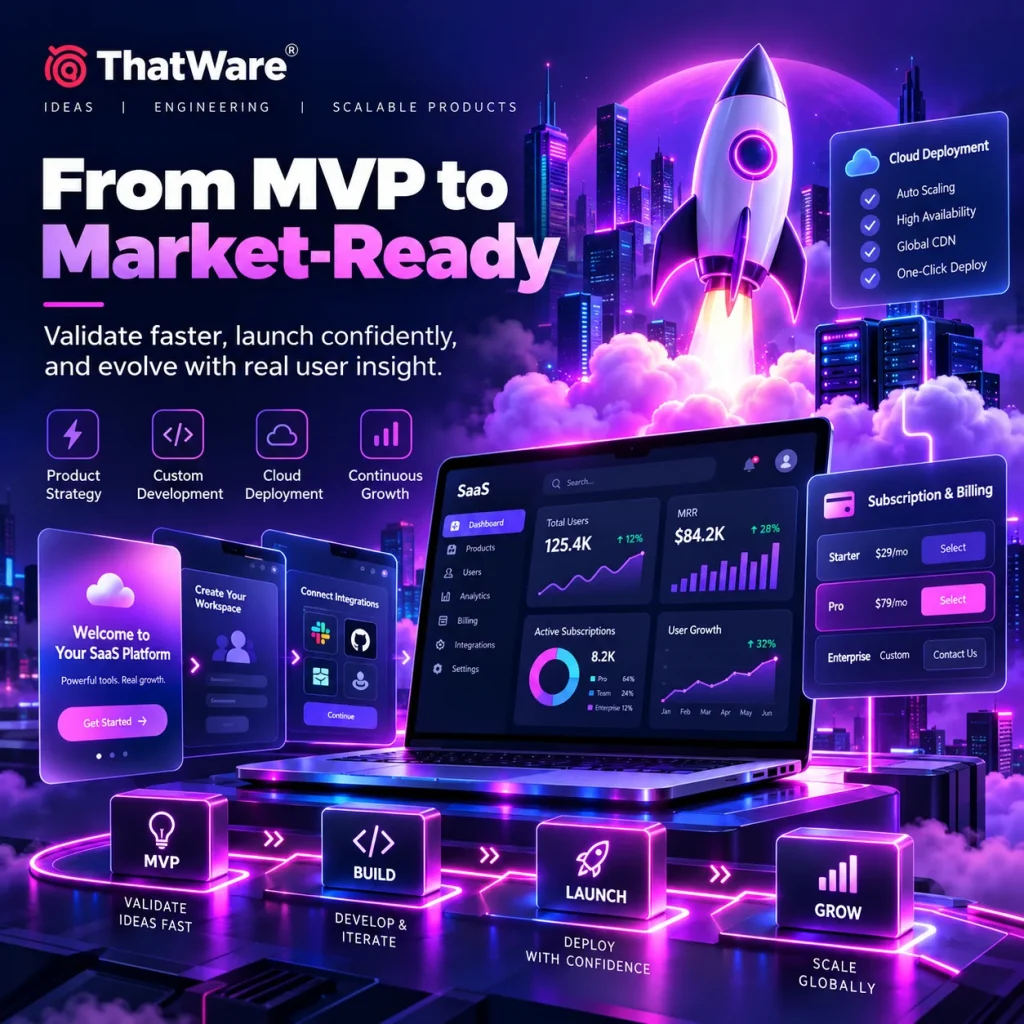
SaaS Platform Development
A SaaS platform often involves considerably more than a single application interface.
It may contain:
- Customer accounts
- Administrator environments
- Payment systems
- APIs
- Databases
- Reporting engines
- Notification services
- Integration layers
- Data pipelines
- Cloud services
- Analytics systems
Our SaaS platform development approach considers how these components work together as one product ecosystem.
ThatWare‘s SaaS platform development services can support both standalone SaaS products and broader platforms with multiple modules or user groups.
SaaS Web Application Development
Browser-based delivery is at the heart of many SaaS models.
Our SaaS web application development capabilities can support products such as:
- CRM applications
- HR software
- Project management tools
- Analytics dashboards
- Financial platforms
- Marketing software
- Scheduling systems
- Healthcare applications
- Business intelligence tools
- Collaboration platforms
- Customer service software
- Vertical SaaS products
Web-based SaaS gives users access from multiple devices while allowing product updates to be deployed centrally.
SaaS App Development Company for Scalable Products
Choosing a SaaS app development company requires evaluating more than programming capabilities.
Your development partner should understand:
- Multi-tenant architecture
- Authentication
- Subscription models
- API design
- Cloud infrastructure
- Data separation
- Performance
- Security
- Product analytics
- User onboarding
- Integrations
- Continuous releases
ThatWare combines product and technical thinking so these decisions are made as parts of one system rather than isolated development tasks.
SaaS Software Development Company With a Product-First Approach
A SaaS software development company should understand that users do not care how technically sophisticated a platform is if it does not help them complete their work.
We therefore prioritise:
Usability
Users should understand what to do without extensive training.
Reliability
Core functionality should work consistently.
Speed
Users should not feel the application slowing down routine tasks.
Scalability
Growth should not immediately create architectural limitations.
Security
Access and data should be protected appropriately.
Maintainability
The software should remain practical to extend and support.
Commercial Flexibility
The platform should support the pricing, subscription and product roadmap behind the business.
SaaS Solution Development
Different SaaS businesses solve different problems.
Our SaaS solution development capabilities can support:
- Workflow automation
- Customer management
- Human resources
- Financial operations
- Marketing technology
- Reporting
- Analytics
- Scheduling
- Collaboration
- Data management
- Project management
- Compliance
- Industry-specific processes
As a SaaS solutions development company, ThatWare focuses on understanding the business problem first and designing technology around the solution.
Cloud SaaS Development Services
SaaS depends on cloud infrastructure that can support accessibility, reliability and changing user demand.
Our Cloud SaaS development services can address:
- Cloud architecture
- Application hosting
- Data storage
- Scalable infrastructure
- Load handling
- Backups
- Monitoring
- Automated deployment
- Environment management
- Disaster recovery planning
Depending on project requirements, cloud environments may involve platforms such as AWS, Microsoft Azure or Google Cloud.
The correct architecture depends on the product’s scale, security needs, geographic audience and operating model.
B2B SaaS Development Services
B2B SaaS products frequently have different requirements from consumer software.
Users may involve multiple departments, permissions, workflows and stakeholders within the same customer account.
Our B2B SaaS development services can support functionality such as:
- Company accounts
- Team management
- Role-based permissions
- Approval workflows
- Advanced reporting
- CRM integrations
- ERP integrations
- Single sign-on
- API access
- Custom plans
- Enterprise billing
- Usage reporting
- Administrative dashboards
B2B products also need to support the sales and onboarding process around the technology.
That can influence trial experiences, demo environments, account provisioning and customer success functionality.
Enterprise SaaS Development Services
Enterprise SaaS introduces additional complexity.
Larger customers may require:
- Advanced permissions
- SSO
- Audit logs
- Complex integrations
- High availability
- Large user volumes
- Data governance
- Advanced security
- Custom reporting
- Administrative controls
- Multiple locations
- Dedicated account structures
Our Enterprise SaaS development services are designed around those more demanding product environments.
Architecture can be planned so enterprise functionality is introduced without making the product unnecessarily complex for smaller users.
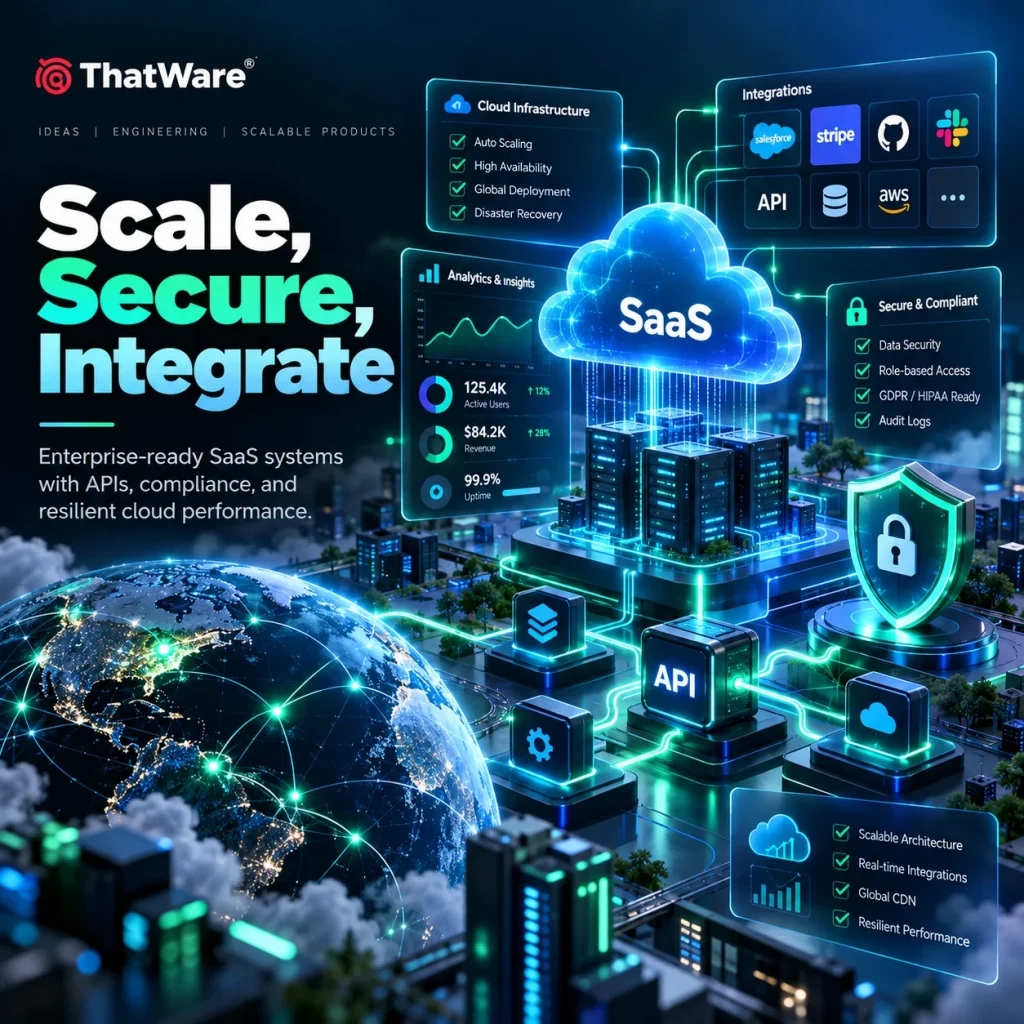
SaaS MVP Development Services
One of the biggest risks in new SaaS development is building too much too early.
A long list of features can consume months of development before anyone confirms whether customers actually value the core product.
Our SaaS MVP development services focus on identifying the smallest useful version of the platform capable of testing the commercial concept.
An MVP may include:
- Core user workflow
- Registration
- Authentication
- Essential dashboard
- Primary functionality
- Subscription logic
- Admin controls
- Basic analytics
- Critical integrations
The objective is not to build a poor-quality product.
It is to build the right amount of product for the current stage of validation.
MVP vs Full SaaS Product Development
| Area | SaaS MVP | Full SaaS Product |
| Primary Goal | Validate core proposition | Scale and deepen product |
| Features | Essential functionality | Broader product ecosystem |
| Integrations | Critical integrations | Multiple advanced integrations |
| User Roles | Usually limited initially | Complex role structures |
| Analytics | Core product metrics | Advanced behavioural analytics |
| Infrastructure | Designed for initial growth | Built for larger-scale usage |
| Timeline | More focused | Longer development roadmap |
| Investment | Prioritised around validation | Greater long-term investment |
| Best For | New product concept | Validated or established SaaS |
Starting with an MVP allows product decisions to be informed by real users rather than assumptions.
SaaS Startup Development Services
Early-stage software companies need development choices that balance ambition with financial and commercial reality.
Our SaaS startup development services can support founders through:
- Product discovery
- Technical feasibility
- MVP definition
- UX design
- Application architecture
- Development
- Cloud deployment
- Initial analytics
- Launch
- Iterative improvement
Startups should avoid two common extremes.
Building an application that cannot scale at all is risky.
Building enterprise-grade complexity before acquiring the first customers can be equally damaging.
The architecture should match the stage of the company while leaving sensible room for growth.
SaaS Application Development Company for Customer-Focused Products
As a SaaS application development company, ThatWare plans software around the moments that matter most to users.
Examples include:
Registration
Can a new customer create an account without unnecessary friction?
Onboarding
Can users understand how to reach the first valuable outcome?
Core Workflow
Can they accomplish the main purpose of the product efficiently?
Upgrade
Can users understand plan differences and move to a higher tier?
Collaboration
Can teams work together where required?
Support
Can users find assistance without leaving the product frustrated?
Application development becomes more effective when these journeys influence the technical and UX decisions behind the platform.
SaaS Software Developers Across the Product Lifecycle
Strong SaaS products require different technical capabilities at different stages.
Our SaaS software developers can contribute across areas such as:
- Frontend development
- Backend development
- Database architecture
- API development
- Cloud infrastructure
- Authentication
- Billing systems
- Subscription logic
- Integrations
- Performance optimisation
- DevOps
- Testing
- Maintenance
The development team should work towards the same product goals rather than individual technical tasks.
Multi-Tenant SaaS Architecture
Many SaaS platforms serve multiple customers through the same underlying application.
This is known as multi-tenancy.
A multi-tenant system needs clear approaches for:
- Account separation
- Data isolation
- Permissions
- Usage tracking
- Plans
- Billing
- Feature access
- Performance
- Reporting
- Administrative controls
The architecture needs to accommodate growth without compromising customer data or operational manageability.
Subscription and Billing Development
Recurring revenue is central to many SaaS businesses.
Subscription functionality can include:
- Free trials
- Monthly plans
- Annual plans
- Seat-based pricing
- Usage-based billing
- Tiered subscriptions
- Feature restrictions
- Upgrades
- Downgrades
- Renewals
- Cancellations
- Coupons
- Billing histories
- Invoices
Payment providers can be integrated according to the business model and target market.
Billing architecture should also account for how pricing may evolve as the product matures.
SaaS Integration Services
Modern SaaS products rarely operate in isolation.
Customers expect their software tools to work together.
Our SaaS integration services can connect platforms with systems such as:
- CRM software
- ERP systems
- Payment providers
- Accounting platforms
- Marketing automation tools
- Email platforms
- Analytics systems
- Communication software
- Identity providers
- Cloud storage
- Data providers
- Third-party APIs
Integrations can improve product value while reducing the need for customers to move information manually between systems.
API Development for SaaS Platforms
APIs can make a SaaS product significantly more valuable.
They allow:
- External applications to connect
- Customers to automate workflows
- Mobile applications to access platform data
- Partners to build integrations
- Internal services to communicate
- Data to move between systems
API architecture should consider:
- Authentication
- Permissions
- Rate limits
- Versioning
- Documentation
- Security
- Performance
A well-designed API can turn a standalone product into part of a broader software ecosystem.
SaaS Security and Data Protection
Customers are trusting your product with information.
That trust needs to influence architecture and development.
Security considerations may include:
- Secure authentication
- Multi-factor authentication
- Role-based access
- Encryption
- Secure API design
- Input validation
- Data isolation
- Audit logs
- Dependency management
- Backup processes
- Security monitoring
- Secure cloud configuration
The exact security controls should be based on what the application does, the sensitivity of the data and relevant regulatory requirements.
SaaS Development Consulting
Sometimes the right starting point is not development.
It is clarity.
Our SaaS development consulting can help founders and businesses evaluate:
- Product concepts
- Existing architecture
- Technology choices
- MVP scope
- Cloud strategy
- Multi-tenancy
- Integrations
- Scalability
- Legacy code
- Technical debt
- Security
- Product roadmap
- Development priorities
Consulting can also help businesses decide whether to rebuild, modernise or continue improving an existing platform.
SaaS Development Solutions for Different Product Models
Our SaaS development solutions can be adapted to different product categories.
Vertical SaaS
Software developed for a specific industry such as healthcare, logistics, property, legal services or manufacturing.
Horizontal SaaS
Products solving broader business needs such as CRM, HR, analytics or collaboration.
B2B SaaS
Software designed for teams and organisations.
Enterprise SaaS
Platforms requiring advanced permissions, integrations and governance.
SaaS Marketplaces
Products that connect multiple user groups within one platform.
Data SaaS
Applications built around analytics, intelligence, reporting or data access.
AI-Enabled SaaS
Products incorporating AI into workflows, automation, discovery or decision support.
Case Study 1: Building a B2B SaaS MVP for Workflow Automation
The Challenge
A B2B startup identified a recurring workflow problem affecting service-based organisations.
Teams were managing requests, approvals and status updates across spreadsheets, email and several disconnected tools.
The founder wanted to test whether businesses would pay for a centralised subscription platform but did not want to spend the first development phase building every planned feature.
The SaaS Development Approach
The proposed MVP focused on the highest-value customer workflow.
The platform architecture included:
- Company registration
- Secure user login
- Team accounts
- Role-based access
- Request creation
- Approval workflows
- Status tracking
- Email notifications
- Management dashboard
- Subscription functionality
- Basic analytics
- Administrative environment
The application was structured so additional workflow modules and integrations could be introduced after product validation.
Why the Approach Works
By prioritising the central workflow, the founder can test:
- Whether customers understand the value proposition
- Which functionality they actually use
- Where onboarding friction exists
- Which integrations matter most
- Which features deserve future investment
This reduces the risk of building an extensive product roadmap based entirely on assumptions.
Relevant capabilities: SaaS MVP development services, B2B SaaS development services, Custom SaaS development, SaaS application development services and Cloud SaaS development services.
Case Study 2: Modernising an Enterprise SaaS Platform for Scalability
The Challenge
An established B2B software product had grown significantly beyond its original architecture.
New enterprise customers required:
- More advanced permissions
- Better reporting
- SSO
- Additional integrations
- Improved performance
- More reliable deployment
- Better administrative controls
The platform could still operate, but continued feature development was becoming slower and more difficult.
The SaaS Development Approach
The proposed modernisation roadmap focused on reducing technical limitations without unnecessarily rebuilding everything at once.
The approach included:
- Architecture review
- Technical debt assessment
- Modularisation of critical components
- Role and permissions redesign
- API improvements
- Integration framework improvements
- Cloud infrastructure optimisation
- Reporting enhancements
- Product analytics
- Automated deployment processes
- Security review
- Phased migration planning
Why the Approach Works
A phased approach allows the existing product to continue serving customers while high-impact technical constraints are progressively addressed.
It also creates a stronger foundation for enterprise functionality and future feature development.
Relevant capabilities: Enterprise SaaS development services, SaaS platform development services, SaaS integration services, SaaS software development services and SaaS maintenance and support services.
New SaaS Development vs SaaS Modernisation
| Factor | New SaaS Product | Existing SaaS Modernisation |
| Starting Point | Product concept | Existing users and codebase |
| Primary Goal | Build and validate | Improve and scale |
| Architecture | Designed from scratch | Existing architecture assessed |
| User Data | Limited initial data | Existing production data |
| Migration | Usually minimal | May require careful migration |
| UX | New experience | Existing behaviour must be considered |
| Integrations | Planned from beginning | Existing integrations must be preserved |
| Product Risk | Market validation | Service continuity |
| Technical Debt | Low initially | Often a major consideration |
| Best Strategy | MVP and iterative growth | Phased modernisation |
SaaS Maintenance and Support Services
A SaaS platform is never truly finished.
Customers continue using it while browsers, APIs, dependencies, cloud services and security threats continue changing.
Our SaaS maintenance and support services can include:
- Bug fixes
- Performance monitoring
- Security updates
- Dependency updates
- API maintenance
- Database optimisation
- Cloud infrastructure monitoring
- Feature improvements
- Integration updates
- Browser compatibility
- Technical troubleshooting
- Product enhancements
- User-reported issue resolution
Maintenance should be treated as part of the product lifecycle, not an emergency service used only when something breaks.
Our SaaS Development Process
1. Product Discovery
We begin by understanding:
- Target users
- Business model
- Product problem
- Competitive positioning
- Commercial objectives
- Core workflows
2. Requirements and MVP Definition
Features are prioritised according to product value rather than enthusiasm alone.
3. UX and Product Design
Important user journeys and interfaces are mapped before development.
4. Architecture Planning
Frontend, backend, database, integrations, cloud services and security requirements are defined.
5. Development
The application is developed iteratively.
6. Integration
Payment providers, CRM systems, analytics tools and relevant third-party services are connected.
7. Quality Assurance
Key workflows, user roles, devices, performance and functional scenarios are tested.
8. Deployment
The SaaS product is prepared for production.
9. Product Analytics
User behaviour and product performance can be evaluated after launch.
10. Continuous Development
The roadmap evolves based on product priorities, customer feedback and business growth.
SaaS Development Services by Business Stage
| Business Stage | Primary Need | Typical Development Focus |
| Idea Stage | Validate feasibility | Discovery and technical consulting |
| Pre-MVP | Define product | UX, architecture and feature prioritisation |
| MVP | Validate market need | Core application and subscriptions |
| Early Growth | Improve retention | UX, analytics and integrations |
| Scale-Up | Handle growth | Performance, architecture and automation |
| Enterprise Expansion | Win larger customers | SSO, security, permissions and integrations |
| Mature Product | Reduce technical debt | Modernisation and optimisation |
Why Choose ThatWare for SaaS Development?
Product Thinking Before Feature Development
A large feature list does not guarantee a successful SaaS product.
We focus first on what creates value for the user.
Custom Development Capability
The product can be developed around its actual workflows and commercial model.
Frontend and Backend Expertise
User experience and technical infrastructure can be developed within one coordinated strategy.
Cloud Architecture
Infrastructure can be designed to support accessibility, scalability and future growth.
Integration Expertise
SaaS platforms can connect with the broader technology ecosystem customers already use.
Security-Conscious Engineering
Security considerations can be incorporated throughout architecture and development.
MVP and Product Scaling
ThatWare can support both early product validation and continued development after traction.
Long-Term Product Support
Development can continue after launch as the product evolves.
What Can Be Included in a ThatWare SaaS Project?
| Area | Potential Scope |
| Product Strategy | Discovery, personas and MVP planning |
| UI/UX | Product journeys, dashboards and interfaces |
| Frontend | Responsive SaaS application interfaces |
| Backend | Business logic, databases and APIs |
| Multi-Tenancy | Account and data separation |
| Subscription | Plans, billing and account management |
| Cloud | Infrastructure and deployment |
| Integrations | CRM, ERP, payments and third-party tools |
| API Development | External and internal APIs |
| Security | Authentication, access and data protection |
| Analytics | Product usage and behavioural tracking |
| Enterprise Features | SSO, audit logs and advanced permissions |
| QA | Functional and workflow testing |
| DevOps | Deployment and release processes |
| Maintenance | Fixes, updates and continued development |
Ready to Build or Scale Your SaaS Product?
A SaaS idea can begin with a simple observation:
There has to be a better way to do this.
Turning that observation into a successful product requires more than development.
It requires product decisions, technical architecture, user experience, cloud infrastructure, pricing logic, integrations, analytics and continuous improvement to work together.
Whether you are validating an MVP, launching a new B2B platform or modernising an existing enterprise product, ThatWare can help turn the product strategy into working software.
Build the right product first. Then build it to scale.