SUPERCHARGE YOUR ONLINE VISIBILITY! CONTACT US AND LET’S ACHIEVE EXCELLENCE TOGETHER!
For years, SEO agencies were judged primarily by familiar metrics:
- Keyword rankings
- Organic traffic
- Backlinks
- Technical health
- Content output
Those metrics still matter.
But the search environment has changed.
Users no longer discover brands only through traditional search engine results. They increasingly interact with AI Overviews, ChatGPT, Gemini, Copilot, Perplexity, Claude, and other generative platforms that summarize, compare, and recommend information directly.
This shift has changed what SEO agencies are expected to do.
The debate around traditional SEO vs AI SEO is not simply about whether artificial intelligence should be used to automate SEO tasks.
It is about something much bigger.
It is about how brands are discovered.
Traditional SEO was primarily built around rankings, clicks, and search engine result pages.
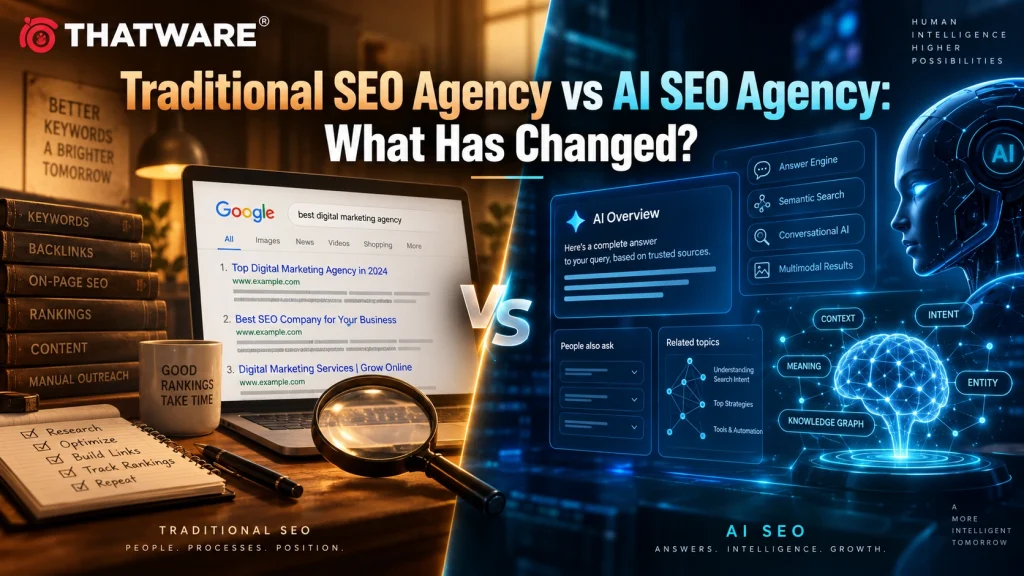
AI SEO increasingly includes retrieval, citation, entity understanding, machine interpretation, recommendation visibility, answer generation, and conversational search.
That is why businesses evaluating an AI SEO agency today should look beyond automation.
The real question is whether the agency understands how search behavior itself is evolving.
At ThatWare, we see AI SEO as an extension of modern search strategy, not a replacement for SEO fundamentals.
Technical SEO still matters.
Authority still matters.
Content still matters.
But now brands must also become understandable and retrievable by AI systems.
What Is Traditional SEO?
Traditional SEO focuses on improving a website’s visibility within search engine results.
Its core activities usually include:
- Keyword research
- On-page SEO
- Technical SEO
- Link building
- Content creation
- Internal linking
- Rank tracking
- Competitor analysis
The central objective is usually straightforward:
Improve rankings so more users click through to the website.
This model remains extremely important.
Search engines still process enormous volumes of queries, and traditional organic visibility continues to drive traffic, leads, and revenue.
The limitation is that the customer discovery journey has expanded.
What Is AI SEO?
AI SEO focuses on helping brands become visible not only in traditional search results but also within AI-generated answers, summaries, recommendations, and conversational experiences.
An AI SEO agency may work on:
- AI visibility analysis
- Entity optimization
- Citation readiness
- Structured data
- Generative search visibility
- AEO
- GEO
- LLM discoverability
- Search intelligence
- AI-assisted analysis
- Knowledge consistency
This does not mean abandoning traditional SEO.
Instead, strong AI SEO services combine established ranking principles with new visibility models.
Quick Q&A
Q: Does AI SEO replace traditional SEO?
No. AI systems still depend heavily on accessible, authoritative, well-structured web content. AI SEO expands the scope of optimization rather than eliminating traditional SEO.
Traditional SEO vs AI SEO: The Core Difference
The most important distinction in traditional SEO vs AI SEO is the type of visibility being optimized.
Traditional SEO asks:
“How do we rank higher?”
AI SEO also asks:
“How do we become a source, citation, entity, or recommendation inside an AI-generated answer?”
That changes the optimization framework.
Traditional SEO Measures
- Rankings
- Clicks
- Impressions
- Organic traffic
- Backlinks
AI SEO May Also Measure
- AI mentions
- Citation frequency
- Recommendation visibility
- Brand inclusion
- Entity accuracy
- Source attribution
- Competitive AI presence
The two disciplines overlap, but they are not identical.
“Search visibility is no longer limited to whether your blue link appears on page one.”
1. Search Has Shifted From Links to Answers
Traditional search results typically provide links.
AI-powered search often provides answers.
A user may ask:
“What are the best enterprise SEO agencies for international expansion?”
Instead of visiting ten websites, the user may receive a summarized answer containing only a handful of companies.
This creates a new competitive challenge.
Being ranked somewhere in traditional results may not guarantee inclusion in the AI-generated response.
An AI search optimization agency therefore needs to understand how information is retrieved, synthesized, and cited.
2. Keywords Are Still Important, but Intent Matters More
Traditional SEO often starts with keyword targeting.
AI search is much more conversational.
Users may ask:
- Which company is best for this use case?
- What platform should I choose?
- What are the differences between these solutions?
- Which service provider is suitable for my industry?
This means agencies need to understand:
- Context
- Intent
- Relationships
- Topic depth
- Entities
- Questions
A modern SEO agency should therefore think beyond exact keyword matching.
3. Content Must Become Citation-Worthy
Traditional SEO content is often optimized to rank.
AI SEO content should also be useful enough to be referenced.
This may require:
- Original research
- Clear definitions
- Expert commentary
- Data
- Comparison frameworks
- Case studies
- Structured explanations
- Unique insights
A generative AI SEO agency should help brands create content that machines can easily interpret and confidently use.
This shifts content strategy from:
“How do we target this keyword?”
to:
“How do we become a reliable source for this topic?”
4. Entity Optimization Has Become More Important
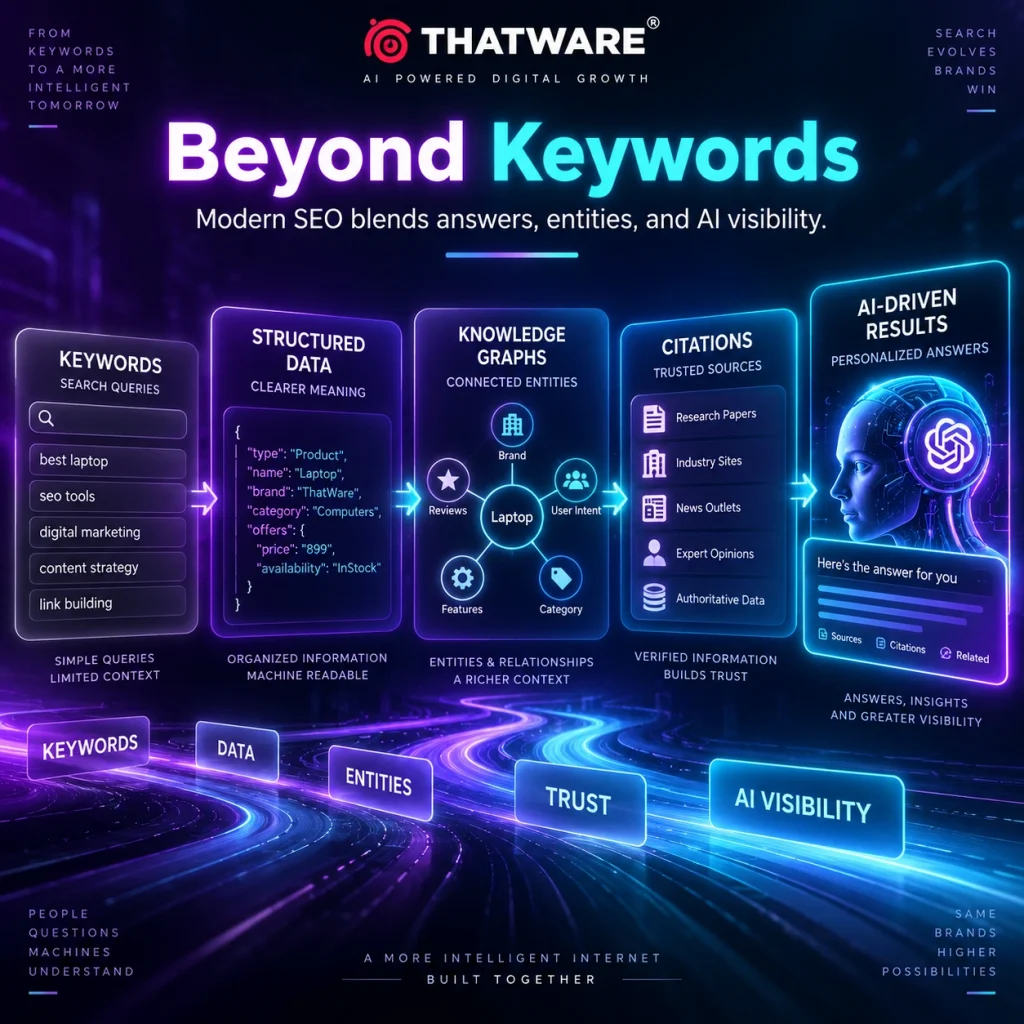
AI systems need to understand what a brand is.
They need clarity around:
- Company name
- Services
- Products
- Founders
- Locations
- Industries
- Expertise
- Relationships
An AI powered SEO agency should therefore consider entity signals across:
- Website content
- Structured data
- Business listings
- Profiles
- Media coverage
- Third-party mentions
This helps create a consistent machine-readable identity.
“If AI systems cannot confidently understand who your company is, they are less likely to recommend it.”
5. AEO Has Become Part of Search Strategy
Answer Engine Optimization focuses on helping content appear in direct answers.
An AEO SEO agency may optimize:
- Definitions
- FAQs
- Question-based content
- Structured responses
- Entity relationships
- Featured answer formats
AEO matters because search increasingly resolves questions directly.
The content that wins is often the content that answers clearly.
6. GEO Expands Optimization Into Generative Search
Generative Engine Optimization focuses on increasing visibility within AI-generated responses.
A GEO SEO agency may work on:
- Citation visibility
- Brand mentions
- Source authority
- Structured content
- Entity clarity
- Comparative relevance
GEO is particularly important for brands that want to appear when users ask AI systems for recommendations or comparisons.
7. LLM SEO Focuses on Machine Retrieval
Large language models interact with information differently from conventional search engines.
An LLM SEO agency focuses on improving how brand information is understood, retrieved, and represented by language models.
This may involve:
- Structured content
- Consistent factual information
- Entity clarity
- Knowledge relationships
- Source authority
- Citation readiness
The goal is not to “rank inside an LLM” in the traditional sense.
It is to improve the probability that relevant brand information is retrieved and represented accurately.
8. AI SEO Uses More Automation
Traditional SEO can involve substantial manual analysis.
AI-assisted workflows allow agencies to process much larger datasets.
An AI driven SEO agency may use automation for:
- Keyword clustering
- Content gap analysis
- Competitor analysis
- Intent classification
- Internal linking
- Anomaly detection
- SERP pattern analysis
- Large-scale audits
This does not mean humans disappear.
It means human strategy can be applied to larger datasets.
9. AI SEO Requires Better Data Interpretation
Automation is useful only if decisions improve.
An AI SEO company should not simply generate more reports.
It should explain:
- Which changes matter
- What caused visibility shifts
- Which opportunities should be prioritized
- Where competitors are gaining
- Which content deserves investment
AI can accelerate analysis.
Strategy still requires judgment.
Mini Case Study 1: Brand Ranking Well but Missing From AI Answers
Imagine a B2B company ranking on page one for several commercial terms.
Despite strong rankings, it rarely appears in AI-generated recommendations.
Analysis reveals that competitors have:
- More third-party mentions
- Better structured data
- Clearer company descriptions
- More citation-worthy content
The strategy expands beyond traditional SEO into entity optimization, digital PR, research content, and AI visibility monitoring.
The lesson is simple:
High rankings do not automatically create AI visibility.
10. Link Building Is Becoming Broader Authority Building
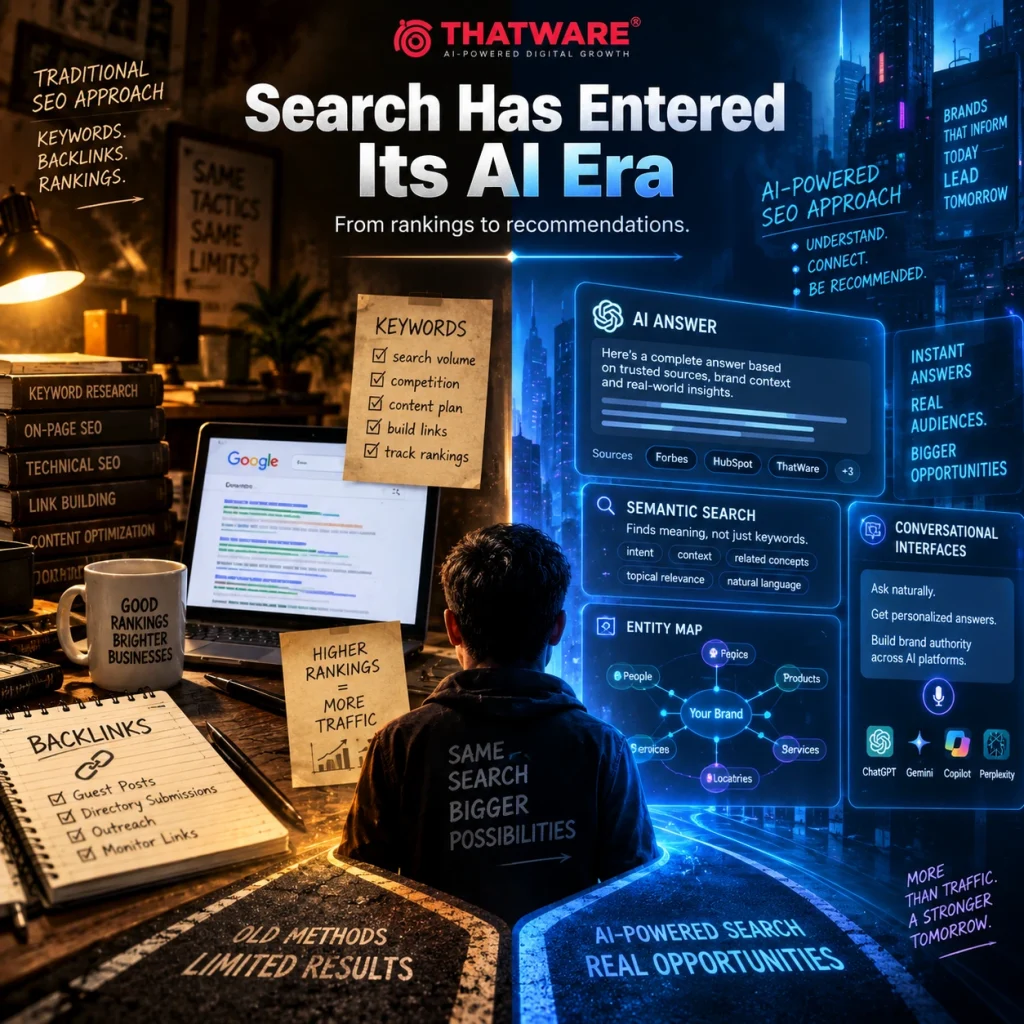
Traditional SEO often emphasizes backlinks.
Backlinks remain important.
But AI-driven discovery also values broader signals.
These may include:
- Media mentions
- Brand citations
- Expert references
- Research
- Industry recognition
- Trusted profiles
An advanced SEO agency should therefore think beyond link quantity.
The goal is stronger digital authority.
11. Technical SEO Still Matters
AI SEO does not make technical SEO obsolete.
Poor crawlability still limits visibility.
Broken canonical tags still cause problems.
Weak internal linking still affects discovery.
Slow or inaccessible websites still reduce performance.
The difference is that technical optimization increasingly supports both search engines and AI retrieval.
This is why an AI SEO agency still needs strong technical expertise.
12. Search Measurement Has Expanded
Traditional SEO reporting may focus on:
- Rankings
- Traffic
- Conversions
AI search introduces additional metrics.
These may include:
- Brand mentions in AI answers
- Citation frequency
- Competitor inclusion
- Recommendation share
- Source visibility
- Entity accuracy
An AI SEO consulting engagement should help businesses decide which metrics actually matter.
Quick Q&A
Q: Can AI visibility be measured accurately?
It can be monitored, but measurement is still evolving. AI outputs can vary by model, query wording, user context, and time, so trends are usually more meaningful than one isolated result.
13. Search Is Becoming More Conversational
Traditional keyword queries are often short.
AI queries are frequently much longer.
A user might ask:
“Which SEO agencies specialize in international enterprise SEO and AI visibility for large websites?”
This query contains:
- Service intent
- Company type
- Market scope
- Technology requirement
A next generation SEO services strategy should therefore optimize for concepts and decision journeys, not only head terms.
14. Buyer Journeys Are Becoming Shorter
AI platforms can compress research.
A user can:
- Ask a question
- Compare providers
- Review strengths
- Narrow options
without visiting many websites.
This means being included early in the AI answer may influence the entire buying journey.
A generative AI SEO agency should therefore treat AI recommendation visibility as a strategic brand opportunity.
15. Search Intelligence Has Become More Important
Modern agencies need to understand not only their client but the whole market.
Search intelligence can reveal:
- Competitor movement
- Emerging queries
- AI citation changes
- SERP shifts
- New content gaps
- Brand demand changes
This helps the agency act before traffic declines.
An advanced SEO agency should be proactive rather than reactive.
16. AI Search Requires Stronger Brand Consistency
AI systems may retrieve information from many sources.
If a brand is described differently across the web, confusion can occur.
Companies should maintain consistency around:
- Services
- Leadership
- Locations
- Product names
- Company descriptions
An AI powered SEO agency should monitor these signals.
Consistency helps improve machine confidence.
17. Content Quality Matters More Than Content Volume
AI tools make publishing faster.
That also means low-quality content can scale faster.
The competitive advantage is therefore shifting toward:
- Originality
- Expertise
- Depth
- Data
- Experience
- Usefulness
A modern SEO agency should resist the temptation to generate large amounts of generic content.
More pages do not automatically mean more authority.
“AI makes content production easier. It does not make valuable content easier.”
Mini Case Study 2: High Content Volume With Weak Search Growth
Imagine a company publishing 30 AI-generated articles every month.
Traffic remains flat.
Analysis shows the content largely repeats information already available elsewhere.
The strategy changes.
Instead of producing 30 generic articles, the company publishes fewer but stronger assets containing proprietary data, expert input, comparisons, and original insights.
Visibility improves because the content becomes more differentiated.
18. Digital PR Becomes More Valuable in AI Search
Authority is increasingly distributed across the web.
Digital PR can help brands earn:
- Trusted mentions
- Backlinks
- Expert citations
- Research references
- Media coverage
These signals may support both traditional SEO and AI visibility.
A GEO SEO agency should therefore understand the relationship between PR, citations, and generative search.
19. AI SEO Is More Cross-Functional
Traditional SEO may have operated mainly within marketing.
AI SEO often intersects with:
- PR
- Product
- Data
- Development
- Branding
- Content
- Legal
Why?
Because AI visibility depends on the broader information ecosystem.
A strong AI SEO company should therefore be comfortable working across teams.
20. The Best Model Combines Traditional and AI SEO
The future is not traditional SEO or AI SEO.
It is both.
Traditional SEO provides:
- Technical foundations
- Organic rankings
- Authority
- Traffic
AI SEO adds:
- Entity understanding
- Citation visibility
- AI recommendations
- Generative discovery
- Conversational search
Businesses should therefore look for next generation SEO services that integrate both models.
What Should an AI SEO Agency Actually Deliver?
A capable AI SEO agency should provide a structured framework.
Traditional Search Layer
- Technical SEO
- Keyword strategy
- Content optimization
- Internal linking
- Authority building
AI Search Layer
- AI visibility audits
- Citation monitoring
- Entity optimization
- Generative search strategy
- AEO
- GEO
- LLM discoverability
Intelligence Layer
- Competitor analysis
- Query research
- Search trends
- Opportunity modeling
Business Layer
- Leads
- Revenue
- Market visibility
- Brand demand
This is what separates real AI SEO strategy from simply adding AI tools to an existing workflow.
How ThatWare Approaches AI SEO
At ThatWare, we treat AI SEO as an extension of search intelligence.
Our work may include:
- Technical SEO
- Content optimization
- AI visibility monitoring
- Entity optimization
- Generative search strategy
- AEO
- GEO
- LLM search optimization
- Search intelligence
- Competitive analysis
- Digital PR
- Structured data
As an AI SEO agency, ThatWare combines conventional SEO fundamentals with emerging generative search practices.
Our AI SEO services are designed to help brands remain visible across both traditional and AI-powered discovery environments.
As an AI search optimization agency, our objective is not simply to increase rankings but also to improve how brands are understood, cited, and recommended.
For organizations needing strategic direction, our AI SEO consulting can help identify the highest-priority opportunities across conventional search, AI answers, entities, content, and authority.
Final Thoughts
The difference between traditional SEO and AI SEO is not that one is old and the other is new.
The difference is that the search ecosystem has expanded.
Traditional SEO remains essential.
But brands now need to think about how they appear when AI systems summarize, compare, cite, and recommend information.
That creates new responsibilities for agencies.
A modern SEO agency should understand rankings.
An AI search optimization agency should understand AI visibility.
A generative AI SEO agency should understand citations and retrieval.
An AEO SEO agency should understand answers.
A GEO SEO agency should understand generative discovery.
An LLM SEO agency should understand machine interpretation.
The strongest model brings all of these disciplines together.
ThatWare combines technical SEO, content intelligence, entity optimization, AI visibility, AEO, GEO, LLM search optimization, competitive intelligence, and digital authority to support brands across the new search landscape.
Because the future of SEO is not about choosing between traditional search and AI search.
It is about building visibility across both.