SUPERCHARGE YOUR ONLINE VISIBILITY! CONTACT US AND LET’S ACHIEVE EXCELLENCE TOGETHER!
SEO has changed dramatically.
A few years ago, businesses often hired agencies for a relatively simple list of tasks:
- Keyword research
- On-page optimization
- Link building
- Technical fixes
- Monthly ranking reports
Those services still matter.
But they are no longer enough.
Search has expanded beyond traditional Google rankings. Buyers now discover brands through AI Overviews, ChatGPT, Gemini, Copilot, Perplexity, video, forums, social platforms, knowledge panels, and other discovery environments.
At the same time, competition has become more sophisticated.
Brands are publishing more content, investing in digital PR, improving technical performance, building entities, tracking AI citations, and using search data to inform wider business decisions.
This changes what companies should expect from a modern SEO agency.
The agency should not operate like a vendor completing an SEO checklist.
It should operate like a strategic search partner.
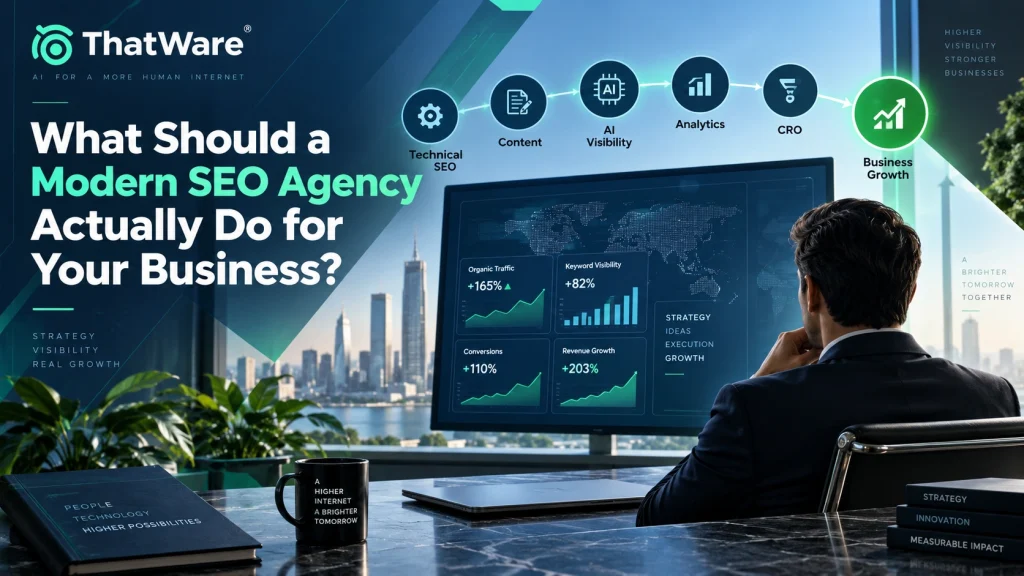
At ThatWare, we believe modern SEO should connect technical optimization, content intelligence, competitive analysis, AI visibility, entity strategy, user experience, data, and commercial growth.
The goal is no longer simply:
“Get this keyword to position one.”
The better question is:
“How can search help this business become more visible, more trusted, and more commercially competitive?”
What Is a Modern SEO Agency?
A modern SEO agency is a search-focused growth partner that combines traditional SEO with advanced analytics, AI search optimization, technical strategy, content intelligence, digital authority, and business-focused measurement.
Its responsibilities may include:
- Search strategy
- Technical SEO
- Keyword research
- Search intent analysis
- Content planning
- Digital PR
- Entity optimization
- AI visibility
- Conversion analysis
- Competitive intelligence
- Search analytics
- Market expansion
- Performance reporting
The main difference is mindset.
Traditional SEO may ask:
“What should we optimize?”
Modern SEO asks:
“What is changing in search, where is the opportunity, and what should the business do next?”
Quick Q&A
Q: Is modern SEO still mainly about Google rankings?
No. Google rankings remain important, but modern SEO also considers AI-generated answers, brand visibility, citations, entities, SERP features, conversion behavior, and the broader customer discovery journey.
Why the Traditional SEO Agency Model Is Becoming Outdated
A business may receive a monthly report showing:
- 50 keywords improved
- 10 backlinks acquired
- 4 blogs published
- Technical score increased
But none of those numbers automatically means the business grew.
The company may still have:
- Weak commercial traffic
- Poor conversion rates
- Low brand visibility
- Limited AI citations
- Unclear positioning
- Competitors gaining market share
This is why modern SEO services must connect activity with outcomes.
The focus should move from deliverables to impact.
“SEO should not be measured by how busy the agency looks. It should be measured by how much stronger the business becomes in search.”
1. Build a Business-Led SEO Strategy
The first responsibility of a strategic SEO agency should be understanding the business.
Before discussing keywords, the agency should understand:
- Revenue model
- Core products
- Customer segments
- Sales cycle
- Priority markets
- Competitors
- Margins
- Growth objectives
- Existing traffic
- Conversion paths
Why?
Because SEO priorities should follow business priorities.
A company may rank for thousands of informational keywords but generate very few qualified leads.
Another company may need only a handful of highly commercial keywords to create significant pipeline.
A strong SEO strategy agency should know the difference.
What a Good SEO Strategy Should Include
A strategic roadmap should define:
- Commercial keyword opportunities
- Content gaps
- Technical priorities
- Authority requirements
- Conversion opportunities
- AI visibility goals
- Competitor threats
- Measurement KPIs
This creates direction before execution.
2. Perform Technical SEO That Supports Growth
Technical SEO is still foundational.
A search optimization agency should ensure search engines can:
- Crawl
- Render
- Understand
- Index
- Rank
the right pages efficiently.
Important areas include:
- Crawlability
- Indexation
- Canonicals
- Redirects
- Internal linking
- JavaScript rendering
- Core Web Vitals
- Structured data
- XML sitemaps
- Mobile performance
- Duplicate content
For large sites, technical SEO should also include:
- Automation
- Log-file analysis
- Crawl prioritization
- Template-level fixes
- Programmatic QA
This becomes especially important for an enterprise SEO agency managing websites with thousands or millions of URLs.
3. Understand Search Intent, Not Just Keywords
Keyword volume alone does not explain what users want.
A modern agency should understand:
- Informational intent
- Commercial intent
- Transactional intent
- Comparison intent
- Navigational intent
- Problem-aware searches
- Solution-aware searches
For example:
“what is enterprise SEO”
and
“best enterprise SEO agency”
may relate to the same topic but represent very different stages of the buying journey.
A strong advanced SEO agency should map content around these stages rather than creating pages around isolated keywords.
4. Build Content Around Demand and Business Value
Modern SEO content should not exist merely to satisfy a publishing calendar.
Content should have a purpose.
It may need to:
- Capture search demand
- Educate buyers
- Build topical authority
- Support sales
- Earn citations
- Attract links
- Improve AI visibility
- Establish expertise
This is where a full service SEO agency should combine SEO research with content strategy.
Content Types a Modern SEO Program May Need
These may include:
- Commercial landing pages
- Service pages
- Buyer guides
- Comparisons
- Case studies
- Research
- Definitions
- FAQs
- Thought leadership
- Product pages
The content mix should depend on customer intent.
5. Optimize for AI Search
This is becoming one of the biggest changes in search.
Users increasingly ask AI systems questions such as:
- What is the best software for this problem?
- Which company offers this service?
- What are the best agencies in this category?
- How do these vendors compare?
An AI powered SEO agency should therefore understand how brands appear inside:
- ChatGPT
- Google AI Overviews
- Gemini
- Copilot
- Perplexity
- Claude
This includes monitoring:
- Brand mentions
- Citations
- Recommendations
- Competitor mentions
- Entity descriptions
- Source attribution
An AI driven SEO agency should also understand how to improve the probability that a brand is retrieved and cited.
This May Include
- Entity clarity
- Structured data
- Expert content
- Original research
- Strong third-party mentions
- Citation-worthy pages
- Consistent brand information
“The next generation of SEO is not only about being ranked. It is about being understood, retrieved, and recommended.”

6. Build Entity Authority
Search engines increasingly understand websites through entities and relationships.
A company should be clearly associated with:
- Its services
- Industries
- Experts
- Locations
- Products
- Topics
- Research
A next generation SEO agency should help strengthen these relationships.
This may involve:
- Organization schema
- Author schema
- Entity-rich content
- Knowledge consistency
- Internal linking
- Trusted external mentions
- Structured data
Entity clarity becomes especially important in AI-driven search environments.
7. Provide Competitive Intelligence
SEO should not happen in isolation.
A strong SEO growth agency should monitor:
- Competitor rankings
- Content velocity
- Link growth
- SERP ownership
- Featured snippets
- AI visibility
- Brand mentions
- New pages
- Market expansion
This helps businesses answer:
- Who is gaining?
- Why are they gaining?
- Where are we losing visibility?
- Which opportunities are being ignored?
Competitive intelligence turns SEO from reactive optimization into proactive strategy.
Mini Case Study 1: B2B Company With Traffic but Weak Leads
Imagine a B2B company receiving strong organic traffic but generating very few qualified enquiries.
A traditional agency might recommend more blogs.
A modern approach would analyze which queries drive traffic, identify gaps in commercial content, improve service pages, strengthen comparison content, refine calls to action, and align SEO with the sales journey.
The focus shifts from traffic volume to revenue potential.
8. Measure Revenue-Relevant SEO Metrics
Rankings are useful.
But they are not enough.
A modern agency should track:
- Organic sessions
- Commercial traffic
- Leads
- Qualified leads
- Revenue
- Conversion rate
- Assisted conversions
- Share of voice
- AI mentions
- AI citations
A good SEO consulting agency should help leadership understand how search contributes to business performance.
This makes SEO easier to evaluate and defend internally.
9. Improve Conversion, Not Just Visibility
Ranking number one is valuable only if the traffic has business value.
A modern agency should examine what happens after users arrive.
This includes:
- Page clarity
- Calls to action
- Trust signals
- Forms
- Page speed
- Content flow
- Mobile usability
- Lead friction
SEO and conversion optimization should work together.
This is particularly important for businesses investing heavily in commercial keywords.
10. Adapt When Search Changes
Search is constantly changing.
Algorithms evolve.
AI answers expand.
SERP layouts change.
New competitors appear.
User behavior shifts.
This is why businesses increasingly need adaptive SEO services.
An agency should monitor changes continuously and adjust strategy.
For example:
If AI Overviews begin reducing clicks for informational searches, the strategy may need to shift toward:
- Stronger commercial content
- Original data
- Brand authority
- Citation visibility
- Deeper funnel targeting
Adaptability is now part of SEO competence.
11. Integrate SEO With Wider Search Marketing
SEO does not exist alone.
A modern search marketing agency should understand how SEO interacts with:
- Paid search
- Digital PR
- Social
- Content
- Brand campaigns
- Video
- Reputation
For example:
Paid search may reveal high-converting terms.
SEO can target those organically.
Digital PR can strengthen authority.
Content can support both search and sales.
A coordinated approach improves efficiency.
12. Support International Growth
Modern SEO should also be able to scale.
Companies expanding globally may need:
- International keyword research
- Hreflang
- Country pages
- Localization
- Regional authority
- Multi-market reporting
An enterprise SEO agency should be capable of supporting this complexity.
The agency should not simply duplicate domestic strategy across new markets.
Each market should be researched independently.
13. Use Data to Prioritize What Matters
One of the biggest SEO problems is prioritization.
Websites may have:
- 500 technical issues
- 1,000 content opportunities
- 100 competitors
- Thousands of keywords
Not everything deserves immediate attention.
A capable advanced SEO agency should rank actions by:
- Impact
- Effort
- Revenue potential
- Strategic importance
- Risk
This ensures teams focus on the work most likely to produce meaningful results.
Quick Q&A
Q: Should an SEO agency fix every technical issue it finds?
Not necessarily. Some issues have minimal impact. A modern agency should prioritize fixes based on search impact, user experience, business value, and implementation effort.

14. Create Search Forecasts and Growth Models
SEO should become more predictable.
A SEO growth agency can use historical data, keyword opportunity, conversion rates, and market demand to create growth scenarios.
These might include:
- Conservative case
- Expected case
- Aggressive case
Forecasting will never be perfect.
But it helps businesses understand:
- Potential traffic
- Lead opportunity
- Content requirements
- Investment needs
- Time horizons
This makes SEO more useful in strategic planning.
15. Build Authority Through Digital PR
Links still matter.
But modern link building should focus on relevance and authority.
A strong full service SEO agency may use:
- Original research
- Expert commentary
- Data studies
- Surveys
- Industry reports
- Newsworthy insights
These assets can generate:
- Backlinks
- Brand mentions
- Referral traffic
- AI citations
- Entity authority
This is far stronger than low-quality link acquisition.
Mini Case Study 2: Brand Losing AI Visibility
Imagine a company ranking well on Google but rarely appearing in AI recommendations.
Analysis reveals competitors have stronger third-party mentions, clearer entity information, and more citation-worthy resources.
The SEO strategy expands to include original research, expert pages, structured data, digital PR, and AI visibility monitoring.
The goal becomes broader than ranking alone.
16. Provide Strategic Consulting
Some businesses need more than execution.
They need guidance.
A SEO consulting agency should help answer questions such as:
- Which market should we enter?
- Should we consolidate domains?
- Which pages should be prioritized?
- Should we invest in programmatic SEO?
- How should AI search affect content strategy?
- Which competitors present the biggest threat?
This makes the agency useful at leadership level.
17. Support Enterprise SEO Governance
Large companies need governance.
An enterprise SEO agency should help coordinate:
- Development teams
- Content teams
- Product teams
- Regional teams
- Brand teams
- Leadership
Without governance, SEO recommendations often fail during implementation.
The agency should create processes for:
- QA
- Prioritization
- Deployment
- Monitoring
- Reporting
18. Communicate Clearly
SEO can be technical.
But reporting should not be confusing.
A strong strategic SEO agency should explain:
- What happened
- Why it happened
- What it means
- What should happen next
Reports should not simply be collections of charts.
They should support decisions.
“The best SEO reporting does not leave the client asking, ‘So what?’ It makes the next action obvious.”
What Businesses Should Expect From Modern SEO Services
A comprehensive modern SEO services program may include several interconnected layers.
Strategy
- Business alignment
- Keyword strategy
- Search intent mapping
- Growth planning
Technical SEO
- Crawlability
- Indexation
- Rendering
- Structured data
- Performance
Content
- Content planning
- Optimization
- Commercial content
- Thought leadership
Authority
- Digital PR
- Backlinks
- Brand mentions
- Entity building
AI Search
- AI visibility monitoring
- Citation analysis
- Entity optimization
- Generative search readiness
Analytics
- Traffic
- Leads
- Revenue
- Share of voice
- Competitive trends
This is what separates basic SEO execution from a true growth system.
Red Flags When Choosing an SEO Agency
Businesses should be cautious if an agency:
- Guarantees rankings
- Focuses only on keyword counts
- Cannot explain search intent
- Ignores AI search
- Does not connect SEO to business outcomes
- Uses generic reporting
- Creates content without strategy
- Builds low-quality links
- Cannot explain technical priorities
- Does not monitor competitors
A modern SEO agency should provide transparency, strategic depth, and measurable accountability.
How ThatWare Approaches Modern SEO
At ThatWare, SEO is approached as a search intelligence and growth function.
Our capabilities can include:
- Advanced keyword research
- Technical SEO
- Search intent modeling
- Content strategy
- Competitive intelligence
- AI search optimization
- Entity engineering
- Digital PR
- Conversion analysis
- International SEO
- Enterprise SEO
- Search analytics
As an AI powered SEO agency, ThatWare combines traditional search optimization with emerging AI visibility frameworks.
Our approach as an AI driven SEO agency also considers how brands are interpreted, cited, and recommended across generative search systems.
For complex organizations, our work as an enterprise SEO agency can support large websites, multiple markets, technical governance, and large-scale optimization.
For businesses seeking strategic guidance, our SEO consulting agency approach can help translate search data into practical growth priorities.
The objective is simple:
Make SEO more useful to the business.
Beyond Rankings: How AVM and VEM Add Intelligence to Modern SEO
A modern SEO agency should not stop at measuring rankings, traffic, backlinks, and conversions. As search becomes increasingly influenced by AI systems, businesses also need to understand how their brand is represented inside machine-generated discovery.
This is where AVM and VEM can add an important intelligence layer to a modern SEO program.
Traditional SEO primarily evaluates what happens on search engine results pages. AI-driven search introduces another question:
What happens when the search result is no longer a list of links, but an AI-generated response?
A user may ask ChatGPT, Gemini, Perplexity, Google AI Overviews, or another answer engine for a recommendation. The system may summarize information from multiple sources, identify relevant companies, compare alternatives, and present a shortlist without requiring the user to visit ten different websites.
For an SEO agency, this changes what should be measured and optimized.
AVM: Measuring the Brand’s Presence in AI Discovery
AVM, or AI Visibility Metric, provides a framework for understanding how a brand appears across AI-powered search and answer environments.
Instead of looking only at whether a webpage ranks for a keyword, AVM examines whether the brand itself becomes visible when relevant questions are asked to AI systems.
For example, an enterprise software company may rank strongly for several Google searches. But when potential customers ask AI:
- Which enterprise software providers should I consider?
- What companies offer this type of solution?
- Which vendors serve large organizations?
- What are the leading platforms in this category?
- How do these providers compare?
the company may or may not appear.
A modern SEO agency should be able to identify that difference.
AVM can be used to examine areas such as:
- Brand mentions
- AI recommendations
- Citation presence
- Prompt coverage
- Competitor visibility
- Brand representation
- Source attribution
- Visibility across different AI platforms
This makes AI visibility measurable rather than treating it as an abstract concept.
It also changes the agency’s reporting model.
Instead of reporting only:
“Your rankings improved.”
the agency can investigate:
“Where is your brand appearing in AI discovery, where is it absent, what sources are influencing the response, and how does competitor visibility compare?”
That provides a much broader understanding of search performance.
VEM: Strengthening the Brand’s Digital Identity
AVM tells an agency about visibility.
But visibility depends partly on whether AI systems can clearly understand the business in the first place.
This is where VEM, or Vector Entity Modelling, becomes relevant.
VEM focuses on the relationships and context surrounding a brand as an entity.
A modern SEO agency should not think of a business simply as a website containing pages and keywords. It should also understand the business through its relationships:
Company → services
Company → industries
Company → locations
Company → experts
Company → products
Company → topics
Company → research
Company → external references
These connections help create a more coherent digital representation of the organization.
For example, imagine a technology company describes itself as an AI company on its website, a software provider on business directories, a consulting company in press coverage, and an IT services company on social profiles.
The information is not necessarily false. But it may create an inconsistent picture of the entity.
A modern SEO agency should identify such inconsistencies and work toward greater clarity through content, internal linking, structured data, author information, external references, digital PR, and consistent brand descriptions.
Why Modern SEO Agencies Need Both
AVM and VEM address two different but connected agency responsibilities.
VEM helps answer: “Is the business clearly understood?”
AVM helps answer: “Is that business actually visible in AI discovery?”
This distinction is important because a visibility problem is not always a content problem.
A business may have excellent content but weak entity clarity.
Another business may have strong entity recognition but limited visibility for commercially important prompts.
A third may appear frequently in AI responses but be described incorrectly.
A modern SEO agency needs to distinguish between these situations rather than applying the same SEO solution to all of them.
Turning AVM and VEM Into Agency-Level SEO Intelligence
The real value comes when these frameworks become part of an ongoing SEO process rather than a one-time audit.
An agency can begin by establishing an AI visibility baseline.
It can identify important commercial and informational prompts, test how the brand and competitors appear, examine cited sources, and identify areas where the brand is missing or inaccurately represented.
VEM can then help investigate the underlying entity structure.
The agency can examine:
- How consistently the company is described
- Whether services are clearly connected to the brand
- Whether important expertise is properly represented
- Whether experts and founders have clear profiles
- Whether structured data supports the same information
- Whether external sources corroborate the company’s positioning
- Whether content creates strong relationships between the brand and its core topics
The resulting insights can feed back into the wider SEO strategy.
That could mean improving a service page, publishing original research, strengthening an expert profile, developing a comparison resource, improving structured data, earning relevant third-party mentions, or creating content around an important knowledge gap.
This is where SEO becomes genuinely adaptive.
From SEO Reporting to Search Intelligence
The significance of AVM and VEM for a modern SEO agency is therefore larger than two additional metrics.
They encourage a change in how agencies think about search.
The old model was largely:
Keywords → Rankings → Traffic
The broader model is:
Entities → Understanding → Retrieval → Visibility → Trust → Action
This does not make traditional SEO less important. Technical SEO, content quality, authority, internal linking, site architecture, and search intent remain fundamental.
Instead, AVM and VEM extend those foundations into an environment where AI systems increasingly participate in discovery.
For businesses, that means their SEO agency should be capable of answering questions beyond:
“Where do we rank?”
It should also be able to investigate:
“How does AI understand our business?”
“Where does AI mention us?”
“Which sources influence our representation?”
“Which competitors are appearing instead?”
“Are we being represented accurately?”
“What can we improve to strengthen both understanding and visibility?”
That is the intelligence layer modern SEO increasingly needs.
A capable SEO agency does not simply optimize webpages for search engines. It helps build a digital presence that is technically accessible, contextually clear, externally supported, commercially relevant, and increasingly visible across both traditional and AI-driven discovery systems.
Final Thoughts
SEO agencies should no longer be judged simply by how many keywords they track, backlinks they build, or blogs they publish.
Search has become too complex for that model.
A modern SEO agency should help businesses understand demand, competitors, technology, content, AI systems, customer intent, and commercial opportunity.
A strong search optimization agency should make websites easier to discover.
A strong SEO strategy agency should make priorities clearer.
A strong AI driven SEO agency should prepare brands for generative discovery.
A strong SEO growth agency should connect visibility with measurable business outcomes.
And a true next generation SEO agency should bring all of those capabilities together.
ThatWare combines search intelligence, technical SEO, content strategy, AI visibility, entity optimization, competitive analysis, digital PR, analytics, and enterprise search expertise into one integrated approach.
Because modern SEO should do more than improve rankings.
It should help the business understand search better, compete more intelligently, and grow more sustainably.