SUPERCHARGE YOUR ONLINE VISIBILITY! CONTACT US AND LET’S ACHIEVE EXCELLENCE TOGETHER!
Choosing an SEO partner used to be relatively straightforward.
Businesses looked at rankings, backlinks, content output, technical audits, and monthly reports. Those factors still matter, but the search environment has changed significantly.
Today, customers do not discover businesses only through Google’s traditional organic results.
They also use:
- Google AI Overviews
- ChatGPT
- Gemini
- Copilot
- Perplexity
- Claude
- Voice assistants
- Conversational search tools
This creates a new challenge for companies trying to understand how to choose an SEO agency.
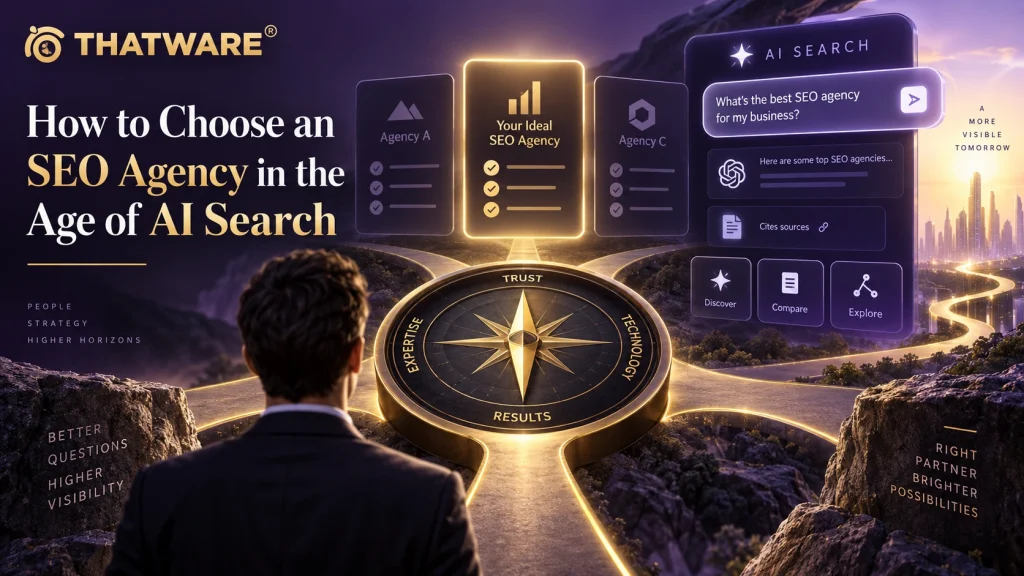
The right agency now needs to do more than improve rankings.
It should understand how brands are discovered, interpreted, cited, compared, and recommended across both search engines and AI-powered platforms.
That means businesses need to evaluate SEO agencies differently.
The question is no longer simply:
“Can this agency rank our website?”
The better question is:
“Can this agency help us remain visible as search itself changes?”
At ThatWare, we believe businesses should look for a partner that combines strong SEO fundamentals with AI search intelligence, entity optimization, AEO, GEO, content strategy, technical expertise, and measurable commercial outcomes.
Why Choosing an SEO Agency Has Become More Complex
A decade ago, search strategy was mostly centered around:
- Ranking keywords
- Earning backlinks
- Publishing content
- Fixing technical issues
Those areas remain essential.
However, a modern search strategy must also consider:
- AI-generated answers
- Citation visibility
- Entity recognition
- Brand mentions
- Conversational queries
- Machine-readable information
- Generative recommendation systems
This changes what businesses should expect from an advanced SEO agency.
A company may rank well on Google and still be absent from AI-generated recommendations.
Another may have strong traffic but poor visibility for high-intent commercial queries.
A third may appear in search but fail to establish enough brand authority to become a trusted AI citation.
Choosing an agency today therefore requires evaluating both traditional SEO capability and AI-search readiness.
Quick Q&A
Q: Is traditional SEO still important in the age of AI search?
Yes. Technical SEO, content quality, authority, crawlability, and search intent still matter. AI search adds new visibility layers, but it does not remove the need for strong SEO foundations.
1. Start by Defining What You Actually Need
Before you choose SEO agency partners, clarify the business objective.
Different companies need different types of support.
You may need traffic growth
If the main goal is increasing organic sessions, the agency should understand:
- Keyword opportunities
- Content gaps
- Technical SEO
- Competitor analysis
You may need lead generation
If the goal is pipeline growth, the focus should include:
- Commercial keywords
- Service pages
- Conversion paths
- Buyer intent
- Lead attribution
You may need AI visibility
If competitors are appearing in ChatGPT, Gemini, or AI Overviews, you may need an SEO agency for AI search.
You may need enterprise scale
Large organizations may require an enterprise SEO agency that can work across:
- Thousands of pages
- Multiple business units
- Several markets
- Complex CMS environments
- Large stakeholder groups
Choosing the right partner starts with choosing the right problem to solve.
2. Look Beyond Rankings
Many agencies still lead with ranking promises.
That is not enough.
The best SEO agency should track rankings, but it should also understand how rankings contribute to:
- Qualified traffic
- Leads
- Revenue
- Pipeline
- Brand visibility
- AI citations
- Market share
A keyword moving from position nine to position four looks positive.
But if it has no commercial value, the business impact may be negligible.
A strong SEO agency for business growth should prioritize outcomes, not vanity metrics.
“Good SEO improves rankings. Strategic SEO improves the business.”
3. Check Whether the Agency Is AI-Ready
AI search is now too important to ignore.
An AI ready SEO agency should understand how businesses appear across generative platforms.
Ask whether they monitor:
- AI brand mentions
- AI citations
- Competitor recommendations
- Entity descriptions
- Source attribution
- Generative search visibility
A credible AI SEO agency should also understand that AI search optimization is not simply about producing content with AI.
That distinction matters.
Using AI tools does not automatically make an agency AI-ready.
A real AI-search strategy should address:
- Content retrieval
- Entity understanding
- Citationworthiness
- Structured information
- Third-party trust signals
- Knowledge consistency
4. Ask About AEO
Answer Engine Optimization focuses on increasing visibility in direct-answer environments.
An AEO agency may optimize:
- FAQs
- Definition content
- Question-led sections
- Structured answers
- Featured snippets
- Conversational queries
AEO matters because users increasingly expect direct answers.
The agency should understand how to structure content so both users and machines can identify the answer quickly.
Quick Q&A
Q: Is AEO just FAQ optimization?
No. FAQs can support AEO, but the broader goal is to make content clear, authoritative, structured, and suitable for direct-answer retrieval.
5. Ask About GEO
Generative Engine Optimization focuses on improving visibility in AI-generated responses.
A GEO agency should understand:
- Citation sources
- Brand mentions
- Entity signals
- Content authority
- AI recommendation patterns
- Generative search queries
A business may rank organically but still fail to appear in AI answers.
GEO addresses that gap.
This is one of the biggest differences between choosing a traditional agency and choosing a future ready SEO agency.
6. Evaluate LLM Search Expertise
Large language models process information differently from conventional search engines.
An LLM SEO agency should understand how to improve the likelihood that brand information is:
- Understood
- Retrieved
- Cited
- Represented accurately
This may involve:
- Clear entity relationships
- Consistent brand information
- Structured content
- Strong source authority
- Original research
- Expert-led content
The objective is not to “rank” inside an LLM the same way you rank in Google.
It is to strengthen machine confidence in the brand.
7. Review Technical SEO Capabilities
AI search does not eliminate technical SEO.
Technical issues can still damage visibility.
A strong AI search optimization agency should also understand:
- Crawlability
- Indexability
- JavaScript rendering
- Canonicalization
- Structured data
- Internal linking
- Site architecture
- Page performance
- XML sitemaps
- Mobile optimization
For large websites, the agency should be able to prioritize issues based on impact rather than sending a generic checklist.
8. Evaluate Their Content Strategy
A modern SEO agency should not publish content simply to meet a monthly quota.
Ask:
- How do you choose topics?
- How do you prioritize search intent?
- How do you avoid generic AI-written content?
- How do you create citation-worthy assets?
- How do you connect content with buyer journeys?
The best SEO company should understand that content quality now matters more than content volume.
As AI makes basic content easier to produce, differentiation becomes more important.
Content should increasingly include:
- Original insights
- Expert commentary
- Research
- Data
- Comparisons
- Practical frameworks
- First-hand knowledge
“When everyone can create content faster, originality becomes more valuable.”
9. Assess Search Intent Expertise
Keyword research alone is no longer enough.
An agency should understand why someone searches.
Important intent categories include:
- Informational
- Commercial
- Transactional
- Comparison
- Navigational
- Problem-aware
- Solution-aware
For example:
“what is AI SEO”
has a very different business value from:
“best AI SEO agency”
The best SEO agency should map content around intent and customer stage rather than only keyword volume.
10. Ask How They Analyze Competitors
A strong agency should examine several competitor types.
Business Competitors
Companies selling similar products or services.
Search Competitors
Websites competing for the same keywords.
Content Competitors
Publishers dominating informational SERPs.
AI Search Competitors
Brands frequently mentioned by AI systems.
An advanced SEO agency should analyze all four.
This helps reveal where competitors are gaining visibility and where new opportunities exist.
Mini Case Study 1: Strong Google Rankings, Weak AI Visibility
Imagine a B2B company ranking on page one for several important commercial terms.
However, when prospects ask AI platforms for recommended providers, the company rarely appears.
A deeper audit reveals that competitors have stronger third-party mentions, clearer entity profiles, and more authoritative comparison content.
The strategy expands beyond rankings to include digital PR, expert content, structured data, and AI citation monitoring.
The lesson is simple:
Traditional rankings alone no longer show the full search picture.
11. Check Their Entity Optimization Capabilities
AI systems need to understand who your company is.
A strong AI SEO agency should help clarify:
- Brand identity
- Services
- Products
- Locations
- Industries
- Leadership
- Expertise
- Relationships
Entity consistency should extend across:
- Website
- Schema
- Social profiles
- Business listings
- Media coverage
- Third-party references
If these signals conflict, machines may struggle to interpret the brand accurately.
12. Ask About Digital PR and Authority
Backlinks still matter.
But authority now extends beyond backlinks.
A strong SEO strategy may include:
- Media mentions
- Expert commentary
- Original research
- Industry references
- Thought leadership
- Trusted citations
This helps strengthen:
- Traditional rankings
- Brand authority
- Entity recognition
- AI citation potential
A capable SEO consulting company should be able to explain how authority supports both organic and AI visibility.
13. Evaluate Their Reporting
A monthly spreadsheet filled with keyword positions is no longer enough.
A modern report should answer:
- What improved?
- What declined?
- Why did it happen?
- Which competitors changed?
- What is the business impact?
- What should happen next?
Useful KPIs may include:
- Rankings
- Organic traffic
- Commercial traffic
- Leads
- Revenue
- Share of voice
- AI mentions
- AI citations
- Conversion rates
A strong SEO agency for business growth should connect SEO activity directly with measurable outcomes.
14. Check Whether They Can Adapt
Search changes constantly.
Algorithms change.
AI platforms evolve.
New SERP features appear.
Competitors publish new content.
Customer search behavior shifts.
This means an AI ready SEO agency should not rely on a fixed annual strategy.
It should monitor changes and adjust priorities.
Adaptability is one of the most important signs of a future ready SEO agency.
15. Understand Their SEO Consulting Capability
Not every business needs another execution vendor.
Some need strategic guidance.
A strong SEO consulting company should help answer questions such as:
- Which market should we prioritize?
- Which content should we consolidate?
- Should we redesign our architecture?
- How should we respond to AI search?
- Which competitors are gaining?
- Where is the highest commercial opportunity?
This is particularly important for companies with in-house SEO teams.
The agency should add expertise, not duplicate internal work.
16. Review Enterprise Experience
Large organizations face different challenges.
An enterprise SEO agency should understand:
- Large-scale crawling
- Complex site structures
- International SEO
- Multiple CMS platforms
- Governance
- Development workflows
- Automation
- Large keyword portfolios
Enterprise SEO is often less about fixing individual pages and more about changing systems.
Ask the agency how it prioritizes recommendations when implementation requires multiple departments.
Mini Case Study 2: Enterprise Site With Too Many SEO Priorities
Imagine a large website with thousands of technical issues and hundreds of content opportunities.
A basic agency may create a huge audit.
A better enterprise partner ranks each issue by business impact, technical risk, implementation effort, and search opportunity.
The result is a focused roadmap rather than an overwhelming checklist.
17. Ask How They Use AI Internally
AI can make agency workflows faster.
An advanced SEO agency may use AI for:
- Keyword clustering
- SERP analysis
- Content gap detection
- Intent classification
- Large-scale audits
- Internal linking analysis
- Competitor monitoring
But human oversight is essential.
Ask how the agency validates:
- Accuracy
- Recommendations
- Content quality
- Data interpretation
An agency that simply automates everything may create more output but less strategic value.
18. Look for Transparency
You should understand what the agency is doing and why.
Red flags include:
- Guaranteed rankings
- Secretive link-building
- Generic monthly deliverables
- No technical roadmap
- No business KPIs
- No AI search strategy
- No explanation of methodology
A credible agency should be able to explain its approach clearly.
“If an SEO strategy cannot be explained clearly, it becomes difficult to evaluate, improve, or trust.”
19. Ask Whether They Can Support International Growth
If your business plans to expand, choose an agency that can scale with you.
International SEO may require:
- Hreflang
- Country targeting
- Localization
- Regional keyword research
- Market-specific competitors
- Multi-country reporting
An enterprise SEO agency or advanced international partner should be able to handle these complexities without weakening existing visibility.
20. Compare Strategy Before Price
SEO pricing matters.
But price alone should not determine the decision.
A cheaper agency that creates irrelevant traffic can cost more in the long run.
A more strategic partner may:
- Reduce wasted content
- Prioritize profitable keywords
- Identify technical risks sooner
- Improve conversion
- Protect existing visibility
- Help build AI authority
When evaluating the best SEO company, compare the quality of thinking as much as the list of deliverables.
A Practical Checklist for Choosing an SEO Agency
Before hiring, evaluate the agency across these areas.
Strategy
Look for:
- Business alignment
- Market understanding
- Commercial prioritization
Technical SEO
Look for:
- Crawlability
- Indexation
- Structured data
- Site architecture
Content
Look for:
- Intent mapping
- Originality
- Expert input
- Citation-worthiness
AI Search
Look for:
- AEO
- GEO
- AI visibility monitoring
- LLM search understanding
Authority
Look for:
- Digital PR
- Brand mentions
- Strong backlinks
- Entity signals
Reporting
Look for:
- Business KPIs
- Actionable insights
- Transparent communication
The right combination is more important than any one tactic.
Questions to Ask Before You Choose an SEO Agency
Q1. How do you connect SEO to revenue?
The answer should go beyond traffic.
Q2. How do you measure AI search visibility?
Look for mentions, citations, recommendations, and competitor comparisons.
Q3. How do you approach AEO and GEO?
The agency should explain the difference clearly.
Q4. How do you prioritize technical SEO issues?
Strong agencies prioritize impact rather than fixing everything equally.
Q5. How do you create content that stands out?
Look for originality, research, expertise, and clear intent.
Q6. How do you monitor competitors?
The process should include traditional search and AI visibility.
Q7. How do you adapt when search changes?
The answer should involve continuous monitoring and strategic adjustment.
How ThatWare Approaches SEO in the Age of AI Search
At ThatWare, we approach search as a connected visibility ecosystem.
Our work may include:
- Technical SEO
- Keyword intelligence
- Search intent analysis
- Content strategy
- AI visibility monitoring
- Entity optimization
- AEO
- GEO
- LLM SEO
- Digital PR
- Competitive intelligence
- Conversion analysis
- Enterprise SEO
As an AI SEO agency, ThatWare combines traditional search fundamentals with newer AI discovery frameworks.
Our work as an AI search optimization agency focuses on helping brands improve visibility across both search engines and generative platforms.
As an AEO agency, we help structure content for direct-answer environments.
As a GEO agency, we focus on visibility and citation opportunities in generative search.
As an LLM SEO agency, we consider how brand information is interpreted, retrieved, and represented by language models.
And for large organizations, our enterprise SEO agency capabilities support technical scale, governance, international SEO, and search intelligence.
The objective is not to chase every new search trend.
It is to build a search strategy that remains useful as discovery evolves.
Final Thoughts
Knowing how to choose an SEO agency has become more important because the definition of search visibility is changing.
Rankings still matter.
Traffic still matters.
Technical SEO still matters.
But brands now also need to think about how they appear inside AI-generated answers, recommendations, comparisons, and summaries.
That means the ideal partner should combine:
- Traditional SEO expertise
- AI search knowledge
- AEO
- GEO
- LLM visibility
- Entity optimization
- Search intelligence
- Commercial strategy
The best SEO company should not merely react to changes in search.
It should help your business prepare for them.
Whether you need an SEO agency for AI search, SEO consulting company, AI search optimization agency, or SEO agency for business growth, the principle is the same:
Choose a partner that understands where search is going, not only where it has been.
ThatWare combines advanced SEO, AI visibility, AEO, GEO, LLM search optimization, technical intelligence, entity strategy, digital authority, and enterprise search expertise to help brands compete across the evolving search ecosystem.
Because in the age of AI search, choosing an SEO agency is no longer just about improving rankings.
It is about choosing who helps shape how your business gets discovered.