SUPERCHARGE YOUR ONLINE VISIBILITY! CONTACT US AND LET’S ACHIEVE EXCELLENCE TOGETHER!
SEO used to feel more predictable.
Businesses could build a keyword list, publish content, improve backlinks, fix technical issues, and follow a relatively stable optimization plan.
That model is becoming less reliable.
Search algorithms change more frequently.
AI-generated answers influence discovery.
User behavior shifts.
Competitors publish faster.
SERP layouts evolve.
New content formats gain visibility.
Search demand can change within weeks.
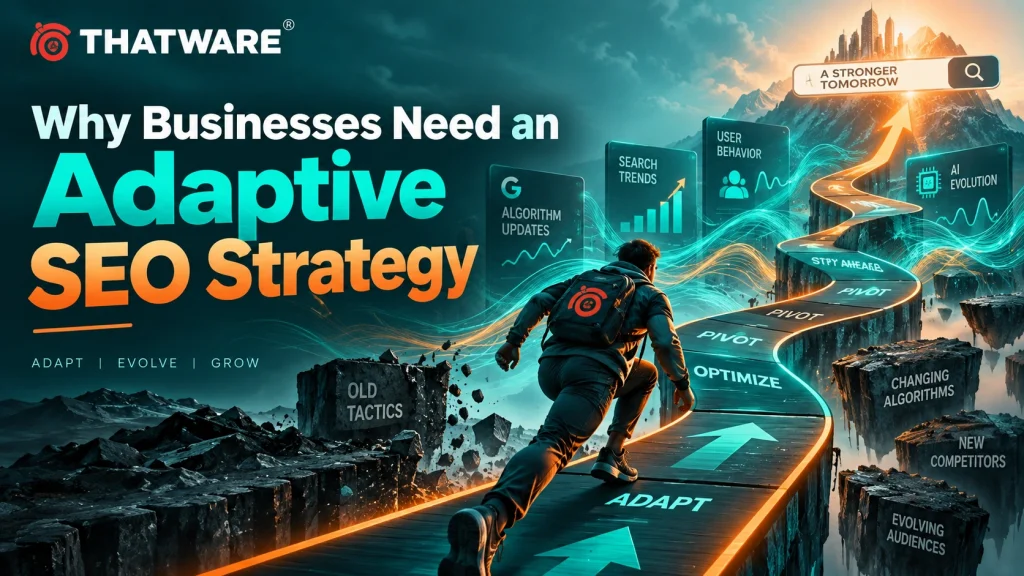
This means businesses can no longer treat SEO as a static annual checklist.
They need an adaptive SEO strategy.
An adaptive strategy continuously analyzes performance, competitors, algorithms, user behavior, AI search patterns, technical signals, and commercial opportunities, then adjusts priorities accordingly.
The goal is not to change direction every week.
The goal is to recognize meaningful change early enough to respond intelligently.
At ThatWare, we view adaptive SEO as a continuous search intelligence system.
Instead of asking:
“What SEO tasks should we complete this quarter?”
A stronger question is:
“What has changed in search, what does it mean for our business, and what should we do next?”
What Is an Adaptive SEO Strategy?
An adaptive SEO strategy is a flexible approach to search optimization that changes based on new data, algorithm updates, competitive movements, user behavior, AI search developments, and business priorities.
Traditional SEO planning may follow a fixed roadmap.
Adaptive SEO still uses a roadmap, but the roadmap is regularly reassessed.
This allows teams to respond when:
- Rankings suddenly decline
- New competitors gain visibility
- Search intent changes
- AI Overviews expand
- Commercial keywords emerge
- Content begins underperforming
- Technical problems appear
- User behavior shifts
- New market opportunities develop
Strong adaptive SEO services combine continuous monitoring with strategic decision-making.
Quick Q&A
Q: Does adaptive SEO mean constantly changing the strategy?
No. It means keeping the core business objective stable while adjusting tactics and priorities when meaningful changes occur.
Why Static SEO Strategies Are Becoming Riskier
A static SEO plan assumes that the search environment will remain relatively stable.
That assumption is increasingly dangerous.
A strategy created in January may become less effective by June because:
- Google changes ranking systems
- Competitors publish stronger content
- AI answers reduce click-through rates
- Search intent shifts
- New queries gain demand
- Users adopt new discovery platforms
A dynamic SEO strategy is designed to recognize these changes.
It does not abandon long-term planning.
It makes long-term planning more resilient.
“The strongest SEO strategy is not the one that never changes. It is the one that knows when change is necessary.”
1. Search Algorithms Constantly Evolve
Search engines continuously refine how they evaluate:
- Relevance
- Authority
- User experience
- Content quality
- Spam
- Helpful information
- Site performance
This means yesterday’s optimization priorities may not have the same impact tomorrow.
An advanced SEO strategy should therefore include:
- Algorithm monitoring
- Ranking volatility analysis
- Page-level diagnosis
- Competitor movement analysis
- Content quality reviews
The objective is not to panic after every update.
It is to identify whether the update materially affects your website.
2. AI Search Is Changing Discovery
Search increasingly extends beyond traditional blue links.
Users now discover brands through:
- AI Overviews
- ChatGPT
- Gemini
- Copilot
- Perplexity
- Claude
This changes visibility.
A page may rank well but receive fewer clicks because AI systems answer the query directly.
Another brand may gain visibility because it is frequently cited in AI responses.
An AI driven SEO strategy should therefore monitor:
- AI brand mentions
- Citations
- Competitor recommendations
- Entity visibility
- Source attribution
This is increasingly important for businesses that depend on search for customer acquisition.
3. Search Intent Can Change
Search intent is not permanent.
A keyword may originally generate informational results.
Later, Google may begin showing:
- Product pages
- Service pages
- Comparisons
- Videos
- Forums
That signals a shift.
A strong SEO strategy agency should monitor SERP composition rather than assuming intent remains unchanged.
For example:
A guide ranking well for a commercial query may suddenly decline because Google begins favoring service pages.
The correct response may not be “optimize the article more.”
It may be “create the right page for the new intent.”
4. Competitors Do Not Stand Still
SEO competition is dynamic.
Competitors may:
- Publish new content
- Build stronger backlinks
- Improve technical SEO
- Launch new tools
- Expand into new markets
- Gain AI citations
A strong SEO growth strategy should include continuous competitive intelligence.
Monitor:
- Ranking changes
- New pages
- Content velocity
- Link acquisition
- SERP ownership
- AI visibility
- Brand demand
This helps businesses identify threats before they become major losses.
Mini Case Study 1: Competitor Overtakes a Content Cluster
Imagine a B2B company that dominates several high-value topics.
Over six months, a competitor publishes deeper comparison guides, builds more relevant backlinks, and improves internal linking.
Rankings slowly decline.
An adaptive strategy detects the pattern early and responds with content refreshes, stronger internal linking, expert input, and digital PR.
The company protects visibility before the decline becomes severe.
5. Search Data Should Influence Priorities
SEO teams often have too many possible tasks.
There may be:
- Hundreds of technical issues
- Thousands of keywords
- Dozens of content gaps
- Many competing recommendations
This is where data driven SEO services become valuable.
The best strategy prioritizes based on:
- Revenue potential
- Search demand
- Ranking opportunity
- Technical impact
- Conversion value
- Implementation effort
This creates a more efficient roadmap.
6. Content Needs Continuous Evaluation
Publishing content is not the end of SEO.
Content can become:
- Outdated
- Less relevant
- Too shallow
- Misaligned with search intent
- Weaker than competitors
An adaptive program regularly reviews content performance.
It may decide to:
- Refresh
- Expand
- Consolidate
- Redirect
- Remove
- Reposition
This is a key part of SEO strategy services.
The objective is not simply to create more content.
It is to maintain the strongest possible content portfolio.
Quick Q&A
Q: How often should SEO content be reviewed?
There is no universal schedule. High-value commercial and fast-changing topics should be reviewed more frequently than evergreen content.
7. Technical SEO Requires Ongoing Monitoring
Websites change constantly.
Developers release updates.
New templates appear.
Plugins change.
Pages move.
Redirects accumulate.
Technical SEO therefore cannot be treated as a one-time project.
Adaptive technical monitoring may include:
- Crawl errors
- Indexing changes
- Canonical issues
- Rendering problems
- Core Web Vitals
- Structured data
- Internal linking
For large websites, algorithmic SEO services can help automate detection and prioritization.
8. AI Can Improve SEO Decision-Making
AI is useful for more than content generation.
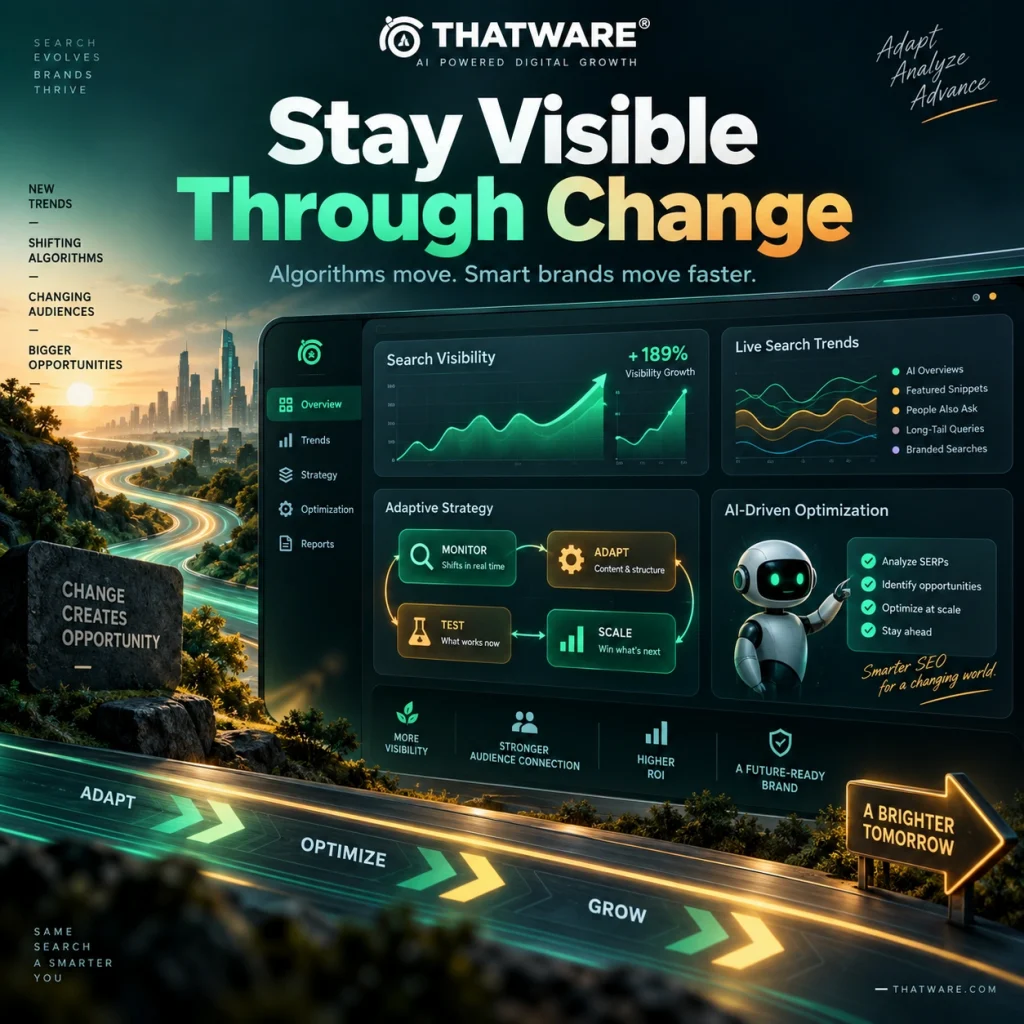
An AI SEO strategy can use machine-assisted analysis for:
- Keyword clustering
- Intent classification
- Competitor monitoring
- Anomaly detection
- Content gaps
- Technical prioritization
- Internal linking
This allows teams to process larger datasets faster.
Human judgment still matters.
AI identifies patterns.
Strategists decide what those patterns mean.
“AI should accelerate SEO thinking, not replace it.”
9. Business Priorities Change
SEO strategy should also adapt when the business changes.
A company may:
- Launch a new product
- Enter a new country
- Change pricing
- Target a new industry
- Reposition its brand
SEO must respond.
This is why search strategy consulting should be aligned closely with leadership and commercial teams.
SEO priorities should follow business priorities.
10. Enterprise SEO Needs Even More Adaptability
Large organizations face additional complexity.
An enterprise SEO strategy may involve:
- Multiple domains
- Thousands of pages
- International markets
- Several teams
- Complex technology
Changes in one area can affect many others.
An adaptive enterprise framework should include:
- Governance
- Automation
- Monitoring
- Prioritization
- Cross-team workflows
This helps large companies react without creating chaos.
11. Adaptive SEO Improves Risk Management
SEO risk can come from:
- Algorithm updates
- Migrations
- Content changes
- Technical releases
- Competitors
- Spam attacks
Adaptive SEO focuses on early detection.
The sooner a problem is identified, the easier it is to respond.
For example:
A sudden ranking decline may come from:
- Indexing
- Technical changes
- Intent shifts
- Algorithm impact
Fast diagnosis can reduce long-term damage.
12. Adaptive SEO Improves Opportunity Detection
The same monitoring systems used for risk can also reveal growth opportunities.
Examples include:
- Emerging keywords
- Competitor weaknesses
- New SERP features
- AI citation gaps
- New markets
- Rising topics
A strong advanced SEO strategy is therefore not only defensive.
It is opportunity-driven.
Mini Case Study 2: Emerging Search Demand
Imagine a technology company monitoring industry queries.
A new category begins gaining search volume before competitors create dedicated content.
The company responds quickly with expert guides, commercial landing pages, and original research.
Because it acts early, it builds authority before the market becomes crowded.
13. SEO Transformation Requires More Than Small Fixes
Some businesses do not need incremental improvements.
They need a broader transformation.
SEO transformation services may involve:
- Restructuring site architecture
- Rebuilding content systems
- Changing reporting
- Introducing AI search monitoring
- Improving governance
- Redefining KPIs
This is common when companies have outgrown traditional SEO workflows.
14. Adaptive SEO Should Be Tied to Commercial Outcomes
Traffic growth is useful.
But commercial outcomes matter more.
A strong SEO consulting services program should track:
- Leads
- Revenue
- Qualified traffic
- Conversions
- Pipeline
- Customer acquisition
This helps teams decide where SEO investment creates the most value.
15. SEO Forecasting Should Be Updated Continuously
Forecasts should not be created once and forgotten.
Traffic expectations may change because:
- Rankings move
- Demand changes
- Conversion rates improve
- SERP features shift
An adaptive forecast can be updated quarterly or after major changes.
This creates more realistic expectations.
16. Search Strategy Should Become a Feedback Loop
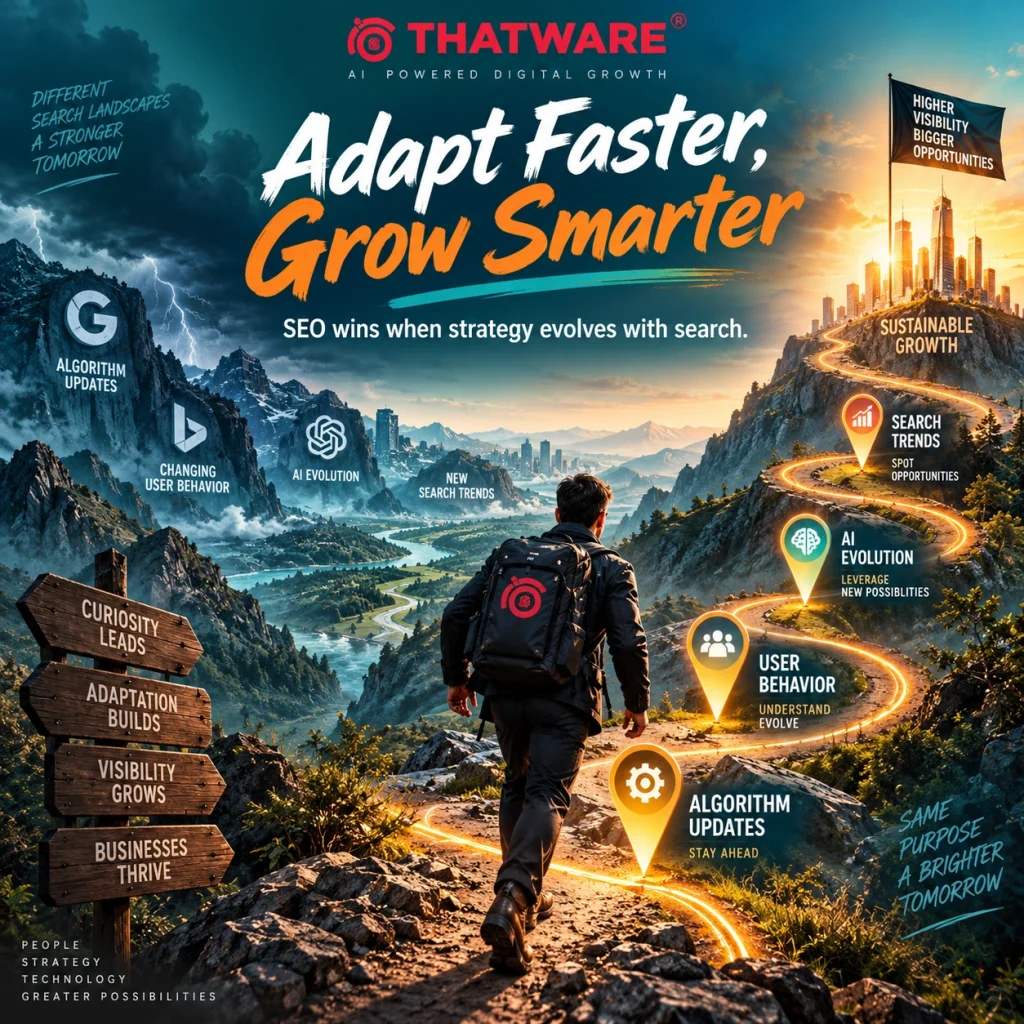
A strong adaptive SEO process can follow five stages.
Monitor
Track rankings, traffic, competitors, AI visibility, and technical health.
Analyze
Understand why changes occurred.
Prioritize
Choose actions based on business impact.
Execute
Implement technical, content, and authority improvements.
Measure
Evaluate outcomes and update the strategy.
This creates a continuous learning cycle.
17. Adaptive SEO Helps Protect Existing Growth
Many businesses focus only on gaining new traffic.
Protecting existing performance is equally important.
Identify pages that generate:
- Revenue
- Leads
- Backlinks
- Rankings
- AI citations
These assets should be monitored carefully.
A SEO strategy agency should prioritize defensive SEO alongside growth.
18. Adaptive SEO Works Better Across Multiple Channels
Search is increasingly connected to:
- Digital PR
- Paid search
- Social
- Video
- Content
- Brand
A dynamic SEO strategy can learn from these channels.
For example:
Paid search may reveal converting keywords.
PR may generate authority.
Social may reveal emerging questions.
SEO can use these signals.
19. Algorithmic SEO Helps Scale Monitoring
Large websites generate too much data for manual analysis.
Algorithmic SEO services can help identify:
- Ranking anomalies
- Crawl changes
- Content decay
- Cannibalization
- Internal linking gaps
This allows human teams to focus on the highest-impact issues.
20. Adaptive SEO Creates Long-Term Resilience
The biggest advantage of an adaptive SEO strategy is resilience.
No agency can predict every algorithm update.
No company can control competitor behavior.
No marketer can know exactly how AI search will evolve.
But businesses can build systems that:
- Monitor
- Learn
- Respond
That is what makes adaptive SEO sustainable.
The Adaptive Intelligence Layer: Using AVM and VEM to Respond to Search Change
Adaptive SEO becomes more powerful when businesses monitor not only traditional search performance, but also how AI systems interpret, retrieve, and represent a business.
This is where AI Visibility Metric (AVM) and Vector Entity Modelling (VEM) can become valuable parts of an adaptive SEO framework.
Traditional SEO monitoring may show that a page has dropped from position 3 to position 9. That is useful, but it does not always explain what has changed in the wider search environment. A business can maintain strong rankings while becoming less visible in AI-generated answers, losing citations, or being replaced by competitors in conversational discovery.
AVM and VEM add another layer of intelligence.
AVM as an Early-Warning Signal
AI Visibility Metric (AVM) provides a structured way to monitor how consistently a brand appears across AI-powered search and answer environments.
Instead of treating AI visibility as a one-time audit, adaptive SEO can monitor it continuously.
Businesses can regularly evaluate questions such as:
- Which AI platforms mention our brand?
- Which competitors appear instead?
- Are our products and services represented accurately?
- Which sources influence AI-generated answers?
- Are we visible for topics where we have genuine expertise?
- Are important commercial questions producing no brand visibility?
The value comes from tracking these signals over time.
For example, a company may rank strongly for a particular service but notice that competitors are increasingly recommended for related questions in AI-generated results. Traditional ranking reports may not reveal this shift.
An AVM-based monitoring process can identify that the business is losing visibility within an emerging discovery channel.
The question therefore becomes:
“Is our AI visibility changing, where is it changing, and what might be causing that change?”
That makes AVM particularly relevant to an adaptive SEO strategy.
VEM Helps Diagnose the Context
AVM can identify visibility changes, but it does not always explain why those changes are occurring.
This is where Vector Entity Modelling (VEM) becomes useful.
VEM examines the relationships surrounding a business rather than focusing only on individual keywords.
Consider a technology company offering cybersecurity solutions for financial institutions. Its digital presence may contain information about cybersecurity, compliance, financial services, risk management, cloud security, products, leadership, research, and partnerships.
If these relationships are clearly and consistently established, AI systems have stronger contextual signals for understanding what the company represents.
If those relationships are fragmented or inconsistent, the business may be interpreted too broadly or associated with the wrong topics.
An adaptive SEO strategy can therefore use VEM to investigate how the business’s entity context may need to evolve.
This becomes especially important when a company launches a new product, enters a new market, changes its positioning, or expands into a new industry.
The response should not simply be adding more keywords. It may require strengthening the connections between the business, its services, products, experts, industries, research, locations, and credible external references.
Connecting Visibility Monitoring With Diagnosis
The strongest application of AVM and VEM within adaptive SEO comes from using them together.
AVM identifies a visibility change.
VEM helps investigate the contextual factors behind that change.
For example:
Signal: A competitor begins appearing more frequently in AI-generated answers for an important topic.
AVM analysis: The competitor is being mentioned and cited across a growing set of relevant prompts while the business has limited presence.
VEM analysis: The competitor has established stronger relationships between its brand, expertise, products, research, and industry use cases.
Adaptive response: The business strengthens relevant entity relationships through expert content, original research, structured information, internal linking, and credible third-party references.
Measurement: AI visibility is tested again to determine whether representation has improved.
This creates a more advanced SEO feedback loop:
Monitor → Detect → Diagnose → Adapt → Measure
Why This Matters for SEO Resilience
Search visibility is no longer determined exclusively by webpage rankings.
Businesses increasingly need to understand whether search systems can:
- Recognize the business
- Understand what it represents
- Connect it with relevant topics and entities
- Retrieve its information
- Cite or recommend it when appropriate
- Represent it accurately
AVM and VEM help turn these questions into measurable areas of search intelligence.
This is particularly relevant during periods of business change.
A company entering a new market may need to establish new entity relationships. A company launching a product may need stronger associations between the product and its category. A business undergoing a rebrand may need to ensure that its entity representation remains consistent.
In each situation, adaptive SEO becomes less about following a fixed checklist and more about maintaining a strong digital and AI-readable representation of the business.
From Reactive SEO to Continuous Search Intelligence
AVM and VEM also change how SEO teams interpret performance.
A ranking decline is not automatically an algorithm problem.
An increase in traffic does not necessarily mean AI visibility is improving.
A competitor’s growth is not always explained by publishing more content.
Adaptive SEO requires teams to investigate the signals behind these outcomes.
AVM provides the visibility perspective: How frequently and accurately is the business appearing across AI-driven discovery?
VEM provides the context perspective: How clearly is the business represented and connected to the concepts that matter?
Together, they make adaptive SEO more diagnostic and responsive.
The evolution can therefore be viewed as:
Rankings → Monitoring → Interpretation → Entity Context → AI Visibility → Continuous Adaptation
For businesses operating in increasingly complex search environments, this creates a more resilient approach to SEO. Rather than waiting for rankings, traffic, or leads to decline before reacting, businesses can monitor how their brand is being understood and surfaced across emerging discovery systems.
That is where AVM and VEM fit into adaptive SEO: they do not replace traditional SEO. They add an intelligence layer that helps businesses understand what is changing, why it may be changing, and where the next optimization response should begin.
How ThatWare Approaches Adaptive SEO
At ThatWare, adaptive SEO is built around continuous intelligence.
Our adaptive SEO services may include:
- Search monitoring
- Algorithm analysis
- Technical SEO
- Competitor intelligence
- Content optimization
- AI visibility tracking
- Entity optimization
- Market analysis
- Forecasting
- Conversion analysis
Our approach to SEO strategy services connects search performance with commercial objectives.
For businesses facing major structural challenges, our SEO transformation services can help redesign search processes, content systems, architecture, and reporting.
Our search strategy consulting approach also helps companies understand what should change, what should remain stable, and where new opportunities are emerging.
For large organizations, our enterprise SEO strategy can support complex websites, international markets, and multiple stakeholders.
Final Thoughts
SEO is becoming less predictable.
That does not mean it is becoming less valuable.
It means businesses need a different way to manage it.
A static strategy can quickly become outdated.
An adaptive SEO strategy continuously learns from:
- Search data
- Competitors
- Algorithms
- AI platforms
- User behavior
- Business priorities
A strong dynamic SEO strategy helps businesses respond faster.
An AI SEO strategy improves decision-making.
Data driven SEO services improve prioritization.
An enterprise SEO strategy creates scalability.
And SEO transformation services help businesses rebuild outdated approaches entirely.
ThatWare combines technical SEO, AI search intelligence, competitor analysis, content strategy, entity optimization, analytics, and search forecasting to create adaptive SEO systems designed for continuous change.
Because sustainable SEO growth does not come from predicting every change.
It comes from building a strategy capable of responding intelligently when change happens.