
SUPERCHARGE YOUR ONLINE VISIBILITY! CONTACT US AND LET’S ACHIEVE EXCELLENCE TOGETHER!
SEO has changed in a major way over the last few years. It is no longer limited to matching a page with a keyword and waiting for rankings to improve. Modern search has become more intelligent, more contextual, and more behavior-driven. Search engines now examine meaning, context, user actions, and relationships between ideas before deciding what content deserves visibility.
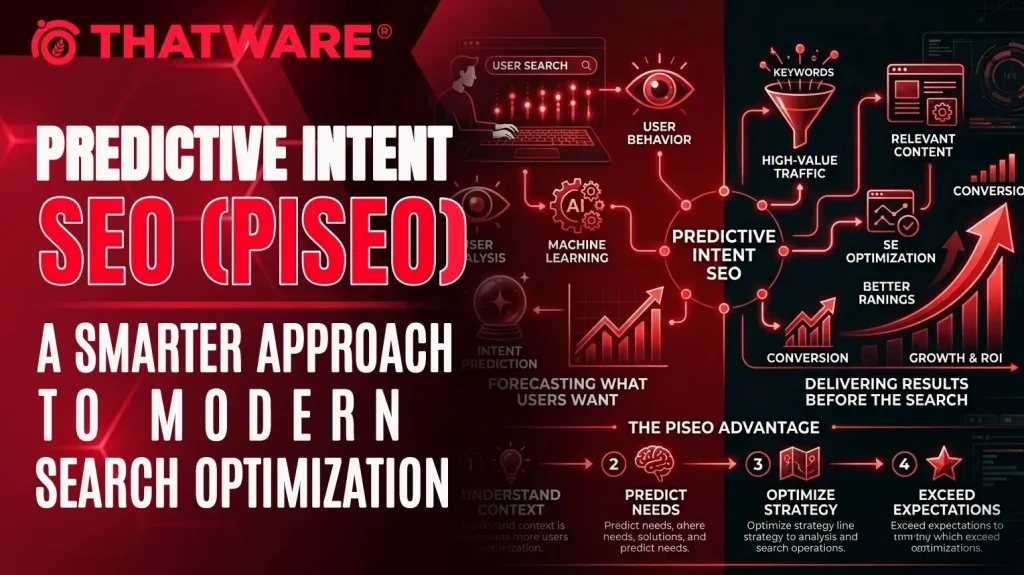
This shift has pushed optimization far beyond old ranking formulas. Today, businesses need to think about what users truly want, why they search, and how search platforms interpret intent. This is where Predictive Intent SEO (PISEO) becomes relevant. It represents a more advanced way to approach optimization by helping brands anticipate what users may search for next rather than only reacting to what is already trending.
Instead of building content after competition becomes crowded, PISEO encourages businesses to prepare earlier by studying future-facing signals. It blends AI, machine learning, NLP, semantic SEO, and deep search intent analysis to shape content strategies that are more proactive and resilient.
In this blog, we will explain what PISEO is, how it works, why it matters, and how it supports a smarter approach to modern search optimization.
What Is Predictive Intent SEO (PISEO)?
Predictive Intent SEO, or PISEO, is a proactive optimization method that aims to anticipate user intent before it becomes fully visible in mainstream search trends. Rather than focusing only on what people are searching for now, it studies patterns that suggest what they are likely to search for next.
This makes PISEO different from routine optimization. It not only responds to existing demand. It studies evolving behavior, contextual clues, market signals, and emerging topic relationships. The goal is to create content that aligns with future intent while remaining useful in the present.
At its core, PISEO is about understanding where search behavior is moving. It combines the logic of predictive SEO with the depth of intent-led content planning. That gives brands a better chance to build authority before a topic becomes saturated.
How It Differs from Traditional SEO
Traditional SEO often focuses on visible indicators such as keywords, search volume, backlinks, and ranking positions. These are still useful, but they mainly reflect what has already happened or what is already competitive.
PISEO shifts the focus toward intent prediction, semantic meaning, entity relationships, future search demand, and search behavior forecasting. Instead of asking only, “What keyword should we target?” it also asks, “What problem is the user moving toward, and how will search systems interpret it?”
Why the Term “Predictive Intent” Matters
The word “predictive” refers to anticipating future movement through meaningful signals. The word “intent” refers to the purpose behind a search. Together, they describe an SEO model that combines forecasting with intent-based content development. This makes PISEO highly relevant in a search environment shaped by AI and contextual understanding.
Why Modern Search Optimization Needs a Smarter Approach
Search engines no longer work on keywords alone. They now rely on AI models, contextual interpretation, user interaction data, and semantic search systems to understand intent and relevance more accurately.
Search Engines No Longer Work on Keywords Alone
Search engines have become far more sophisticated. They now use AI, NLP, and semantic search principles to understand what users mean, not just what they type. Instead of relying only on exact matches, they study topic relevance, contextual accuracy, and the overall usefulness of a page.
Because of this, strong optimization now depends on meaning, coverage, and clarity. A page that repeats the right phrase but fails to address the user’s actual need may struggle to perform well.
Users Search with More Complexity Than Before
Search behavior is also changing. Users are asking longer, more conversational questions. They search with layered goals. One person may want quick information. Another may want a comparison. Someone else may be close to making a purchase but still needs reassurance.
Modern search includes informational queries, comparison searches, transactional intent, exploratory research, voice-driven interactions, and AI-assisted discovery. This is why search intent optimization has become more important than simple keyword placement.
The Limitations of Reactive SEO
Many businesses still create content only after a topic becomes obviously popular. By then, the competition is usually stronger, and the opportunity for early authority is smaller. Reactive SEO often places brands in a cycle of chasing visibility instead of building it early.
PISEO offers a smarter model because it encourages preparation before demand peaks. It helps businesses move earlier, plan better, and create assets that meet future user needs with stronger timing.
The Core Idea Behind Predictive Intent SEO (PISEO)
The core shift behind PISEO is simple. Traditional optimization often reacts. Predictive optimization anticipates. Instead of waiting for search demand to become clear and crowded, brands look for signals that reveal where interest is forming.
These signals may include changes in user behavior, emerging subtopics, new questions in a market, and evolving relationships between entities. When studied carefully, they help brands act sooner.
Understanding the “Why” Behind Search
A search query rarely tells the whole story. Two users may type similar words but want completely different outcomes. One may want education. Another may want validation. Another may be looking for the best option before making a purchase.
This is why PISEO pays close attention to the deeper “why” behind a search. By understanding motivation, businesses can build content that addresses the real need, not just the visible phrase.
Aligning Content with Emerging User Needs
When content is aligned with user needs that are still taking shape, brands gain an early-mover advantage. They are not just catching traffic. They are building relevance before the market becomes noisy. That is one of the strongest reasons PISEO is becoming valuable in modern AI SEO strategy.
How Predictive Intent SEO (PISEO) Works
The first step is understanding what users want when they search. Intent generally falls into categories such as informational, navigational, commercial, transactional, and comparative. Each one requires a different content approach.
A page built for a transactional user should not sound like a beginner guide. A page aimed at an early-stage learner should not read like a product page. Accurate search intent analysis helps close that gap.
Semantic Search Mapping
Next comes semantic mapping. This involves building content around related ideas, topic clusters, contextual phrases, and subject depth. Search engines now evaluate how well a page covers a topic across connected concepts.
This is where semantic SEO becomes essential. Instead of optimizing around one isolated keyword, businesses create content ecosystems that reflect the real structure of a topic. This approach also supports entity-based SEO, since modern search systems often use entities and their relationships to understand content more deeply.
NLP and Machine Learning Integration
Natural language processing helps search systems interpret human language in a more accurate and contextual way. It helps decode nuance, conversational phrasing, and layered meaning. Machine learning adds another layer by identifying patterns in search behavior, engagement, and content performance over time.
Together, these technologies support AI search optimization because they allow content strategies to align with how intelligent systems interpret language and intent.
Trend Forecasting and Predictive Modeling
PISEO also studies emerging topics, user behavior trends, content engagement patterns, ranking shifts, and semantic relevance signals. This helps identify what may become more important in the near future.
Continuous Refinement
Predictive optimization is not a one-time project. It requires ongoing monitoring, updating, and refinement. User needs change, search systems evolve, and content must adapt accordingly.
Key Pillars of Predictive Intent SEO (PISEO)
Predictive SEO Intelligence (PSI)
Predictive SEO Intelligence acts as the forecasting engine behind the strategy. It uses historical search patterns, behavioral signals, and analytical modeling to estimate future movement in search demand and topical interest.
Intent Resonance
Intent Resonance refers to how closely a piece of content aligns with the layered purpose of a user query. The better the match, the more useful the content becomes. This helps improve relevance, engagement, and long-term visibility.
Semantic Engineering
Semantic engineering means structuring content around meaning, topic relationships, and entity depth. It ensures that content feels complete and contextually rich. This is especially important in a world shaped by semantic search.
Algorithmic Foresight
Search systems keep changing. Ranking factors evolve, user behavior shifts, and new forms of discovery appear. PISEO tries to reduce disruption by preparing for likely changes rather than waiting for damage to occur.
Anticipatory Content Design
Anticipatory content design means building pages for future relevance. Instead of writing only for today’s traffic, brands create content that can remain useful as search behavior develops.
Predictive Intent SEO vs Traditional SEO
Traditional SEO Approach
Traditional SEO usually focuses on current keyword demand, present ranking opportunities, and visible competitor behavior. It tends to respond to what is already measurable and established. While this can still work, it often creates a delayed strategy.
Predictive Intent SEO Approach
PISEO goes further. It forecasts new search demand, studies layered user intent, builds semantically rich content, and prepares for AI-driven shifts in search behavior. It focuses on long-term relevance, not just short-term ranking gains.
Why the Difference Matters
This difference matters because the predictive model helps brands become more proactive, more resilient, and more strategically positioned. Instead of chasing yesterday’s opportunity, they begin building for tomorrow’s visibility.
Benefits of Predictive Intent SEO (PISEO) for Businesses
Traditional SEO has delivered results for many years, and many of its principles still matter. Keyword research, technical health, links, crawlability, and user experience are still important. However, traditional SEO often focuses on existing keywords, current rankings, and visible competition.
Better Content Relevance
PISEO helps businesses produce content that is more closely aligned with what users actually need. This improves usefulness, topic depth, and trust.
Early Visibility Advantage
When a business publishes before a topic becomes crowded, it has more room to gain traction and authority. Timing can become a real competitive advantage.
Improved User Engagement
When content matches user intent more accurately, visitors are more likely to stay longer, interact more meaningfully, and explore further. Better alignment often supports stronger on-page behavior.
Stronger Conversion Potential
Intent-aware content attracts visitors who are more likely to act. When a page answers the right question at the right stage of the journey, the path to conversion becomes smoother.
Future-Ready Search Presence
PISEO supports a stronger presence across modern search experiences, including AI-driven discovery. It also helps brands adapt their strategy for Answer Engine Optimization, where search is increasingly about direct answers, context, and trust signals.
More Strategic SEO Planning
This approach helps shape better editorial planning, stronger topic clusters, and smarter content roadmaps. It turns SEO into a more strategic business function instead of a series of isolated tasks.
The Role of AI, NLP, and Semantic Search in PISEO
Together, AI, NLP, and semantic search make PISEO possible. They create the technical and conceptual foundation for future-focused optimization. Without them, the predictive strategy would remain too vague.
AI as the Intelligence Layer
AI helps identify patterns faster than manual research alone. It can process larger data sets, uncover correlations, and support faster strategic decisions.
NLP for Understanding Human Queries
NLP helps decode conversational language, mixed intent, and subtle wording differences. This is important because modern users often search in more natural language than before.
Semantic Search for Contextual Relevance
Semantic search connects topics, entities, and contextual meaning. It allows search systems to evaluate how well a piece of content fits the broader topic landscape, not just one phrase.
Why These Technologies Make PISEO Possible
Together, AI, NLP, and semantic interpretation make predictive optimization practical. They create the technical foundation needed to anticipate search behavior and optimize content for AI search engines in a more intelligent way.
How to Apply Predictive Intent SEO (PISEO) in a Content Strategy
The first step is to research emerging search patterns. Do not look only at high-volume keywords. Study rising questions, related themes, industry changes, community discussions, and content gaps. Early signals often appear before volume spikes.
Next, build content around intent stages. Some users are discovering a topic for the first time. Others are researching, comparing, validating, or preparing to buy. A strong PISEO strategy creates content for each stage of that journey. This makes the content ecosystem stronger and more useful.
Topic clusters also matter. Organize content into connected hubs so that each page supports the broader subject. Cover entities, subtopics, use cases, definitions, comparisons, and deeper explanations. This helps optimize content for AI search engines because AI systems prefer content that is clear, structured, and contextually complete.
It is also important to optimize for multiple search experiences. Modern visibility does not only come from blue links. Brands should consider featured snippets, voice search, AI overviews, answer surfaces, and knowledge graph-style visibility. This is where AI search optimization and Answer Engine Optimization work together.
Finally, refresh content continuously. Search behavior does not stand still. Intent signals shift. SERP features change. Pages should be revised as new questions emerge and as new search patterns become visible. This keeps the strategy alive and relevant.
Common Challenges in Predictive Intent SEO (PISEO)
Forecasting Is Never Perfect
Prediction is based on probability, not certainty. No strategy can forecast every search shift with complete accuracy.
Requires Strong Data Interpretation
Not every pattern is meaningful. Businesses need careful analysis, not random assumptions. The quality of insight matters more than the volume of data.
Demands a Long-Term Mindset
PISEO is strategic by nature. It may not always deliver instant wins, but it builds a stronger long-term foundation.
Needs Content Depth and Consistency
Thin or shallow content will not support predictive intent strategies well. Businesses need depth, clarity, and consistency to see better results.
Who Should Use Predictive Intent SEO (PISEO)?
PISEO is especially useful for growing brands that want to lead rather than follow. It helps businesses in competitive industries gain an earlier position in rising topic areas.
Growing Brands
Brands in competitive markets can use PISEO to move earlier and build stronger authority.
Content-Heavy Websites
Publishers, SaaS companies, agencies, and knowledge-led businesses benefit from this approach because they depend heavily on content visibility.
Businesses in Fast-Changing Markets
Industries with rapidly changing trends, demand shifts, or evolving buyer questions can benefit from predictive planning.
Companies Focused on AI-Led Search Growth
Any brand preparing for future search environments should consider PISEO as part of its modern AI SEO and content strategy.
The Future of Search and the Growing Importance of PISEO
Search is becoming more predictive. Systems increasingly try to understand what users are really asking, what they may ask next, and which answers best fit the broader context. That means SEO must evolve with search intelligence.
Old methods are not useless, but they are no longer enough on their own. Ranking for existing phrases is only part of the challenge. The bigger opportunity lies in preparing for future patterns, deeper intent, and changing search interfaces.
This is where PISEO becomes especially relevant. It offers a future-focused framework for brands that want to align with AI-driven search evolution. It treats optimization as a living process shaped by data, semantics, and foresight.
Conclusion
Predictive Intent SEO (PISEO) represents a smarter and more forward-looking way to approach modern search optimization. It combines search intent analysis, semantic SEO, AI, NLP, predictive modeling, and content foresight to help brands create content that aligns with both present needs and future search behavior. In today’s environment, SEO is no longer only about ranking for existing keywords. It is about understanding emerging user expectations, evolving search patterns, and the growing influence of AI-driven discovery. Businesses that adopt this mindset can move from reactive tactics to an intelligent, anticipatory strategy. As the pioneer agency to coin this term and build services around this concept, ThatWare stands at the center of this shift, helping brands approach modern optimization with greater clarity, foresight, and long-term relevance.