
SUPERCHARGE YOUR ONLINE VISIBILITY! CONTACT US AND LET’S ACHIEVE EXCELLENCE TOGETHER!
Search is no longer just about typing keywords into a search engine—it’s about having conversations.
Over the past decade, traditional search engines like Google have dominated how users discover information. But today, we are witnessing a major shift. Users are increasingly turning to AI-driven conversational platforms like ChatGPT, Gemini, and other AI assistants to ask questions, explore ideas, and make decisions.

Instead of clicking through multiple links, users now expect direct, contextual answers.
This shift has fundamentally changed how visibility works online.
Why SEO Alone Is No Longer Enough
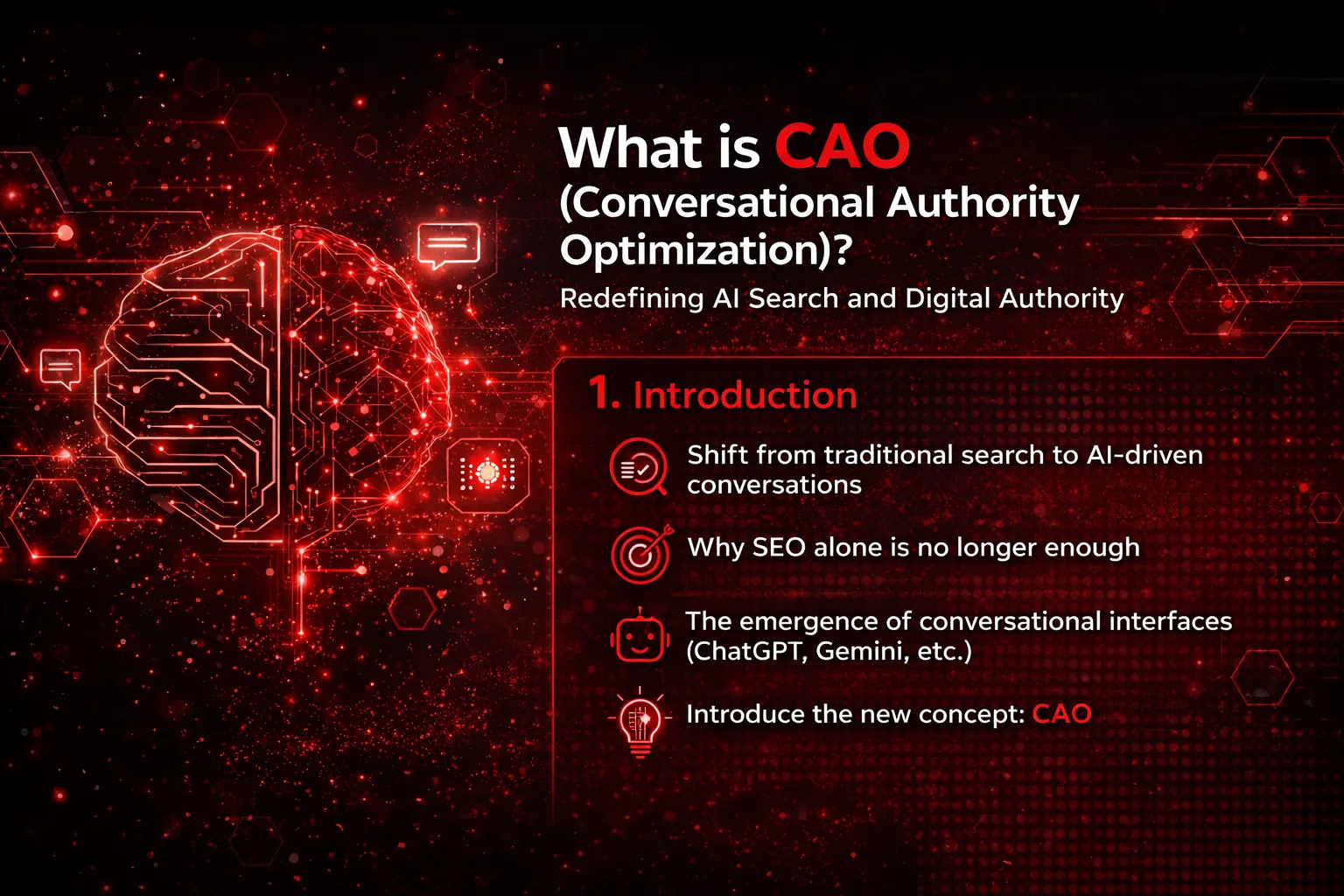
Traditional SEO focused on:
- Ranking pages for keywords
- Building backlinks
- Optimizing metadata
But in an AI-first world:
- Users may never visit your website
- AI systems summarize and synthesize content
- Visibility depends on whether your brand is mentioned, trusted, and used in answers
In other words, ranking on Google is no longer the final goal—being part of the answer is.
The Rise of Conversational Interfaces
Platforms like:
- ChatGPT
- Google Gemini
- Perplexity AI
are redefining search into a dialogue-driven experience.
Users don’t search—they ask.
They don’t browse—they interact.
And this is where a new paradigm emerges.
Introducing CAO
To adapt to this shift, we introduce a new concept:
CAO — Conversational Authority Optimization
A framework designed for the era where:
- AI mediates information
- Conversations replace queries
- Authority is determined dynamically
What is CAO (Conversational Authority Optimization)?
Conversational Authority Optimization (CAO) is the process of optimizing a brand’s presence so that it becomes a trusted, authoritative source within AI-driven conversations.
It’s not just about being found. It’s about being chosen, cited, and surfaced by AI systems when users ask questions.
In simple terms:
If SEO helps you rank pages, CAO helps you own conversations.
SEO vs AEO vs CAO
To understand CAO, it’s important to see how it evolves from earlier optimization models:
SEO (Search Engine Optimization)
- Focus: Ranking in search engine results pages (SERPs)
- Method: Keywords, backlinks, technical optimization
- Goal: Drive traffic to websites
AEO (Answer Engine Optimization)
- Focus: Getting featured in direct answers (snippets, voice search)
- Method: Structured content, FAQs, concise answers
- Goal: Become the selected answer
CAO (Conversational Authority Optimization)
- Focus: Influencing AI-generated conversations
- Method: Authority, trust, entity presence, narrative control
- Goal: Become the default source in AI dialogue
Why “Conversation” is the New Search Layer
Search is no longer a static results page—it’s a dynamic interaction layer.
Here’s what’s changing:
- From queries to conversations
Users ask follow-up questions, refine context, and explore deeper. - From links to synthesized answers
AI combines multiple sources into one response. - From traffic to influence
The brand that shapes the answer wins—even without a click.
This means:
- Your content must be understood, not just indexed
- Your brand must be recognized as an entity, not just a website
- Your authority must be consistent across the entire web ecosystem
Why CAO Matters in 2026 and Beyond
The way users interact with search has fundamentally changed. We are no longer in a world where people click through ten blue links to find answers. Instead, AI-driven interfaces now deliver instant, synthesized responses, often eliminating the need to visit a website altogether.
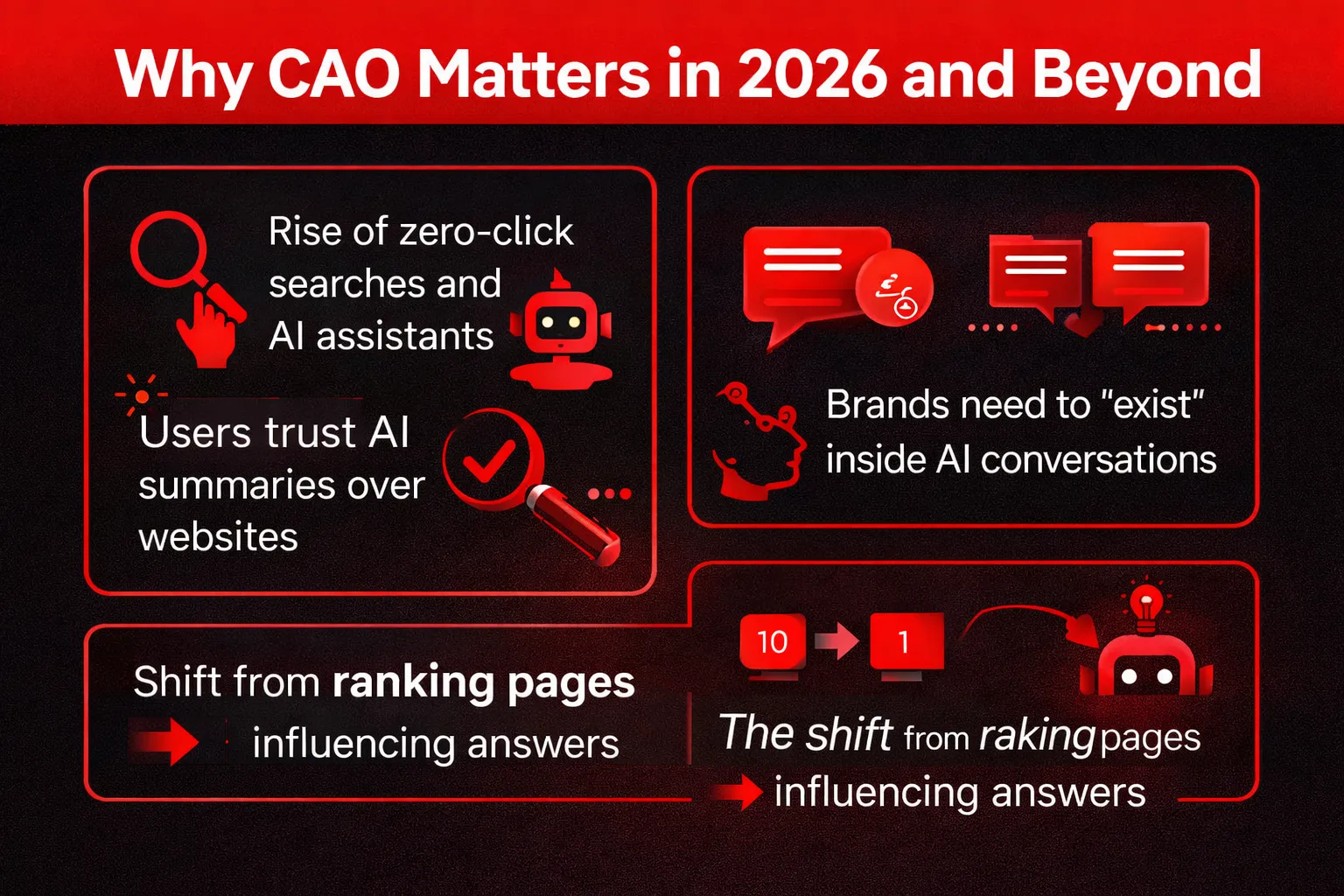
The Rise of Zero-Click Searches and AI Assistants
Search behavior has shifted toward zero-click experiences, where users get answers directly from AI systems like ChatGPT, Google’s AI Overviews, and other assistants. These platforms aggregate, interpret, and present information in a conversational format—reducing reliance on traditional search results.
Users Trust AI Summaries Over Websites
Modern users increasingly trust AI-generated summaries because they are:
- Faster
- Contextual
- Aggregated from multiple sources
This creates a new challenge: users may never see your website—even if your content is being used.
Brands Need to “Exist” Inside AI Conversations
Visibility is no longer just about ranking on search engines. It’s about being:
- Referenced
- Quoted
- Represented
inside AI-generated responses. If your brand is absent from these conversations, you effectively don’t exist in the decision-making layer.
The Shift: From Ranking Pages → Influencing Answers
Traditional SEO focused on ranking webpages. CAO shifts the goal toward:
- Influencing how AI models interpret your brand
- Ensuring your insights are included in generated answers
- Becoming part of the “source layer” AI relies on
In short, success is no longer about being clicked—it’s about being chosen by AI as the answer.
Core Pillars of CAO
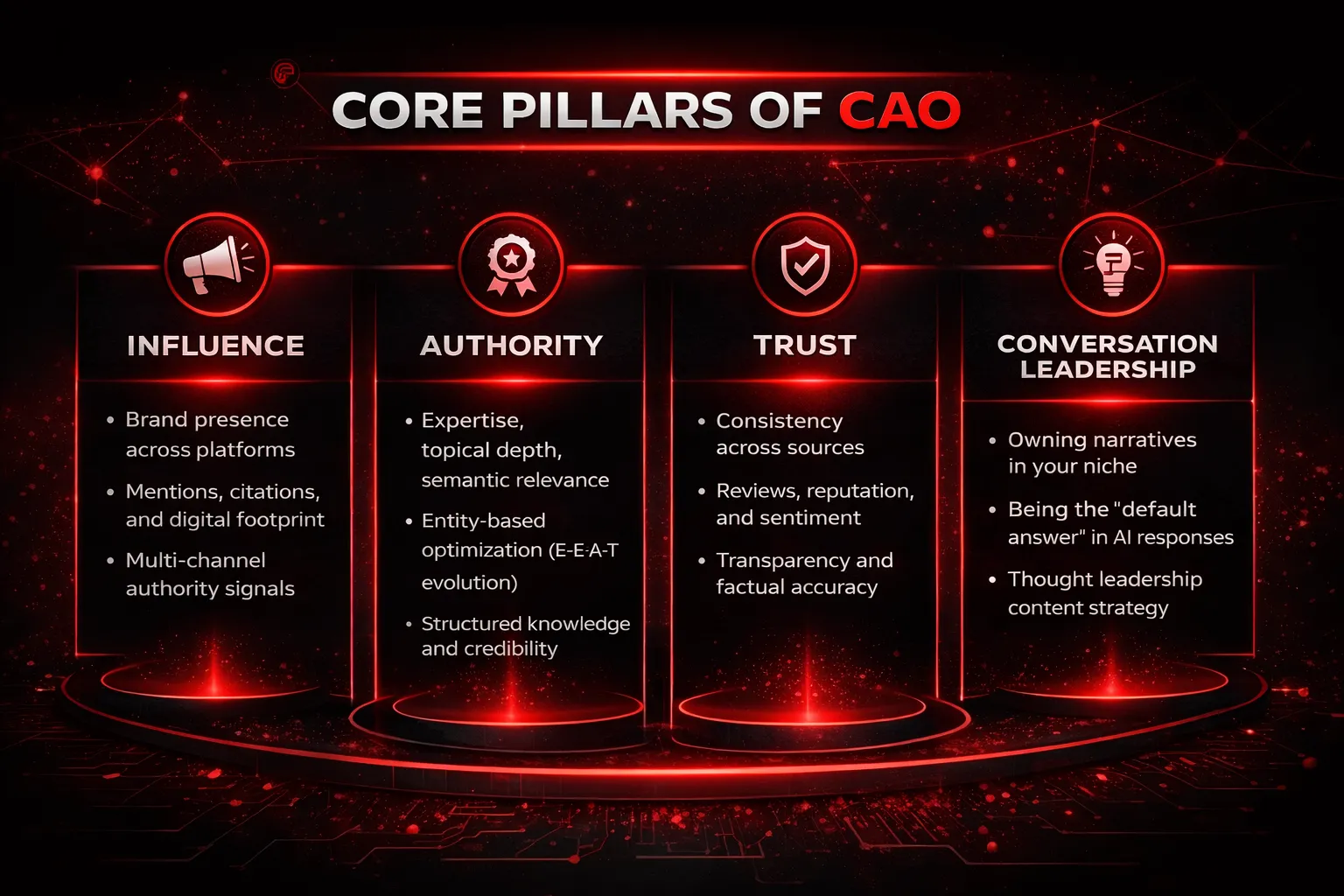
To succeed in this new paradigm, Conversational Authority Optimization is built on four foundational pillars:
Influence
Influence determines how widely and consistently your brand appears across the digital ecosystem.
- Brand Presence Across Platforms
Your visibility must extend beyond your website—into social media, forums, publications, and third-party platforms. - Mentions, Citations, and Digital Footprint
AI models rely heavily on distributed signals. The more your brand is mentioned and cited across trusted sources, the stronger your influence. - Multi-Channel Authority Signals
Influence is cumulative. A brand consistently referenced across multiple channels is more likely to be surfaced in AI responses.
👉 In CAO, influence is not about backlinks alone—it’s about omnipresence.
Authority
Authority defines how credible and knowledgeable your brand appears within a specific domain.
- Expertise, Topical Depth, Semantic Relevance
AI prioritizes content that demonstrates deep subject-matter expertise and covers topics comprehensively. - Entity-Based Optimization (Evolution of E-E-A-T)
Search is moving from keywords to entities. Your brand must be recognized as a distinct, authoritative entity in its niche. - Structured Knowledge and Credibility
Clear, structured, and well-organized information helps AI systems understand and trust your content.
👉 Authority in CAO is about being recognized as a source—not just a publisher.
Trust
Trust is the foundation that determines whether AI systems feel confident referencing your brand.
- Consistency Across Sources
Your brand messaging, data, and positioning must align across all platforms. - Reviews, Reputation, and Sentiment
Public perception matters. Positive sentiment signals reinforce credibility in AI models. - Transparency and Factual Accuracy
Reliable, verifiable information increases the likelihood of being included in AI-generated answers.
👉 In CAO, trust is the filter through which all influence and authority must pass.
Conversation Leadership
This is the highest level of CAO—where your brand doesn’t just participate in conversations but leads them.
- Owning Narratives in Your Niche
Define key concepts, frameworks, and ideas that others reference. - Being the “Default Answer” in AI Responses
The goal is to become the go-to source AI systems consistently surface. - Thought Leadership Content Strategy
Publish original insights, unique frameworks, and forward-thinking ideas that shape industry discussions.
👉 Conversation leadership is where brands move from visibility to dominance.
How CAO Differs from Traditional SEO
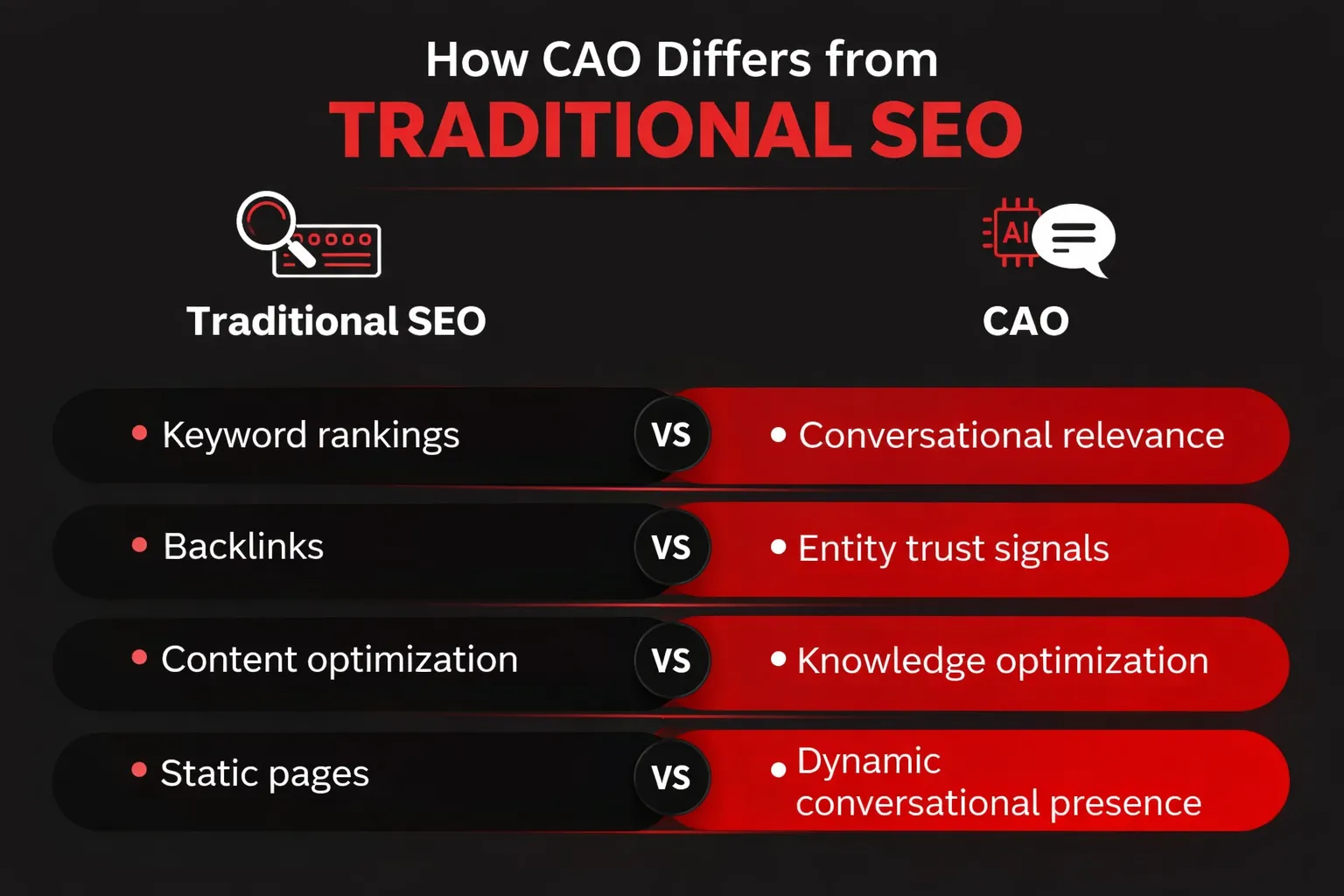
For over two decades, SEO has revolved around ranking web pages on search engines. But with the rise of AI-driven search, the game is no longer about pages—it’s about presence within conversations. This is where Conversational Authority Optimization (CAO) fundamentally diverges from traditional SEO.
Keyword Ranking vs Conversational Relevance
Traditional SEO prioritizes keywords—identifying what users type and optimizing content to rank for those exact phrases. CAO, on the other hand, focuses on contextual understanding.
AI doesn’t just match keywords; it interprets intent, nuance, and conversational flow. Brands that win are those whose content aligns naturally with how people ask and discuss topics, not just how they search.
Backlinks vs Entity Trust Signals
Backlinks have long been the backbone of SEO authority. But in AI search, authority is increasingly tied to entity recognition and trust signals.
Instead of simply counting links, AI evaluates:
- How often your brand is mentioned across credible sources
- The context in which those mentions occur
- Your association with recognized entities in your domain
In CAO, authority is not just linked—it’s understood.
Content Optimization vs Knowledge Optimization
SEO optimizes individual pages. CAO optimizes knowledge ecosystems. Rather than focusing solely on keyword density or on-page factors, CAO emphasizes:
- Structured, interconnected information
- Topic depth and semantic relationships
- Clear, factual, and reusable knowledge
The goal is to become a trusted source of truth, not just a well-optimized page.
Static Pages vs Dynamic Conversational Presence
SEO operates on static assets—web pages that rank on SERPs. CAO operates in a dynamic environment where answers are generated in real time.
This means your brand must:
- Appear across multiple platforms and data sources
- Be consistently referenced in relevant discussions
- Maintain visibility within evolving AI-generated conversations
In short, SEO helps you rank. CAO helps you be referenced.
How AI Determines Conversational Authority
To succeed in CAO, it’s critical to understand how AI systems decide which brands and sources to trust when generating answers.
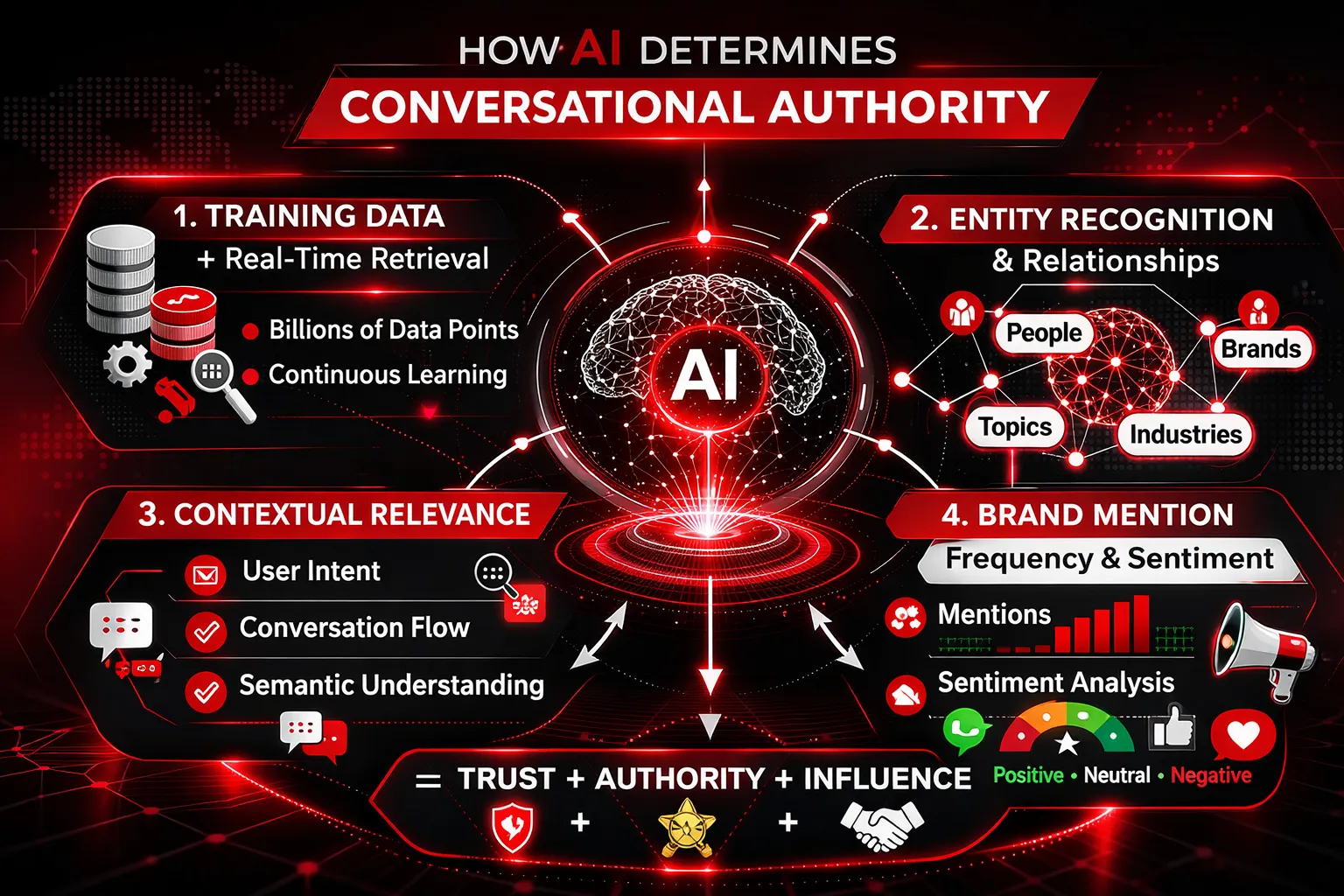
Training Data + Real-Time Retrieval
AI models rely on a combination of:
- Pre-trained knowledge (historical data, web content, structured datasets)
- Real-time retrieval (fresh, relevant, and authoritative sources)
Your brand’s visibility across both layers determines whether it gets included in AI-generated responses.
Entity Recognition and Relationships
Modern AI systems don’t just see websites—they see entities.
They map relationships between:
- Brands
- People
- Topics
- Concepts
If your brand is strongly associated with a topic (e.g., AI SEO), you are more likely to be surfaced as an authoritative source. CAO strengthens these associations through consistent, multi-channel presence.
Contextual Relevance in Conversations
AI prioritizes relevance within the specific context of a query.
It evaluates:
- How well your content answers the intent behind a question
- Whether your information fits naturally into the conversation
- The depth and clarity of your explanation
This means generic content loses. Context-rich, intent-driven insights win.
Brand Mention Frequency and Sentiment
AI also measures how often your brand is mentioned—and more importantly, how it is mentioned.
Key factors include:
- Frequency of mentions across authoritative platforms
- Positive vs negative sentiment
- Consistency of messaging
A brand that is frequently cited in a positive, authoritative context becomes a default reference point in AI-generated answers.
Practical Strategies to Implement CAO
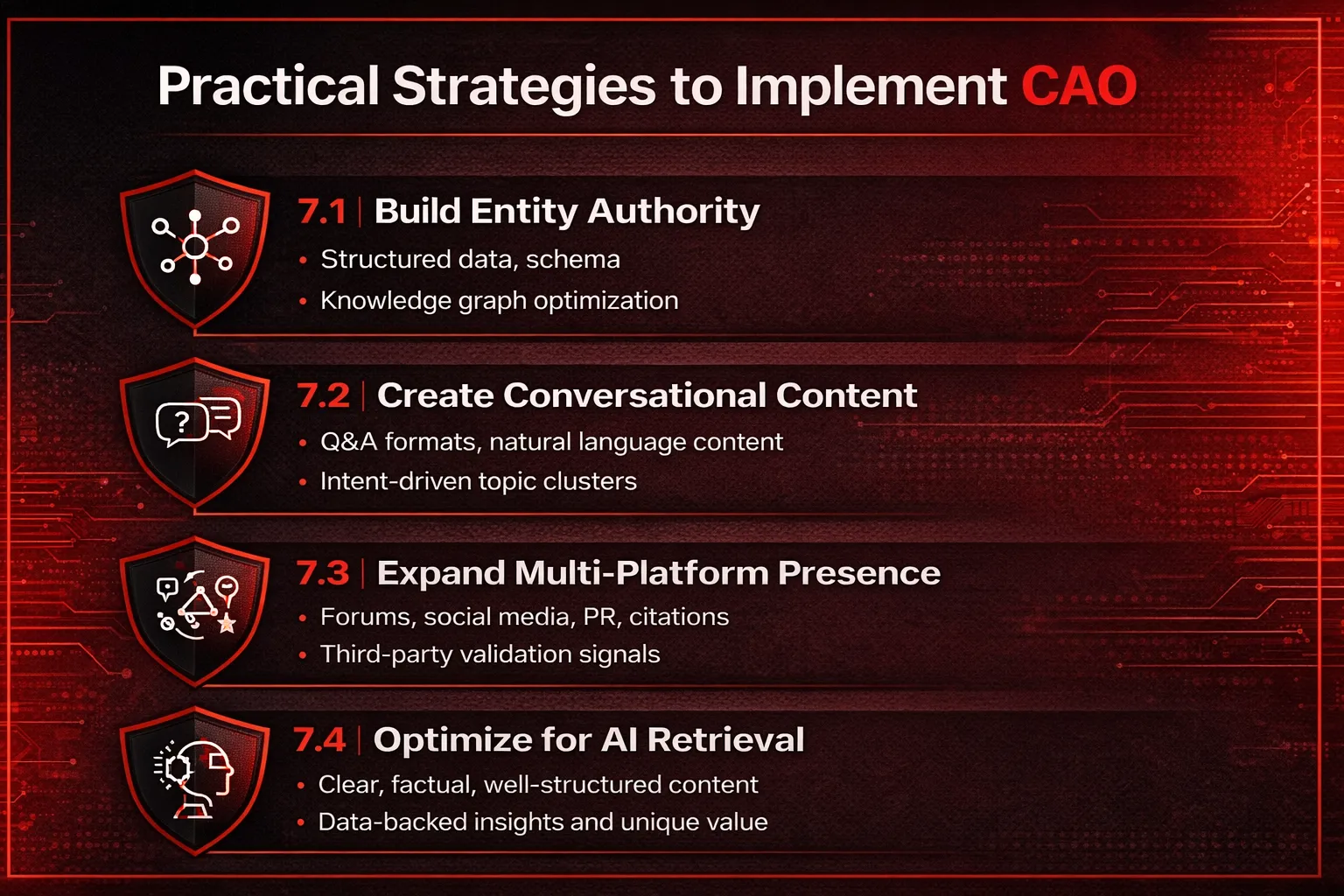
Implementing Conversational Authority Optimization (CAO) requires a shift from traditional optimization tactics to a more holistic, AI-first approach. It’s not just about ranking pages anymore—it’s about becoming a trusted entity that AI systems consistently reference in conversations.
Here’s how to do it:
Build Entity Authority
At the core of CAO lies entity-based optimization. AI systems don’t just rank keywords—they understand entities (brands, people, concepts) and their relationships.
To strengthen your entity authority:
- Implement structured data (schema markup) to clearly define your brand, services, and expertise
- Optimize for knowledge graph inclusion by maintaining consistent brand information across platforms
- Establish strong connections between your brand and key industry topics
The goal is simple: when AI models interpret a topic, your brand should naturally appear as a recognized and authoritative entity within that context.
Create Conversational Content
AI search thrives on natural language and contextual understanding. That means your content must mirror how real people ask and discuss things.
Focus on:
- Q&A-driven formats that directly answer user queries
- Writing in a natural, conversational tone rather than rigid keyword stuffing
- Building intent-driven topic clusters that cover a subject comprehensively
Instead of optimizing for a single keyword, you’re optimizing for an entire conversation ecosystem. The more context you provide, the more likely AI systems will pull your content into responses.
Expand Multi-Platform Presence
Conversational authority isn’t built on your website alone. AI systems evaluate distributed signals across the web.
To expand your presence:
- Engage in forums, communities, and discussion platforms
- Maintain active visibility across social media and PR channels
- Earn citations and mentions from third-party sources
These external signals act as validation layers. The more your brand is referenced across credible platforms, the stronger your authority becomes in AI-generated outputs.
Optimize for AI Retrieval
AI systems prioritize content that is clear, structured, and trustworthy. If your content is difficult to interpret, it won’t be used—no matter how valuable it is.
To optimize for retrieval:
- Write clear, factual, and well-structured content with logical flow
- Use headings, bullet points, and concise explanations for better parsing
- Include data-backed insights, statistics, and unique perspectives
AI doesn’t just look for content—it looks for confidence. The more precise and reliable your information is, the more likely it will be surfaced in conversations.
Case Example: From Invisible to AI-Dominant
Consider a mid-sized SaaS brand in the marketing automation space.
Before CAO Implementation
- The brand ranked decently on Google for a few niche keywords
- Traffic was steady but limited to traditional search clicks
- In AI tools like ChatGPT or Gemini, the brand was rarely mentioned
- Competitors with stronger authority signals dominated AI-generated answers
- The brand existed on the web—but not inside conversations
After CAO Implementation
After applying Conversational Authority Optimization (CAO) strategies:
- The brand expanded its presence across authoritative platforms (PR, forums, expert contributions)
- Content shifted from keyword-heavy blogs to intent-driven, conversational knowledge assets
- Entity signals were strengthened through structured data, consistent branding, and citations
- Thought leadership content positioned the brand as a category expert
The Result
- The brand began appearing in AI-generated recommendations for relevant queries
- Mentions increased across conversational interfaces, not just search engines
- Users encountered the brand within answers, not just as links
- Trust and recall improved significantly—without relying solely on rankings
Key Insight: The brand didn’t just optimize for search—it optimized to be part of the answer.
The Future of Search: From SEO → CAO
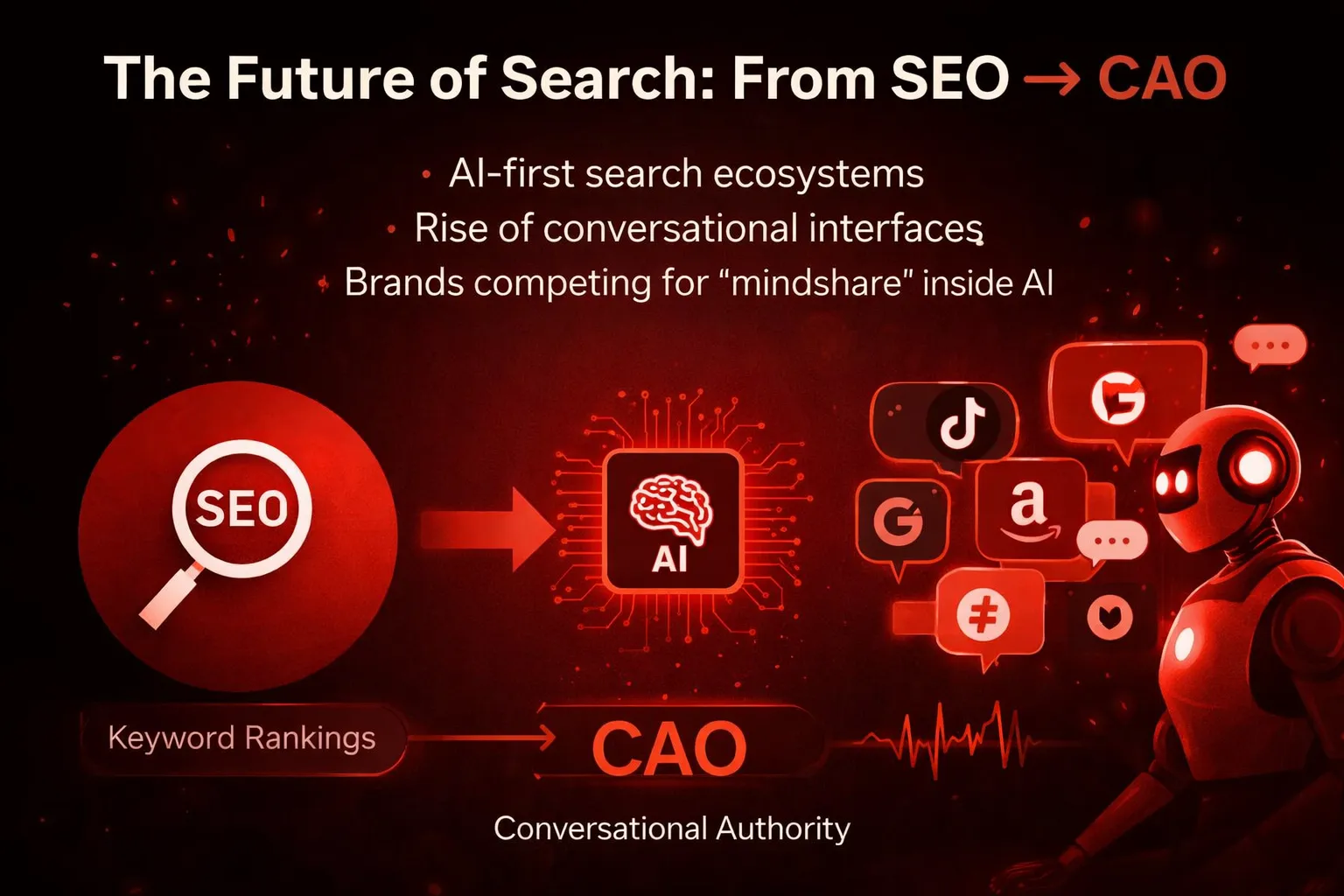
Search is no longer just about finding links—it’s about receiving answers. And those answers are increasingly generated by AI.
AI-First Search Ecosystems
Search engines are evolving into answer engines powered by AI. Instead of presenting a list of websites, they synthesize information and deliver direct responses.
In this ecosystem, visibility depends on whether your brand is included in the AI’s understanding—not just indexed on a page.
The Rise of Conversational Interfaces
Users are shifting toward natural, conversational queries:
- “What’s the best tool for X?”
- “Which company should I trust for Y?”
These interactions happen inside AI systems where:
- There are fewer clicks
- Fewer opportunities to compete via rankings
- More emphasis on authority and trust signals
Competing for Mindshare Inside AI
The real competition is no longer just SERPs—it’s AI mindshare.
Brands are now competing to:
- Be referenced in AI-generated answers
- Shape narratives within conversations
- Become the “default recommendation” in their category
This is where CAO becomes critical.
If SEO was about ranking pages, CAO is about owning conversations.
Why ThatWare is Leading the CAO Movement
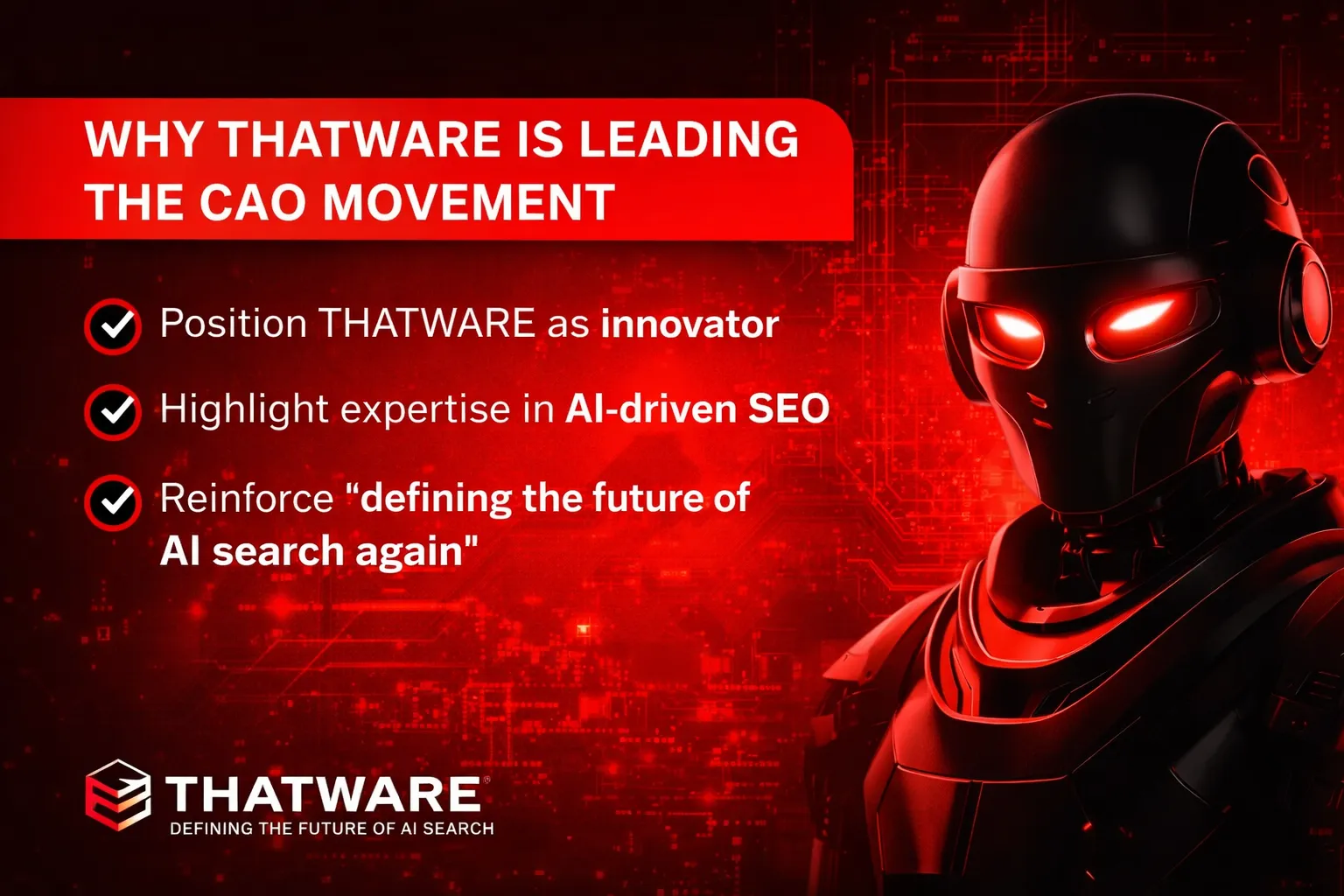
As the digital landscape shifts from search engines to conversational AI, ThatWare is not just adapting—it is actively shaping this transformation. With a proven track record in advanced SEO and AI-driven strategies, ThatWare stands at the forefront of what comes next: Conversational Authority Optimization (CAO).
Unlike traditional agencies that focus solely on rankings, ThatWare has consistently pushed boundaries by integrating artificial intelligence, data science, and semantic search into its core methodologies. This deep expertise allows the company to understand not just how search engines work—but how AI systems think, interpret, and generate answers.
ThatWare’s approach goes beyond optimizing content for visibility. It focuses on building entity authority, trust signals, and conversational relevance, ensuring that brands are not just found—but referenced, recommended, and relied upon within AI-generated responses.
This is where ThatWare differentiates itself as an innovator. By recognizing early that the future of search lies in conversations, not queries, it is once again positioning itself as a pioneer—defining the future of AI search, not reacting to it.
Conclusion
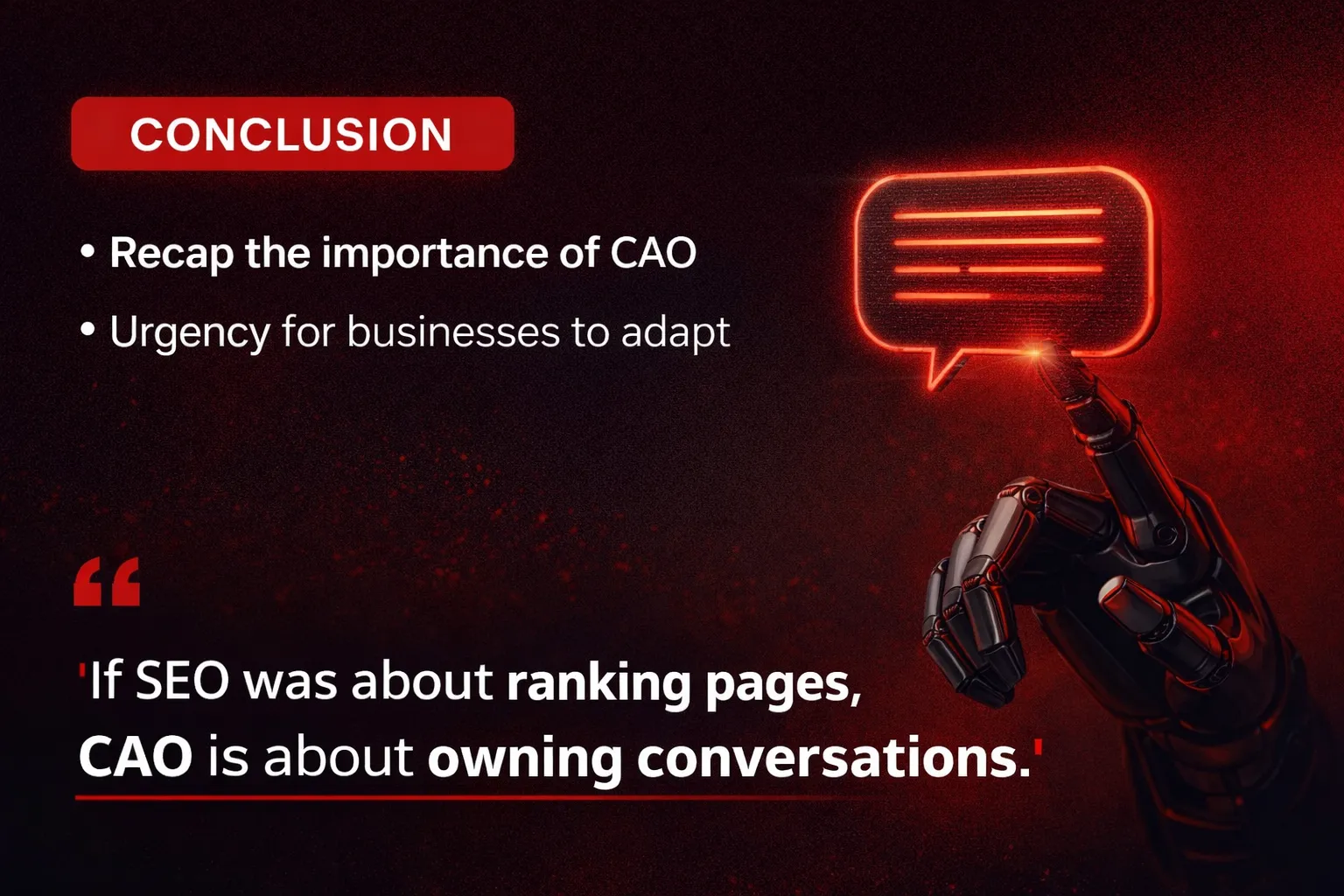
The evolution from SEO to CAO marks one of the most significant shifts in digital marketing history. Search is no longer about blue links—it’s about answers, context, and trust within AI-driven conversations.
Conversational Authority Optimization introduces a new paradigm where influence, authority, trust, and conversation leadership determine whether your brand becomes part of the answer—or gets left out entirely.
The urgency is clear. Businesses that fail to adapt risk becoming invisible in an ecosystem where users increasingly rely on AI to make decisions, discover brands, and validate information.
The future belongs to those who can establish authority not just on webpages, but within conversations.
If SEO was about ranking pages, CAO is about owning conversations.