
SUPERCHARGE YOUR ONLINE VISIBILITY! CONTACT US AND LET’S ACHIEVE EXCELLENCE TOGETHER!
It’s Monday, and you’re staring at 20-plus locations that all need attention before noon. One store’s hours are wrong on Google. Two profiles have fresh reviews sitting unanswered. A new listing went live with a typo in the address. And the calls? They come from the map pack, not your homepage. Sound familiar?
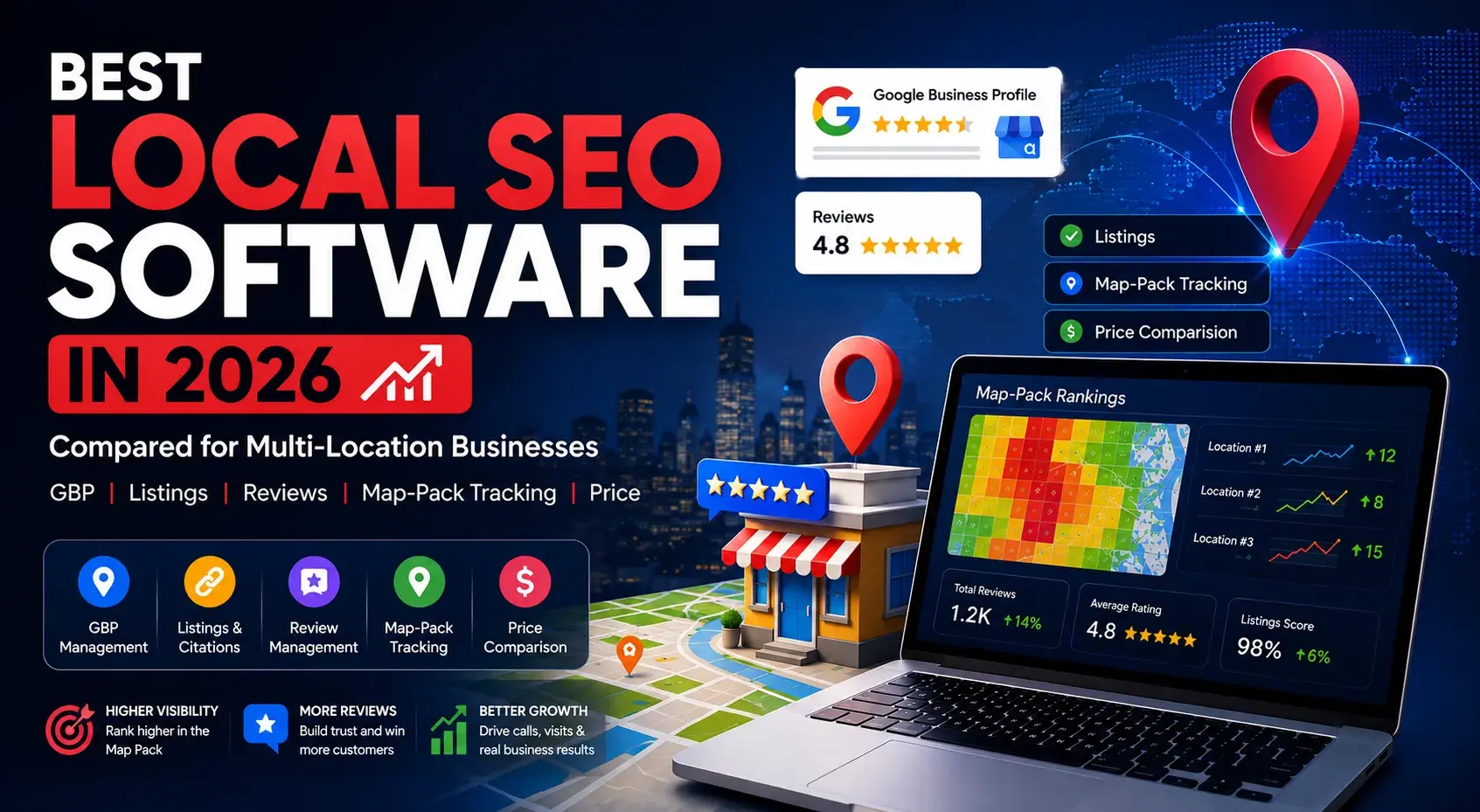
What’s the best local SEO software in 2026?
For most multi-location businesses, SE Ranking is the strongest all-round pick. Its Local Marketing Module handles Google Business Profile, listings, and reviews, while local rank tracking, organic SEO, and AI-search visibility live in the same platform so your local work isn’t stranded in a tool that’s blind to everything else. One honest caveat: if your entire focus is enterprise listings sync across hundreds of locations, a dedicated listings network goes deeper on that one job. Here’s how it and seven other platforms compare.
Here’s the thing the local surface is now enormous. Google Maps passes 2 billion monthly users (Google, 2026), which is where a huge share of “near me” intent lands before anyone sees your site. And reviews do real work: 82% of US adults read online reviews before a first-time purchase. That’s why local software stops being optional once you run more than a handful of locations.
Here’s what we looked for in local SEO software:
- GBP management with bulk edits across every location
- Listing and citation accuracy kept consistent across directories
- Review monitoring and response in one inbox
- Local, geo-grid map-pack rank tracking per location
- Multi-location support that scales without manual copy-paste
- Reporting and data access you can actually export and share
We evaluated each platform on those jobs, using product facts pulled from each vendor’s own pricing pages not third-party roundups.
What local SEO software actually does
A local SEO platform sometimes sold as local SEO marketing software centralizes the recurring local jobs so you’re not doing them by hand across every storefront. It manages your profiles, keeps listings accurate across directories, gathers and answers reviews, and tracks per-location map-pack rankings in one place. Instead of ten browser tabs and a spreadsheet, you get one console that shows where each location stands and what needs a fix today.
A quick note before the list: this table is the fast scan. If you run multi-location local SEO software for a mid-market brand, read the “Multi-location support” column first that’s usually the make-or-break.
| Software | Best for | Local features | Multi-location support | Starting price |
| SE Ranking | Local + organic + AI visibility in one place | GBP, reviews, citations, local rank tracking | Yes (3 locations base, add more) | $129/mo |
| BrightLocal | Local-first console | Rank grid, GBP audits, citations, listings, reviews | Yes | from $39/mo |
| Moz Local | Listing accuracy + reviews | 90+ directory sync, Local Grid, review monitoring | Per location | $20/mo per location |
| Semrush Local | Local layered on Semrush | GBP automation, listing management, map rank tracker | Per location | $30/mo per location |
| Yext | Enterprise listings network | 200+ directory sync, local pages, reviews, GBP | Yes (enterprise) | Quote-based |
| Localo | GBP-first automation | GBP posts/audit, position map, reviews, citations | Up to 60 profiles (Pro) | $39/mo (billed annually) |
| Whitespark | Citation / listing accuracy | À-la-carte: GBP, citations, ranking grids, reputation | Per location | from $1/mo per location |
| Local Falcon | Map-pack diagnostics | Geo-grid + AI-visibility tracking only | Per scan | $24.99/mo |
Here’s how the eight platforms stack up, starting with the one that covers the most ground.
1. SE Ranking

Here’s the thing this is the rare all-in-one where local (GBP, reviews, citations, map-pack tracking) sits right beside your organic SEO and AI-search visibility.
Best for: mid-market and multi-location teams that want local, organic, and AI visibility in one platform.
Standout feature: The Local Marketing Module handles GBP, listings, and reviews, while local rank tracking, organic SEO, and AI-search visibility across five LLM surfaces ChatGPT, Perplexity, Gemini, AI Overviews, AI Mode run from the same login. It’s local SEO software that doesn’t make you leave for the rest of your work; API and MCP ship on every plan from $129/mo.
Pros:
- GBP, reviews, and citations plus map-pack tracking in one place
- local, organic, and AI visibility from one login
- API and MCP on every plan
- white-label reporting via the Agency Pack (from $69/mo, billed annually)
Cons:
- local is one module inside a broad platform, not a GBP-only suite
- 3-location baseline; more locations cost extra from $23/mo
- the geo-grid view is less specialized than a dedicated grid tool
Pricing: Core $129/mo ($103.20/mo billed annually), Growth $279/mo ($223.20/mo billed annually). 14-day free trial, no card.
My take: if you want one place for the recurring local grind plus organic and AI visibility start here and see how much you stop tab-hopping. Bring in a specialist later, only when enterprise listings sync or true pixel-grid precision is genuinely the job you’re solving.
2. BrightLocal
BrightLocal is multi-location local SEO software built around one job local search and years of focus show in how deep those features run.
Best for: teams whose main job is local search audits, citations, and per-location map-pack tracking.
Standout feature: BrightLocal’s Local Search Grid maps your map-pack rank cell by cell across a geo-grid, so you see exactly where each location wins or slips. Pair that with Citation Builder for building and cleaning listings, plus GBP audits and benchmarking, and every core local job runs inside one local console.
Pros:
- Local Search Grid shows map-pack rank by location
- Citation Builder builds and cleans listings
- GBP audit and benchmarking
- White-label local reporting
Cons:
- Entry tier tracks rankings only; listings and reviews need higher tiers
- Public per-tier pricing is shifting to custom quotes
- Citation building bills separately per citation
Pricing: from $39/mo (Track/Manage/Grow); Citation Builder add-on ~$2/citation.
My take: If local search is the whole job not a side task BrightLocal earns its keep. Start on Track to watch rankings, then move up once you need listings and reviews. Just budget for citations separately, and confirm your quote by location count before you sign.
3. Moz Local
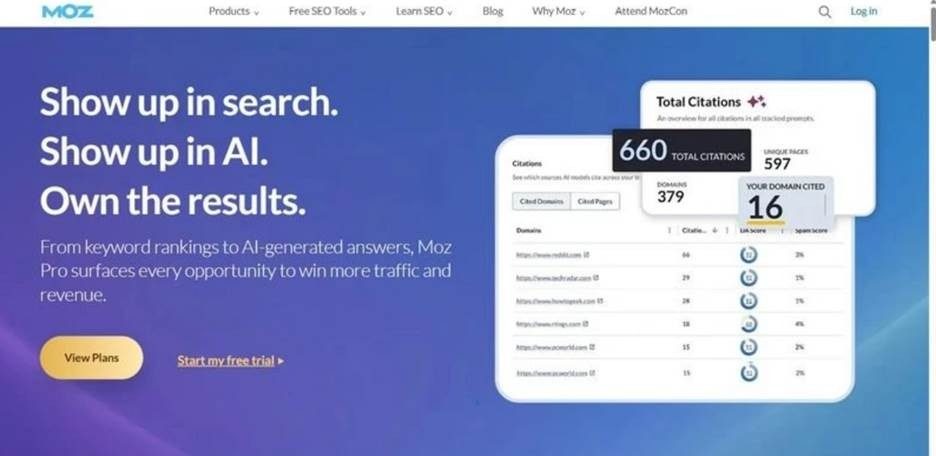
Moz Local leads with listing management: it pushes your business details out and keeps profiles clean, then watches reviews on top.
Best for: teams whose priority is listing accuracy and review monitoring across locations.
Standout feature: Moz Local syncs your listings to 90+ directories to keep names, addresses, and hours consistent, then layers on the Local Grid map-pack heatmap so you can see where each location ranks. Review monitoring pulls activity from every network into one view, and sentiment analysis flags which reviews need a reply first.
Pros:
- Syncs listings to 90+ directories for consistent business data
- Local Grid heatmap shows map-pack rank across the area
- Review monitoring with sentiment analysis to triage responses
- Social posting and analytics built in
Cons:
- Each location needs its own subscription, so multi-location bills add up
- Listings management covers only the US, UK, and Canada
- Review responding and social posting are gated to Preferred and above
Pricing: Lite $20/mo ($16/mo billed annually) per location; Preferred $30/mo; Elite $40/mo.
My take: Moz Local does listings and review monitoring well, but run the per-location math before you commit. At 15 stores, Lite is roughly $300 a month, and you’re still on the base tier without review responding or social. If accurate listings are your one job, it fits. Managing more from one console, look elsewhere.
4. Semrush Local
Semrush Local is a local toolkit layered onto the broader Semrush platform, adding GBP, listings, and rank tracking to your existing setup.
Best for: teams already on Semrush that want local features layered onto their existing setup.
Standout feature: Semrush layers automated GBP management onto its platform, with an AI agent that generates and publishes posts, Listing Management to sync your details across directories, and a credit-based Map Rank Tracker geo-grid that plots local rank cell by cell — all inside the Semrush workspace you already log into.
Pros:
- GBP automation with an AI agent for post generation and publishing
- Listing Management syncs your details across directories
- Map Rank Tracker geo-grid shows local rank cell by cell
- Review auto-replies and management
Cons:
- Per-location pricing scales with every location you add
- Full value assumes you’re already on the Semrush platform
- The deepest local features listings and reviews need the Pro tier
Pricing: Base $30/mo per location (billed annually); Pro $60/mo per location.
My take: Semrush Local makes sense if your team already lives in Semrush. The local features slot right in, no new login. But the deepest ones, listings and reviews, sit on Pro, and $60 a location adds up fast across a dozen stores. Not already on Semrush? The math gets harder.
5. Yext
[image unavailable: CAPTURE-PENDING]
Yext runs enterprise digital presence: one record feeds listings, local Pages, reviews, and GBP across a huge publisher network.
Best for: large multi-location and franchise brands that need listings accuracy at scale plus local landing pages.
Standout feature: Yext syncs structured listings from a single record out to a 200+ publisher network of directories, apps, and voice assistants, so one correction propagates everywhere at once. Layer on hosted local Pages, and each location gets a landing page that stays in step with the same source data.
Pros:
- 200+ publisher network syncs from one record
- Hosted local landing Pages per location
- Review and GBP management in one place
- Built for multi-location scale
Cons:
- Enterprise pricing; overkill for a small footprint
- Complex to set up and run
- Network model means stopping the subscription can revert your listings
Pricing: quote-based / enterprise (contact sales); listings deals commonly run ~$1,000–$3,000 per location per year.
My take: Here’s the thing — Yext earns its keep once you’re running hundreds of locations and one bad address costs you real money. It’s the multi-location local SEO software you buy for scale. Below that, you’re paying enterprise rates for reach you won’t use.
6. Localo
Localo (formerly Surfer Local) is automated local SEO built around one job: keeping your Google Business Profiles ranked, published to, and protected.
Best for: teams whose local job is mostly Google Business Profile management and posting.
Standout feature: GBP automation. Localo schedules AI-written posts straight to Google and Facebook, plots your rankings on a position map, and runs Smart Tasks that tell you what to fix next. GBP protection watches for unauthorized profile edits, and MCP integration lets you pull it all into ChatGPT and Claude.
Pros:
- AI post publisher that schedules to Google and Facebook
- Position map for local rank across your service area
- GBP audit plus protection against profile tampering
- MCP integration for ChatGPT and Claude
Cons:
- Heavy GBP focus, so less depth on organic and web SEO
- Single Business plan covers only one profile
- European pricing is shown before VAT
Pricing: Single Business $39/mo (billed annually; $49 monthly) +VAT; Pro (up to 60 profiles) $149/mo (billed annually).
My take: Look at it this way: if your local work lives inside Google Business Profile, Localo does that job well and saves you real hours on posting and monitoring. But you manage multiple locations, and the Single Business plan stops at one profile, so you’re jumping to Pro fast. Weigh that against how much broader organic SEO you still need elsewhere.
7. Whitespark
Whitespark is a local SEO toolkit plus done-for-you services, sold à la carte so you buy only the modules you actually need.
Best for: teams whose priority is citation building and listing accuracy.
Standout feature: Local Citation Finder surfaces where you should be listed and monitors the citations you already have, and pairs with hands-on citation-building services for deep NAP cleanup. Local Ranking Grids then plot your position as a geo-grid across up to 225 points around a location, so you see exactly where rankings hold and where they fade block by block.
Pros:
- à-la-carte modules you can turn on as you need them
- deep citation building and NAP cleanup
- ranking grids across up to 225 points
- Yext-replacement citation service
Cons:
- no unified plan; assembling modules adds cost and admin
- tooling fragmented across separate products
- less of a single dashboard than an all-in-one
Pricing: Local Platform from $1/mo per location; individual tools roughly $10–$79/mo.
My take: Honestly? Whitespark wins on citations, and that’s a real job most tools half-do. If listing accuracy is your bottleneck, the Citation Finder and build service pay for themselves. Just go in knowing you’re stitching modules together, not logging into one dashboard, and price the admin time in.
8. Local Falcon
Local Falcon is a geo-grid rank tracker built to show exactly where you rank on the map, pin by pin, across a service area.
Best for: teams that want pixel-precise map-pack tracking on top of their main platform.
Standout feature: geo-grid scanning. Local Falcon drops a grid of up to 21×21 pins across your target area and reports your Google and Apple Maps position at each one, then layers on AI Visibility Tracking. It runs on credits, where a single credit buys one scanned map pin, so you pay only for the coverage you actually pull.
Pros:
- Deep geo-grids, up to 21×21 pins per scan
- Coverage across both Google and Apple Maps
- AI Visibility Tracking for AI-driven local results
- API plus an MCP and Claude connector
Cons:
- Tracking only; no listings, citations, reviews, or GBP editing
- Monthly-plan credits expire at the end of each cycle
- Needs a companion tool to do the actual fixing
Pricing: Starter $24.99/mo (7,500 credits), Pro $99.99/mo; pay-as-you-go $0.05/credit.
My take: Here’s the thing. Local Falcon measures; it doesn’t manage. You get sharp, defensible data on where you sit across the map, which is genuinely useful when you’re proving local wins to a boss or a board. But nothing here builds a citation or fixes a profile, so treat it as your measurement layer and pair it with a platform that does the work.
Where most teams should start
Here’s the thing the local job never really ends. Google Business Profiles drift, reviews pile up, citations rot, and map-pack rankings move week to week. For most multi-location businesses, SE Ranking is where to start, because it puts that recurring work in one place alongside your organic and AI visibility. When the best local SEO software also handles GBP, reviews, citations, and map-pack tracking, you stop juggling four logins and stitching exports across every location. That’s hours back each month for whoever owns local, and one dashboard your regional managers can actually read. Start there, add a specialist tool only when a real gap shows up.
Skip an enterprise listings network if you’re under ~10 locations — the cost and setup outweigh the benefit.
Skip a standalone geo-grid tracker if your all-in-one’s map-pack view already covers your reporting.
Skip a GBP-only tool if you also need organic and web SEO in the same place.