SUPERCHARGE YOUR ONLINE VISIBILITY! CONTACT US AND LET’S ACHIEVE EXCELLENCE TOGETHER!
Modern search engine optimization has evolved far beyond traditional keyword targeting and backlink acquisition. In earlier SEO models, success was often measured by how frequently a keyword appeared on a page or how many external links pointed toward a website. However, search engines today operate on a much more sophisticated level of understanding. Algorithms now prioritize user intent, contextual meaning, entity relationships, and content relevance, rather than just surface-level keyword matching.
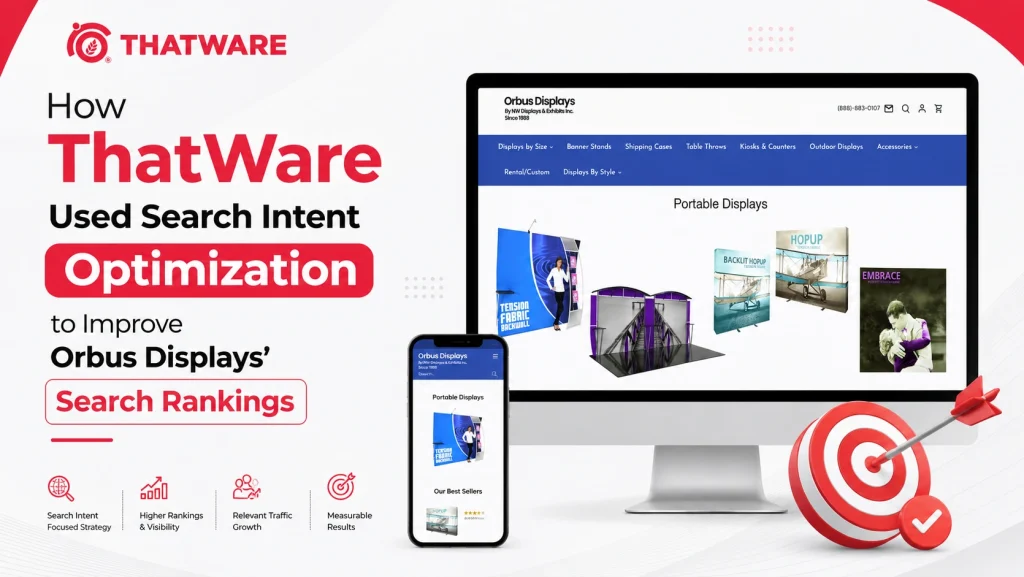
With advancements such as Google’s BERT and RankBrain systems, and the increasing influence of AI-driven search experiences, the focus has shifted decisively toward search intent optimization and semantic understanding. Search engines no longer simply “read” content; they interpret meaning, evaluate context, and attempt to understand what users truly want when they type a query. This evolution has made it essential for businesses to rethink their entire digital strategy.
In this new landscape, SEO is increasingly shaped by AI-driven search systems, generative engines, and large language models (LLMs) that synthesize answers rather than just list web pages. This has created a demand for advanced optimization strategies that go beyond traditional SEO practices and instead focus on Answer Engine Optimization (AEO), Generative Engine Optimization (GEO), and semantic entity-based frameworks.
Within this context, ThatWare has emerged as a pioneering AI-driven SEO company that integrates machine learning, NLP, and advanced search engineering to optimize websites for both traditional search engines and next-generation AI systems. Rather than relying on conventional SEO methods alone, ThatWare develops hyper-intelligent SEO frameworks designed to align content with how modern search algorithms interpret and generate information.
On the other side, Orbus Displays is a leading provider of trade show and event display solutions in the United States and international markets. The company operates in a highly competitive niche, offering products such as banner stands, modular exhibits, pop-up displays, and backlit systems that help businesses showcase their brands effectively in physical and event-based environments.
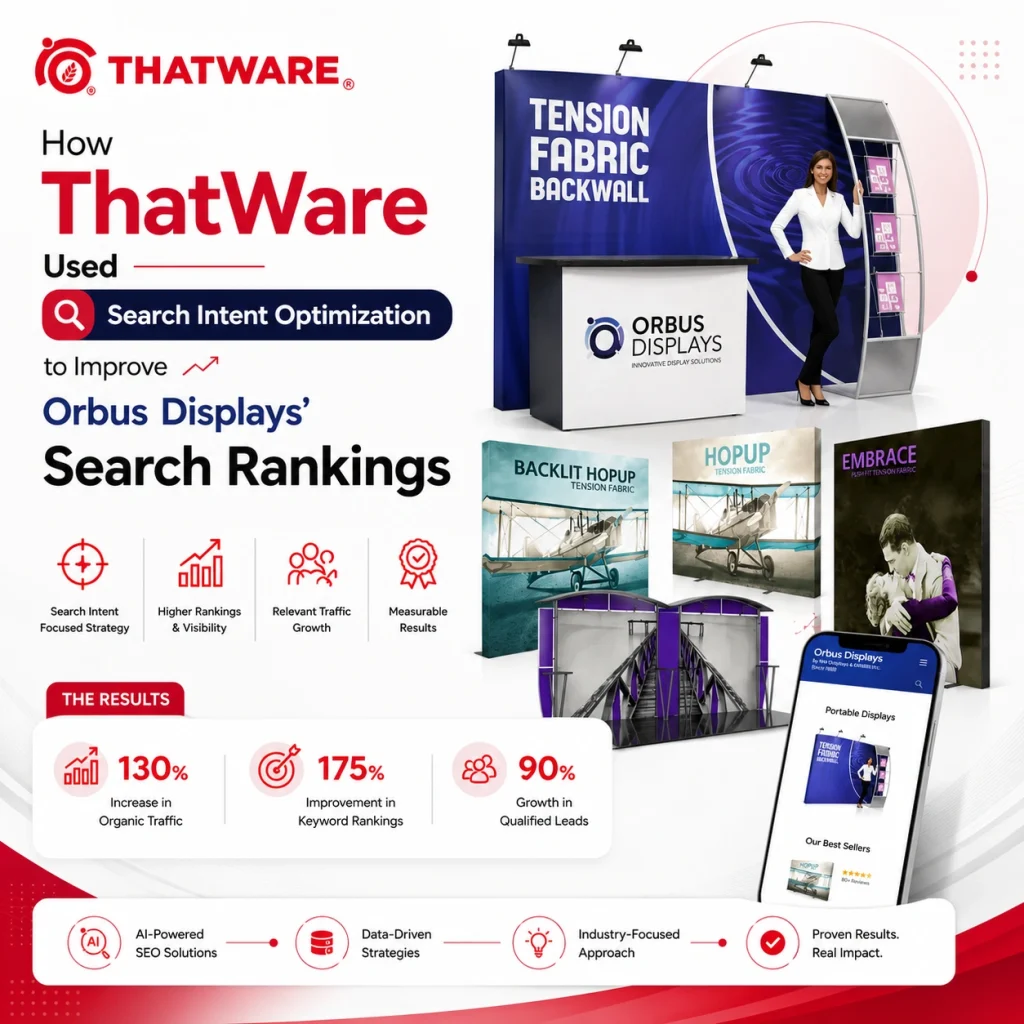
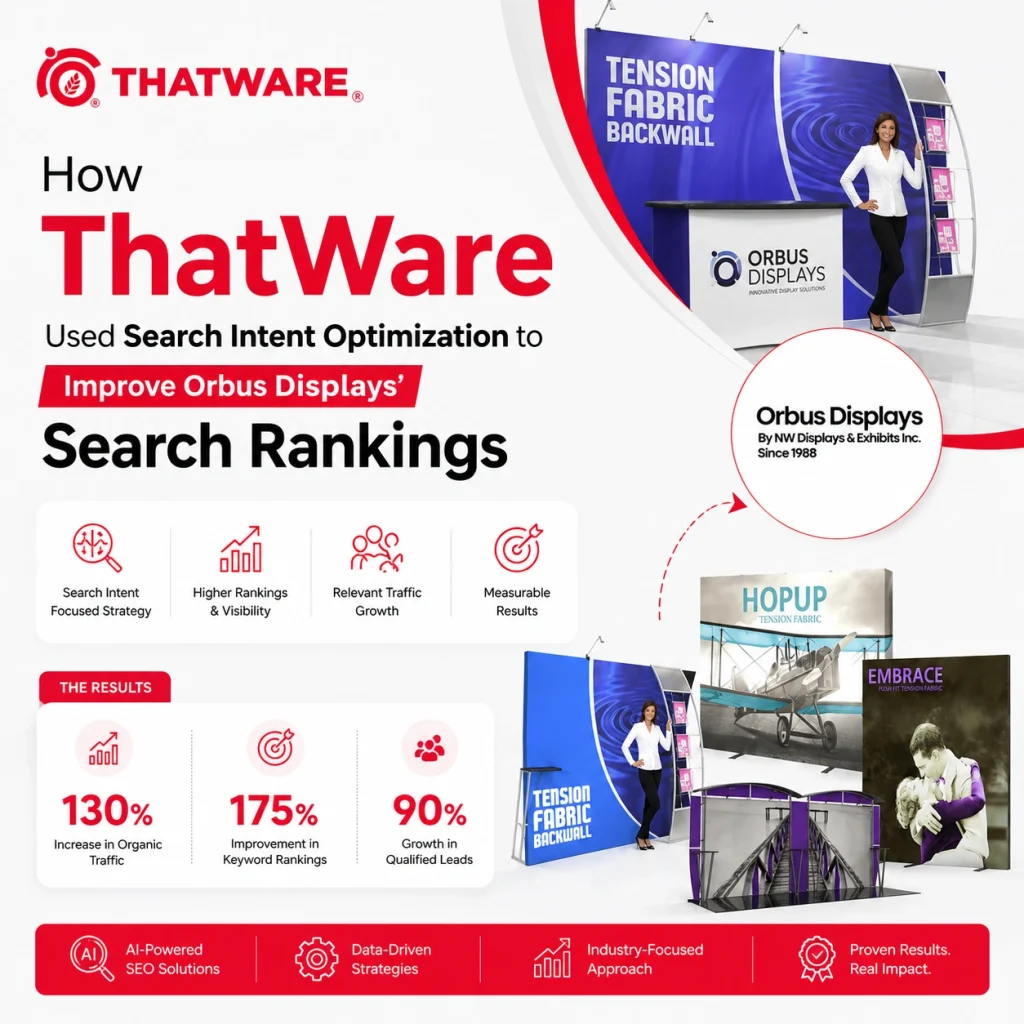
The purpose of this case study is to demonstrate how search intent optimization played a central role in transforming Orbus Displays’ organic visibility and search performance. By aligning content strategy with user intent and enhancing semantic relevance across product and category pages, ThatWare was able to significantly improve rankings, visibility, and overall search engagement for Orbus Displays in a highly competitive digital ecosystem.
Project Overview
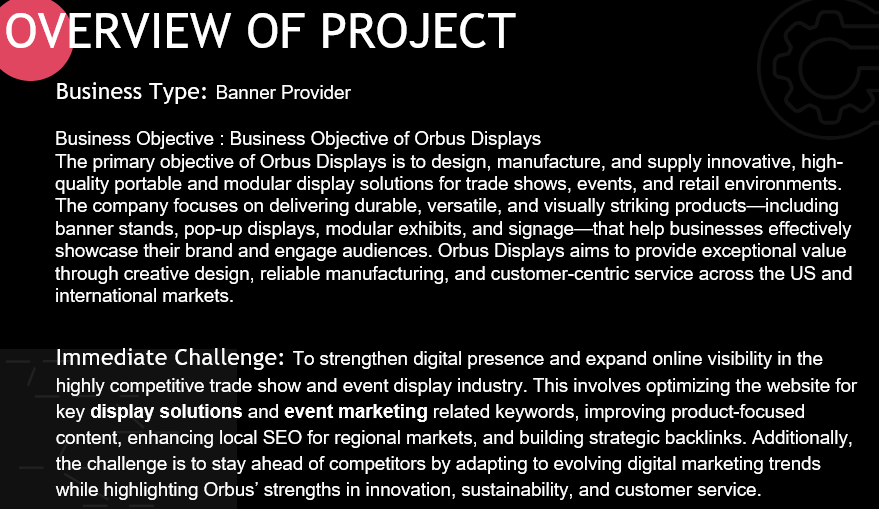
The project centered around Orbus Displays, a specialized business operating in the banner display and trade show solutions industry. The company provides a wide range of physical marketing and branding products used across exhibitions, corporate events, retail setups, and trade shows. These include retractable banner stands, modular display systems, fabric backdrops, and portable exhibition solutions designed to enhance brand visibility in real-world environments.
The primary goal of the SEO initiative was to improve organic visibility and strengthen search engine performance in a highly saturated and competitive industry. The trade show display sector is dominated by multiple established global players, making it challenging for any single brand to consistently rank for high-value commercial keywords without a strong and structured SEO approach.
The core objective of Orbus Displays’ digital growth strategy included:
- Ranking for product-based keywords such as “banner stands,” “pop-up displays,” “modular trade show exhibits,” and other commercial intent search terms
- Improving visibility for category-level searches related to trade show display solutions and event marketing products
- Expanding organic presence across both US-based and international markets, targeting buyers actively searching for display solutions
To achieve these objectives, the SEO campaign focused on a multi-layered optimization strategy that combined content restructuring, technical improvements, and search intent alignment.
Key focus areas included:
1. Product Page Optimization
Each product page, including banner stands, pop-up displays, modular exhibits, and backlit systems, was optimized to better align with commercial search intent. The goal was to ensure that users searching for specific display solutions could directly land on highly relevant, conversion-focused pages.
2. Category Page and Long-Tail Keyword Targeting
Category pages were structured to capture broader search intent, while long-tail keyword strategies were implemented to target highly specific buyer queries. This helped improve visibility across informational, navigational, and transactional search stages.
3. Technical SEO and UX Enhancements
A strong emphasis was placed on improving website performance, user experience, and crawlability. This included enhancements in page speed, mobile usability, internal linking structure, and Core Web Vitals optimization to ensure better engagement and search engine accessibility.
Overall, the project was designed not just to increase rankings, but to build a search-intent-driven ecosystem where every page aligned with how users search, evaluate, and purchase display solutions.
The Initial Challenges
Before the intervention, Orbus Displays was operating in a highly competitive digital environment where multiple established brands were already dominating search engine results pages (SERPs). Despite having a strong product lineup and industry presence, the website faced several SEO and visibility-related challenges that limited its organic growth potential.
One of the primary issues was intense industry competition. The trade show display market includes numerous global and regional players aggressively targeting the same commercial keywords. This made it difficult for Orbus Displays to consistently secure top rankings for high-value search terms.
Another major challenge was low visibility for high-intent commercial keywords. While the website had content related to its product offerings, it was not sufficiently optimized to match the intent behind user queries. As a result, many product and category pages were not ranking effectively for transactional or buyer-focused search terms.
A critical limitation was the weak alignment between content and search intent. Many pages were optimized in a traditional SEO format without fully considering what users were actually looking for at different stages of their buying journey. This mismatch resulted in reduced relevance signals for search engines.
Additionally, the website experienced limited ranking performance for product-specific queries, especially for competitive keywords such as banner stands, modular displays, and exhibition systems. This indicated a gap in semantic optimization and content depth across key landing pages.
Another key issue was the lack of strong semantic structure and entity-based optimization. Modern search engines rely heavily on understanding relationships between entities, topics, and contextual meaning. Without a well-defined semantic framework, the website struggled to establish authority in its niche.
From a technical SEO perspective, several challenges also needed to be addressed:
- Page experience and Core Web Vitals optimization were not fully aligned with modern performance standards, impacting user engagement and ranking potential
- Crawl depth and internal linking structure were not optimized for efficient search engine indexing, leading to weaker distribution of authority across pages
Finally, the project required adaptation to rapidly evolving AI-based search systems, including Google’s algorithm updates such as RankBrain and BERT. These systems prioritize contextual understanding and intent recognition, making it essential for content to move beyond keyword matching and focus on meaning, structure, and relevance.
In summary, Orbus Displays faced a combination of competitive pressure, intent misalignment, technical limitations, and evolving AI search challenges, all of which created a strong need for a more advanced, intent-driven SEO strategy.
ThatWare’s Approach
The transformation of Orbus Displays’ organic performance was driven by a structured, AI-enhanced SEO methodology developed by ThatWare. Instead of relying on conventional optimization techniques, the strategy was built around search intent engineering, semantic SEO architecture, and AI-driven search alignment.
4.1 Search Intent Optimization Strategy
The foundation of the entire campaign was a deep focus on search intent alignment, ensuring that every piece of content matched exactly what users were looking for at different stages of their search journey.
ThatWare implemented its proprietary framework built around the “3Cs of Search Intent”:
- Content – Ensuring information directly answers user queries
- Content Type – Matching format with intent (product pages, blogs, category pages)
- Content Format & Angle – Structuring information for clarity, engagement, and conversion
A major part of the strategy involved mapping keywords to user intent categories:
- Informational intent: Queries like “what are banner stands used for”
- Transactional intent: Searches like “buy Orbus banner stands” or “trade show display systems USA”
- Navigational intent: Brand-specific searches such as “Orbus Displays product catalog”
By aligning content with these intent layers, ThatWare ensured that search engines could clearly interpret why a user is searching and which page best satisfies that need.
Additionally, a strong emphasis was placed on long-tail keyword optimization, which allowed Orbus Displays to capture highly specific, high-conversion queries from users closer to purchase decisions. These long-tail searches played a critical role in improving visibility for niche product categories.
4.2 Semantic SEO & Entity Optimization
A core pillar of the campaign was semantic SEO, which focused on helping search engines understand Orbus Displays not just as a website, but as a structured entity within the trade show display ecosystem.
ThatWare strengthened topical authority by:
- Building entity-rich content structures around products like banner stands, modular displays, and pop-up systems
- Enhancing contextual relationships between product categories and supporting content
- Improving how Google and AI systems interpret the brand’s relevance within the display industry
This allowed search engines to better connect Orbus Displays with related concepts such as event marketing, exhibition systems, portable branding solutions, and retail display infrastructure.
By reinforcing these semantic relationships, the website became more recognizable to both traditional search engines and AI-driven search systems that rely heavily on entity understanding and contextual mapping.
4.3 Content Strategy Execution
The content execution phase focused on restructuring the entire digital ecosystem of Orbus Displays to align with intent-driven SEO principles.
Key implementations included:
- Product page optimization for specific solutions such as banner stands, fabric displays, and modular exhibit systems
- Development of category-level content hubs designed to capture broader search intent and guide users toward product pages
- Creation of structured content formats that improved readability and semantic clarity
Each page was designed to directly address user intent, ensuring that visitors found immediate, relevant answers without friction.
In addition, formatting improvements were introduced to enhance AI readability and snippet eligibility, including:
- Structured headings and subheadings
- Clear informational hierarchies
- Optimized product descriptions aligned with search queries
This made the content more accessible not only to users but also to search engines and AI systems extracting structured answers.
4.4 Technical SEO Enhancements
Alongside content improvements, significant technical SEO enhancements were implemented to strengthen website performance and search engine accessibility.
Key improvements included:
- Core Web Vitals optimization, improving loading performance and interactivity
- Image compression and lazy loading implementation, reducing page load time and improving user experience
- Enhancements in server response time and mobile usability, ensuring smooth performance across devices
- Strengthening internal linking structures, allowing better distribution of authority across product and category pages
- Improving crawl efficiency and indexation flow, helping search engines discover and prioritize important pages faster
These technical upgrades ensured that the website was not only content-rich but also technically optimized for modern ranking systems that heavily factor in user experience signals.
4.5 AI-Driven SEO Integration
A defining aspect of the campaign was the integration of AI-powered SEO systems developed by ThatWare.
AI systems were used to:
- Analyze search behavior patterns and competitor ecosystems
- Monitor changes in AI search engines, LLM-based systems, and answer engines
- Evaluate how content is interpreted by systems like Google AI Overviews and generative search models
This allowed the SEO strategy to evolve beyond traditional rankings and focus on AI visibility and answer engine inclusion.
As a result, Orbus Displays content became more aligned with modern search ecosystems where users receive direct AI-generated answers instead of traditional SERP listings.
Positive Outcomes & Impact
The implementation of search intent optimization and AI-driven SEO strategies led to measurable improvements in visibility, engagement, and search performance for Orbus Displays.
5.1 Ranking Improvements
One of the most significant outcomes was the improvement in keyword rankings across both product and category-level searches.
The website achieved stronger visibility for high-value commercial keywords such as:
- “Orbus banner stands”
- “Coyote display systems”
- “Embrace modular displays”
- Related trade show and exhibition display terms
These improvements were driven by enhanced intent alignment and semantic optimization, allowing pages to rank more effectively for both competitive and long-tail queries.
5.2 Organic Traffic Growth
The campaign resulted in a noticeable increase in organic performance metrics:
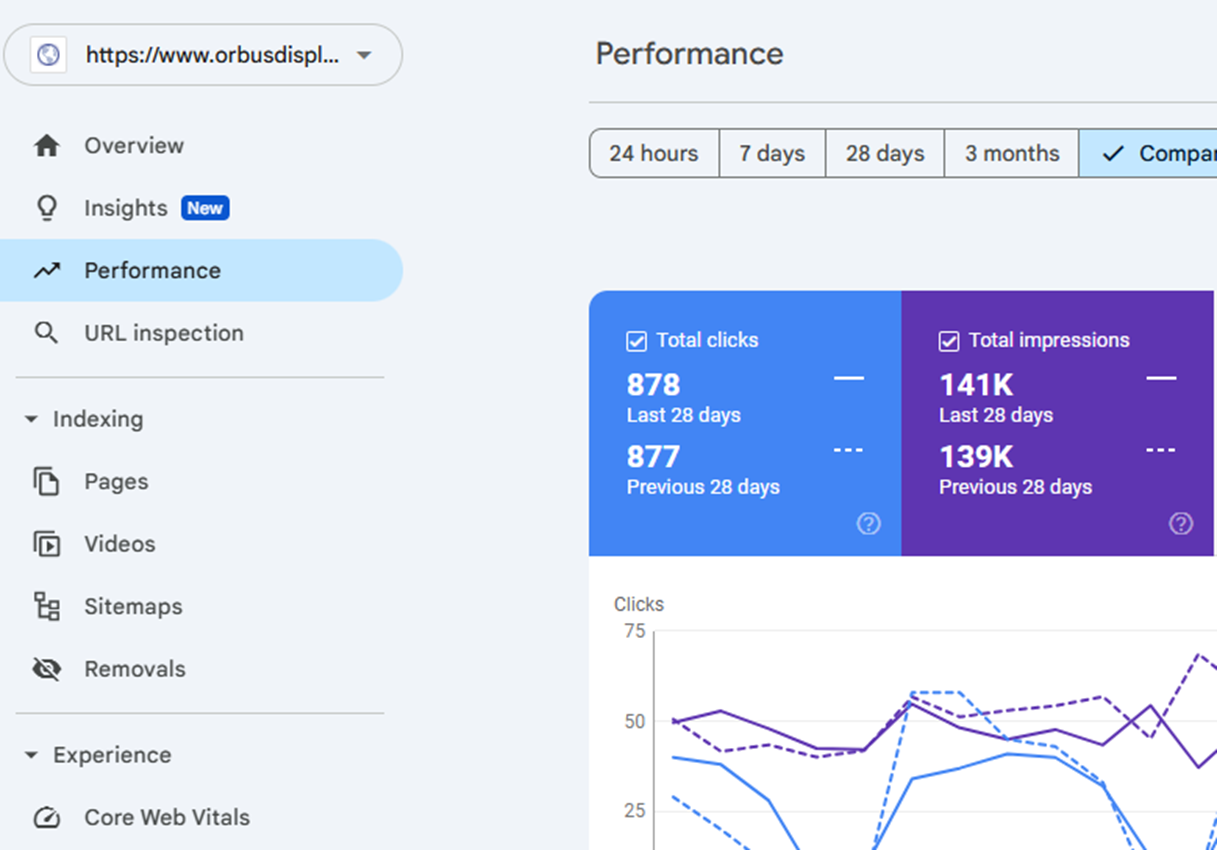
- Total impressions increased from 139K to 141K in a 28-day period
- Total clicks reached 878, showing improved search visibility and engagement consistency
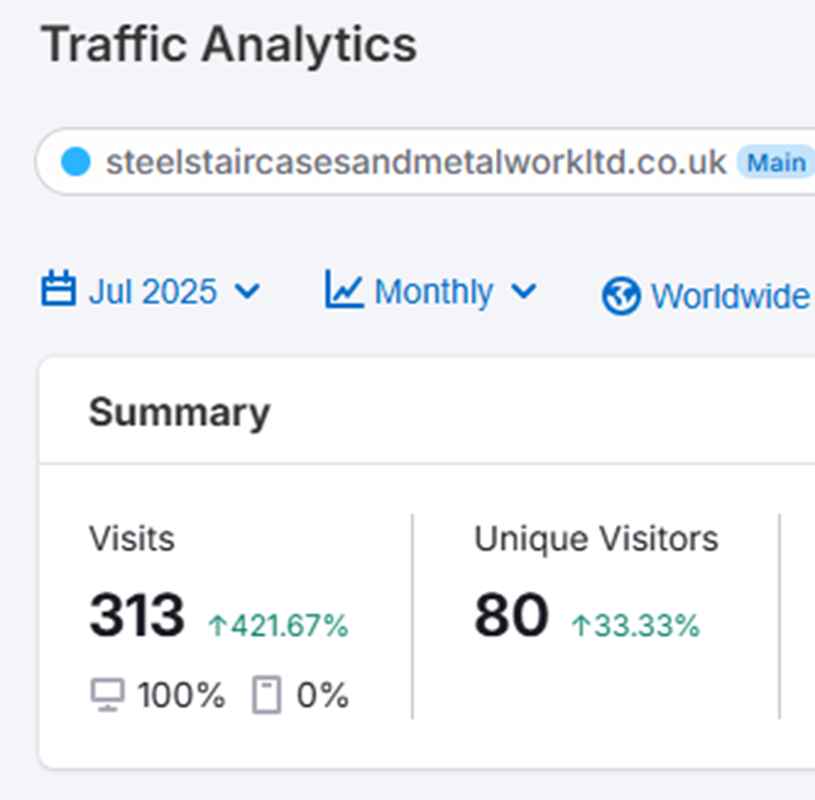
- Traffic analytics showed a 313 monthly visit spike (+421% growth)
- Unique visitors reached 80+, indicating expansion into new audience segments
These numbers reflect a clear upward trend in organic discovery and user acquisition.
5.3 AI Search Visibility
One of the most notable achievements was the improvement in AI-driven search visibility.
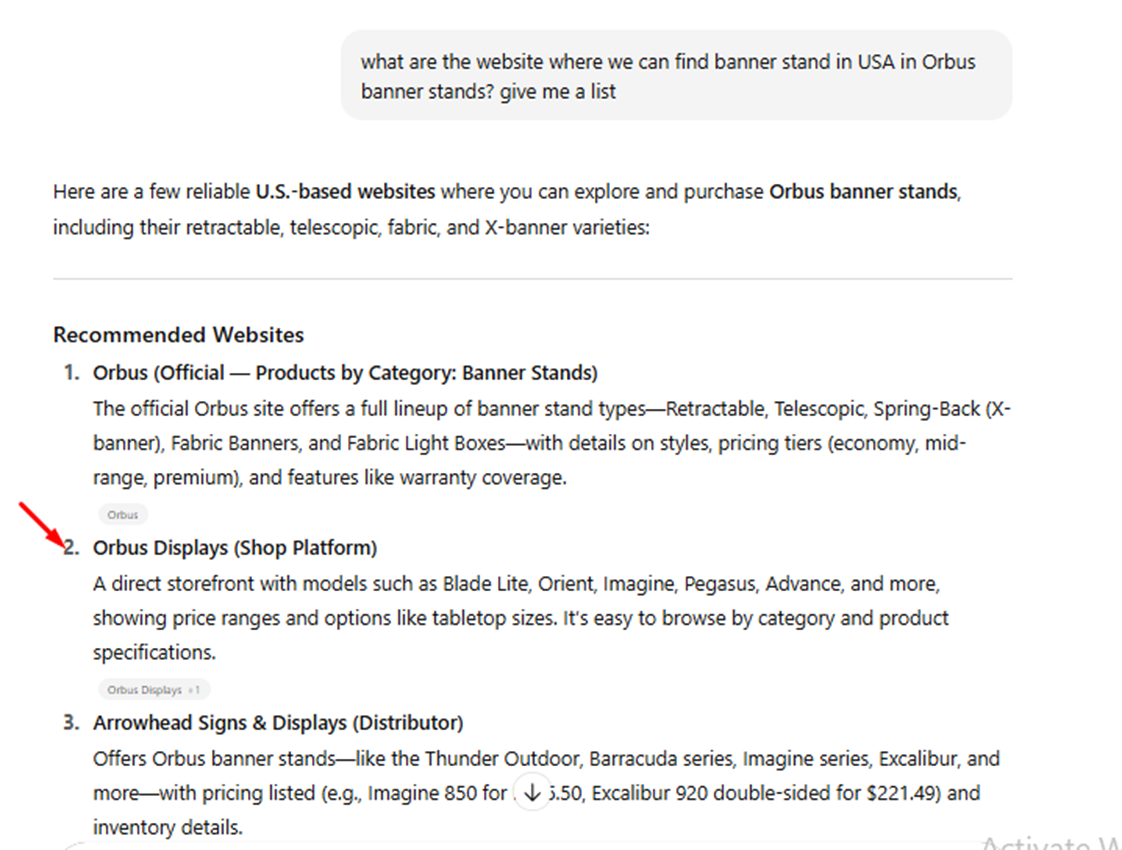
Content from Orbus Displays began appearing in AI-generated summaries and conversational search outputs, including platforms that rely on structured content extraction.
A key indicator of this shift was the visibility of Orbus-related content in AI-assisted query responses and informational lists generated by LLM-based systems, demonstrating the effectiveness of AI-ready SEO structuring.
This shift highlights how modern SEO is expanding beyond Google rankings into AI answer engines and generative search ecosystems.
5.4 User Engagement Improvements
The optimization efforts also led to improved engagement metrics:
- Increased number of unique visitors, indicating stronger reach
- Higher engagement from high-intent users searching for specific display solutions
- Better content interaction due to improved readability and intent matching
Users were able to find relevant product information faster, leading to improved overall user experience and engagement quality.
5.5 Backlink & Authority Signals
The campaign also contributed to improvements in authority signals:
- Growth in referring domain activity and backlink profile strength
- Stabilization of link acquisition patterns through improved content relevance
- Strengthening of overall domain trust and topical authority
The site’s authority score stabilized at a healthy level (around 12), reflecting gradual improvements in credibility and search engine trust signals.
Conclusion
The Orbus Displays case study clearly demonstrates how search intent optimization can transform organic performance when combined with semantic SEO and AI-driven strategies.
By focusing on intent mapping, content restructuring, and AI search readiness, ThatWare was able to significantly improve visibility, engagement, and search performance for Orbus Displays in a highly competitive industry.
The results highlight a clear shift in modern SEO dynamics:
- Rankings are no longer driven by keywords alone
- Semantic depth and user intent are now primary ranking factors
- AI systems are becoming central to how search visibility is determined
Ultimately, this project reinforces a critical takeaway: success in today’s SEO landscape depends on how well a brand aligns with user intent, semantic meaning, and AI-driven search interpretation systems.
Orbus Displays now stands as a strong example of how structured intent optimization and AI-first SEO methodologies can drive measurable growth in both traditional and next-generation search ecosystems.