SUPERCHARGE YOUR ONLINE VISIBILITY! CONTACT US AND LET’S ACHIEVE EXCELLENCE TOGETHER!
Search systems no longer depend only on whether a page contains an exact keyword. They interpret the subject of the page, the user’s intent, the entities being discussed, the relationships among those entities, the depth of coverage and the wider authority of the website.
ThatWare’s Semantic SEO services are designed to turn a website from a collection of keyword-targeted URLs into a connected knowledge structure. Every important page receives a defined topic, intent, entity set, relationship model, internal-link role and place within the wider topical architecture.
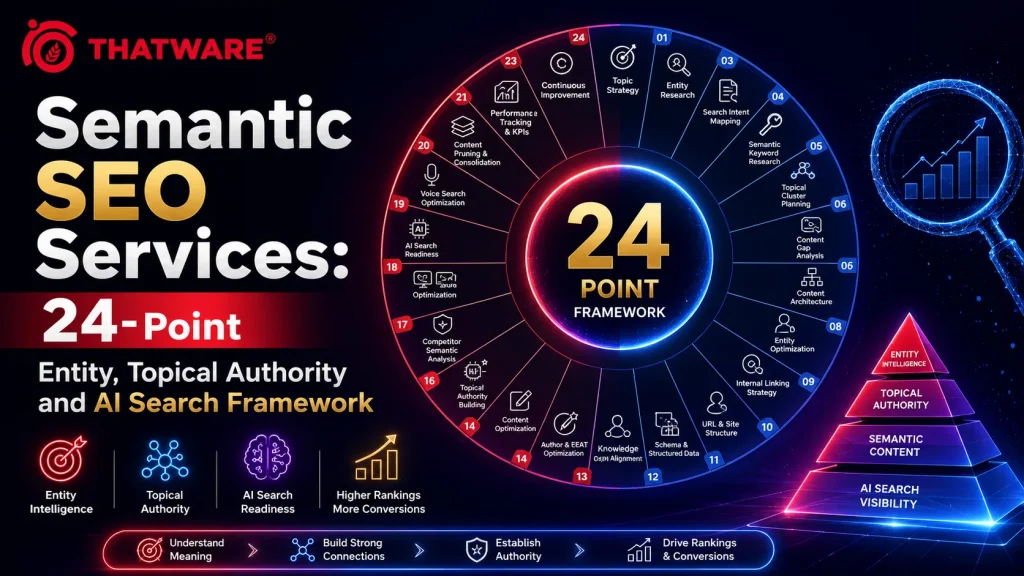
The submitted audit translates this approach into 24 individually assessed deliverables. Each deliverable contains an audit finding, a plan of action, a before-and-after fix model, an implementation output and a measurable success indicator.
The live pricing page already explains Semantic SEO through strategy, auditing, intent mapping, semantic keyword research, topic clusters, entities, topical authority, content gaps, structured data, knowledge graphs and AI search readiness. It therefore has a strong subject foundation. However, the proposed version below makes the offering more implementation-focused, connects it directly with the 24 audited deliverables and replaces broad descriptions with measurable outputs. (Thatware)
Analysis of the Existing Semantic SEO Pricing Page
The live page positions Semantic SEO pricing around meaning, context, user intent, entity relationships and topical authority. It also explains that the service supports AI-powered search by improving structured answers, source clarity, content summaries, structured data and connected topic clusters. (Thatware)
Its existing strengths include:
- Clear differentiation between keyword-based SEO and meaning-based optimization
- Detailed coverage of entities and topic clusters
- Strong alignment with internal linking and structured data
- Inclusion of knowledge graph alignment
- Inclusion of NLP and embedding-based analysis
- Recognition of AI search and semantic readiness
- Monthly reporting and implementation positioning
The page can be strengthened in four important ways.
First, the live version uses several H1 headings, including headings for pricing, scope, benefits and importance. The revised page should use one H1, followed by correctly nested H2, H3 and H4 headings. (Thatware)
Second, the page currently explains approximately 20 broad service areas, while the submitted audit contains 24 precise deliverables. The revised page should make those deliverables visible and explain the business output of each one. (Thatware)
Third, each service area should contain a clear before state, implementation plan, after state and success metric. This helps prospects understand what ThatWare will diagnose, what will be changed and how progress will be demonstrated.
Fourth, Semantic SEO should be positioned as the foundation connecting conventional organic visibility with AEO, GEO, AI search visibility and LLM retrieval. ThatWare’s live page already introduces this relationship, but the revised content makes the implementation connection more explicit. (Thatware)
What Is Semantic SEO?
Semantic SEO is the process of improving how clearly a website communicates meaning.
Rather than optimizing a page for one phrase in isolation, it examines:
- What subject the page represents
- Which entity should be dominant
- Which supporting entities should appear
- What the user is trying to accomplish
- Which questions should be answered
- How the page relates to other pages
- Whether the topic is covered completely
- Whether content is structured logically
- Whether schema supports the visible meaning
- Whether search and AI systems can retrieve the correct information
A semantic campaign may still use keyword data, rankings, technical audits and backlinks. The difference is that these elements are organized around topics, entities, relationships and search intent.
How Semantic SEO Differs From Keyword-Only SEO
Keyword-only SEO often begins with a phrase and asks where it should be placed.
Semantic SEO begins with the subject and asks:
- Which page should own this topic?
- What does the user need from the page?
- Which concepts are essential to explain the subject?
- Which entities prove relevance and expertise?
- Which supporting pages are required?
- How should those pages be connected?
- Which content is redundant or incomplete?
- How should the subject be represented in structured data?
- Which page should be retrieved for a related AI prompt?
This difference affects the complete website architecture.
A keyword may belong inside a title or heading. An entity belongs within a larger network containing attributes, related entities, evidence, pages, authors, services, locations and contextual links.
Complete Service Scope From ThatWare
Core Semantic SEO Strategy and Consulting
ThatWare provides Semantic SEO services for businesses that need stronger topic ownership, entity clarity and long-term search authority.
As a specialist Semantic SEO company, ThatWare connects strategy, content, entities, site architecture, schema, internal linking and AI readiness within one implementation framework.
A capable Semantic SEO agency should not merely add related terms to existing copy. It should determine which page owns each topic, identify missing relationships and build a measurable topical authority system.
A Semantic SEO consultant can guide internal marketing, development, content and SEO teams through complex entity and architecture decisions.
ThatWare’s Semantic SEO consulting services are suitable for organizations that have internal implementation resources but need specialist auditing, modelling, briefs, recommendations or validation.
Our Semantic SEO audit services create a page-level view of content quality, entity coverage, search intent, topic depth and internal relationships.
Large organizations can use enterprise Semantic SEO services across multiple websites, regions, categories, products or business divisions.
Semantic SEO strategy consulting establishes the entity, content, architecture and authority principles that guide implementation.
Semantic SEO website optimization applies those principles across service pages, product pages, categories, articles, FAQs, author pages and conversion pathways.
ThatWare’s semantic search optimization services improve how clearly pages communicate meaning to both users and machine-driven search systems.
Semantic Auditing and Competitive Analysis
Our semantic content audit services examine whether each page fully explains its subject and satisfies its intended search purpose.
Entity SEO audit services identify missing, weak, ambiguous, overused or poorly positioned entities.
Topical authority audit services determine whether the website has sufficient pillar pages, supporting content, entity families and internal links around each important subject.
A semantic SEO baseline audit assigns an initial score to every priority URL before implementation begins.
The resulting semantic readiness assessment shows whether each page is ready, partially ready, underdeveloped or structurally misaligned.
ThatWare’s semantic competitor analysis services compare competing pages according to entity coverage, content structure, depth, answer format, schema and internal authority.
A semantic competitor gap analysis converts those differences into exact additions, rewrites or structural changes.
The wider semantic content gap analysis identifies missing meaning rather than only missing keyword phrases.
Our semantic SEO roadmap services organize those findings into phased implementation.
The final Semantic SEO monthly action plan assigns each task to an owner, page, deadline, output and success metric.
Topical Authority and Cluster Development
ThatWare’s topical authority building services organize website content around complete subjects.
Topical authority map development identifies the topics the website currently owns, partially supports or has not yet covered.
Our topical authority consulting services help teams decide which themes deserve investment and which supporting assets are required.
A topical authority gap analysis identifies missing subtopics, questions, entities, formats and evidence.
Our topic cluster strategy services define the relationship between pillar pages and narrower supporting content.
Pillar page architecture services determine the sections, subtopics, entities, FAQs, proof elements and links required on each central authority page.
A hub and spoke content strategy organizes broad topics around hubs and specialist questions around supporting spokes.
Our supporting content mapping services assign every article, FAQ, guide or comparison page to one authority objective.
Topical coverage optimization improves breadth, depth and relationship completeness across the cluster.
ThatWare’s content depth optimization services add the exact definitions, examples, comparisons, evidence and answers required without introducing filler.
Entity SEO and Knowledge Graph Development
Our entity SEO services clarify the people, brands, services, locations, topics, products and concepts represented by the website.
An entity-first SEO strategy assigns one primary entity and a controlled supporting entity set to each priority page.
Entity extraction services identify what search systems can currently detect within the content.
Entity coverage optimization improves pages that omit important related concepts or include irrelevant entity noise.
Entity salience optimization strengthens the prominence of the most important entity within titles, headings, introductions, summaries and schema.
Entity co-occurrence optimization places related concepts close enough to establish a clear relationship.
Our primary entity reinforcement services improve the consistency with which a page communicates its central subject.
Brand entity optimization services improve canonical naming, brand facts, profiles and topic associations.
Service entity optimization connects the organization with the services it provides, their attributes and their intended audiences.
Author entity optimization strengthens author identity, credentials, content relationships and reviewer signals.
ThatWare’s knowledge graph optimization services connect those entities through visible statements, internal links, identifiers and structured data.
Where required, custom knowledge graph development creates a controlled graph containing entity nodes, attributes, URLs and relationships.
Our semantic entity mapping services show where each entity appears and what it supports.
Entity relationship mapping services define relationships such as provider, author, subject, location, category, audience and related service.
Entity ownership mapping assigns one canonical page to each major entity.
Entity ambiguity reduction services address inconsistent names, overlapping pages and uncertain entity references.
sameAs optimization services align appropriate external profiles and identity references.
Entity-based content optimization strengthens pages according to the entities required for their topic and intent.
An entity-based schema strategy converts valid relationships into machine-readable structured data.
Our semantic knowledge graph consulting helps organizations maintain entity consistency as their website and content inventory expand.
Search Intent, NLP and Semantic Content Intelligence
ThatWare’s semantic keyword clustering services group phrases by meaning, context, entity and search purpose.
NLP keyword mapping services assign terms, synonyms, variants and related concepts to the most appropriate URLs.
Search intent relationship mapping explains how informational, commercial, comparison, local and support queries relate to one another.
Query-to-page intent mapping assigns each query group to a page capable of satisfying it without creating cannibalization.
Our semantic search intent analysis evaluates what type of page, answer and action users expect.
Intent-based content optimization changes content structure and calls to action according to the user’s stage.
Content relationship scoring services measure how closely pages relate and whether they should link, merge, split or remain separate.
Semantic relevance scoring services evaluate the alignment among topic, entity, intent and page content.
Contextual keyword optimization places important terminology where it contributes meaning instead of forcing repetitions.
Semantic content brief creation gives writers instructions covering intent, entities, headings, questions, proof, links and schema needs.
Internal Linking, Architecture and AI Search Readiness
Our contextual internal linking services connect pages that share a meaningful topic, entity or journey relationship.
A semantic internal linking strategy determines which supporting pages should strengthen each pillar or conversion page.
Internal link relevance optimization improves the source page, target page, anchor text and contextual placement of each link.
ThatWare’s semantic site architecture services organize pages according to topic hierarchy, entity ownership and user intent.
Hub and spoke architecture optimization ensures every hub has sufficient supporting content and each spoke has a defined authority role.
Breadcrumb taxonomy optimization aligns labels, categories, parent-child relationships and BreadcrumbList markup.
Our semantic schema markup services reinforce page type, entity relationships and visible content.
Structured data optimization for entities connects Organization, Person, Service, Article, WebPage, BreadcrumbList and other appropriate nodes.
AI search semantic optimization improves answer structure, entity clarity, source context and retrieval confidence for AI-driven discovery.
LLM-ready semantic content optimization prepares pages as clear, self-contained and sourceable knowledge resources for large language model retrieval.
Before and After Semantic SEO Implementation
Before Semantic SEO
A website may have many pages and still lack a coherent semantic system.
Common problems include:
- Pages created around isolated keywords
- No canonical page ownership for important topics
- Similar pages competing with one another
- Unclear search intent
- Weak or missing supporting entities
- Important entities mentioned only once
- Content depth measured by word count
- Blogs disconnected from commercial pages
- Pillar pages without sufficient supporting content
- Internal links added without relationship analysis
- Generic anchors
- Orphan pages
- Schema selected only for rich-result eligibility
- Author and brand evidence separated from claims
- Categories that do not reflect topical relationships
- Duplicate or thin taxonomy pages
- Content gaps recorded as keyword lists
- No knowledge graph model
- No cluster-level reporting
- No implementation or validation tracker
After Semantic SEO
The target state includes:
- One canonical owner for each priority topic and entity
- Intent-aligned page roles
- Complete topical authority maps
- Defined hubs, pillars and spokes
- Entity-rich content with controlled co-occurrence
- Semantic content briefs
- Page-specific depth recommendations
- Contextual internal linking
- Connected schema graphs
- Consistent author, brand and service entities
- Validated external identity signals
- Clear category, taxonomy and breadcrumb relationships
- Semantic gap tracking
- Cluster completion measurement
- Before-and-after entity scores
- Before-and-after internal-link evidence
- Monthly topical authority reporting
- AI-readable, LLM-ready page structures
ThatWare’s Audit, Action and Fix Method
The submitted framework applies the same delivery logic to all 24 deliverables.
Audit and Result
Each audit identifies:
- The page, cluster, entity or asset reviewed
- Evidence already present
- Missing semantic signals
- Current implementation status
- Search and authority risk
- Recommended focus
- Initial priority
Plan of Action
Each plan states:
- The tasks required
- The pages affected
- The owner
- The priority
- Dependencies
- Expected output
- Validation process
- Success metric
Fix Report
Each completed fix should record:
- Before condition
- Recommended change
- Implementation evidence
- After condition
- Updated semantic score
- Remaining weakness
- Follow-up task
- Next review point
Complete 24-Point Semantic SEO Framework
The following framework includes every deliverable listed in the submitted presentation.
Phase One: Semantic Baseline, Authority and Intent Intelligence
Semantic Foundation Auditing
1. Semantic SEO Audit for Content, Entities, Intent and Topical Depth
Before
Pages may contain useful copy and relevant keywords, but content quality, entity coverage, intent alignment and topic depth are reviewed separately. A page can therefore appear complete while still being semantically weak.
Plan of action
- Export every priority URL and classify the page type.
- Record the intended user and search purpose.
- extract primary, supporting and missing entities.
- Score informational and commercial intent alignment.
- Compare current sections with the expected topical model.
- Mark weak headings, answers, examples and proof blocks.
- Prioritize pages by revenue value, authority value, gap size and implementation effort.
After
Each priority URL has a combined semantic baseline showing:
- Intended topic
- Primary entity
- Supporting entities
- Search intent
- Topical-depth score
- Weak sections
- Recommended action
- Priority level
Implementation output
A semantic audit workbook containing URL, page type, entity coverage, intent fit, topic depth, weak sections, recommended action and priority.
Success metric
- Percentage of target pages audited
- Baseline semantic score per page
- Number of high-risk pages identified
- Percentage of findings converted into implementation tasks
2. Topical Authority Map Development
Before
Service pages, blogs, FAQs and guides exist, but no system explains which broad topics the website owns or which page should lead each topic family.
Plan of action
- Define the subjects that matter commercially.
- Select one pillar or authority page for every core topic.
- Map existing supporting pages to each pillar.
- Group related questions, entities, attributes and modifiers.
- Flag missing spokes and underdeveloped clusters.
- Classify topics as owned, supported, underbuilt or absent.
- update the map as new content and links are added.
After
The website has a visual authority model showing:
- Core topics
- Pillar URLs
- Supporting pages
- Entity families
- Missing assets
- Link paths
- Authority priority
Implementation output
A topical authority map with one record for each cluster and authority zone.
Success metric
- Cluster completeness percentage
- Missing spokes created
- Support-to-pillar link coverage
- Visibility movement by topic family
Search Intent and Competitor Intelligence
3. Search Intent Relationship Mapping
Before
Keywords may be grouped by shared wording while representing different user objectives. One page may attempt to satisfy someone researching a subject, comparing solutions and preparing to buy.
Plan of action
- Gather keyword groups, questions and long-tail queries.
- Analyse the dominant SERP format for each group.
- Label informational, comparison, commercial, transactional, local, navigational and support intent.
- Assign each intent to a suitable page role.
- Separate mixed intents that require different answers.
- Align the CTA with the user’s stage.
- Track impressions, CTR, engagement and conversion by intent group.
After
Every important query cluster has:
- A primary intent
- A secondary intent where relevant
- A journey stage
- A canonical target page
- A recommended content angle
- A suitable CTA
Implementation output
An intent relationship map linking queries with user objectives, page roles and conversion pathways.
Success metric
- Query-to-page confidence
- Cannibalization reduction
- CTR improvement
- Conversion movement by intent
4. Semantic Competitor Gap Analysis
Before
Competitors are reviewed mainly through rankings, backlinks and keyword coverage. Their semantic advantages are not converted into page-level actions.
Plan of action
- Select top-ranking competitors for each topic and intent.
- Extract headings, entities, subtopics, FAQs and answer formats.
- Compare depth, evidence, schema, internal links and page structure.
- Identify missing sections and weak explanations.
- Separate quick additions from full-page rebuilds.
- Assign each gap to an existing or new URL.
- Recheck rankings and answer-surface visibility after correction.
After
Every target page has a competitor gap profile containing:
- Missing entities
- Missing subtopics
- Weak headings
- Missing formats
- Evidence gaps
- Recommended additions
- Priority and effort
Implementation output
A semantic competitor grid with URL-level recommendations.
Success metric
- High-priority gaps closed
- Semantic coverage improvement
- Ranking movement
- Featured-answer visibility
- Cluster-level gains
Phase Two: Entity-First Strategy and Content Architecture
Entity Ownership and Page Roles
5. Entity-First SEO Strategy Planning
Before
SEO planning begins with keyword variants while entity ownership is secondary. Several pages may mention the same service without one becoming its recognized canonical source.
Plan of action
- Create an inventory of brand, author, service, product, location, audience and attribute entities.
- Select one owner page for each primary entity.
- Map supporting entities and attributes.
- Define proof requirements.
- Connect entity assignments with internal links and schema.
- Identify ownership conflicts.
- Reassess entity coverage after implementation.
After
Every priority URL has a controlled entity model containing:
- Primary entity
- Supporting entities
- Relevant attributes
- Associated audience
- Proof signals
- Internal-link targets
- Schema needs
Implementation output
An entity-first strategy plan with canonical ownership and reinforcement requirements.
Success metric
- Primary entity coverage
- Ownership conflicts resolved
- Entity recognition consistency
- Number of pages with complete entity models
6. Topic Cluster and Pillar Page Architecture
Before
The website contains related content, but there is no formal definition of pillars, spokes, cluster roles or required support.
Plan of action
- Select commercially important pillar topics.
- Audit existing supporting content.
- Identify missing definitions, questions, comparisons and use cases.
- Define the required pillar-page sections.
- Establish bidirectional link rules.
- Sequence production according to authority and conversion impact.
- Monitor cluster growth monthly.
After
Each cluster includes:
- A defined pillar URL
- Existing spokes
- Planned spokes
- Entity families
- Required pillar sections
- Link directions
- Completion status
Implementation output
A pillar and cluster architecture workbook.
Success metric
- Pillar-to-spoke coverage
- Internal-link completion
- Pillar visibility
- Number of clusters reaching the completion threshold
7. Supporting Content Map for Topical Authority
Before
Articles and FAQs may generate impressions without strengthening the service or pillar pages most important to the business.
Plan of action
- Inventory blogs, FAQs, resources, guides and comparisons.
- Assign each asset to one primary authority hub.
- Define its role as definition, problem, comparison, process, proof or FAQ.
- Record the entity or question gap it closes.
- Define anchor text and target-page links.
- Identify missing support pieces.
- Track assisted visits and conversions.
After
Every supporting asset has:
- A topical objective
- An authority hub
- An intent role
- A missing entity or question it addresses
- A defined internal-link path
- A measurable contribution
Implementation output
A supporting content map showing topic, purpose, target hub, entities, intent and links.
Success metric
- Supporting pages assigned to hubs
- Correct contextual links implemented
- Assisted conversions
- Hub-page authority improvement
Phase Three: Semantic Gaps, Depth and Content Briefing
Meaning and Coverage Improvement
8. Semantic Content Gap Identification
Before
Content gaps are recorded as new keyword opportunities. Missing entities, formats, evidence and user intents remain hidden.
Plan of action
- Compare the live content inventory with the topic map.
- Identify absent subtopics and questions.
- Identify missing or weak entities.
- Find unaddressed comparison, local, commercial, proof and process intents.
- Mark where a table, list, FAQ, glossary, example or case proof is required.
- Score each gap by demand, authority value, commercial relevance and effort.
- Re-score the affected cluster after implementation.
After
Every gap is classified as one or more of the following:
- Topic gap
- Entity gap
- Intent gap
- Format gap
- Evidence gap
- Internal-link gap
- Authority gap
Implementation output
A semantic gap register with type, page, recommendation, priority, owner and status.
Success metric
- High-value gaps closed
- Coverage score improvement
- Previously unanswered intents addressed
- Gap revalidation rate
9. Content Depth and Coverage Recommendations
Before
Word count is used as a substitute for depth. Some pages are short and incomplete, while others are long but repetitive.
Plan of action
- Record all current headings and information blocks.
- Define expected depth according to page type and intent.
- Flag missing definitions, steps, comparisons, examples, FAQs and proof.
- Recommend exact content modules.
- Remove filler or duplicated material.
- Estimate the expected semantic gain from each addition.
- Re-score depth after implementation.
After
Each page receives a depth plan explaining:
- Sections to retain
- Sections to expand
- Sections to consolidate
- New answers required
- New proof required
- New formats required
- Expected improvement
Implementation output
A URL-level content-depth recommendation workbook.
Success metric
- Topic-depth score
- Thin-section reduction
- Redundant-section reduction
- Improved engagement and ranking stability
10. Semantic Brief Creation for Priority Topics
Before
Writers receive keywords, headings and word-count guidance but little information about entities, relationships, proof and page purpose.
Plan of action
- Select topics according to authority and commercial value.
- Define the search intent and desired user action.
- Assign primary, secondary and supporting entities.
- Specify entities or claims to avoid.
- Outline the page structure.
- Add required questions, tables, examples and proof.
- Define contextual internal links.
- Add schema and review requirements.
- Score the finished draft against the brief.
After
Every priority content asset begins with a controlled specification covering:
- Page purpose
- Search intent
- Primary entity
- Supporting entities
- Section flow
- Required questions
- Evidence
- Links
- Schema
- CTA
Implementation output
A semantic content brief pack for all approved topics.
Success metric
- Brief completion rate
- First-draft approval rate
- Semantic score of completed content
- Reduction in revision cycles
Phase Four: Entity Coverage and Knowledge Graph Optimization
Page-Level Entity Improvement
11. Entity Extraction and Entity Coverage Improvement
Before
Entity usage depends on natural writing. Important concepts may be missing, misplaced or overshadowed by less relevant terminology.
Plan of action
- Extract entities from each target URL.
- Compare them against the topic model and leading competitors.
- Separate missing, weak, excessive and irrelevant entities.
- Recommend placement in titles, headings, introductions, FAQs and proof blocks.
- Remove off-topic entity noise.
- Align visible content with structured data.
- Re-run extraction after implementation.
After
Each page has a controlled entity coverage profile showing:
- Current entities
- Required entities
- Weak entities
- Irrelevant entities
- Recommended placement
- Content and schema changes
Implementation output
An entity coverage improvement report.
Success metric
- Entity coverage lift
- Missing entity reduction
- Irrelevant entity reduction
- Primary entity confidence
12. Knowledge Graph Optimization Recommendations
Before
Brand, service, author, topic and location information appears throughout the site, but their relationships must be inferred manually.
Plan of action
- Define the knowledge graph nodes.
- Assign a canonical page and identifier to each important entity.
- Map relationships among brands, authors, services, audiences, topics and locations.
- Audit external identity and profile consistency.
- Recommend suitable schema nodes and properties.
- Create concise canonical entity statements.
- Monitor graph completeness and ambiguity.
After
The website has a documented entity graph containing:
- Nodes
- Attributes
- Relationships
- Canonical URLs
- External references
- Structured data requirements
- Validation status
Implementation output
A knowledge graph optimization plan with schema and identity recommendations.
Success metric
- Graph completeness
- Entity ambiguity reduction
- Valid relationship coverage
- External identity consistency
13. Entity Salience and Co-Occurrence Optimization
Before
Relevant entities appear on the page but may be placed too low, too far apart or outside the sections where their relationship should be established.
Plan of action
- Record the location of primary and supporting entities.
- Score prominence within the title, H1, introduction, headings, answers and schema.
- Define important co-occurrence pairs.
- Rewrite weak sections.
- Position related concepts within the same contextual block.
- Align visible relationships with structured data.
- Re-test salience and contextual relevance.
After
Primary entities are prominent and supporting entities appear in meaningful relationships rather than isolated repetitions.
Implementation output
A salience and co-occurrence improvement plan.
Success metric
- Entity salience score
- Co-occurrence coverage
- Primary-topic recognition
- Semantic relevance improvement
Brand and Expertise Reinforcement
14. Author, Brand and Service Entity Strengthening
Before
Author credentials, brand proof and service claims may exist on separate pages. Search systems must infer whether the expertise supports the specific content.
Plan of action
- Audit author names, bios, credentials and related content.
- Audit company proof, citations, recognition, reviews and case evidence.
- Match relevant proof with each service.
- Add author, publisher, reviewer and service relationships where valid.
- Connect biographies with related articles and service pages.
- Place trust evidence near important claims.
- Track trust coverage by URL.
After
Priority pages clearly show:
- Who created or reviewed the content
- Why that person or organization is qualified
- Which service or topic the expertise supports
- Where the supporting evidence can be verified
Implementation output
An entity-strengthening pack covering authors, brand signals, service proof, links and schema.
Success metric
- Priority pages with complete trust signals
- Author-to-content relationship coverage
- Service proof coverage
- Schema relationship validity
Phase Five: Schema, Internal Linking and Semantic Architecture
Machine-Readable Meaning
15. Schema Recommendations for Semantic Understanding
Before
Schema is selected primarily for rich-result potential. Important entity and page relationships may remain undocumented.
Plan of action
- Classify every page type.
- Select appropriate schema types.
- Map entity properties such as name, description, about, mentions, author, provider, mainEntity and sameAs.
- Connect schema nodes using stable identifiers.
- Confirm that every statement matches visible content.
- Add validation and testing instructions.
- Maintain a deployment and review log.
After
Structured data reinforces the visible subject, page purpose and entity relationships without introducing unsupported claims.
Implementation output
A URL-level schema recommendation matrix.
Success metric
- Valid schema coverage
- Entity relationship coverage
- Zero critical content mismatches
- Reduction in schema errors and warnings
16. Contextual Internal Linking Plan
Before
Internal links are added manually, through navigation or according to keyword availability. Their entity, topic and authority relationships are not documented.
Plan of action
- Export all current internal links.
- Identify semantically related page pairs.
- Prioritize links from support pages to pillars and commercial destinations.
- Write natural entity-aware anchor text.
- Add links to valuable orphan or under-supported pages.
- Remove irrelevant or excessive links.
- Track crawl depth and target-page movement.
After
Every important internal link has:
- A source page
- A target page
- A semantic relationship
- An approved anchor
- A defined placement
- A priority
- A measurable purpose
Implementation output
A contextual linking workbook.
Success metric
- Recommended links implemented
- Orphan pages reduced
- Crawl depth improved
- Authority flow toward priority pages
- Target-page visibility movement
Website and Cluster Architecture
17. Semantic Site Architecture Recommendations
Before
The site may be convenient to navigate but fail to communicate which pages are central, supporting or secondary within each topic.
Plan of action
- Audit URL paths, folders, categories and parent pages.
- Define major topic groups.
- Assign pillar, supporting and conversion roles.
- Identify duplicated categories and misplaced content.
- Recommend navigation and contextual pathways.
- Suggest URL changes only where meaning improves materially.
- Monitor crawl depth, indexation and hub performance.
After
The website architecture reflects:
- Topic hierarchy
- Entity ownership
- User intent
- Page role
- Cluster relationships
- Conversion pathways
- Crawl priority
Implementation output
A semantic architecture map with restructuring recommendations.
Success metric
- Reduced crawl depth
- Clearer topic hierarchy
- Improved hub visibility
- Misclassified and orphan pages resolved
18. Hub-and-Spoke Content Structure Optimization
Before
Hubs and supporting pages exist, but their roles, links and completeness are inconsistent.
Plan of action
- Identify the pages that should act as hubs.
- Classify existing spokes by purpose.
- Identify missing spokes.
- Define bidirectional linking.
- Sequence new content according to authority impact.
- Add curated spoke sections to each hub.
- Monitor cluster strength and visibility.
After
Each cluster has a complete and controlled hub-and-spoke model.
Implementation output
A hub-and-spoke blueprint showing page roles, missing assets and link direction.
Success metric
- Hub-spoke completion
- Bidirectional link coverage
- Pillar visibility
- Cluster authority improvement
19. Breadcrumb, Category and Taxonomy Recommendations
Before
Breadcrumbs, category names, tags and URL paths may use inconsistent or overlapping terminology.
Plan of action
- Inventory all categories, tags, parents and breadcrumbs.
- Normalize overlapping or vague labels.
- Establish logical parent-child paths.
- Remove or consolidate thin tag archives.
- Align visible breadcrumbs and BreadcrumbList markup.
- Review taxonomy indexability.
- Monitor category and crawl performance.
After
Taxonomy and breadcrumb systems reinforce the same semantic hierarchy used by content and internal links.
Implementation output
A taxonomy recommendation sheet containing labels, relationships, paths, schema and required changes.
Success metric
- Breadcrumb consistency
- Duplicate taxonomy reduction
- Thin archive reduction
- Clear parent-child relationship coverage
Phase Six: Relationship Scoring, Roadmap and Reporting
Content Relationship Intelligence
20. Content Relationship and Relevance Scoring
Before
Page relationships are determined manually. Closely related pages may compete, while useful related pages may remain disconnected.
Plan of action
- Generate potential related page pairs.
- Compare entities, topics and intent.
- Score semantic similarity.
- Identify potential cannibalization.
- Recommend link, merge, split, rewrite or no action.
- Prioritize relationships affecting pillar and revenue pages.
- Re-score after implementation.
After
Each relevant URL pair has:
- A relationship score
- Shared entities
- Intent compatibility
- Cannibalization risk
- Recommended action
- Priority
Implementation output
A content-relationship scorecard.
Success metric
- Relevance score improvement
- Cannibalization reduction
- Weak page pairs resolved
- Relevant contextual links created
Execution and Performance Management
21. Semantic SEO Roadmap and Monthly Action Plan
Before
Audit findings exist in separate documents without one delivery schedule.
Plan of action
- Consolidate audit, entity, content, schema and linking recommendations.
- Score each task by impact, value, risk and effort.
- Group tasks into audit, build, optimize, validate and report phases.
- Assign owners and dependencies.
- Define one success metric per task.
- Establish monthly capacity.
- Reprioritize according to measured results.
After
The campaign operates from one implementation roadmap containing:
- Task
- Target URL
- Cluster
- Owner
- Priority
- Due month
- Dependency
- Output
- KPI
- Status
Implementation output
A monthly Semantic SEO roadmap and delivery tracker.
Success metric
- Monthly roadmap completion
- High-impact tasks completed
- Blocked-task reduction
- Percentage of completed tasks validated
22. Topical Authority Growth Report
Before
Reports show rankings and traffic but do not explain whether topic clusters are becoming more complete or authoritative.
Plan of action
- Define reporting clusters.
- Measure visibility by topic family.
- Track pillar and spoke completion.
- Track entity and schema coverage.
- Track contextual internal links.
- Connect performance changes with completed work.
- Identify the next authority gaps.
After
Stakeholders can see how each topic family is progressing across content, entities, links, schema and visibility.
Implementation output
A monthly topical authority report.
Success metric
- Cluster-completeness trend
- Visibility by topic family
- Pillar performance
- Entity coverage growth
- Internal-link coverage growth
23. Semantic Gap and Cluster Completion Tracker
Before
Gaps may be identified but remain open because ownership, dates, implementation and revalidation are not centralized.
Plan of action
- Import every gap from all audits.
- Assign the relevant cluster and URL.
- Add an owner, deadline and dependency.
- Track planned, writing, review, published and validated states.
- attach implementation evidence.
- Re-score completed fixes.
- Report closure rates and blockers.
After
Every semantic gap can be followed from discovery through implementation and validation.
Implementation output
A semantic gap and cluster tracker.
Success metric
- Gap closure percentage
- Revalidation percentage
- Clusters reaching completion threshold
- Average time from discovery to validation
24. Entity and Internal Linking Improvement Report
Before
Entity edits and internal-link changes may be reported separately, making their combined semantic effect difficult to demonstrate.
Plan of action
- Record baseline entity coverage.
- Record baseline internal links, anchors and crawl depth.
- Document entities added, removed, repositioned or reinforced.
- Document links added, updated or removed.
- Re-score entity and link strength.
- Attach page-level implementation evidence.
- Summarize performance movement and remaining actions.
After
Stakeholders receive one before-and-after report showing how content meaning and authority flow changed.
Implementation output
An improvement report containing:
- Baseline entity score
- Updated entity score
- Links added
- Anchors used
- Crawl-depth movement
- Semantic score change
- Evidence
- Next recommendation
Success metric
- Entity coverage lift
- Contextual links implemented
- Orphan-page reduction
- Improved target-page semantic strength
- Visibility movement after implementation
Recommended 12-Month Semantic SEO Roadmap
Months 1 and 2: Baseline and Semantic Intelligence
Complete:
- Semantic baseline audit
- Search-intent mapping
- Competitor gap analysis
- Entity inventory
- Entity ownership assignment
- Initial semantic scoring
- Priority fix queue
Months 3 and 4: Topic and Cluster Architecture
Complete:
- Topical authority map
- Pillar architecture
- Supporting-content map
- Hub-and-spoke blueprint
- Semantic gap register
- Content-depth recommendations
Months 5 and 6: Content and Entity Optimization
Complete:
- Semantic content briefs
- Entity extraction
- Entity coverage improvements
- Entity salience changes
- Co-occurrence improvements
- Author, brand and service strengthening
Months 7 and 8: Knowledge Graph and Schema
Complete:
- Knowledge graph recommendations
- Canonical entity statements
- External identity alignment
- Entity-based schema strategy
- Schema deployment and validation
- Breadcrumb and taxonomy improvements
Months 9 and 10: Architecture and Internal Linking
Complete:
- Contextual link map
- Orphan-page fixes
- Semantic site architecture
- Cluster-navigation improvements
- Content relationship scoring
- Consolidation and cannibalization fixes
Months 11 and 12: Validation and Growth Reporting
Complete:
- Semantic re-scoring
- Cluster-completion validation
- Entity and internal-link report
- Topical authority growth report
- Remaining gap prioritization
- Next-year Semantic SEO roadmap
Recommended Monthly Semantic SEO Dashboard
The dashboard should include:
- URLs audited
- Baseline semantic score
- Average updated semantic score
- Primary entity coverage
- Supporting entity coverage
- Entity salience
- Entity ownership conflicts
- Intent-to-page confidence
- Cannibalization risks
- Topic clusters mapped
- Cluster completeness
- Missing spokes
- Supporting pages linked
- Contextual links added
- Orphan pages resolved
- Average crawl depth
- Schema coverage
- Schema validation errors
- Knowledge graph completeness
- Semantic gaps identified
- Semantic gaps closed
- Content briefs completed
- Pages improved
- Content-depth score
- Pillar visibility
- Topic-family visibility
- AI search readiness
- Roadmap completion
- Next-month priorities
Build Search Authority Around Meaning
A website should not be treated as a disconnected collection of keywords and pages.
It should operate as a structured knowledge system in which:
- Every topic has an owner
- Every page has a purpose
- Every entity has a clear identity
- Every supporting asset strengthens a larger authority objective
- Every internal link communicates a relationship
- Every schema statement reflects visible evidence
- Every content gap is tracked through implementation
- Every improvement can be validated
ThatWare’s 24-point framework turns Semantic SEO into a practical programme of auditing, mapping, content improvement, entity engineering, architecture, implementation and reporting.