
SUPERCHARGE YOUR ONLINE VISIBILITY! CONTACT US AND LET’S ACHIEVE EXCELLENCE TOGETHER!
Search optimisation has moved beyond manual keyword placement, generic technical checklists and occasional content updates.
Search engines and AI-powered discovery systems analyse meaning, intent, entities, relationships, page quality, authority, freshness, structured data and user experience. Businesses now need a search strategy that can process larger datasets, recognise patterns sooner, prioritise opportunities accurately and connect every recommendation with a measurable business outcome.
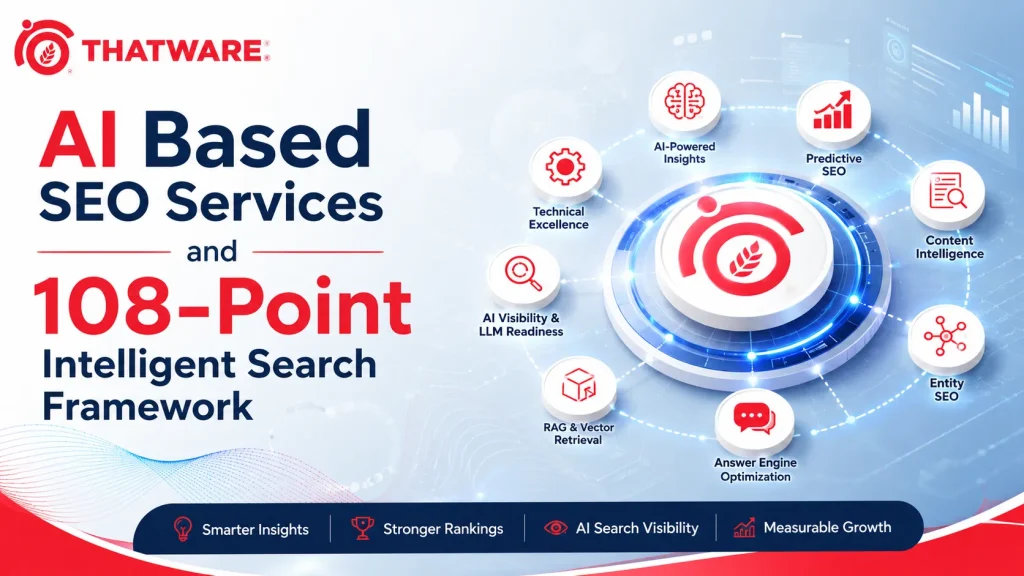
ThatWare’s AI Based SEO pricing services combine human SEO expertise with artificial intelligence, machine learning, natural language processing, semantic modelling, predictive analytics, answer engineering and workflow automation.
The framework is designed to improve performance across:
- Traditional organic search
- Google AI Overviews
- Featured snippets
- People Also Ask results
- Conversational search
- Voice search
- AI-generated answers
- Entity-based discovery
- Large language model retrieval
- Local and commercial search journeys
The purpose is not to replace experienced SEO professionals with automated tools. The purpose is to give strategists, content teams, developers and decision-makers better evidence, clearer priorities and faster implementation pathways.
What Is AI-Based SEO?
AI-Based SEO is an advanced search optimisation model that uses artificial intelligence to analyse, prioritise, create, test and improve SEO activity.
It can process information from:
- Website crawls
- Search performance
- Keyword datasets
- Search-result pages
- Competitor websites
- Content inventories
- Structured data
- Backlink profiles
- User behaviour
- AI prompts
- Entity relationships
- Internal links
- Conversion pathways
The system uses these inputs to identify technical blockers, content gaps, ranking opportunities, weak entity signals, conversational questions, answer-surface opportunities and emerging search patterns.
Human experts then validate the findings, approve the strategy and control implementation.
How AI-Based SEO Differs From Basic SEO Automation
Basic SEO automation performs repeatable tasks such as exporting keyword rankings, scanning broken links or generating metadata suggestions.
AI-Based SEO goes further by interpreting relationships and probabilities.
It can help answer questions such as:
- Which technical problem is most likely to affect revenue?
- Which page should own a particular search intent?
- Which content gap is commercially important?
- Which competitor format is winning the answer surface?
- Which page is most likely to improve with a targeted rewrite?
- Which entity relationships remain unclear?
- Which topics could gain demand in the coming months?
- Which answers are too long for AI extraction?
- Which pages should be refreshed before performance declines?
- Which recommendations should enter the next implementation sprint?
ThatWare combines these AI-supported findings with technical review, editorial judgement, entity governance, structured data validation and strategic quality control.
ThatWare’s Complete AI SEO Service Scope
Core AI SEO Strategy and Consulting
ThatWare provides AI Based SEO services for businesses seeking a more intelligent alternative to conventional optimisation. Our AI SEO services connect technical SEO, content intelligence, entity optimisation, answer engineering, predictive analysis and AI search readiness.
As an AI SEO company, ThatWare develops measurable strategies rather than relying on isolated automated recommendations. A specialist AI SEO agency should be able to audit data, interpret opportunities and connect every action with a target page, business objective and validation method.
An AI SEO consultant can guide internal marketing, editorial and development teams through complex implementation decisions. Our AI SEO consulting services can support organisations with an existing execution team that needs specialist audits, models, roadmaps and quality assurance.
ThatWare’s AI SEO audit services establish a baseline across technical health, content quality, search intent, semantic relevance, entity clarity, AI visibility and conversion readiness. Large organisations can use enterprise AI SEO services across multiple domains, regions, languages, teams and product categories.
Our AI-driven SEO services combine automation with human validation. ThatWare is positioned as an artificial intelligence SEO company that uses data science and search intelligence to strengthen decision-making without removing editorial or strategic accountability.
AI Technical Auditing and Website Health
An AI-powered SEO audit examines technical, content, semantic and visibility issues within one connected assessment.
Our AI technical SEO audit services review crawl paths, indexation, rendering, canonicalisation, redirects, sitemaps, mobile usability, page performance and structured data.
An AI content and visibility audit evaluates how well the website explains its subjects and whether important pages appear across traditional and AI-driven search environments.
ThatWare’s AI crawlability audit services identify pages, resources and conversion paths that may be difficult for search systems to access. AI indexability analysis determines which URLs are indexed, excluded, duplicated, canonicalised or incorrectly prioritised.
Our AI crawlability optimization services convert these findings into URL-level implementation tasks. An automated technical SEO audit can identify recurring patterns at scale, while expert review confirms whether each recommendation is appropriate.
An AI website health audit connects technical findings with traffic, visibility, user experience and conversion risk. Our AI SEO issue detection services identify potential problems, while automated SEO issue prioritization ranks them by severity, commercial impact, implementation effort and dependency.
Predictive SEO and Competitive Intelligence
ThatWare’s predictive SEO services use historical performance, competitor movement, topic demand and ranking signals to identify likely opportunities.
Predictive ranking analysis estimates which pages have the strongest improvement potential. Predictive keyword opportunity analysis compares current performance, search demand, intent, competition and page readiness.
AI SEO opportunity forecasting helps teams plan content and technical work before demand becomes highly competitive.
Our AI-assisted competitor analysis examines page structure, answer format, schema, entities, authority, links, trust signals and conversion paths. An AI competitor gap analysis identifies what competitors communicate or structure more effectively.
AI content opportunity scoring assigns a weighted score to each proposed page, section or rewrite. The resulting predictive SEO opportunity pipeline creates an ongoing list of opportunities ranked by value and probability.
ThatWare’s AI search competitive intelligence separates traditional ranking competitors from businesses or sources appearing inside AI-generated answers. Our algorithm update impact analysis services compare performance changes by page type, query class, topic cluster and technical condition.
AI Keyword, Query and Intent Intelligence
Our AI keyword research services identify exact phrases, semantic variants, questions, modifiers and conversational prompts.
AI keyword clustering services group those phrases by meaning, intent, entity, funnel stage and target URL. AI semantic keyword research focuses on relationships rather than repeating isolated terms.
ThatWare’s AI search intent analysis classifies searches as informational, commercial, transactional, comparison, local, navigational or support-based. Search intent prediction services help estimate the format and depth users are likely to expect.
Automated keyword mapping services assign every priority query family to one canonical page. Conversational keyword research captures the natural language used in longer searches and AI prompts.
Our AI query clustering services organise prompt and question variants into usable content groups. Question-based keyword research identifies opportunities for FAQs, guides, comparison sections, tables, steps and direct answers.
NLP keyword and synonym mapping defines natural variations while protecting pages from keyword cannibalisation.
AI Content Optimisation and Automation
ThatWare’s AI content optimization services improve existing pages according to search intent, semantic coverage, answer quality, entity clarity and conversion needs.
Our AI content audit services score content for completeness, structure, readability, duplication, evidence and machine comprehension. AI content gap analysis identifies missing subjects, questions, entities, proof elements and answer formats.
AI-assisted content brief creation gives writers clear instructions covering primary entities, secondary entities, intent, headings, questions, evidence, schema, internal links and calls to action.
Our AI metadata optimization services develop title and description recommendations based on query relevance and click potential. AI heading optimization services improve hierarchy, clarity, entity placement and answer extraction.
Automated SEO content recommendations may include paragraph rewrites, summaries, lists, tables, FAQs, internal links and schema opportunities.
AI content refresh prioritization identifies which assets require updating first. An AI topical authority roadmap organises hubs, supporting pages, questions and entity relationships.
ThatWare’s AI SEO workflow automation connects audit findings, briefs, approvals, implementation tasks, validation and reporting.
Answer Engine and Conversational Search Optimisation
Our AI answer optimization services develop clear, complete and extractable responses for high-value questions.
AI answer surface optimization improves content for featured snippets, People Also Ask results, AI Overviews, voice interfaces and conversational systems.
ThatWare’s Answer Engine Optimization services connect question research, answer structure, source authority, schema, entities and validation.
Question-answer opportunity mapping determines which questions matter, which page should answer them and what format should be used.
Our conversational search optimization services align content with natural-language prompts. High-intent question clustering separates general research questions from comparison, cost, suitability and purchase-ready questions.
Featured snippet optimization services create concise paragraph, list, table and process formats. People Also Ask optimization services assign related questions to the most relevant pages.
Google AI Overview optimization strengthens source pages through direct answers, evidence, clear entities, citations, internal links and current information.
Voice search answer optimization prepares concise spoken responses that remain accurate without relying on visual context.
Entity, Schema and Knowledge Graph Optimisation
ThatWare’s AI entity optimization services clarify organisations, services, people, products, locations, topics and relationships.
Our entity SEO services align those entities across visible content, structured data, internal links and external sources.
Entity-based JSON-LD implementation creates connected machine-readable relationships. AI schema optimization services determine which types and properties support the page without overstating its purpose.
Our structured data optimization services include deployment, validation, error tracking and visible-content checks.
Custom knowledge graph development connects canonical entities, URLs, attributes, evidence and relationships within a governed model.
RAG, Vector Retrieval and LLM Readiness
ThatWare’s RAG implementation services create controlled knowledge resources for retrieval-augmented systems.
Our vector search optimization services improve how approved passages are represented, indexed and retrieved.
AI content chunking services divide large pages into focused, independently understandable blocks.
LLM-ready website optimization strengthens page structure, source clarity, entity context, metadata, answer primitives and machine-readable discovery assets.
Before and After AI-Based SEO Implementation
Before Implementation
A website may contain valuable content but still suffer from:
- Technical issues stored in disconnected audit files
- No prioritisation by commercial impact
- Keywords without clear page ownership
- Overlapping service or category pages
- Competitor gaps without opportunity scores
- Long paragraphs that delay the answer
- Generic metadata
- Incomplete FAQs
- Weak entity connections
- Missing or unvalidated structured data
- Limited visibility reporting for AI search
- Content refreshes based only on age
- No predictable opportunity pipeline
- No implementation tracker
- No retrieval-ready content system
- No controlled AI-facing source files
- No human approval process for AI recommendations
After Implementation
The target state includes:
- A URL-level technical and content issue register
- Ranked implementation priorities
- Canonical keyword and query mapping
- Predictive opportunity scoring
- Competitor and answer-surface intelligence
- Answer-first content modules
- Page-specific metadata and heading plans
- Controlled entity and relationship maps
- Validated structured data
- RAG-ready source records
- Vector-optimised content clusters
- AI visibility tracking
- Content freshness and drift monitoring
- Monthly implementation reporting
- Human review and governance controls
- Machine-readable discovery and source files
ThatWare’s Audit, Action and Fix Method
The uploaded framework uses a consistent method for every deliverable.
Audit and Result
Every workstream begins with:
- The exact asset or URL reviewed
- Existing evidence
- The identified gap
- Current status
- Potential risk
- Recommended focus
Plan of Action
The plan defines:
- High-priority tasks
- Medium-priority tasks
- Ongoing monitoring
- Required owner
- Expected output
- Success measurement
- Dependencies
- Validation requirements
Fix Report
The fix report records:
- Before state
- Target after state
- Exact change
- Implementation proof
- Validation result
- Remaining risk
- Performance metric
- Future review requirement
The Complete 108-Point AI-Based SEO Framework
Phase One: AI SEO Intelligence, Auditing and Planning
Technical and Visibility Intelligence
1. AI-Powered Technical, Content and Visibility SEO Audit
Before: Technical, content and visibility issues are reviewed separately, making it difficult to understand their combined effect.
Plan: Audit crawlability, indexation, content quality, search intent, entity clarity, AI visibility and conversion paths. Record each issue by URL, severity, impact and implementation effort.
After: The organisation receives one URL-level AI SEO audit covering technical, semantic, visibility and business risks.
Output and metric: AI SEO issue register. Measure unresolved high-impact issues, completed fixes and verified performance improvements.
2. AI Crawlability and Indexability Issue Detection
Before: Important pages may be blocked, duplicated, orphaned, incorrectly canonicalised or rendered inconsistently.
Plan: Audit robots directives, canonicals, XML sitemaps, redirects, rendering, crawl depth, internal links and indexation signals.
After: Priority pages have clear crawl and index paths.
Output and metric: Crawlability and indexability workbook. Measure index coverage, crawl errors and successful page validation.
3. AI-Assisted Competitor Gap Analysis
Before: Competitor research focuses mainly on rankings and keyword lists.
Plan: Compare competitors by page type, content format, schema, entities, evidence, backlinks, answer ownership and conversion pathway.
After: Competitor advantages are converted into page-specific opportunities.
Output and metric: Competitor gap matrix. Measure priority gaps closed and target-page movement.
4. Predictive Ranking and Opportunity Analysis
Before: SEO priorities are chosen through historical performance or intuition.
Plan: Analyse ranking proximity, demand, authority, content quality, competition, intent and implementation effort.
After: Pages are ranked by improvement potential and business value.
Output and metric: Predictive opportunity model. Measure forecast accuracy and performance of prioritised pages.
5. Automated SEO Issue Prioritization by Impact
Before: Technical and content recommendations are presented as one unranked task list.
Plan: Score issues by visibility impact, revenue relevance, risk, affected URLs, dependency and implementation complexity.
After: Teams receive a sequenced fix queue rather than a generic audit.
Output and metric: Impact-scored backlog. Measure closure of critical and high-priority tasks.
Keyword, Intent and Content Opportunity Intelligence
6. AI-Driven Keyword Research and Clustering
Before: Keywords are collected without consistent intent or page ownership rules.
Plan: Extract exact terms, questions, semantic variants, local modifiers and conversational prompts. Cluster them by entity, intent and canonical page.
After: Every keyword family supports one defined content destination.
Output and metric: Keyword and query map. Measure long-tail growth and reduced cannibalisation.
7. AI Content Gap Detection
Before: Gap analysis identifies missing keywords but may overlook missing questions, proof and entities.
Plan: Compare the website with competitors, SERP formats, AI-generated answers and user journeys.
After: Content gaps become specific creation, expansion, consolidation or evidence tasks.
Output and metric: Content gap register. Measure high-value gaps closed.
8. Search Intent Prediction and Classification
Before: Several pages may target the same keyword without matching the same user need.
Plan: Classify queries and pages by informational, commercial, comparison, transactional, local, navigational and support intent.
After: Content type, page structure and CTA reflect the predicted intent.
Output and metric: Intent classification matrix. Measure target-page alignment and engagement.
9. Topical Authority Roadmap Generation
Before: Content is published as isolated blogs or pages.
Plan: Map pillar topics, supporting entities, questions, proof assets, internal links and commercial destinations.
After: The website follows a connected authority-building roadmap.
Output and metric: Topical roadmap. Measure cluster completion and visibility growth.
10. Automated Content Opportunity Scoring
Before: Every content idea appears equally important.
Plan: Score opportunities by demand, ranking potential, commercial value, content gap, authority and production effort.
After: High-value pages and updates enter the production queue first.
Output and metric: Content opportunity scorecard. Measure performance of prioritised content.
AI Content Production and Quality Control
11. AI-Assisted Content Brief Creation
Before: Briefs contain keywords and headings but omit entity, evidence and answer requirements.
Plan: Add intent, entities, questions, answer formats, internal links, schema notes, proof elements and CTA guidance.
After: Writers receive complete search and AI-readiness instructions.
Output and metric: AI content brief template. Measure first-draft acceptance and reduced revision cycles.
12. AI Content Optimization for Existing Pages
Before: Existing pages receive superficial keyword edits.
Plan: Improve intent alignment, opening answers, semantic coverage, entities, evidence, headings, links, readability and CTA progression.
After: Each page has a clearer search purpose and stronger answer structure.
Output and metric: Page optimisation pack. Measure rankings, engagement and answer extraction.
13. AI-Generated Metadata and Heading Recommendations
Before: Titles, descriptions and headings are generic or duplicated.
Plan: Generate options based on intent, differentiation, click value, page entity and expected answer format. Require human selection and editing.
After: Metadata and headings communicate page relevance clearly.
Output and metric: URL-level metadata sheet. Measure CTR and query alignment.
14. Automated FAQ, Summary and Snippet Block Recommendations
Before: Useful answers remain hidden inside long paragraphs.
Plan: Identify suitable FAQ, summary, list, table, step and snippet opportunities.
After: Priority pages contain reusable, structured answer modules.
Output and metric: Answer-module recommendation pack. Measure extraction and engagement.
15. Human Review and AI Quality Control Recommendations
Before: AI-generated suggestions can move into production without adequate verification.
Plan: Assign reviewers, evidence sources, risk levels, approval status and update dates.
After: AI supports production, while qualified humans retain final control.
Output and metric: AI quality register. Measure approved high-risk changes and evidence coverage.
16. Automated Schema Recommendations
Before: Schema is missing, generic or disconnected from visible content.
Plan: Identify eligible types and fields by page, draft JSON-LD and validate visible-content parity.
After: Each eligible page receives a controlled schema recommendation.
Output and metric: Schema recommendation pack. Measure valid deployment and error reduction.
17. AI Internal Linking Recommendations
Before: Links are added manually without complete semantic or journey analysis.
Plan: Analyse entity overlap, topical similarity, crawl depth, authority flow and user progression.
After: Internal links connect supporting content with the most relevant hub or commercial page.
Output and metric: Internal linking map. Measure orphan-page reduction and assisted conversions.
18. AI-Based Content Refresh Prioritization
Before: Content is refreshed according to publication date alone.
Plan: Score pages by traffic decline, ranking loss, outdated claims, competitor movement, conversion value and answer volatility.
After: The most commercially and semantically important pages are refreshed first.
Output and metric: Refresh priority queue. Measure recovered visibility and content freshness.
19. Algorithm Update Impact Analysis
Before: Traffic changes are attributed broadly to an algorithm update.
Plan: Compare affected templates, query classes, content types, technical conditions, trust signals and competitor movement.
After: The business receives evidence-based recovery or growth recommendations.
Output and metric: Algorithm impact report. Measure recovery across affected segments.
Workflow, Reporting and Strategic Management
20. AI SEO Workflow Automation Roadmap
Before: Audits, briefs, approvals and fixes move through disconnected tools.
Plan: Map repeatable workflows, decision points, owners, triggers, human approvals and validation steps.
After: Routine tasks are automated while high-risk decisions remain controlled.
Output and metric: Workflow automation blueprint. Measure processing time and backlog reduction.
21. AI SEO Dashboard and Monthly Performance Report
Before: Reports list activities without linking them to outcomes.
Plan: Combine rankings, traffic, conversions, technical fixes, content updates, schema, AI visibility and implementation progress.
After: Stakeholders can see what changed, why it matters and what happens next.
Output and metric: Monthly AI SEO dashboard. Measure score movement and completed priorities.
22. AI Recommendations Implementation Tracker
Before: Recommendations remain in presentation files or audit documents.
Plan: Convert each recommendation into an owned task with URL, priority, evidence, due date, status and validation result.
After: Every action is traceable from audit to completion.
Output and metric: Implementation tracker. Measure completion and validation rates.
23. Predictive SEO Opportunity Pipeline
Before: New opportunities are identified irregularly.
Plan: Maintain a recurring pipeline of technical, content, query, link and AI visibility opportunities.
After: The SEO programme always has a ranked next-action queue.
Output and metric: Predictive opportunity pipeline. Measure opportunity progression and realised value.
24. AI SEO Strategy Call and Action Plan
Before: Reporting meetings review numbers without resolving strategic decisions.
Plan: Use the strategy call to review progress, blockers, emerging opportunities, risk and the next implementation sprint.
After: Each meeting ends with approved owners, priorities and deadlines.
Output and metric: Monthly action plan. Measure action completion before the next review.

Phase Two: Answer Engine and Conversational Search Optimisation
Question and Answer Opportunity Development
25. Question-Answer Opportunity Map
Before: Questions appear across blogs, service pages and FAQs without clear ownership.
Plan: Map each question to intent, entity, target URL, answer format, supporting evidence and CTA.
After: Every priority question has one canonical answer source.
Output and metric: Question-answer map. Measure coverage and correct-page retrieval.
26. Conversational Query Opportunity Discovery
Before: Research focuses on short phrases rather than complete user questions.
Plan: Collect prompt-style searches, long-tail queries, comparison questions and sales or support language.
After: The website covers natural user phrasing across multiple decision stages.
Output and metric: Conversational query library. Measure long-tail visibility and qualified traffic.
27. AI Answer Surface Gap Analysis
Before: The website may contain information but lack suitable extractable answers.
Plan: Compare target questions with existing paragraphs, lists, tables, steps and summaries.
After: Missing answer formats are created on the correct pages.
Output and metric: Answer-surface gap register. Measure extraction pass rate.
28. Featured Snippet Competitor Mapping
Before: Competitor snippet ownership is not documented.
Plan: Record the winning URL, format, length, heading, entities, evidence and schema.
After: ThatWare can design a stronger competing answer module.
Output and metric: Snippet competitor map. Measure targeted snippet gains.
29. High-Intent Question Clustering
Before: Research questions and purchase-ready questions are mixed.
Plan: Cluster questions around price, suitability, comparison, urgency, process, trust and provider selection.
After: Each cluster receives appropriate proof and CTA treatment.
Output and metric: High-intent question matrix. Measure assisted conversions.
Structured Answer Formatting
30. FAQ Extraction Formatting
Before: FAQs are long, duplicated or poorly assigned.
Plan: Extract questions, remove duplication, assign page ownership and lead with concise answers.
After: FAQs become easier to read, retrieve and maintain.
Output and metric: FAQ content pack. Measure answer completeness and extraction.
31. Listicle Answer Formatting
Before: List-based information is hidden in prose.
Plan: Convert suitable content into numbered or bulleted formats with short explanations.
After: Users and answer engines can identify key items quickly.
Output and metric: List-answer modules. Measure engagement and snippet eligibility.
32. Table-Based Answer Optimization
Before: Comparisons require users to interpret several paragraphs.
Plan: Create tables for features, options, use cases, requirements, benefits and limitations.
After: Comparison intent is satisfied through one organised view.
Output and metric: Comparison tables. Measure interaction and comparison-query performance.
33. Step-by-Step Response Structuring
Before: Processes are described in unstructured narrative copy.
Plan: Convert legitimate workflows into ordered steps with actions, requirements, warnings and completion points.
After: Process answers become easier to follow and extract.
Output and metric: Step modules. Measure task completion and process-query visibility.
34. Featured Snippet Targeting
Before: Correct answers appear too late within the page.
Plan: Place a concise response beneath a query-aligned heading and support it with detail.
After: Target pages contain deliberate paragraph, list, table or step candidates.
Output and metric: Snippet-target pack. Measure snippet observations and CTR.
35. People Also Ask Optimization
Before: Related questions are concentrated on generic FAQ pages.
Plan: Assign each PAA-style question to the page best qualified to answer it.
After: Service and supporting pages gain distinct question coverage.
Output and metric: PAA map. Measure question visibility and page relevance.
36. AI Overview Optimization
Before: AI systems must combine facts from several disconnected URLs.
Plan: Build complete source pages containing summary, evidence, entities, process, limitations, FAQs and current information.
After: Priority URLs become stronger candidates for generated summaries.
Output and metric: AI Overview page pack. Measure brand and citation appearances.
37. Voice Search Answer Optimization
Before: Answers depend on visual context or are too long when spoken.
Plan: Create brief spoken responses containing the main answer, qualifier and next step.
After: Priority questions have voice-ready answers.
Output and metric: Voice answer library. Measure spoken-answer clarity and accuracy.
Structured Data for Answer Surfaces
38. FAQ Schema Deployment
Before: Visible FAQs lack matching machine-readable records.
Plan: Confirm eligibility, deploy accurate JSON-LD and validate content parity.
After: Appropriate FAQ content is supported by valid markup.
Output and metric: FAQ schema register. Measure valid detection and errors.
39. Speakable Schema Implementation
Before: Suitable short informational passages are not identified for spoken use.
Plan: Evaluate page and platform applicability, select approved passages and validate the markup.
After: Eligible spoken-answer sections have controlled structured support.
Output and metric: Speakable implementation pack. Measure validation status.
40. HowTo Schema Integration
Before: Genuine process content may lack step-level structure.
Plan: Apply HowTo markup only where visible content and current eligibility requirements support it.
After: Suitable workflows contain aligned visible and structured steps.
Output and metric: HowTo schema register. Measure valid implementation.
41. Entity-Based JSON-LD Markup
Before: Structured data types appear as isolated blocks.
Plan: Connect Organization, WebPage, Service, Person, Product, Article and other relevant nodes through stable identifiers.
After: The site has a connected entity graph.
Output and metric: Entity-based JSON-LD graph. Measure valid relationships and reduced ambiguity.
Answer-First Content Engineering
42. AI-Friendly Content Restructuring
Before: Pages combine several subjects and intents inside large content blocks.
Plan: Divide pages into labelled summaries, answers, evidence, comparisons, FAQs and actions.
After: Every section has one clear retrieval and user purpose.
Output and metric: Restructured page modules. Measure passage-level retrieval.
43. Conversational Content Rewriting
Before: Content reflects internal terminology rather than customer language.
Plan: Rewrite selected sections around natural questions and direct answers.
After: Copy matches how people speak and prompt AI systems.
Output and metric: Conversational rewrite pack. Measure query coverage and engagement.
44. Answer-First Paragraph Optimization
Before: Background and promotional information appear before the answer.
Plan: Open important sections with one or two direct sentences.
After: The essential response is immediately available.
Output and metric: Answer-first modules. Measure extraction and readability.
45. Concise Semantic Response Engineering
Before: Answer blocks contain several entities or intents.
Plan: Create atomic responses with one question, central entity, essential qualifier and next step.
After: Answers can stand alone without losing accuracy.
Output and metric: Semantic response library. Measure retrieval precision.
Phase Three: Semantic SEO, Entity Engineering and Retrieval Readiness
Advanced Schema and Semantic Content Scoring
46. Schema Layering for Contextual Rich Results
Before: Structured data is selected without a complete page and entity model.
Plan: Layer appropriate schema types while confirming visible-content support and avoiding misleading properties.
After: Related schema nodes form a coherent graph.
Output and metric: Layered schema specification. Measure validation and relationship coverage.
47. Entity Extraction, TF-IDF and BERT-Based Content Scoring
Before: Content relevance is evaluated mainly through manual review.
Plan: Extract entities, compare term importance, assess contextual relevance and benchmark competitors.
After: Each priority page receives a semantic content score and missing-entity plan.
Output and metric: Content-scoring report. Measure semantic coverage improvement.
48. Vector Embeddings and AI-Assisted Content Restructuring
Before: Long or duplicated passages reduce retrieval precision.
Plan: Create canonical chunks tagged by entity, intent, page, evidence and update date.
After: Vector-based retrieval is more likely to return the intended passage.
Output and metric: Embedding-ready content set. Measure top-k retrieval precision.
49. LSI Clustering and Sentence Scoring
Before: Sentence quality and topical relevance are evaluated inconsistently.
Plan: Cluster related concepts and score sentences for intent, readability, duplication and semantic fit.
After: Rewrites are prioritised using measurable language signals.
Output and metric: Sentence-scoring workbook. Measure intent match and clarity.
Entity and Knowledge Graph Development
50. Primary Entity Reinforcement
Before: A page may discuss several subjects without a dominant entity.
Plan: Reinforce the primary entity in the title, H1, introduction, answer block, links and schema.
After: Search and AI systems can identify the page’s central subject.
Output and metric: Entity reinforcement plan. Measure recognition confidence.
51. Semantic Relationship Mapping
Before: Services, audiences, products, people and locations appear without explicit relationships.
Plan: Map who offers what, for whom, where, how and with which evidence.
After: Those relationships are reflected in content, internal links and schema.
Output and metric: Semantic relationship graph. Measure relationship coverage.
52. Topical Entity Association Optimization
Before: The brand and target topic appear separately.
Plan: Create relevant co-occurrence blocks connecting the brand, service, method, audience, problem and proof.
After: Important brand-topic associations become stronger.
Output and metric: Association map. Measure entity co-occurrence and visibility.
53. Brand Entity Disambiguation
Before: Naming variations or similar entities can create confusion.
Plan: Establish canonical names, aliases, identifiers, descriptions, profiles and exclusions.
After: The brand is represented consistently across sources.
Output and metric: Brand identity register. Measure ambiguity reduction.
54. Custom Knowledge Graph Integrations and Prompt-Engineered Content Clusters
Before: Pages, entities, questions, evidence and prompts are managed separately.
Plan: Connect them inside a governed knowledge graph and content cluster model.
After: Content, schema, RAG and prompt testing use the same approved relationships.
Output and metric: Custom knowledge graph. Measure node and relationship coverage.
NLP, Topical Authority and AI Overview Development
55. NLP-Led Keyword Placement and Synonym Mapping
Before: Keywords and synonyms are distributed without clear page ownership.
Plan: Define primary phrases, natural variants, contextual terms, anchor forms and exclusions.
After: Semantic breadth improves without creating overlap.
Output and metric: NLP keyword map. Measure variation coverage and cannibalisation reduction.
56. Content Gap Analysis
Before: Missing content is identified only through competitor keywords.
Plan: Evaluate topics, entities, questions, evidence, formats, intent and journey stages.
After: Every gap receives a page, section, format, owner and priority.
Output and metric: Content gap roadmap. Measure gap closure.
57. Custom Topical Maps
Before: Website architecture reflects navigation rather than topic relationships.
Plan: Map hubs, supporting pages, entities, questions, proof assets and conversion paths.
After: The site develops a connected topical ecosystem.
Output and metric: Topical map. Measure cluster completion and internal connectivity.
58. AI-Overview Optimized Pages
Before: Important pages lack complete answer, evidence and source structures.
Plan: Build pages around summary, explanation, evidence, process, limitations, FAQs, schema and review information.
After: Priority pages become stronger AI Overview source candidates.
Output and metric: AI Overview page templates. Measure visibility and citation observations.
59. Entity-Dense Authority Articles
Before: Blog content attracts traffic but adds limited entity authority.
Plan: Create expert-supported articles connecting brand, topic, evidence, related entities and commercial pages.
After: Supporting content reinforces topical and brand credibility.
Output and metric: Authority article programme. Measure citations, links and assisted conversions.
60. E-E-A-T-Based Planning
Before: Experience, expertise, authority and trust are added after drafting.
Plan: Build author, reviewer, evidence, methodology, date and limitation requirements into briefs.
After: Trust signals become part of the production process.
Output and metric: E-E-A-T planning template. Measure trust-field completion.
Retrieval, RAG and Vector Engineering
61. Entity-Based Content Modeling to Improve Co-Occurrence Relevance
Before: Related entities appear across different pages without clear context.
Plan: Define entity combinations required for each page, question and intent.
After: Content reinforces relationships naturally.
Output and metric: Entity content model. Measure co-occurrence and entity confidence.
62. AIO Content Flows
Before: Content moves abruptly from information to promotion.
Plan: Structure pages around problem, answer, suitability, method, evidence, limitation and action.
After: Pages support both retrieval and decision-making.
Output and metric: AIO flow blueprint. Measure section engagement and CTA movement.
63. RAG Implementation
Before: Approved facts are not stored in a controlled retrieval format.
Plan: Create records containing answer, source URL, entity, owner, date, reviewer, risk and access fields.
After: Retrieval systems can return traceable, approved information.
Output and metric: RAG knowledge base. Measure grounded-answer accuracy.
64. Vector Engineering-Based Content Cluster Optimisation
Before: Duplicate or generic chunks weaken vector matches.
Plan: Deduplicate content, create canonical chunks, add metadata and test retrieval queries.
After: Similarity search returns more relevant source passages.
Output and metric: Vector content cluster model. Measure top-k accuracy.
Phase Four: Authority, Citations, Freshness and Validation
Authority and Link Development
65. Tier 1 and Tier 2 Backlinks, Referring Domains and IP Enhancement
Before: Link acquisition may focus on quantity or surface-level metrics.
Plan: Classify opportunities by editorial quality, topical relevance, traffic, authority, source diversity and risk.
After: Authority development follows a controlled tiered plan.
Output and metric: Link acquisition roadmap. Measure qualified referring-domain growth.
66. Digital PR, Curated Placements, Niche Edits and Press Placements
Before: Internal expertise is not packaged for reputable publishers.
Plan: Develop expert commentary, original data, research angles, press resources and citation-ready pages.
After: The brand earns more relevant third-party coverage.
Output and metric: Digital PR pipeline. Measure qualified mentions and placements.
67. Google Entity Stacking, Contextual and Competitor Backlinks
Before: External profiles and citations may use inconsistent descriptions.
Plan: Align legitimate brand-controlled properties and pursue contextually relevant competitor-source opportunities.
After: External sources reinforce the approved entity model.
Output and metric: Entity source alignment register. Measure consistency and contextual links.
68. Citation-Ready Reference Pages
Before: Facts, definitions and evidence are distributed across the website.
Plan: Create reference pages with clear methodology, evidence, authorship, sources and update dates.
After: Search engines, AI systems and publishers have stronger pages to cite.
Output and metric: Reference page library. Measure external citations and source retrieval.
69. Link Acquisition Through Google Search Operators
Before: Link prospecting uses broad database searches.
Plan: Develop operator combinations for resources, associations, contributions, expert quotes and industry lists.
After: Prospecting identifies more contextually relevant opportunities.
Output and metric: Qualified prospect database. Measure approval and placement rates.
70. Forum Participation, Guest Blogging and Link Equity Redistribution
Before: Community activity may be inconsistent or overly promotional.
Plan: Define approved platforms, expert topics, review requirements, disclosure rules and target pages.
After: Participation supports reputation and relevant referral traffic.
Output and metric: Participation plan. Measure qualified referral visits and placements.
71. Programmatic Backlink Acquisition
Before: Automated prospecting creates irrelevant or risky lists.
Plan: Automate discovery and enrichment while retaining human relevance, quality and compliance checks.
After: Prospecting scales without removing editorial control.
Output and metric: Programmatic prospecting workflow. Measure qualified-prospect ratio.
Conversational Expansion and Content Freshness
72. Long-Tail Conversational Query Expansion
Before: Supporting content covers only broad search terms.
Plan: Expand detailed questions, comparisons, local modifiers, use cases and recommendation prompts.
After: Long-tail content connects directly with relevant commercial pages.
Output and metric: Long-tail query map. Measure impressions and assisted conversions.
73. Intent-Based Topic Coverage
Before: A topic may be comprehensive but poorly aligned with the user’s stage.
Plan: Separate informational, comparison, commercial, local and transactional coverage.
After: Each intent receives the correct format, proof and CTA.
Output and metric: Intent coverage matrix. Measure visibility and engagement by intent.
74. Multi-Format Answer Generation
Before: Every answer is presented as long-form prose.
Plan: Produce approved paragraph, FAQ, list, table, step, summary and spoken formats.
After: The same verified information can support several search surfaces.
Output and metric: Multi-format answer library. Measure consistency and format coverage.
75. Semantic Keyword Clustering
Before: Pages target overlapping keyword lists.
Plan: Cluster terms by semantic similarity, intent, entity and canonical URL.
After: Keyword families have clear page ownership.
Output and metric: Semantic cluster map. Measure reduced cannibalisation.
76. Content Freshness Monitoring
Before: Updates happen after content becomes visibly outdated.
Plan: Assign volatility, owner, review date, source dependency and update trigger.
After: Important content follows a controlled review schedule.
Output and metric: Freshness register. Measure on-time review completion.
77. AI Answer Recency Updates
Before: AI systems may retrieve old product, policy, price or process details.
Plan: Identify volatile answer blocks and update visible content, schema and retrieval records together.
After: Priority answers communicate current information.
Output and metric: Recency tracker. Measure outdated-answer reduction.
78. Trend-Driven Content Refreshes
Before: Refreshes follow a calendar rather than changes in demand.
Plan: Monitor emerging searches, competitor activity, new questions and industry events.
After: Content is updated when search behaviour changes.
Output and metric: Trend refresh pipeline. Measure response time and renewed visibility.
79. Temporal Query Optimization
Before: Evergreen and date-sensitive queries are treated identically.
Plan: Map current-year, recent, seasonal, upcoming and deadline-based modifiers.
After: Time-sensitive searches reach clearly dated sources.
Output and metric: Temporal query map. Measure correct-date visibility.
Extraction, Consistency and Visibility Testing
80. AI Extraction Validation Testing
Before: Teams assume that visible answers will be extracted correctly.
Plan: Define target prompts, expected answers, required qualifiers and acceptable sources.
After: Each answer receives a pass, partial or fail result.
Output and metric: Extraction test pack. Measure extraction pass rate.
81. Structured Data Error Auditing
Before: Schema errors are identified across separate tools.
Plan: Centralise errors, warnings, affected URLs, owners, fixes and retest status.
After: Structured data quality is actively governed.
Output and metric: Schema error register. Measure critical error reduction.
82. SERP Answer Consistency Testing
Before: Page content, snippets, PAA results and AI answers may conflict.
Plan: Compare wording, dates, entities, claims, qualifiers and source pages.
After: Priority answer surfaces communicate compatible information.
Output and metric: Consistency test report. Measure cross-surface alignment.
83. Mobile Voice Answer Verification
Before: Desktop content may sound incomplete when spoken.
Plan: Test priority questions on mobile voice interfaces and record clarity, length and completeness.
After: Spoken responses remain accurate and understandable.
Output and metric: Voice verification sheet. Measure voice-answer pass rate.
84. AI Visibility Tracking
Before: AI appearances are checked irregularly.
Plan: Test a fixed prompt library and record mentions, citations, recommendations, omissions, competitors and sources.
After: AI visibility can be compared over time.
Output and metric: AI visibility dashboard. Measure mention, citation and recommendation movement.
Phase Five: AI Discovery Files and Machine-Readable Infrastructure
The following deliverables should be treated as governed technical or knowledge assets. They should include ownership, version control, source references and validation. Publishing a file does not guarantee that every search engine or AI system will consume it.
Discovery, Security and Query Reporting
85. /.well-known/security.txt Setup
Before: Security reporting information is difficult to locate.
Plan: Publish approved contact, policy, communication and expiry details.
After: Responsible disclosure guidance is available in a standard location.
Output and metric: Valid security file. Measure successful access and current expiry.
86. Conversational Query Ranking Reports
Before: Reporting concentrates on short keyword rankings.
Plan: Track complete questions, prompt families, target URLs, answer formats and AI appearances.
After: Reports reflect conversational search performance.
Output and metric: Conversational query report. Measure movement by prompt cluster.
87. /.well-known/ai.txt Setup
Before: AI-facing website guidance lacks an owned well-known location.
Plan: Define the purpose, public sources, owner and update process before deployment.
After: The site has a controlled AI guidance asset where appropriate.
Output and metric: Governed well-known file. Measure accessibility and freshness.
Semantic Sitemap and Feed Infrastructure
88. semantic-sitemap.xml Implementation and Update
Before: The standard sitemap does not document semantic classifications.
Plan: Record canonical URL, topic, entity, page type, priority and freshness.
After: Priority pages form a structured semantic inventory.
Output and metric: Semantic sitemap. Measure valid parsing and coverage.
89. vector-feed.xml Creation
Before: Retrieval-ready chunks lack a controlled feed.
Plan: Publish chunk IDs, canonical URLs, topics, entities, owners and dates.
After: Vector systems can use traceable source records.
Output and metric: Vector feed. Measure record validity and coverage.
90. ai-manifesto.json Implementation
Before: Brand identity, values and source policies are distributed across pages.
Plan: Create a structured statement of approved identity, categories, principles and sources.
After: The organisation has a governed machine-readable brand reference.
Output and metric: AI manifesto file. Measure parity with public content.
91. llms.txt Implementation
Before: Important public resources are not summarised for LLM-oriented discovery.
Plan: List key services, documentation, policies and reference pages with concise descriptions.
After: A maintained resource guide is available.
Output and metric: LLM resource file. Measure coverage and accessibility.
92. ai.txt Implementation
Before: AI guidance and source hierarchy are not centralised.
Plan: Define approved source groups, public boundaries, ownership and update requirements.
After: AI-facing guidance is managed in one version-controlled asset.
Output and metric: AI guidance file. Measure freshness and parity.
93. Entity-Identity Schema Deployment
Before: Canonical entities lack stable connected identifiers.
Plan: Deploy entity IDs and relationships across organisations, services, products, people and locations.
After: Structured identity matches verified public information.
Output and metric: Entity identity graph. Measure validity and consistency.
AI Index, Decision and Retrieval Files
94. ai-index.json Implementation
Before: AI-relevant resources are not listed in a structured directory.
Plan: Record URL, entity, type, owner, date, priority and risk.
After: Public and internal AI assets are easier to govern.
Output and metric: AI index. Measure resource coverage.
95. ai-decision-layer.json Implementation
Before: Decision questions, criteria, evidence and next steps are disconnected.
Plan: Map decisions to sources, requirements, limitations and actions.
After: A structured decision-support layer becomes available.
Output and metric: Decision layer. Measure decision-path coverage.
96. rag-index.json Implementation
Before: RAG chunks lack a central governance record.
Plan: Record chunk ID, source, intent, entity, reviewer, date, access and risk.
After: Every retrieval record is traceable.
Output and metric: RAG index. Measure governed-chunk coverage.
97. ai-endpoints.json Implementation
Before: Approved machine-readable endpoints are undocumented.
Plan: Record endpoint, purpose, format, access, owner and review date.
After: Endpoints can be discovered and monitored consistently.
Output and metric: Endpoint directory. Measure documentation completeness.
98. reasoning-map.json Implementation
Before: Relationships between questions, evidence and approved conclusions are not documented.
Plan: Map question classes to evidence requirements, limitations and response routes.
After: Answer logic becomes easier to audit.
Output and metric: Reasoning map. Measure validated reasoning paths.
99. context-engine.json Implementation
Before: Audience, location, product, situation and exclusion context is distributed across documents.
Plan: Create structured context variables linked to approved entities and sources.
After: Internal systems can apply clearer contextual boundaries.
Output and metric: Context engine file. Measure context-field completeness.
Trust, Citation and Signal Files
100. trust-signals.json Implementation
Before: Credentials, awards, policies, reviews and evidence are difficult to retrieve centrally.
Plan: Record verified trust assets, related entities, sources, dates and owners.
After: Trust signals become structured and maintainable.
Output and metric: Trust-signal register. Measure verified coverage.
101. citation-preferences.json Implementation
Before: Preferred sources are not formally assigned to important claims.
Plan: Connect topics, entities and claims with approved source URLs.
After: A controlled citation preference layer exists.
Output and metric: Citation preference file. Measure claim-to-source coverage.
102. ai-signals.json Implementation
Before: Authority, quality, freshness and entity signals remain in separate systems.
Plan: Consolidate signal, evidence, owner, date, status and target URL.
After: AI-facing signals can be reviewed in one register.
Output and metric: AI signal file. Measure completeness and freshness.
103. activity-stream.json Implementation
Before: Content, schema and knowledge changes are not logged consistently.
Plan: Record URL, change type, entity, date, owner and validation status.
After: Updates become traceable and auditable.
Output and metric: Machine-readable activity stream. Measure change-log completeness.
104. llms-full Implementation
Before: A short resource file cannot contain detailed documentation.
Plan: Create an extended governed resource covering services, definitions, policies, evidence and canonical sources.
After: Detailed AI-readable documentation is available.
Output and metric: Extended LLM resource. Measure documentation parity.
105. external-citations.json
Before: Third-party citations are stored in disconnected spreadsheets.
Plan: Record source, cited entity, destination URL, context, date, quality and status.
After: External references form a maintained authority database.
Output and metric: Citation database. Measure live and verified citation coverage.
106. external-authority.json
Before: Awards, profiles, partnerships and media references are difficult to compare.
Plan: Consolidate authority assets by entity, source, relevance, evidence and quality.
After: External authority can be analysed systematically.
Output and metric: Authority register. Measure verified authority coverage.
107. ai-query-map.json
Before: Prompts, intents and target pages remain in separate files.
Plan: Record query, family, intent, canonical page, answer format, entity and test result.
After: Prompt research and page ownership are managed centrally.
Output and metric: AI query map. Measure query-to-page completion.
108. Answer Primitives
Before: Teams repeatedly recreate definitions, facts, steps, qualifiers and CTAs.
Plan: Create approved reusable answer units with canonical sources, reviewers, version dates and usage rules.
After: Content, RAG systems and AI testing use consistent response components.
Output and metric: Answer primitive library. Measure approved reuse and answer consistency.
Recommended 12-Month Implementation Roadmap
Months 1 and 2: Baseline Audit and Intelligence
Complete:
- Technical, content and visibility audit
- Crawlability and indexability review
- Competitor gap analysis
- Keyword and query mapping
- Search intent classification
- AI visibility baseline
- Initial implementation tracker
Months 3 and 4: Content and Answer Engineering
Complete:
- Existing-page optimisation
- Metadata and heading recommendations
- Direct answer modules
- FAQs, lists, tables and steps
- Featured snippet targets
- PAA mapping
- AI Overview page priorities
Months 5 and 6: Entity and Schema Foundation
Complete:
- Entity extraction
- Primary entity reinforcement
- Relationship mapping
- Brand disambiguation
- JSON-LD implementation
- Schema validation
- Knowledge graph development
Months 7 and 8: Topical Authority and Retrieval Readiness
Complete:
- Topical maps
- Authority articles
- E-E-A-T requirements
- Content chunking
- Vector clusters
- RAG knowledge base
- Retrieval validation
Months 9 and 10: Authority and Citation Development
Complete:
- Citation-ready pages
- Digital PR resources
- Link prospecting
- External entity alignment
- Citation tracking
- Authority registers
Months 11 and 12: Technical AI Infrastructure and Governance
Complete:
- Semantic sitemap
- Vector feed
- AI and LLM resource files
- Query and decision maps
- Trust and citation files
- Answer primitives
- Final validation and next-cycle roadmap
Recommended Monthly AI SEO Dashboard
The reporting dashboard should include:
- Technical issues found and closed
- Crawl and indexation changes
- Pages optimised
- Keyword cluster movement
- Long-tail visibility
- Search-intent alignment
- Competitor gaps closed
- Predictive opportunities added
- Content refresh completion
- Featured snippet observations
- People Also Ask visibility
- AI Overview appearances
- Voice-answer test results
- Entity confidence
- Schema validity
- RAG retrieval accuracy
- Vector top-k precision
- AI brand mentions
- AI citations
- AI recommendations
- AI omissions
- Referring-domain growth
- External authority growth
- Implementation completion
- Next-month priorities
Build a Smarter Search System With ThatWare
AI-Based SEO is not simply a faster way to produce metadata or content.
It is a connected operating system for search growth.
ThatWare’s 108-point framework brings together:
- Technical intelligence
- Predictive opportunity analysis
- Keyword and intent modelling
- Content optimisation
- Answer-engine visibility
- Entity and knowledge graph development
- Structured data
- Retrieval engineering
- Digital PR and authority
- AI visibility measurement
- Governance and continuous improvement
The result is a website that is easier to crawl, easier to understand, easier to retrieve, easier to trust and better prepared for both traditional and AI-powered search.