
SUPERCHARGE YOUR ONLINE VISIBILITY! CONTACT US AND LET’S ACHIEVE EXCELLENCE TOGETHER!
A pharmaceutical website can offer valuable products, useful healthcare information, and a wide range of solutions, but none of that guarantees strong organic visibility. Search engines have become increasingly sophisticated in evaluating whether a webpage genuinely satisfies what a user is looking for. As a result, successful organic search performance depends on much more than placing keywords on a page.
For websites operating in the pharmaceutical and healthcare space, this becomes particularly important. Users can arrive with very different objectives. One person may be looking for information about a pharmaceutical product, another may be comparing available options, while another may already have a specific product in mind and be looking for a transactional result. Each of these searches represents a different intent, and each requires a different type of search experience.
This is where the role of a professional seo company extends beyond conventional keyword optimization. A modern SEO campaign needs to understand the relationship between search intent, content relevance, page experience, technical accessibility, website architecture, and search-engine interpretation.
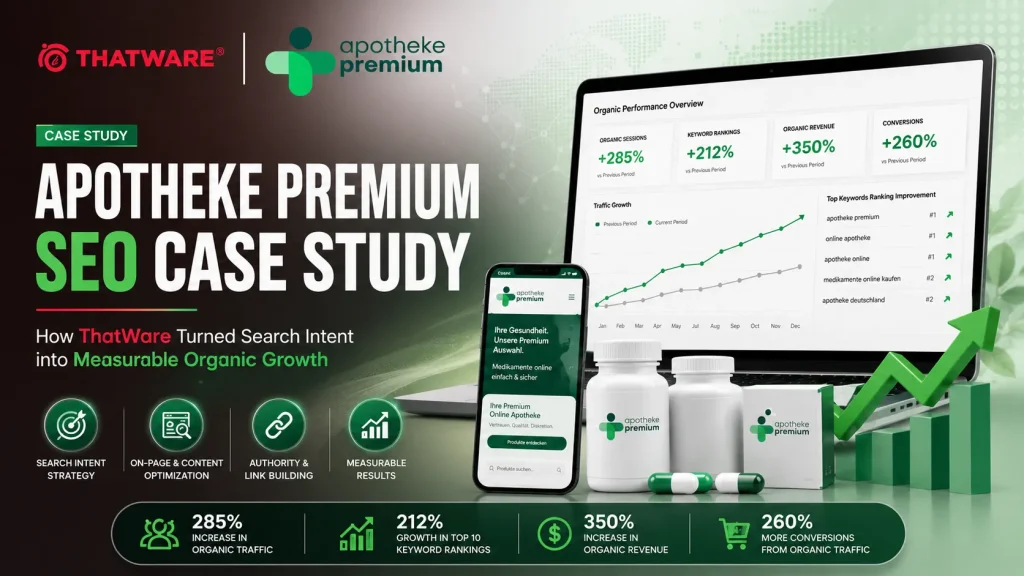
Apotheke Premium approached ThatWare with a straightforward business objective: increase organic traffic through searches related to pharmaceutical products, services, and healthcare solutions. At the beginning of the campaign, organic traffic was relatively low, and the website had an opportunity to capture considerably more relevant search demand.
The solution was not to simply publish more pages or add more keywords. ThatWare developed an integrated SEO approach focused on understanding search intent and then aligning the website’s content, page structure, technical performance, user experience, and information architecture with that intent.
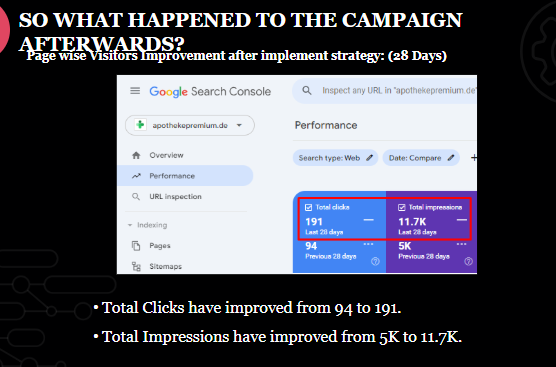
The resulting campaign produced measurable movement across several important indicators. Google Search Console data showed clicks increasing from 94 to 191 and impressions from approximately 5,000 to 11,700. Google Analytics data also recorded significant growth in organic users, sessions, and engaged sessions.
The Apotheke Premium campaign therefore provides a useful example of how a search-intent-led SEO strategy can translate into measurable organic growth.
Apotheke Premium SEO Project: The Business Challenge
The Business Challenge: Turning Search Demand into Organic Traffic
Apotheke Premium is a pharmaceutical website serving users searching for products, pharmaceutical information, and related healthcare solutions. Its broad product ecosystem created an opportunity to attract searchers at different stages of the search journey, from users researching a pharmaceutical subject to users making highly specific product-related searches.
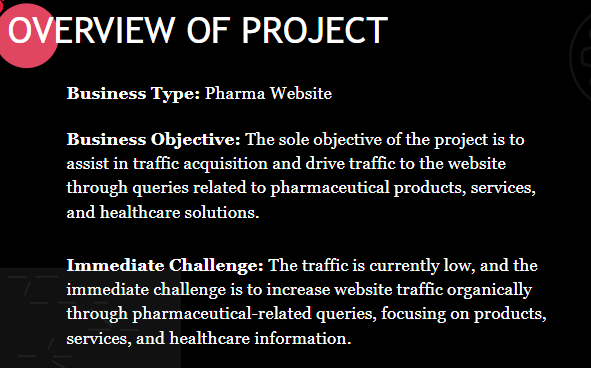
The central business objective of the campaign was to increase traffic acquisition through organic search. More specifically, ThatWare needed to improve the website’s ability to appear for queries connected with pharmaceutical products, services, and healthcare-related information.
At the outset, the primary challenge was low organic traffic and insufficient visibility for relevant pharmaceutical searches. The website had pages capable of serving users, but those pages needed stronger alignment with the expectations behind individual search queries.
The campaign therefore focused on six interconnected objectives:
- Increase organic search visibility.
- Improve rankings for relevant pharmaceutical queries.
- Attract more qualified organic search traffic.
- Align product pages more closely with transactional search intent.
- Improve the overall user experience.
- Establish a stronger technical and architectural foundation for organic search.
Rather than approaching the project as a short-term ranking exercise, ThatWare treated the website as a complete search ecosystem. The work involved evaluating what users were searching for, what type of result they expected, what information they needed, and how easily both users and search engines could access that information.
This distinction is important. A professional seo agency should not measure success only by the number of keywords appearing in a ranking report. Rankings matter, but they become more meaningful when they contribute to visibility, clicks, relevant traffic, and engagement.
The objective, therefore, was not to promise a particular position for every keyword. It was to improve Apotheke Premium’s ability to compete for relevant searches by creating stronger alignment between user intent and the website experience.
That principle became the foundation for everything that followed.
Why Search Intent Became the Starting Point of the Campaign
Search engines ultimately need to answer one fundamental question: What result best satisfies the user’s query?
That question has become increasingly complex as search technology has evolved. A query is not merely a collection of individual words. It represents a user’s need, expectation, context, and desired outcome.
For example, someone searching for general information about a pharmaceutical subject may expect an educational article. A person searching for a specific product may expect a product page. Someone comparing alternatives may expect a category or comparison-oriented result. Meanwhile, a user using a commercial phrase may be much closer to making a transaction.
This means that two queries containing related words can still require completely different pages.
For Apotheke Premium, understanding this distinction was critical. The campaign examined queries from the perspective of what the searcher was actually trying to accomplish rather than treating every keyword as an isolated ranking opportunity.
This approach also reflects the broader evolution of Google’s search systems.
The Panda update placed greater emphasis on content quality and helped reduce the visibility of low-quality and duplicate content. RankBrain represented a further move toward understanding the meaning and context behind queries rather than relying solely on exact word matching. BERT subsequently improved Google’s ability to interpret language and relationships between words within a query.
The progression is significant because it illustrates a broader transformation in search: relevance increasingly depends on meaning and context.
That is why seo intelligence became an important conceptual layer in the campaign. Instead of asking only, “Which keyword should this page target?”, the more useful questions became: “What does the user want?”, “What kind of page satisfies that need?”, “What information should the page contain?”, and “How should that information be presented?”
Apotheke Premium’s campaign was therefore structured around four major search-intent categories:
- Informational intent: The user wants to learn about a topic or product.
- Navigational intent: The user wants to reach a particular website, page, or resource.
- Commercial investigation: The user is evaluating options before taking action.
- Transactional intent: The user is looking for a product, service, or opportunity to complete an action.
The importance of this framework becomes especially clear when looking at the campaign’s keyword examples.
A broad query such as “kapsules” and a highly specific query such as “priligy kaufen” do not necessarily represent the same search journey. Treating them identically could lead to a mismatch between the page and the user’s expectations.
The central question was therefore simple:
What does the searcher expect to find when they enter this query?
The answer determined the content type, content format, content angle, page structure, and optimization priorities.
The 3C Framework: Matching Content With What Searchers Expect
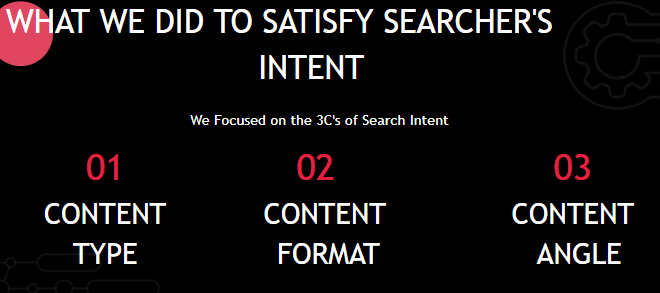
Once search intent became the foundation, ThatWare applied a three-part framework built around Content Type, Content Format, and Content Angle.
The framework provided a practical way to translate search-intent analysis into actual page-level optimization.
1. Content Type: Choosing the Right Page
The first question was:
What type of webpage best satisfies this particular query?
Depending on the search, the appropriate result could be:
- A blog post
- A product page
- A category page
- A landing page
This distinction matters because search engines have to determine whether a page is an appropriate response to a query. A detailed blog post may be useful for an informational search, but it may not be the ideal result when someone is actively searching for a specific product.
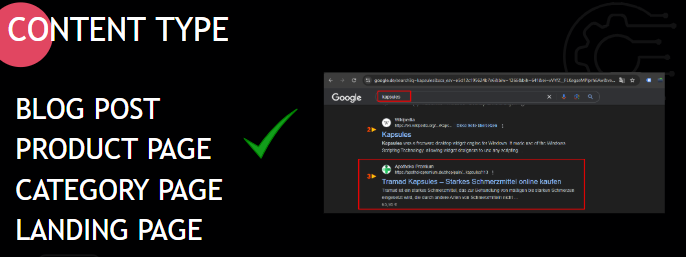
For Apotheke Premium, ThatWare examined the SERPs to understand the types of pages already appearing for relevant queries. This provided a practical benchmark for determining what type of content could compete.
The query “kapsules” provides one example from the campaign. In the supplied SERP snapshot, Wikipedia appeared around Position 2, while an Apotheke Premium page appeared around Position 3 for the relevant result.
That ranking was significant not simply because the page appeared on the first page, but because it demonstrated that a relevant Apotheke Premium page could compete for the query within the observed SERP environment.
This is where an experienced professional seo service becomes valuable: the objective is not to force a predetermined page type onto a keyword but to understand the search landscape and align the website accordingly.
The question becomes less about “How many times should this term appear?” and more about “What kind of result does the search engine believe will satisfy this user?”
That change in perspective shaped the next stage of the campaign.
2. Content Format: Building the Right Search Experience
The second part of the 3C framework was Content Format.
The focus example was the transactional query:
“Priligy Kaufen”
A user entering a query like this is not necessarily looking for a general article about the subject. The search is commercially oriented and suggests an expectation of finding relevant product information and a pathway toward a purchase decision.
For that reason, a product-oriented page was more appropriate than a purely educational article.
The Apotheke Premium page achieved Position 7 on Google SERP for the tracked query in the campaign data.
This result illustrates why content format matters. A transactional search requires a page capable of supporting a user’s decision-making process. It should provide relevant information about the product and make it easy for the visitor to understand what is being offered.
The page therefore included relevant product information and supporting details rather than functioning simply as a keyword-targeted landing page.
This is also where seo intelligence agency thinking becomes important. Search optimization needs to consider the relationship between the query, the SERP, the page format, and the user’s expected next step.
The ranking itself is only one part of the story. The more important question is whether the page format gives the searcher a reason to stay, explore, and continue through the website.
3. Content Angle: Giving Searchers the Information They Need
The third element of the framework was Content Angle.
Once the page type and format had been determined, ThatWare focused on what information the page should provide.
For the relevant product page, the content angle included comprehensive product information such as:
- Product description
- Dosage-related information
- Side-effect information
- Ingredient details
- Product variants
- Additional product information
The objective was not simply to increase the word count.
Instead, the aim was to answer the questions a user could reasonably have after arriving on a pharmaceutical product page.
A page that provides only a product name and a short description may leave significant information gaps. A more comprehensive product experience can make the page more useful by organizing relevant information in a way that supports the user’s search journey.
The campaign therefore followed a straightforward principle:
Add the right information in the right structure for the right search intent.
This approach also meant that content was considered as part of the broader website experience rather than as an isolated SEO asset.
Content Optimization: Updating the Website for Current Search Demand
After identifying search intent and determining the appropriate page-level requirements, the next stage was content optimization.
The goal was not to replace content indiscriminately. Instead, ThatWare worked to identify where existing pages could become more relevant, useful, and aligned with current search demand.
The optimization process included updating information to reflect developments within the relevant subject area, improving textual relevance, addressing new and previously missed search queries, adding graphical content where useful, refreshing page information, and updating dates where appropriate.
This process was particularly important for a pharmaceutical website because information can become outdated or incomplete over time. Users expect product and healthcare-related pages to present information in a clear and structured manner.
A seo intelligence search approach looks beyond a single keyword and examines the broader relationship between a topic, related queries, content gaps, competing results, and user expectations.
That principle guided the optimization process for Apotheke Premium.
The team considered several questions:
- What are users actually searching for?
- Which relevant queries were not adequately addressed?
- What information was missing from existing pages?
- How were competing pages structuring their information?
- Did the page provide enough context to satisfy the query?
- Was the content organized in a way that made sense to the searcher?
This created a more purposeful content optimization process.
Rather than treating content as a static asset, the campaign treated it as something that needs to evolve alongside search behavior and information requirements.
The result was a stronger connection between the search query and the content presented after the user clicked through from Google.
Once content relevance had been addressed, the campaign expanded into the technical and user-experience layers of SEO.
Improving User Experience to Strengthen the Search Journey
Organic visibility is only one part of a successful search campaign.
A user may click a result because the page appears relevant, but what happens next is equally important. If a page loads slowly, is difficult to navigate, performs poorly on mobile devices, or makes important information difficult to find, the search journey becomes weaker.
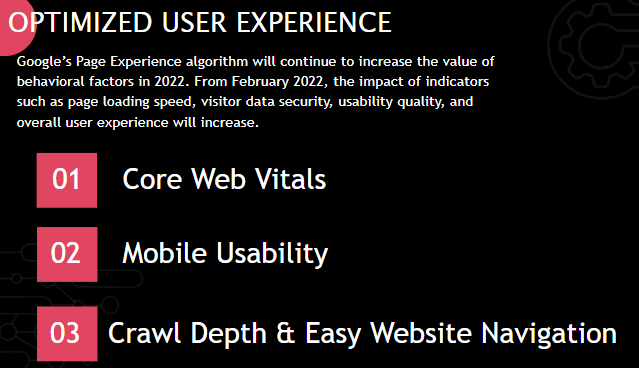
For Apotheke Premium, user experience optimization therefore focused on three major areas:
Core Web Vitals
The website needed to provide an efficient page experience, particularly around loading performance, responsiveness, and visual stability.
Mobile Usability
A significant portion of modern search activity takes place on mobile devices. Pages therefore need to remain usable and accessible across different screen sizes.
Crawl Depth and Navigation
Important pages should be discoverable without forcing users or search-engine crawlers through unnecessary layers.
This is particularly relevant for pharmaceutical ecommerce websites because they can contain extensive product catalogs, categories, product variations, informational pages, and supporting resources.
A strong Answer Engine Optimization mindset also reinforces the importance of clarity and accessibility: information should be organized so that both users and modern search systems can understand the subject, relationships, and purpose of a page.
However, the Apotheke Premium campaign remained grounded in the specific SEO objectives demonstrated by the project data. The emphasis was on improving the actual search experience rather than introducing emerging terminology simply for the sake of it.
The broader objective was straightforward:
Make the website easier to use, easier to navigate, and easier for search engines to understand.
Technical Optimization: Building a Faster, More Efficient Website
The next layer of the campaign focused on technical performance.
Technical SEO can sometimes appear disconnected from content strategy, but in practice the two are closely related. A highly relevant page still needs to be accessible, efficiently rendered, and usable.
ThatWare addressed several areas connected with Core Web Vitals and page performance.
Reducing JavaScript Execution
Unnecessary JavaScript processing can consume browser resources and delay page responsiveness. Reducing excessive execution can help create a more efficient experience.
Implementing Lazy Loading
Resources that do not need to appear immediately can be loaded when they become necessary. This can reduce the initial resource burden placed on the browser.
Optimizing and Compressing Images
Large image files can increase page weight. Image optimization and compression can therefore contribute to improved loading efficiency.
Providing Appropriate Dimensions for Images and Embeds
Defining dimensions helps browsers allocate space correctly and can reduce unexpected layout movement while a page loads.
Improving Server Response Time
Server response time contributes to how quickly the browser can begin receiving the resources required to render the page.
These technical improvements were not implemented as isolated tasks. They formed part of the wider campaign objective of creating a faster, more efficient, and more accessible website.
This is also where AEO Services can complement a broader search strategy when appropriately applied. Modern search experiences increasingly depend on clear, accessible, well-structured information. However, technical foundations remain essential regardless of the search surface being targeted.
For Apotheke Premium, the immediate priority was to establish a stronger technical environment that could support both users and organic search performance.
The technical work therefore complemented the content and intent work rather than replacing it.
Making Important Pages Easier to Discover With a Flatter Site Structure
Website architecture is another factor that can influence how efficiently users and search engines move through a website.
A deep website structure can place important pages several levels away from the homepage. For users, that can mean additional clicks. For search engines, it can create a more complicated path through the site’s hierarchy.
The campaign therefore examined the site’s architecture with a focus on creating a flatter structure.
A simplified deep structure might look like:
Homepage → Category → Subcategory → Sub-subcategory → Product
A flatter structure could instead look like:
Homepage → Category → Product
The objective is not to remove useful categories or create an artificially shallow website. Rather, it is to prevent important commercial pages from becoming unnecessarily buried beneath multiple layers.
A flatter architecture can provide several advantages:
- Fewer clicks to reach important pages.
- Better discoverability.
- Clearer relationships between categories and products.
- More logical navigation.
- A stronger understanding of the website’s hierarchy.
For a pharmaceutical ecommerce website, this becomes especially relevant because product catalogs can contain large numbers of individual pages.
The site architecture therefore needs to balance organization with accessibility.
This approach also supports AI Answer Optimization because clearly organized information is easier to interpret when search systems need to retrieve and understand individual pieces of content.
The important distinction is that architecture should be designed around the needs of the website rather than around SEO terminology alone.
For Apotheke Premium, the architectural objective was simple: make important pages easier to discover and ensure that users did not have to navigate through unnecessary layers to reach relevant products or information.
From Strategy to SERPs: Evidence of Improved Search Visibility
The effectiveness of an SEO campaign ultimately needs to be evaluated against observable outcomes.
For Apotheke Premium, the campaign included specific SERP evidence demonstrating visibility for relevant pharmaceutical queries.
Example 1: “Kapsules”
The supplied SERP snapshot showed:
- Wikipedia — approximately Position 2
- Apotheke Premium — approximately Position 3
The result demonstrates that an Apotheke Premium page was able to compete prominently for the observed query.
More importantly, the result aligns with the campaign’s intent-first approach.
The page was not optimized simply because the keyword had search demand. The content type and page structure were considered in relation to what users searching for the term could reasonably expect to find.
This is a central principle behind Generative Engine Optimization as well as conventional organic search: relevance begins with understanding the information need represented by a query.
For the Apotheke Premium campaign, the SERP result provides a concrete example of how search-intent alignment can translate into visible ranking performance.
Example 2: “Priligy Kaufen”
The second example involved the transactional keyword:
“Priligy Kaufen”
The relevant Apotheke Premium page achieved Position 7 on Google SERP in the provided campaign data.
The importance of this result comes from the nature of the query itself.
This was not simply an informational phrase. It was classified as transactional, meaning that the page needed to satisfy a user who was potentially looking for a product and evaluating information relevant to a purchase decision.
The page therefore combined product-oriented content with relevant supporting information.
Rather than claiming that the campaign made Apotheke Premium “number one,” the more accurate interpretation is that the campaign helped the relevant page reach Position 7 for the tracked transactional query in the supplied SERP snapshot.
This distinction matters.
SEO results can vary according to time, location, device, query context, competition, and algorithmic changes. A responsible case study should therefore present observed ranking evidence without turning one snapshot into a universal ranking guarantee.
The two examples—one around Position 3 and the other at Position 7—show how different search opportunities could be addressed through intent-specific optimization.
Google Search Console Results: Clicks and Impressions More Than Doubled
Ranking improvements are useful indicators, but they become more meaningful when accompanied by changes in actual search visibility.
For Apotheke Premium, Google Search Console provided a clear comparison of search performance.
The supplied data showed the following changes:
| Metric | Before | After | Approx. Improvement |
| Total Clicks | 94 | 191 | +103% |
| Total Impressions | 5K | 11.7K | +134% |
The percentage increases are approximate because the impression values in the source data are rounded.
Clicks: 94 to 191
Total clicks increased from 94 to 191.
That represents an increase of approximately 103%.
The change indicates that more users were reaching Apotheke Premium through Google Search during the comparison period.
Clicks are particularly useful because they move beyond visibility alone. An impression means a result was displayed; a click indicates that a searcher chose to visit the website.
For a traffic-acquisition campaign, that distinction is important.
The increase in clicks therefore provides evidence that the campaign’s improved search presence translated into more search visits.
Impressions: 5,000 to 11,700
Total impressions increased from approximately 5,000 to 11,700.
That represents an approximate increase of 134%.
The increase in impressions suggests that Apotheke Premium’s pages were appearing in search results substantially more often during the comparison period.
This is particularly important because it indicates an expansion of search exposure rather than merely a change in traffic from a very narrow set of existing searches.
In other words, the website was becoming visible across a broader range of search opportunities.
This is an important distinction in modern SEO and GEO Services strategy. Visibility is no longer best understood as a single ranking position. It is better understood as the cumulative ability of a website to appear across relevant search journeys.
For Apotheke Premium, the movement from 5K to 11.7K impressions demonstrated that the campaign had generated a substantially larger search footprint during the measured period.
Combined with the increase in clicks, the GSC data provided a strong indication that the campaign was moving in the intended direction.
Organic Traffic Growth: What Happened After Implementation?
Search Console demonstrated improved visibility and clicks, while Google Analytics provided another perspective: what happened to organic traffic after the strategy was implemented?
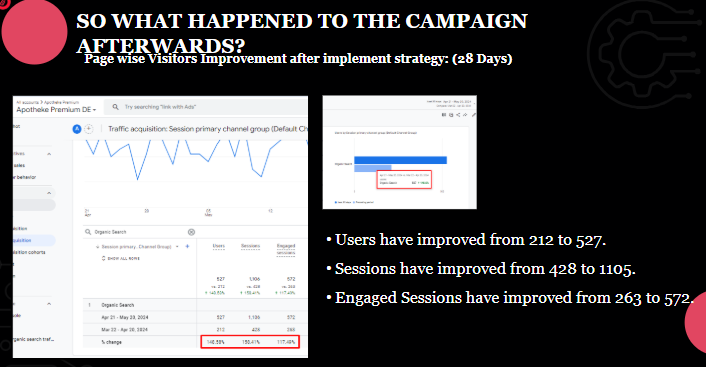
The reported results were:
| Metric | Previous Period | Campaign Period | Growth |
| Users | 212 | 527 | +148.6% |
| Sessions | 428 | 1,106 | +158.4% |
| Engaged Sessions | 263 | 572 | +117.5% |
The numbers reveal substantial growth across all three measured metrics.
Users: 212 to 527
Organic users increased from 212 to 527, representing growth of approximately 148.6%.
This means considerably more users reached the website through organic search during the campaign comparison period.
The change aligns with the increase in Google Search Console clicks and indicates that the additional search visibility translated into a larger organic audience.
Sessions: 428 to 1,106
Sessions increased from 428 to 1,106, representing approximately 158.4% growth.
The increase in sessions is important because it demonstrates that the growth was not restricted to a small number of users making repeated visits. The website generated a significantly larger number of organic search sessions during the measured period.
For a traffic-acquisition campaign, this is directly relevant to the original business objective.
Engaged Sessions: 263 to 572
Engaged sessions increased from 263 to 572, representing approximately 117.5% growth.
This provides another layer of evidence because the campaign was not only concerned with generating impressions. The increase also extended to sessions that met the analytics platform’s engagement criteria.
Taken together, the data establishes a clear progression:
Better intent alignment → stronger search visibility → more impressions → more clicks → more organic users → more sessions → more engaged sessions.
That sequence is more meaningful than any individual ranking alone.
It shows how different layers of SEO can contribute to a broader organic growth outcome.
The results also demonstrate why AI Search Optimization should not be viewed as an isolated concept. Whether users discover a website through conventional search or increasingly sophisticated search experiences, the underlying principles of relevance, useful content, accessible information, and strong website foundations remain important.
The Growth Wasn’t One SEO Tactic—It Was the Combination
One of the most important lessons from the Apotheke Premium campaign is that the reported growth cannot reasonably be attributed to a single SEO adjustment.
The campaign involved multiple interconnected layers.
Layer 1: Search Intent
The process began with understanding what users were actually trying to accomplish through their queries.
This determined the direction of the subsequent optimization work.
Layer 2: Content
Pages were updated to provide information that was more relevant to the searcher’s needs.
The objective was to close information gaps rather than simply increase content volume.
Layer 3: Content Type and Format
Different search intents required different page experiences.
Product-oriented queries needed product pages, while informational searches could require a different content structure.
Layer 4: Technical SEO
Technical performance was addressed through improvements involving JavaScript execution, lazy loading, image optimization, image dimensions, embeds, and server response time.
Layer 5: User Experience
The campaign considered Core Web Vitals, mobile usability, navigation, and crawl depth.
Layer 6: Website Architecture
The site structure was reviewed to make important pages easier to discover and reduce unnecessary depth.
Layer 7: Measurement
The campaign’s progress was assessed through SERP observations, Google Search Console, and Google Analytics.
This integrated approach is central to AI SEO Services, where search optimization increasingly requires multiple signals and disciplines to work together.
The Apotheke Premium campaign demonstrates that organic growth is rarely the product of a single “ranking trick.”
Instead, it is often the cumulative result of making a website more relevant, accessible, technically efficient, useful, and aligned with the expectations behind search queries.
Why ThatWare Took a Search Engineering Approach
ThatWare’s approach to SEO extends beyond conventional keyword placement.
The campaign demonstrates a broader search-engineering mindset built around understanding how users search and how search systems evaluate pages.
The process can be represented as:
User Intent → SERP Understanding → Content → Technical Foundation → UX → Architecture → Measurement
This differs from a simplistic:
Keyword → Page → Ranking
model.
The first model recognizes that a ranking is an outcome of multiple underlying factors.
ThatWare’s broader capabilities include technical SEO, semantic SEO, advanced content optimization, AI-focused search strategies, and emerging search methodologies. The purpose of these capabilities is not to replace fundamental SEO principles, but to build upon them.
For example, AI Powered SEO can support the analysis of large amounts of search, content, and competitive information, while human expertise remains necessary to interpret business objectives and translate those insights into practical website changes.
Similarly, Artificial Intelligence SEO is most useful when it contributes to better analysis, prioritization, contextual understanding, or optimization rather than becoming a substitute for strategic thinking.
The Apotheke Premium project reinforces an important principle: technology is most valuable when it helps solve a real search problem.
In this campaign, that meant understanding intent, improving page relevance, strengthening the user experience, addressing technical barriers, and making important content easier to discover.
The result was a search strategy grounded in measurable outcomes rather than abstract optimization claims.
From Search Visibility to Sustainable Organic Growth
The Apotheke Premium campaign began with a clear challenge: the website needed to attract more organic traffic and improve its visibility for relevant pharmaceutical searches.
The response was not based on a single optimization technique.
Instead, ThatWare built the campaign around the relationship between search intent and the complete website experience.
The strategy incorporated:
- Search-intent analysis
- The 3C framework
- Content optimization
- User experience optimization
- Core Web Vitals improvements
- Technical SEO
- Site architecture refinement
- SERP analysis
- Performance measurement
The campaign’s results provide measurable evidence of progress.
Google Search Console showed:
- 191 total clicks compared with 94 previously
- 11.7K impressions compared with approximately 5K previously
The Google Analytics comparison showed:
- 527 users compared with 212
- 1,106 sessions compared with 428
- 572 engaged sessions compared with 263
The SERP examples provided additional evidence, including an observed Position 3 result for “kapsules” and a Position 7 result for “Priligy Kaufen.”
These results should be viewed in context. They represent the supplied campaign snapshots and comparison periods rather than a universal guarantee of future rankings or traffic.
What they do demonstrate is the potential impact of systematically aligning a website with search intent while improving its content, technical foundation, user experience, and architecture.
The Apotheke Premium campaign also highlights the importance of Link Building Services as part of the broader SEO ecosystem, when authority development is relevant to a site’s competitive environment. However, the specific results presented in this case study are primarily supported by the documented intent, content, UX, technical, architecture, SERP, Search Console, and Analytics work described above.
The same evidence-first principle applies to authority development. White Hat Link Building should focus on earning relevant, credible references rather than relying on manipulative tactics that can undermine long-term search performance.
Likewise, Authority Backlinks should be considered as one potential component of a broader authority strategy rather than treated as a standalone solution capable of fixing problems with intent, content, technical SEO, or user experience.
Ultimately, the Apotheke Premium case study demonstrates a straightforward but increasingly important lesson:
SEO performance improves when a website is optimized not simply for keywords, but for the complete journey from query to content to experience.
ThatWare’s role was to connect these elements into a coherent search strategy—one that began with understanding what users wanted and continued through the technical and structural improvements required to make that information easier to find and use.
For businesses operating in competitive search environments, that shift in perspective can be the difference between simply having a website and building a website that is genuinely discoverable.
Looking to Build a More Effective Organic Search Strategy?
If your website is struggling with low visibility, limited organic traffic, or inconsistent rankings, the first step is not necessarily to create more content.
It is to understand why the website is not earning the visibility it deserves.
ThatWare combines search-intent analysis, content strategy, technical SEO, user-experience optimization, semantic understanding, and data-driven measurement to develop search strategies around measurable business objectives.
The Apotheke Premium campaign is one example of that approach in action: start with the searcher, understand the SERP, optimize the experience, measure the outcome, and continuously refine the strategy.
Want to turn search intent into measurable organic growth? Connect with ThatWare to explore an SEO strategy tailored to your website, market, and business objectives.