SUPERCHARGE YOUR ONLINE VISIBILITY! CONTACT US AND LET’S ACHIEVE EXCELLENCE TOGETHER!
Artificial intelligence is entering a new phase.
For years, businesses primarily used AI to generate content, summarize information, answer questions, analyze data, write code and provide recommendations. The human remained responsible for opening the relevant applications, finding the required information, moving data between systems and completing the actual workflow.
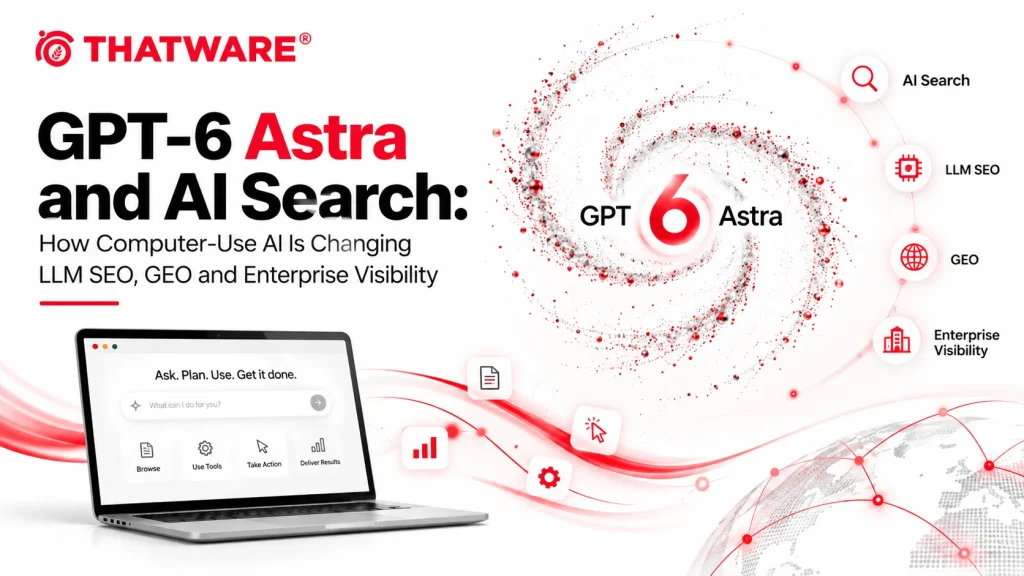
That boundary is beginning to change.
Modern AI systems are increasingly capable of understanding objectives, researching information, using tools, navigating software, interacting with websites and applications, completing multi-step tasks and verifying outcomes.
This is what makes GPT-6 Astra particularly important.
OpenAI positions GPT-6 Astra as a highly capable model for complex, end-to-end work involving areas such as computer use, browsing, software engineering, research and professional workflows. Computer-use capabilities allow AI to interact with digital environments rather than simply explain what a human should do.
But the implications of GPT-6 Astra extend beyond enterprise automation.
They also affect the future of AI Search, LLM SEO, Generative Engine Optimization (GEO), Answer Engine Optimization (AEO), semantic SEO and digital visibility.
As AI becomes better at understanding information, evaluating sources and performing actions, businesses need to think beyond traditional rankings.
The important question is no longer only:
Can people find our website?
It is increasingly:
Can AI systems find, understand, trust, retrieve, cite and act on information about our business?
That question sits at the intersection of enterprise AI readiness and modern search optimization.
This article explores what GPT-6 Astra means for businesses, how computer-use AI changes enterprise workflows, why data and knowledge quality matter more, and why organizations should prepare their digital presence for an AI-first search environment.
What Is GPT-6 Astra?
GPT-6 Astra represents a new generation of AI designed for more complex, multi-step work.
Traditional language models are often used as conversational systems. A user provides an instruction, the model processes it and returns an answer.
GPT-6 Astra extends that model toward workflows in which AI can reason about a goal, interact with tools and operate within digital environments.
A simplified interaction looks like this:
User → Prompt → AI → Answer
A more advanced agentic workflow can look like:
User → Objective → AI → Plan → Search/Tools → Applications → Action → Verification → Outcome
That distinction is important.
The value of an AI system is no longer measured only by how well it generates an answer. It can increasingly be measured by whether it can help move a business process toward a successful outcome.
GPT-6 Astra Is More Than a Chatbot
A chatbot waits for the next instruction.
An agentic system can potentially manage a sequence of related actions.
For example, consider a customer-service workflow.
A traditional chatbot may answer:
“Your refund policy allows returns within 30 days.”
A copilot may go one step further:
“Based on the policy, here is a response you can send to the customer.”
A computer-use agent could potentially:
- Identify the customer.
- Retrieve the relevant transaction.
- Review the applicable policy.
- Determine eligibility.
- Prepare a response.
- Update the support system.
- Route an exception for approval.
- Verify that the workflow was completed.
The difference is not simply intelligence.
It is execution capability.
From AI Answers to AI Outcomes
This transition changes the way businesses should think about artificial intelligence.
The old model was:
AI produces information → Human performs the work.
The emerging model is:
AI understands an objective → AI coordinates authorized work → Systems execute actions → AI verifies the outcome.
That makes the quality of the environment surrounding the AI increasingly important.
AI needs accurate information.
It needs current information.
It needs authoritative sources.
It needs permissions.
It needs business rules.
It needs predictable workflows.
It needs verification.
And, when AI is being used for discovery, it needs a reliable understanding of the public information surrounding a business.
From Chatbots to AI Agents
The development of AI can be understood as a progression from conversation toward execution.
AI as a Chatbot
A user asks:
“What are the benefits of technical SEO?”
The AI produces an explanation.
The user decides what to do next.
AI as a Copilot
The user asks:
“Create a technical SEO audit checklist for my website.”
The AI produces the checklist.
The user then performs the audit.
AI as an Agent
The user might say:
“Analyze my website and identify the highest-priority technical SEO problems.”
Now the AI needs to gather information, interpret it and produce an actionable result.
AI as a Computer-Use Agent
The workflow can go further.
The AI may potentially:
- Navigate websites
- Open software
- Read documents
- Analyze information
- Work with spreadsheets
- Interact with forms
- Update records
- Move between applications
- Complete approved actions
- Verify results
This is where computer use becomes strategically important.
The Observe, Understand, Plan, Act and Verify Loop
A useful way to understand computer-use AI is through a continuous operational loop:
Observe → Understand → Plan → Act → Verify → Correct → Repeat
Each stage introduces its own requirements.
Observe
The agent needs to understand its environment.
Depending on the workflow, this may include:
- Browser state
- Application state
- Screens
- Forms
- Tables
- Error messages
- Documents
- Enterprise data
- Tool outputs
- Workflow status
Understand
The AI must interpret what it sees.
A CRM screen may contain:
- Customer name
- Account number
- Billing address
- Shipping address
- Account status
- Recent activity
- Support tickets
- Contract information
The system must determine which information matters.
Plan
Planning is where business context becomes critical.
Suppose an employee asks:
“Update this customer’s billing address.”
The AI may need to determine:
- Which customer?
- What is the new address?
- Is the address verified?
- Is the user authorized?
- Which system is authoritative?
- Does the change require approval?
- How will the change be verified?
The ability to interact with a screen is therefore only one part of computer use.
Context determines whether the action is appropriate.
Act
The system can potentially:
- Click
- Type
- Scroll
- Select
- Upload
- Download
- Navigate
- Enter information
- Submit forms
- Move between applications
Verify
Verification is essential.
Clicking Submit does not prove that a transaction succeeded.
The application could have:
- Rejected the request
- Required additional approval
- Lost the session
- Returned an error
- Created a duplicate
- Failed to save the record
Therefore:
Attempted action is not the same as confirmed outcome.
Correct
Applications can behave unpredictably.
A page can change.
A session can expire.
A field can disappear.
A workflow can require an additional step.
A record may already have been modified.
A reliable AI system therefore needs to recognize when its assumptions are no longer valid.
Sometimes the safest action is:
Stop and ask a human.
Why Computer Use Changes Enterprise AI
Computer use changes where AI operates.
Traditional AI primarily communicates through text.
Computer-use AI can potentially operate within the digital environments where business activity already occurs.
This matters because most enterprises do not operate through one application.
A typical organization may have separate systems for:
- CRM
- ERP
- Finance
- HR
- Customer support
- Analytics
- Procurement
- Project management
- Documents
- Identity management
- Security
- Internal applications
Employees have historically acted as the integration layer between these systems.
They copy information from one application to another.
They read policies.
They reconcile records.
They check approvals.
They interpret exceptions.
They update systems.
Computer-use AI creates the possibility that some of this coordination can increasingly be performed by AI.
But that possibility also exposes weaknesses in enterprise environments.
The Enterprise Desktop as an AI Execution Layer
The enterprise desktop can be viewed as a control surface for business activity.
A sales employee may move between CRM, email, pricing, proposals and analytics.
A finance employee may work across ERP, accounting systems, spreadsheets, invoice platforms and reporting tools.
An IT employee may use ticketing systems, cloud consoles, monitoring tools, endpoint management and security applications.
The applications are different, but the employee’s objective is usually consistent:
Complete a business outcome.
An AI-native environment could increasingly organize work around that outcome instead of around individual applications.
Instead of:
Open CRM → search customer → open ERP → check invoice → open support → check dispute → write email.
An employee could potentially express the objective:
“Review this overdue enterprise account, determine whether an active dispute exists, prepare the appropriate follow-up and route anything requiring approval.”
The AI becomes an orchestration layer across the applications.
GPT-6 Astra and the Future of AI Search
Computer use is only one side of the GPT-6 Astra story.
The other is AI-driven discovery.
Search behavior is changing.
Traditional search generally presents users with a list of pages.
AI Search increasingly attempts to understand the question, synthesize information and provide a direct response.
A user might search:
“What is GEO?”
But another user might ask an AI:
“Which companies specialize in GEO and LLM SEO for enterprise brands?”
That second query creates a fundamentally different visibility challenge.
The AI must understand:
- Which companies are relevant
- What each company actually does
- Which claims are supported
- Which sources are authoritative
- Which information is current
- Which entities are connected
- Which businesses are credible for the specific request
This is where GEO, AEO and LLM SEO become increasingly important.
Traditional SEO vs AI Search
Traditional SEO asks:
How can we help a search engine rank our page?
AI-search optimization asks a broader question:
How can we make our business understandable and useful to AI systems when they answer relevant user questions?
This does not mean traditional SEO is disappearing.
Technical SEO, crawlability, indexing, internal linking, content quality and authority remain important.
Instead, the optimization layer is expanding.
A modern digital visibility strategy needs to consider:
Search engines + answer engines + generative AI + language models + entity understanding.
What Is LLM SEO?
LLM SEO focuses on improving how a brand, business, product or subject is represented across large language models and AI-driven discovery environments.
A company can have thousands of indexed pages and still have weak AI visibility if AI systems cannot confidently determine:
- What the company does
- Which services it offers
- Who it serves
- Where it operates
- What makes it different
- What expertise it has
- Which sources validate its claims
LLM SEO therefore involves more than inserting keywords.
It requires a coherent information ecosystem.
What Is GEO?
Generative Engine Optimization, or GEO, focuses on improving a brand’s likelihood of being represented in AI-generated search experiences.
GEO involves many of the principles associated with modern semantic and entity-based search:
- Clear information
- Strong topical coverage
- Structured content
- Entity relationships
- Authoritative sources
- Consistent facts
- Supporting evidence
- Useful answers
- Strong website architecture
The goal is not to manipulate an AI answer.
The goal is to provide enough reliable information for AI systems to understand the business correctly.
What Is AEO?
Answer Engine Optimization focuses on making content useful for systems that provide direct answers.
Instead of optimizing only for:
“SEO company”
A business may also optimize for questions such as:
- What is AI SEO?
- What is GEO?
- How does LLM SEO work?
- How can a business improve AI-search visibility?
- What is the difference between SEO and GEO?
- How do AI search engines evaluate businesses?
Answer-focused content can help establish topical authority while giving AI systems clearer information to retrieve and synthesize.
GEO, AEO and LLM SEO Are Converging
These disciplines are different, but their objectives increasingly overlap.
| Optimization | Primary objective |
| SEO | Search visibility |
| AEO | Answer visibility |
| GEO | Generative AI visibility |
| LLM SEO | Language-model visibility |
| Semantic SEO | Meaning and context |
| Entity SEO | Relationships and identity |
The common requirement is machine-readable authority.
A business needs to communicate:
Who we are → What we do → Who we serve → Where we operate → Why we are credible → What evidence supports our expertise.
That is increasingly important in AI search.
Why Entity Optimization Matters for AI Search
AI systems need to understand entities and relationships.
Consider a business entity.
The AI may need to understand:
Brand → Services → Industries → Locations → Experts → Content → Evidence → External Sources
If those relationships are consistent, the system has a stronger basis for understanding the organization.
If they conflict, ambiguity increases.
For example, suppose a business website describes the company as an AI SEO agency, while external sources describe it as a generic digital marketing company.
The AI has to reconcile those signals.
That is why entity consistency matters.
Building a Strong Business Entity
A business should clearly communicate:
Brand Identity
- Official business name
- Brand variations
- About information
- Company description
Service Identity
- Core services
- Specialized services
- Relationships between services
Expertise
- Subject-matter experts
- Authors
- Credentials
- Research
- Case studies
Geographic Identity
- Locations
- Service regions
- Market focus
Industry Identity
- Target industries
- Specialized vertical expertise
- Relevant case studies
External Authority
- Industry references
- Publications
- Partnerships
- Reviews
- Third-party evidence
Together, these signals create a stronger digital entity.
Why Content Quality Becomes More Important in the Astra Era
AI systems have access to enormous amounts of information.
Publishing more content is therefore not enough.
The question becomes:
What information should AI systems trust?
A high-quality business content ecosystem should contain:
- Original insights
- Clear explanations
- First-hand expertise
- Relevant data
- Examples
- Case studies
- Author information
- Updated information
- Structured relationships
- Strong internal linking
The objective is to build topical authority, not simply page volume.
From Keyword Pages to Knowledge Architecture
A traditional SEO strategy might create individual pages targeting individual keywords.
A modern AI-search strategy should think in terms of knowledge architecture.
For example:
AI SEO
could connect to:
- AI Search
- LLM SEO
- GEO
- AEO
- Semantic SEO
- Entity SEO
- Structured data
- Topical authority
- AI citations
- Search visibility
Each concept reinforces the others.
This creates a clearer topical ecosystem for both users and machines.
Why GPT-6 Astra Makes Enterprise Data More Important
A more capable AI does not make poor data irrelevant.
It can make poor data more dangerous.
Traditional systems might produce:
Bad Data → Bad Report
Agentic systems can create:
Bad Data → Bad Decision → Bad Action
Imagine a customer address is incorrect.
A reporting system might simply display the wrong address.
An AI agent could potentially:
- Update another system
- Generate a document
- Send correspondence
- Trigger fulfillment
- Create a support case
- Modify a customer record
The problem has moved from information quality to operational execution.
What Data Does an AI Agent Need?
A computer-use system may interact with the screen, but the screen is only the visible layer.
Behind it are:
- Databases
- Documents
- Policies
- Identities
- Workflows
- Business rules
- Metadata
- Permissions
A useful framework is:
Transactional Data + Reference Data + Unstructured Knowledge + Metadata + Process Data + Permission Data
Transactional Data
Transactional data represents what is actually happening.
Examples include:
- Orders
- Invoices
- Payments
- Customer records
- Inventory
- Contracts
- Purchase orders
- Shipments
- Expenses
- Subscriptions
- Support tickets
An agent investigating an unpaid invoice may need to connect:
- Customer
- Invoice
- Payment history
- Account status
- Disputes
- Contract
- Collection process
This information may exist in different systems.
Agent readiness therefore requires reliable relationships between them.
Reference Data
Reference data provides the vocabulary of the enterprise.
Examples include:
- Product catalogs
- Pricing tables
- Employee directories
- Department codes
- Currency codes
- Tax codes
- Customer classifications
- Product categories
- Location lists
- Supplier information
A transaction may contain:
SKU-48392
Reference data explains what that identifier actually represents.
Enterprise Knowledge
Not everything important exists in a database.
Organizations depend on:
- Policies
- SOPs
- Manuals
- Contracts
- Employee handbooks
- Technical documentation
- Sales playbooks
- Compliance guidance
- Emails
- Presentations
- Internal guides
This information often determines what happens when a transaction becomes an exception.
Preparing Unstructured Enterprise Data for AI
Large amounts of enterprise knowledge live in:
- PDFs
- Word documents
- Presentations
- Spreadsheets
- Emails
- Shared drives
- Intranets
- Collaboration platforms
- Attachments
Making them searchable is not enough.
An AI system also needs to understand:
- What does the document represent?
- Is it current?
- Is it authoritative?
- Who owns it?
- Which region applies?
- Which process does it support?
- Is it approved?
- Has it been superseded?
This is where metadata becomes important.
Document Metadata
Useful metadata can include:
- Title
- Owner
- Source
- Version
- Effective date
- Expiration date
- Department
- Business unit
- Approval status
- Related process
- Region
- Classification
Consider two pricing documents.
One was approved yesterday.
Another was created three years ago.
Both may contain relevant keywords.
Without metadata, relevance alone may not distinguish them.
Metadata can turn:
“This document looks relevant.”
into:
“This is the current approved document for this region and customer segment.”
That distinction is critical for operational AI.
Data Normalization Before AI Automation
AI cannot safely act if it does not know which entity it is dealing with.
A customer could appear as:
- ABC Corporation
- ABC Corp.
- ABC Ltd.
- ABC International
A product could appear under:
- Enterprise Analytics Suite
- EAS
- Analytics Enterprise
- Product-4721
- SKU-88492
Humans often resolve these differences intuitively.
AI systems need reliable identity resolution.
Canonical Customer Identity
Organizations can establish:
Customer ID → Canonical Name → Known Aliases
The goal is not necessarily to make every system display the same name.
The goal is to create a reliable underlying identity.
Canonical Product Identity
A product identity could connect:
Product ID → Commercial Name → SKU → Internal Code → Product Family → Version
This helps prevent AI from confusing similar products.
Employee Identity
Employee records can connect:
- Employee ID
- Name
- Department
- Role
- Manager
- Location
- Employment status
- Authorization level
This becomes important when AI needs to determine who can approve an action.
The same principle applies to public AI search.
AI systems need to know which brand, organization, product or person they are dealing with.
APIs, Tools and Computer Use: Why Enterprises Need All Three
Computer use should not be viewed as a replacement for APIs.
A strong enterprise architecture will likely use different mechanisms for different jobs.
APIs
APIs are generally preferable for:
- Structured operations
- High-volume transactions
- Deterministic workflows
- Reliable system-to-system communication
If an API can create an order reliably, there may be little reason for an AI agent to navigate several screens to perform the same operation.
Tools
Tools provide controlled capabilities.
A tool could allow AI to:
- Search a customer
- Retrieve an order
- Check inventory
- Generate a quote
- Create a ticket
- Request approval
- Submit a workflow
Tools provide a boundary between reasoning and execution.
Computer Use
Computer use becomes particularly valuable when:
- APIs do not exist
- APIs are incomplete
- Legacy applications are involved
- Integration is impractical
- Existing interfaces support the required workflow
This can make computer use especially relevant to organizations with long-lived enterprise software.
The Hybrid Enterprise AI Architecture
A mature architecture can look like:
AI Reasoning Layer
↓
Identity + Policy Layer
↓
API / Tool / Computer-Use Decision
↓
Enterprise Applications
↓
Verification
↓
Audit
The principle is simple:
Use the safest and most reliable execution mechanism available for each task.
Computer use expands what AI can potentially interact with.
It does not eliminate the value of structured integrations.
Why a Vector Database Alone Is Not Enough
Semantic search and vector databases can be valuable components of enterprise AI systems.
But retrieval alone does not create operational readiness.
Finding a relevant document does not necessarily tell AI:
- Whether it is current
- Whether it is authoritative
- Whether it applies to the user’s region
- Whether the user can access it
- Whether it defines an approved action
- Whether approval is required
- Whether the resulting transaction succeeded
Therefore:
Retrieval is not the same as operational context.
The AI needs:
Relevant + Authorized + Current + Authoritative + Actionable Context
The same principle applies to AI search.
A page being relevant to a query does not automatically mean an AI system should use it as authoritative evidence.
AI Search Also Needs More Than Retrieval
AI search systems need to determine not only:
“Can I find this company?”
but also:
“Do I understand this company?”
That requires multiple signals.
For a business, AI may need to determine:
- What the company does
- Whether its claims are supported
- Which services it specializes in
- Which industries it serves
- Which locations it covers
- Whether information is current
- Which sources corroborate its expertise
This is why modern AI-search optimization is increasingly about information architecture and authority, not just keywords.
Permission-Aware Enterprise Knowledge
Enterprise knowledge should be permission-aware.
If an employee cannot access a confidential document, AI should not automatically bypass that restriction.
If an employee can view a customer record but cannot modify it, AI should not convert viewing access into modification authority.
This matters especially for:
- HR information
- Financial data
- Legal contracts
- Customer records
- Security documentation
- M&A information
- Confidential product plans
- Executive communications
AI should not become a privilege-escalation mechanism.
GPT-6 Astra and Enterprise Governance
Enterprise AI governance traditionally focuses on:
- Models
- Data
- Privacy
- Compliance
- Responsible AI
Computer-use agents add another category:
Actions.
Organizations need policies covering:
- Approved models
- Approved agents
- Agent identities
- Permitted tools
- Data access
- High-risk actions
- Human approvals
- Logging
- Retention
- Monitoring
- Evaluation
- Incident response
- Change management
Every production agent should have an accountable owner.
That owner should understand:
- What the agent does
- Which systems it accesses
- What data it uses
- Which permissions it has
- What risks it creates
- How performance is measured
- How it can be disabled
Security Becomes More Important With Computer-Use AI
An incorrect chatbot answer is undesirable.
An AI agent that changes the wrong customer, sends confidential information, deletes a file or submits an unauthorized transaction can create a much more serious incident.
The risk therefore changes from:
Incorrect Information
to:
Incorrect Action
Least Privilege for AI Agents
Agents should receive only the permissions necessary for their assigned work.
Permissions can be scoped by:
- User
- Agent
- Role
- Application
- Data type
- Transaction type
- Region
- Business unit
- Environment
- Risk level
More access does not necessarily create better automation.
It creates a larger potential blast radius.
Access Is Not Approval
An AI may be able to access payment information without being authorized to make a payment.
It may be able to read a contract without being authorized to execute it.
It may be able to edit a draft without being allowed to publish it.
Enterprise AI should therefore distinguish:
Access → Action → Approval → Authorization
Human-in-the-Loop AI
The goal of enterprise AI should not be to remove humans from every workflow.
The better goal is to determine where human judgment provides the most value.
Low-Risk Tasks
Potentially suitable for higher automation include:
- Information retrieval
- Routine record updates
- Internal summaries
- Draft creation
- Request classification
- Standard reporting
- Routine reconciliation
High-Risk Tasks
Potentially requiring explicit approval include:
- Large financial transactions
- Contract execution
- Irreversible deletion
- Permission changes
- High-value refunds
- Sensitive employee changes
- Regulatory submissions
- Legally significant actions
The objective is:
Human involvement where judgment matters, automation where risk is controlled.
Verification and Auditability
A powerful AI agent is not enough.
The enterprise needs to know what happened.
An appropriate audit trail should capture:
- Task received
- Initiating user
- Information accessed
- Sources used
- Actions performed
- Applications accessed
- Changes made
- Approvals
- Exceptions
- Human interventions
- Final outcome
One principle should remain central:
Intent is not outcome.
An AI can intend to submit an order.
The application can reject it.
The session can expire.
The transaction can fail.
Therefore:
Attempted Action ≠ Confirmed Outcome
Designing Enterprise Applications for AI Operators
If AI becomes another category of software user, enterprise applications need to become more predictable.
This does not necessarily mean rebuilding every application.
It means making important operations:
Predictable + Observable + Controllable
Clear Interfaces
Applications should use:
- Clear labels
- Consistent terminology
- Predictable navigation
- Visible actions
Stable Workflows
Frequent changes to critical interfaces can make computer-use automation fragile.
Organizations should consider AI dependencies when modifying important workflows.
Strong Confirmation Signals
Applications should clearly communicate:
- Transaction ID
- Status
- Confirmation
- Record creation
- Workflow progression
Structured Error Messages
Compare:
Error.
with:
Payment rejected: approval limit exceeded. Manager approval required.
The second message provides a useful next step for both humans and AI.
Legacy Applications and GPT-6 Astra
Legacy systems may become one of the most interesting applications of computer-use AI.
Many organizations still depend on software with:
- Old interfaces
- Limited APIs
- Terminal workflows
- Custom screens
- Manual data entry
- Complex authentication
- Undocumented dependencies
Replacing these systems can take years.
Computer use creates a possible bridge.
An appropriately controlled AI agent can potentially interact with an existing interface without requiring every legacy application to be replaced immediately.
But organizations should avoid one major mistake:
Do not automate the chaos.
Fix the Process Before Automating It
Before automating a legacy workflow, ask:
- What is the actual business objective?
- Which steps are necessary?
- Which steps exist only because of historical limitations?
- Where do errors occur?
- Which actions are reversible?
- How will the result be verified?
AI should bridge technology gaps.
It should not preserve unnecessary process problems indefinitely.
The AI-Ready Website
Enterprise AI readiness is only one side of the transformation.
Businesses also need to consider their public digital presence.
A modern website should work for:
Humans + Search Engines + AI Systems
This means important business information should be clear and discoverable.
AI systems should be able to determine:
- Who the company is
- What it does
- Which services it provides
- Who it serves
- Where it operates
- What makes it different
- Who its experts are
- What evidence supports its claims
How to Make a Website More AI-Readable
An AI-ready website should have a clear information architecture.
Clear Service Pages
Each major service should have a dedicated page explaining:
- What it is
- Who needs it
- How it works
- Benefits
- Process
- Examples
- FAQs
- Supporting evidence
Strong About Information
The company should clearly explain:
- Who it is
- What it specializes in
- Its experience
- Its expertise
- Its market focus
Author and Expert Signals
Where appropriate, content should identify:
- Authors
- Subject-matter experts
- Credentials
- Experience
- Areas of expertise
Structured Data
Structured data can help search systems understand entities and relationships.
Relevant implementations may include appropriate schema for:
- Organization
- Local business
- Person
- Article
- Service
- Product
- FAQ where appropriate
Structured data is not a shortcut to AI visibility, but it can contribute to clearer machine interpretation when implemented accurately.
Building an AI-Readable Knowledge Graph Around Your Brand
Businesses should think beyond individual web pages.
A useful conceptual model is:
Brand → Services → Topics → Industries → Locations → Experts → Content → Evidence
For example:
AI SEO → LLM SEO → GEO → AEO → AI Search → Enterprise SEO
Each relationship helps establish context.
This is one reason semantic SEO and entity optimization are becoming increasingly important.
Source Consistency Matters
AI systems may encounter information about a company across:
- Official websites
- Industry publications
- Directories
- Social platforms
- News websites
- Reviews
- Research
- Author profiles
- Third-party references
If these sources provide contradictory information, AI systems have to reconcile those signals.
A consistent digital presence makes the task easier.
Businesses should therefore audit:
- Company descriptions
- Service descriptions
- Locations
- Leadership information
- Expertise
- Product information
- Brand naming
- Industry positioning
Consistency helps create a clearer entity.
Why Topical Authority Matters for AI Search
AI systems need enough context to answer complex questions.
Suppose a company publishes one article about GEO.
That provides some information.
But an extensive, internally connected knowledge ecosystem covering:
- GEO
- AEO
- LLM SEO
- AI SEO
- AI Search
- Semantic SEO
- Entity SEO
- Technical SEO
- Structured data
- Topical authority
- Search behavior
creates a much stronger topical footprint.
This does not guarantee AI recommendations.
But it creates a better information environment for search engines and AI systems to understand the organization’s expertise.
AI Search and the Future of Brand Discovery
Imagine a user asking:
“Find an AI SEO agency that specializes in GEO and LLM SEO, has experience with enterprise businesses and can improve visibility across AI search platforms.”
The AI system must evaluate businesses against several dimensions.
It needs to understand:
- Services
- Expertise
- Industry experience
- Geography
- Reputation
- Evidence
- Current information
- Relevant content
That is a fundamentally different search experience from a simple keyword query.
The winning businesses will not necessarily be those with the most pages.
They will increasingly be those with the clearest, most authoritative and most consistently represented digital entities.
Where GPT-6 Astra Can Be Used in the Enterprise
Once the underlying infrastructure is ready, computer-use AI can potentially support workflows across many departments.
Customer Service
Potential workflows include:
- Retrieving customer information
- Reviewing previous interactions
- Checking order status
- Reviewing policies
- Preparing responses
- Updating support systems
- Routing exceptions
Finance
Potential workflows include:
- Invoice investigation
- Reconciliation
- Exception identification
- Report preparation
- Payment-request preparation
- Approval routing
Sales
Potential workflows include:
- CRM updates
- Account research
- Pricing retrieval
- Proposal preparation
- Opportunity review
- Follow-up coordination
IT Operations
Potential applications include:
- Routine ticket investigation
- Diagnostic information gathering
- Administrative interface navigation
- Approved remediation
- Ticket updates
HR Operations
Potential workflows include:
- Policy retrieval
- Routine employee requests
- Documentation preparation
- Sensitive-request routing
- Approval coordination
Procurement
Potential workflows include:
- Supplier research
- Purchase-request preparation
- Purchase-order creation
- Policy checks
- Approval coordination
The common factor is not the department.
It is the ability to move work across systems while respecting business rules.
The AI-Native Enterprise Desktop
The traditional desktop is organized around applications.
Employees think:
CRM for customers.
ERP for finance.
Email for communication.
HR system for employees.
Ticketing system for support.
An AI-native environment can increasingly be organized around intent.
An employee could say:
“Find overdue enterprise accounts, identify active disputes, prepare follow-up actions and route anything requiring approval.”
The AI coordinates across applications.
The applications remain.
The databases remain.
The APIs remain.
But the AI becomes an orchestration layer above them.
The Emerging Agent Firewall
As AI agents become more operational, enterprises may need a control layer between AI systems and business systems.
One useful way to conceptualize this is an agent firewall.
Such a layer could enforce:
- Identity
- Permissions
- Data boundaries
- Tool access
- Transaction limits
- Approval requirements
- Destination restrictions
- Rate limits
- Logging
- Policy enforcement
For example, an agent could be permitted to:
- Read customer records
- Create low-value refunds
- Prepare emails
while being prohibited from:
- Exporting the customer database
- Authorizing large payments
- Changing access privileges
- Sending confidential information externally
The principle is:
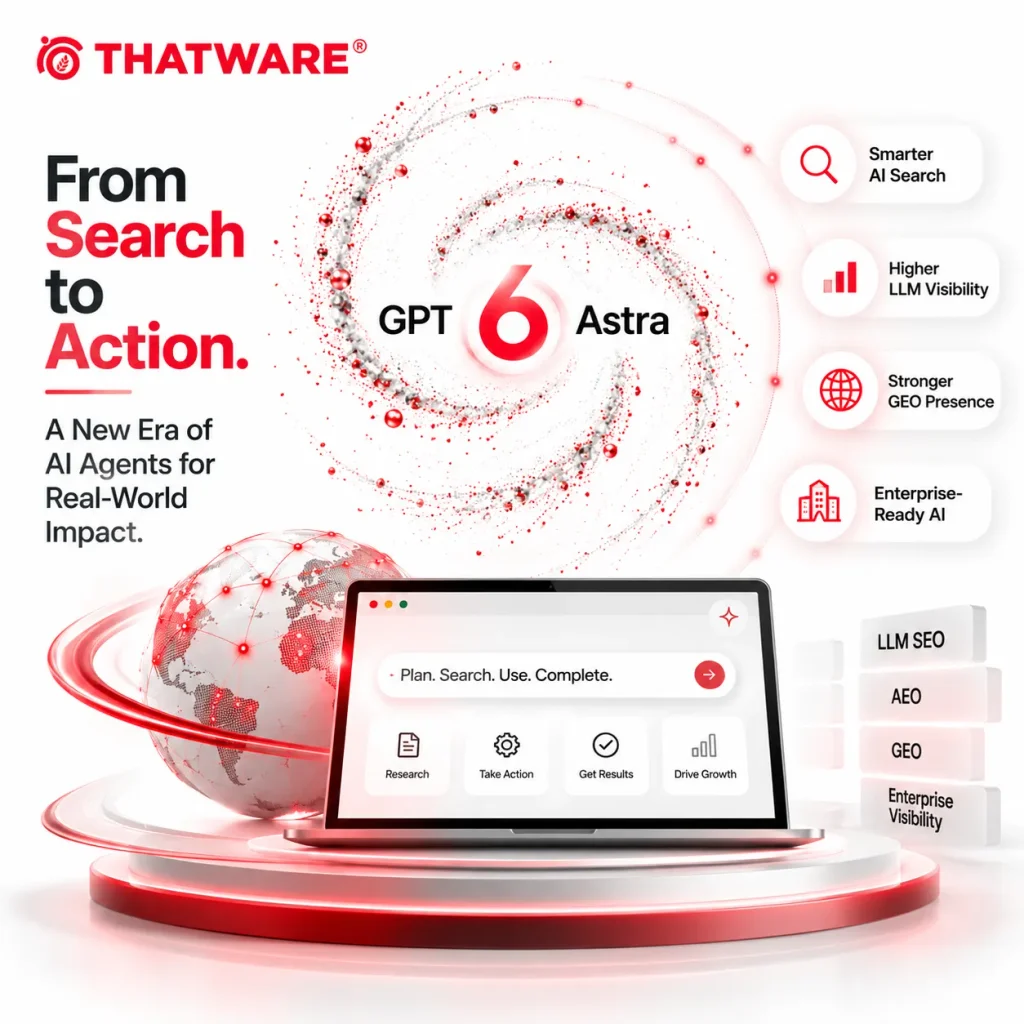
Control not only who can access the enterprise, but what an AI agent can do after it enters.
Protecting Enterprise Knowledge
As AI becomes more dependent on organizational knowledge, knowledge integrity becomes a security concern.
A malicious or accidental change to a policy repository could influence AI behavior.
So could:
- An outdated spreadsheet
- An incorrect SOP
- An unverified document
- A misleading internal instruction
Organizations therefore need controls around:
- Ownership
- Source verification
- Approval
- Version control
- Change history
- Permissions
- Review cycles
- Deprecation
- Provenance
The same principle applies to public information.
Relevance is not authority.
A page can be highly relevant to a topic without being the strongest source of truth.
Testing GPT-6 Astra in Enterprise Workflows
General AI benchmarks are useful.
They are not sufficient.
Enterprise testing should focus on realistic situations.
Test scenarios should include:
- Correct customer
- Wrong customer
- Missing information
- Conflicting information
- Expired policy
- Permission denied
- Application unavailable
- Unexpected popup
- Duplicate transaction
- Approval required
- Session timeout
- Incorrect user input
The objective is not:
Can AI complete the task?
It is:
Can AI complete the task correctly and fail safely when it cannot?
Measuring AI Performance
Enterprise evaluation should consider:
- Task success
- Accuracy
- Policy compliance
- Permission compliance
- Recovery
- Verification
- Human escalation
- Audit completeness
A system that completes 98% of tasks but makes dangerous errors in the remaining 2% may not be suitable for production.
Risk-weighted performance matters more than simple completion rates.
For AI search, businesses should also evaluate:
- AI visibility
- Relevant query coverage
- Brand mentions
- Citations
- Source consistency
- Entity accuracy
- Topical coverage
- AI referral traffic where measurable
What CIOs and CTOs Should Do Now
Organizations do not need to wait for fully autonomous AI.
The foundational work can begin now.
Map Critical Workflows
Identify repetitive workflows crossing multiple applications.
Document:
- Systems
- Data
- Decisions
- Approvals
- Exceptions
- Verification
- Bottlenecks
Identify Sources of Truth
For important entities, determine:
Which system is authoritative?
Inventory Enterprise Knowledge
Identify:
- Policies
- SOPs
- Manuals
- Contracts
- Spreadsheets
- Internal guides
- Email-based processes
Remove or clearly label outdated content.
Normalize Enterprise Entities
Create reliable relationships between:
- Customers
- Products
- Employees
- Suppliers
- Accounts
- Contracts
- Locations
Establish Agent Permissions
Separate:
Read → Write → Submit → Approve → Authorize
Build Verification
Every important automated action needs a reliable confirmation mechanism.
Start With Controlled Pilots
Choose low-risk, high-frequency workflows.
Learn before expanding authority.
What Marketing Teams Should Do Now
Marketing teams should perform a similar readiness assessment for the public digital ecosystem.
Audit Brand Identity
Ask:
- Is the company name consistent?
- Are descriptions consistent?
- Are brand entities clearly defined?
Audit Services
Ask:
- Are services clearly explained?
- Are related services connected?
- Are target industries identified?
Audit Content
Ask:
- Is content organized around topic clusters?
- Are experts identifiable?
- Is information current?
- Are claims supported?
Audit Technical SEO
Ask:
- Can search engines crawl important content?
- Is structured data accurate?
- Are internal links logical?
- Are important pages indexable?
Audit AI Search Visibility
Ask:
- Is the brand appearing in relevant AI answers?
- Are AI systems accurately describing the company?
- Are important services represented?
- Are sources consistent?
- Are relevant entities associated with the brand?
This is where AI SEO, GEO, AEO and LLM SEO become practical business disciplines.
A 90-Day GPT-6 Astra and AI-Search Readiness Plan
Days 1–30: Discover
Inventory:
- Critical applications
- High-volume workflows
- Enterprise data sources
- Knowledge repositories
- Legacy applications
- APIs
- Automation
- Permissions
- Public digital assets
- AI-search visibility
Identify data-quality, documentation and digital-authority problems.
Days 31–60: Prepare
Focus on:
- Entity normalization
- Source-of-truth definitions
- Data ownership
- Document metadata
- Policy versioning
- Workflow documentation
- Permission mapping
- Audit requirements
- Content architecture
- Structured data
- Topical authority
- AI-search consistency
Select one or two low-risk workflows for a pilot.
Days 61–90: Pilot and Evaluate
Measure:
- Task completion
- Accuracy
- Time saved
- Failure rate
- Escalation rate
- Policy compliance
- Permission violations
- Verification accuracy
- Human intervention
- Audit completeness
For marketing, evaluate:
- Organic visibility
- AI-search mentions
- Citations
- Brand/entity consistency
- Query coverage
- Topical authority
- AI referral traffic
The goal is not simply:
“How much manual work did we remove?”
It is:
“Did AI perform the work correctly, safely and predictably—and can AI systems understand our business accurately?”
GPT-6 Astra Enterprise Readiness Checklist
Before allowing an AI agent to operate a production workflow, organizations should be able to answer yes to the following.
Data
- Is the required data available?
- Is it current?
- Is ownership defined?
- Are important entities normalized?
- Are authoritative sources identified?
Knowledge
- Are relevant SOPs documented?
- Are policies current?
- Are outdated documents identified?
- Is metadata available?
- Are exceptions documented?
Process
- Are workflow steps explicit?
- Are decision rules defined?
- Are approvals clear?
- Are escalation paths documented?
- Are exceptions handled?
Security
- Does the agent have a defined identity?
- Are permissions scoped?
- Is sensitive information protected?
- Are high-risk actions restricted?
- Is human approval available?
Technology
- Are APIs used where appropriate?
- Are controlled tools available?
- Can computer use address integration gaps?
- Are applications stable?
- Are outcomes observable?
AI Search
- Is the brand clearly represented online?
- Are important entities consistent?
- Are services clearly defined?
- Is authoritative content available?
- Can AI systems understand the organization’s expertise?
- Is the business visible for relevant AI-search queries?
Governance
- Is there an accountable owner?
- Are actions logged?
- Can failures be investigated?
- Are agents evaluated regularly?
- Can agents be disabled quickly?
Common Mistakes Enterprises Should Avoid
Automating Before Fixing the Process
AI can accelerate a broken workflow.
It does not automatically improve it.
Giving Agents Excessive Permissions
More access creates more potential risk.
Treating All Data as Equally Trustworthy
A current approved record should not have the same authority as an old spreadsheet.
Ignoring Documentation
Undocumented processes are difficult to automate reliably.
Using Computer Use When an API Is Better
Screen automation should not unnecessarily replace structured integration.
Measuring Only Task Completion
Speed is not enough.
Accuracy, safety and policy compliance matter.
Skipping Verification
A click is not proof of a successful transaction.
Ignoring AI Search
A business can have strong traditional rankings while remaining poorly represented in AI-generated answers.
Publishing Content Without Entity Strategy
Thousands of disconnected pages do not automatically establish authority.
Scaling Without Governance
A successful pilot can quickly become a production dependency.
Agent identity, ownership, permissions, monitoring and auditability should be considered before scaling.
The Rise of the Digital Worker
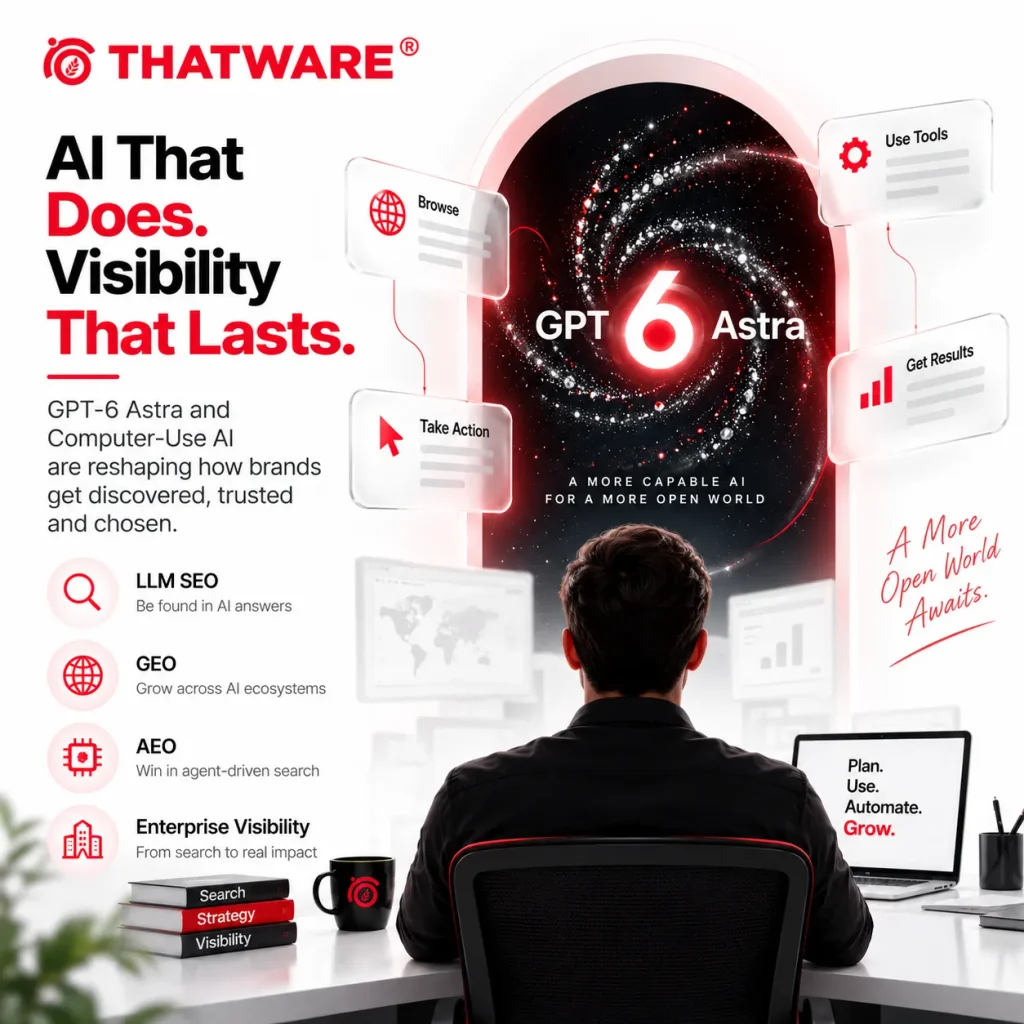
The long-term significance of GPT-6 Astra and computer-use AI may extend beyond individual automation tasks.
Enterprises may increasingly treat AI agents as a new category of digital worker.
A digital worker could potentially:
- Read enterprise information
- Understand instructions
- Navigate applications
- Perform repetitive workflows
- Communicate across systems
- Escalate exceptions
- Request approval
- Confirm outcomes
- Maintain an operational record
This does not necessarily mean replacing employees.
Instead, businesses may redesign work around complementary strengths.
Humans can focus on:
- Judgment
- Strategy
- Relationships
- Negotiation
- Creativity
- Leadership
- Complex exceptions
AI can handle:
- Information movement
- Routine processing
- System navigation
- Repetitive execution
- Cross-application coordination
The competitive advantage may come from designing the boundary between humans and AI.
The Rise of the AI-Ready Business
There is another transformation happening at the same time.
Businesses are becoming AI-discoverable.
A company’s website is no longer only a destination for human visitors.
It is also part of the information environment that search engines and AI systems use to understand the organization.
That means businesses should build digital ecosystems in which:
- The brand is identifiable
- Services are understandable
- Entities are connected
- Expertise is supported
- Information is current
- Sources are consistent
- Content is retrievable
- Evidence is available
This is the broader opportunity behind GEO and LLM SEO.
The objective is not to manipulate AI.
It is to make the business easier for AI systems to understand accurately.
What GPT-6 Astra Really Means for Enterprise AI and Search
The importance of GPT-6 Astra is not simply that it is another more capable language model.
The deeper significance is the combination of:
Reasoning + Computer Use + Tools + Context + Professional Workflows
That combination moves AI closer to the systems employees have actually needed for years.
Businesses have never had a shortage of software.
They have had a shortage of seamless coordination between software.
Employees have traditionally filled that gap.
They copy information.
They read policies.
They reconcile records.
They navigate applications.
They check approvals.
They interpret exceptions.
They verify outcomes.
Computer-use AI creates the possibility that some of this coordination can increasingly be performed by AI.
But the same development exposes weaknesses in enterprise environments.
If customer records are inconsistent, AI may select the wrong record.
If policies are outdated, AI may follow the wrong rule.
If permissions are unclear, AI may have too much authority.
If workflows are undocumented, AI may not know what to do.
If systems provide weak confirmation signals, AI may not know whether an action succeeded.
If audit trails are incomplete, the organization may not know what happened.
And if a company’s public digital presence is fragmented, AI search systems may struggle to understand the business.
This is why the environment surrounding AI matters so much.
The Future Is Not an Uncontrolled AI Desktop
It is tempting to imagine the future as an AI sitting in front of a computer and controlling everything a human can control.
That is probably not the most useful enterprise architecture.
A more practical model is:
Human Objective
↓
AI Reasoning
↓
Enterprise Knowledge
↓
Identity + Policy
↓
APIs + Tools + Computer Use
↓
Enterprise Applications
↓
Verification
↓
Audit
For AI search, a parallel model is emerging:
Business Entity
↓
Structured + Unstructured Content
↓
Semantic Relationships
↓
Authority + Evidence
↓
Search + Retrieval
↓
AI Reasoning
↓
Answer / Recommendation / Citation
These systems increasingly intersect.
The objective is not simply to give AI a computer.
The objective is to give AI controlled access to the information and capabilities required to accomplish a legitimate business outcome.
For search, the objective is not simply to publish more pages.
It is to create a digital presence that AI systems can find, understand, trust and accurately represent.
Conclusion: Preparing for GPT-6 Astra and the AI-Search Era
GPT-6 Astra represents an important shift in the evolution of artificial intelligence.
AI is moving beyond systems that simply answer questions and generate content toward systems that can increasingly participate in the execution of real work.
Computer use is a major part of that transition.
It allows AI to interact with software and digital environments, particularly in situations where conventional APIs and integrations are unavailable or incomplete.
But the real challenge is not teaching AI how to click buttons.
The real challenge is preparing everything behind those buttons.
Enterprise AI needs:
- Reliable transactional data
- Consistent reference data
- Normalized entities
- Current information
- Authoritative sources
- Structured metadata
- Explicit workflows
- Documented policies
- Permission-aware knowledge
- Controlled execution mechanisms
- Verification
- Human oversight
- Auditability
At the same time, AI-search visibility increasingly requires:
- Clear entity definitions
- Strong topical authority
- Structured content
- Consistent business information
- Authoritative sources
- Semantic relationships
- AI-readable content
- Citation-worthy evidence
- GEO
- AEO
- LLM SEO
This creates a broader equation for the AI era:
Data + Context + Entities + Content + Process + Permissions + Authority = AI Readiness
Organizations that understand this will approach GPT-6 Astra differently.
They will not simply ask:
“How can we give AI access to our applications?”
They will ask:
“How can we make our applications, data, knowledge, content and processes safe, reliable and understandable for AI?”
And marketing teams should ask a parallel question:
“How can we make our business easy for AI systems to discover, understand, trust and recommend?”
That is the more important question.
Because the future of AI will not be determined only by how intelligent the model becomes.
It will also be determined by how AI-ready the business becomes.
The enterprise desktop is evolving from a collection of applications into a potential AI execution environment.
At the same time, the website is evolving from a collection of pages into an AI-readable knowledge and authority layer.
The organizations that prepare their data, normalize their systems, document their knowledge, define their permissions, establish verification mechanisms, strengthen their digital entities and build authoritative content will be in a stronger position to benefit from the next generation of AI.
The future is not simply:
AI that can use a computer.
It is:
Humans define outcomes.
AI understands context.
AI coordinates authorized work.
Applications execute transactions.
Search systems retrieve evidence.
AI systems evaluate that evidence.
Businesses become discoverable, understandable and actionable.
Important actions remain controlled, verifiable and accountable.
GPT-6 Astra is an important step toward that future.
For businesses, the opportunity is therefore no longer simply to rank in search.
It is to become a business that AI systems can find, understand, trust, cite, recommend and work with.
That is the next evolution of search.
And it is why AI SEO, LLM SEO, GEO and AEO are becoming increasingly important parts of a modern digital growth strategy.