
Get a Customized Website SEO Audit and Online Marketing Strategy and Action Plan
Scenario: A recently launched LLM by a Chinese computational science research hub, DeepSeek is creating a massive changes in AI industry, so while studying and researching on different LLMs and its architectures, I have found that it is only open source LLM has been launched so far. So, I decided to cover these topic and also try to utilize the new LLM for advanced SEO optimization.

Opportunity: Early to take advantage of this topic to cover for ranking on “DeepSeek” related terms as it is very much trending.
What is DeepSeek?
DeepSeek is a new Large Language Model (LLM) developed by a Chinese AI research lab that has quickly gained attention for its cost efficiency and high reasoning capabilities. It competes with major players like OpenAI, Google, and Meta by leveraging advanced training techniques that significantly reduce costs while improving performance.
How its different from open.ai?
- Cost Efficiency: DeepSeek is trained at a fraction of the cost compared to models like OpenAI’s GPT, reportedly costing only $5-$6 million, whereas other models cost 100 times more.
- Performance: It outperforms many existing models in metrics like code solving, general knowledge, and reasoning.
- Training Innovation: Instead of relying on traditional Supervised Fine-Tuning (SFT), DeepSeek employs Reinforcement Learning (RL) to improve reasoning and inference capabilities.
- Open-Source Advantage: Unlike OpenAI’s proprietary models, DeepSeek has open-sourced many of its research papers and methodologies.
- Inference Speed & Cost: It operates at a much lower inference cost than OpenAI, charging in cents instead of dollars for 1 million tokens.
- Hardware Constraints: Due to U.S. restrictions on NVIDIA’s H100 GPUs, DeepSeek was trained using lower-end H800 and A800 chips, showcasing innovative optimization techniques.


What are the advantages of DeepSeek over open ai and other LLMs?
Key Features and Innovations
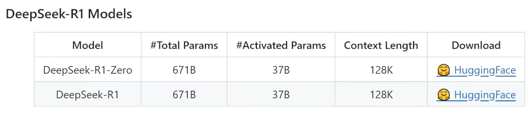
1. Reinforcement Learning-Based Training
Unlike conventional LLMs that rely on Supervised Fine-Tuning (SFT) for model improvement, DeepSeek integrates Reinforcement Learning (RL) in both:
- Pre-training: Creating a strong foundational model.
- Post-training: Applying reinforcement learning to refine reasoning and decision-making.
This approach allows DeepSeek to:
- Develop better logical reasoning.
- Improve self-verification and reflection capabilities.
- Optimize long chain-of-thought (COT) processing.
2. Distillation for Smaller Yet Powerful Models
DeepSeek employs model distillation, a technique that transfers knowledge from larger models to smaller ones while maintaining high accuracy. This enables:
- Lower computation costs.
- Faster inference speeds.
- Reduced hardware dependency.
3. Architectural Advancements
DeepSeek incorporates:
- Mixture of Experts (MoE): Only a subset of the model activates at a time, making it more efficient than dense models.
- Multi-head Latent Attention Mechanisms: Enhancing contextual understanding and recall.
Comparison with Other LLMs
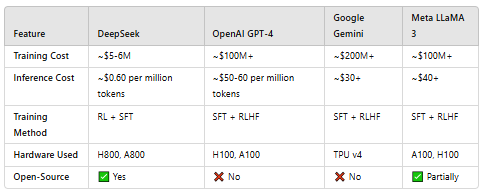
Technological and Specification difference between DeepSeek and Open AI?
1. Core Architecture Differences
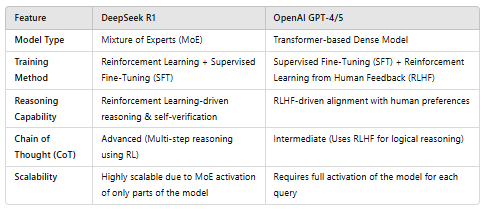
Key Takeaway:
- DeepSeek activates only a subset of parameters using MoE, making it more cost-efficient than OpenAI’s dense transformer models.
- OpenAI models rely on RLHF, which enhances alignment with human responses but increases training costs.
2. Training & Computational Cost Differences
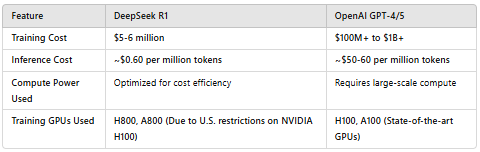
Key Takeaway:
- DeepSeek is 100x cheaper to train than OpenAI’s models.
- Inference cost is drastically lower, making it more affordable for AI applications.
- OpenAI has access to cutting-edge NVIDIA hardware, whereas DeepSeek is restricted to less powerful GPUs.
3. Model Performance & Benchmarking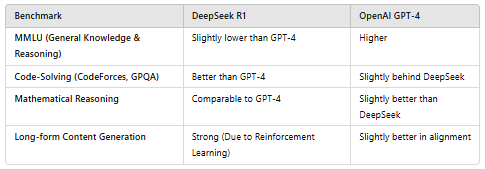
Key Takeaway:
- DeepSeek outperforms GPT-4 in coding tasks.
- GPT-4 has better alignment and factual consistency.
- Mathematical reasoning and general knowledge are comparable.
Hardware & Scalability Differences

Key Takeaway:
- DeepSeek is more efficient with lower-tier GPUs.
- OpenAI’s models require state-of-the-art hardware, making them costly and harder to scale.
Accessibility & Open-Source Approach
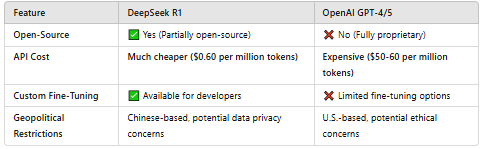
Key Takeaway:
- DeepSeek is open-source, making it more customizable.
- GPT-4/5 is proprietary, restricting user customization but offering superior safety and moderation.
- Data privacy concerns exist for DeepSeek, especially regarding storage in Chinese servers.
Ethical & Safety Considerations
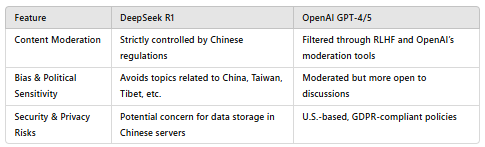
Key Takeaway:
- DeepSeek is heavily restricted in political discussions.
- OpenAI filters responses but allows for broader engagement.
Drawbacks & Limitations of DeepSeek and OpenAI for Real-Time Website Data Analysis
- Inability to Access Real-Time Web Data
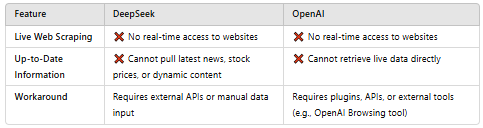
🔹 Issue: Neither DeepSeek nor OpenAI has native access to live web data. Both depend on pretrained knowledge (data cutoff for OpenAI, while DeepSeek is trained with reinforcement learning).
🔹 Workaround:
- Use APIs like Google SERP API or web scraping tools (e.g., Scrapy, BeautifulSoup).
- For OpenAI, the pro version (ChatGPT-4 with browsing) can fetch live web data, but DeepSeek lacks this feature.
- Latency Issues for Large-Scale Real-Time Analysis
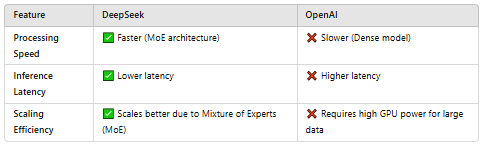
🔹 Issue:
- DeepSeek processes requests faster due to Mixture of Experts (MoE), which activates only parts of the model.
- OpenAI’s dense model requires full model activation, leading to higher computational cost and slower response times for real-time analysis.
🔹 Workaround:
- Use vector databases (e.g., Pinecone, Weaviate) to pre-index website data for faster lookups.
- Use smaller, fine-tuned models for lightweight tasks.
- Cost Constraints for Continuous Data Analysis

🔹 Issue:
- OpenAI is too expensive for continuous website data analysis. A single real-time monitoring tool could rack up thousands of dollars in API costs.
- DeepSeek is cheaper but still requires substantial compute resources for large-scale real-time tasks.
🔹 Workaround:
- Use offline processing + caching for frequently accessed data.
- Consider hybrid solutions (e.g., combining OpenAI with local LLMs like Mistral or DeepSeek).
- Accuracy & Data Hallucination Risks
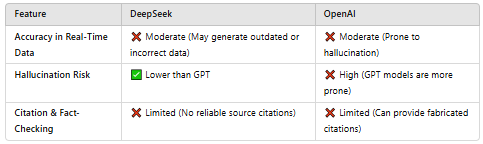
🔹 Issue:
- Both models hallucinate (generate inaccurate data).
- OpenAI sometimes fabricates sources, making fact-checking essential.
- DeepSeek avoids some sensitive topics, restricting responses.
🔹 Workaround:
- Verify outputs with external APIs (e.g., Google Knowledge Graph, Wolfram Alpha).
- Use human-in-the-loop (HITL) verification for critical data.
- Security & Privacy Concerns

🔹 Issue:
- DeepSeek stores data in Chinese servers, raising concerns over data privacy and compliance.
- OpenAI collects input data, which can be used to train future models (unless explicitly opted out).
🔹 Workaround:
- For privacy-critical applications, use local on-premise LLMs (e.g., Llama 3, Mistral).
- Encrypt sensitive data before sending queries.
- Limited Customization & Fine-Tuning

🔹 Issue:
- OpenAI does not allow fine-tuning for GPT-4, forcing users to use pre-trained knowledge only.
- DeepSeek allows limited customization, but model control is still lacking.
🔹 Workaround:
- Consider open-source models like Llama 3 or Falcon for full control.
- Use RAG (Retrieval-Augmented Generation) to improve output quality.
- Geopolitical & Ethical Restrictions
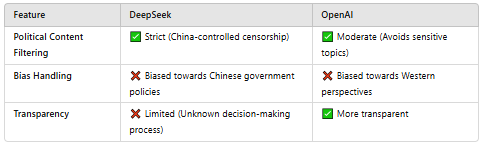
🔹 Issue:
- DeepSeek refuses to answer politically sensitive questions (e.g., China-Taiwan, India-China conflicts).
- OpenAI enforces content moderation but is still biased based on Western policies.
🔹 Workaround:
- Use neutral datasets for unbiased analysis.
- Combine models for diverse perspectives.
Which LLM can analyse SERP trend better?
When analyzing Search Engine Results Page (SERP) trends, an LLM needs to process, analyze, and extract insights from real-time search data. However, most LLMs (DeepSeek, OpenAI GPT-4, Claude, Gemini, etc.) do not have built-in real-time web access. To effectively analyze SERP trends, a hybrid approach that integrates LLMs with real-time data sources (APIs, web scrapers) is essential.
Best LLMs for SERP Trend Analysis
When analyzing Search Engine Results Page (SERP) trends, an LLM needs to process, analyze, and extract insights from real-time search data. However, most LLMs (DeepSeek, OpenAI GPT-4, Claude, Gemini, etc.) do not have built-in real-time web access. To effectively analyze SERP trends, a hybrid approach that integrates LLMs with real-time data sources (APIs, web scrapers) is essential.
🔹 Top LLMs for SERP Trend Analysis

🔹 Best Setup for Real-Time SERP Analysis
Since no LLM can natively scrape SERP data, the best approach is to combine LLMs with external tools:
🔗 Hybrid Solution
- Use Web Scraping/APIs to Gather SERP Data:
- Google SERP API (SerpAPI, DataForSEO) → Real-time rankings
- SEMrush, Ahrefs API → Keyword difficulty & competition
- Google Trends API → Trending search queries
- Process Data with an LLM for Insights:
- GPT-4 + SERP API → Best for SEO content strategy & trend analysis
- DeepSeek + Python NLP → Fast & cheaper SEO trend processing
- Mistral 7B (Local Processing) → If privacy is a concern
- Predict Trends & Generate SEO Insights:
- Use GPT-4 or Claude for query clustering, ranking prediction
- Use DeepSeek for cost-efficient bulk keyword analysis
- Use Gemini if you rely on Google’s algorithm insights
🔹 Final Recommendation
- For the most accurate SERP analysis: ✅ GPT-4 with Browsing API + Google SERP API
- For budget-friendly SEO automation: ✅ DeepSeek + Ahrefs/SEMrush API
- For private/on-premise processing: ✅ Mistral 7B + Custom Web Scraper
How DeepSeek LLM can be utilized in advanced data analysis in SEO?
DeepSeek LLM can be an efficient and cost-effective AI model for SEO data analysis, providing advanced capabilities in keyword research, content optimization, competitor analysis, and trend forecasting. With its reinforcement learning-based reasoning and lower inference costs, DeepSeek is well-suited for scalable SEO automation.
🔹 Key SEO Use Cases for DeepSeek LLM
1. Keyword Research & Topic Clustering
✅ Analyze high-ranking keywords based on user intent
✅ Cluster search queries into categories (informational, navigational, transactional)
✅ Generate keyword variations & long-tail suggestions
💡 How to Implement:
- Step 1: Extract SERP keyword data from Google Search Console (GSC), Ahrefs, or SEMrush API.
- Step 2: Use DeepSeek to cluster keywords based on search intent.
- Step 3: Generate LSI (Latent Semantic Indexing) keywords for better content optimization.
📌 Example Prompt for DeepSeek:
Analyze the following keyword list and categorize them into
search intent types (informational, navigational, transactional, commercial).
Provide semantically related keyword suggestions.
2. SERP Trend Prediction & Rank Tracking
✅ Analyze historical ranking data to predict future trends
✅ Detect ranking fluctuations & Google algorithm updates
✅ Provide insights on ranking volatility
💡 How to Implement:
- Step 1: Collect SERP ranking data from Google SERP API.
- Step 2: Use DeepSeek’s reasoning capability to detect ranking trends.
- Step 3: Forecast which keywords will gain or lose rankings.
📌 Example Prompt for DeepSeek:
Based on the following historical SERP ranking data, analyze trends and predict
which keywords will gain or lose rankings in the next 3 months.
3. Competitor SEO Analysis
✅ Extract keyword gaps between competitors
✅ Identify backlinks & content strategies used by top competitors
✅ Analyze competitors’ domain authority & ranking signals
💡 How to Implement:
- Step 1: Extract competitor data using SEMrush, Ahrefs, or Moz API.
- Step 2: Feed DeepSeek the extracted competitor content and ranking data.
- Step 3: Use DeepSeek’s NLP capabilities to analyze patterns & generate recommendations.
📌 Example Prompt for DeepSeek:
Compare the SEO strategies of website A and website B based on keyword usage,
content quality, and backlink profile. Provide actionable insights to outrank them.
4. Content Optimization & NLP-Based SEO
✅ Improve existing content for better search rankings
✅ Enhance readability & keyword density
✅ Optimize on-page elements (title, meta description, headers)
💡 How to Implement:
- Step 1: Input content from existing website pages.
- Step 2: Use DeepSeek to analyze readability, keyword density, and LSI keyword usage.
- Step 3: Optimize content structure based on SEO best practices.
📌 Example Prompt for DeepSeek:
Analyze the following blog post and suggest improvements for SEO.
Ensure it follows Google’s EEAT principles and includes semantically relevant keywords.
5. AI-Driven FAQ & Featured Snippet Optimization
✅ Extract common user queries from SERP & People Also Ask (PAA) results
✅ Generate concise, structured answers for featured snippets
✅ Optimize FAQs for voice search & zero-click results
💡 How to Implement:
- Step 1: Extract People Also Ask (PAA) data from Google SERP API.
- Step 2: Use DeepSeek to generate concise, structured answers.
- Step 3: Format responses in a FAQ schema to increase chances of appearing in featured snippets.
📌 Example Prompt for DeepSeek:
Generate a structured FAQ list based on the following “People Also Ask” questions.
Ensure each answer is concise, informative, and optimized for featured snippets.
6. Automated SEO Reporting & Insights
✅ Summarize SEO performance metrics
✅ Detect patterns & anomalies in traffic, ranking, and CTR
✅ Generate weekly/monthly SEO reports
💡 How to Implement:
- Step 1: Pull Google Search Console & Google Analytics data.
- Step 2: Feed the data into DeepSeek for automated analysis.
- Step 3: Generate an actionable SEO performance report.
📌 Example Prompt for DeepSeek:
Analyze the following website’s SEO performance metrics over the last 6 months.
Identify key patterns, ranking drops, and provide optimization recommendations.
Why Use DeepSeek for SEO Data Analysis?
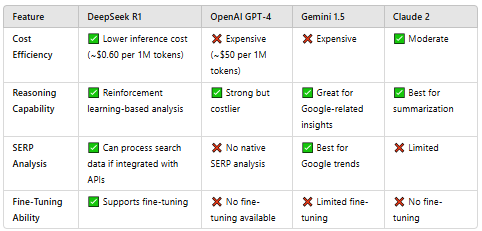
Final Verdict: Which Model is Better?
It depends on use case and requirements:
🔹 Choose DeepSeek If:
✅ You need a cost-effective, fast, and open-source model.
✅ You work with coding tasks where DeepSeek excels.
✅ You want lower inference costs for large-scale AI applications.
🔹 Choose OpenAI GPT-4/5 If:
✅ You need better factual accuracy and alignment.
✅ You prioritize data privacy & content safety.
✅ You require a commercially-supported solution with strong moderation.
DeepSeek can be a game-changer in the LLM space!
The Future of LLMs: Competition Heats UpWith DeepSeek’s emergence, OpenAI, Google, and Meta must innovate to remain competitive. The result?
🚀 Better AI models at lower prices for everyone!



