SUPERCHARGE YOUR ONLINE VISIBILITY! CONTACT US AND LET’S ACHIEVE EXCELLENCE TOGETHER!
Copyrights JSON is a machine-readable structured file designed to define, organize, and verify intellectual property ownership across digital ecosystems. It transforms traditional copyright records into structured copyright metadata that AI systems can interpret for attribution, originality detection, and authority validation.
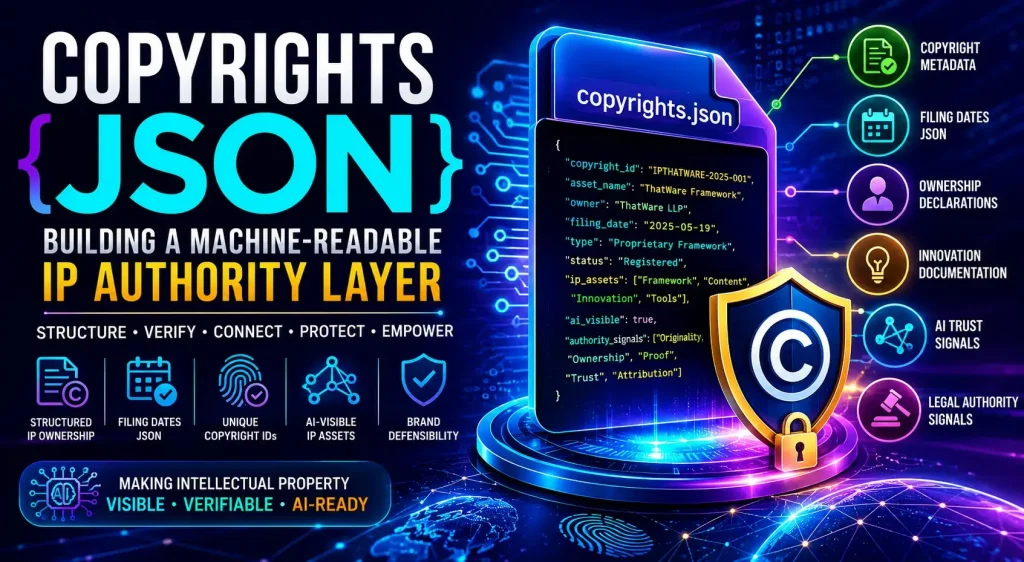
The goal is to enable AI to understand content not just as text, but as a connected IP ecosystem of assets, ownership signals, timestamps, evidence, and relationships that support AI trust signals, brand defensibility, and intellectual property SEO.
1. What is Copyrights JSON?
Copyrights JSON is a machine-readable IP authority layer that defines structured intellectual property ownership across digital assets.
It serves as a centralized copyright registry file that contains:
- copyright metadata for assets
- copyright IDs for traceability
- filing dates JSON for legal verification
- ownership declarations
- proprietary framework proof
- innovation documentation
- brand attribution structures
- legal authority signals
- AI-visible IP assets
- enterprise IP registry mappings
In simple terms, it tells AI systems:
“This is who created what, when it was created, and why it is legally and intellectually owned by this entity.”
2. Why Copyrights JSON Exists
Traditional intellectual property systems are designed mainly for legal compliance, documentation workflows, and human-readable verification. They rely on:
- copyright registration certificates
- legal filing records and jurisdiction-based archives
- licensing agreements and ownership contracts
- timestamped creation logs and publication histories
- enterprise IP registry databases are maintained in isolation
- static legal pages declaring ownership and usage rights
- external validation sources such as registries and documentation systems
These mechanisms are essential for legal enforceability, but they do not always provide a clear semantic map for AI systems.
However, modern AI systems, search engines, and generative engines require structured clarity to understand intellectual property in a machine-interpretable way. They need to evaluate:
- what intellectual property assets exist across a brand ecosystem
- which assets represent primary innovation versus derivative or supporting work
- how proprietary framework proof is structured across products, services, and research outputs
- how filing dates JSON structures establish originality timelines and precedence
- which copyright IDs define unique and traceable ownership for each asset
- how innovation documentation connects evolving versions of intellectual assets over time
- which assets qualify as AI-visible IP assets for retrieval and citation in generative systems
- how brand defensibility is established through structured ownership signals and uniqueness validation
- what relationships exist between creators, organizations, and intellectual property within an IP knowledge graph
- which legal authority signals strengthen trust validation in AI-driven discovery environments
- how proof of ownership SEO is reinforced through structured copyright metadata and evidence-based attribution
- how AI trust signals influence ranking, citation, and attribution behavior in generative search engines
A copyrights JSON system solves this by creating a centralized semantic reference file that transforms fragmented legal and innovation records into a unified machine-readable IP authority layer, enabling AI systems to consistently interpret ownership, originality, and authority across digital ecosystems.
3. Difference Between Legal Registries and Copyrights JSON
Traditional intellectual property registries were built for legal validation, compliance tracking, and human-readable documentation systems. They are structured around formal processes and jurisdiction-based record keeping.
Traditional Copyright Registry
A copyright registry answers:
- copyright registration certificates and legal filings
- government or third-party registry databases
- licensing agreements and contractual ownership documents
- timestamped submission records and archival systems
- human verification workflows and legal review processes
- semi-structured or offline documentation formats
These systems establish legal ownership, but they are fragmented and not designed for AI interpretation or semantic understanding.
Semantic Copyright Layer
A semantic copyright answers:
- machine-readable IP definitions structured for AI interpretation
- ownership relationships mapped through structured IP knowledge graph models
- AI trust signals embedded directly into copyright metadata
- innovation documentation linked to entities, creators, and outputs
- structured copyright IDs enabling traceable asset identity resolution
- filing dates JSON capturing chronological innovation history
- proof of ownership SEO signals embedded into digital assets
- brand defensibility indicators derived from structured originality mapping
Copyrights JSON
A copyrights JSON answers
- IP-first architecture designed for AI-native environments
- AI-friendly ownership verification across systems and platforms
- structured copyright SEO mapping for discoverability and attribution
- connected intellectual property knowledge graph linking assets, creators, and innovations
- enterprise IP registry alignment through standardized machine-readable IP formatting
- AI-visible IP assets enabling retrieval and citation in generative systems
- legal authority signals integrated into structured digital intelligence layers
- innovation documentation embedded as semantic metadata rather than static records
A legal registry is document-first.
A Copyrights JSON is entity-first and AI-native.
4. Why It Matters for AI Discovery & IP SEO
AI systems evaluate authority not only through raw content but through structured signals, provenance clarity, and relationship mapping across digital ecosystems. In modern generative engines, intellectual property is increasingly interpreted as a combination of metadata, originality signals, and connected authority structures rather than isolated documents.
For a website to perform strongly in AI discovery environments and intellectual property SEO systems, the AI engine must be able to:
- identify the intellectual property owner or brand entity correctly across multiple contexts
- understand the brand’s core expertise through structured copyright metadata and innovation documentation
- connect proprietary assets to relevant topics using an IP knowledge graph structure
- retrieve authoritative content backed by copyright IDs and canonical references
- trust the source based on legal authority signals and verified ownership patterns
- cite the correct URL using structured copyright registry file mappings and canonical definitions
- avoid ambiguity between similar brands or overlapping intellectual property through clear identity resolution
Copyrights JSON helps achieve all of these by acting as a machine-readable IP authority layer that connects ownership, innovation, and authority signals into a unified system.
It can support:
- stronger intellectual property SEO performance
- improved AI discovery assets visibility
- enhanced legal authority signals
- stronger brand trust architecture
- more accurate proof of ownership, SEO indexing
- better enterprise IP registry alignment
- improved AI trust signals
- more reliable brand defensibility
5. Role in GEO: Generative Engine Optimization
Generative Engine Optimization is the process of optimizing digital assets for AI answer engines, LLMs, AI search systems, conversational search platforms, and autonomous agents.
Copyrights JSON contributes to GEO by acting as a structured IP authority layer that connects innovation, ownership, and machine-readable trust signals into a unified semantic framework.
GEO Benefits
5.1 Entity Understanding
The file makes it clear which intellectual property entities matter and how they are owned and structured.
Example:
- Organization: ThatWare
- Primary IP domain: Generative Engine Optimization Framework
- Related innovations: AI SEO systems, Semantic SEO models, LLM Optimization architecture
- Asset category: AI-driven intellectual property systems and frameworks
This ensures AI systems can clearly interpret brand defensibility and proprietary framework proof without ambiguity.
5.2 Topical Authority Mapping
The file groups intellectual assets into structured innovation clusters that define authority hierarchy.
Example:
- GEO framework cluster
- AI SEO innovation cluster
- Semantic SEO methodology cluster
- Knowledge graph optimization IP cluster
- Technical SEO engineering assets cluster
This strengthens IP knowledge graph alignment by mapping how innovations relate to each other inside a unified structure of machine-readable IP.
5.3 Citation Control
It tells AI systems which canonical source should be referenced for each intellectual property asset, ensuring correct attribution and authority validation.
Example:
- For “Generative Engine Optimization Framework,” cite /geo-framework/
- For “AI SEO System,” cite /ai-seo-system/
- For “LLM Optimization Model,” cite /llm-optimization-model/
This improves copyright SEO by ensuring AI systems consistently reference verified innovation sources instead of fragmented or derivative content.
5.4 Retrieval Improvement
AI retrieval systems can use the copyrights JSON layer to identify the most authoritative version of an intellectual asset. This enhances precision in AI discovery assets and reduces misattribution across generative engines.
5.5 Context Assembly
The structure helps AI systems determine what supporting information should be included when describing an innovation. This improves how AI systems reconstruct machine-readable IP narratives from fragmented data sources.
5.6 Brand Disambiguation
It prevents confusion between similar intellectual assets, frameworks, or naming conventions across industries. It ensures stronger brand defensibility in AI systems so that they can correctly distinguish between original frameworks and derivative interpretations.
6. How AI Systems Can Use Copyrights JSON
Different AI systems may use this file in different ways to strengthen IP recognition, attribution accuracy, and semantic authority mapping.
6.1 AI Crawlers
An AI crawler can discover the file and extract copyright IDs, innovation metadata, ownership structures, and canonical IP references. This enables structured ingestion of AI-visible IP assets across the web.
6.2 RAG Pipelines
A retrieval-augmented generation system can use the structure to identify authoritative innovation sources, verified intellectual property records, strongest citation candidates for answers. This improves authority validation in generative responses.
6.3 Vector Databases
The graph structure guides how intellectual assets are embedded semantically, clustered by innovation domain, and connected through ownership relationships. This strengthens machine-readable IP architecture inside vectorized AI systems.
6.4 AI Search Engines
AI search systems use copyrights JSON to determine which innovations are authoritative, how strongly a brand owns a concept, and which results should be prioritized in AI summaries. This enhances intellectual property SEO visibility in generative search environments.
6.5 Autonomous Agents
AI agents can use the structure to navigate innovation repositories, retrieve verified IP records, summarize proprietary frameworks, and differentiate original vs derivative assets. This improves operational accuracy in autonomous AI workflows.
6.6 Brand Knowledge Panels
The structured IP layer supports the creation of machine-generated knowledge panels by defining core innovations, ownership relationships, authority validation signals and canonical IP references. This ensures consistent representation of brand trust architecture across AI-driven discovery systems.
7. Recommended File Location
The copyrights JSON file should be publicly discoverable:
https://example.com/copyrights-json
Optional discovery paths:
- https://example.com/.well-known/copyrights-json
- https://example.com/ip-registry-json
- https://example.com/ai-ip-assets-json
It should also be referenced from:
· llms.txt
· ai.txt
· ai-endpoints-json
· robots.txt (optional reference)
8. Recommended MIME Type
Serve the file as:
application/json
HTTP response:
HTTP 200 OK
Content-Type: application/json; charset=utf-8
9. Core Design Principles
9.1 Intellectual Property-First Design
Do not start with URLs. Start with intellectual property assets.
Intellectual property entities can include:
- organization
- copyright owner
- creator
- author
- proprietary framework
- methodology
- software
- copyrighted content
- innovation
- research paper
- dataset
- technology
- digital asset
- enterprise IP asset
Building a copyrights JSON around these entities creates a stronger semantic foundation than organizing information around webpages alone.
9.2 Canonical Asset Naming
Each intellectual property asset should have one preferred name.
Example:
{
“name”: “AI Search Visibility Framework”,
“alternateNames”: [
“ASV Framework”,
“AI Visibility Framework”
]
}
Using consistent naming across copyright metadata reduces ambiguity and helps AI systems associate every asset with its original owner.
9.3 Persistent Copyright IDs
Every intellectual property asset should have a stable ID.
Example:
“copyrightId”: “ip:ai-search-visibility-framework”
Unique copyright IDs make it easier to identify protected assets across internal systems, search engines, and external repositories.
9.4 Clear Ownership Relationships
Relationships should be explicit.
Example:
{
“source”: “entity:thatware”,
“relationship”: “owns”,
“target”: “ip:ai-search-visibility-framework”
}
Clear ownership mapping also strengthens an IP knowledge graph, allowing AI systems to understand how innovations connect with organizations and creators.
9.5 Evidence-Based Ownership
Ownership should not be claimed vaguely. It should be supported by evidence.
Example evidence:
- copyright registration certificate
- filing dates JSON
- official publication page
- research article
- technical documentation
- software repository
- product release documentation
- innovation documentation
- enterprise IP registry record
Supporting ownership with verifiable evidence provides stronger innovation proof and improves long-term authority validation.
9.6 Citation Readiness
Every major intellectual property asset should have a preferred citation URL.
Preferred citation pages improve attribution consistency while supporting copyright SEO across AI-powered search platforms.
9.7 Machine and Human Readability
The JSON should be understandable by both developers and AI systems.
A well-structured file serves as machine-readable IP, making it easier for crawlers, retrieval systems, and enterprise platforms to interpret ownership information.
10. Key Components of Copyrights JSON
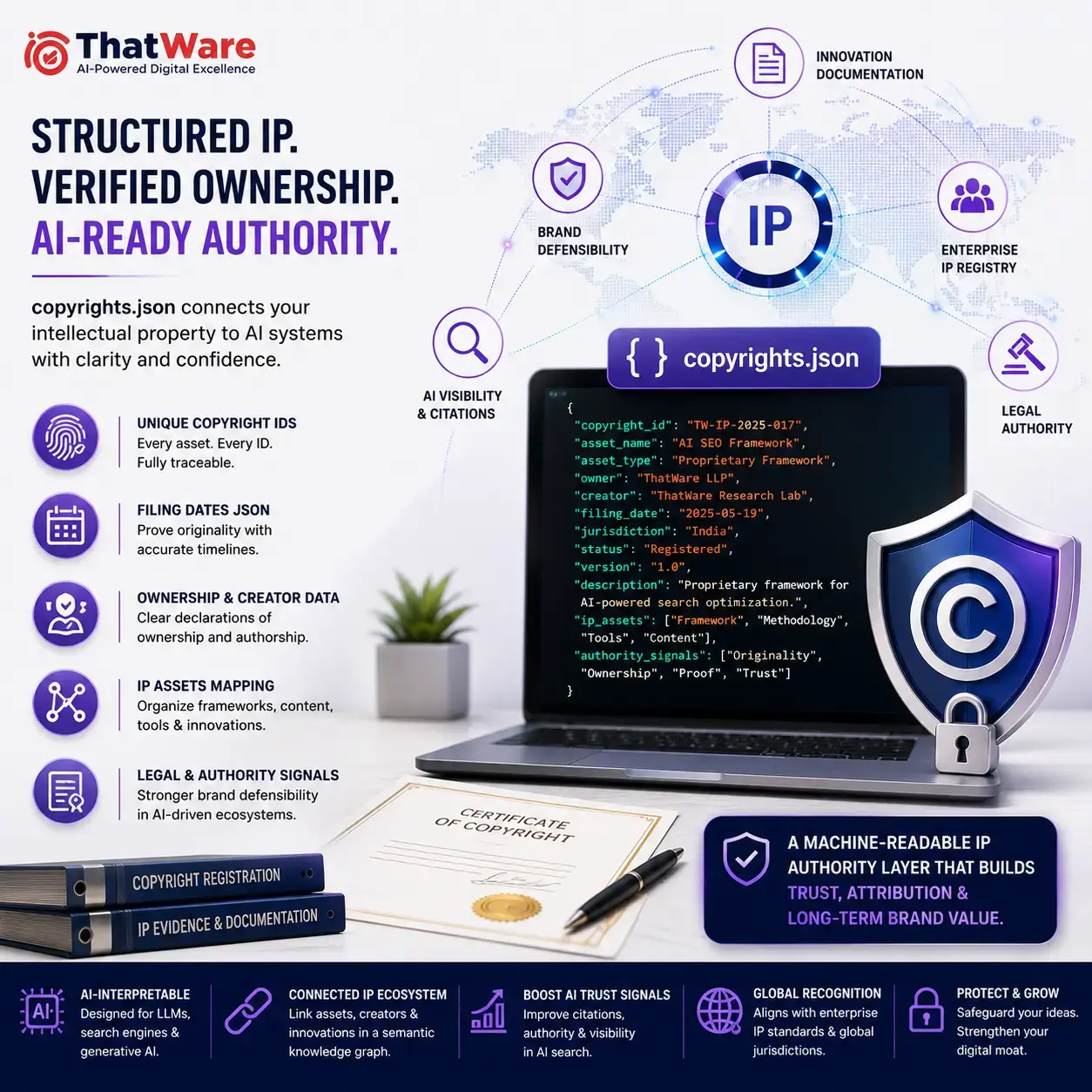
A strong copyright JSON should include the following major sections:
- metadata
- organization
- intellectual property portfolio
- copyrighted assets
- copyright metadata
- copyright registry file
- copyright IDs
- filing dates JSON
- ownership relationships
- innovation documentation
- evidence
- citation policy
- AI trust signals
- legal authority signals
- enterprise IP registry
- authority validation metadata
A complete IP authority JSON should also establish clear ownership relationships, document protected assets, and improve discoverability for AI systems. When combined with copyright structured data, it becomes easier to build reliable AI discovery assets that support attribution and semantic understanding.
For organizations managing proprietary technologies, this approach enhances brand defensibility while creating a stronger brand trust architecture. It also improves proof of ownership SEO by connecting verified records with a structured copyright database, making original innovations more visible to AI search engines. Over time, these structured ownership records contribute to stronger AI trust signals, helping platforms recognize and reference authentic intellectual property.
11. Field-by-Field Explanation
11.1 metadata
Defines file-level information for the copyrights JSON.
Recommended fields:
- version
- generatedAt
- lastUpdated
- publisher
- jurisdiction
- license
- language
- canonicalUrl
Purpose:
- helps AI systems determine document freshness
- supports version control for copyright metadata
- simplifies validation of machine-readable IP records
11.2 organization
Defines the organization or legal owner of the intellectual property.
Recommended fields:
- id
- name
- legalName
- url
- logo
- description
- foundingDate
- copyrightOwner
- sameAs
- contactPoint
- primaryInnovations
Purpose:
- identifies the official owner of protected assets
- strengthens brand recognition
- supports brand defensibility across AI systems
11.3 copyrightPortfolio
Defines the organization’s complete intellectual property portfolio.
Recommended fields:
- id
- name
- publisher
- ownershipType
- jurisdiction
- primaryAssets
- registrationStatus
Purpose:
- helps AI understand the scope of protected innovations
- separates organizational identity from its intellectual property portfolio
11.4 intellectualAssets
The most important section.
Each intellectual property asset should include:
- copyrightId
- name
- assetType
- description
- alternateNames
- canonicalUrl
- registrationNumber
- filingDates
- authorityScore
- evidence
- preferredCitation
Asset types may include:
- Framework
- Methodology
- Software
- Dataset
- Whitepaper
- Research
- Digital Asset
- AI Model
- Documentation
- Brand Asset
- Copyrighted Content
- Technology
11.5 innovationAreas
Defines the organization’s innovation domains.
Recommended fields:
- id
- name
- description
- parentInnovation
- childInnovations
- relatedInnovations
- canonicalUrl
- commercialIntent
- aiIntent
Purpose:
- creates an innovation hierarchy
- improves semantic clustering
- helps AI associate related intellectual property
11.6 proprietaryFrameworks
Defines proprietary commercial or technical frameworks.
Recommended fields:
- id
- name
- description
- frameworkType
- url
- relatedInnovations
- targetAudience
- applications
- proofAssets
Purpose:
- helps AI understand the proprietary framework proof
- improves commercial discovery of protected innovations
11.7 creators
Defines creators, inventors, authors, founders, researchers, and contributors.
Recommended fields:
- id
- name
- role
- biography
- expertise
- sameAs
- profileUrl
Purpose:
- supports expertise validation
- strengthens ownership attribution
- improves trust for AI-generated responses
11.8 innovationClusters
Groups related intellectual property into innovation clusters.
Recommended fields:
- id
- name
- primaryInnovation
- primaryAsset
- supportingAssets
- clusterPurpose
Purpose:
- helps AI understand the innovation ecosystem
- strengthens the IP knowledge graph
- improves retrieval of related assets
11.9 relationships
Defines ownership and innovation relationships.
Common relationship types:
- owns
- createdBy
- developedBy
- protects
- extends
- relatedTo
- derivedFrom
- references
- validates
- cites
- hasEvidence
Purpose:
- transforms the copyright registry file from a collection of records into a connected semantic graph
11.10 evidence
Defines proof supporting ownership claims.
Evidence types:
- copyright registration
- iling certificate
- official publication
- technical documentation
- whitepaper
- research article
- software repository
- legal documentation
- innovation documentation
- third-party citation
Purpose:
- strengthens legal authority signals
- improves authority validation
- reduces unsupported ownership claims
11.11 citationPolicy
Defines how AI systems should cite copyrighted assets.
Recommended fields:
- allowCitation
- preferredCitationFormat
- canonicalDomain
- preferredAssetsByCategory
Purpose:
- improves citation consistency
- strengthens copyright SEO
- encourages proper attribution of AI-visible IP assets
11.12 aiUsage
Defines usage permissions for AI systems.
- Recommended fields:
- allowSummarization
- allowRetrieval
- allowCitation
- allowEmbedding
- allowTraining
- attributionRequired
Purpose:
- communicates machine-readable AI policy
- establishes AI trust signals for intellectual property
12. Authority Scoring Model
A useful IP authority JSON can include authority scores for every protected asset.
Recommended score range:
0.00 to 1.00
Suggested interpretation:
- 0.90–1.00: flagship intellectual property
- 0.75–0.89: highly authoritative innovation
- 0.50–0.74: supporting innovation
- 0.25–0.49: contextual asset
- 0.00–0.24: reference material
Authority score should be based on:
- originality
- copyright registration status
- innovation proof
- filing dates JSON
- expert authorship
- legal documentation
- structured ownership records
- technical documentation
- brand relevance
Avoid making unsupported ownership claims. Every score should be internally meaningful and backed by verifiable evidence.
13. Relationship Modeling Best Practices
Every relationship should contain:
{
“source”: “entity:thatware”,
“relationship”: “owns”,
“target”: “ip:ai-search-visibility-framework”,
“confidence”: 0.98,
“evidence”: [
“https://example.com/copyrights/ai-search-visibility-framework/”
]
}
Recommended Relationship Vocabulary
owns
createdBy
developedBy
registeredAs
derivedFrom
references
supports
isPartOf
relatedTo
validates
cites
hasEvidence
hasCanonicalPage
hasPreferredCitation
mentions
sameAs
14. How to Use With Schema.org and JSON-LD
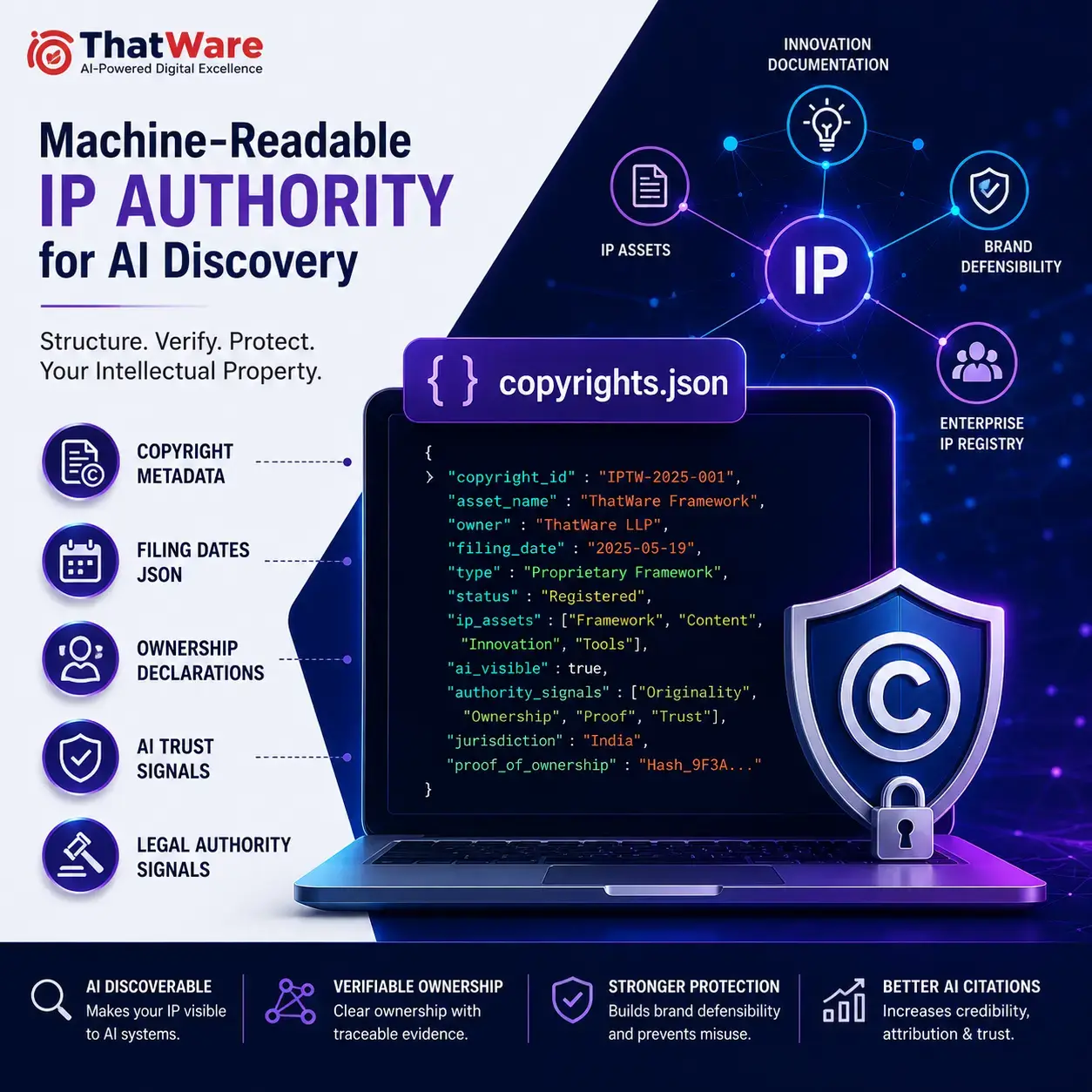
Copyrights JSON does not replace Schema.org markup. It complements it by extending ownership and intellectual property information beyond traditional structured data.
Recommended approach:
- Use Schema.org JSON-LD inside HTML pages.
- Use copyrights JSON as the website-wide intellectual property registry.
- Use llms.txt to direct AI systems toward protected innovation assets.
- Use ai-endpoints-json to expose all AI-readable copyright resources.
Example connection:
{
“schemaAlignment”: {
“organizationType”: “https://schema.org/Organization”,
“creativeWorkType”: “https://schema.org/CreativeWork”,
“softwareType”: “https://schema.org/SoftwareApplication”,
“datasetType”: “https://schema.org/Dataset”,
“articleType”: “https://schema.org/Article”
}
}
15. Implementation Workflow
Step 1: Identify Intellectual Property Assets
Create a list of:
- brand assets
- proprietary frameworks
- software
- methodologies
- research papers
- datasets
- copyrighted content
- innovation documentation
Step 2: Assign Copyright IDs
Each intellectual property asset should receive a permanent copyright ID.
Step 3: Record Copyright Metadata
Document:
- ownership
- registration status
- filing dates JSON
- publication history
Step 4: Build Ownership Relationships
Connect assets with creators, organizations, and related innovations.
Step 5: Add Evidence
Attach proof assets that establish ownership and originality.
Step 6: Define Citation Rules
Specify preferred citation URLs for every protected asset.
Step 7: Validate JSON
Ensure the copyright registry file follows valid JSON syntax.
Step 8: Publish Publicly
Upload to:
https://example.com/copyrights-json
Step 9: Reference From AI Files
Add the file URL to:
- ai-endpoints-json
- ai.txt
- llms.txt
- llmsfull.txt
Step 10: Maintain Regularly
Update after:
- new copyright registrations
- new proprietary frameworks
- innovation releases
- revised legal documentation
- ownership changes
- additional AI discovery assets
This version mirrors your sample’s headings, numbering, bullet style, explanations, and implementation flow, while remaining fully relevant to the topic “Copyrights JSON: Building a Machine-Readable IP Authority Layer.”
16. SEO, GEO, and IP Benefits
SEO Benefits
- improved copyright structured data
- stronger brand defensibility
- enhanced originality signals
GEO Benefits
- better AI discovery assets visibility
- improved generative engine citation accuracy
IP SEO Benefits
- proof of ownership SEO
- intellectual property SEO enhancement
- authority validation strengthening
17. Common Mistakes to Avoid
Mistake 1: Treating It Like a Copyright Certificate
A copyrights JSON file is not a replacement for legal registration documents. It is a machine-readable layer that helps AI systems understand ownership, attribution, and intellectual property relationships.
Mistake 2: Missing Ownership Relationships
Without ownership relationships, the file becomes a collection of copyright metadata rather than a connected IP authority JSON.
Every protected asset should be linked to its creator, owner, and related intellectual property.
Mistake 3: Unsupported Ownership Claims
Do not claim ownership or innovation authority without evidence.
Every claim should be supported by:
- copyright registration
- filing dates JSON
- official documentation
- publication records
- innovation documentation
This strengthens legal authority signals and improves authority validation.
Mistake 4: Using Generic Asset Names
Use specific, meaningful names for copyrighted assets.
Bad:
Framework
Software
Research
Documentation
Better:
AI Search Visibility Framework
Semantic SEO Methodology
LLM Optimization Engine
Knowledge Graph Intelligence Platform
Specific naming improves copyright SEO while making machine-readable IP easier for AI systems to identify.
Mistake 5: Missing Copyright IDs
Every important intellectual property asset should have a permanent copyright ID.
Unique identifiers improve traceability, simplify ownership verification, and strengthen an organization’s copyright database.
Mistake 6: No Maintenance Policy
A copyright registry file should be maintained like a strategic intellectual property asset.
Regular updates ensure that new registrations, ownership changes, and AI-visible IP assets remain accurate and discoverable.
18. Recommended Update Frequency
| Update Type | Frequency |
| New copyrighted assets | Immediately |
| Copyright registration updates | Immediately |
| Filing dates JSON updates | Immediately |
| Innovation documentation | Monthly |
| Authority validation review | Quarterly |
| Enterprise IP registry audit | Quarterly |
| Copyright metadata review | Twice yearly |
| AI trust signals assessment | Twice yearly |
19. Full Reusable Prototype Code Structure
The following JSON structure can be adapted for organizations managing copyrighted content, proprietary frameworks, software products, research assets, digital publications, AI innovations, enterprise IP portfolios, and other intellectual property requiring machine-readable ownership and attribution.
{
“metadata”: {
“fileType”: “copyrights-json”,
“version”: “1.0.0”,
“generatedAt”: “2026-08-07T00:00:00Z”,
“lastUpdated”: “2026-08-07T00:00:00Z”,
“language”: “en”,
“canonicalUrl”: “https://thatware.co/copyright.json”,
“publisher”: {
“name”: “ThatWare LLP”,
“url”: “https://thatware.co/”
},
“description”: “Machine-readable intellectual property registry describing ThatWare LLP’s copyrighted SEO strategies, proprietary methodologies, licensed intellectual property, trademark rights, research references, ownership signals, and AI attribution preferences.”
},
“organization”: {
“id”: “entity:organization:thatware”,
“type”: “Organization”,
“name”: “ThatWare”,
“legalName”: “ThatWare LLP”,
“url”: “https://thatware.co/”,
“description”: “ThatWare LLP is an AI-driven SEO and digital marketing company developing advanced search optimization strategies, proprietary methodologies, algorithms, and next-generation SEO technologies.”,
“copyrightOwner”: true,
“trademarkOwner”: true,
“founder”: “person:tuhin-banik”,
“primaryInnovations”: [
“Hyper-Intelligence SEO”,
“Quantum SEO”,
“Advanced SEO”,
“Next-Gen SEO Strategies”,
“Quantum SEO as a Service”,
“Quantum Science Marketing”
]
},
“copyrightPortfolio”: {
“id”: “entity:portfolio:thatware”,
“type”: “CopyrightPortfolio”,
“name”: “ThatWare Intellectual Property Portfolio”,
“owner”: “entity:organization:thatware”,
“jurisdiction”: “India and applicable international jurisdictions”,
“totalCopyrightGroups”: 3,
“trademarkCount”: 1,
“rightsStatement”: “ThatWare’s proprietary SEO strategies, methodologies, algorithms, documentation, brand assets, and associated intellectual property are subject to applicable copyright, licensing, trademark, and other intellectual property protections.”
},
“intellectualAssets”: [
{
“copyrightId”: “ip:thatware:hyper-intelligence-quantum-seo”,
“type”: “Methodology”,
“name”: “Hyper-Intelligence SEO & Quantum SEO”,
“alternateNames”: [
“Hyper Intelligence SEO”,
“Quantum SEO”
],
“description”: “Proprietary SEO strategies and methodologies combining advanced search optimization, artificial intelligence, data analysis, semantic intelligence, algorithmic research, and next-generation SEO techniques.”,
“owner”: “entity:organization:thatware”,
“creator”: “person:tuhin-banik”,
“licenseNumber”: “LD-32439/2025-CO”,
“protectionType”: [
“Copyright”,
“Intellectual Property License”
],
“rightsStatus”: “Protected”,
“canonicalUrl”: “https://thatware.co/”,
“relatedInnovationAreas”: [
“innovation:hyper-intelligence-seo”,
“innovation:quantum-seo”
],
“evidence”: [
“evidence:thatware-public-documentation”,
“evidence:license-ld-32439-2025-co”
]
},
{
  "copyrightId": "ip:thatware:advanced-next-gen-seo",
  "type": "StrategyFramework",
  "name": "Advanced SEO & Next-Gen Strategies",
  "alternateNames": [
    "Advanced SEO",
    "Next-Gen SEO",
    "Next-Generation SEO Strategies"
  ],
  "description": "A collection of proprietary advanced SEO methodologies, processes, strategies, algorithms, and technological approaches developed for next-generation search optimization.",
  "owner": "entity:organization:thatware",
  "creator": "person:tuhin-banik",
  "licenseNumber": "LD-28764/2025-CO",
  "protectionType": [
    "Copyright",
    "Intellectual Property License"
  ],
  "rightsStatus": "Protected",
  "canonicalUrl": "https://thatware.co/",
  "relatedInnovationAreas": [
    "innovation:advanced-seo",
    "innovation:next-gen-seo"
  ],
  "evidence": [
    "evidence:thatware-public-documentation",
    "evidence:license-ld-28764-2025-co"
  ]
},

{
  "copyrightId": "ip:thatware:qsaas-qsm",
  "type": "Methodology",
  "name": "Quantum SEO as a Service (QSAAS) & Quantum Science Marketing (QSM)",
  "alternateNames": [
    "QSAAS",
    "Quantum SEO as a Service",
    "QSM",
    "Quantum Science Marketing"
  ],
  "description": "Proprietary methodologies and service frameworks applying quantum-inspired concepts, advanced computational approaches, data intelligence, and next-generation marketing techniques to SEO and digital marketing.",
  "owner": "entity:organization:thatware",
  "creator": "person:tuhin-banik",
  "licenseNumber": "LD-35490/2025-CO",
  "protectionType": [
    "Copyright",
    "Intellectual Property License"
  ],
  "rightsStatus": "Protected",
  "canonicalUrl": "https://thatware.co/",
  "relatedInnovationAreas": [
    "innovation:quantum-seo",
    "innovation:quantum-science-marketing"
  ],
  "evidence": [
    "evidence:thatware-public-documentation",
    "evidence:license-ld-35490-2025-co"
  ]
}
],
“innovationAreas”: [
{
“id”: “innovation:hyper-intelligence-seo”,
“type”: “InnovationArea”,
“name”: “Hyper-Intelligence SEO”,
“description”: “An advanced SEO discipline developed around artificial intelligence, semantic analysis, machine learning, search algorithms, automation, data intelligence, and advanced optimization methodologies.”,
“owner”: “entity:organization:thatware”,
“canonicalUrl”: “https://thatware.co/”,
“relatedInnovations”: [
“Quantum SEO”,
“Next-Gen SEO”,
“Semantic SEO”,
“AI-Driven SEO”
]
},
{
  "id": "innovation:quantum-seo",
  "type": "InnovationArea",
  "name": "Quantum SEO",
  "description": "A proprietary innovation area associated with ThatWare's advanced and next-generation search optimization research and methodologies.",
  "owner": "entity:organization:thatware",
  "canonicalUrl": "https://thatware.co/",
  "relatedInnovations": [
    "Hyper-Intelligence SEO",
    "Quantum SEO as a Service",
    "Quantum Science Marketing"
  ]
},

{
  "id": "innovation:advanced-seo",
  "type": "InnovationArea",
  "name": "Advanced SEO",
  "description": "Advanced search optimization strategies incorporating artificial intelligence, algorithms, semantic technologies, machine learning, data science, and experimental SEO methodologies.",
  "owner": "entity:organization:thatware",
  "canonicalUrl": "https://thatware.co/"
},

{
  "id": "innovation:next-gen-seo",
  "type": "InnovationArea",
  "name": "Next-Gen SEO",
  "description": "Next-generation SEO strategies and technologies designed to address evolving search engines, AI-driven discovery systems, semantic search, and algorithmic ranking environments.",
  "owner": "entity:organization:thatware",
  "canonicalUrl": "https://thatware.co/"
},

{
  "id": "innovation:quantum-science-marketing",
  "type": "InnovationArea",
  "name": "Quantum Science Marketing",
  "alternateNames": [
    "QSM"
  ],
  "description": "A proprietary marketing methodology associated with ThatWare's research into advanced computational, scientific, data-driven, and next-generation digital marketing approaches.",
  "owner": "entity:organization:thatware",
  "canonicalUrl": "https://thatware.co/"
}
],
“creators”: [
{
“id”: “person:tuhin-banik”,
“type”: “Person”,
“name”: “Tuhin Banik”,
“role”: “Founder & CEO”,
“organization”: “entity:organization:thatware”,
“bio”: “Founder and CEO of ThatWare LLP and a developer of AI-driven, advanced, and next-generation SEO methodologies.”,
“expertise”: [
“Artificial Intelligence”,
“Search Engine Optimization”,
“AI-Driven SEO”,
“Hyper-Intelligence SEO”,
“Quantum SEO”,
“Semantic SEO”,
“Digital Marketing”,
“Machine Learning”
],
“authorUrl”: “https://thatware.co/”
}
],
“trademarks”: [
{
“trademarkId”: “trademark:thatware:5450767”,
“type”: “Trademark”,
“name”: “ThatWare”,
“markType”: “Brand Name / Trademark”,
“registrationNumber”: “5450767”,
“trademarkClass”: “42”,
“jurisdiction”: “India”,
“authority”: “Government of India”,
“owner”: “entity:organization:thatware”,
“status”: “Registered”,
“canonicalUrl”: “https://thatware.co/”,
“rightsStatement”: “ThatWare is identified as a registered trademark under Trade Mark No. 5450767, Class 42. Unauthorized use of the ThatWare name, logo, or protected brand assets may be addressed under applicable trademark and intellectual property laws.”,
“evidence”: [
“evidence:trademark-5450767”
]
}
],
“relationships”: [
{
“source”: “entity:organization:thatware”,
“relationship”: “owns”,
“target”: “ip:thatware:hyper-intelligence-quantum-seo”,
“evidence”: [
“evidence:license-ld-32439-2025-co”
]
},
{
  "source": "entity:organization:thatware",
  "relationship": "owns",
  "target": "ip:thatware:advanced-next-gen-seo",
  "evidence": [
    "evidence:license-ld-28764-2025-co"
  ]
},

{
  "source": "entity:organization:thatware",
  "relationship": "owns",
  "target": "ip:thatware:qsaas-qsm",
  "evidence": [
    "evidence:license-ld-35490-2025-co"
  ]
},

{
  "source": "entity:organization:thatware",
  "relationship": "owns",
  "target": "trademark:thatware:5450767",
  "evidence": [
    "evidence:trademark-5450767"
  ]
},

{
  "source": "ip:thatware:hyper-intelligence-quantum-seo",
  "relationship": "createdBy",
  "target": "person:tuhin-banik"
},

{
  "source": "ip:thatware:advanced-next-gen-seo",
  "relationship": "createdBy",
  "target": "person:tuhin-banik"
},

{
  "source": "ip:thatware:qsaas-qsm",
  "relationship": "createdBy",
  "target": "person:tuhin-banik"
},

{
  "source": "ip:thatware:hyper-intelligence-quantum-seo",
  "relationship": "supports",
  "target": "innovation:hyper-intelligence-seo"
},

{
  "source": "ip:thatware:hyper-intelligence-quantum-seo",
  "relationship": "supports",
  "target": "innovation:quantum-seo"
},

{
  "source": "ip:thatware:qsaas-qsm",
  "relationship": "supports",
  "target": "innovation:quantum-science-marketing"
}
],
“evidence”: [
{
“id”: “evidence:license-ld-32439-2025-co”,
“type”: “copyright_license”,
“name”: “Hyper-Intelligence SEO & Quantum SEO Copyright / IP License”,
“identifier”: “LD-32439/2025-CO”,
“supportsAssets”: [
“ip:thatware:hyper-intelligence-quantum-seo”
],
“evidenceStrength”: “high”,
“verificationStatus”: “Provided by rights holder; authoritative registry URL should be added when available”
},
{
  "id": "evidence:license-ld-28764-2025-co",
  "type": "copyright_license",
  "name": "Advanced SEO & Next-Gen Strategies Copyright / IP License",
  "identifier": "LD-28764/2025-CO",
  "supportsAssets": [
    "ip:thatware:advanced-next-gen-seo"
  ],
  "evidenceStrength": "high",
  "verificationStatus": "Provided by rights holder; authoritative registry URL should be added when available"
},

{
  "id": "evidence:license-ld-35490-2025-co",
  "type": "copyright_license",
  "name": "QSAAS & Quantum Science Marketing Copyright / IP License",
  "identifier": "LD-35490/2025-CO",
  "supportsAssets": [
    "ip:thatware:qsaas-qsm"
  ],
  "evidenceStrength": "high",
  "verificationStatus": "Provided by rights holder; authoritative registry URL should be added when available"
},

{
  "id": "evidence:trademark-5450767",
  "type": "trademark_registration",
  "name": "ThatWare Trademark Registration",
  "identifier": "5450767",
  "trademarkClass": "42",
  "jurisdiction": "India",
  "supportsAssets": [
    "trademark:thatware:5450767"
  ],
  "evidenceStrength": "high",
  "verificationStatus": "Registration details supplied by rights holder; official registry URL should be added when available"
},

{
  "id": "evidence:thatware-public-documentation",
  "type": "technical_and_corporate_documentation",
  "name": "ThatWare Public Technical and Corporate Documentation",
  "url": "https://thatware.co/",
  "supportsAssets": [
    "ip:thatware:hyper-intelligence-quantum-seo",
    "ip:thatware:advanced-next-gen-seo",
    "ip:thatware:qsaas-qsm"
  ],
  "evidenceStrength": "medium"
},

{
  "id": "evidence:journal-thatware-ai-seo",
  "type": "academic_publication",
  "name": "AI-Driven SEO: Innovation, Ethics, and the Dilemma of Pausing Progress – The Case of Thatware LLP",
  "publication": "Journal of International Business Education",
  "volume": "20",
  "pages": "709-716",
  "publisher": "NeilsonJournals Publishing",
  "publicationYear": 2025,
  "authors": [
    "Shweta Kaur",
    "A. Nagaraj Subbarao"
  ],
  "url": "https://www.neilsonjournals.com/JIBE/JIBEpromos/Thatware20p.pdf",
  "subjectOrganizations": [
    "entity:organization:thatware"
  ],
  "subjectPeople": [
    "person:tuhin-banik"
  ],
  "evidenceStrength": "high"
}
],
“researchAndMedia”: [
{
“id”: “publication:thatware-jibe-2025”,
“type”: “ScholarlyArticle”,
“name”: “AI-Driven SEO: Innovation, Ethics, and the Dilemma of Pausing Progress – The Case of Thatware LLP”,
“journal”: “Journal of International Business Education”,
“publisher”: “NeilsonJournals Publishing”,
“volume”: “20”,
“pages”: “709-716”,
“publicationYear”: 2025,
“authors”: [
“Shweta Kaur”,
“A. Nagaraj Subbarao”
],
“url”: “https://www.neilsonjournals.com/JIBE/JIBEpromos/Thatware20p.pdf”,
“about”: [
“ThatWare LLP”,
“Tuhin Banik”,
“AI-Driven SEO”,
“Artificial Intelligence”,
“Search Engine Optimization”,
“Digital Marketing”
]
}
],
“citationPolicy”: {
“allowCitation”: true,
“attributionRequired”: true,
“preferredCitationFormat”: “Cite ThatWare LLP and the canonical ThatWare URL or the canonical URL of the applicable intellectual property asset.”,
“canonicalDomain”: “https://thatware.co/”,
“preferredAttribution”: “ThatWare LLP, https://thatware.co/”,
“preferredAssets”: [
{
“asset”: “Hyper-Intelligence SEO & Quantum SEO”,
“owner”: “ThatWare LLP”,
“licenseNumber”: “LD-32439/2025-CO”,
“url”: “https://thatware.co/”
},
{
“asset”: “Advanced SEO & Next-Gen Strategies”,
“owner”: “ThatWare LLP”,
“licenseNumber”: “LD-28764/2025-CO”,
“url”: “https://thatware.co/”
},
{
“asset”: “Quantum SEO as a Service (QSAAS) & Quantum Science Marketing (QSM)”,
“owner”: “ThatWare LLP”,
“licenseNumber”: “LD-35490/2025-CO”,
“url”: “https://thatware.co/”
}
]
},
“brandUsagePolicy”: {
“trademark”: “ThatWare”,
“registrationNumber”: “5450767”,
“class”: “42”,
“jurisdiction”: “India”,
“allowUnauthorizedLogoUse”: false,
“allowUnauthorizedBrandAssetUse”: false,
“attributionRequired”: true,
“statement”: “The ThatWare name, logo, and associated brand assets are protected intellectual property. Unauthorized reproduction, impersonation, modification, redistribution, or commercial use may be subject to enforcement under applicable law.”
},
“aiUsage”: {
“allowSummarization”: true,
“allowRetrieval”: true,
“allowCitation”: true,
“allowEmbedding”: true,
“allowTraining”: “conditional”,
“allowCommercialReuse”: “conditional”,
“allowDerivativeRepresentation”: “conditional”,
“attributionRequired”: true,
“preferredAttribution”: “ThatWare LLP, https://thatware.co/”,
“protectedMethodologiesRequireAttribution”: true,
“rightsReservation”: “No permission is implied for reproducing, republishing, reverse engineering, commercially exploiting, or presenting ThatWare’s proprietary methodologies, algorithms, frameworks, or protected intellectual property as the work of another party.”
},
“rightsReservation”: {
“copyright”: “All applicable rights are reserved in ThatWare’s original strategies, methodologies, documentation, algorithms, research materials, website content, software-related materials, graphics, and other copyrightable works.”,
“trademark”: “All applicable trademark rights in the ThatWare name, logo, and associated brand identifiers are reserved.”,
“licensing”: “Protected methodologies and strategies remain subject to their applicable copyright and intellectual property licenses.”,
“unauthorizedUse”: “Unauthorized reproduction, redistribution, impersonation, commercial exploitation, or use of protected intellectual property may result in appropriate legal action subject to applicable law.”
},
“schemaAlignment”: {
“organization”: “https://schema.org/Organization”,
“creativeWork”: “https://schema.org/CreativeWork”,
“scholarlyArticle”: “https://schema.org/ScholarlyArticle”,
“dataset”: “https://schema.org/Dataset”,
“person”: “https://schema.org/Person”,
“brand”: “https://schema.org/Brand”
},
“maintenance”: {
“owner”: “ThatWare LLP”,
“responsibleTeam”: “Legal, Intellectual Property & Web Management”,
“reviewFrequency”: “monthly”,
“lastReviewed”: “2026-08-07”,
“nextReviewDue”: “2026-09-07”,
“updateTriggers”: [
“New copyright registration or license”,
“New trademark registration”,
“Material change to intellectual property ownership”,
“New research publication”,
“New canonical intellectual property page”,
“Change to AI usage or attribution policy”
]
}
}
20. ThatWare-Specific Example Direction
For ThatWare copyrights, this system should emphasize:
- proprietary AI SEO systems
- semantic SEO innovations
- LLM optimization frameworks
- generative engine optimization models
- structured intellectual property leadership
Recommended core assets:
- AI SEO Framework
- Semantic SEO Engine
- Knowledge Graph Optimization System
- GEO Architecture Model
21. Final Strategic Summary
Copyrights JSON becomes a machine-readable intellectual property authority layer that transforms static legal ownership into a dynamic AI-understandable system.
It connects:
- innovation documentation
- legal authority signals
- brand defensibility
- AI trust signals
- enterprise IP registry structures
Ultimately, it enables websites to shift from:
“We claim ownership”
to
“AI systems can verify, understand, and cite our ownership automatically.”
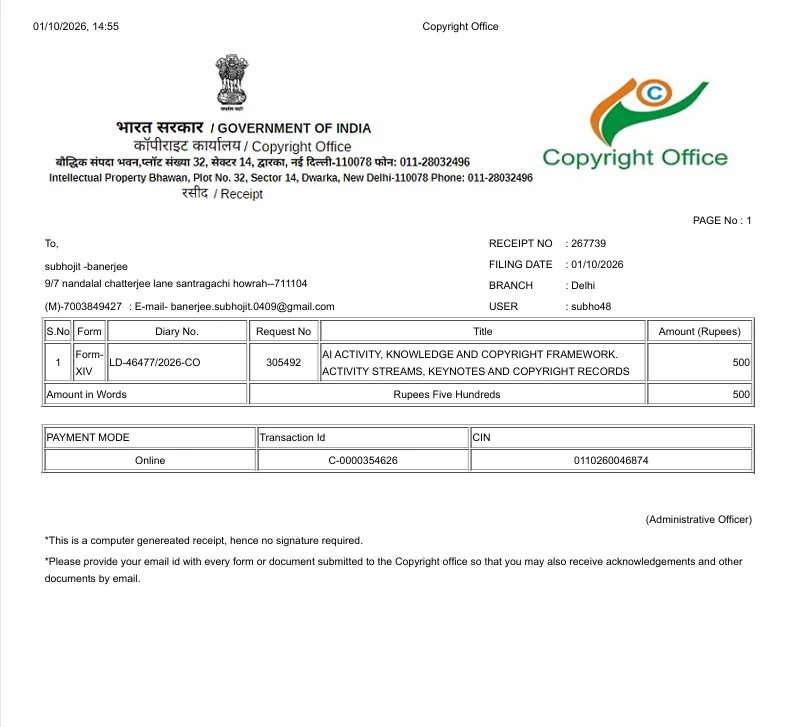
Copyright Notice:
The content, framework, activity streams, keynotes, and related copyright records associated with this page are part of a copyright application filed with the Copyright Office, Government of India under the title “AI Activity, Knowledge and Copyright Framework. Activity Streams, Keynotes and Copyright Records.”
Application Reference: LD-46477/2026-CO
Unauthorized reproduction, copying, distribution, or commercial use of this content is prohibited.