SUPERCHARGE YOUR ONLINE VISIBILITY! CONTACT US AND LET’S ACHIEVE EXCELLENCE TOGETHER!
Artificial intelligence has evolved rapidly over the past few years, transforming how developers design applications and how businesses deliver digital experiences. In the early stages of AI adoption, most applications were built around a single language model or a single AI service provider. While this approach worked for many basic use cases, it often limited an application’s ability to adapt to varying workloads, user expectations, and specialized tasks. As AI technologies continue to mature, relying on a single model is becoming less practical for building sophisticated and scalable solutions.
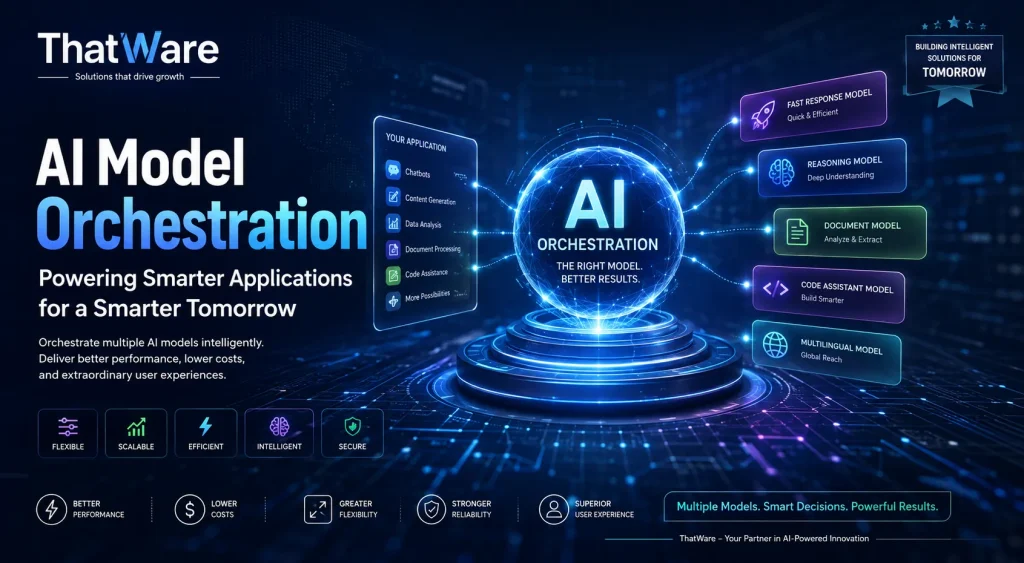
Today’s intelligent applications demand greater flexibility because different AI models excel at different responsibilities. Some models are designed to generate responses quickly, while others are optimized for complex reasoning, multilingual communication, code generation, or document understanding. Modern development teams therefore require systems that can efficiently manage multiple AI models while balancing security requirements, operational costs, response times, and overall performance.
This growing need has led to the emergence of AI Model Orchestration, an approach that acts as a coordination layer between applications and multiple AI models. Rather than depending on one model for every request, orchestration enables applications to intelligently determine the most suitable AI resource for each scenario, improving both efficiency and user experience.
As businesses also invest in AI Search Optimization to make digital platforms more compatible with evolving AI-driven ecosystems, AI Model Orchestration is becoming an equally important architectural component. Together, these advancements are shaping the foundation of next-generation intelligent applications that are more adaptive, scalable, and prepared for the future of AI-powered development.
Understanding AI Model Orchestration: What Does It Mean?
At its core, AI Model Orchestration refers to the process of coordinating multiple artificial intelligence models within a single application or system. Instead of directing every user request to one AI model, orchestration intelligently evaluates the nature of each task and determines which model is best equipped to deliver the desired outcome. This creates a more efficient, flexible, and scalable environment for modern AI-powered applications.
To better understand this concept, it is helpful to compare three different approaches. In a single AI model architecture, every request is processed by the same model regardless of complexity or purpose. Although this setup is relatively simple to implement, it often lacks flexibility because one model cannot always deliver the best performance across diverse tasks. A multi-model AI architecture introduces several AI models into the same ecosystem, allowing organizations to leverage different capabilities. However, without a central coordination mechanism, developers must manually manage interactions between these models, increasing system complexity.
This is where AI Model Orchestration becomes valuable. It functions as an intelligent management layer that sits between applications and AI models. When a user submits a request, the orchestration layer evaluates the request, selects the most appropriate model, determines how the request should be processed, and manages communication between different AI services. It can also optimize resource allocation by balancing workloads, reducing unnecessary processing, and ensuring that available computing resources are used efficiently.
A practical way to visualize AI Model Orchestration is to imagine a traffic management system controlling vehicles at a busy intersection. Rather than allowing traffic to move randomly, the system directs vehicles through the most efficient routes based on current conditions. Similarly, AI orchestration analyzes incoming requests and routes them to the most suitable AI model.
For example, a customer support platform may use a lightweight model to answer common questions quickly, a reasoning-focused model to resolve complex customer issues, and a specialized document-processing model to analyze contracts or policy documents. The orchestration layer coordinates these interactions seamlessly, ensuring that every request reaches the right AI capability at the right time. This intelligent coordination enables developers to build applications that are not only more efficient but also better equipped to handle diverse business requirements.
Why Single AI Model Strategies Are Becoming Less Practical
The rapid evolution of artificial intelligence has shown that no single AI model can excel at every task. While earlier AI applications often relied on one model to perform all functions, modern software development demands far greater adaptability. As organizations build more sophisticated digital solutions, AI Model Orchestration is becoming essential for managing the strengths and limitations of multiple AI models within a unified workflow.
Different AI Models Have Different Strengths
Every AI model is designed with unique capabilities. Some models generate responses almost instantly, making them ideal for real-time interactions, while others focus on deeper reasoning, contextual understanding, or domain-specific expertise. Because these capabilities differ, developers can no longer assume that one model will consistently deliver the best results across every scenario.
One Model Cannot Meet Every Business Requirement
Businesses operate across diverse industries with varying objectives. An e-commerce platform, a healthcare solution, and a financial application all have different operational priorities. A single AI model may perform exceptionally well in one environment but fall short in another. This is one of the primary reasons developers are embracing AI Model Orchestration instead of relying on isolated AI implementations.
Performance, Cost, and Accuracy Must Be Balanced
Choosing the most capable model is not always the most practical decision. High-performing AI models may introduce higher operational costs or increased response times, while lightweight models can deliver faster results for simpler tasks. Successful AI applications require a balance between performance, latency, accuracy, and resource utilization rather than focusing on a single factor.
As businesses continue improving their digital ecosystems through Answer Engine Optimization, developers are also recognizing the importance of selecting AI models that can efficiently support evolving user interactions and information delivery.
Flexibility Is Becoming a Competitive Advantage
Artificial intelligence is advancing at an extraordinary pace. New models, improved capabilities, and changing business requirements mean today’s ideal solution may become outdated tomorrow. AI Model Orchestration provides the flexibility to integrate newer technologies without rebuilding entire applications, allowing organizations to evolve alongside the AI landscape.
Different Applications Require Different Priorities
The importance of selecting the right model becomes clearer when considering real-world applications.
- A conversational chatbot primarily values fast response times to maintain natural interactions.
- A research assistant benefits from models capable of extensive reasoning, summarization, and knowledge synthesis.
- Enterprise business workflows often prioritize security, governance, and regulatory compliance when processing sensitive information.
Similarly, organizations investing in Generative Engine Optimization are redesigning their digital strategies to ensure AI systems can better interpret and present their information, reinforcing the growing need for flexible AI infrastructures.
Ultimately, businesses need AI systems that can adapt to changing workloads, technologies, and user expectations. AI Model Orchestration provides this adaptability by enabling applications to leverage the right AI capability for the right task, resulting in smarter, more efficient, and future-ready solutions.
How AI Model Orchestration Works Behind Modern Applications
Although AI Model Orchestration may seem complex, its underlying structure can be understood by examining the key layers that work together behind every intelligent application. Each layer performs a specific function while contributing to a seamless user experience.
1. Application Layer
The Application Layer represents the interface where users interact with AI-powered solutions. These applications may include:
- Customer support chatbots
- AI virtual assistants
- Enterprise software platforms
- Mobile applications
- Productivity tools
Regardless of the platform, users simply submit requests without needing to know which AI model processes them behind the scenes.
2. Orchestration Layer
The Orchestration Layer acts as the central decision-making component of the entire architecture. It receives incoming user requests and evaluates multiple factors before determining the most suitable processing path.
Its primary responsibilities include:
- Receiving user requests
- Understanding user intent and task requirements
- Selecting the most appropriate AI model
- Managing communication between different AI services
- Coordinating data flow throughout the application
Instead of developers manually assigning every request to a specific model, AI Model Orchestration automates this decision-making process, making applications significantly more scalable and efficient.
3. AI Model Layer
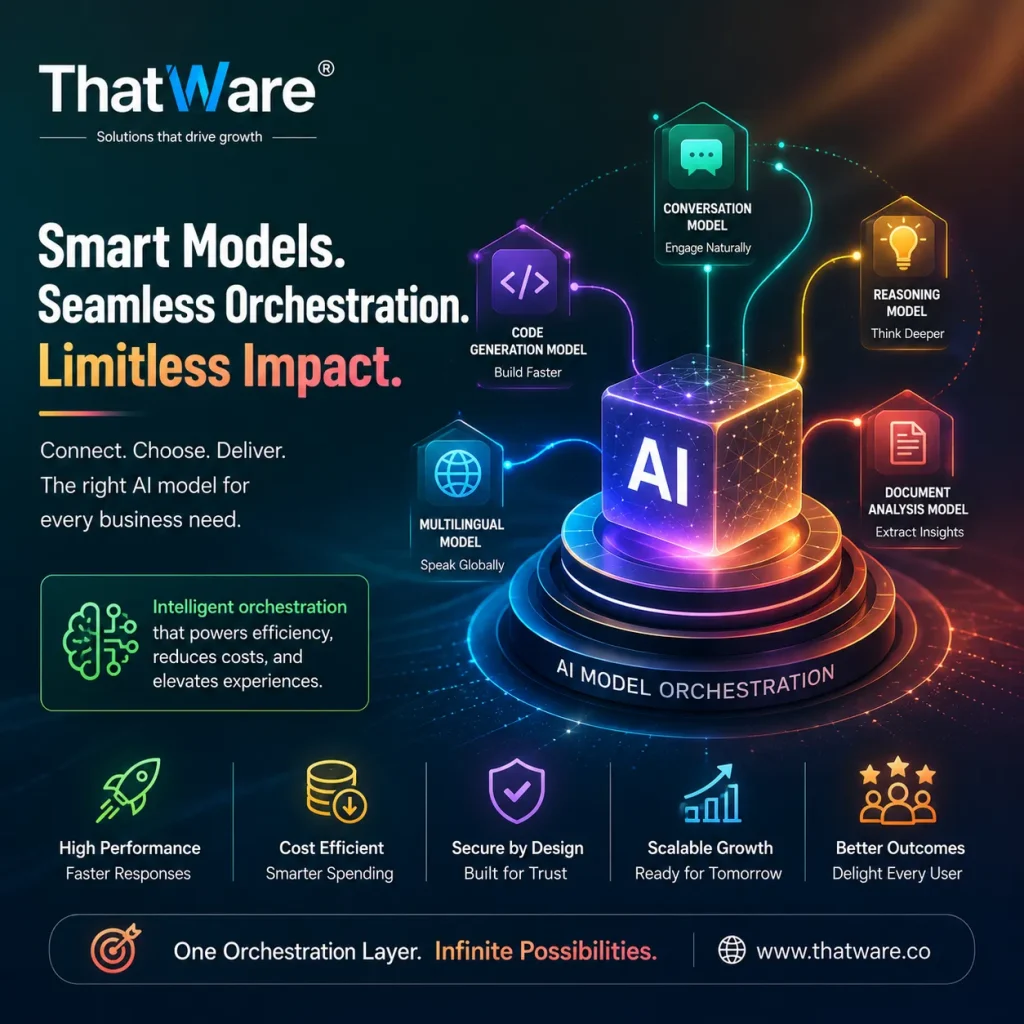
Once a request reaches the orchestration layer, it is forwarded to the AI Model Layer. This layer may consist of multiple categories of AI technologies, including:
- Large Language Models (LLMs)
- Specialized AI models designed for niche tasks
- Open-source AI models
- Proprietary commercial AI models
- Models offered by different AI providers
Each model contributes unique strengths, allowing applications to utilize the most appropriate capability for each request rather than forcing every task through a single AI engine.
As organizations continue exploring LLM SEO, developers are also recognizing that understanding the capabilities of different language models is becoming increasingly important for designing future-ready AI applications.
4. Monitoring and Optimization Layer
An effective orchestration system also requires continuous monitoring to ensure reliable performance over time.
This layer focuses on:
- Tracking application performance
- Monitoring AI usage patterns
- Managing operational costs
- Maintaining security controls
- Identifying opportunities for optimization
Rather than treating AI as a static component, developers can continuously refine system performance based on real-world usage data. This ongoing optimization helps organizations maintain reliability while adapting to changing workloads and evolving AI technologies.
Together, these four layers create an intelligent ecosystem where applications can efficiently utilize multiple AI models while maintaining performance, scalability, security, and operational efficiency.
The Role of Intelligent Routing in AI Applications
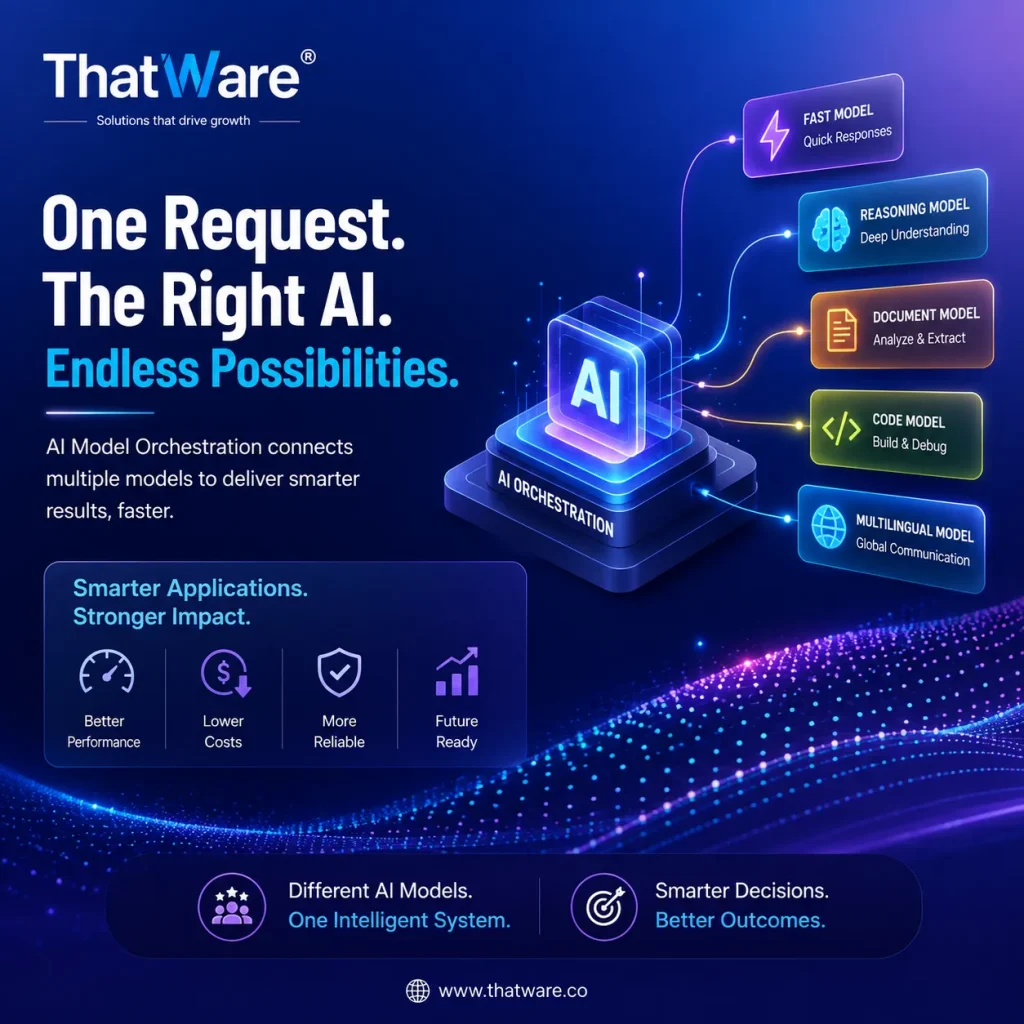
One of the most important capabilities within AI Model Orchestration is intelligent routing. Instead of sending every request to the same AI model, intelligent routing evaluates each request and directs it to the model best suited for the task. This dynamic decision-making process enables applications to deliver more efficient, accurate, and cost-effective outcomes while making optimal use of available AI resources.
What Determines AI Routing Decisions?
Modern AI systems consider several factors before selecting an appropriate model. These factors may include:
- Complexity of the user’s request
- Required response speed
- Operational cost
- Data sensitivity
- Individual model capabilities
By evaluating these variables, AI Model Orchestration ensures that each request is handled by the most suitable AI resource rather than following a one-size-fits-all approach.
Practical Examples of Intelligent Routing
Intelligent routing becomes easier to understand through practical scenarios.
For example, a customer asking a simple FAQ can be served by a lightweight AI model capable of producing quick responses with minimal computing resources.
In contrast, a business analyst requesting market insights or document interpretation may require a more advanced reasoning model capable of deeper contextual understanding.
Similarly, applications handling confidential company records may route requests to secure enterprise AI environments that comply with organizational governance and security policies.
Improving Efficiency Through Smarter Decisions
Instead of maximizing raw AI power for every interaction, intelligent routing focuses on maximizing efficiency. Fast tasks remain fast, complex tasks receive appropriate computational resources, and sensitive information follows secure processing pathways. This balanced approach helps organizations improve application responsiveness while controlling infrastructure costs.
As businesses continue preparing their websites and digital ecosystems for AI-driven discovery through evolving technologies, AI Model Orchestration and intelligent routing provide the operational foundation that enables these experiences to scale effectively. Together, they represent a significant step toward building adaptive applications capable of meeting the diverse demands of modern users and enterprises alike.
Benefits of AI Model Orchestration for Developers and Businesses
As AI-powered applications become increasingly sophisticated, organizations need development strategies that prioritize flexibility, efficiency, and long-term scalability. This is where AI Model Orchestration delivers significant value. Instead of relying on a single AI model, developers can intelligently combine multiple models to create applications that are more adaptive and capable of meeting diverse business requirements.
1. Greater Flexibility
One of the biggest advantages of AI Model Orchestration is flexibility. Developers are no longer restricted to a single AI provider or model throughout an application’s lifecycle. As new AI technologies emerge, they can integrate improved models without redesigning the entire system. This makes future upgrades simpler and helps organizations remain competitive in a rapidly evolving AI landscape.
Modern businesses investing in AEO Services are similarly recognizing the importance of building digital ecosystems that can evolve alongside changing AI technologies instead of depending on static infrastructures.
2. Improved Application Performance
Different AI models specialize in different tasks. Some are designed for conversational speed, while others excel at logical reasoning, content generation, or data analysis. AI Model Orchestration ensures that every request is directed to the most suitable model, allowing applications to deliver faster response times while maintaining higher levels of accuracy and relevance.
3. Better Cost Management
Running advanced AI models continuously can significantly increase operational expenses. AI Model Orchestration allows organizations to reserve high-capacity models for demanding tasks while assigning routine requests to smaller, more efficient models. This balanced resource allocation helps reduce infrastructure costs without compromising application quality.
Organizations also working toward AI Answer Optimization often adopt efficient AI workflows to improve how information is generated and delivered while maintaining sustainable operational costs.
4. Enhanced Scalability
As user demand increases, applications must be able to process larger volumes of AI requests without sacrificing performance. AI Model Orchestration enables systems to distribute workloads intelligently across multiple AI resources, making it easier to accommodate business growth, seasonal traffic spikes, and expanding service offerings.
5. Improved Reliability
Relying entirely on a single AI model introduces operational risks. Service interruptions, changing pricing structures, or performance limitations can directly affect application availability. By utilizing multiple AI models, organizations reduce dependency on any one provider while creating more resilient AI infrastructures capable of maintaining consistent service.
Businesses expanding their digital visibility through GEO Services are also adopting resilient technology strategies that support long-term adaptability as AI-driven platforms continue to evolve.
6. Better User Experience
Ultimately, every technological improvement should enhance the experience for end users. AI Model Orchestration allows applications to respond more quickly, understand user intent more effectively, and deliver contextually relevant interactions. Whether users are interacting with virtual assistants, enterprise software, or intelligent search systems, they benefit from smoother, faster, and more personalized experiences.
As organizations invest in AI Search Optimization services, delivering intelligent and responsive user experiences becomes an increasingly important factor in building future-ready digital platforms that can effectively interact with AI-powered ecosystems.
AI Model Orchestration in Real-World Applications
Although AI Model Orchestration is a technical concept, its impact can be observed across a wide range of industries. By intelligently coordinating multiple AI models, organizations can build applications that are more responsive, efficient, and capable of handling specialized business requirements.
Customer Service Platforms
Modern customer support systems rarely depend on a single AI model for every interaction. Instead, AI Model Orchestration enables organizations to assign simple customer inquiries to lightweight conversational models while directing more complicated issues to advanced reasoning models. Specialized AI systems can also process uploaded documents, warranty claims, or technical support materials, creating a smoother customer service experience.
Healthcare Applications
Healthcare organizations increasingly rely on multiple AI capabilities within the same workflow. One model may analyze medical images, another may summarize patient records, while a different model assists healthcare professionals by generating understandable explanations for patients. AI Model Orchestration helps coordinate these specialized systems while maintaining efficient communication between them.
E-commerce Platforms
Online retailers utilize AI in numerous ways throughout the customer journey. Product recommendation engines, intelligent search assistants, personalized shopping experiences, and automated customer support often require different AI capabilities. AI Model Orchestration allows these systems to work together seamlessly, ensuring users receive relevant recommendations and timely assistance.
As businesses continue strengthening their digital presence through Large Language Model SEO, developers are increasingly designing AI-powered shopping experiences that align with how modern language models interpret online information.
Software Development Tools
Today’s coding assistants perform much more than code generation. Developers may use one AI model to explain programming concepts, another to generate new code, and another to debug existing applications. AI Model Orchestration enables software development platforms to intelligently switch between these capabilities based on the user’s current objective.
Enterprise Knowledge Systems
Organizations generate vast amounts of internal documents, policies, reports, and operational data. AI assistants designed for enterprise environments often require multiple AI models to retrieve information, summarize documents, answer employee questions, and automate internal workflows. AI Model Orchestration coordinates these tasks while ensuring that business knowledge remains organized, accessible, and secure.
As enterprises explore technologies such as ChatGPT SEO, they are also recognizing the importance of building AI-ready digital infrastructures capable of supporting increasingly intelligent knowledge systems.
Challenges Developers Need to Consider When Implementing AI Orchestration
While AI Model Orchestration provides significant advantages, implementing it successfully requires thoughtful planning. Managing multiple AI models introduces technical, operational, and organizational challenges that developers must address to build reliable and scalable applications.
Complexity Management
Adding multiple AI models naturally increases architectural complexity. Developers must design workflows that coordinate model selection, request routing, data exchange, and system monitoring without creating unnecessary bottlenecks. A well-designed orchestration framework is essential for maintaining long-term maintainability.
Data Security
Many AI applications process confidential business information, customer records, or sensitive enterprise data. Developers must ensure that requests are handled according to organizational security policies while maintaining proper authentication, authorization, and data protection throughout the orchestration process.
Model Evaluation
Not every AI model performs equally well across different tasks. Organizations need measurable evaluation criteria such as response quality, accuracy, latency, reliability, and cost efficiency. Continuous testing helps developers determine whether each model continues to meet business expectations as AI technologies evolve.
Integration Challenges
Different AI providers often use different interfaces, capabilities, and operational requirements. Successfully integrating multiple AI systems requires careful planning to ensure consistent communication between application components while minimizing compatibility issues.
Cost Monitoring
Although AI Model Orchestration can reduce operational expenses, effective cost management requires continuous monitoring. Organizations should regularly analyze AI usage patterns, identify inefficient workloads, and optimize resource allocation to maintain sustainable operating costs.
Businesses investing in Generative Engine Optimization services similarly recognize that long-term success depends on continuous measurement, refinement, and adaptation as AI ecosystems continue to change.
Maintaining Consistency
Perhaps the greatest challenge is maintaining a consistent user experience. Since multiple AI models may produce different response styles or levels of detail, developers must establish governance mechanisms that ensure application behavior remains reliable regardless of which model processes a request.
By carefully addressing these challenges, organizations can unlock the full potential of AI Model Orchestration while building intelligent applications that remain secure, scalable, and dependable over time.
The Future of AI Development: From Individual Models to AI Ecosystems
The future of artificial intelligence is no longer centered on selecting the “best” AI model. Instead, it is moving toward building intelligent ecosystems where multiple AI models, tools, and services work together to solve increasingly complex business challenges. As organizations continue adopting AI Model Orchestration, the focus is shifting from individual model performance to the ability of an entire AI ecosystem to deliver seamless, efficient, and context-aware experiences.
From Individual Models to Intelligent AI Ecosystems
Earlier AI development largely revolved around integrating a single language model into an application. While this approach simplified implementation, it often limited flexibility and scalability. Today’s development landscape is different. Businesses require applications capable of combining conversational AI, reasoning models, document analysis, image understanding, and automation within a unified workflow.
As organizations continue embracing Answer Engine Optimization services, developers are also recognizing that modern digital platforms must be designed to communicate effectively with increasingly intelligent AI ecosystems rather than isolated search technologies.
Dynamic AI Capabilities Will Become the Standard
Future applications will intelligently combine multiple AI capabilities depending on the situation. Instead of assigning every request to one model, systems will automatically determine which combination of models can deliver the best outcome. A single user interaction may involve one model retrieving information, another performing logical reasoning, and another generating personalized responses.
This dynamic collaboration will allow applications to become significantly more efficient while improving response quality across diverse use cases.
AI Orchestration Will Shape Enterprise Architecture
Enterprise software is rapidly evolving beyond traditional application architectures. AI Model Orchestration is expected to become a foundational component of modern enterprise systems because it enables organizations to integrate multiple AI services without creating fragmented infrastructures.
Rather than viewing AI as an isolated feature, businesses will increasingly incorporate orchestration directly into their core technology stack, making intelligent decision-making an integral part of everyday operations.
Developers Will Build Intelligent Workflows
The role of developers is also evolving. Instead of spending most of their time integrating individual AI models, they will focus on designing intelligent workflows that coordinate multiple AI services. These workflows will automate model selection, optimize resource allocation, and improve collaboration between various AI capabilities while simplifying long-term system management.
Smarter, More Adaptive AI Systems
Looking ahead, AI applications will become increasingly adaptive, context-aware, and capable of learning from changing business requirements. AI Model Orchestration will enable organizations to continuously improve application performance while incorporating new AI innovations with minimal disruption. This evolution will ultimately transform software from static applications into intelligent ecosystems capable of responding dynamically to users, data, and emerging technologies.
How ThatWare Helps Businesses Adapt to the New AI-Driven Digital Landscape
Artificial intelligence is transforming far more than search experiences—it is fundamentally changing how websites, applications, and digital platforms are planned, developed, and optimized. At ThatWare, we recognize that successful website development today goes beyond attractive interfaces. Modern businesses require scalable, intelligent, and future-ready digital solutions that can seamlessly integrate with emerging AI technologies and adapt to continuously evolving user expectations.
Being recognized as a Top AEO company, ThatWare combines advanced development methodologies with AI-driven innovation to help businesses prepare for the next generation of intelligent digital experiences. Our development philosophy focuses on creating websites that are not only visually engaging but also technically robust, scalable, secure, and capable of supporting AI-powered functionalities as technology continues to evolve.
Our website development approach emphasizes several key areas:
- Modern and scalable development architecture
- User-centric design and intuitive experiences
- High-performance optimization for speed and reliability
- Secure and flexible development frameworks
- Integration of emerging AI technologies and intelligent automation
- Future-ready infrastructure that supports business growth
Beyond development, our expertise extends to expert seo service, enabling businesses to build digital platforms that are technically optimized while remaining prepared for evolving AI-driven discovery systems. Rather than treating development and optimization as separate processes, we build websites with long-term adaptability in mind.
Our multidisciplinary teams also deliver seo strategy services that complement modern web development by aligning technical architecture with business objectives and emerging AI technologies. This integrated approach allows organizations to create digital platforms that are prepared for both today’s users and tomorrow’s intelligent ecosystems.
By combining innovative website development, AI-aware architecture, and quality seo service, ThatWare helps businesses confidently embrace the future of AI Model Orchestration, ensuring their websites and digital applications remain scalable, intelligent, and ready for the rapidly evolving digital landscape.
Conclusion
The evolution of artificial intelligence has fundamentally changed how developers design and build intelligent applications. Rather than depending on a single AI model to perform every task, organizations are increasingly adopting AI Model Orchestration to create flexible ecosystems where multiple AI models collaborate efficiently. This shift enables applications to deliver better performance, improved scalability, stronger reliability, and more personalized user experiences while adapting to diverse business requirements.
As AI technologies continue to advance, concepts such as intelligent routing, multi-model architectures, and centralized AI management layers will become integral components of modern software development. Instead of simply integrating individual AI models, developers will focus on designing intelligent workflows that automatically select the most appropriate AI capabilities for every interaction. This approach not only optimizes resources but also creates applications that are more resilient, efficient, and capable of evolving alongside rapidly changing technologies.
Organizations that embrace AI Model Orchestration today will be better prepared for the next generation of AI-powered digital experiences. Whether developing enterprise platforms, customer-facing applications, healthcare systems, or intelligent business solutions, adopting a flexible AI ecosystem enables businesses to remain competitive in an increasingly AI-driven world.
Ultimately, AI Model Orchestration is about much more than managing multiple AI models. It represents a new way of thinking about application development—one that emphasizes adaptability, intelligent decision-making, and continuous innovation. As businesses and developers continue embracing this transformation, AI-powered applications will become increasingly context-aware, scalable, and capable of delivering smarter digital experiences that meet the demands of the future.