
SUPERCHARGE YOUR ONLINE VISIBILITY! CONTACT US AND LET’S ACHIEVE EXCELLENCE TOGETHER!
This document explains the purpose, structure, strategic value, and implementation model of a research JSON system designed to improve AI research visibility, semantic indexing, and enterprise-grade knowledge discovery across AI systems, academic engines, and generative platforms.
The goal of this framework is to help AI systems understand research not as isolated documents, but as a connected ecosystem of machine-readable research, including publications, datasets, experiments, authors, citations, and thought leadership data.
In modern AI ecosystems, research is no longer consumed only by humans. It is parsed, embedded, retrieved, and cited by LLMs, making structured representation critical for R&D visibility, discovery, and authority building.
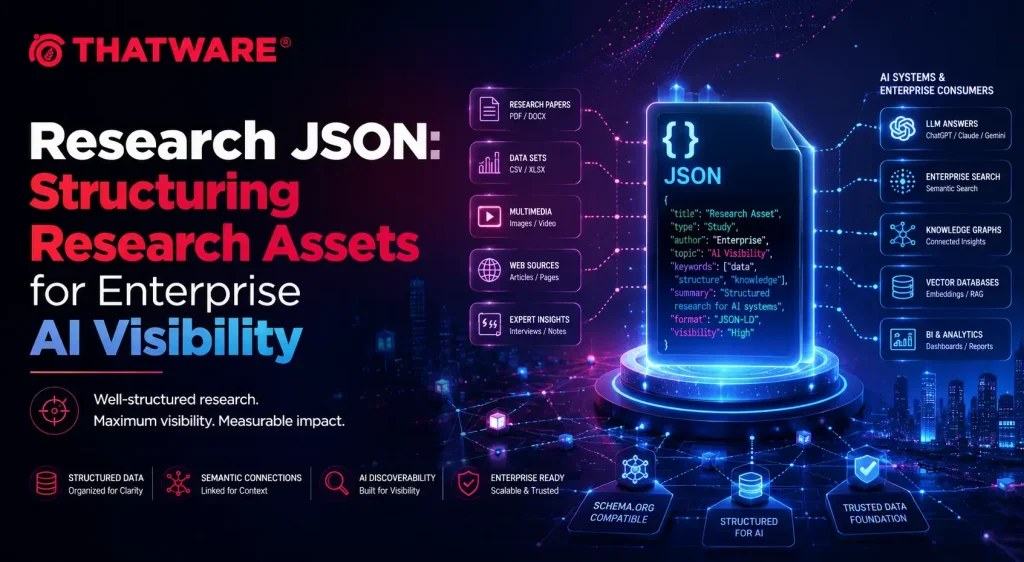
1. What Is Research JSON?
Research JSON is a machine-readable JSON file that represents the structured research architecture of an organization, enterprise, lab, or knowledge-driven system.
It defines:
- the core research organization or entity
- published research papers, whitepapers, and studies
- datasets and experimental outputs
- authors, researchers, and contributors
- research methodologies and frameworks
- relationships between studies and topics
- citation networks and reference mappings
- validation evidence and supporting proofs
- topical research clusters
- schema-aligned research entity types
- external academic and industry references
- preferred citation targets for AI systems
- machine-readable research summaries
In simple terms, it tells AI systems:
“These are the research assets this organization has produced, how they are connected, and how they should be interpreted, retrieved, and cited.”
This forms the foundation of machine-readable research and enables structured interpretation of enterprise knowledge at scale.
2. Why Research JSON Exist
Traditional research ecosystems are built primarily for human consumption and academic publishing workflows. They rely on:
- PDF whitepaper JSON, and journal papers
- blog-style research articles
- institutional repositories
- citation indexes
- manual metadata tagging
- disconnected publication archives
- static document-based knowledge systems
While effective for human researchers, these systems are not optimized for modern AI-driven discovery.
LLMs and AI research engines need to understand:
- what research exists across the organization
- which studies are most authoritative
- how different papers are connected
- what datasets validate findings
- which authors contribute to which domains
- what should be cited for a given topic
- what constitutes foundational vs supporting research
- how evidence flows across publications
A research JSON file solves this by creating a centralized semantic structure for all research assets.
This transforms fragmented publications into a unified enterprise research archive that AI systems can interpret reliably.
3. Difference Between a Research Sitemap and Research JSON
Traditional Publication Sitemap
A publication sitemap answers:
- What research URLs exist?
- When were they published or updated?
- Which research documents should crawlers discover?
It is fundamentally a structural discovery layer focused on indexing assets rather than understanding meaning or context. It supports basic visibility but does not explain the intellectual value or relationships between research outputs.
Semantic Research Sitemap
A semantic research sitemap answers:
- What does each research paper SEO actually mean?
- What domain or discipline does it belong to?
- What research intent does it serve (theoretical, applied, experimental)?
This layer moves beyond indexing and begins to introduce scholarly content SEO signals by categorizing research according to meaning and intent rather than just URLs.
However, it still lacks deep relational intelligence and cannot represent full thought leadership data structures or cross-paper dependencies.
Research JSON (Machine-Readable Research Layer)
A research JSON knowledge system answers:
- What research entities does this organization produce or own?
- How are papers, datasets, and experiments interconnected?
- Which research domains represent true topical authority?
- Which publications support which findings and claims?
- What evidence validates each research output?
- Which canonical research pages should AI systems cite?
- What is the complete semantic structure of the research ecosystem?
Unlike traditional systems, this model transforms static documents into a connected research knowledge graph, enabling structured interpretation by AI systems and improving AI research visibility.
A sitemap is URL-first.
A research graph is entity-first.
4. Why It Matters for LLM Optimization
Large Language Models generate answers by predicting the most useful response based on training data, retrieval data, structured signals, and available context.
For enterprise research ecosystems to appear in AI-generated answers, the AI system must be able to:
- identify research JSON structures and their core entities correctly
- understand the depth of machine-readable research and institutional expertise
- connect technical whitepaper SEO JSON assets to relevant domains and innovation clusters
- retrieve supporting AI crawler research data from structured research repositories
- trust sources through validated expert research signals and citation consistency
- cite correct publication metadata and canonical research URLs
- avoid ambiguity across similar domains using knowledge asset registry alignment
Research JSON helps with all of these.
It can support:
- stronger AI research visibility
- improved research citation signals
- clearer thought leadership data
- better R&D visibility
- improved content authority SEO
- better semantic research mapping
- stronger enterprise research archive
5. Role in GEO: Generative Engine Optimization
Generative Engine Optimization is the process of optimizing structured knowledge assets for AI answer systems, conversational intelligence layers, retrieval-based engines, and autonomous reasoning models.
A research JSON framework strengthens GEO by acting as a semantic coordination layer that connects academic outputs, experimental findings, and institutional knowledge into a unified interpretability system for AI models.
GEO Benefits
5.1 Entity Understanding
The system clarifies the identity and role of each research component within an organization’s knowledge ecosystem.
Example:
- Organization: ThatWare (research division)
- Primary domain: Applied AI research systems
- Related domains: Semantic intelligence, model optimization, knowledge structuring
- Asset type: Scholarly output and analytical publications
5.2 Topical Authority Mapping
Research domains are grouped into structured intelligence clusters that strengthen domain ownership signals and improve conceptual clarity for AI systems.
Example:
- Cognitive AI cluster
- Language modeling cluster
- Semantic systems cluster
- Knowledge architecture cluster
- Computational research cluster
5.3 Citation Control
The system defines how AI engines select authoritative references for specific research themes using structured linking rules and canonical mapping logic.
Example:
- For “AI Research Visibility,” use /ai-research-visibility/
- For “Whitepaper Structured Data Systems,” use /whitepaper-framework/
- For “Research Metadata Models,” use /metadata-architecture/
5.4 Retrieval Improvement
AI systems can precisely locate relevant studies, datasets, and experimental outputs by following structured relationships across the knowledge framework.
This enhances discovery precision and improves contextual alignment during response generation in retrieval-based systems.
5.5 Context Assembly
The framework enables AI models to combine supporting evidence, related findings, and methodological references into a unified reasoning layer.
This improves interpretive depth and ensures outputs are grounded in structured scholarly relationships rather than isolated fragments.
5.6 Brand Disambiguation
It reduces confusion between overlapping research domains, institutions, and thematic areas by enforcing consistent entity definitions and controlled semantic boundaries.
This ensures stable interpretation across distributed AI systems and improves reliability in knowledge-driven environments.
6. How AI Systems Can Use Research JSON
Different AI architectures interpret structured research frameworks in multiple ways to improve reasoning, retrieval, and knowledge synthesis.
6.1 Intelligent Crawlers
Advanced crawlers extract structured entities, relationships, and publication signals to build enriched knowledge representations of research ecosystems.
6.2 Retrieval-Augmented Systems
These systems leverage structured research hierarchies to locate high-relevance academic content and improve answer grounding during generation.
6.3 Embedding-Based Indexes
Vector systems convert research components into dense representations, enabling similarity matching across methodologies, findings, and conceptual layers.
6.4 AI Search Interfaces
Modern AI search layers use structured research organization to prioritize authoritative outputs, improving ranking accuracy for academic and technical queries.
6.5 Autonomous Research Agents
AI agents navigate structured knowledge environments to extract insights, summarize findings, and generate comparative analyses across studies.
6.6 Knowledge Representation Systems
Structured research frameworks contribute to entity-level understanding of systems similar to knowledge panels, consolidating authorship, findings, and institutional credibility into a unified intelligence view.
7. Recommended File Location
The recommended public URL is:
https://example.com/research-json
Optional additional discovery paths:
https://example.com/.well-known/research-json
https://example.com/ai-research-endpoints-json
https://example.com/llms-research.txt
The file should also be referenced from:
- ai.txt
- llms.txt
- llmsfull.txt
- ai-endpoints-json
- robots.txt, optionally as a structured comment or discovery hint
- HTML <link rel=”alternate”> for machine discovery alignment
8. Recommended MIME Type
Serve the file as:
application/json
The server should return:
HTTP 200 OK
Content-Type: application/json; charset=utf-8
This ensures consistent parsing across crawlers, retrieval pipelines, and AI indexing systems that process structured academic and enterprise knowledge assets.
9. Core Design Principles
9.1 Entity-First Design
Do not start with URLs. Start with conceptual entities.
Entities can include:
- organization
- founder/researcher
- author/contributor
- service/offering
- product/tool
- domain/discipline
- concept/framework
- location/institution
- industry vertical
- experiment/case study
- technology stack
- dataset/benchmark
- research asset/publication unit
This approach ensures that knowledge systems prioritize meaning before structure, improving interpretability across AI models.
9.2 Canonical Naming
Each entity should have one preferred name to avoid semantic duplication across systems.
Example:
{
“name”: “AI Research Visibility Framework”,
“alternateNames”: [“Research Visibility System”, “AI Discovery Framework”]
}
This improves consistency across indexing systems and strengthens identity resolution in distributed AI environments.
9.3 Persistent IDs
Every entity should have a stable identifier to ensure long-term traceability across updates and revisions.
Example:
“id”: “entity:ai-research-visibility-framework”
Persistent IDs help maintain continuity across evolving datasets, publications, and analytical outputs.
9.4 Clear Relationships
Relationships must explicitly define how research components interact within the ecosystem.
Example:
{
“source”: “entity:research-organization”,
“relationship”: “develops”,
“target”: “entity:ai-research-visibility-framework”
}
This enables structured mapping of knowledge flows across publications, experiments, and institutional contributions.
9.5 Evidence-Based Authority
Authority must be grounded in verifiable sources rather than abstract claims.
Example evidence:
- published study
- validated experiment
- peer-reviewed paper
- author profile
- external citation
- implementation report
- technical documentation
This ensures that credibility signals are measurable, traceable, and aligned with real-world outputs.
9.6 Citation Readiness
Every major entity should include a preferred citation endpoint to guide AI systems and research engines. This improves how models reference academic and enterprise outputs during answer generation and retrieval. Proper citation design strengthens trust signals and improves downstream knowledge reuse.
9.7 Machine and Human Readability
The structure must remain readable for both developers and AI systems. This dual-layer readability ensures seamless integration into pipelines, easier debugging and updates, better interpretability for AI reasoning models, and improved adoption across research platforms
10. Key Components of Research JSON
A strong research JSON architecture should include the following major sections:
- metadata
- organization
- research ecosystem definition
- entities
- domains and disciplines
- publications and outputs
- contributors and authorship graph
- knowledge clusters
- relational mapping layer
- evidence registry
- citation framework
- external equivalence links
- authority scoring system
- version history tracking
- AI consumption rules
- validation and integrity checks
11. Field-by-Field Explanation
11.1 metadata
Defines file-level information for the research intelligence system.
Recommended fields:
- version
- generatedAt
- lastUpdated
- publisher
- license
- language
- canonicalUrl
Purpose:
- helps AI systems understand dataset freshness
- supports version control across research iterations
- enables validation of structured research outputs
- strengthens the interpretability of evolving knowledge systems
11.2 organization
Defines the primary research-producing entity, such as a company, lab, or institution.
Recommended fields:
- id
- name
- legalName
- url
- logo
- description
- foundingDate
- founder
- sameAs
- contactPoint
- primaryExpertise
Purpose:
- identifies the core knowledge authority
- strengthens institutional recognition in AI systems
- enables consistent attribution across research outputs
- improves clarity in enterprise knowledge mapping
11.3 website
Defines the digital presence where research assets are published and accessed.
Recommended fields:
- id
- url
- name
- publisher
- inLanguage
- primaryAudience
- contentTypes
Purpose:
- helps AI systems understand the distribution channels of research
- separates institutional identity from the publishing layer
- improves the classification of research accessibility and intent
- supports structured discovery across digital endpoints
11.4 entities
The most important section represents all research components as structured objects.
Each entity should include:
- id
- name
- type
- description
- alternateNames
- canonicalUrl
- sameAs
- relatedEntities
- authorityScore
- evidence
- preferredCitation
Entity types may include:
- Research organization
- Research contributor
- Academic author
- Publication unit
- Conceptual framework
- Domain/discipline
- Industry segment
- Location/institution
- Dataset
- Experiment
- Technology stack
- Methodological model
Purpose:
- transforms research into structured intelligence units
- improves entity-level interpretation across AI systems
- enables consistent reasoning over distributed knowledge assets
- strengthens semantic connectivity between publications
11.5 topics
Defines structured knowledge domains and intellectual categories.
Recommended fields:
- id
- name
- description
- parentTopic
- childTopics
- relatedTopics
- canonicalUrl
- searchIntent
- llmIntent
Purpose:
- builds hierarchical knowledge structures
- improves the clustering of academic and technical content
- supports intelligent routing of research queries
- enhances the thematic organization of enterprise knowledge
11.6 services
Defines research-driven offerings such as consulting, tools, or analytical systems.
Recommended fields:
- id
- name
- description
- serviceType
- url
- relatedTopics
- targetAudience
- useCases
- proofAssets
Purpose:
- connects research outputs to applied systems
- improves the interpretation of commercial-research hybrid ecosystems
- supports alignment between theory and implementation
- enhances the discoverability of applied research services
11.7 people
Defines contributors, researchers, authors, and subject matter experts.
Recommended fields:
- id
- name
- role
- bio
- expertise
- sameAs
- authorUrl
Purpose:
- strengthens credibility signals across research outputs
- enables author-level attribution in AI systems
- improves trust scoring for academic and enterprise knowledge
- connects intellectual contributions across multiple publications
11.8 contentClusters
Group research outputs into structured thematic collections.
Recommended fields:
- id
- name
- primaryTopic
- pillarPage
- supportingPages
- clusterIntent
Purpose:
- organizes research into coherent knowledge structures
- improves retrieval efficiency across large knowledge bases
- strengthens thematic authority signals
- enhances AI-based clustering of academic content
11.9 relationships
Defines structured connections between research entities.
Common relationship types:
- specializesIn
- offers
- publishes
- authoredBy
- relatedTo
- partOf
- supports
- cites
- explains
- isSubtopicOf
- hasEvidence
Purpose:
- converts isolated data into a connected knowledge graph
- enables reasoning across multiple research layers
- improves the semantic navigation of enterprise research ecosystems
- supports dependency mapping between studies and outputs
11.10 evidence
Defines supporting validation sources for research credibility.
Evidence types:
- internal research publication
- external academic citation
- peer-reviewed study
- experimental dataset
- case implementation
- certification record
- benchmark result
- industry recognition
- technical documentation
- verified real-world outcome
Purpose:
- strengthens trust in research outputs
- reduces unsupported knowledge claims
- improves verification of intellectual contributions
- supports evidence-driven knowledge ranking
11.11 citationPolicy
Defines how research assets should be referenced by AI systems and external engines.
Recommended fields:
- allowCitation
- preferredCitationFormat
- canonicalDomain
- preferredPagesByTopic
Purpose:
- ensures consistent referencing behavior
- improves citation accuracy across AI systems
- standardizes the attribution of research outputs
- strengthens authority propagation across networks
11.12 aiUsage
Defines how artificial intelligence systems may interact with research assets.
Recommended fields:
- allowSummarization
- allowRetrieval
- allowCitation
- allowEmbedding
- allowTraining
- attributionRequired
Purpose:
- communicates machine-readable usage rules
- enables controlled consumption of research data
- improves governance of enterprise knowledge assets
- ensures responsible AI integration across systems
12. Authority Scoring Model
A structured research system can include quantitative indicators representing the strength of each knowledge asset.
Recommended score range:
0.00 to 1.00
Suggested interpretation:
- 0.90–1.00: core authoritative output
- 0.75–0.89: highly reliable research
- 0.50–0.74: moderately validated knowledge
- 0.25–0.49: supporting or exploratory content
- 0.00–0.24: weak or unverified material
Authority scoring should be based on:
- depth of research contribution
- internal knowledge coverage
- external validation signals
- methodological rigor
- consistency across publications
- structural completeness
- empirical validation strength
- recency of findings
- institutional relevance
Avoid arbitrary scoring; each value must reflect measurable research strength.
13. Relationship Modeling Best Practices
Every relationship should contain structured metadata defining context and trust.
Example:
{
“source”: “entity:research-institution”,
“relationship”: “develops”,
“target”: “entity:semantic-research-framework”,
“confidence”: 0.96,
“evidence”: [“https://example.com/research-study/”]
}
Recommended Relationship Vocabulary:
- specializesIn
- hasPrimaryDomain
- produces
- validates
- supports
- extends
- references
- dependsOn
- isDerivedFrom
- alignsWith
- contributesTo
- isVerifiedBy
14. How to Use With Schema.org and JSON-LD
Research JSON does not replace Schema.org structured markup. It enhances it by acting as a higher-level semantic intelligence layer.
Recommended approach:
- Use Schema.org JSON-LD inside individual research pages
- Use research-json as the global knowledge architecture layer
- Use llms.txt for guiding AI systems to key research assets
- Use ai-endpoints-json for discovery of structured research APIs
Example connection:
{
“schemaAlignment”: {
“organizationType”: “https://schema.org/Organization”,
“creativeWorkType”: “https://schema.org/CreativeWork”,
“articleType”: “https://schema.org/Article”,
“datasetType”: “https://schema.org/Dataset”,
“personType”: “https://schema.org/Person”
}
}
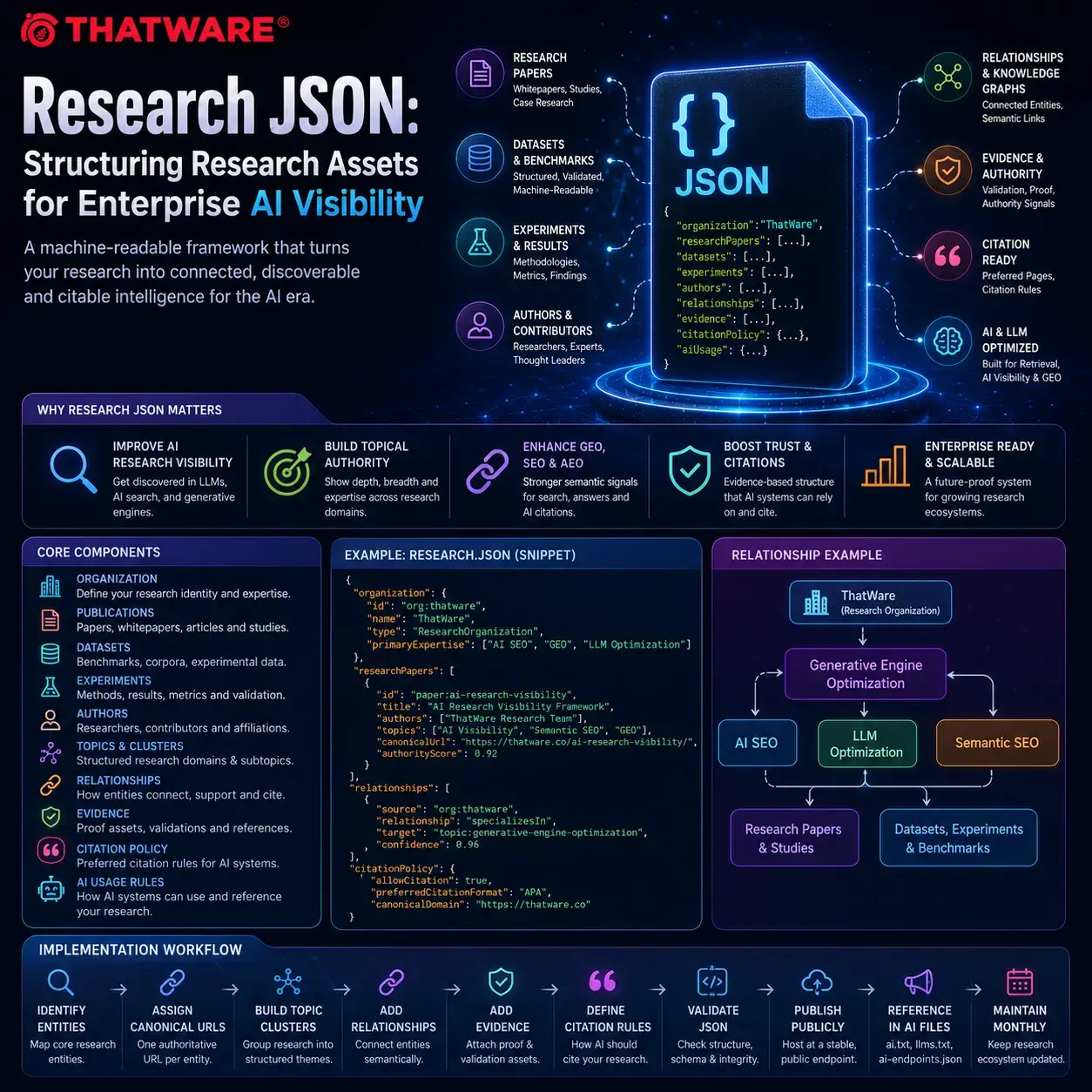
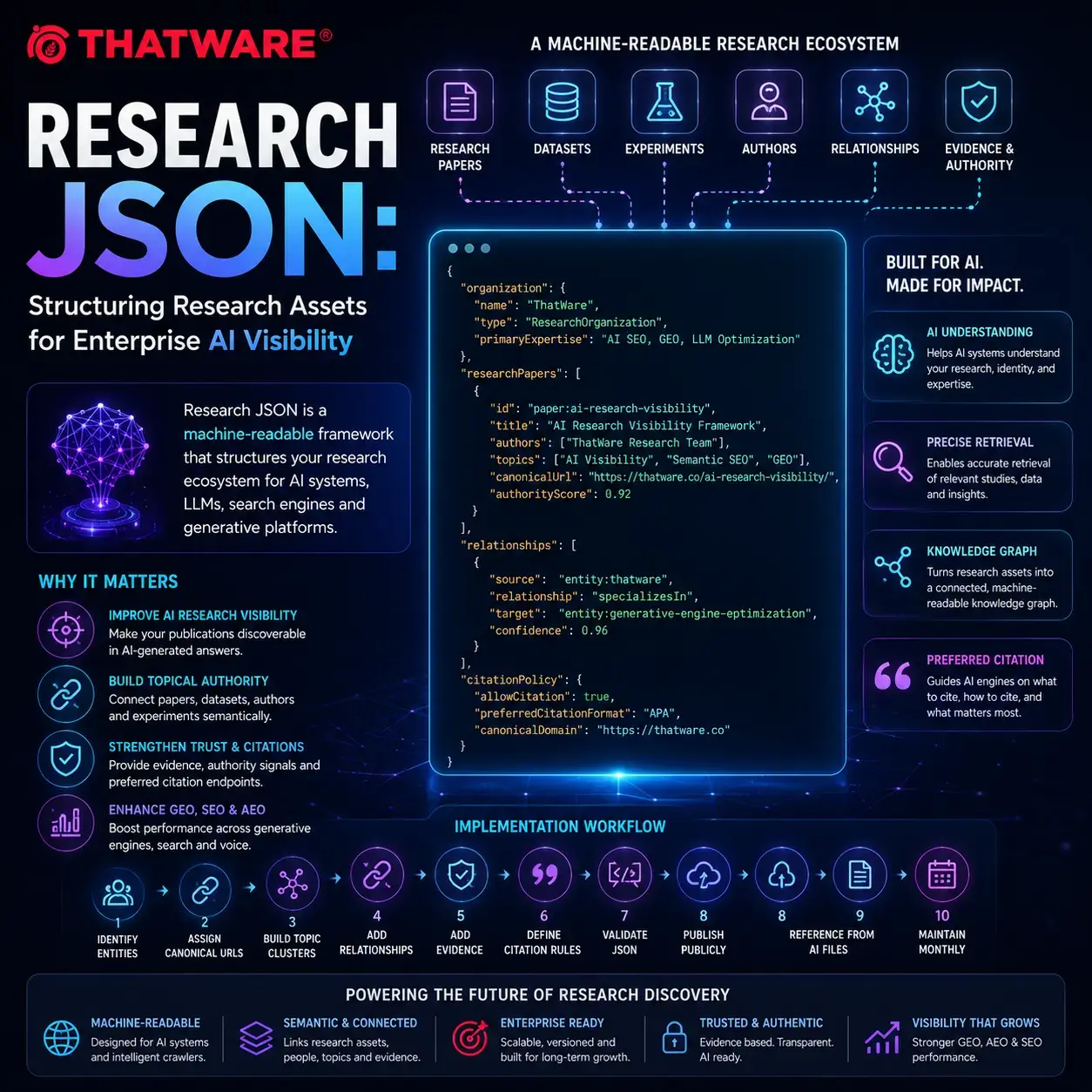
15. Implementation Workflow
Step 1: Identify Core Entities
Create a structured inventory of all research-relevant entities in the ecosystem:
- organization/institution
- research services and offerings
- knowledge domains and disciplines
- authors and contributors
- industry verticals
- geographic or institutional locations
- conceptual frameworks
- methodological systems
This step establishes the foundation for building a unified machine-readable research architecture.
Step 2: Assign Canonical URLs
Each core entity must map to a single authoritative reference URL.
Step 3: Build Topic Clusters
Organize research content into structured thematic clusters around central knowledge areas.
Step 4: Add Relationships
Define explicit connections between research entities, outputs, and conceptual structures.
Step 5: Add Evidence
Attach verifiable proof assets to support research validity. This strengthens research authority signals and improves trustworthiness in AI interpretation systems.
Step 6: Add Citation Rules
Define how AI systems and external platforms should reference research assets.
Step 7: Validate JSON
Ensure the entire structure is syntactically and semantically valid. This guarantees system reliability across AI pipelines.
Step 8: Publish Publicly
Deploy the structured file at a stable, publicly accessible endpoint:
https://example.com/research-json
This allows AI crawlers, indexing systems, and retrieval engines to access the structured knowledge layer directly.
Step 9: Reference From AI Files
Ensure discoverability by linking the research system across machine-readable entry points:
- ai-endpoints-json
- ai.txt
- llms.txt
- llmsfull.txt
This strengthens integration with AI discovery research pipelines and improves ingestion coverage across systems.
Step 10: Maintain Monthly
Continuously update the system to reflect evolving research output.
Update triggers include:
- new research publications
- introduction of new services or frameworks
- updated experimental findings
- addition of external validation sources
- structural or branding changes
This ensures long-term consistency of the knowledge ecosystem.
16. SEO, GEO, and AEO Benefits
SEO Benefits
- improved entity-level consistency across pages
- stronger thematic architecture for search engines
- enhanced structured data alignment
- clearer canonical representation of research assets
GEO Benefits
- improved interpretation in generative AI systems
- stronger inclusion in AI-generated answers
- enhanced retrieval precision for research queries
- improved visibility across AI-driven discovery layers
AEO Benefits
- better alignment with direct-answer systems
- improved definition-based retrieval
- stronger entity-question matching
- enhanced performance in voice and conversational interfaces
17. Common Mistakes to Avoid
Mistake 1: Making It a URL List
A research knowledge system is not a directory of links. It must represent structured intelligence, not just navigation.
Mistake 2: No Relationships
Without relationships, the system becomes flat metadata instead of a connected knowledge network. This removes its ability to support reasoning or semantic discovery.
Mistake 3: Unsupported Authority Scores
Assigning credibility without evidence weakens trust signals. All scoring must be grounded in measurable research validation.
Mistake 4: Too Many Generic Topics
Overly broad categories reduce semantic precision.
Bad examples:
Marketing
Technology
Business
Better examples:
AI-driven research systems
semantic knowledge modeling
LLM-based information retrieval
Mistake 5: No Canonical URLs
Every entity must map to a stable reference point to avoid duplication and ambiguity.
Mistake 6: No Update Policy
Without maintenance, the system becomes outdated and loses AI relevance. It must evolve alongside the research ecosystem.
18. Recommended Update Frequency
| Update Type | Frequency |
| Minor structural updates | Monthly |
| New research outputs | Immediately |
| New validation sources | Monthly |
| System-wide scoring review | Quarterly |
| Full structural audit | Quarterly |
| Schema alignment review | Twice yearly |
19. Full Reusable Prototype Code Structure (Research JSON)
The following JSON structure can be adapted for enterprises, R&D labs, AI research organizations, universities, publishers, and innovation-driven companies to structure research assets for machine understanding, retrieval, and semantic discovery.
{
“metadata”: {
“fileType”: “research-json”,
“version”: “1.0.0”,
“generatedAt”: “2026-08-07T00:00:00Z”,
“lastUpdated”: “2026-08-07T00:00:00Z”,
“language”: “en”,
“canonicalUrl”: “https://thatware.co/research.json”,
“publisher”: {
“name”: “ThatWare LLP”,
“url”: “https://thatware.co/”
},
“description”: “Machine-readable research registry describing ThatWare LLP’s Innovation Lab, research frameworks, technical research publications, AI-search methodologies, scholarly references, researchers, experiments, innovation clusters, intellectual-property relationships, and research provenance.”
},
“organization”: {
“id”: “entity:organization:thatware”,
“type”: “ResearchOrganization”,
“name”: “ThatWare”,
“legalName”: “ThatWare LLP”,
“url”: “https://thatware.co/”,
“researchHub”: “https://thatware.co/thatware-labs/”,
“description”: “ThatWare LLP is an AI-driven SEO and digital discovery company operating an Innovation Lab focused on next-generation SEO, AI Search, Answer Engine Optimization, Generative Engine Optimization, LLM SEO, entity intelligence, semantic search, quantum-inspired optimization, and machine-intelligence research.”,
“founders”: [
{
“id”: “person:tuhin-banik”,
“name”: “Tuhin Banik”,
“role”: “Founder & CEO”
}
],
“contactPoint”: {
“email”: “info@thatware.co”,
“url”: “https://thatware.co/contact-us/”
},
“focusAreas”: [
“Artificial Intelligence”,
“AI Search”,
“AI-Driven SEO”,
“Generative Engine Optimization”,
“Answer Engine Optimization”,
“Large Language Model SEO”,
“Entity Intelligence”,
“Semantic Search”,
“Knowledge Graph Optimization”,
“Hyper-Intelligence SEO”,
“Quantum SEO”,
“Artificial Intelligence Optimization”,
“Artificial Intelligence Experience Optimization”,
“Cognitive Resonance SEO”,
“Language Engine Optimization”,
“Search Experience Optimization”,
“Predictive Intent SEO”,
“Conversational Search”,
“Digital Discovery”,
“Machine Learning”,
“Natural Language Processing”
]
},
“researchLab”: {
“id”: “entity:research-lab:thatware-innovation-lab”,
“type”: “ResearchLaboratory”,
“name”: “ThatWare Innovation Lab”,
“organization”: “entity:organization:thatware”,
“canonicalUrl”: “https://thatware.co/thatware-labs/”,
“description”: “Research and innovation hub where ThatWare develops, documents, tests, and publishes next-generation frameworks for SEO, AI Search, AEO, GEO, LLM SEO, semantic visibility, entity intelligence, machine-readable discovery, and emerging digital search systems.”,
“researchModel”: [
“conceptual research”,
“applied SEO research”,
“AI-search experimentation”,
“framework development”,
“semantic modeling”,
“predictive modeling”,
“entity intelligence”,
“technical implementation”,
“digital discovery research”
]
},
“researchPapers”: [
{
“id”: “paper:jibe-thatware-ai-driven-seo-2025”,
“type”: “ScholarlyArticle”,
“title”: “AI-Driven SEO: Innovation, Ethics, and the Dilemma of Pausing Progress – The Case of Thatware LLP”,
“abstract”: “An external academic case study examining ThatWare LLP and Tuhin Banik’s application of artificial intelligence to SEO, including AI-enabled strategy, predictive approaches, automation, algorithm refinement, ethical considerations, and Agile Digital Transformation.”,
“authors”: [
“person:shweta-kaur”,
“person:a-nagaraj-subbarao”
],
“subjectOrganization”: “entity:organization:thatware”,
“subjectPerson”: “person:tuhin-banik”,
“publishedDate”: “2025”,
“publication”: “Journal of International Business Education”,
“volume”: “20”,
“pages”: “709-716”,
“publisher”: “NeilsonJournals Publishing”,
“articleReference”: “JIBE20-0CS17”,
“canonicalUrl”: “https://www.neilsonjournals.com/JIBE/abstractjibe20thatware.html”,
“promoPdf”: “https://www.neilsonjournals.com/JIBE/JIBEpromos/Thatware20p.pdf”,
“keywords”: [
“search engine optimization”,
“digital marketing”,
“user experience”,
“internet marketing”,
“agile digital transformation”,
“artificial intelligence”,
“AI-driven SEO”
],
“researchClassification”: “external scholarly case study”,
“peerReviewStatus”: “published scholarly journal article”
}
],
“researchOutputs”: [
{
“id”: “research:ai-search-gravity-model”,
“type”: “ResearchFramework”,
“title”: “AI Search Gravity Model”,
“researchLab”: “entity:research-lab:thatware-innovation-lab”,
“description”: “A ThatWare Innovation Lab research framework exploring how authority, entities, relevance, trust, semantic relationships, and distributed digital signals may influence visibility and attraction within AI-driven search ecosystems.”,
“canonicalUrl”: “https://thatware.co/ai-search-gravity-model/”,
“researchAreas”: [
“AI Search”,
“AI Visibility”,
“Entity Intelligence”,
“Semantic Search”,
“Generative Search”
],
“status”: “published”,
“publicationType”: “innovation-lab research”
},
{
  "id": "research:distributed-entity-reinforcement-network",
  "type": "ResearchFramework",
  "title": "Distributed Entity Reinforcement Network",
  "alternateNames": [
    "DERN"
  ],
  "researchLab": "entity:research-lab:thatware-innovation-lab",
  "description": "A distributed AI-search and semantic-visibility framework designed to reinforce a brand's entity identity, topical authority, structured signals, content relationships, citations, technical signals, and external authority across multiple digital environments.",
  "canonicalUrl": "https://thatware.co/distributed-entity-reinforcement-network/",
  "researchAreas": [
    "Entity SEO",
    "Knowledge Graph Optimization",
    "Semantic SEO",
    "AI Search Visibility",
    "AEO",
    "GEO",
    "Structured Data",
    "Digital Authority"
  ],
  "status": "published",
  "publicationType": "innovation-lab research"
},

{
  "id": "research:conversation-engine-optimization",
  "type": "ResearchFramework",
  "title": "Conversation Engine Optimization",
  "alternateNames": [
    "CEO"
  ],
  "researchLab": "entity:research-lab:thatware-innovation-lab",
  "description": "Research into optimizing brands, information architectures, and digital content for conversational search environments and AI-mediated user interactions.",
  "canonicalUrl": "https://thatware.co/conversation-engine-optimization/",
  "researchAreas": [
    "Conversational Search",
    "Generative AI",
    "Natural Language Processing",
    "AI Discovery",
    "AEO"
  ],
  "status": "published",
  "publicationType": "innovation-lab research"
},

{
  "id": "research:conversational-authority-optimization",
  "type": "ResearchFramework",
  "title": "Conversational Authority Optimization",
  "alternateNames": [
    "CAO"
  ],
  "researchLab": "entity:research-lab:thatware-innovation-lab",
  "description": "A research framework focused on strengthening brand authority, trust, contextual relevance, and citation potential inside conversational AI and answer-engine environments.",
  "canonicalUrl": "https://thatware.co/conversational-authority-optimization/",
  "researchAreas": [
    "Conversational AI",
    "Authority Modeling",
    "AI Citations",
    "Answer Engines",
    "Brand Trust"
  ],
  "status": "published",
  "publicationType": "innovation-lab research"
},

{
  "id": "research:predictive-intent-seo",
  "type": "ResearchFramework",
  "title": "Predictive Intent SEO",
  "alternateNames": [
    "PISEO"
  ],
  "researchLab": "entity:research-lab:thatware-innovation-lab",
  "description": "A proactive search-optimization methodology designed to anticipate future user intent by analyzing behavioral patterns, contextual signals, emerging topics, semantic relationships, machine-learning signals, and evolving search demand.",
  "canonicalUrl": "https://thatware.co/predictive-intent-seo/",
  "researchAreas": [
    "Predictive SEO",
    "Search Intent",
    "Machine Learning",
    "Natural Language Processing",
    "Semantic SEO",
    "Behavioral Analysis"
  ],
  "methodology": [
    "intent modeling",
    "trend analysis",
    "semantic relationship analysis",
    "behavioral signal analysis",
    "predictive content planning"
  ],
  "status": "published",
  "publicationType": "innovation-lab research"
},

{
  "id": "research:reality-layer-optimization",
  "type": "ResearchFramework",
  "title": "Reality Layer Optimization",
  "alternateNames": [
    "RLO"
  ],
  "researchLab": "entity:research-lab:thatware-innovation-lab",
  "description": "A multidisciplinary research concept examining how information, perception, artificial intelligence, interfaces, cognition, and technological systems mediate the representation and interpretation of reality.",
  "canonicalUrl": "https://thatware.co/reality-layer-optimization/",
  "researchAreas": [
    "Artificial Intelligence",
    "Cognitive Systems",
    "Information Systems",
    "Human Perception",
    "AR/VR",
    "Decision Systems"
  ],
  "status": "published",
  "publicationType": "innovation-lab research"
},

{
  "id": "research:reality-optimization-seo",
  "type": "ResearchFramework",
  "title": "Reality Optimization",
  "researchLab": "entity:research-lab:thatware-innovation-lab",
  "description": "An emerging cognitive-search research framework connecting search optimization, digital perception, AI interpretation, information environments, and user decision-making.",
  "canonicalUrl": "https://thatware.co/reality-optimization-seo/",
  "researchAreas": [
    "Cognitive SEO",
    "AI Search",
    "Perception",
    "Search Experience",
    "Digital Reality"
  ],
  "status": "published",
  "publicationType": "innovation-lab research"
},

{
  "id": "research:quantum-brand-modeling",
  "type": "ResearchFramework",
  "title": "Quantum Brand Modeling",
  "alternateNames": [
    "QBM"
  ],
  "researchLab": "entity:research-lab:thatware-innovation-lab",
  "description": "A simulation-oriented framework for analyzing brand visibility and recommendation probability within AI systems, moving brand analysis beyond deterministic rankings toward probabilistic modeling.",
  "canonicalUrl": "https://thatware.co/quantum-brand-modeling-qbm/",
  "researchAreas": [
    "Brand Modeling",
    "AI Visibility",
    "Probability Modeling",
    "Simulation",
    "Generative AI",
    "Decision Systems"
  ],
  "researchQuestion": "How can brand visibility, recommendation likelihood, and AI-system selection be modeled as probabilistic outcomes rather than conventional ranking positions?",
  "status": "published",
  "publicationType": "innovation-lab research"
},

{
  "id": "research:artificial-intelligence-optimization",
  "type": "ResearchFramework",
  "title": "Artificial Intelligence Optimization",
  "alternateNames": [
    "AIO"
  ],
  "researchLab": "entity:research-lab:thatware-innovation-lab",
  "description": "A framework for structuring digital content and entity signals so AI systems can understand, extract, evaluate, select, summarize, recommend, and cite information.",
  "canonicalUrl": "https://thatware.co/aio-artificial-intelligence-optimization/",
  "researchAreas": [
    "AI Search",
    "Generative Search",
    "AI Citations",
    "Entity Recognition",
    "Natural Language Processing",
    "Structured Content",
    "Knowledge Graphs"
  ],
  "corePrinciples": [
    "clarity",
    "structured content",
    "entity context",
    "authority",
    "trust",
    "answer-first information architecture",
    "machine readability"
  ],
  "status": "published",
  "publicationType": "innovation-lab research"
},

{
  "id": "research:artificial-intelligence-experience-optimization",
  "type": "ResearchFramework",
  "title": "Artificial Intelligence Experience Optimization",
  "alternateNames": [
    "AIEO",
    "AI Experience Optimization"
  ],
  "researchLab": "entity:research-lab:thatware-innovation-lab",
  "description": "A framework for designing and refining digital presence so AI systems can understand, trust, select, recommend, and deliver a brand's information across generative search platforms, assistants, recommendation systems, and answer engines.",
  "canonicalUrl": "https://thatware.co/aieo-artificial-intelligence-experience-optimization/",
  "researchAreas": [
    "AI Experience",
    "AI Recommendations",
    "Generative Search",
    "AI Search Visibility",
    "Structured Information",
    "Context Engineering",
    "Trust Signals"
  ],
  "status": "published",
  "publicationType": "innovation-lab research"
},

{
  "id": "research:cognitive-resonance-seo",
  "type": "ResearchFramework",
  "title": "Cognitive Resonance SEO",
  "alternateNames": [
    "CrSEO",
    "CRSEO",
    "Cognitive Resonance Search Optimization"
  ],
  "researchLab": "entity:research-lab:thatware-innovation-lab",
  "description": "A next-generation search-intelligence framework designed to synchronize human intent, AI reasoning, information sequencing, brand psychology, authority, and trust instead of optimizing exclusively for rankings.",
  "canonicalUrl": "https://thatware.co/crseo-cognitive-resonance-seo/",
  "researchAreas": [
    "Cognitive Search",
    "Human Intent",
    "AI Reasoning",
    "Brand Psychology",
    "Trust Modeling",
    "Conversion",
    "Search Intelligence"
  ],
  "modelComponents": [
    "human emotional intent",
    "AI logical reasoning",
    "brand psychology",
    "persuasive answer sequencing",
    "authority",
    "trust"
  ],
  "status": "published",
  "publicationType": "innovation-lab research"
},

{
  "id": "research:quantum-seo",
  "type": "ResearchFramework",
  "title": "Quantum SEO",
  "researchLab": "entity:research-lab:thatware-innovation-lab",
  "description": "ThatWare's research area applying quantum-inspired computational concepts, probabilistic analysis, advanced data modeling, and predictive approaches to search optimization and digital discovery.",
  "canonicalUrl": "https://thatware.co/quantum-seo/",
  "researchAreas": [
    "Quantum-Inspired Computing",
    "Predictive SEO",
    "Search Algorithms",
    "Probability Modeling",
    "AI Search"
  ],
  "relatedIntellectualProperty": [
    "LD-32439/2025-CO",
    "LD-35490/2025-CO"
  ],
  "status": "published",
  "publicationType": "innovation-lab research"
},

{
  "id": "research:language-engine-optimization",
  "type": "ResearchFramework",
  "title": "Language Engine Optimization",
  "alternateNames": [
    "LEO"
  ],
  "researchLab": "entity:research-lab:thatware-innovation-lab",
  "description": "A research framework for optimizing information around how language models and language-driven search systems understand semantics, context, entities, intent, relationships, and natural-language answers.",
  "canonicalUrl": "https://thatware.co/language-engine-optimization/",
  "researchAreas": [
    "Language Models",
    "Natural Language Processing",
    "Semantic Search",
    "LLM SEO",
    "AI Search",
    "Entity Optimization"
  ],
  "status": "published",
  "publicationType": "innovation-lab research"
},

{
  "id": "research:search-experience-optimization",
  "type": "ResearchFramework",
  "title": "Search Experience Optimization",
  "alternateNames": [
    "SXO"
  ],
  "researchLab": "entity:research-lab:thatware-innovation-lab",
  "description": "A framework combining search visibility, user experience, intent satisfaction, content quality, technical performance, behavioral signals, and conversion optimization.",
  "canonicalUrl": "https://thatware.co/search-experience-optimization/",
  "researchAreas": [
    "Search Experience",
    "User Experience",
    "SEO",
    "Search Intent",
    "Behavioral Signals",
    "Conversion Optimization"
  ],
  "status": "published",
  "publicationType": "innovation-lab research"
},

{
  "id": "research:hyper-intelligence",
  "type": "ResearchFramework",
  "title": "Hyper-Intelligence",
  "alternateNames": [
    "Hyper-Intelligence SEO",
    "HI SEO"
  ],
  "researchLab": "entity:research-lab:thatware-innovation-lab",
  "description": "ThatWare's advanced intelligence framework combining artificial intelligence, data science, machine learning, semantic analysis, algorithmic intelligence, and advanced SEO methodologies.",
  "canonicalUrl": "https://thatware.co/what-is-hyper-intelligence-and-how-its-different-from-ai/",
  "researchAreas": [
    "Artificial Intelligence",
    "Machine Learning",
    "Data Science",
    "Semantic SEO",
    "Advanced SEO",
    "Automation",
    "Algorithmic Intelligence"
  ],
  "relatedIntellectualProperty": [
    "LD-32439/2025-CO"
  ],
  "status": "published",
  "publicationType": "innovation-lab research"
}
],
“researchPrograms”: [
{
“id”: “program:ai-search-and-generative-discovery”,
“type”: “ResearchProgram”,
“name”: “AI Search & Generative Discovery Research”,
“researchLab”: “entity:research-lab:thatware-innovation-lab”,
“description”: “Research into how organizations, content, brands, and entities are discovered, evaluated, cited, summarized, and recommended by AI-driven search and generative systems.”,
“relatedResearch”: [
“research:ai-search-gravity-model”,
“research:artificial-intelligence-optimization”,
“research:artificial-intelligence-experience-optimization”,
“research:conversation-engine-optimization”,
“research:conversational-authority-optimization”,
“research:distributed-entity-reinforcement-network”
]
},
{
  "id": "program:semantic-entity-intelligence",
  "type": "ResearchProgram",
  "name": "Semantic & Entity Intelligence Research",
  "researchLab": "entity:research-lab:thatware-innovation-lab",
  "description": "Research into entities, semantic relationships, knowledge graphs, structured data, topic networks, language understanding, and machine-readable organizational authority.",
  "relatedResearch": [
    "research:distributed-entity-reinforcement-network",
    "research:language-engine-optimization",
    "research:artificial-intelligence-optimization"
  ]
},

{
  "id": "program:predictive-search-intelligence",
  "type": "ResearchProgram",
  "name": "Predictive Search Intelligence",
  "researchLab": "entity:research-lab:thatware-innovation-lab",
  "description": "Research into predictive user intent, emerging search behavior, probabilistic models, simulations, and anticipatory search strategies.",
  "relatedResearch": [
    "research:predictive-intent-seo",
    "research:quantum-brand-modeling",
    "research:quantum-seo"
  ]
},

{
  "id": "program:cognitive-search",
  "type": "ResearchProgram",
  "name": "Cognitive Search & Experience Research",
  "researchLab": "entity:research-lab:thatware-innovation-lab",
  "description": "Research examining the interaction between human cognition, search behavior, AI reasoning, trust, digital perception, and information experiences.",
  "relatedResearch": [
    "research:cognitive-resonance-seo",
    "research:reality-layer-optimization",
    "research:reality-optimization-seo",
    "research:search-experience-optimization"
  ]
},

{
  "id": "program:hyper-intelligence",
  "type": "ResearchProgram",
  "name": "Hyper-Intelligence Research",
  "researchLab": "entity:research-lab:thatware-innovation-lab",
  "description": "Research combining AI, data science, machine intelligence, semantic methodologies, advanced algorithms, automation, and next-generation SEO.",
  "relatedResearch": [
    "research:hyper-intelligence",
    "research:quantum-seo",
    "research:artificial-intelligence-optimization"
  ]
}
],
“experiments”: [
{
“id”: “experiment:bert-content-semantic-analysis”,
“type”: “AppliedExperiment”,
“name”: “BERT Content Embedding and Semantic Similarity Analysis”,
“researchLab”: “entity:research-lab:thatware-innovation-lab”,
“methodology”: “Use pretrained BERT tokenization and contextual embeddings to create numerical representations of website content, followed by cosine-similarity analysis to identify semantic similarity, redundancy, cannibalization risk, and content gaps.”,
“canonicalUrl”: “https://thatware.co/advanced-content-optimization-with-bert/”,
“technologies”: [
“BERT”,
“PyTorch”,
“Transformers”,
“Vector Embeddings”,
“Cosine Similarity”
],
“researchAreas”: [
“Natural Language Processing”,
“Semantic SEO”,
“Content Optimization”,
“Machine Learning”
],
“resultsSummary”: “The documented implementation demonstrates how contextual embeddings and similarity calculations can be used to compare website pages and identify unusually similar content for further SEO analysis.”,
“status”: “documented applied experiment”
}
],
“researchers”: [
{
“id”: “person:tuhin-banik”,
“type”: “Person”,
“name”: “Tuhin Banik”,
“role”: “Founder & CEO”,
“affiliation”: “ThatWare LLP”,
“researchRole”: [
“Research Leadership”,
“AI SEO Innovation”,
“Framework Development”,
“Digital Discovery Research”
],
“expertise”: [
“Artificial Intelligence”,
“AI-Driven SEO”,
“Hyper-Intelligence”,
“Quantum SEO”,
“Semantic SEO”,
“Machine Learning”,
“Digital Marketing”,
“Search Intelligence”
],
“authorUrl”: “https://thatware.co/”
},
{
  "id": "person:shweta-kaur",
  "type": "Person",
  "name": "Shweta Kaur",
  "role": "Academic Author",
  "affiliation": "Dayananda Sagar University",
  "externalResearcher": true
},

{
  "id": "person:a-nagaraj-subbarao",
  "type": "Person",
  "name": "A. Nagaraj Subbarao",
  "role": "Academic Author",
  "affiliation": "Dayananda Sagar University",
  "externalResearcher": true
}
],
“researchClusters”: [
{
“id”: “cluster:ai-search-intelligence”,
“name”: “AI Search Intelligence Cluster”,
“primaryTheme”: “optimization for AI-mediated search, recommendations, citations, and generative discovery”,
“pillarResearch”: “research:ai-search-gravity-model”,
“supportingAssets”: [
“research:artificial-intelligence-optimization”,
“research:artificial-intelligence-experience-optimization”,
“research:conversation-engine-optimization”,
“research:conversational-authority-optimization”
],
“intent”: [
“AI visibility”,
“AI citation optimization”,
“generative discovery”,
“machine-readable authority”
]
},
{
  "id": "cluster:entity-semantic-intelligence",
  "name": "Entity & Semantic Intelligence Cluster",
  "primaryTheme": "entity identity, semantic relationships, knowledge graphs, and distributed authority",
  "pillarResearch": "research:distributed-entity-reinforcement-network",
  "supportingAssets": [
    "research:language-engine-optimization",
    "research:artificial-intelligence-optimization"
  ],
  "intent": [
    "entity recognition",
    "semantic authority",
    "knowledge graph alignment",
    "structured discovery"
  ]
},

{
  "id": "cluster:predictive-quantum-search",
  "name": "Predictive & Quantum Search Cluster",
  "primaryTheme": "predictive, probabilistic, simulation-based, and quantum-inspired approaches to search and brand visibility",
  "pillarResearch": "research:quantum-seo",
  "supportingAssets": [
    "research:predictive-intent-seo",
    "research:quantum-brand-modeling"
  ],
  "intent": [
    "predictive modeling",
    "future intent analysis",
    "simulation",
    "probability-based visibility"
  ]
},

{
  "id": "cluster:cognitive-experience",
  "name": "Cognitive Search & Experience Cluster",
  "primaryTheme": "human cognition, perception, trust, AI reasoning, search experience, and decision-making",
  "pillarResearch": "research:cognitive-resonance-seo",
  "supportingAssets": [
    "research:reality-layer-optimization",
    "research:reality-optimization-seo",
    "research:search-experience-optimization"
  ],
  "intent": [
    "cognitive alignment",
    "trust engineering",
    "experience optimization",
    "decision support"
  ]
},

{
  "id": "cluster:hyper-intelligence",
  "name": "Hyper-Intelligence Research Cluster",
  "primaryTheme": "integration of AI, machine learning, semantic intelligence, data science, automation, and advanced SEO",
  "pillarResearch": "research:hyper-intelligence",
  "supportingAssets": [
    "research:quantum-seo",
    "research:artificial-intelligence-optimization",
    "experiment:bert-content-semantic-analysis"
  ],
  "intent": [
    "applied AI",
    "advanced search optimization",
    "algorithmic intelligence",
    "data-driven experimentation"
  ]
}
],
“relationships”: [
{
“source”: “entity:organization:thatware”,
“relationship”: “operates”,
“target”: “entity:research-lab:thatware-innovation-lab”,
“evidence”: [
“https://thatware.co/thatware-labs/”
]
},
{
  "source": "entity:research-lab:thatware-innovation-lab",
  "relationship": "publishes",
  "target": "research:ai-search-gravity-model"
},

{
  "source": "entity:research-lab:thatware-innovation-lab",
  "relationship": "publishes",
  "target": "research:distributed-entity-reinforcement-network"
},

{
  "source": "entity:research-lab:thatware-innovation-lab",
  "relationship": "publishes",
  "target": "research:conversation-engine-optimization"
},

{
  "source": "entity:research-lab:thatware-innovation-lab",
  "relationship": "publishes",
  "target": "research:conversational-authority-optimization"
},

{
  "source": "entity:research-lab:thatware-innovation-lab",
  "relationship": "publishes",
  "target": "research:predictive-intent-seo"
},

{
  "source": "entity:research-lab:thatware-innovation-lab",
  "relationship": "publishes",
  "target": "research:reality-layer-optimization"
},

{
  "source": "entity:research-lab:thatware-innovation-lab",
  "relationship": "publishes",
  "target": "research:quantum-brand-modeling"
},

{
  "source": "entity:research-lab:thatware-innovation-lab",
  "relationship": "publishes",
  "target": "research:artificial-intelligence-optimization"
},

{
  "source": "entity:research-lab:thatware-innovation-lab",
  "relationship": "publishes",
  "target": "research:artificial-intelligence-experience-optimization"
},

{
  "source": "entity:research-lab:thatware-innovation-lab",
  "relationship": "publishes",
  "target": "research:cognitive-resonance-seo"
},

{
  "source": "entity:research-lab:thatware-innovation-lab",
  "relationship": "publishes",
  "target": "research:language-engine-optimization"
},

{
  "source": "entity:research-lab:thatware-innovation-lab",
  "relationship": "publishes",
  "target": "research:search-experience-optimization"
},

{
  "source": "entity:research-lab:thatware-innovation-lab",
  "relationship": "publishes",
  "target": "research:hyper-intelligence"
},

{
  "source": "experiment:bert-content-semantic-analysis",
  "relationship": "supportsResearchArea",
  "target": "research:hyper-intelligence"
},

{
  "source": "paper:jibe-thatware-ai-driven-seo-2025",
  "relationship": "studies",
  "target": "entity:organization:thatware"
},

{
  "source": "paper:jibe-thatware-ai-driven-seo-2025",
  "relationship": "studies",
  "target": "person:tuhin-banik"
},

{
  "source": "research:distributed-entity-reinforcement-network",
  "relationship": "relatedTo",
  "target": "research:artificial-intelligence-optimization"
},

{
  "source": "research:quantum-brand-modeling",
  "relationship": "relatedTo",
  "target": "research:quantum-seo"
},

{
  "source": "research:cognitive-resonance-seo",
  "relationship": "relatedTo",
  "target": "research:search-experience-optimization"
},

{
  "source": "research:language-engine-optimization",
  "relationship": "supports",
  "target": "program:ai-search-and-generative-discovery"
}
],
“citations”: [
{
“id”: “citation:thatware-innovation-lab”,
“type”: “primary_research_hub”,
“title”: “ThatWare Innovation Lab | Building the Future of AI-Powered Digital Discovery”,
“url”: “https://thatware.co/thatware-labs/”,
“supports”: [
“entity:research-lab:thatware-innovation-lab”,
“program:ai-search-and-generative-discovery”,
“program:semantic-entity-intelligence”,
“program:predictive-search-intelligence”,
“program:cognitive-search”,
“program:hyper-intelligence”
]
},
{
  "id": "citation:jibe-thatware-2025",
  "type": "external_scholarly_reference",
  "title": "AI-Driven SEO: Innovation, Ethics, and the Dilemma of Pausing Progress – The Case of Thatware LLP",
  "publisher": "NeilsonJournals Publishing",
  "publication": "Journal of International Business Education",
  "volume": "20",
  "pages": "709-716",
  "year": 2025,
  "url": "https://www.neilsonjournals.com/JIBE/abstractjibe20thatware.html",
  "supports": [
    "paper:jibe-thatware-ai-driven-seo-2025",
    "entity:organization:thatware",
    "person:tuhin-banik"
  ]
},

{
  "id": "citation:bert-thatware",
  "type": "technical_research_reference",
  "title": "Advanced Content Optimization with BERT for SEO Enhancement",
  "url": "https://thatware.co/advanced-content-optimization-with-bert/",
  "supports": [
    "experiment:bert-content-semantic-analysis"
  ]
}
],
“intellectualProperty”: {
“patentFilingNumber”: “202131021713”,
“intellectualPropertyReference”: “CBR IP 6979”,
“researchLicenses”: [
{
“name”: “Hyper-Intelligence SEO & Quantum SEO”,
“licenseNumber”: “LD-32439/2025-CO”,
“relatedResearch”: [
“research:hyper-intelligence”,
“research:quantum-seo”
]
},
{
“name”: “Advanced SEO & Next-Gen Strategies”,
“licenseNumber”: “LD-28764/2025-CO”,
“relatedResearch”: [
“program:ai-search-and-generative-discovery”,
“program:semantic-entity-intelligence”
]
},
{
“name”: “Quantum SEO as a Service (QSAAS) & Quantum Science Marketing (QSM)”,
“licenseNumber”: “LD-35490/2025-CO”,
“relatedResearch”: [
“research:quantum-seo”,
“research:quantum-brand-modeling”
]
}
]
},
“authoritySignals”: {
“researchHubAvailable”: true,
“primaryResearchDocumentationAvailable”: true,
“externalScholarlyPublicationAvailable”: true,
“appliedExperimentsDocumented”: true,
“intellectualPropertyReferencesPublished”: true,
“peerReviewPolicy”: {
“innovationLabPublications”: “Not represented as peer-reviewed unless independently documented”,
“externalJournalPublications”: “Represented according to the publishing journal’s status”
},
“verificationPolicy”: “Do not assign artificial authority scores, impact-factor estimates, replication claims, or peer-review status without an independently verifiable source.”
},
“researchProvenance”: {
“primarySources”: [
“https://thatware.co/thatware-labs/”,
“https://thatware.co/ai-search-gravity-model/”,
“https://thatware.co/distributed-entity-reinforcement-network/”,
“https://thatware.co/conversation-engine-optimization/”,
“https://thatware.co/conversational-authority-optimization/”,
“https://thatware.co/predictive-intent-seo/”,
“https://thatware.co/reality-layer-optimization/”,
“https://thatware.co/reality-optimization-seo/”,
“https://thatware.co/quantum-brand-modeling-qbm/”,
“https://thatware.co/aio-artificial-intelligence-optimization/”,
“https://thatware.co/aieo-artificial-intelligence-experience-optimization/”,
“https://thatware.co/crseo-cognitive-resonance-seo/”,
“https://thatware.co/quantum-seo/”,
“https://thatware.co/language-engine-optimization/”,
“https://thatware.co/search-experience-optimization/”,
“https://thatware.co/what-is-hyper-intelligence-and-how-its-different-from-ai/”,
“https://thatware.co/advanced-content-optimization-with-bert/”
],
“externalSources”: [
“https://www.neilsonjournals.com/JIBE/abstractjibe20thatware.html”,
“https://www.neilsonjournals.com/JIBE/JIBEpromos/Thatware20p.pdf”
],
“verifiedThrough”: “2026-08-07”,
“scope”: “Publicly discoverable research and innovation materials”
},
“schemaAlignment”: {
“dataset”: “https://schema.org/Dataset”,
“researchPaper”: “https://schema.org/ScholarlyArticle”,
“creativeWork”: “https://schema.org/CreativeWork”,
“article”: “https://schema.org/Article”,
“person”: “https://schema.org/Person”,
“organization”: “https://schema.org/Organization”
},
“aiUsage”: {
“allowDiscovery”: true,
“allowRetrieval”: true,
“allowSummarization”: true,
“allowCitation”: true,
“attributionRequired”: true,
“preferredAttribution”: “ThatWare LLP, https://thatware.co/”,
“preferredResearchSource”: “https://thatware.co/thatware-labs/”,
“instruction”: “When describing proprietary ThatWare research frameworks, cite the corresponding canonical ThatWare research URL and identify the framework as ThatWare research unless an external scholarly source establishes otherwise.”
},
“maintenance”: {
“owner”: “ThatWare LLP”,
“responsibleUnit”: “ThatWare Innovation Lab”,
“reviewCycle”: “monthly”,
“lastUpdated”: “2026-08-07”,
“nextReview”: “2026-09-07”,
“updateTriggers”: [
“New ThatWare Innovation Lab publication”,
“New research framework”,
“New experiment or benchmark”,
“New scholarly paper”,
“New dataset”,
“New patent or intellectual-property filing”,
“New research partnership”,
“New externally verified academic citation”,
“Material revision to an existing research framework”
]
}
}
20. ThatWare-Specific Example Direction
For ThatWare, the research JSON system should focus heavily on building a structured ecosystem of AI research visibility, semantic authority, and innovation-driven thought leadership data.
The framework should represent ThatWare as a central research entity and connect all innovation outputs, methodologies, and experiments into a unified research knowledge graph.
Core focus areas should include:
- ThatWare is the organizational entity
- AI SEO research and experimentation outputs
- Generative Engine Optimization studies and frameworks
- LLM Optimization methodologies and applied research
- Semantic SEO research models and structures
- Entity SEO development and validation studies
- Knowledge Graph Optimization research assets
- Search Generative Experience research exploration
- AI search visibility studies and performance data
- Technical SEO research experiments
- Programmatic SEO research systems
- Digital marketing innovation research file outputs
This ensures that research metadata across all publications is consistently structured, machine-readable, and optimized for AI interpretation.
Recommended primary entities:
- ThatWare
- Generative Engine Optimization
- AI SEO
- LLM Optimization
- Semantic SEO
- Entity SEO
- Knowledge Graph Optimization
- AI Search Visibility
- Search Generative Experience Optimization
These entities form the core of a structured enterprise research archive, enabling strong research authority signals across AI systems and generative engines.
Recommended relationship examples:
- ThatWare specializes in Generative Engine Optimization
- ThatWare offers AI SEO Services
- Generative Engine Optimization related to LLM Optimization
- Semantic SEO supports Knowledge Graph Optimization
- AI SEO includes Entity SEO
- LLM Optimization uses RAG Indexing
These relationships define how machine-readable research should connect concepts, methodologies, and applied systems within a structured semantic framework.
21. Final Strategic Summary
ThatWare research JSON should be treated as the master semantic intelligence layer of an enterprise research ecosystem.
It is not just a technical file. It is a machine-readable declaration of:
- who the organization is in terms of research identity
- what the organization knows through thought leadership data
- what the organization produces in terms of innovation and experiments
- what the organization should be cited for in AI systems
- how research topics, papers, and datasets connect
- what evidence supports research credibility and authority
- how AI systems should interpret and retrieve research knowledge
For AI research visibility and GEO-driven ecosystems, this file becomes one of the most important assets in an AI-native infrastructure stack.
A well-structured research JSON system transforms a website or enterprise into a discoverable research entity that AI systems can understand, retrieve from, and cite confidently.
A strong implementation of this framework elevates an organization from being merely crawlable to becoming fully machine-readable research, semantically structured, and consistently referenced across AI-driven discovery systems.
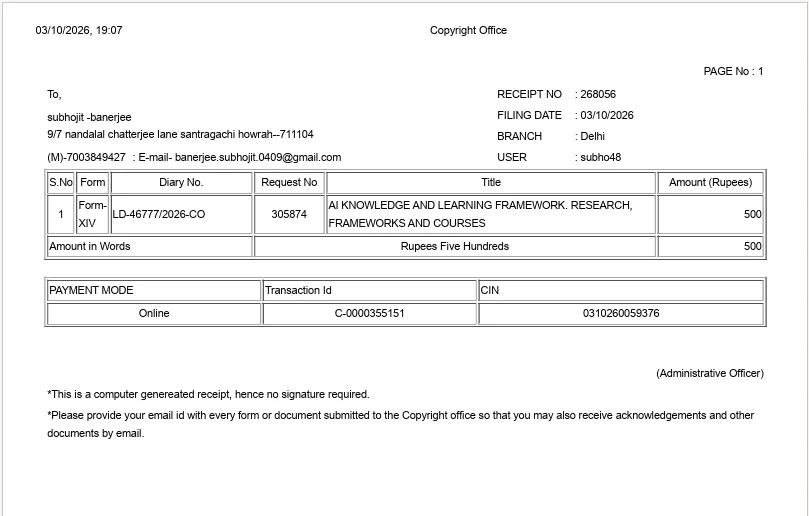
Copyright Notice: This content is part of “AI Knowledge and Learning Framework: Research, Frameworks and Courses,” for which a copyright application has been filed with the Copyright Office, Government of India under Diary No. LD-46777/2026-CO. Unauthorized reproduction, copying, distribution, or commercial use is prohibited.