
SUPERCHARGE YOUR ONLINE VISIBILITY! CONTACT US AND LET’S ACHIEVE EXCELLENCE TOGETHER!
Search has fundamentally changed. What once revolved around keywords, backlinks, and page-level optimisation has evolved into a far more complex system driven by artificial intelligence, intent recognition, and contextual understanding. Traditional SEO, built on linear tactics and predictable ranking signals, is no longer sufficient in a landscape where search engines interpret meaning rather than match phrases. Today, visibility is earned not by chasing algorithms, but by aligning with how machines and humans think, evaluate, and decide.
We are now operating in the era of hyper-intelligent search, where AI systems such as RankBrain, BERT, and generative models influence how information is discovered, prioritised, and presented. Search engines no longer act as directories of links. They function as answer engines, synthesising knowledge and delivering direct, intent-driven responses. In this environment, brands are assessed as entities, content is judged by semantic depth, and authority is determined by contextual trust rather than mechanical optimisation. This shift has redefined what it means to be visible in search.
At ThatWare, we recognised early that SEO needed to evolve from a tactical service into a form of digital engineering. Our approach focuses on constructing ecosystems that search engines and AI models can understand, trust, and reference. By combining Hyper-Intelligence with frameworks such as Quantum SEO as a Service, Answer Engine Optimisation, and Generative Engine Optimisation, we help brands move beyond rankings and into sustained authority. The transformation of Minairal Co Ltd stands as a clear example of how modern SEO, when executed correctly, becomes a strategic growth engine rather than a collection of isolated tactics.
The New Search Reality: How Hyper-Intelligence Is Reshaping Visibility
Search Has Shifted from Retrieval to Interpretation
Search engines no longer operate as simple retrieval systems that match queries to indexed pages. Modern search is interpretative, not extractive. AI-driven systems analyse context, intent, historical behaviour, and semantic relationships to determine what information is most relevant and trustworthy. Instead of asking, “Which page contains this keyword?”, search engines now ask, “Which source best understands and answers this intent?” This shift has fundamentally altered how visibility is earned and sustained in competitive digital environments.
Hyper-Intelligence as the Core Decision-Making Layer
Hyper-Intelligence refers to the convergence of artificial intelligence, behavioural data, semantic understanding, and predictive modelling within search ecosystems. Algorithms such as RankBrain and BERT continuously learn from user interactions, refining how they interpret queries and assess content quality. Visibility is no longer static or position-based. It is dynamic, personalised, and influenced by how well a brand aligns with evolving intent patterns. Brands that rely solely on traditional optimisation signals struggle because they fail to communicate meaning at the depth AI systems now require.
Entities, Context, and Trust Over Keywords
In the hyper-intelligent search landscape, keywords have been replaced by entities and contextual relevance. Search engines evaluate how concepts relate to one another, how consistently a brand communicates expertise, and how often it is reinforced as a trusted source across multiple contexts. Content is no longer judged in isolation. It is assessed as part of a broader knowledge graph where topical authority, semantic connections, and clarity of intent determine visibility. This is why isolated content strategies rarely succeed in AI-driven search environments.
Why Hyper-Intelligence Demands a New SEO Mindset
At ThatWare, we approach this shift as a structural transformation rather than a tactical adjustment. Hyper-Intelligent search rewards brands that are engineered for understanding, not manipulation. This requires aligning technical performance, semantic architecture, behavioural signals, and AI compatibility into a single, cohesive system. Visibility today is not about outperforming competitors on individual keywords. It is about becoming the most reliable, interpretable, and authoritative source within a topic ecosystem. Those who adapt to this reality gain durable visibility. Those who do not are gradually filtered out by increasingly intelligent search systems.
Minairal’s Digital Landscape: A Breakthrough Technology That Needed Authority
Innovating in Atmospheric Water Generation
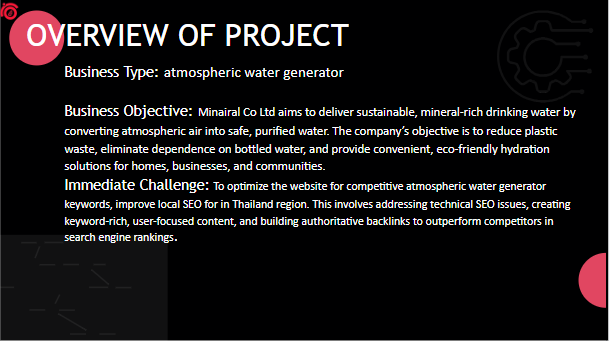
Minairal Co Ltd operates at the intersection of sustainability, engineering, and future-ready infrastructure through its atmospheric water generation technology. By extracting potable water directly from the air, Minairal addresses critical global challenges such as water scarcity, environmental impact, and decentralised access to clean drinking water. However, innovation alone does not guarantee digital visibility. Technologies that challenge conventional understanding often face an additional burden online: they must first educate before they can convert.
The Complexity of Communicating Advanced Technology
Atmospheric water generation is not a universally understood concept. For most users, the idea of turning air into water raises questions around feasibility, safety, efficiency, and cost. Search behaviour in this space is fragmented, ranging from curiosity-driven research to high-intent commercial queries. Without a strong digital authority framework, even technically superior products risk being misunderstood or overlooked. Generic SEO content or surface-level explanations would fail to address the depth of user concerns present across the buyer journey.
A Competitive Market with Misinformation Noise
The sustainability and clean-tech space is saturated with partial information, exaggerated claims, and poorly substantiated content. This creates an environment where trust becomes the primary differentiator. For Minairal, competing was not just about ranking against other brands, but also about standing apart from low-quality sources that diluted credibility. Search engines, particularly AI-driven systems, are increasingly cautious in such spaces, favouring sources that demonstrate expertise, consistency, and verifiable relevance over aggressive optimisation.
Why Authority Was the Missing Digital Layer
Minairal did not suffer from a lack of innovation. What it required was digital authority that matched the sophistication of its technology. At ThatWare, we recognised that authority could not be forced through keywords or backlinks alone. It had to be engineered through semantic depth, intent alignment, and contextual trust. The challenge was to position Minairal not just as a product provider, but as a definitive knowledge entity within the atmospheric water ecosystem. Only then could visibility translate into confidence, engagement, and long-term growth in an AI-driven search landscape.
Elevating the Digital Infrastructure: Engineering Performance, Trust, and Scalability
Why We Elevated Minairal’s Website Architecture Strategically
For modern search engines, a website is no longer just a container for content. It is a signal of credibility, intent alignment, and long-term reliability. When we assessed Minairal’s digital presence, it was clear that visibility could not be sustained without elevating the underlying architecture. Our focus was not cosmetic improvement, but structural engineering. Every architectural decision was made to support discoverability, interpretability, and scalability in an AI-driven search ecosystem.
We approached the website as a living system rather than a static asset. This meant designing an architecture capable of supporting future content expansion, semantic depth, and multi-market growth without fragmenting authority. Search engines reward consistency and clarity. By strategically elevating the site’s foundation, we ensured that every future optimisation would compound rather than conflict.
Technical SEO as a Credibility and Trust Signal
Technical SEO has evolved into one of the strongest trust indicators in modern search. AI-driven systems increasingly associate performance stability, security, and accessibility with brand reliability. We treated technical optimisation as a credibility layer rather than a checklist.
Our work focused on clean code execution, predictable rendering behaviour, and frictionless crawling. By eliminating unnecessary complexity, we allowed search engines to interpret Minairal’s content without distortion. This clarity improved indexation quality and reduced ambiguity, two factors that are critical when algorithms assess authoritative sources in complex technology domains.
Modular Architecture Designed for Scalability and AI-Readiness
To support long-term growth, we implemented a modular site architecture. This allowed content, features, and landing experiences to scale independently while remaining semantically connected. Modular design ensures that authority flows horizontally across the site instead of being trapped in isolated silos.
From an AI-readiness perspective, modularity enables clearer entity mapping. Each section of the site reinforces Minairal’s topical authority while maintaining logical separation for users and crawlers. This structure future-proofs the platform for new technologies, markets, and content types without requiring disruptive reengineering.
Core Web Vitals Aligned with Page Experience Signals
Performance is no longer optional. Core Web Vitals directly influence how search engines assess usability and reliability. We optimised loading performance, interaction responsiveness, and visual stability to align with Google’s Page Experience expectations.
By reducing execution delays, stabilising layouts, and improving interaction feedback, we created an experience that supports both human engagement and algorithmic trust. These improvements were not isolated wins. They reinforced every other SEO effort by ensuring that content quality was not undermined by poor delivery.
Flat Site Structure for Crawl Efficiency and Discoverability
Traditional deep hierarchies create friction for both users and search engines. We replaced this with a flat site structure that reduced crawl depth and improved content accessibility. Important pages became easier to discover, index, and rank.
A flatter structure also enhances internal authority distribution. Instead of forcing relevance through excessive internal links, we allowed semantic proximity to guide discoverability naturally. This approach supports both classic crawling and AI-driven retrieval models.
Mobile Usability, Security, and Performance as Ranking Multipliers
Mobile-first indexing means that mobile experience defines overall search performance. We prioritised mobile usability, ensuring responsive layouts, touch-friendly interactions, and fast loading across devices. Security was treated as non-negotiable. Strong HTTPS implementation and data integrity reinforced trust signals at both user and algorithmic levels.
Together, these elements acted as ranking multipliers, amplifying the impact of content, intent alignment, and semantic authority.
Introducing Quantum SEO as a Service (QSaaS): A Multi-Dimensional Framework
Why Traditional Linear SEO Models Are Obsolete
Traditional SEO follows a linear logic: keyword research, on-page optimisation, link building, and rank tracking. This model fails in an environment where search engines evaluate meaning, behaviour, and trust simultaneously. Linear optimisation cannot keep pace with systems that learn, adapt, and personalise results in real time.
We recognised that SEO needed to evolve into a multi-dimensional discipline. One that accounts for technical performance, semantic relevance, user behaviour, and AI interpretation at the same time.
What QSaaS Is and How It Redefines Optimisation
Quantum SEO as a Service (QSaaS) is our response to this complexity. QSaaS is not a tactic or a toolset. It is a framework that treats SEO as a dynamic system where multiple variables interact continuously.
Instead of optimising individual elements in isolation, QSaaS synchronises them. Technical architecture supports semantic clarity. Content structure reinforces intent alignment. Behavioural signals validate relevance. Together, they form a cohesive optimisation ecosystem that adapts as search evolves.
Integrating Technical, Semantic, Behavioural, and AI Signals
QSaaS integrates four critical layers:
- Technical signals that establish trust and accessibility
- Semantic signals that communicate meaning and authority
- Behavioural signals that validate relevance through engagement
- AI signals that influence how content is interpreted, summarised, and surfaced
By aligning these layers, we eliminate friction between optimisation efforts. Each action reinforces the others, creating compound visibility rather than fragmented gains.
How Hyper-Intelligence Guides Every Optimisation Decision
Hyper-Intelligence is the decision engine behind QSaaS. It combines data analysis, intent modelling, and predictive insight to guide optimisation priorities. Rather than reacting to rankings, we anticipate how search systems will evaluate content and structure in future states.
This approach allows us to optimise proactively, positioning brands like Minairal ahead of algorithmic shifts instead of constantly chasing them.
Searcher Intent as the Core Ranking Signal
Why Understanding Intent Outweighs Chasing Keywords
Keywords are symptoms. Intent is the cause. Modern search engines prioritise understanding why a query exists, not just how it is phrased. Optimising for keywords without intent alignment leads to short-lived visibility and poor engagement.
We centred Minairal’s strategy around intent comprehension. This allowed us to address real user needs rather than surface-level queries.
The Psychology Behind Modern Search Behaviour
Search behaviour reflects human psychology. Users move from curiosity to evaluation to decision-making. Each stage carries different expectations, language patterns, and information needs.
AI systems recognise these shifts and adjust result presentation accordingly. Content that fails to match psychological context is filtered out, regardless of keyword relevance.
Intent Across Awareness, Consideration, and Decision Stages
We mapped Minairal’s content to all stages of the buyer journey:
- Awareness: Educational content explaining atmospheric water generation
- Consideration: Comparative and technical insights validating feasibility
- Decision: Product-focused pages addressing cost, application, and deployment
This ensured consistent visibility as users progressed through their decision-making process.
Turning User Needs into Structured, Scalable Optimisation
Intent mapping is only effective when translated into structure. We transformed intent insights into scalable content architectures that could grow without diluting relevance. This structure allowed search engines to understand not just individual pages, but the journey they collectively supported.
The 3C Framework: Translating Human Intent into Digital Architecture
Content Type Alignment Across the Buyer Journey
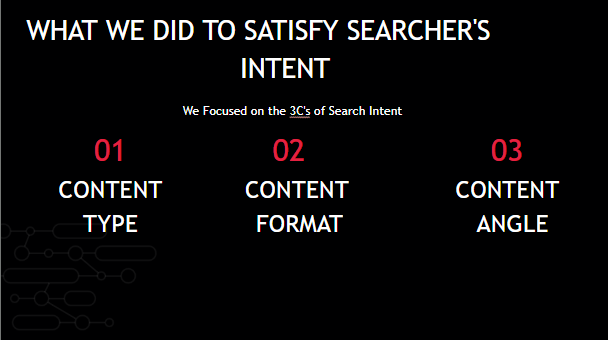
Using our 3C Framework, we aligned content types with intent stages. Blog articles addressed learning needs. Product pages supported evaluation. Landing pages facilitated conversion. Each content type had a defined role within the ecosystem.
Content Format Dominance Through Education and Clarity
Complex technology requires clarity. We prioritised formats that simplify understanding, such as guides, explanations, and structured breakdowns. These formats perform exceptionally well in AI-driven search because they reduce ambiguity and improve answer extraction.
Content Angle Selection for Commercial and Local Relevance
Angles determine competitiveness. By targeting high-value commercial phrases and localised variations, we aligned content with high-intent opportunities. This allowed Minairal to appear in both global and regional contexts without fragmenting authority.
Creating Intent-Matched Pathways Instead of Isolated Pages
Rather than treating pages as standalone assets, we engineered pathways that guide users logically through information. These pathways improve engagement, reinforce semantic relationships, and signal coherence to search engines.
In a hyper-intelligent search environment, coherence equals authority. Through the 3C Framework, we ensured Minairal’s digital presence communicated intent, expertise, and trust as a unified system rather than a collection of disconnected pages.
Semantic SEO and Entity Authority: Constructing a Topical Ecosystem
Moving Beyond Keyword Clusters to Entity Ecosystems
Search engines no longer interpret content as isolated keyword targets. They interpret meaning through entities, relationships, and contextual signals. Keyword clustering, while once effective, fails to capture the depth required by AI-driven systems. We moved Minairal beyond fragmented keyword groups into a fully connected entity ecosystem.
An entity ecosystem allows search engines to understand not just what a page is about, but how it relates to broader concepts, technologies, use cases, and industries. By aligning content around entities such as atmospheric water generation, sustainable water solutions, air-to-water dispensers, and decentralised water infrastructure, we enabled deeper contextual interpretation. This shift positioned Minairal as a knowledge authority rather than a keyword competitor.
Establishing Minairal as an Authority Entity in Air-to-Water Technology
Authority in modern search is not declared. It is inferred through consistency, depth, and contextual reinforcement. We focused on establishing Minairal as a primary entity within the air-to-water technology space by ensuring its content consistently demonstrated expertise, accuracy, and relevance.
This involved reinforcing Minairal’s association with core concepts across multiple content formats, technical explanations, and commercial contexts. Over time, search engines began recognising Minairal not just as a website, but as a reliable reference point within the broader knowledge graph of atmospheric water generation.
Internal Linking as Semantic Reinforcement
Internal linking was treated as a semantic signal rather than a navigational convenience. Every internal link was placed to reinforce topical relationships and strengthen entity associations. Instead of generic linking patterns, we used contextual anchors that clarified meaning and hierarchy.
This approach helped search engines understand how ideas connect across the site. It also guided users naturally through learning and decision pathways, reinforcing behavioural signals that further validated relevance and authority.
Contextual Depth, Co-Occurrence, and Topical Consistency
Depth matters in AI-driven search. We ensured that key concepts appeared consistently across the site in varied yet contextually aligned ways. This co-occurrence strengthened semantic signals and reduced ambiguity.
Topical consistency does not mean repetition. It means reinforcing meaning through diverse explanations, applications, and perspectives. This depth made Minairal’s content highly interpretable by AI systems tasked with summarisation, comparison, and answer generation.
Why Entity Authority Outperforms Backlink Dependency
Backlinks remain relevant, but they are no longer sufficient on their own. Entity authority compounds over time and is far more resilient to algorithmic shifts. By focusing on semantic depth and entity recognition, we reduced reliance on external signals and built intrinsic authority.
In an AI-first ecosystem, brands that are understood are preferred over brands that are merely referenced. Entity authority ensures sustained visibility even as ranking mechanics evolve.
The Answer Engine Shift: Optimising for AEO in an AI-First World
How AI Overviews and Zero-Click Searches Redefine Visibility
Search results have shifted from lists of links to synthesised answers. AI Overviews and zero-click experiences mean users often receive information without visiting a website. This does not eliminate opportunity. It changes how authority is earned.
Visibility now depends on whether a brand’s content is selected as the source of truth. We optimised Minairal to become that source by aligning content structure, clarity, and semantic precision with answer engine requirements.
Structuring Content to Become the Definitive Answer Source
Answer engines prioritise clarity, completeness, and trustworthiness. We structured content with direct explanations, logical progression, and clear definitions. Ambiguity was eliminated in favour of precision.
Each page was designed to answer specific questions fully, making it easier for AI systems to extract, summarise, and reference Minairal’s content confidently.
Schema, Clarity, and Semantic Precision in Practice
Structured data played a supporting role in reinforcing meaning. We implemented schema strategically to clarify relationships between concepts, products, and informational content.
However, schema alone is not enough. Semantic clarity within the content itself ensured that AI systems could interpret meaning even without explicit markup. This dual approach strengthened Minairal’s AEO performance across competitive queries.
Measuring AEO Success Beyond Traditional Rankings
AEO success cannot be measured solely by keyword positions. We evaluated visibility through inclusion in AI Overviews, presence in featured answers, and consistency of brand mentions within answer-driven results.
This shift in measurement reflects the reality of modern search, where influence matters more than clicks and authority matters more than rank.
Generative Engine Optimisation (GEO): Becoming Visible Inside AI Systems
What GEO Means for Brands Competing in AI-Generated Results
Generative Engine Optimisation focuses on how brands appear within AI-generated narratives. Unlike traditional search results, generative engines synthesise information from multiple sources to create new responses.
Our goal was to ensure Minairal’s perspective, terminology, and expertise were embedded within these narratives. GEO ensures that when AI speaks about air-to-water technology, Minairal is part of the conversation.
How LLMs Select, Reference, and Surface Content
Large language models evaluate content based on clarity, consistency, and trust signals. They favour sources that demonstrate subject mastery and contextual reliability.
We optimised Minairal’s content to meet these criteria by maintaining factual accuracy, consistent terminology, and comprehensive explanations. This made the content more likely to be referenced during generative synthesis.
Optimising for Gemini and Generative Search Experiences
Generative platforms like Google Gemini rely on structured understanding rather than surface optimisation. We aligned content with how these systems interpret entities, relationships, and intent.
By optimising for comprehension rather than manipulation, we increased Minairal’s visibility within AI-driven discovery journeys that extend beyond traditional SERPs.
Ensuring Minairal Is Recognised as a Trusted AI Source
Trust is the currency of generative search. We reinforced Minairal’s trust signals through consistency, technical stability, and semantic clarity. Over time, this positioned Minairal as a reliable AI reference point rather than a peripheral source.
Localised GEO Strategy: Strengthening Authority in Target Markets
Why Geography Still Matters in Generative Search
Despite global AI systems, local context remains critical. Generative engines tailor responses based on geographic relevance, availability, and regional intent.
We recognised Thailand as a strategic growth market and optimised Minairal’s content to align with local demand signals without fragmenting global authority.
Local Intent Signals Inside AI Responses
Local intent is communicated through language, usage scenarios, and contextual relevance. We refined content to address region-specific concerns while maintaining semantic alignment with the global entity framework.
This ensured Minairal appeared in AI responses tailored to local users searching for air-to-water solutions in Thailand.
Optimising for Thailand as a Strategic Growth Region
Localised content was structured to reinforce relevance without duplicating or diluting authority. This balance allowed Minairal to dominate regional AI visibility while strengthening its global credibility.
Turning Regional Relevance into Global Authority Signals
Successful localisation enhances global authority. By demonstrating relevance across geographies, Minairal signalled scalability and reliability, two factors highly valued by AI-driven systems.
Ranking in Competitive Landscapes: Overcoming High-Difficulty Keywords
Why Keyword Difficulty Is Misunderstood in Modern SEO
Keyword difficulty metrics are based on outdated assumptions. They do not account for semantic authority, intent alignment, or AI interpretation.
We treated difficulty as a contextual variable rather than a barrier.
Intent Layering and Semantic Reinforcement Strategies
By layering intent, education, and commercial relevance, we positioned Minairal to rank for keywords with up to 48 percent difficulty. Semantic reinforcement ensured that authority outweighed competition.
How Minairal Achieved Visibility for High-Difficulty Keywords
Minairal’s success came from being the best answer, not the most optimised page. Depth, clarity, and trust enabled visibility where others failed.
Why Authority Beats Optimisation Shortcuts
Shortcuts create volatility. Authority creates durability. In competitive environments, only brands that are deeply understood can sustain visibility.
Behavioural SEO: Aligning User Experience with Algorithmic Expectations
The Role of Engagement Metrics in AI-Driven Rankings
Engagement validates relevance. AI systems analyse behaviour to confirm whether content satisfies intent.
Intent-Matched Landing Experiences
We designed landing experiences that matched user expectations precisely, reducing friction and confusion.
Reducing Bounce Rates Through Relevance and Clarity
Clear messaging and structured content reduced bounce rates significantly by delivering immediate value.
Increasing Pages per Visit Through Strategic Content Flow
Intent-driven pathways encouraged exploration, reinforcing both engagement and semantic relationships.
Omnichannel Authority: Building a Balanced and Resilient Traffic Ecosystem
Why Search Engines Reward Multi-Channel Trust Signals
Search engines value consistency across platforms. Multi-channel presence reinforces legitimacy.
Integrating Google and Facebook Traffic Strategically
We aligned messaging across search and social, ensuring consistent intent reinforcement.
Consistent Intent Messaging Across Platforms
Consistency builds trust. Trust builds authority.
How Omnichannel Signals Strengthen AI Confidence
When AI systems detect consistent signals across ecosystems, confidence increases. This confidence translates into sustained visibility, authority, and growth.
Measuring Impact: Translating Data into Digital Authority
Interpreting Traffic Growth in an AI-First Environment
In an AI-first search landscape, traffic growth must be interpreted with nuance. A simple increase in visits no longer tells the full story. We analyse traffic as a signal of authority alignment rather than a standalone success metric. For Minairal, the growth in sessions reflected more than improved discoverability. It indicated that search engines and AI systems were increasingly confident in surfacing Minairal as a relevant and trustworthy source.
AI-driven visibility prioritises consistency and contextual reliability. When traffic grows alongside improvements in engagement and intent matching, it confirms that optimisation efforts are resonating at both algorithmic and human levels. This is why we view traffic growth as a validation layer rather than an end goal.
Understanding Audience Expansion Beyond Vanity Metrics
Audience growth is often reduced to user counts, but modern SEO requires deeper interpretation. We evaluate who is arriving, why they are arriving, and how they interact once they do. For Minairal, the rise in unique users signalled successful top-of-funnel AEO and GEO positioning, particularly among users seeking educational and evaluative information.
More importantly, this expansion occurred without sacrificing relevance. New audiences aligned with Minairal’s core value proposition, reinforcing the brand’s authority rather than diluting it. This distinction separates sustainable growth from inflated metrics that offer little long-term value.
Behavioural Improvements as Authority Indicators
Engagement metrics serve as behavioural confirmations of relevance. Reduced bounce rates, increased pages per visit, and longer session durations indicate that content is meeting user expectations. In AI-driven search systems, these signals play a crucial role in reinforcing authority.
We treat behavioural improvements as feedback loops. When users engage deeply, AI systems interpret this as confirmation that the content satisfies intent. This reinforcement increases the likelihood of continued visibility across search, answer engines, and generative platforms.
Why Modern SEO Success Is Multi-Layered
SEO success today exists across multiple layers: technical performance, semantic authority, behavioural validation, and AI recognition. Focusing on any single layer creates fragility. Sustainable visibility requires alignment across all of them.
For Minairal, performance improvements, semantic depth, and behavioural engagement worked together to build digital authority. This multi-layered success model is what allows brands to remain visible even as search systems continue to evolve.
Data-Driven Results & Market Impact
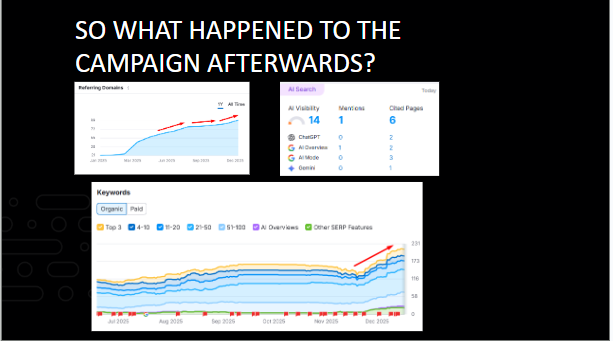
The combined application of ThatWare’s advanced SEO, AEO, GEO, and behavioural frameworks did not just improve visibility. It fundamentally reshaped Minairal’s digital performance and market positioning. Every metric reflected not isolated optimisation wins, but a systemic shift toward authority, relevance, and trust across search engines, AI systems, and user touchpoints.
Traffic Explosion: Authority-Driven Growth at Scale
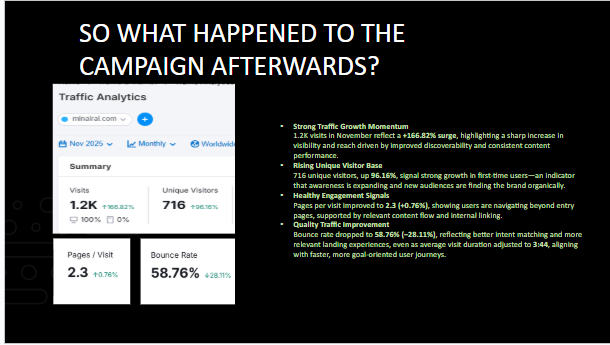
The most visible outcome was a 166.82% surge in monthly visits, with traffic reaching 1.2K sessions in a single month. This growth was not the result of broad keyword targeting or short-term ranking spikes. Instead, it was driven by semantic expansion, entity reinforcement, and answer-focused visibility. Minairal began attracting users across multiple intent layers, including awareness-stage education, mid-funnel comparison, and solution validation. This confirmed that the site was no longer dependent on a narrow set of commercial queries but had evolved into a discoverable knowledge hub within the air-to-water technology space.
Audience Expansion: Capturing New Demand, Not Recycling Old Traffic
Unique visitors increased by 96.16%, validating the effectiveness of our top-of-funnel AEO and GEO strategies. Rather than relying on repeat exposure to the same user base, Minairal successfully intercepted new demand from AI-generated answers, informational searches, and zero-click environments. This expansion demonstrated that the brand was being surfaced in discovery moments where users were not explicitly searching for Minairal by name, but for solutions, explanations, and technologies the brand now owns semantically.
Behavioural Transformation: Intent Alignment in Action
The behavioural improvements were among the strongest indicators of long-term authority. The bounce rate dropped by 28.11%, settling at 58.76%, reflecting a clear improvement in intent matching. Visitors were landing on pages that immediately answered their questions, aligned with their search psychology, and guided them logically forward.
At the same time, pages per visit increased to 2.3, proving that users were engaging with the content ecosystem as designed. Strategic internal linking, contextual progression, and clear informational hierarchy encouraged exploration rather than abandonment. This behaviour mirrors how AI systems evaluate satisfaction and topical completeness, reinforcing Minairal’s credibility algorithmically.
Omnichannel Authority: Building a Resilient Traffic Ecosystem
One of the most strategically important outcomes was traffic diversification. Minairal achieved an almost perfectly balanced split between Google (50.34%) and Facebook (49.66%). This omnichannel equilibrium reduced dependency on any single platform and sent strong trust signals across the digital ecosystem. Consistent intent messaging across channels strengthened brand recognition, reinforced semantic associations, and increased confidence for both search engines and generative AI systems.
What This Impact Truly Represents
Collectively, these results signal more than growth. They represent a brand transitioning from optimisation-driven visibility to authority-driven demand capture. Minairal is no longer competing solely for rankings. It is being recognised, referenced, and trusted across search, social, and AI-driven discovery. That is the true market impact of data-led, future-ready optimisation.
Key Learnings for Future-Ready Brands
Why SEO Must Be Treated as Digital Infrastructure
SEO is no longer a marketing tactic. It is digital infrastructure. Just as physical infrastructure supports long-term growth, SEO infrastructure supports visibility, trust, and scalability. Brands that treat SEO as a short-term campaign struggle to adapt to AI-driven change.
At ThatWare, we approach SEO as an engineering discipline. When infrastructure is designed correctly, optimisation compounds over time rather than resetting with every algorithm update.
The Importance of Intent Ownership and Entity Control
Owning intent means understanding and addressing user needs better than anyone else. Controlling entity representation ensures that search engines and AI systems associate those needs with your brand. Together, these elements form the foundation of authority in modern search.
Minairal’s growth demonstrates that intent ownership and entity control outperform isolated keyword strategies. Brands that invest in these areas gain durable visibility and strategic resilience.
Lessons for Sustainability, Manufacturing, and Tech-Driven Brands
Industries built on innovation face unique digital challenges. Complex products require education. Emerging technologies require trust. Sustainability requires credibility. The Minairal case illustrates that authority-driven SEO is particularly powerful in these sectors.
By prioritising clarity, depth, and semantic alignment, brands can overcome scepticism and stand out in crowded markets. This approach transforms innovation into discoverability.
Preparing for the Next Evolution of Search
Search will continue to evolve toward deeper intelligence, personalisation, and generative interaction. Brands that succeed will be those prepared to be understood, referenced, and trusted by AI systems.
Future-ready SEO requires adaptability, structural thinking, and a commitment to authority. By embracing frameworks like QSaaS, AEO, and GEO, brands can position themselves not just for current visibility, but for long-term relevance in an increasingly intelligent search ecosystem.
Wrapping Up
Minairal’s journey shows that modern SEO is no longer about chasing rankings but about building durable digital authority in an AI-first search ecosystem. By shifting focus from isolated keywords to entity-driven ecosystems, semantic depth, behavioural alignment, and generative engine optimisation, the brand positioned itself not just to be found, but to be trusted by both users and intelligent systems. The integration of AEO, GEO, localisation, omnichannel signals, and experience-led optimisation demonstrates that visibility today is earned through clarity, relevance, and sustained intent ownership. As search continues to evolve toward hyper-intelligent answer engines, Minairal’s strategy stands as proof that brands willing to treat SEO as long-term infrastructure rather than a tactical shortcut will not only survive algorithmic change, but compound authority, resilience, and growth over time.