SUPERCHARGE YOUR ONLINE VISIBILITY! CONTACT US AND LET’S ACHIEVE EXCELLENCE TOGETHER!
Since 2019 Google has rolled out multiple core algorithm updates, which have radically affected the SEO industry and how websites are created and optimized for search.
While there have been numerous technical breakdowns of individual updates, in this article, we take a broader perspective on all of them together. Our aim is to clearly understand the direction in which search is evolving. We do this by closely observing one core element—the Google SERP itself. By analysing visible outcomes rather than assumptions, we uncover how intent classification and search intent taxonomy are shaping modern search behaviour.
Search Intent and Relevance
Over the years, Google has published countless blog posts, announcements, and tweets discussing its algorithm updates. However, in most of these so-called “explanations,” Google rarely discloses precise technical details. Instead, it repeatedly falls back on a familiar statement: “Create helpful and informative content that satisfies user search.”
When we examine these communications collectively, two recurring terms consistently stand out. The first is “search intent,” and the second is “relevance.” These concepts form the foundation of how Google evaluates, ranks, and serves content to users.
What is Search Intent?
In the simplest terms, search intent refers to the purpose behind a search query. More specifically, it represents the actual need, goal, or expectation a user has when typing a query into Google. Understanding this intent allows search engines to deliver results that align closely with what the user truly wants, rather than just matching keywords.
When analysing search queries and keywords, only two metrics truly matter in any keyword research tool: search demand and CPC. Despite this, many SEO experts and platforms have long promoted a third metric called “Keyword Difficulty.” Over time, it has become one of the most overused and misunderstood terms in the SEO community, often disconnected from real ranking performance and search intent taxonomy.
What is Keyword Difficulty?
Keyword difficulty is intended to represent how hard it is to rank for a specific search query in organic results.
Why is Keyword Difficulty unreliable?
As a metric, keyword difficulty lacks a standardised or universally accepted measurement method within the SEO industry. Different tools and organisations rely on their own proprietary formulas, each using varying parameters. Based on our experience across 500+ SEO projects, we have consistently observed that this metric functions more as abstract jargon than a dependable indicator of actual ranking complexity.
Look at these examples below:
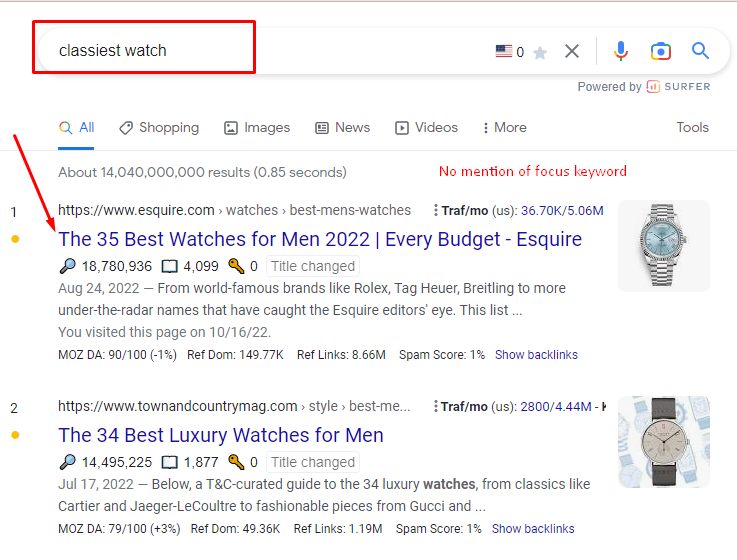
The word “classiest watch” is not even present in the title or description of the top-ranking results.
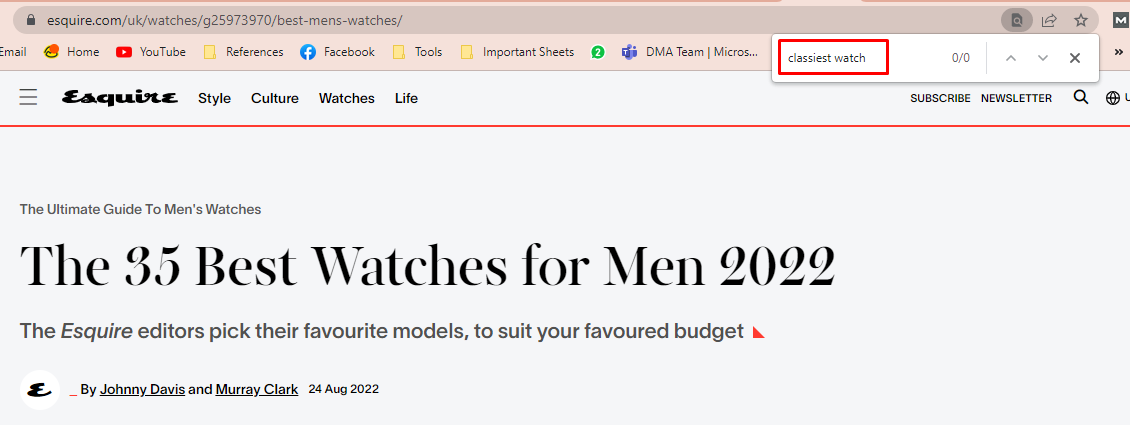

Also, the most interesting fact is that the focus keyword is not present on the top-ranking page. Also, the word “classy” is not present.
Also, it has been said that keyword difficulty depends on the referring domains and domain authority of the top-ranking websites. Here’s an example contrary to it.


As seen above, the page from allied.com with only a few backlinks outranks highly authoritative pages with many backlinks and referring domains. Also, the SEMRush authority score is less than the competing pages.
This is because Google relies heavily on satisfying the Search intent. The rest of the article will explore how to analyze Search Intent using the SERP.
How to Analyse Search Intent using the SERP
What to Look for in the Google SERP?
When evaluating any search query to understand its intent, the goal is to decode the underlying search intent taxonomy behind the results. This process focuses on identifying several critical elements that shape why certain pages appear and others do not.
- What type of content is being written?
- Why is this content ranking on the first page?
- What kind of websites is Google prioritising for these results?
Answering these questions helps reveal how Google interprets the query and what users are truly seeking.
What Are the Different Types of Search Intent?
After reviewing thousands of search engine results pages, we have identified the following broad classifications of search intent:
- Commercial / Investigative
- Informational
- Transactional
- Navigational
What are different Classifications of Content used to satisfy the search
- Content-Type
This refers to the overall “type” of content in the search results and is usually one of the following:
- Blog post
- Product page
- Category page
- Landing page
- Content Format
This refers to the “format” of the top-ranking pages. Some common formats include:
- “How-to” guides
- Step-by-step tutorials
- List posts
- Opinion pieces
- Reviews
- Comparisons
How to Analyse the SERP?
- Make a list of a few Seed Keywords. Search one of the target keyphrases.
We have experimented with the phrase “rotating proxy manage”
- Create a Spreadsheet with the following columns: Position, Ranking URL, Intent Classification, Source Type Classification.

- Continue filling in the information for the top 5 ranking results.
With the above basic analysis of the SERP, we now understand that landing pages with commercial content with little information are performing well in search.
Hence we have understood most search intent for a person looking for a rotating proxy management tool.
A Few Additional Checks
- Check for the presence of the focus keyword in the Title, Body, Meta Description and H1 Tags.
- Check for the Schema Markup types used in the Top 5 Search Results.
- Check the Readability of the top 5 ranking results.
Creating your Own Content
We have analysed the SERP for gathering competitor data and determined the target keywords’ primary search intent.
Now comes the hard part. Creating content that will outrank the top-ranking pages.
Here are some best practices to keep in mind while creating the content.
Make sure the content itself satisfies the search intent
This means including all features that we just researched. In the above example for “rotating proxy manage”, we determined the majority of the top ranking pages are “Landing pages with Commercial Nature”.
So it should have features like > Product info, CTA, Testimonials, USPs,etc.
Make sure the keyword is present in Title, Body, Meta Description and H1
Pretty self-explanatory. However, make sure to include the keywords in a natural flow. Synonyms can also be used. Just make sure they are semantically relevant.
Readability Score
Make sure you run readability tests on the content created and compare it to the top-ranking pages.
Include appropriate Schema Markups
You can check the type of schema used by simply reviewing the source code of the top-ranking pages.
- Open a competitor’s page
- Press Ctrl + U
- Search for “schema.org”.
Here’s what it looks like:

We can understand the web page uses the “WebPage” Schema.
Give Proper Sub Heading Distribution
Make sure to use proper subheadings from H1 to H6 if required.
Build some Backlinks
Although search intent is the number 1 ranking factor, backlinks are still the second most important. Build some backlinks to the recently published page from authoritative sources to help it rank.