
Get a Customized Website SEO Audit and Online Marketing Strategy and Action Plan
How many times in a day do you search for information on the internet? Can you imagine your entire city doing the same? The information age continues to astound even the savviest computer scientists, and search engines enhance the experience by introducing us to different algorithms. One of which is the much-awaited passage indexing.
Simply put, Google will index passages from content relevant to your search regardless of the entire site’s relevance. If you have very specific queries, Google analyzes and indexes passages that will best answer your question without regard for the site’s relevance.
The same way internet speeds are growing, search results are now released faster through passage indexing. It makes the regular internet user happy, but how does this impact search engine optimization?
For businesses, Google passage indexing creates new opportunities to surface highly relevant information even when an entire page does not rank for a broad topic. This means SEO strategies should focus on creating clear, well-structured sections that directly address specific search queries, helping individual passages demonstrate relevance and provide useful answers to users.
With Passage indexing SEO, businesses can optimize content by organizing information around specific questions, maintaining strong topical relevance, and improving readability. Rather than relying solely on overall page optimization, this approach encourages marketers to develop comprehensive content where each section delivers standalone value, making it easier for search systems to understand and retrieve relevant information.
10 Things You Should Know About Passage Indexing
Since it is yet to be rolled out, the impact of passage indexing cannot be fully identified, but a few observations based on questions addressed to Google can be made.
1. Passage Indexing Will Change What The Results Page Will Look Like
Google’s Martin Splitt refers to passage indexing as passage ranking. Essentially, you’ll be seeing a ranking of passage snippets on your page rather than the regular blue lines linked to the webpage. This new algorithm will rank passages based on your query’s relevance regardless of the website’s overall theme. It doesn’t make things look longer. The snippets that you see now is merely a snippet without the passage ranking algorithm. If SEOs have been basing it on this algorithm, there may be a few changes needed moving forward.
2. Long Websites Can Benefit From Passage Indexing
If you write long-form content, you may benefit from passage indexing. The current algorithm may be skipping a lot of relevant information in your content because it does not relate to your main topic. Splitt confirms this, mentioning it is the “core” of this ranking change. Straightforward websites like E-commerce are not affected by this ranking. When a user searches specific, niche queries, websites with lengthy content, and even blogs can benefit because of Google’s capacity to analyze passages.
3. Passage Indexing Will Help People Who Have Little Knowledge On SEO
Passage ranking will help people learn how to structure the content for a better strategy. Some pages have a hard time ranking because they’re too long and are overshadowed by the main topic, rendering relevant content within the article ignored. Passage indexing in this way levels the playing field. But Splitt still clarifies that a proper structure will help systems identify important bits in your content. This algorithm will help other pages rank well.
4. Passage Ranking Has Nothing To Do With The Length Of The Passage In Your Content
Passage ranking can be lengthy or straight to the point, and it all depends on what the algorithm is picking up. But, since it’s a passage, it is expected to be at least a paragraph long relevant to the query.
5. Passage Ranking Will Look At Relevance Rather Than The Presence Of The Keyword
This algorithm will analyze passages that best answer the queries, which means relevance is essential. And in this note, a relevant answer in the body may outrank a page that merely mentions the keyword in its title. The featured snippets that you see now are just a portion of a page related to your query’s general topic. With this algorithm’s presence, it includes websites that are not entirely relevant to the theme of your question but has a “passage” that answers your query. In a way, it is a more inclusive algorithm.
6. Passage Ranking Can Improve Visibility for Specific Search Queries
One of the important aspects of Google passage ranking is its ability to identify highly relevant information within a broader piece of content. A page may cover several related subjects, but a specific section can provide a direct answer to a user’s query. This gives well-written, informative sections an opportunity to gain visibility for specific searches even when the entire page focuses on a broader topic.
7. Content Structure Becomes More Important
As search systems become better at understanding individual sections of a webpage, content structure plays an increasingly important role. Clear headings, descriptive subheadings, logical paragraphs, and concise explanations can help search engines understand what each section discusses. Passage ranking SEO therefore requires content creators to organize information naturally, ensuring that individual sections remain meaningful while still contributing to the overall topic of the page.
8. Comprehensive Content Can Address Multiple Search Intents
A single long-form article can answer several related questions when its sections are carefully developed around different aspects of a topic. Instead of creating separate pages for every closely related query, businesses can provide comprehensive resources that address multiple user needs. Each section should offer useful information on its own while maintaining a clear connection to the primary subject covered by the webpage.
9. Relevant Context Still Matters for Individual Passages
Although individual passages can provide answers to specific queries, they should not be treated as completely isolated pieces of content. The surrounding context helps establish the meaning and relevance of each section. Writers should therefore avoid adding disconnected paragraphs simply to target additional searches. Strong content should maintain topical consistency, provide supporting information, and naturally connect each passage to the broader subject.
10. SEO Should Focus on Users Rather Than Keyword Placement
Passage-based search reinforces the importance of creating content that genuinely answers users’ questions. SEO passage optimization should focus on clarity, usefulness, context, and search intent rather than repeatedly inserting keywords into a page. When a section provides a complete and relevant answer, it becomes easier for search systems to understand its purpose and match it with users looking for that specific information.
How Passage Indexing Works
1. From Page-Level to Passage-Level Ranking
Passage indexing represents a significant evolution in how Google processes and ranks content. Unlike traditional page-level indexing, where the relevance of an entire webpage determines its ranking, passage indexing allows Google to identify and rank specific passages within a page. This ensures that even if the overall page does not align closely with a search query, a relevant section of the content can still surface in the search results.
2. The Role of Machine Learning and Natural Language Processing
At its core, the mechanism behind passage indexing relies heavily on machine learning (ML) and natural language processing (NLP) technologies. These advanced tools enable Google to dissect and analyze web pages at a granular level. The NLP algorithms understand the context, intent, and relationships between words in a passage, while ML models categorize and prioritize this information to match specific user queries.
3. How Passages Are Displayed in Search Results
Google highlights these relevant passages in featured snippets or search result previews. A search for “how to optimize meta descriptions” might showcase a paragraph from a larger guide on SEO, emphasizing the exact steps needed for optimization. This feature benefits users by providing instant, precise answers and content creators by giving visibility to valuable information that might otherwise be overlooked.
4. Enhancing Search Accuracy and Efficiency
Ultimately, passage indexing enhances search accuracy and efficiency, creating a win-win scenario for both users and content providers. By breaking down barriers in how information is ranked and presented, it opens new opportunities for content creators to reach audiences through carefully crafted, highly relevant passages.
5. Understanding Context Beyond Exact-Match Keywords
Modern search systems can evaluate the broader meaning of a passage rather than relying only on exact keyword matches. Google passage indexing SEO therefore places greater importance on context, relationships between concepts, and the usefulness of information provided within a section. Content that clearly addresses a specific question can be understood in relation to the surrounding topic, even when the exact wording of the search query does not appear throughout the passage.
6. Identifying Relevant Information Within Comprehensive Content
Long-form resources often contain information covering multiple questions, subtopics, and search intents. Passage-based indexing allows search systems to examine these individual sections and identify content that may be particularly relevant to a specific query. This means a comprehensive article can potentially provide useful answers for several related searches, provided its sections are clearly written, logically organized, and supported by sufficient context.
The Impact of Passage Indexing on SEO
1. Enhanced Opportunities for Long-Form Content
Long-form content often contains valuable information, but in traditional SEO practices, its ranking depends largely on the relevance of the page as a whole. With passage indexing, Google can identify and rank specific sections of lengthy articles, even if the overall page doesn’t align perfectly with a search query.
For instance, an in-depth guide on “Digital Marketing Strategies” may include a section on “How to Use AI Tools for Marketing.” Previously, the guide’s ability to rank for AI-related queries would depend on its overall relevance. Now, passage indexing enables the AI-focused section to stand out, driving more targeted traffic.
This approach incentivizes content creators to focus on producing comprehensive, high-quality articles with clearly defined sections that address a variety of related queries. As a result, long-form content gains enhanced visibility and competitiveness in search results.
2. Improved Ranking Possibilities for Niche and Specific Queries
Passage indexing shines in addressing niche or highly specific queries. Users searching for detailed or technical information often encounter content buried deep within websites. This algorithm allows Google to extract and highlight the most relevant passages, even from pages that otherwise might not rank.
For example, someone searching for “how to fix a broken zipper on a leather bag” could be directed to a specific paragraph within a larger article on leather care. By focusing on relevance at the passage level, Google ensures users find answers quickly and efficiently, benefiting both searchers and content providers.
3. Benefits for Websites with Detailed Yet Scattered Information
Websites with fragmented or scattered information now have a better chance of ranking for specific queries. Passage indexing ensures that valuable content, even if overshadowed by a broader theme, is not overlooked.
For instance, a blog about “Sustainable Living” might have a hidden gem of a paragraph detailing “How to Compost in Small Apartments.” Previously, such content might struggle to rank due to lack of overall page alignment with the query. Passage indexing highlights these specific details, providing new ranking opportunities for scattered yet informative content.
Key Changes in Search Results
Passage indexing has introduced a transformative approach to search engine result pages (SERPs), enhancing their structure and functionality. Below are the key changes brought by passage indexing and their impact on search results.
1. Visual and Structural Changes in Search Engine Result Pages (SERPs)
With passage indexing, search results now emphasize the relevance of specific sections within a page rather than evaluating the entire page’s alignment with a query. This change introduces a more targeted and visually distinct SERP structure.
Instead of just linking to a webpage, Google now displays highly relevant passages directly within the snippet. This refined structure offers a preview of the exact section that answers the user’s query. For instance, users searching for “how to make sourdough bread starter” might see a snippet that highlights the specific steps or ingredients, saving them from skimming an entire article.
This visual change provides clarity and relevance, improving the user experience. It also encourages content creators to organize their work in a way that ensures each passage can stand independently while contributing to the broader topic.
2. How Passage Indexing Affects the Ranking of Specific Content Types
The new algorithm benefits particular content types over others, emphasizing detailed, informative, and well-structured articles.
- Long-form content: Articles with diverse topics or subtopics within a single piece now have individual sections evaluated and ranked.
- How-to guides and tutorials: These often contain clear, step-by-step instructions that naturally align with passage indexing’s intent.
- Niche content: Topics that might not dominate entire articles but are covered in-depth within a section of a larger piece can now rank more effectively.
Conversely, highly focused pages or single-topic content may see less impact since their entire content aligns with search intent without needing passage-specific ranking.
3. Comparison: Pre-Passage Indexing vs. Post-Passage Indexing SERPs
Before passage indexing, Google relied heavily on the relevance of the entire webpage for ranking. Content buried deep within an article had little chance of being featured unless the entire page matched the query. This approach often left users frustrated, requiring them to sift through unrelated content to find the answer.
With passage indexing, Google highlights the most relevant section, even if the page’s broader topic doesn’t perfectly align with the search intent. For example:
- Pre-Passage Indexing: A search for “best plants for indoor air quality” might display general gardening websites, requiring users to dig through content for specific plant recommendations.
- Post-Passage Indexing: The search now directly surfaces a passage listing the best indoor plants, streamlining the user experience.
This shift prioritizes precision and user satisfaction, transforming the way SERPs function.
Benefits of Passage Indexing
Passage indexing delivers significant advantages for various stakeholders in the SEO and content landscape. From content creators to users and SEO professionals, this innovation provides new opportunities and solutions.
1. For Content Creators: Easier Optimization of Detailed Articles
Passage indexing allows content creators to craft detailed, comprehensive articles without fear of losing visibility due to a lack of overarching relevance. It encourages writers to include niche sections or answer specific queries within broader content.
For example, a blog post titled “The Ultimate Guide to Personal Finance” might include subsections on budgeting apps, saving strategies, and investment tips. Even if the entire article doesn’t rank for a general personal finance query, the subsection on budgeting apps might still surface for users searching for “best budgeting apps for beginners.”
This provides creators with greater flexibility in structuring content and reduces the need for excessive keyword stuffing. Instead, the focus shifts to providing value-packed, well-organized sections that stand out in search results.
2. For Users: Faster and More Precise Answers to Specific Queries
One of the most significant benefits of passage indexing is its ability to enhance the user experience. By directly highlighting the most relevant section within a webpage, users can find answers more quickly and efficiently.
For instance, a user searching for “symptoms of vitamin D deficiency” will no longer have to navigate through an entire article about general health tips. Google will pinpoint and display the passage listing the specific symptoms, saving time and effort.
This precision benefits users with niche or technical queries, making it easier to access detailed information that might otherwise be buried within broader content.
3. For SEO Professionals: Greater Flexibility in Structuring Content
SEO professionals gain a new tool in their optimization strategies with passage indexing. The algorithm rewards clear organization and relevance, encouraging the use of headings, subheadings, and structured formatting to highlight important content.
For example, adding descriptive subheadings like “How to Install Solar Panels” or “Top 10 Benefits of Renewable Energy” ensures that specific sections stand out. Including lists, bullet points, and clear formatting enhances readability and passage identification.
Passage indexing also enables SEOs to revisit older content and optimize it for modern algorithms. By restructuring articles and emphasizing key sections, they can revive underperforming pages and align them with evolving user search behavior.
Understanding how Google passage indexing works can help businesses and content creators develop more useful, search-friendly resources. By focusing on relevance, clear organization, and comprehensive answers, websites can make valuable information easier for search systems to identify and users to discover. This approach supports better content visibility while encouraging publishers to prioritize genuine usefulness over outdated optimization techniques and excessive keyword usage.
Passage Indexing vs. Traditional SEO
| SEO Factor | Traditional Page-Level SEO | Passage-Based Optimization |
| Primary Focus | Optimizes the webpage around a main topic or keyword | Optimizes individual sections around specific search intents |
| Content Structure | Focuses mainly on overall page organization | Uses clear headings, subheadings, and self-contained sections |
| Search Relevance | Evaluates the relevance of the webpage as a whole | Can identify highly relevant information within a broader page |
| Keyword Strategy | Often emphasizes primary and related keywords across the page | Prioritizes contextual relevance and natural language within individual passages |
| Long-Form Content | Very long pages may have difficulty making every section equally relevant | Comprehensive content can address multiple related queries through distinct sections |
| User Experience | Users may need to navigate through the page to find specific information | Relevant sections can make specific answers easier to discover |
| Optimization Approach | Focuses on page-level relevance, authority, technical SEO, and content quality | Combines page-level SEO with clear, relevant, well-structured passages |
7 Tips for Making Sure Your Website is Optimized for Passage Indexing
1. Passage Length
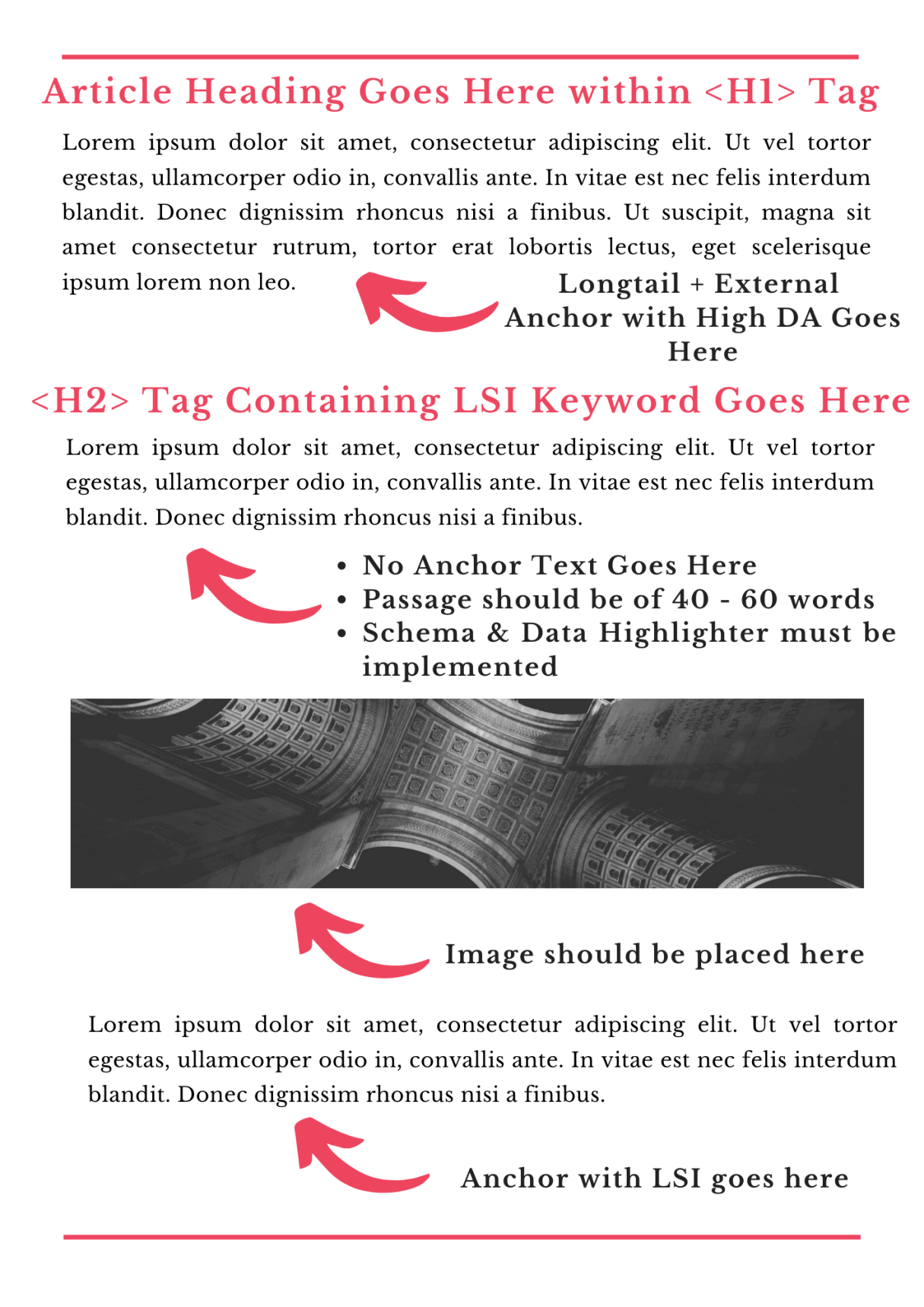
At the time of performing passage optimization, SEOs should aware of the length of the passage. For instance, if you are writing the content of a landing page containing 3000 words then the passage segregation should be 1% to 2% of the entire or you can at least maintain 3 to 6 passages of entire content length. This is also known as Passage Density.
2. Passage Word Count
In order to optimize passage maintaining the SEO guideline, one should make the passage length between 40 words to 60 words. The more comprehensive it is, the better would be chances for appearing as a passage!
3. Passage <h2> Tag
If a passage consists of a <H2> tag then it should have an LSI keyword into the tag. In other words, if a passage is followed by any h-tag then it’s recommended to use an LSI keyword within the H-tag whether it be <h1> or H2> or etc.
4. Use Data Highlighter
If you are optimizing a certain passage from the content then you have to use data highlighter with the help of Google Search Console’s Data Highlighter tool. The option varies in the list from site to site, suppose if you are optimizing a passage for an article based website, then you have to choose an article from the given list in GSC.
5. Use Image
It is recommended that you use at least one image for the particular page which you are optimizing for passage indexing. And it should be placed below a passage. For reference, please see the attached layout by end of this article!
6. Use Valid Schema Mark-up
It is recommended that you use the specific passage into the schema code for which you are optimizing the page. It’s advised to use JSON-LD for the mark-up!
7. No Anchor Text in between
The passage should not contain anchors but there should be internal and external hyperlinks above or below. Well, there is no such rule still it’s our practical experience that having no anchors within the passage helps with the optimization. Moreover, having an internal link / external link above or beyond also helps with the process.
Wrapping Up
To wrap up the process for passage index optimization, we have put together a contextual image as shown below. This will give an idea about the entire optimization procedure in a single picture.
Effective Passage ranking optimization requires a balanced approach that combines clear content structure, relevant information, descriptive headings, appropriate schema markup, supporting visuals, and logical internal linking. Rather than focusing on isolated ranking factors, website owners should create useful, well-organized content that allows search engines to understand individual sections while helping users quickly find accurate answers to their specific queries.
Conclusion
We hope these practical DIY strategies have given you a clearer understanding of how passage indexing can influence modern SEO and how you can prepare your website for passage-based search. From creating well-structured content and relevant passages to using descriptive headings, schema markup, images, and contextual links, small improvements can make important information easier for search systems to understand. As search technology continues to evolve, passage ranking may create new opportunities for detailed and comprehensive content. However, algorithms and search systems continue to change, so these practices should complement, rather than replace, a strong overall SEO strategy focused on relevance, quality, usability, and user intent.