
SUPERCHARGE YOUR ONLINE VISIBILITY! CONTACT US AND LET’S ACHIEVE EXCELLENCE TOGETHER!
A practical analysis of abnormal query data, misleading metrics, live-site validation, and responsible incident reporting
| 1.15M | 415 | 0.036% | 1,989 | 0 |
| Impressions | Clicks | Calculated CTR | URLs crawled | Live matches |
Contents
- The investigation finding and evidence snapshot
- Why unusual GSC query data requires careful diagnosis
- Screenshot 1: Query-list outlier
- Screenshot 2: Time-series spike and metric mismatch
- Screenshot 3: Landing-page distribution
- Current-site and indexed-search validation
- Screenshot 4: Six Screaming Frog search scopes
- Screenshot 5: 1,989 URLs and zero matches
- Interpretation, possible causes, and evidentiary limits
- Reusable investigation framework
- Reporting impact, monitoring plan, and FAQs
One number made our team stop and look twice: 1,148,028.
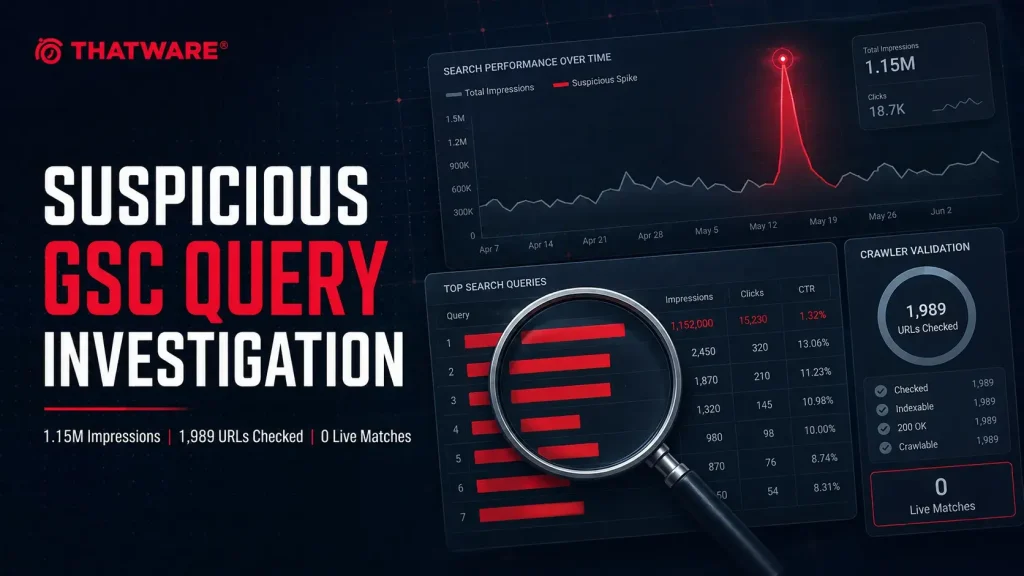
It appeared in Google Search Console beside a query that had no sensible connection to ThatWare, its services, its content strategy, or the language used across the website. The query had generated roughly 1.15 million impressions, yet it had produced only 415 clicks. Search Console also reported an average position of 2.9. On the surface, those figures did not belong together. A query with that much visibility and such a strong reported position would normally leave a much clearer trail in content, traffic, conversions, or sustained search demand.
It did not.
That mismatch is what turned a strange row in a dashboard into a proper investigation. We needed to answer a practical question: was the website actively targeting an unrelated phrase, had something been injected into the site, or were we looking at a historical anomaly in search activity?
The distinction matters. A rushed diagnosis can create unnecessary panic, waste technical resources, and lead to damaging decisions such as deleting legitimate pages or rewriting content that was never involved. A careful diagnosis protects the website and the quality of the data used to guide SEO.
This article walks through the full investigation. It explains every screenshot from the report, the meaning of each metric, the checks performed across 1,989 URLs, the limits of the available evidence, and the monitoring process we recommend when a suspicious Google Search Console query appears.
The unrelated phrase has been redacted from the screenshots and is referred to only as the “suspicious query.” This keeps the case useful without giving an irrelevant term more visibility or creating an unintended association with the ThatWare brand.
The Short Answer: What Did the Investigation Find?
The suspicious query existed in historical Google Search Console data. Its impression pattern was abnormal, its engagement was negligible, and its visibility was distributed across pages that served very different topics and locations.
However, the current website investigation found no evidence that the phrase was present on the live ThatWare site, no indexed ThatWare result for it, no dedicated landing page built around it, and no sign that it was an intentionally targeted keyword. A completed Screaming Frog custom-search crawl checked 1,989 URLs across six content and source-code scopes. Every search returned zero matches.
The most defensible conclusion is therefore narrow and evidence-led: this was a historical suspicious query and impression anomaly, not a currently active on-site keyword issue.
That conclusion does not identify who or what caused the activity. Search Console shows how a property appeared in Google Search, but it does not reveal the identity or motive of the people, scripts, devices, or systems behind a query. Without separate evidence, blaming a third party would be speculation.
Case evidence at a glance
| Signal | Recorded evidence | What it suggests |
|---|---|---|
| Impressions | About 1.15 million | Visibility was far outside normal expectations for an unrelated phrase |
| Clicks | 415 | Very little engagement compared with the impression volume |
| Calculated CTR | About 0.036%, shown as 0% after rounding | The impressions did not behave like genuine, high-intent demand |
| Average position | 2.9 | Strong reported visibility without matching content or engagement |
| Peak day | 220,738 impressions and 221 clicks | Activity was concentrated into an extreme daily spike |
| Page distribution | Many unrelated URLs | Google was not responding to one purpose-built landing page |
| Current-site text checks | No match found | No active on-page use was identified |
| Crawl verification | 1,989 URLs, six scopes, zero matches | The suspicious token was absent from the tested live HTML and content areas |
Why a Strange GSC Query Deserves More Than a Quick Screenshot
Search Console data is often treated as a direct record of audience demand. In ordinary reporting, that is a useful working assumption. Queries tell us what people searched, impressions show when Google displayed a result, clicks show visits from those results, and average position helps explain visibility.
An outlier can break that simple reading.
Suppose an SEO team sees a million impressions and a top-three average position. If it treats those numbers as normal demand, it may believe the site has discovered a valuable keyword. It may plan content, compare conversion rates, forecast traffic, or report “growth” to stakeholders. Yet the underlying query may have no commercial meaning, no connection to the brand, and almost no real engagement.
The opposite mistake is just as risky. A strange phrase can trigger an immediate assumption of hacking, spam injection, or negative SEO. Those possibilities should be checked, but they should not be presented as facts before the website is examined.
Our investigation separated four different questions:
- What exactly did Search Console record?
- How did that activity behave over time?
- Which pages were associated with it?
- Does any trace of the phrase exist on the website now?
Each question requires different evidence. The query table establishes scale. The trend graph shows timing. The page report shows distribution. Current-site and crawl checks test whether the phrase is active in the website’s code or copy. No single screenshot answers the whole case.
Screenshot 1: The Query List Reveals the Scale of the Outlier
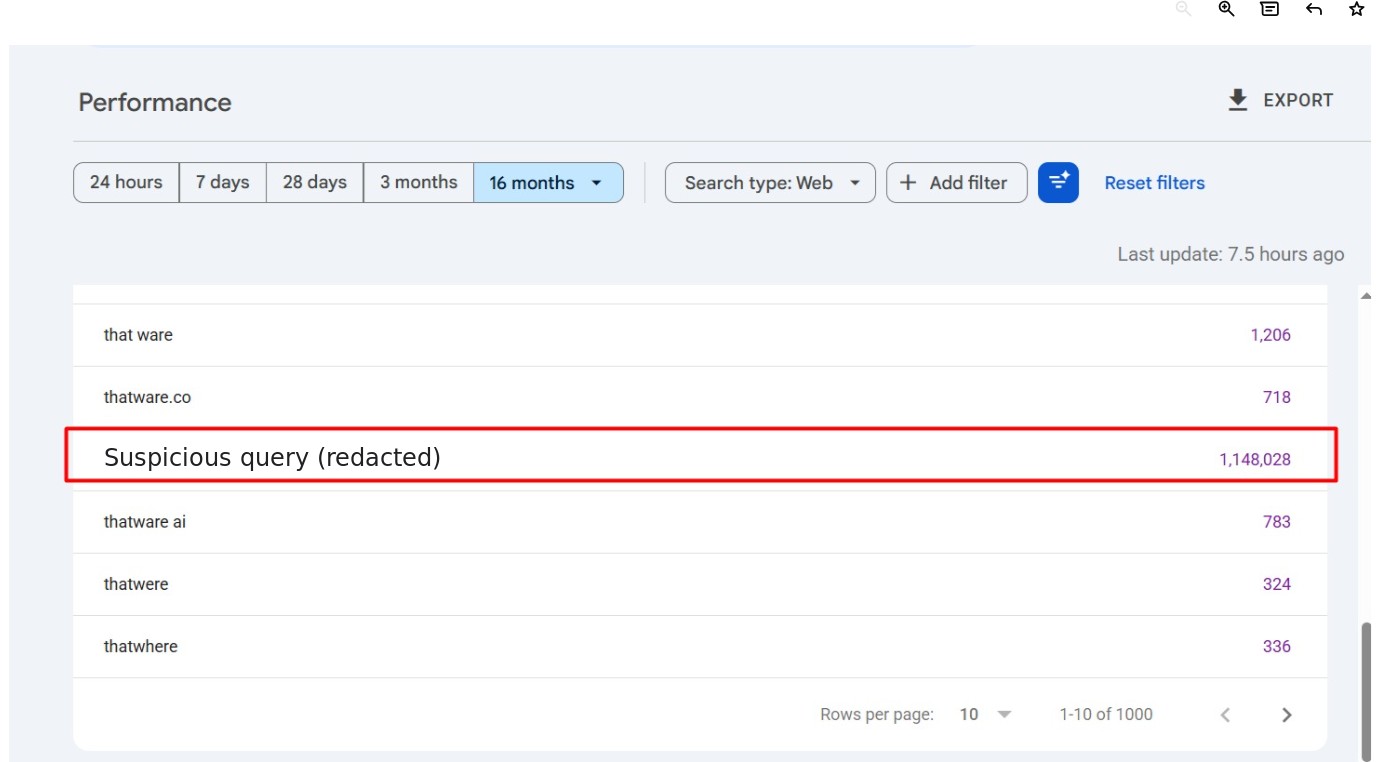
Figure 1. Google Search Console query list in a 16-month view. The unrelated phrase is redacted, while the recorded 1,148,028 impressions remain visible.
The first screenshot comes from the Performance report with a 16-month date range selected. A red outline identifies the suspicious query row. The wording has been removed in the publication copy, but the impression count remains visible: 1,148,028.
That number is the first clear warning sign. The surrounding rows contain recognisable brand variations such as “that ware,” “thatware.co,” “thatware ai,” and common misspellings. Their displayed impression counts sit in the hundreds or low thousands. The suspicious query sits among them with more than one million impressions.
This is not a small reporting quirk. It is a category-level difference in scale.
The screenshot also helps rule out one possible misunderstanding. The high number was not taken from a general site total and then attributed to a query by assumption. It appeared as a query-level row inside Search Console. That makes the record real within the platform, even if its cause is unknown.
At the same time, a query row is not proof that the words existed on the website. Google can match pages to searches through many signals, including topical relevance, links, entity associations, user context, and its own interpretation of intent. Search Console reports the query that triggered the impression. It does not say that the query was copied from a title tag, heading, paragraph, anchor, or schema field.
This distinction shaped the rest of the investigation. We accepted that the historical record existed, but we did not treat it as evidence of on-page targeting.
The 16-month view also matters. A short report might have missed the event completely, while a long report can make an old event look current. Historical records need a clear date label. Teams should also sort queries by impressions from time to time, since a click-led report can hide visibility anomalies.
Screenshot 2: The Trend Graph Shows a Burst, Not Normal Search Demand
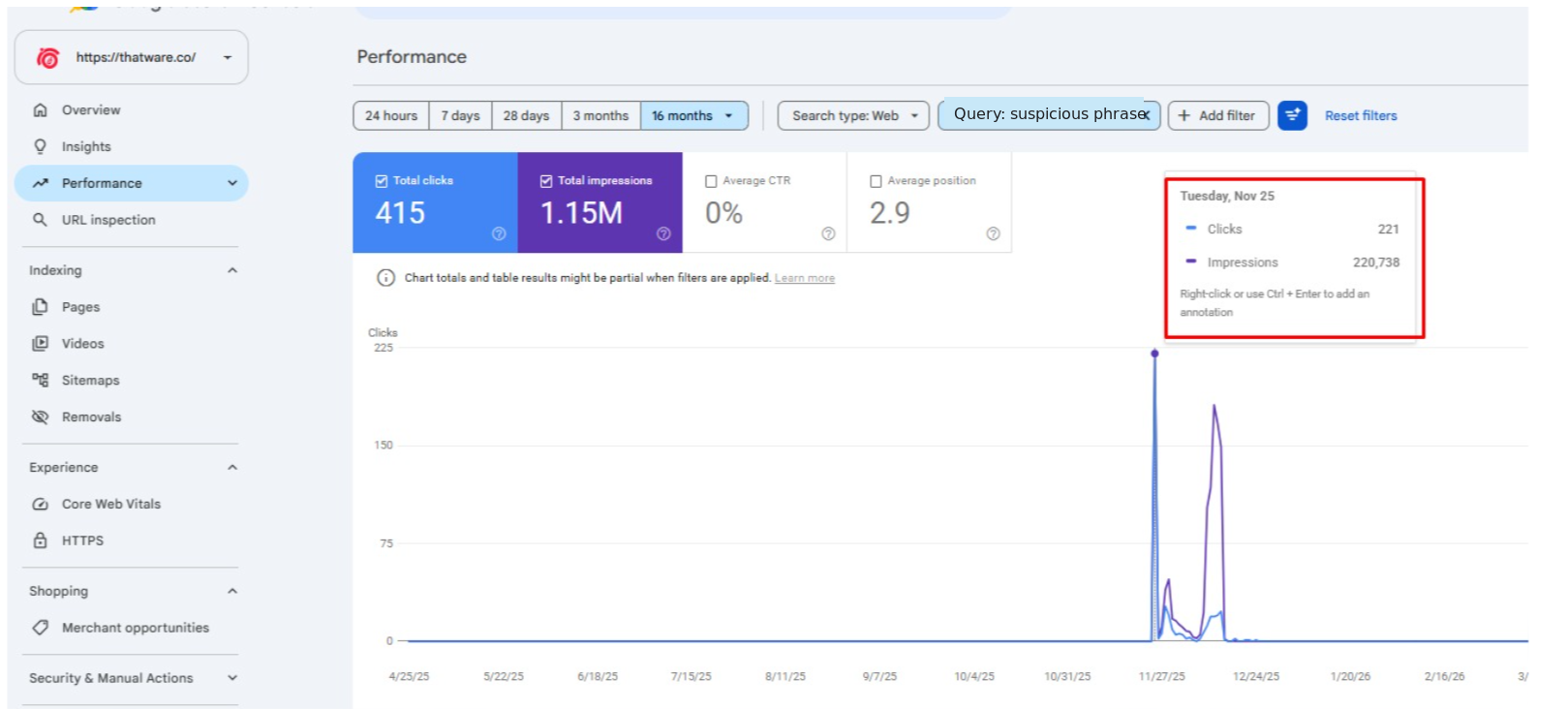
Figure 2. Filtered performance trend showing 415 clicks, 1.15 million impressions, 0% rounded CTR, 2.9 average position, and a peak day with 220,738 impressions and 221 clicks.
The second screenshot is the most revealing piece of historical evidence. It applies a query filter and displays clicks and impressions over the selected period.
Four headline metrics appear at the top:
- 415 total clicks
- 1.15 million total impressions
- 0% displayed CTR
- 2.9 average position
The chart beneath those totals remains almost flat for most of the reporting period. Activity then erupts in a short cluster around late November and December before falling back close to zero. A highlighted point on Tuesday, November 25, shows 220,738 impressions and 221 clicks in one day.
Normal search growth rarely looks like this. When a page starts ranking for a relevant commercial query, impressions usually develop with some continuity. They may rise as rankings improve, move with seasonality, or react to news and campaigns. Even a viral event normally has an identifiable reason and an engagement pattern that matches the attention.
Here, the graph shows abrupt concentration. The query was quiet, surged violently, produced a second concentrated wave, and then disappeared. That does not prove automation or manipulation, but it makes ordinary, stable customer demand a poor explanation.
What the click-through rate really means
Search Console displays the CTR as 0% because the interface rounds the figure. Using the values in the report, the approximate rate is:
| CALCULATED CLICK-THROUGH RATE CTR = 415 clicks / 1,148,028 impressions x 100 = about 0.036% |
In other words, fewer than four clicks were recorded for every 10,000 impressions.
The peak day was also weak relative to its scale. With 221 clicks from 220,738 impressions, the daily CTR was about 0.10%. The chart therefore does not show a huge wave of interested searchers choosing ThatWare. It shows a huge wave of appearances with very little response.
Low CTR alone is not suspicious. A page can earn many impressions for broad informational searches, rank below strong competitors, or appear in a search feature that attracts few clicks. What matters here is the combination of factors: an unrelated phrase, an average position of 2.9, more than one million impressions, a CTR near zero, and a short-lived spike.
Why average position 2.9 needs context
Average position is often misread as “the site ranked third.” Search Console actually averages recorded positions across impressions, places, devices, result types, and times. The 2.9 figure tells us that ThatWare was often recorded near the top. It does not prove one page held a fixed third position for months, and it does not make the query valuable. The strong position paired with near-zero engagement is precisely what makes the event unusual.
The graph matters more than the total alone because it shows the event was bounded in time. It also gives the team a recurrence signature: sudden impressions, weak engagement, strong reported position, and rapid disappearance.
Screenshot 3: Unrelated Landing Pages Break the “Intentional Targeting” Theory
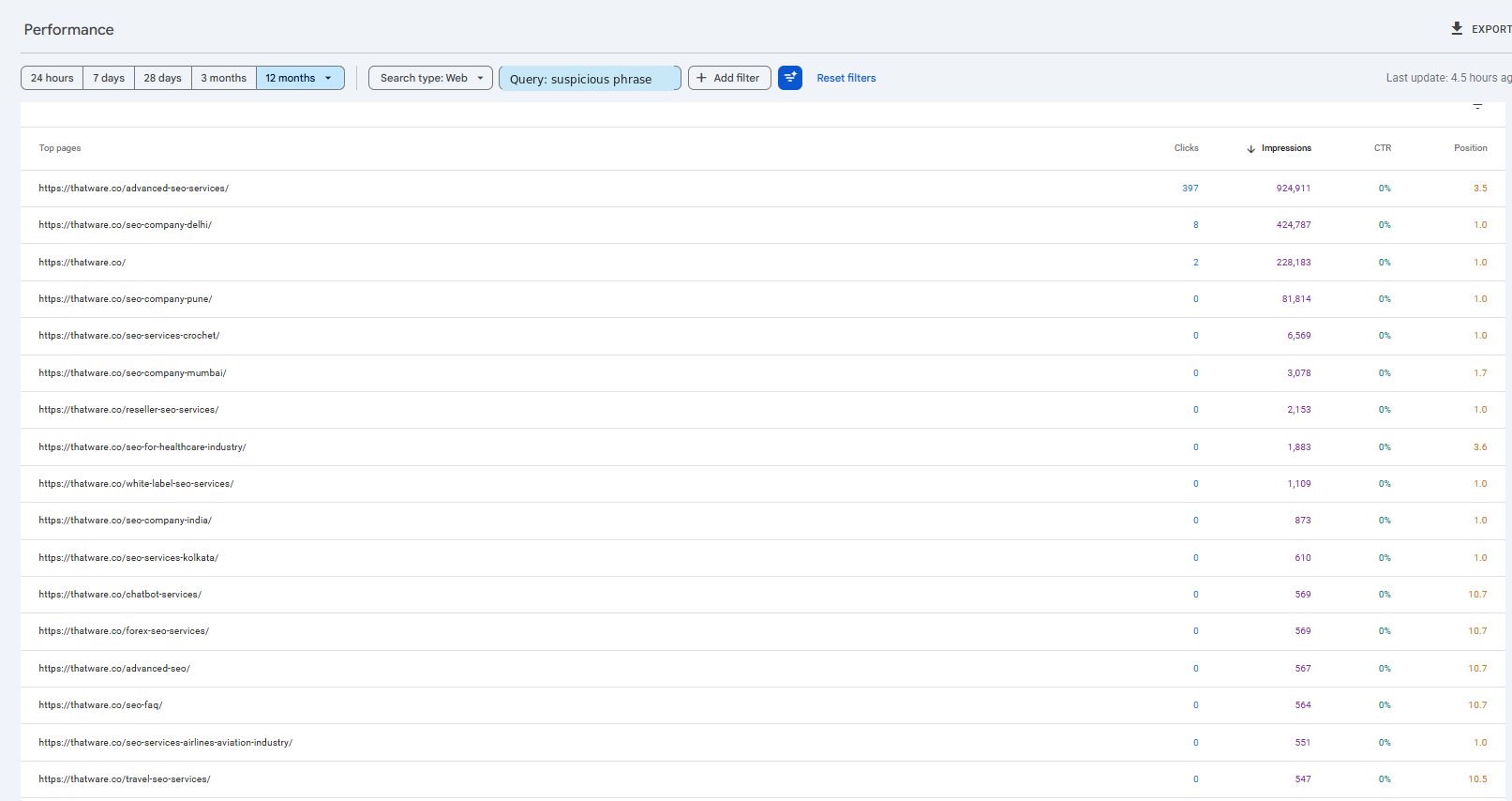
Figure 3. Page-level distribution across advanced SEO, location, homepage, service-model, and industry URLs. The query wording is redacted in the filter.
The third screenshot changes the Search Console dimension from queries to pages while keeping the suspicious query filter active. This reveals which ThatWare URLs were associated with the impressions.
The largest row is the advanced SEO services page, with 924,911 impressions, 397 clicks, a displayed CTR of 0%, and an average position of 3.5. That page is at least broadly connected to SEO services, so it is understandable that Google might consider it relevant to a query containing an SEO-related phrase.
The distribution becomes stranger after that. The Delhi SEO company page shows 424,787 impressions and only eight clicks. The homepage shows 228,183 impressions and two clicks. The Pune page shows 81,814 impressions with no clicks. Other visible rows include Mumbai and Kolkata location pages, reseller and white-label SEO pages, healthcare SEO, chatbot services, forex SEO, aviation SEO, travel SEO, an FAQ page, and another advanced SEO URL.
These pages do not form a deliberate content cluster for the suspicious phrase. They cover cities, service models, industries, and broader site topics. No single landing page appears to have been created to own the query. The pattern looks more like broad matching against ThatWare’s established SEO relevance.
The page table is evidence of breadth, not a total to add up
Some page-level impression figures overlap with or collectively exceed the query-level property total. They should not be mechanically added to rebuild the 1.15 million figure. Search Console can count and aggregate data differently when a report is grouped by property, query, or individual URL. Multiple URLs can also appear in relation to the same search event.
This is a common reporting trap. Page rows are useful for finding distribution and identifying affected URLs. They are not always safe to sum as if they were mutually exclusive accounting entries.
What the landing-page pattern tells us
The broad assignment weakens three theories. Deliberate targeting would usually produce a clear primary page, supporting content, internal anchors, and relevant metadata. A single injected page or affected template would usually create a tighter URL pattern. Neither appears here. The visible pages also produced mostly zero or single-digit clicks, so the activity did not resemble a qualified prospect journey.
The advanced SEO page received most of the clicks because it was the most logical general match. That still does not make the query useful. Commercial value must be judged through engaged sessions, conversions, lead quality, and relevance.
The Current-Site Investigation: Searching for a Live Trace
Historical Search Console evidence tells us what Google recorded. It cannot tell us whether the same condition exists on the site today. That required a new set of checks.
The investigation looked for both the full suspicious phrase and its distinctive token across the current ThatWare website. It also checked indexed Google results using site-restricted searches and reviewed whether a dedicated landing page had been created around the phrase.
The results were consistent:
- The exact suspicious phrase was not found on the current site.
- Its distinctive token was not found in current website content.
- Site-restricted indexed searches returned no matching ThatWare page at the time of testing.
- No dedicated landing page targeting the query was identified.
These checks matter because suspicious text can hide in places that are easy to miss during a visual page review. It may sit in a title, meta description, hidden element, footer template, old article, anchor, script-generated block, or copied content module. A homepage search and a quick look at recent blogs would not be enough.
Indexed-site searches provide a useful external view, but they are not a perfect audit. Google may not index every live URL, may retain stale snippets, and may take time to reflect removed content. That is why the investigation added a controlled crawler search across the live site.
Screenshot 4: Six Search Scopes Were Configured in Screaming Frog
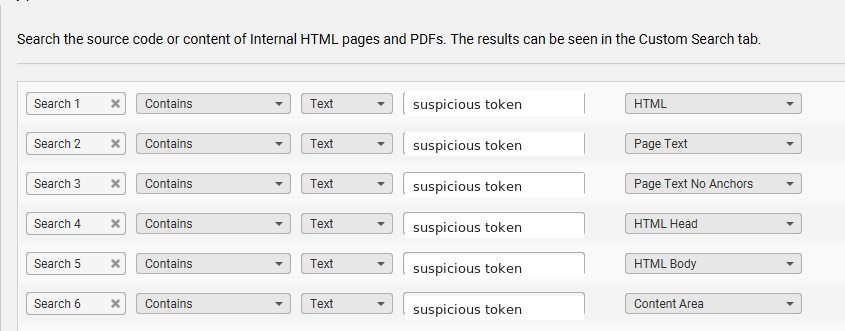
Figure 4. Screaming Frog custom-search setup covering HTML, Page Text, Page Text No Anchors, HTML Head, HTML Body, and Content Area.
The fourth screenshot shows the Screaming Frog SEO Spider custom-search configuration. The distinctive token from the suspicious query was entered into six separate “Contains” searches. In the publication image, the token has been replaced with the label “suspicious token,” but the original test logic is unchanged.
Each row searches a different part of the crawled document:
1. HTML
The HTML scope checks the fetched source for the token. This is the broadest source-level test and can catch wording that does not appear as ordinary visible copy. It is useful for finding text inside markup, attributes, scripts, structured data, navigation, and template elements.
2. Page Text
Page Text checks the text content available from the page. This helps answer the question a reader or search engine parser would care about: does the page actually present the suspicious wording as content?
3. Page Text No Anchors
This scope removes anchor text from the page-text check. It helps separate ordinary copy from wording that appears only inside links. That distinction matters when an unwanted term has entered a site through a navigation element, third-party link, user-generated link, or compromised anchor.
4. HTML Head
The head contains signals that may not be visibly printed in the main page. These can include the title, meta tags, canonical references, alternate links, scripts, and structured data. A phrase hidden from the body but inserted into metadata could still affect how a page is understood or displayed.
5. HTML Body
The body check focuses on the main body markup. It covers visible sections as well as body elements that may be hidden through styling or used by scripts and templates.
6. Content Area
The Content Area search narrows the review to the primary content identified by the crawler. It reduces template noise from global navigation, headers, footers, and repeated site elements. If the token had been placed inside the main article or service-page copy, this scope should have surfaced it.
Each scope closes a different gap. Visible text can miss metadata, an HTML search can include code noise, and the content area can exclude a sitewide template. Together, the six searches form a repeatable test across every reachable URL in the crawl.
Screenshot 5: 1,989 Crawled URLs and Zero Matches
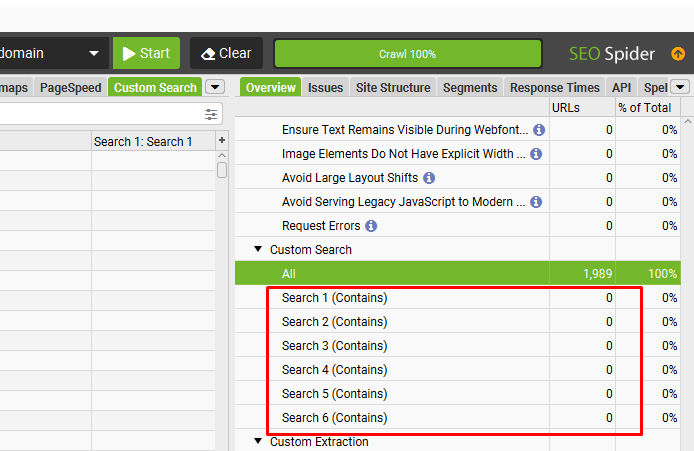
Figure 5. Completed 100% crawl covering 1,989 URLs. Every configured custom search returned zero URLs and 0% matches.
The fifth screenshot records the completed crawl. The progress bar shows 100%. The overview lists 1,989 URLs under “All,” and the six custom searches each show zero URLs and 0% of the total.
This is the strongest current-site evidence in the report.
It means the crawler did not find the suspicious token in any of the six tested scopes across the 1,989 URLs it reached. No match appeared in the HTML source, visible page text, page text with anchors excluded, document head, body, or primary content area.
The result supports a clear operational decision: there is no evidence that the current live website needs a keyword-removal project for this phrase. Rewriting hundreds of pages, removing valid SEO service content, or redirecting legitimate location URLs would not be justified by the available evidence.
The zero-match result also strengthens the historical interpretation. The GSC spike had already ended, indexed searches found nothing, and the live crawl found nothing. These independent checks point in the same direction.
What a zero-match crawl does not prove
A good forensic report should state its boundaries. This crawl confirms absence within the pages, files, scopes, and conditions tested. It is not a complete cybersecurity audit.
For example, a standard crawl may not expose content served only to a specific user agent, IP range, cookie state, login, device, or time window. It does not inspect historical backups, server logs, database records that never render, private administration areas, or external websites. JavaScript and access controls can also affect what a crawler receives.
None of those limitations creates evidence of compromise. They simply define what the test can support. The accurate statement is that the token was not present in the crawled live site across the six configured scopes. That is strong evidence for an SEO investigation and a sound basis for classifying the immediate on-site concern as not presently active.
Reading the Metrics as a Connected Story
Low CTR, changing positions, demand spikes, broad page selection, and zero crawler matches can each occur for ordinary reasons. The case becomes abnormal only when they meet: 1.15 million impressions for an unrelated query, about 0.036% CTR, a 2.9 average position, a one-day peak above 220,000 impressions, many unrelated pages, and no current-site match.
That connected story explains why the visibility was not treated as a keyword win, while the unexplained history was not labelled a current infection. Metrics are observations, not diagnoses. Impressions record appearances, position records placement, and a crawler records what it found under defined conditions. None identifies who caused a historical search pattern.
What Might Cause a Suspicious Query Pattern?
The report deliberately avoids assigning a cause because the available evidence cannot support one. Still, understanding the possible categories helps teams decide which checks to run.
Automated or coordinated search activity
Repeated searches from automated systems or coordinated activity can generate impression patterns that do not resemble ordinary audience demand. A burst may appear suddenly, produce very few genuine clicks, and stop just as quickly. Search Console alone cannot confirm automation, so this remains a hypothesis rather than a verdict.
Google matching broad topical relevance
ThatWare has extensive content around SEO services, locations, industries, and advanced search topics. If a strange query contains an SEO-related component, Google may test several authoritative pages even though the complete phrase is absent. The broad landing-page distribution in Screenshot 3 is consistent with this possibility.
Historical content or an already-removed reference
A term may have existed in a past page version, feed, template, script, or external reference and disappeared before the investigation. Current checks cannot reconstruct every historical state. This is why server backups, release records, content histories, and archived crawls can be valuable when the risk level justifies deeper work.
External association without on-site text
Google’s understanding of a page is not limited to its exact words. External links, mentions, surrounding anchor text, copied snippets, entity connections, or user behaviour can influence query matching. A website may therefore receive impressions for wording it never published.
The right response is not to choose the most dramatic theory. It is to list plausible causes, test the ones that leave observable evidence, and retain “unknown” when the source cannot be proven.
Does This Mean the Website Was Hacked or Hit by Negative SEO?
No such conclusion can be drawn from this report.
A strange Search Console query can be a reason to inspect the site for injected text, spam pages, cloaking, unauthorised redirects, altered metadata, and unexpected indexation. The ThatWare investigation did that at the SEO layer and found no current trace of the query.
The evidence also does not identify a negative SEO campaign. That label implies intent by an outside actor. Search Console provides no actor identity, and the investigation found no independent proof of who generated the searches or why.
The safest case classification is “historical abnormal or suspicious query activity.” That wording is not evasive. It is precise. It records what happened without turning an unexplained pattern into an unsupported accusation.
If other warning signs appeared, such as unknown indexed URLs, unauthorised file changes, server-level anomalies, security alerts, new backlinks from compromised networks, or cloaked responses, then a broader security and log investigation would be appropriate. Those signs are not established by the screenshots in this report.
A Practical Investigation Framework for Any Website
When an unrelated query floods Search Console, teams need a process that can be followed under pressure. The following framework reflects the steps used in this case and adds the controls needed for future incidents.
Step 1: Preserve the historical evidence
Export query, page, country, device, date, and search-appearance data. Record the property, date range, filters, totals, and screenshots. A capture without its date range or filter is easy to misread later.
Step 2: Recalculate the headline ratios
Calculate CTR from clicks and impressions rather than relying on rounded values. Compare peak-day and period CTR, then ask whether position and engagement make sense together. Here, the displayed 0% became roughly 0.036%.
Step 3: Inspect the time series
Use daily data to find the start, peak, recurrence, and end. Compare the shape with campaigns, releases, incidents, news, and seasonality. A short burst is not the same as stable demand.
Step 4: Segment by page
Find every associated URL. Check for a dominant page, shared template, metadata, headings, anchors, structured data, and canonical rules. Use the rows to find distribution patterns, not to force page figures into a property total.
Step 5: Check countries, devices, and result types
Country, device, and search-appearance segments can narrow the source. These views were not included in the supplied screenshots, so they remain recommended follow-up checks rather than findings from this case.
Step 6: Search the live site manually
Search the exact phrase and distinctive tokens across copy, source, metadata, anchors, structured data, PDFs, feeds, scripts, and templates. Add site-restricted Google searches, while remembering that the index can be delayed or incomplete.
Step 7: Run a controlled crawler search
Configure source and content searches, crawl all reachable internal URLs, and retain the settings and results. Tie any zero-match statement to the completed crawl, URL count, and named scopes.
Step 8: Review indexation and security signals
Inspect indexation, URL Inspection, sitemaps, manual actions, security issues, subdomains, redirects, and new URLs. If the evidence moves beyond SEO, review server logs, file integrity, deployments, access records, and backups with development or security specialists.
Step 9: Classify the finding by confidence
Use language that matches the proof:
- Confirmed current issue: the term or page is live and reproducible.
- Historical issue, no longer active: historical evidence exists, current checks are clear.
- Suspicious anomaly: the pattern is abnormal, but its cause is not proven.
- Inconclusive: checks are blocked or evidence conflicts.
ThatWare’s case combines the second and third descriptions: a suspicious historical event with no current on-site presence identified.
Step 10: Create a monitoring rule and closure note
Record the final finding, test boundaries, recurrence trigger, and owner. If the pattern returns, reopen the case with the earlier evidence beside it.
How Suspicious Query Data Can Distort SEO Decisions
Even when it does not harm rankings, abnormal query activity can damage decision quality.
First, it can inflate impression growth. A reporting dashboard may show a dramatic year-on-year rise that has nothing to do with audience reach or content performance. If the anomaly is not separated, stakeholders may believe brand awareness has exploded.
Second, it can collapse sitewide CTR. More than a million low-engagement impressions added to the property can make ordinary pages appear less attractive in aggregate. Teams may start rewriting titles and descriptions even though the real issue sits in one irrelevant query.
Third, it can distort average position and query mix. A high-volume query with a strong reported position may make visibility look healthier while qualified clicks and leads remain unchanged.
Fourth, it can waste content resources. Treating the query as an opportunity could lead writers to publish pages around an irrelevant or unsafe term, creating exactly the on-site association that did not previously exist.
The fix is analytical segmentation. Maintain a raw view for auditability, then create a decision-making view that excludes documented anomalies. Report both when the difference is material. Never delete or hide the evidence. Label it and prevent it from steering strategy.
Monitoring Plan After the Immediate Concern Is Closed
The report recommends periodic GSC monitoring. That recommendation should become a simple operating routine.
Maintain a suspicious-query register
Record the query in a restricted internal log, along with the first and last observed dates, peak impressions, affected pages, investigation result, and reviewer. The public blog does not need to repeat the wording, but the internal team needs an exact reference for filtering and recurrence checks.
Use separate raw and cleaned reporting views
Keep all Search Console data in the raw view. Exclude the documented anomaly only from the decision-making view, and label the method for stakeholders.
Watch for recurrence by pattern, not only phrase
A future anomaly may use different wording. Watch for sudden impressions, extreme low CTR, top positions without clicks, unrelated high-volume terms, and one query spreading across many pages.
Compare GSC with analytics and leads
If impressions spike but organic sessions, engaged visits, enquiries, and sales do not move, investigate before celebrating. Cross-platform consistency is one of the fastest reality checks available.
Repeat the crawl when evidence changes
There is no need to recrawl solely because an old screenshot still exists. Repeat the custom search if the query returns, an affected page changes, a security signal appears, or indexed results begin showing the term.
What Business Leaders Should Take From This Case
The largest number in an SEO report is not always the most valuable number.
The 1.15 million impressions looked dramatic. The 415 clicks, near-zero CTR, short spike window, and absence of current on-site evidence told the real story. For a business leader, this is why SEO reporting must connect visibility to relevance, engagement, and commercial outcomes.
It also shows the value of restraint. ThatWare did not turn an unexplained row into a public accusation or a fear-led security claim. The team documented the anomaly, checked the live website, tested 1,989 URLs, explained the limits of the tests, and closed only the concern the evidence could close.
That approach protects trust. Clients should be able to see not only what an SEO team believes, but how it reached the belief and what would cause it to revise the conclusion.
Final Finding: Historical Anomaly, No Active On-Site Match
The investigation began with a startling Search Console row and ended with a measured answer.
The suspicious query generated about 1.15 million historical impressions, 415 clicks, an approximate CTR of 0.036%, and an average position of 2.9. Its activity appeared in sudden bursts, including a day with 220,738 impressions. Google associated it with a wide group of ThatWare pages rather than a dedicated target.
Current checks changed the risk assessment. Neither the phrase nor its distinctive token was found on the live site. Site-restricted indexed searches returned no matching ThatWare result at the time of investigation. Screaming Frog completed a crawl of 1,989 URLs and returned zero matches across HTML, Page Text, Page Text No Anchors, HTML Head, HTML Body, and Content Area.
Based on that evidence, the immediate website-level concern is not presently active. The record should remain documented as a historical suspicious GSC query and impression anomaly, with periodic monitoring for recurrence.
The wider lesson is worth keeping. When SEO data behaves strangely, do not let a large number write the conclusion for you. Preserve the evidence, test the site, connect the metrics, state the limits, and use only the confidence the facts have earned.
For organisations dealing with unexplained search visibility, unstable rankings, contaminated reporting, or technical SEO risk, ThatWare combines Search Console analysis, crawler validation, search intelligence, and evidence-led diagnostics to separate genuine opportunity from misleading noise.
| Need an evidence-led SEO investigation? ThatWare can audit abnormal Search Console patterns, validate live-site signals, and separate genuine search opportunity from misleading noise.thatware.co |