
SUPERCHARGE YOUR ONLINE VISIBILITY! CONTACT US AND LET’S ACHIEVE EXCELLENCE TOGETHER!
For more than two decades, the Google homepage has trained users to do one simple thing: type a query and search. That behaviour is now being subtly challenged as Google tests a new desktop homepage experience that puts AI-powered actions closer to the centre of the search journey. For a limited group of users, the familiar “Google Search” button is being replaced with options such as “Create images,” “Ask about files,” and “Brainstorm,” while AI Mode is given greater prominence within the search interface. Google has confirmed that this is a small desktop experiment designed to help users discover new ways to use Search, rather than a permanent replacement of traditional search functionality.
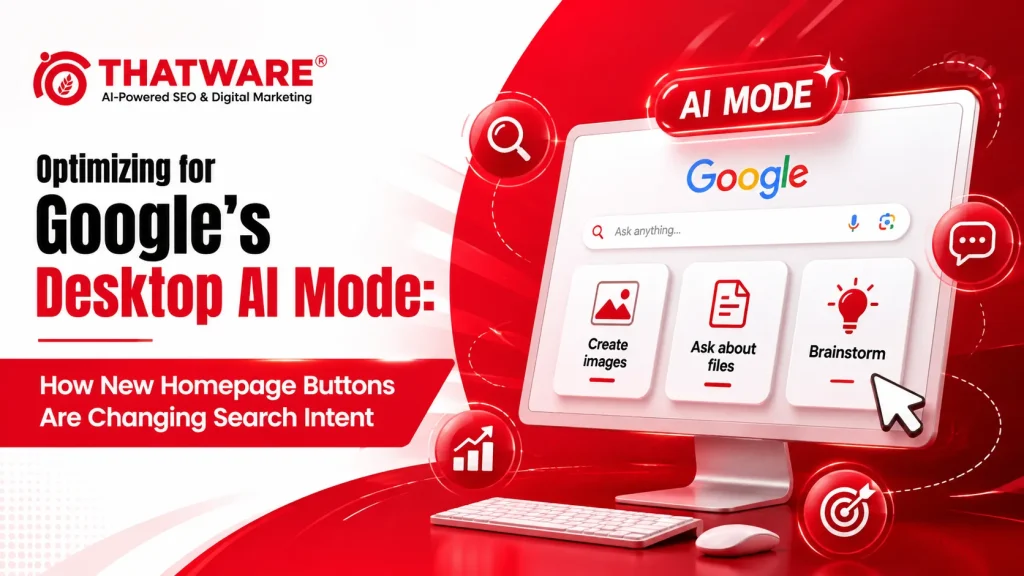
On the surface, these may look like simple interface changes. From an SEO perspective, however, they signal something more significant: Google is encouraging users to communicate intent, tasks and context rather than relying solely on short keyword queries.
Traditional search behaviour often begins with a phrase such as “best CRM software”, “SEO services for SaaS” or “how to optimise a website”. AI-powered Search can begin with something considerably more detailed: a business problem, a comparison request, a document that needs analysis, an image that needs interpretation or an idea that needs developing. Google’s AI Mode is designed to handle these more complex interactions, including follow-up questions and multimodal inputs such as text, images and files.
This creates a fundamental shift in the search journey:
Traditional Search:
Keyword → Search Results → Website → Action
AI-First Search:
Intent → Context → AI Interpretation → Synthesised Answer → Sources → Follow-up → Action
The distinction matters because search visibility is no longer limited to winning a position on a conventional results page. A brand can increasingly be discovered when an AI system interprets a user’s broader intent, researches related subtopics and selects information to incorporate into its response. Google’s AI Mode can break complex questions into multiple searches and explore different aspects of a topic before producing an answer, making comprehensive and authoritative content increasingly important.
For businesses and SEO professionals, the question is therefore changing. It is no longer enough to ask, “Which keywords should we rank for?” The more important question is becoming, “Which user intents, questions and decision-making moments should our brand be visible for when AI constructs the answer?”
Google’s homepage experiment does not mean traditional SEO is disappearing. The company has explicitly stated that users can continue to perform conventional searches through the search box. Instead, it demonstrates how Google is expanding Search from a query-and-results interface into an intent-and-task interface.
For SEO, AEO, GEO and LLM visibility strategies, this shift deserves close attention. The brands best positioned for the next stage of Search will not simply optimise individual pages for individual keywords. They will build strong entities, authoritative topic ecosystems, original information and content that can answer increasingly complex questions across the entire user journey.
What Is Google Testing on Its Desktop Homepage?
Google is testing a new version of its desktop homepage that gives AI-powered activities more prominence than the traditional search experience. The experiment has been spotted among a limited group of users, particularly signed-out desktop users, and Google has confirmed that it is a small test rather than a permanent redesign.
The most noticeable change is the treatment of the familiar “Google Search” button. In the experimental interface, users can instead see AI-focused options such as “Create images,” “Ask about files,” and “Brainstorm.” An AI Mode option is also surfaced within the search interface, making Google’s conversational AI experience easier to discover from the homepage.
The change is important because these buttons represent different types of user intent. Rather than simply encouraging users to find a webpage, Google is presenting Search as a tool for creating, analysing, exploring and solving problems.
The Traditional Google Search Button Is Being Tested Away
For years, the Google homepage has centred around a simple interaction: enter a query, select Google Search, and browse the results.
The new experiment changes that visual emphasis. Instead of making the conventional search action the only prominent choice, Google is testing shortcuts that guide users towards specific AI-powered tasks.
Importantly, this does not mean Google has removed traditional search. Users can still enter a normal query into the search box and submit it in the usual way. Google’s VP of Product Robby Stein confirmed that the experiment is designed to help people discover additional things they can do with Search, while the underlying search box continues to function normally.
This distinction matters for SEO professionals. The change should not be interpreted as the immediate end of keyword-based search or traditional rankings. Instead, it signals that Google is experimenting with additional entry points into Search.
The Three New AI Shortcuts
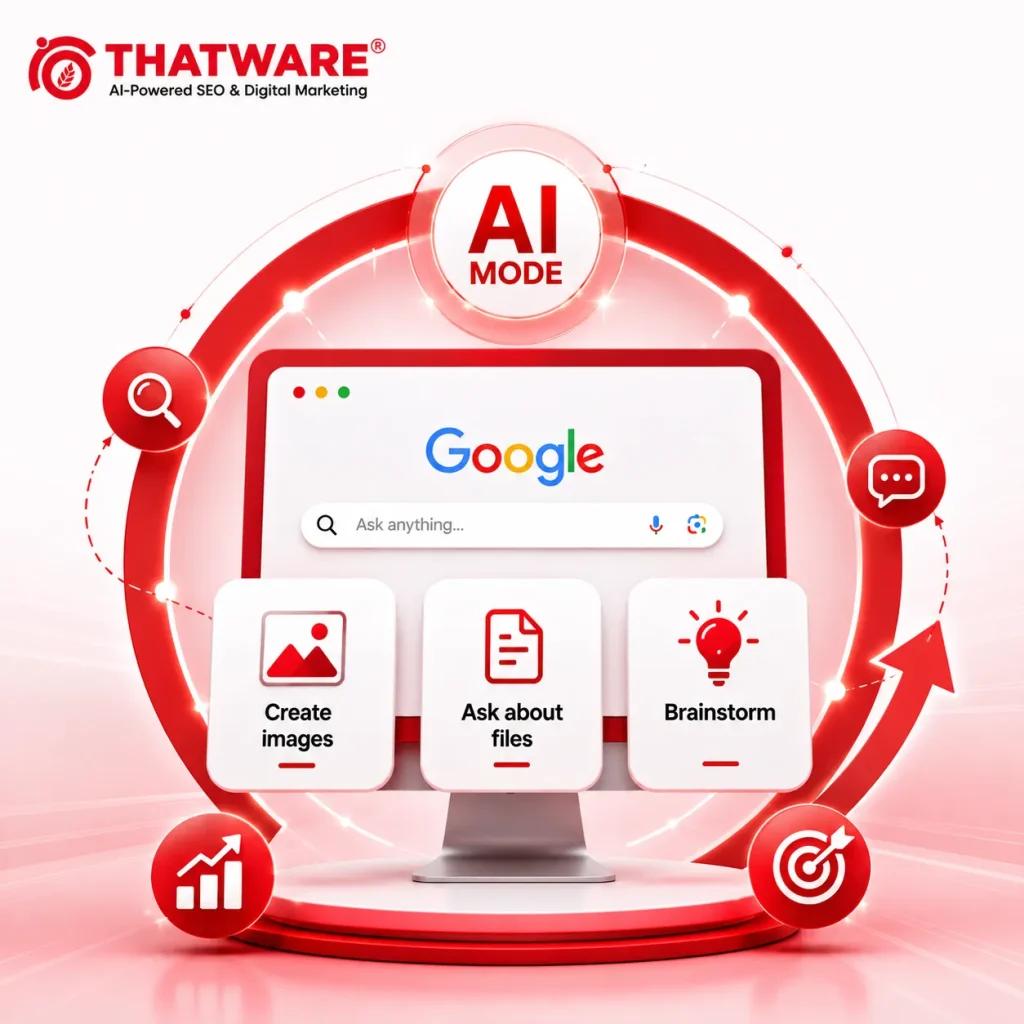
The experimental homepage reportedly highlights three specific AI actions: Create images, Ask about files and Brainstorm. Each represents a different type of search behaviour.
Create Images: Moving From Discovery to Creation
The Create images option represents a shift from finding existing information to generating a new output.
Instead of searching for an existing image, a user can describe what they want and ask Google’s AI tools to create it. This reflects the broader movement towards generative intent, where the user’s goal is not simply to discover a webpage but to produce something.
For marketers, this makes visual context increasingly relevant. Images, illustrations, diagrams and other visual assets need to be connected clearly to the topics and entities they represent rather than treated as isolated elements on a webpage.
Ask About Files: Turning Search Into Document Analysis
Ask about files represents another important behavioural change. Instead of starting with an open-web query, users can provide a document and ask questions about its contents.
This type of interaction is particularly relevant for:
- PDFs and reports
- Research documents
- Product specifications
- Technical documentation
- Business presentations
- Data-rich files
- Whitepapers
- Other reference material
Google’s AI Mode documentation confirms that users can use files, images and other information as context for AI-powered questions.
For content creators and businesses, this reinforces the importance of making important information clear, structured, factual and machine-understandable. A well-organised document can become an information source for an AI interaction rather than simply a downloadable asset.
Brainstorm: Search for Ideas, Not Just Answers
The Brainstorm option is perhaps the clearest example of how AI changes search intent.
A traditional query usually assumes that the user knows what information they are looking for. Brainstorming is different. The user may have a goal or problem but may not know exactly what questions to ask.
For example, instead of searching:
“content marketing strategies for SaaS”
a user could ask an AI system:
“Give me innovative ways a B2B SaaS company could generate more qualified leads without increasing its advertising budget.”
The second interaction contains more context, constraints and intent.
This creates opportunities for brands that can demonstrate genuine expertise across an entire topic rather than simply targeting one keyword.
AI Mode Becomes More Prominent
Alongside these shortcuts, AI Mode is becoming a more visible part of Google’s search interface.
Google describes AI Mode as its most powerful AI Search experience. It is designed to handle more complex questions, support follow-up conversations and work with multiple forms of input, including text, voice, images and files.
One particularly important capability is query fan-out. Rather than treating a complex question as a single search, Google’s AI systems can break it into related subtopics, search for information across those areas and combine the findings into a response.
For example, a user asking:
“What is the best CRM for a 50-person SaaS company that needs sales automation, reporting and integrations?”
may trigger research across several related areas:
- CRM features
- SaaS business requirements
- Sales automation
- Reporting capabilities
- Integrations
- Pricing
- Competitor comparisons
- User reviews and other supporting information
This has a direct implication for SEO: one page targeting one keyword may no longer be enough to establish visibility across a complex search journey.
Brands need to build connected content ecosystems that demonstrate expertise around the wider topic, answer related questions and provide original information that AI systems have a reason to retrieve and reference.
Ultimately, Google’s desktop homepage experiment is less about replacing one button and more about changing the starting point of search. The homepage is beginning to communicate that Google can do more than return links. It can help users create, analyse, brainstorm, investigate and have an ongoing conversation around an objective.
Why Google’s Homepage Experiment Matters for Search Intent
Google’s desktop homepage experiment matters because it signals a deeper change in how users may interact with Search. The visible buttons are only the interface layer. The more important development is that Google is testing ways to encourage users to communicate what they want to accomplish, rather than simply entering a short keyword query.
Google has confirmed that the experiment is limited and does not remove conventional search. However, the choice to place actions such as Create images, Ask about files and Brainstorm alongside the search experience shows how Google is expanding the definition of Search beyond retrieving webpages.
For SEO professionals, this is significant because search intent has always been the foundation of effective optimisation. What is changing is the amount of context users can provide and the way AI systems interpret that context.
Traditional Search Starts With a Query
Traditional Google Search generally begins with a relatively compact query.
A user might search:
“best project management software”
or:
“how to improve website rankings”
The search engine interprets the query, retrieves relevant webpages and presents a results page. The user then decides which result to click, compare or explore.
This creates a familiar journey:
Keyword → Search Engine → SERP → Website → Action
SEO strategies have consequently focused heavily on understanding keyword demand, matching pages to search intent and competing for visibility within the results.
This model is still important. Google’s new homepage experiment does not eliminate conventional search, and users can continue to type queries directly into the search box.
However, AI Mode introduces another way to begin the journey.
AI Search Starts With a Task
AI-powered Search allows users to express a much broader objective.
Instead of:
“best accounting software”
a user might ask:
“I run a 30-person ecommerce company and need accounting software that can handle inventory, integrate with Shopify and support multiple users. Which options should I consider?”
The second query contains significantly more context.
It communicates:
- Who the user is
- What they need
- What problem they are solving
- Which constraints matter
- What outcome they expect
Google’s AI Mode is specifically designed to handle complex questions, follow-up interactions and different types of inputs. Its query-fan-out capability can also break a complicated question into multiple related searches before generating a response.
This changes the optimisation challenge.
The goal is no longer simply to match a webpage with the phrase “accounting software”.
The content needs to demonstrate enough depth, relevance and authority to remain useful across the different questions that may form part of the user’s research process.
Search Intent Is Becoming More Conversational
The emergence of AI Mode also makes conversational search behaviour more important.
Traditional keyword research commonly categorises intent as:
- Informational
- Navigational
- Commercial
- Transactional
These categories remain useful, but AI Search introduces more nuanced forms of intent.
A user might now want to:
- Compare multiple products
- Plan a project
- Analyse a document
- Generate an idea
- Solve a complicated problem
- Understand competing options
- Ask a sequence of related questions
- Refine an initial answer through follow-ups
For example, someone researching an SEO agency may begin with:
“What is GEO?”
Then ask:
“How is GEO different from SEO?”
Then:
“Does GEO affect AI citations?”
And finally:
“How can my company improve its visibility in AI search?”
This is not four independent searches.
It is one evolving search journey.
Google’s AI Mode is built around this type of continued interaction, allowing users to ask follow-up questions while maintaining conversational context.
For SEO teams, that means content should be designed to support the entire journey rather than answering one isolated question and stopping there.
Search Intent Is Moving From Keywords to Context
The biggest shift can be summarised simply:
Traditional SEO:
“What keyword is the user searching?”
AI Search:
“What is the user trying to accomplish?”
This distinction is critical.
Consider the keyword:
“CRM software”
By itself, the keyword reveals very little about the user’s specific situation.
The user could be:
- A student researching CRM terminology
- A startup looking for its first CRM
- An enterprise comparing platforms
- A salesperson evaluating automation tools
- A business owner looking for pricing
- An agency researching CRM integrations
AI-driven conversations allow users to provide this context directly.
That makes contextual relevance increasingly important alongside keyword relevance.
A page that simply defines CRM software may satisfy an informational query. A comprehensive resource covering selection criteria, features, pricing considerations, implementation, integrations and use cases can potentially serve a much wider range of related intents.
Search Journeys Are Becoming More Dynamic
Traditional search tends to produce a sequence of separate searches:
Query 1 → Results → Query 2 → Results → Query 3 → Results
AI Search can turn that process into a continuous conversation:
Initial intent → AI response → Follow-up → Refined response → Further exploration
This matters commercially because the system may introduce brands, products and sources at different points in that journey.
A company might not be relevant to the user’s initial broad question but could become highly relevant when the user asks a more specific follow-up.
That creates a new visibility opportunity around intent progression.
SEO strategies should therefore consider not only:
“What does our audience search?”
but also:
“What questions do they ask next?”
and:
“What information do they need before making a decision?”
The Implications for SEO, AEO and GEO
This shift brings traditional SEO closer to Answer Engine Optimisation (AEO) and Generative Engine Optimisation (GEO).
SEO focuses heavily on helping search engines discover, understand and rank webpages.
AEO focuses on making information useful and accessible for systems that provide direct answers.
GEO extends this concept into generative search environments, where AI systems synthesise information from multiple sources and may mention or cite brands within generated responses.
Google’s AI Mode makes the connection particularly relevant because it can research multiple subtopics and provide links to supporting web content.
For brands, this means visibility can occur at several levels:
Traditional SEO:
Ranking in search results.
AEO:
Being used to answer a specific question.
GEO:
Being surfaced, referenced or cited within a generative response.
LLM visibility:
Being consistently recognised as a relevant entity or source across conversational AI experiences.
The four approaches should not be treated as completely separate disciplines. They increasingly overlap around one fundamental objective:
Make your brand the most useful, credible and relevant source for the user’s underlying intent.
Why This Matters for Businesses
The homepage experiment is still only a test, so businesses should not make major SEO decisions based on the buttons alone. The broader AI Search direction, however, is already visible through Google’s continued development of AI Mode and other AI-powered Search experiences.
The practical lesson is to prepare for more complex, contextual and conversational discovery.
Businesses should start building content that:
- Answers questions directly
- Covers related subtopics
- Anticipates follow-up questions
- Demonstrates genuine expertise
- Provides original evidence
- Establishes clear entity relationships
- Supports different stages of the buyer journey
- Works across text, images and documents
The strategic shift is therefore straightforward:
Don’t optimise only for the query. Optimise for the intent behind the query and the questions that follow it.
As Google experiments with making AI-powered tasks more visible from the homepage, the competitive advantage will increasingly belong to brands that can remain useful throughout an entire AI-mediated search journey, not just those that secure one position for one keyword.
What the Three Homepage Buttons Tell Us About the Future of Search
Google’s experimental desktop homepage is interesting not simply because it introduces new buttons, but because each button represents a different way of interacting with information. The options reportedly being tested, Create images, Ask about files and Brainstorm, move Search beyond the traditional model of entering a keyword and receiving a list of webpages.
Together, these features point towards a broader evolution in search behaviour: users increasingly want Google to create something, understand something, or help them think through something.
For SEO and AI Search professionals, this matters because each behaviour represents a different form of search intent. The future of visibility will therefore depend on understanding not only what users search for, but also what they are trying to achieve with Search.
“Create Images” Signals Generative Search Intent
The Create images option represents a move from information retrieval towards content generation.
Traditional image search assumes that the user wants to find something that already exists. A user might search for:
“modern office interior design”
and browse existing images, websites or visual resources.
A generative interaction is fundamentally different:
“Create a modern office interior for a technology startup with a minimalist design and collaborative workspace.”
The user is no longer looking for a webpage. They want an output.
This is an important distinction for marketers because generative search introduces a new layer of intent:
Discovery intent → Find existing information
Generative intent → Produce something based on a description
Google’s broader AI Search development already incorporates multimodal interactions, including the ability to work with images alongside text.
For brands, this makes visual context increasingly important.
Images should not be treated as decorative elements added after the written content is complete. They can contribute to the overall understanding of a topic, product or entity when they are properly contextualised through:
- Relevant surrounding content
- Descriptive image information
- Meaningful captions where appropriate
- Clear topical relationships
- Consistent brand and product information
- Supporting textual context
The strategic opportunity is to create visual assets that reinforce the entities and concepts a brand wants to be associated with.
For example, an automobile company should not simply publish attractive vehicle images. Its visual content ecosystem could also communicate:
- Vehicle categories
- Features
- Interior design
- Safety technologies
- Performance characteristics
- Use cases
- Comparisons
This gives both users and AI systems more context around what the visual content represents.
“Ask About Files” Signals Document-Based Search
The Ask about files option points towards another significant development: Search is increasingly becoming a tool for understanding information that the user already possesses.
Traditional search starts with the open web.
Document-based AI search can start with a user’s own information.
A user might upload a report and ask:
“Summarise the key findings from this report and identify the three biggest risks.”
Or provide a product document and ask:
“Compare the specifications in this document with what I need for my business.”
Google’s AI Mode supports file-based interactions and allows users to use documents, images and other information as context for their questions.
This changes the role of content.
A PDF, whitepaper, research report or technical document is no longer simply a downloadable resource designed for human reading. It can also become a source of structured information for AI-assisted analysis.
For businesses, this increases the importance of document quality.
Important information should be:
- Clearly organised
- Accurately labelled
- Logically structured
- Easy to interpret
- Consistent with information on the main website
- Supported by clear terminology
- Based on credible sources where appropriate
This is particularly relevant for industries that rely heavily on documentation, including technology, healthcare, finance, manufacturing, professional services and B2B.
The broader SEO lesson is that content visibility is expanding beyond webpages.
Businesses should think about the entire information ecosystem surrounding their brand, including webpages, PDFs, reports, product documentation, presentations and research assets.
“Brainstorm” Signals Exploratory Search Intent
Of the three options, Brainstorm may offer the most interesting insight into how search intent is evolving.
Traditional search assumes that the user knows what they are looking for.
Brainstorming assumes the opposite.
The user may know the problem or objective, but not the precise question or solution.
For example, a traditional search might be:
“SaaS content marketing strategies”
An exploratory AI interaction could be:
“What are some unconventional ways a B2B SaaS company could generate qualified leads through content without relying heavily on paid advertising?”
The second interaction is broader, more contextual and less dependent on predefined keywords.
The AI is being asked to help the user develop the search itself.
This creates a new category of intent that businesses need to consider:
Exploratory intent.
A user might move through several stages:
Problem → Ideas → Options → Comparison → Evaluation → Decision
At each stage, different brands and sources may become relevant.
This is particularly important for thought leadership and category-level marketing. A brand that consistently publishes useful, original insights can become part of the user’s consideration set before the user has identified a specific product or provider.
The Three Buttons Represent Three Different Search Jobs
The three experimental buttons can therefore be viewed as three different jobs that users want AI Search to perform:
| Homepage option | Primary user intent | Search behaviour |
| Create images | Generative | Produce an output |
| Ask about files | Analytical | Understand existing information |
| Brainstorm | Exploratory | Develop ideas and possibilities |
This is a significant departure from the traditional concept of Search as a single activity.
The search engine is increasingly becoming a general-purpose interface for accomplishing information-related tasks.
That is why the homepage experiment matters to SEO.
The search box itself is no longer the complete story.
Search Is Moving From “Find” to “Do”
The broader pattern becomes clear when these features are viewed together.
Traditional Google Search primarily helps users:
Find information.
AI-powered Search increasingly helps users:
Find → Understand → Compare → Create → Plan → Decide
This means the underlying search journey can become much longer and more sophisticated.
A user might start by asking for ideas, upload a document for analysis, compare possible solutions and then investigate a specific provider, all within an AI-assisted search journey.
Google’s AI Mode is designed to support this type of complex exploration through follow-up questions and query fan-out, where a broader question can be broken into multiple related searches.
For brands, this means visibility needs to extend across multiple stages of intent.
Being visible for one transactional keyword is valuable, but it may not be enough.
A stronger strategy is to establish authority across the complete journey:
Awareness → Education → Exploration → Comparison → Evaluation → Conversion
What This Means for SEO Strategy
The three buttons provide a useful framework for thinking about AI-era optimisation.
For generative intent, brands should strengthen their visual and multimodal content.
For analytical intent, brands should ensure their documents and information assets are clear, structured and authoritative.
For exploratory intent, brands should build comprehensive thought leadership and topical authority.
This leads to a broader principle:
The future of search optimisation is not simply about matching content to keywords. It is about making a brand useful across the different tasks users perform while solving a problem.
That is where traditional SEO increasingly intersects with AEO, GEO, entity optimisation and LLM visibility.
Google’s homepage experiment may be small for now, but the behaviour it promotes reflects a much larger direction for Search: users are being encouraged not just to search for information, but to ask AI to help them accomplish something with it.
How Google AI Mode Changes the SEO Funnel
Google AI Mode is changing more than the appearance of search results. It is changing the journey a user takes from an initial question to a final decision.
In traditional Google Search, the process is relatively linear:
Search → SERP → Click → Website → Conversion
The user enters a query, reviews a list of results, clicks a webpage and continues the journey on the brand’s website.
AI-powered Search introduces a more dynamic journey:
Prompt → AI interpretation → AI answer → Source discovery → Follow-up → Website → Conversion
Google’s AI Mode is designed to handle complex questions by breaking them into related subtopics, searching across those areas and synthesising the information into a response. Google refers to this process as query fan-out. AI Mode can also support follow-up questions, allowing users to continue exploring a subject without restarting the search from scratch.
This creates additional opportunities for brands to become visible before the user reaches a website.
A brand can potentially appear through:
- AI mentions within a generated response
- Citations linking back to supporting content
- Recommendations when users ask for solutions or providers
- Comparisons between products, services or alternatives
- Supporting sources used to substantiate an answer
- Follow-up questions where a user’s intent becomes more specific
This means the traditional concept of a ranking position becomes only one part of the visibility equation.
Traditional Search Funnel vs AI Search Funnel
Consider a user researching SEO services.
In a traditional search journey, they might search:
“best SEO agency for SaaS companies”
They receive a SERP, click several websites, compare services and eventually contact an agency.
In an AI-powered journey, the user might begin with:
“I run a B2B SaaS company and want to increase organic leads in the US. What SEO strategies should I consider?”
The AI system can interpret the context, explore related topics and provide an initial answer.
The user might then ask:
“Which agencies specialise in this?”
Then:
“Compare their approaches.”
And finally:
“Which one would be suitable for a company with a $10,000 monthly SEO budget?”
The brand therefore has multiple opportunities to become visible throughout the conversation.
This is why AI Search visibility should be viewed as a journey rather than a single ranking event.
The Importance of Query Fan-Out
Google’s query-fan-out approach is particularly relevant to SEO because a complex prompt can generate multiple related searches.
For example, a user might ask:
“What is the best CRM for a growing ecommerce business?”
Rather than treating this as one isolated query, the system can investigate related dimensions such as:
- CRM features
- Ecommerce integrations
- Pricing
- Automation
- Customer support
- Scalability
- Reviews
- Competitor products
Google explains that AI Mode can use this multi-search approach to explore different aspects of a complex question before producing its response.
The implication for content strategy is significant.
A page optimised for one keyword may not provide enough contextual coverage to compete across an entire AI-generated research journey.
Brands need content ecosystems capable of answering the broader set of questions surrounding their core topics.
How to Optimise Your Website for Google’s Desktop AI Mode
Optimising for Google’s AI-powered Search should not mean abandoning traditional SEO fundamentals. Technical SEO, crawlability, indexability, relevance, authority and high-quality content remain foundational.
The difference is that websites now need to be optimised for more complex forms of intent and information retrieval.
The following practices can help build a stronger foundation for AI Search visibility.
1. Optimise for Search Intent, Not Just Keywords
Keywords tell you what users type.
Intent tells you what they are trying to accomplish.
A page targeting “CRM software” should not simply repeat the phrase throughout the content. It should understand the different problems behind that search.
Users may want to:
- Understand what CRM software does
- Compare CRM platforms
- Find software for a specific industry
- Understand pricing
- Evaluate features
- Integrate CRM with existing tools
- Replace an existing platform
- Choose a CRM for a particular business size
Content should therefore be structured around the problem behind the query.
Start by identifying:
What does the user want?
Then ask:
Why do they want it?
And finally:
What information do they need before they can act?
This approach creates content that serves user goals rather than simply matching keyword variations.
2. Create Direct, Extractable Answers
AI-powered Search needs to understand information quickly.
That makes content structure increasingly important.
Start important sections with clear answers instead of forcing users or search systems to extract the main point from several paragraphs.
Use:
- Clear definitions
- Concise answers
- Descriptive headings
- Logical content hierarchy
- Short explanatory sections
- Supporting evidence
- Relevant examples
- Tables where comparisons benefit from structured presentation
For example, if the question is:
“What is Generative Engine Optimisation?”
the opening of that section should provide a direct definition before expanding into methodology, examples and strategic implications.
This creates a strong answer-first structure that benefits human readers as well as AI-driven information retrieval.
The goal is not to write artificially short content. It is to make the meaning of each section unambiguous.
3. Build Topical Authority
AI Search makes topical breadth increasingly important because complex questions can span several related subjects.
A single article may answer the initial question, but a connected content ecosystem can demonstrate much deeper expertise.
For a topic such as AI Search, for example, a website could develop:
Pillar page:
AI Search Optimisation
Supporting topics:
- AI Mode
- AI Overviews
- AEO
- GEO
- LLM SEO
- Entity SEO
- Conversational Search
- AI citations
- Search intent
- AI visibility measurement
- Query fan-out
- Multimodal search
Additional formats can include:
- FAQs
- Comparisons
- Case studies
- Original research
- Expert commentary
- Practical guides
This creates a network of related information rather than a collection of isolated articles.
The objective is to establish depth around an entity and topic, not simply publish dozens of pages containing variations of the same keyword.
4. Strengthen Entity Signals
AI systems need to understand relationships between entities.
For a business, that means clearly establishing:
- Organisation
- People
- Products
- Services
- Locations
- Industry relationships
For example, if a company provides GEO services, its website should clearly communicate:
Who the company is → What it offers → Who it serves → What it specialises in → Where it operates → What evidence supports its expertise
These signals should remain consistent across the broader web ecosystem.
That includes:
- Company website
- About pages
- Author profiles
- Digital PR
- Industry publications
- Business profiles
- Social profiles
- Structured data
- Third-party references
Entity consistency helps establish a clearer relationship between the brand and the subjects it claims expertise in.
For AI Search, this matters because visibility is increasingly about being recognised as a relevant entity within a topic, not merely matching a keyword on a webpage.
5. Create Citation-Worthy Content
One of the most important questions for AI Search optimisation is:
Why should an AI system cite this page instead of another page saying the same thing?
If ten websites publish essentially identical explanations of a subject, generic information alone provides little differentiation.
Brands should therefore create content that contains information worth referencing.
This can include:
- Original research
- Statistics
- First-party data
- Case studies
- Expert insights
- Proprietary frameworks
- Unique analysis
- Industry surveys
- Original experiments
- Practical datasets
For example, instead of writing another generic article about “SEO trends”, a brand could publish an original analysis of thousands of search queries, document the methodology, present the findings and explain what the data means for businesses.
That creates an information asset with greater potential value than a rewritten version of existing industry commentary.
The principle is simple:
Don’t just publish information. Publish evidence, experience and insights that add something to the information ecosystem.
6. Optimise for Follow-Up Questions
AI Mode is conversational, so the initial question is often only the beginning.
Google’s AI Mode supports follow-up questions that allow users to continue exploring a topic while maintaining context.
Content should therefore anticipate the next questions.
A useful framework is:
What? → Why? → How? → Which? → How much? → What are the alternatives? → What should I do next?
For example:
What is GEO?
Then naturally address:
Why does GEO matter?
How does GEO work?
Which content is most useful for GEO?
How much does GEO cost?
How is GEO different from SEO?
What should a business do first?
This creates a more complete information journey.
It also helps prevent content from becoming overly dependent on one narrow query.
7. Make Content Multimodal
AI Search is increasingly multimodal.
Google’s AI Mode supports different forms of input, including text, voice, images and files, allowing users to interact with Search in ways that go beyond traditional typed queries.
For businesses, this means the website’s information ecosystem should not be limited to written articles.
Consider using:
- Text for explanations and definitions
- Images for visual concepts and product information
- Video for demonstrations and expert explanations
- PDFs for detailed reports and research
- Charts for data interpretation
- Tables for comparisons
- Infographics for complex concepts
- Original datasets for evidence and analysis
The objective is not to add every format simply because it exists.
Each format should serve a specific information need.
A technical process may benefit from a diagram. A product comparison may benefit from a table. Original research may benefit from charts and downloadable datasets. A complex demonstration may be better communicated through video.
The strongest approach is to create interconnected information assets, where different formats reinforce the same underlying topic and entity.
AI Search Optimisation Is an Extension of SEO
The most important point is that optimising for AI Mode should not become a separate strategy that ignores conventional SEO.
AI-powered Search still depends heavily on accessible, relevant and useful web information. Google states that AI Mode provides links to supporting web content and uses information from across the web when constructing responses.
Therefore, the foundation remains:
Technical SEO + Quality Content + Authority + Entity Clarity + Search Intent
AI Search optimisation builds on top of that foundation with:
Conversational Intent + Topical Depth + Original Evidence + Citation Readiness + Multimodal Content + AI Visibility
The strategic shift is therefore not:
SEO → AI Search
It is:
SEO → SEO + AEO + GEO + AI Search Visibility
The brands most prepared for Google’s evolving search experience will be those that can satisfy both sides of the equation: ranking when traditional search is used and providing useful, authoritative information when AI interprets and synthesises the user’s intent.
Desktop AI Mode and the Rise of Zero-Click Search
The growth of AI-powered Search raises an important question for SEO professionals: what happens when users receive enough information from the search experience that they do not need to click a traditional result?
This is the underlying concern behind the rise of zero-click search. Google’s AI Mode can generate comprehensive responses directly within Search, allowing users to explore a topic, compare options and ask follow-up questions without necessarily opening several individual webpages. Google says AI Mode is designed to provide answers alongside helpful links to the web, while its query-fan-out system can search multiple related subtopics simultaneously.
This does not mean websites are becoming irrelevant.
In fact, Google is actively developing AI Search to connect users with websites, original content and trusted sources. In May, Google announced additional ways to surface links within AI responses, including links placed alongside relevant points and previews that give users more context about where a link leads.
The more accurate way to describe the shift is:
The value of being visible is expanding beyond the traditional blue-link click.
AI-Generated Answers Change the First Interaction
Traditional Search typically presents the user with a set of webpages and asks them to decide which source to visit.
AI Mode can place a synthesised answer at the beginning of the interaction.
For example, instead of requiring a user to open five pages to compare CRM platforms, AI Mode can interpret the request, investigate multiple sources and produce a consolidated response.
The user can then ask:
“Which one is best for a small ecommerce company?”
followed by:
“Which has the strongest Shopify integration?”
The search journey can therefore become a conversation rather than a sequence of independent SERPs.
Google reports that AI Mode users are asking questions that are longer and more complex than traditional searches, and its systems are designed specifically to support this deeper exploration.
Reduced Dependency on Traditional SERPs
AI Mode does not eliminate the conventional results page, but it can reduce the need to manually visit multiple results for certain types of queries.
This is particularly relevant for:
- Definitions
- Simple factual questions
- Comparisons
- Basic how-to questions
- Initial product research
- General planning
- Topic exploration
For these searches, an AI-generated response may satisfy much of the user’s initial information requirement.
That creates a potential traffic challenge for publishers and brands whose content has historically depended on clicks from straightforward informational searches.
However, the impact should not be reduced to “AI means fewer website visitors.”
Google itself says AI Search is intended to help people explore the web, and it continues to add links and source-discovery features to AI Mode and AI Overviews.
The more meaningful change is that the role of the website visit is evolving.
A user may no longer need to click simply to obtain a basic definition. They may click when they want deeper evidence, original research, detailed instructions, a product, a service or a trusted source.
Simple Informational Queries May Face Greater Click Pressure
Not every search is equally vulnerable to zero-click behaviour.
A query such as:
“What is GEO?”
can potentially be answered directly.
A more complex query such as:
“Analyse these three GEO strategies for my SaaS company and recommend which approach fits a $15,000 monthly marketing budget”
creates a much stronger reason for deeper research.
This distinction is important for content strategy.
Businesses should not assume that every page needs to generate the same type of traffic.
Instead, identify where your content sits within the user’s journey:
Basic information → Education → Research → Comparison → Evaluation → Decision
The closer a user gets to a meaningful decision, the more opportunities there are for differentiated information, evidence, expertise and commercial interaction.
Web Sources and Links Still Matter
The rise of AI answers does not remove the web from Google’s search infrastructure.
Google explicitly states that AI Mode relies on its understanding of web information and that responses are supported by high-quality web content. It also provides links that allow users to explore sources further.
Google has also introduced additional mechanisms for discovering original content in AI Search. Its May update highlighted links placed directly alongside relevant parts of AI responses and additional context for linked websites.
This creates an important opportunity for publishers and businesses.
The objective is no longer simply:
“Get the click.”
It becomes:
“Become a source worth including, referencing and exploring.”
That requires content with genuine value, clear expertise, original information and strong topical relevance.
New SEO Metrics for the AI Search Era
Traditional SEO measurement has largely revolved around:
- Rankings
- Impressions
- Click-through rate
- Organic traffic
- Conversions
- Backlinks
These metrics remain important, but they do not fully describe visibility inside AI-generated search experiences.
If a brand appears in an AI answer but the user does not immediately click, traditional analytics may record little or no direct traffic from that interaction.
Yet the brand has still gained exposure.
Google’s continued development of AI Search, including more visible links and source-discovery features, makes it increasingly important to understand visibility at the answer and source level, not just the SERP level.
AI Mention Visibility
AI Mention Visibility measures how frequently a brand appears in relevant AI-generated responses.
For example, if you track 100 commercially relevant prompts and your brand appears in 27 of them, your AI mention visibility would be 27%.
This can reveal whether AI systems recognise your brand as relevant to a particular category.
The metric becomes more useful when segmented by:
- Topic
- Product
- Service
- Geography
- Search intent
- Customer segment
- Competitor set
AI Citation Visibility
Mentioning a brand and citing its website are not necessarily the same thing.
AI Citation Visibility measures how frequently your website or specific webpages are used as supporting sources within AI responses.
This is particularly valuable because Google says AI Mode provides links to web sources and continues to improve how those links are presented within AI experiences.
A useful report could identify:
- Which pages are cited
- Which topics generate citations
- Which competitors are cited
- Which content formats attract citations
- Which prompts produce citations
This can reveal which assets have genuine information value.
Prompt Coverage
Prompt Coverage measures how many relevant prompts produce brand visibility.
For example, a company might track 500 prompts covering:
- Informational intent
- Commercial research
- Product comparisons
- Transactional intent
- Industry questions
- Problem-solving queries
The objective is not simply to maximise the number.
The objective is to establish visibility across the commercially important intent landscape.
A brand that appears for only one narrow category of prompts may have strong topical relevance but weak journey coverage.
Competitor AI Visibility
Traditional competitor analysis asks:
“Who ranks above us?”
AI Search requires an additional question:
“Who does the AI system mention instead of us?”
Competitor AI Visibility measures how frequently competing brands appear across the same prompt set.
Track:
- Brand mentions
- Citations
- Recommendations
- Comparisons
- Product inclusion
- Category associations
This can reveal situations where a competitor has stronger AI visibility despite having similar or even weaker traditional rankings.
Entity Association
Entity Association examines the concepts, categories, products and attributes that AI systems associate with a brand.
For example, an SEO company may want to be consistently associated with:
- Technical SEO
- Enterprise SEO
- AI Search
- GEO
- AEO
- LLM visibility
- Search strategy
The important question is not simply whether the brand appears.
It is:
What does the AI system believe this brand is relevant for?
This makes entity clarity increasingly important to long-term AI Search strategy.
Follow-Up Visibility
AI Search is conversational, so visibility should not be measured only against the first prompt.
A user may begin with:
“What is GEO?”
Then ask:
“How does GEO work?”
Then:
“Which agencies offer GEO services?”
Then:
“Compare these agencies.”
Follow-Up Visibility measures whether a brand remains visible as the user’s intent becomes more specific.
This is particularly valuable for understanding whether a brand has genuine authority across a topic or is simply appearing for one isolated query.
Google AI Mode vs Traditional Google Search
| Traditional Search | AI Mode |
| Keyword-driven | Intent-driven |
| Short queries | Longer, contextual prompts |
| SERP results | Synthesised responses with supporting sources |
| Individual searches | Conversational follow-ups |
| Primarily text-based | Multimodal: text, voice, images and files |
| Ranking-focused | Answer, mention and citation visibility |
| Click-oriented | Discovery, exploration and decision-oriented |
The distinction is not absolute. Traditional Search remains a core part of Google’s ecosystem, and AI Mode itself continues to rely on web content and links.
The difference is primarily in the interaction model.
Traditional Search asks:
“Which webpage should I visit?”
AI Search can begin with:
“Help me solve this problem.”
That distinction has major implications for how content is planned, structured and measured.
What SEO Professionals Should Do Now
The arrival of AI Mode does not require SEO teams to abandon the fundamentals that make websites discoverable.
Instead, the priority should be to extend existing SEO practices into the AI Search environment.
Immediate Priorities
1. Audit existing content for search intent.
Determine whether each important page actually addresses the problem behind the query or simply targets a keyword.
2. Identify important entity relationships.
Map the connections between your organisation, people, products, services, locations and industry topics.
3. Build topic clusters.
Create pillar pages supported by detailed articles, comparisons, FAQs, case studies and research.
4. Add original research and first-party insights.
Give AI systems and users information that cannot easily be found by copying another generic article.
5. Strengthen author and organisation signals.
Make expertise, experience and organisational identity clear across your website and relevant external sources.
6. Improve content structure.
Use descriptive headings, direct answers, logical sections, evidence and clear relationships between topics.
7. Create multimodal assets.
Use relevant images, videos, PDFs, charts, tables, infographics and datasets when they genuinely improve the information.
8. Develop FAQ and follow-up-question coverage.
Think beyond the first query and address the questions users are likely to ask next.
9. Monitor AI visibility.
Track brand mentions, citations, prompt coverage, competitor visibility and follow-up visibility alongside conventional SEO metrics.
10. Continue investing in technical SEO.
Crawlability, indexability, site architecture, performance and accessibility remain essential foundations.
The core principle is simple:
AI optimisation does not replace SEO. It extends SEO.
Google’s own guidance reinforces this connection. AI Mode relies on Google’s understanding of web information and high-quality web content, while its newer AI Search features continue to provide pathways into websites and original sources.
The Bigger Shift: From Ranking for Queries to Being Selected for Answers
For years, one of the central questions in SEO has been:
“How do we rank for this keyword?”
That question remains relevant.
But AI Search introduces a broader strategic question:
“How do we become a trusted source when the system answers this user’s question?”
That is a fundamentally different optimisation objective.
A webpage can rank well for a keyword but still provide little value when an AI system needs evidence, context or original information.
Conversely, a highly authoritative resource may become valuable across numerous related questions because it provides information that AI systems can use to construct more complete answers.
Google’s query-fan-out approach makes this especially important. AI Mode can divide a complex question into multiple subtopics and search across them simultaneously, meaning that the system is not necessarily evaluating a page against one isolated keyword. It is looking across an information landscape to construct a response.
That makes several qualities increasingly important.
Authority
Demonstrate genuine expertise through experience, authorship, credible references, research and proven results.
Relevance
Make the relationship between your content and the user’s question unmistakably clear.
Context
Cover the surrounding questions, entities and concepts that help explain the subject properly.
Entity Clarity
Clearly establish who you are, what you offer, whom you serve and which topics you have expertise in.
Originality
Provide research, data, insights, frameworks, case studies or experiences that add something beyond existing information.
Evidence
Support important claims with credible sources, first-party data and demonstrable expertise.
Technical Accessibility
Make sure search engines can crawl, understand and access the content and resources that demonstrate your expertise.
The result is a fundamental change in how visibility should be understood.
Traditional SEO asks brands to compete for positions.
AI Search increasingly asks brands to compete for consideration within an answer.
That does not make rankings irrelevant. It makes them part of a larger visibility ecosystem.
The strongest future-ready strategy will therefore combine technical SEO, search intent optimisation, entity intelligence, topical authority, original content and AI visibility.
The ultimate objective is not merely to appear somewhere on a results page.
It is to become a source that Google’s AI systems can understand, trust, retrieve, reference and recommend when it matters to the user.
Conclusion
Google’s desktop AI Mode experiment signals a broader evolution in how people discover, evaluate and act on information. While traditional SEO, rankings and website traffic remain important, AI-powered Search is expanding visibility into new areas such as AI mentions, citations, recommendations, comparisons and conversational follow-ups. The emergence of features such as Create images, Ask about files and Brainstorm shows that Search is increasingly moving from a simple keyword-and-results model towards an intent-driven, task-oriented experience. For businesses, this means optimising only for individual keywords is no longer enough. Brands need to build strong entities, authoritative topic ecosystems, direct and well-structured answers, original research, evidence-rich content and multimodal resources that AI systems can understand and reference. AI optimisation does not replace SEO; it extends it, creating a broader search visibility strategy where the goal is not only to rank for queries, but to become a trusted and relevant source when AI systems generate answers and guide users through their decision-making journey.