SUPERCHARGE YOUR ONLINE VISIBILITY! CONTACT US AND LET’S ACHIEVE EXCELLENCE TOGETHER!
For businesses investing in digital growth, one question appears again and again:
Should we invest more in SEO or paid search?
The debate around SEO vs paid search is often framed as if businesses must choose one channel and abandon the other.
In reality, the answer is more nuanced.
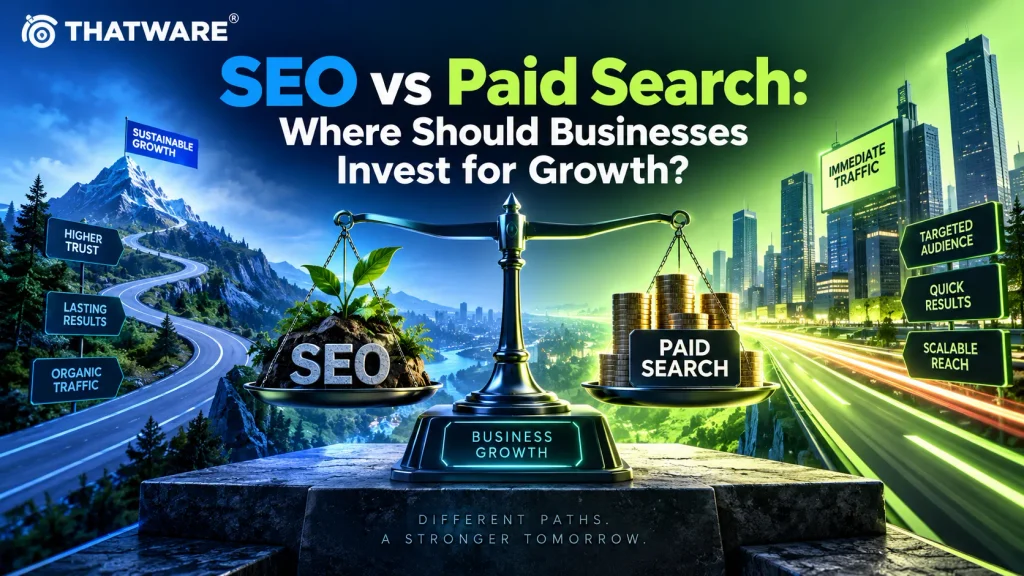
Paid search can generate immediate visibility.
SEO can build long-term organic demand capture.
Paid campaigns can be turned on quickly.
SEO usually takes longer to mature.
Paid media gives businesses control over targeting and budget.
Organic search can create compounding visibility that continues generating traffic after the initial optimization work is complete.
That is why the decision between SEO vs PPC should not be made based on which channel is “better.”
It should be based on:
- Growth objectives
- Time horizon
- Customer acquisition costs
- Search demand
- Competition
- Conversion rates
- Budget
- Existing brand authority
- Business maturity
At ThatWare, we believe the strongest search strategies treat paid and organic search as complementary growth systems rather than competing channels.
The real question is not:
“Should we use SEO or PPC?”
It is:
“What role should each channel play in our customer acquisition strategy?”
Understanding SEO and Paid Search
SEO and paid search both help businesses capture demand from search engines.
But they operate very differently.
What Is SEO?
SEO focuses on improving unpaid visibility across search engines.
It may involve:
- Technical SEO
- Keyword research
- Content
- Internal linking
- Authority building
- Structured data
- Conversion optimization
- AI search visibility
Strong SEO marketing services aim to build sustainable organic visibility over time.
What Is Paid Search?
Paid search involves buying ad placements for selected queries.
The most familiar example is Google Ads.
Advertisers may pay each time someone clicks the ad.
Paid search offers:
- Fast visibility
- Targeting
- Budget control
- Measurable click costs
- Campaign flexibility
Both approaches can generate leads.
But their economics and timelines differ.
SEO vs PPC: The Fundamental Difference
The core distinction in SEO vs PPC is how visibility is acquired.
Paid search purchases visibility.
SEO earns visibility through relevance, authority, technical quality, and content.
When paid spending stops, ad traffic generally stops.
When SEO activity slows, strong organic pages may continue generating traffic, although ongoing maintenance is still required.
This creates different financial models.
“Paid search rents attention. SEO builds an asset designed to keep earning attention.”
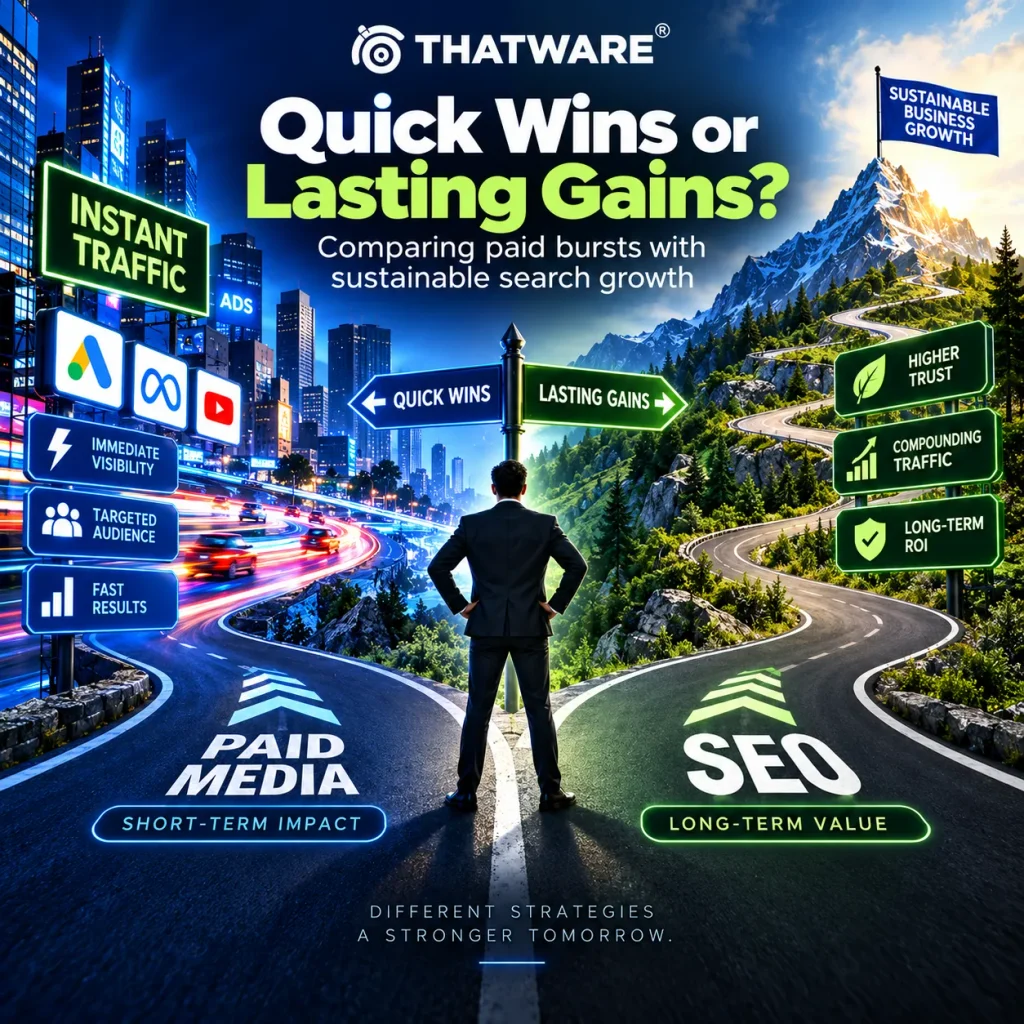
SEO vs Google Ads: Which Produces Faster Results?
In most cases, Google Ads can generate visibility faster.
A business can launch a campaign and potentially begin receiving clicks quickly.
SEO usually takes longer because search engines need to:
- Discover pages
- Evaluate content
- Understand authority
- Compare competitors
- Adjust rankings
This makes SEO vs Google Ads partly a question of timing.
Paid Search Is Useful When You Need
- Immediate leads
- Product-launch traffic
- Short-term promotions
- Rapid market testing
SEO Is Useful When You Need
- Sustainable traffic
- Organic authority
- Long-term acquisition
- Reduced reliance on paid clicks
For many businesses, both are useful at different stages.
SEO or PPC for Business: Start With Your Growth Horizon
When deciding SEO or PPC for business, ask how quickly results are needed.
Short-Term Growth
Paid search is usually better for immediate visibility.
Medium-Term Growth
A combination often works best.
Long-Term Growth
SEO becomes increasingly important because organic assets can compound.
This is why businesses looking at SEO for long term growth should avoid evaluating SEO only through immediate monthly ROI.
1. Compare Cost Structure
Paid search has a direct cost per click.
SEO does not charge per visitor, but it still has costs.
SEO investment can include:
- Agency fees
- Content
- Developers
- Tools
- Digital PR
The difference is how those costs behave.
With PPC, additional traffic generally requires additional budget.
With SEO, one strong page may continue attracting visitors without paying for every click.
This is a major consideration in any SEO investment strategy.
2. Compare Customer Acquisition Cost
Customer acquisition cost can help determine which channel is more efficient.
Suppose:
Paid search CAC = $500
Organic search CAC = $300
SEO may offer better efficiency.
However, the comparison needs context.
SEO may have required months of upfront investment before reaching that efficiency.
A strong SEO ROI services provider should evaluate cost over the correct time horizon.
3. Compare Commercial Intent
Paid search offers strong targeting.
Businesses can bid directly on high-intent terms such as:
- buy accounting software
- enterprise SEO agency
- commercial insurance quote
SEO can also target those terms, but achieving strong rankings may take longer.
The advantage of SEO is that once visibility is established, the business may continue receiving high-intent traffic organically.
4. Compare Scalability
Paid campaigns scale by increasing spend.
SEO scales differently.
SEO can grow through:
- More ranking pages
- Better authority
- Stronger topical coverage
- Improved internal linking
- International expansion
This can create compounding growth.
A strong organic growth agency should design systems where successful SEO assets reinforce one another.
Quick Q&A
Q: Does SEO become free once a page ranks?
No. SEO still requires maintenance, technical support, content updates and authority building. The difference is that you are not directly paying for every organic click.
5. Paid Search Is Excellent for Testing Demand
Paid campaigns can provide fast market feedback.
Suppose a company is considering a new service.
It can run paid ads for relevant commercial searches and track:
- CTR
- Leads
- Conversion rates
- Customer quality
This data can then inform SEO.
If certain terms convert strongly, those queries may become organic priorities.
This is where paid search vs organic search becomes a collaborative rather than competitive relationship.
6. SEO Can Improve Long-Term Search Coverage
Paid search gives visibility while the campaign is active.
SEO can create multiple long-term assets.
A business may rank with:
- Service pages
- Product pages
- Guides
- Comparisons
- Case studies
- Research
This creates broader search coverage.
Strong organic search marketing services should therefore focus on building a complete search ecosystem rather than isolated keywords.
7. SEO Builds More Than Traffic
SEO can contribute to:
- Brand authority
- Market credibility
- Thought leadership
- Backlinks
- AI citations
- Search share of voice
Paid advertising can increase awareness, but organic visibility often carries a different trust dynamic because the listing is earned rather than sponsored.
8. Paid Search Offers Greater Immediate Control
With PPC, businesses can control:
- Keywords
- Geography
- Budget
- Timing
- Ads
- Landing pages
SEO is less controllable.
Rankings are determined algorithmically.
That makes paid search useful when precision and speed matter.
Mini Case Study 1: B2B Company With Rising PPC Costs
Imagine a B2B software company generating reliable leads through Google Ads.
Over time, cost per click increases and customer acquisition becomes more expensive.
Instead of shutting down paid campaigns, the business starts building organic visibility around the same high-converting commercial topics.
Paid search continues generating immediate leads while SEO gradually captures more demand organically.
The outcome is a more balanced acquisition model.
9. SEO Can Reduce Paid Search Dependency
Dependence on one acquisition channel creates risk.
If advertising costs rise significantly, margins may suffer.
SEO can diversify acquisition.
An SEO agency for business growth should identify areas where organic rankings can reduce long-term dependence on paid traffic.
This does not necessarily mean reducing paid budgets immediately.
It means creating alternatives.
10. Paid Search Can Support SEO Keyword Strategy
PPC data can reveal valuable information about:
- Keyword conversions
- Ad messaging
- Search terms
- Landing page performance
SEO teams can use this data.
For example:
A keyword with high paid conversion rates may deserve stronger organic investment.
A good SEO consulting services strategy should use cross-channel data wherever possible.
11. SEO Supports Different Stages of the Funnel
Paid campaigns often prioritize high-intent keywords.
SEO can cover the entire journey.
Awareness
“What is enterprise cybersecurity?”
Evaluation
“Enterprise cybersecurity solutions comparison”
Purchase
“Enterprise cybersecurity company”
This allows SEO to influence prospects before they are ready to buy.
Strong SEO lead generation services should map content across these stages.
12. Paid Search Works Well for Promotions
If a business has:
- Limited-time offer
- Seasonal sale
- Product launch
- Event
paid search can create immediate visibility.
SEO is usually less suitable for very short-term campaigns because rankings may take time.
This is another reason channel selection should follow the objective.
13. SEO Works Better for Compounding Content Assets
Consider a high-quality guide that attracts:
- Traffic
- Links
- Leads
- AI citations
over several years.
Its value can compound.
Paid ads do not behave the same way.
Once spend stops, the campaign usually stops producing new clicks.
That makes SEO attractive for businesses building long-term digital assets.
“The most valuable SEO pages do not simply generate traffic once. They keep participating in the customer journey.”
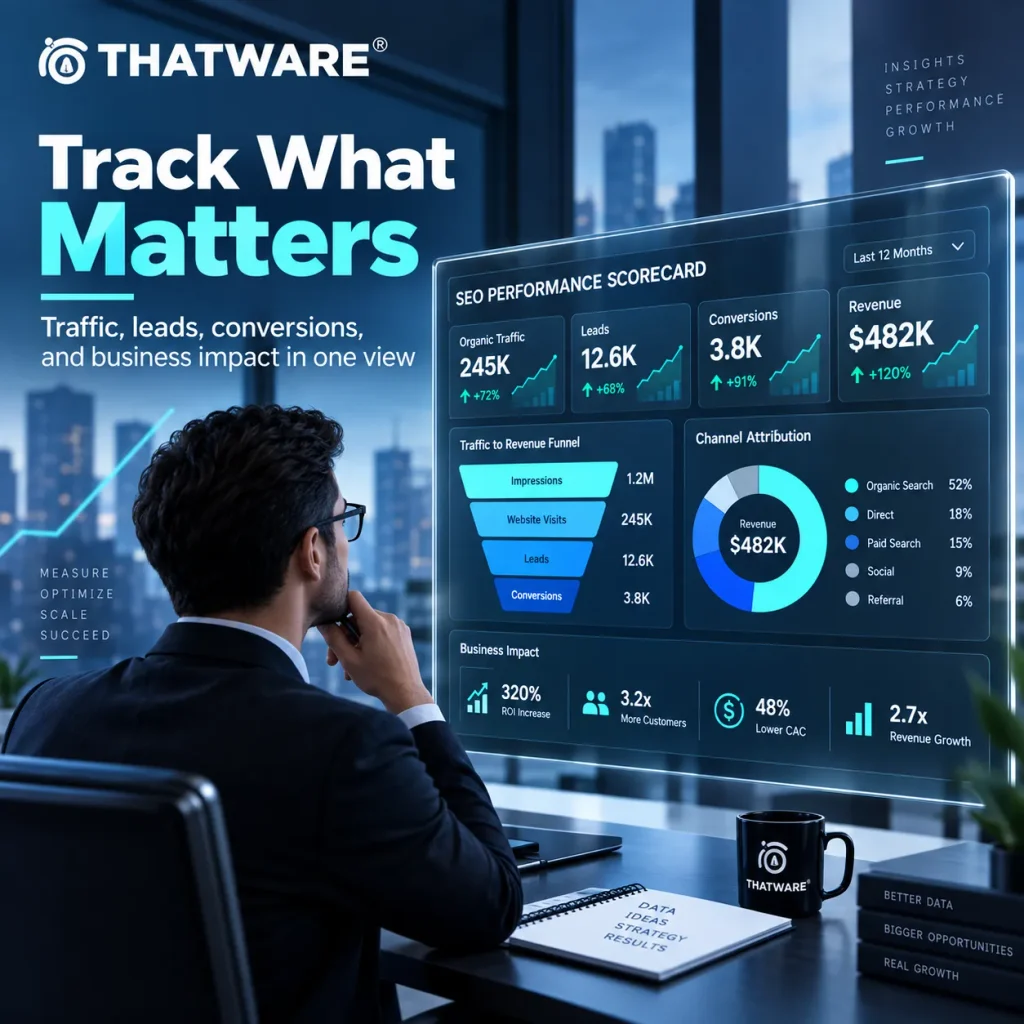
14. SEO and PPC Have Different Attribution Challenges
Paid search attribution can often be more direct.
SEO may influence users across multiple visits.
For example:
Organic search
→ Email
→ Branded search
→ Paid search
→ Conversion
If only the final click gets credit, SEO may look less valuable than it actually was.
This is why SEO ROI services should include assisted conversions where appropriate.
15. SEO Can Improve Branded Search Demand
Users may discover a brand through:
- Informational content
- Research
- Industry guides
Later, they may search for the brand directly.
This means SEO can contribute to brand demand even when the final search is branded.
16. Paid Search Can Protect Branded Queries
Competitors may bid on your brand name.
Paid search can protect high-value branded SERPs.
SEO alone may not control the entire results page.
In some industries, using both organic and paid listings can increase SERP coverage.
17. SEO Can Be More Efficient for Large Keyword Portfolios
Suppose an ecommerce site needs visibility for 50,000 product and category queries.
Buying paid clicks across all those terms can be expensive.
SEO can provide scalable coverage through:
- Product optimization
- Category architecture
- Internal linking
- Structured data
This is where large-scale organic strategy becomes powerful.
18. Paid Search Can Become Expensive in Competitive Industries
Industries such as:
- Legal
- Insurance
- Finance
- SaaS
can have expensive commercial clicks.
Businesses in these markets may benefit significantly from investing in organic visibility.
A long-term SEO investment strategy can help improve acquisition resilience.
Mini Case Study 2: Ecommerce Brand Combining SEO and PPC
Imagine an ecommerce company heavily dependent on paid advertising.
The business identifies its highest-converting product categories and strengthens SEO around those categories through technical improvements, buying guides, internal links, and authority building.
Paid campaigns continue to support seasonal demand.
Organic search gradually contributes a larger share of revenue.
The benefit is not choosing one channel.
It is creating a healthier channel mix.
19. Organic Search Can Support AI Visibility
SEO is also evolving beyond classic rankings.
Strong organic content can help brands become discoverable within:
- AI Overviews
- ChatGPT
- Gemini
- Perplexity
This creates additional potential value from SEO for long term growth.
Content can contribute to both traditional rankings and AI-powered discovery.
20. Paid Search Does Not Directly Build Organic Authority
PPC can generate traffic and awareness.
But buying ads does not directly create organic rankings.
SEO requires separate investments in:
- Content
- Technical quality
- Authority
- Relevance
This is why paid search should not be treated as a substitute for organic strategy.
When SEO Should Receive More Investment
SEO may deserve greater investment when:
- Search demand is stable
- Paid clicks are expensive
- Your website has strong conversion potential
- You want long-term acquisition
- Competitors dominate organic search
Businesses in this position may benefit from an SEO agency for business growth or organic growth agency focused on compounding visibility.
When Paid Search Should Receive More Investment
Paid search may deserve priority when:
- Immediate leads are required
- A new product is launching
- SEO authority is currently weak
- Demand needs to be tested
- Campaign timing is short
It can also act as a bridge while SEO gains momentum.
When Businesses Should Invest in Both
For many organizations, the strongest strategy combines both.
Paid Search
Captures immediate demand.
SEO
Builds long-term acquisition.
Together, they can improve:
- SERP coverage
- Data quality
- Lead volume
- Channel resilience
This is often a more sophisticated answer to SEO services vs PPC than choosing one winner.
How to Allocate Budget Between SEO and PPC
There is no universal percentage.
Budget should depend on:
- Time horizon
- Growth stage
- Competition
- Existing rankings
- CAC
- Customer value
Early-Stage Business
May use more PPC for immediate demand testing.
Growing Business
May progressively increase SEO investment.
Established Business
May use mature SEO and paid programs together.
A strong SEO consulting services partner should help model these trade-offs based on real data.
Compare Incremental Return, Not Vanity Metrics
Do not compare:
“SEO generated 50,000 sessions.”
with:
“PPC generated 5,000 sessions.”
Compare outcomes such as:
- Customers
- Revenue
- CAC
- Lifetime value
- Pipeline
Fewer PPC visitors may create more revenue.
Or a large organic traffic base may deliver lower CAC over time.
The right conclusion depends on economics.
How SEO and Paid Search Can Work Together
A unified search program can use PPC insights to improve SEO and SEO insights to improve PPC.
PPC Can Inform SEO
Use paid data to identify:
- Converting keywords
- High-performing messages
- Profitable products
SEO Can Inform PPC
Use organic data to identify:
- Emerging queries
- Content gaps
- Search intent
This creates a stronger search intelligence loop.
Building a Balanced Search Investment Strategy
A practical framework can include four layers.
Layer 1: Immediate Demand
Use paid search to capture customers ready to convert.
Layer 2: Commercial Organic Visibility
Build SEO around high-value product and service terms.
Layer 3: Demand Creation and Education
Use organic content to influence earlier research stages.
Layer 4: Measurement
Compare:
- Revenue
- Leads
- CAC
- Lifetime value
This produces a more complete SEO investment strategy.
How ThatWare Approaches SEO and Paid Search Decisions
At ThatWare, we believe search investment should be based on commercial opportunity rather than channel preference.
Our SEO marketing services can include:
- Search demand analysis
- Keyword strategy
- Technical SEO
- Content
- Competitive intelligence
- Conversion analysis
- AI search visibility
- Attribution
Our organic search marketing services focus on creating sustainable visibility across high-value search journeys.
Our SEO ROI services can help businesses connect organic investment with leads, revenue and acquisition efficiency.
For organizations seeking strategy, our SEO consulting services can help determine where organic search should sit within the wider acquisition mix.
As an SEO agency for business growth, ThatWare focuses on turning search visibility into measurable commercial opportunity.
Final Thoughts
The debate around SEO vs paid search should not end with a universal winner.
The channels serve different purposes.
Paid search gives businesses speed, precision and immediate visibility.
SEO builds authority, sustainable demand capture and potentially more efficient acquisition over time.
The strongest growth strategies often use both.
Use paid search to capture demand now.
Use SEO to build the assets that can capture demand tomorrow.
A strong SEO investment strategy should therefore consider:
- CAC
- Revenue
- Customer lifetime value
- Search demand
- Time horizon
- Channel dependency
ThatWare combines SEO marketing services, SEO lead generation services, search intelligence, technical optimization, AI visibility, conversion strategy and ROI measurement to help businesses build stronger organic acquisition systems.
Because the real choice is rarely SEO or PPC.
It is deciding how much each channel should contribute to a sustainable growth engine.