
SUPERCHARGE YOUR ONLINE VISIBILITY! CONTACT US AND LET’S ACHIEVE EXCELLENCE TOGETHER!
SEO can generate traffic, rankings, leads, and brand visibility.
But businesses still need to answer one important question:
Is the investment actually paying off?
That is where SEO ROI becomes essential.

For years, many companies measured SEO success using metrics such as:
- Keyword rankings
- Organic traffic
- Impressions
- Backlinks
- Domain authority
These metrics are useful.
But they do not automatically prove business value.
A website can increase organic traffic significantly and still produce weak revenue.
A keyword can reach position one without generating a single qualified lead.
A content campaign can attract thousands of visitors who never enter the sales funnel.
This is why modern SEO measurement must go further.
At ThatWare, we believe SEO should be connected to commercial outcomes such as:
- Leads
- Revenue
- Pipeline
- Conversion rate
- Customer acquisition cost
- Assisted conversions
- Lifetime value
The objective is not just to show that SEO activity happened.
The objective is to show what that activity contributed to the business.
What Is SEO ROI?
SEO ROI measures the financial return generated from organic search compared with the amount invested in SEO.
A basic formula is:
SEO ROI = (Revenue From SEO – Cost of SEO) ÷ Cost of SEO × 100
For example:
If a company spends $40,000 on SEO and generates $120,000 in attributable organic revenue:
SEO ROI = ($120,000 – $40,000) ÷ $40,000 × 100
SEO ROI = 200%
That means the business generated $2 in profit contribution for every $1 invested, based on the chosen attribution model.
However, real-world SEO measurement is often more complicated.
Organic search may assist sales without being the final click.
That is why strong SEO measurement services should evaluate both direct and assisted value.
Quick Q&A
Q: Is traffic enough to prove SEO ROI?
No. Traffic shows visibility and demand capture, but ROI should connect organic activity to leads, conversions, revenue, or another measurable business outcome.
Why SEO ROI Is Harder to Measure Than Paid Media
Paid advertising is usually easier to attribute.
A user clicks an ad.
The cost is known.
The conversion can often be tracked directly.
SEO works differently.
A customer might:
- Discover your brand through an organic article
- Return through direct traffic
- Read a case study
- Click a branded search result
- Convert three weeks later
Which touchpoint receives credit?
This is where SEO analytics services and attribution become important.
A simplistic last-click model may underestimate SEO’s role.
Start by Defining What SEO Success Means
Before calculating ROI, determine what SEO is expected to achieve.
Different businesses have different goals.
Ecommerce
May focus on:
- Revenue
- Transactions
- Average order value
B2B
May focus on:
- Qualified leads
- Pipeline
- Sales opportunities
- Closed deals
SaaS
May focus on:
- Demo requests
- Trials
- Paid subscriptions
- Lifetime value
Publishers
May focus on:
- Organic traffic
- Ad revenue
- Subscriptions
Effective SEO ROI services should align the measurement framework with the actual business model.
1. Calculate Your Total SEO Investment
You cannot calculate ROI accurately without understanding total cost.
SEO investment may include:
- Agency retainers
- Consultants
- Internal salaries
- Writers
- Developers
- SEO tools
- Digital PR
- Content production
A strong SEO ROI agency should help businesses account for the full cost rather than comparing revenue against only one expense line.
Example
Suppose monthly SEO costs include:
- Agency: $8,000
- Content: $3,000
- Development: $2,000
- Tools: $1,000
Total monthly cost = $14,000
Annual cost = $168,000
That becomes the investment baseline.
2. Track Organic Conversions Properly
Traffic without conversion data provides limited insight.
Businesses should track actions such as:
- Form submissions
- Calls
- Purchases
- Demo requests
- Trial sign-ups
- Downloads
- Bookings
This is where SEO conversion optimization and measurement overlap.
If organic traffic grows but conversion rates fall, SEO may be attracting the wrong audience or sending users to weak landing pages.
3. Assign Financial Value to Leads
For lead-generation businesses, not every conversion has an immediate revenue value.
You can estimate value using:
- Lead-to-sale rate
- Average contract value
- Lifetime value
Example
Suppose:
100 organic leads
20% become customers
Average customer value = $5,000
Expected revenue:
100 × 20% × $5,000 = $100,000
This provides a stronger estimate of SEO value.
4. Separate Branded and Non-Branded Performance
Branded organic traffic comes from users already searching for your company.
Non-branded traffic often shows how SEO is generating new discovery.
Examples of non-branded searches:
- enterprise SEO agency
- CRM software for manufacturers
- commercial water tanks
Strong SEO reporting services should separate branded and non-branded performance where useful.
This helps determine whether SEO is generating incremental demand or simply capturing existing brand awareness.
“Good SEO reporting should explain where growth came from, not just show that traffic increased.”
5. Measure Revenue From Organic Search
For ecommerce or direct-purchase businesses, revenue attribution can be relatively straightforward.
Track:
- Organic transactions
- Revenue
- Average order value
- Repeat purchases
Then compare organic revenue with SEO spend.
For longer sales cycles, attribution requires deeper CRM integration.
6. Connect SEO With CRM Data
B2B businesses often lose visibility after a lead submits a form.
The marketing platform may record:
“Organic lead generated.”
But sales systems should also reveal:
- Was it qualified?
- Did it enter the pipeline?
- Did it close?
- What was the deal value?
A strong SEO consulting company should encourage this connection between analytics and CRM data.
This makes SEO ROI much more accurate.
7. Measure Assisted Conversions
SEO may influence a purchase without being the final touchpoint.
For example:
Organic search → Website visit
Email → Return visit
Paid search → Conversion
If only the final click receives credit, SEO appears less valuable than it really was.
SEO ROI consulting should therefore consider attribution models that capture assisted influence.
8. Track Conversion Rate, Not Just Traffic Growth
Suppose organic traffic grows 40%.
That sounds excellent.
But conversion rate falls from 3% to 1%.
Business performance may actually decline.
This is why SEO performance marketing services should combine acquisition metrics with conversion data.
Important metrics include:
- Organic sessions
- Conversion rate
- Revenue per session
- Lead quality
- Cost per acquired customer
Mini Case Study 1: Traffic Growth Without Revenue Growth
Imagine a B2B website that increases organic traffic by 60% over nine months.
Leadership expects strong revenue growth.
Instead, pipeline barely moves.
Analysis shows most growth came from broad informational keywords with weak purchase intent.
The strategy shifts toward commercial landing pages, comparison content, bottom-funnel queries, and stronger conversion paths.
Traffic growth slows, but lead quality improves.
The lesson:
More organic traffic does not always mean better ROI.
9. Calculate Revenue Per Organic Visitor
This is a useful efficiency metric.
Formula:
Organic Revenue ÷ Organic Sessions
For example:
Organic revenue = $200,000
Organic sessions = 50,000
Revenue per organic visit = $4
If this increases over time, SEO traffic may be becoming more commercially valuable.
10. Track SEO Revenue Growth
SEO revenue growth should be evaluated over time.
Compare:
- Month over month
- Quarter over quarter
- Year over year
Year-over-year comparisons are often useful because search demand can be seasonal.
Avoid evaluating one isolated month without context.
11. Measure Cost Per Organic Lead
Another useful metric is:
SEO Investment ÷ Organic Leads
Suppose:
Monthly SEO investment = $20,000
Organic leads = 100
Cost per organic lead = $200
You can then compare this with:
- Paid search CPL
- Social advertising CPL
- Referral CPL
This helps leadership evaluate channel efficiency.
12. Measure Organic Customer Acquisition Cost
Go one step further.
Formula:
SEO Investment ÷ Organic Customers Acquired
If:
Annual SEO spend = $120,000
Organic customers = 60
Organic CAC = $2,000
Compare this against customer lifetime value.
If lifetime value is $15,000, the economics may be attractive.
13. Consider Customer Lifetime Value
Many businesses underestimate SEO because they measure only first-purchase revenue.
Suppose a customer generates:
$2,000 initially
but has a three-year lifetime value of:
$12,000
SEO ROI may be significantly higher than first-touch revenue suggests.
A sophisticated performance based SEO strategy should consider LTV where appropriate.
14. Measure Share of Voice
SEO ROI is not purely financial in the short term.
Share of voice shows how much search visibility your brand owns relative to competitors.
It can be useful for tracking strategic market position.
For example:
If your visibility across 500 commercial keywords increases from 12% to 24%, the business is capturing more category-level demand.
15. Track High-Value Keyword Groups
Avoid measuring every keyword equally.
A position-one ranking for a low-value informational keyword may be less useful than position five for a high-intent commercial term.

Strong SEO measurement services should segment keywords by:
- Funnel stage
- Intent
- Revenue potential
- Product category
This makes reporting more meaningful.
16. Measure Landing Page Performance
SEO ROI often depends heavily on a relatively small group of pages.
Analyze:
- Organic sessions
- Conversions
- Revenue
- Conversion rate
- Engagement
This helps identify pages that produce the greatest commercial value.
17. Combine SEO and Conversion Optimization
Getting more traffic is only one side of ROI.
Improving the value of existing traffic can be equally powerful.
That is where SEO conversion optimization matters.
Consider improving:
- Calls to action
- Forms
- Trust signals
- Page clarity
- Proof
- Pricing information
- Navigation
A small conversion-rate improvement can significantly improve SEO ROI without increasing traffic.
Quick Q&A
Q: Can CRO improve SEO ROI even if rankings do not change?
Yes. If the same organic traffic converts at a higher rate, revenue can increase without additional ranking growth.
18. Measure Content ROI
Content should also be evaluated commercially.
For each major content asset, track:
- Traffic
- Rankings
- Links
- Leads
- Assisted conversions
- Revenue influence
This helps identify what types of content deserve more investment.
19. Evaluate Technical SEO ROI
Technical improvements can be harder to isolate.
For example:
- Improved crawlability
- Better indexing
- Faster performance
- Fixed canonicalization
These changes may benefit hundreds or thousands of URLs.
Measure technical projects using before-and-after trends in:
- Indexed pages
- Rankings
- Traffic
- Conversion
20. Enterprise SEO ROI Requires a Different Approach
Enterprise SEO ROI becomes more complex because large websites may have:
- Millions of URLs
- Multiple markets
- Several business units
- Different products
Small improvements can create substantial aggregate value.
For example:
A 2% uplift across 500,000 monthly organic visits can be commercially significant.
Enterprise measurement should therefore focus on scalable impact.
21. Measure Incremental SEO Value
One of the most difficult questions is:
“What would have happened without SEO?”
This is the concept of incremental value.
Businesses can estimate it through:
- Historical baselines
- Market comparisons
- Controlled tests
- Page-level experiments
- Forecast versus actual performance
This helps separate SEO-driven growth from broader market growth.
22. Build SEO Forecasts
Forecasting helps businesses estimate potential returns.
Inputs may include:
- Search volume
- Expected rankings
- CTR
- Conversion rate
- Revenue per conversion
Example:
Search volume = 20,000
Expected CTR = 10%
Estimated visits = 2,000
Conversion rate = 3%
Conversions = 60
Average conversion value = $2,000
Potential revenue = $120,000
Forecasts are not guarantees.
But they help prioritize opportunities.
Mini Case Study 2: Enterprise SEO ROI
Imagine an enterprise ecommerce site with hundreds of category pages.
Instead of optimizing every page equally, the SEO team identifies 40 high-revenue categories with strong ranking opportunity.
Technical fixes, internal linking, and content improvements are prioritized there first.
The company generates a stronger commercial uplift with less wasted effort.
The lesson:
Prioritization is a major part of ROI.
23. Compare SEO Against Other Acquisition Channels
SEO should be evaluated within the broader marketing mix.
Compare:
- CAC
- CPL
- Revenue
- Conversion rate
- Lifetime value
against:
- Paid search
- Social
- Affiliates
- Events
- Outbound
This helps determine where SEO deserves more or less investment.
24. Use Cohort Analysis
Cohort analysis can reveal whether customers acquired through organic search behave differently.
For example:
Organic customers may:
- Retain longer
- Spend more
- Convert faster
If organic users have higher lifetime value, SEO may be more valuable than top-line acquisition numbers suggest.
25. Build a Performance-Based SEO Strategy
A performance based SEO strategy should prioritize activities based on measurable impact.
This can include:
- Commercial keyword growth
- Revenue-driving pages
- Conversion opportunities
- High-value content
- Technical fixes
This avoids spending too much time on tasks that look productive but have limited business value.
26. Understand the Difference Between Attribution and Causation
Not every organic conversion happened because of SEO.
Some users may already know the brand.
Likewise, not every SEO-driven interaction receives organic attribution.
Measurement should therefore avoid false precision.
Good SEO ROI consulting uses reasonable models and clearly communicates limitations.
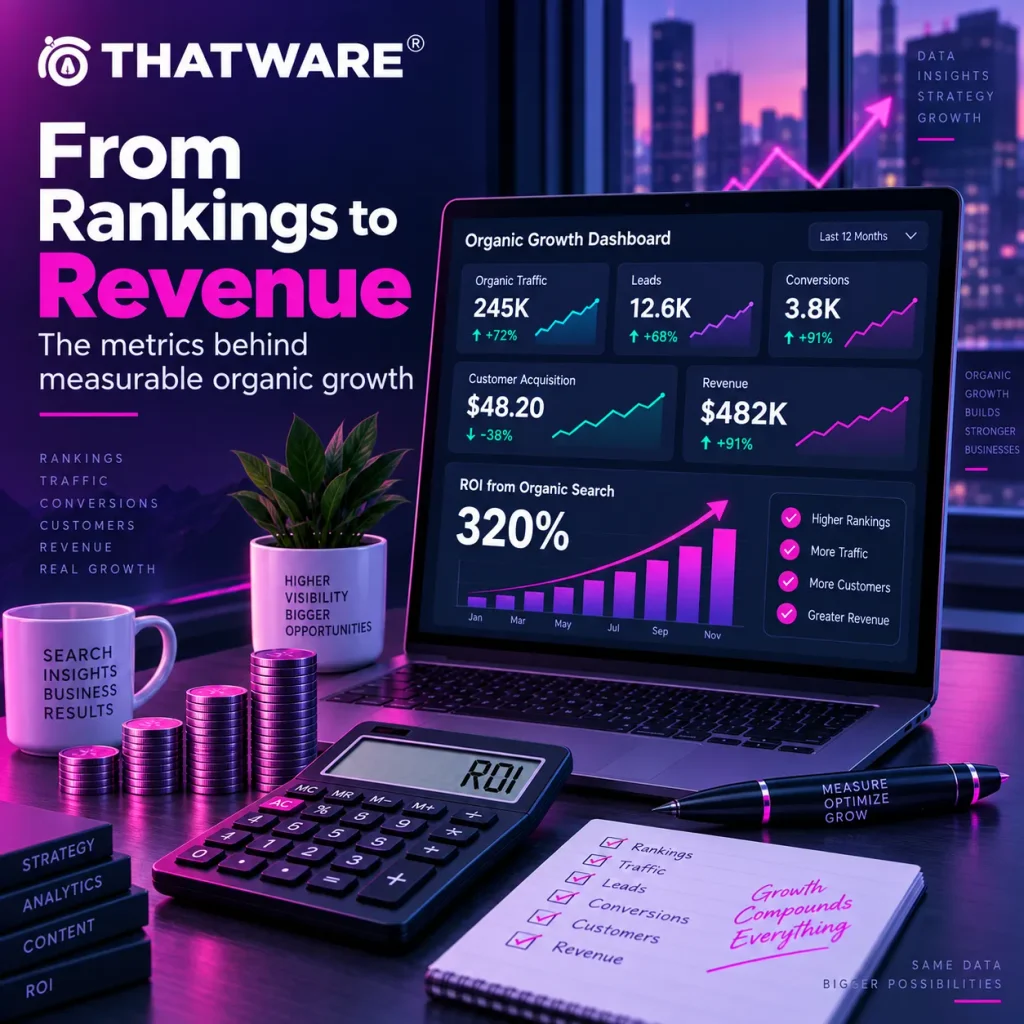
27. Build an SEO ROI Dashboard
A useful dashboard might include:
Visibility
- Rankings
- Share of voice
- Non-branded visibility
Traffic
- Organic sessions
- New users
Conversion
- Leads
- Sales
- Conversion rate
Revenue
- Organic revenue
- Pipeline
- Assisted revenue
Efficiency
- CPL
- CAC
- ROI
This creates a complete picture.
28. Avoid Vanity Metrics
Metrics can become distracting.
Examples include:
- Total keyword count
- Raw backlink volume
- Traffic without intent
- Domain metrics without commercial context
A strong SEO growth agency should translate SEO metrics into business language.
29. Use SEO Reporting to Drive Decisions
Reporting should answer:
- What improved?
- What declined?
- Why?
- What generated revenue?
- What should we prioritize next?
That is the real purpose of SEO reporting services.
Reports should lead to action.
“SEO measurement becomes valuable when it changes what the business does next.”
30. Review SEO ROI Over the Right Time Horizon
SEO should not be judged only month by month.
Many initiatives require time to compound.
Useful evaluation windows can include:
- Monthly for operational tracking
- Quarterly for strategic progress
- Annually for ROI assessment
This creates a more realistic view.
How ThatWare Approaches SEO ROI
At ThatWare, we believe SEO measurement should connect search visibility with business performance.
Our SEO ROI services can include:
- Search opportunity analysis
- Conversion tracking
- Revenue attribution
- Keyword value modeling
- Commercial landing page analysis
- Competitor benchmarking
- Forecasting
- Analytics integration
- Reporting
Our SEO ROI consulting helps businesses determine which metrics actually matter.
As an SEO ROI agency, ThatWare focuses on understanding not only whether rankings improved, but whether search contributed to measurable business value.
Our ROI driven SEO services prioritize technical, content, authority, and conversion opportunities according to impact.
For larger organizations, our enterprise SEO ROI frameworks can help measure SEO across multiple markets, products, and large-scale websites.
Final Thoughts
Measuring SEO ROI is not about finding one perfect number.
It is about building a credible connection between search activity and business performance.
The strongest measurement frameworks combine:
- Rankings
- Traffic
- Conversions
- Revenue
- Attribution
- Customer value
- Acquisition efficiency
Good SEO analytics services show what happened.
Good SEO measurement services explain whether it mattered.
Good SEO reporting services show what should happen next.
And effective ROI driven SEO services use those insights to improve future investment decisions.
ThatWare combines SEO analytics, conversion analysis, search intelligence, attribution, forecasting, enterprise measurement, and strategic optimization to help businesses understand where SEO creates real commercial value.
Because the real question is not whether SEO generated more traffic.
It is whether that traffic helped the business grow.