GET A FREE CUSTOMIZED SEO AUDIT & DIGITAL MARKETING STRATEGY FOR YOUR BUSINESS IN MALTA
Building Search Visibility in Malta’s Evolving Digital Market
Malta has developed into a highly connected business environment where companies increasingly depend on digital channels to attract customers, generate enquiries, build authority, and expand into new markets. As more consumers and decision-makers use search engines to research products, compare providers, and find local businesses, having a website is no longer enough. Businesses need a search strategy capable of making their digital presence visible, relevant, useful, and trustworthy across an increasingly complex search ecosystem.
Modern search has moved far beyond traditional keyword rankings. Search engines now evaluate context, entities, relationships, content quality, user experience, website performance, location, authority, and intent. At the same time, AI-powered search platforms are changing how people discover and evaluate information. Users can now ask conversational questions and receive synthesized answers rather than simply browsing a list of blue links.
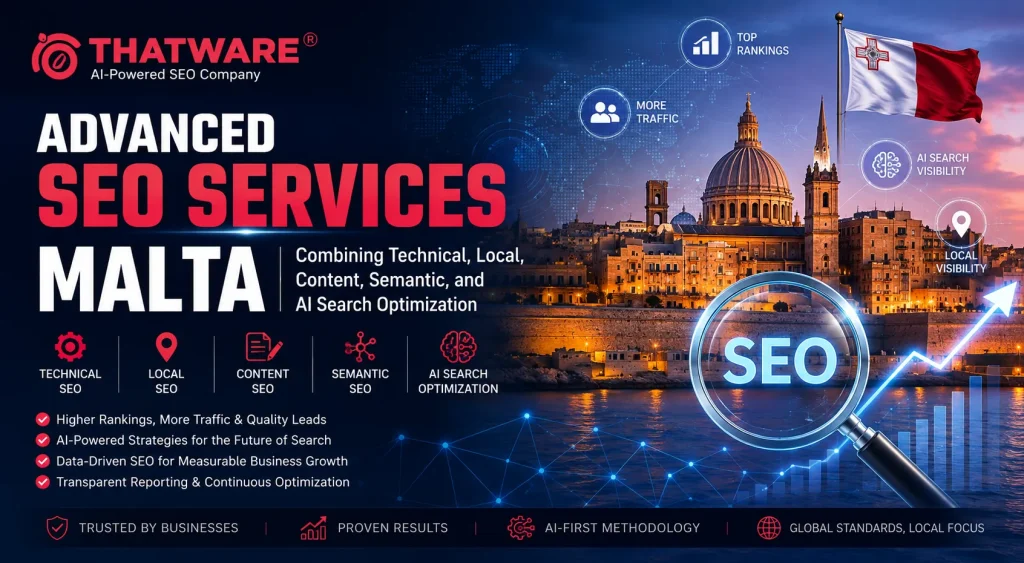
ThatWare approaches this changing environment through an integrated SEO methodology that connects technical optimization, content strategy, semantic relevance, local visibility, authority development, user experience, and AI search readiness. The objective is not to chase rankings in isolation but to create sustainable organic visibility that attracts qualified visitors and supports measurable business outcomes.
A successful SEO Services Malta strategy should help the right audience discover a business at the right stage of the customer journey. It should also provide search engines and AI systems with enough reliable context to understand the organization, its expertise, its offerings, and its relevance to specific queries. This combination creates a stronger foundation for traffic, engagement, enquiries, conversions, and long-term digital growth.
Malta’s Digital Search Landscape Creates a Strong SEO Opportunity
Malta’s highly connected market makes organic visibility increasingly important for businesses competing online. DataReportal reports 511,000 internet users and 93.5% internet penetration in Malta at the end of 2025. At the business level, 81.3% of Maltese enterprises had at least a basic level of digital technology adoption, while 17.3% were using AI, according to the European Commission’s 2025 Digital Decade report. Malta also recorded 88.2% enterprise social-media usage in 2025, the highest share reported among EU countries. These figures highlight a digitally mature and competitive environment where businesses need more than a basic online presence. With its AI-first methodology, technical expertise, semantic SEO capabilities, and advanced search strategies, ThatWare can help businesses strengthen visibility across traditional and emerging search experiences, making it a strong choice for companies seeking a future-ready SEO partner in Malta.
A Complete SEO Framework Built Around Business Objectives
Effective search optimization begins with understanding the business behind the website. Before selecting keywords or creating content, it is important to establish what the organization wants to achieve, who it wants to reach, which markets it serves, how customers make decisions, and where competitors are gaining visibility.
ThatWare develops strategies around these business realities rather than applying a fixed checklist to every website. A startup entering a competitive market may require foundational technical improvements and focused content development, while an established organization may need enterprise-level architecture, international targeting, advanced authority building, or AI search optimization.
Business and Market Discovery
The initial research process can examine:
- Business objectives and commercial priorities
- Products and services
- Existing customer segments
- Geographic markets
- Customer search journeys
- Competitor visibility
- Existing organic performance
- Website architecture
- Content quality and coverage
- Conversion opportunities
- Existing authority and brand signals
This discovery stage helps establish the relationship between business objectives and search demand. Instead of treating every keyword as equally valuable, opportunities can be prioritized according to relevance, competition, intent, commercial potential, and the ability of the business to satisfy the search.
A Customized Roadmap for Sustainable Growth
A strategic roadmap may combine technical fixes, content production, internal linking, local optimization, digital PR, structured data, authority development, conversion improvements, and AI visibility initiatives. Each activity should have a defined purpose within the wider campaign.
This approach allows optimization to evolve as performance data accumulates. Search behavior changes, competitors introduce new content, algorithms evolve, and new search interfaces emerge. Continuous analysis therefore becomes an essential part of maintaining organic visibility.
Technical SEO: Creating a Strong Foundation for Search Crawling and Indexation
A search strategy cannot reach its full potential if search engines struggle to crawl, understand, render, or index a website. Technical optimization creates the infrastructure required for pages and content to be discovered and interpreted efficiently.
Technical work begins with a detailed examination of the website’s architecture and underlying implementation. The objective is to identify barriers that could prevent important pages from receiving appropriate search visibility.
Website Architecture and Crawlability
A logical website structure helps users and search engines move through related information. Important services, products, categories, and resources should be accessible through clear navigation and contextual internal links.
Technical analysis may examine:
- URL structures
- XML sitemaps
- Robots.txt directives
- Crawl paths
- Internal linking
- Orphan pages
- Redirect chains
- Canonical signals
- Pagination
- Faceted navigation
- Crawl efficiency
Large websites require particular attention because unnecessary URLs, duplicated pathways, and poorly controlled parameters can make crawling less efficient. A carefully planned architecture helps concentrate attention on pages that contribute genuine value.
Indexation and Rendering
Not every accessible URL should necessarily be indexed. Search optimization therefore includes evaluating indexability, canonicalization, duplicate content, thin pages, rendering behavior, and JavaScript-dependent content.
Search engines increasingly rely on sophisticated rendering systems to interpret modern websites. Technical reviews can identify situations where important content or navigation elements may not be readily accessible during crawling and rendering.
Performance and Mobile Experience
Website speed and usability influence how visitors interact with pages. Technical optimization can include Core Web Vitals, responsive layouts, image compression, resource loading, caching, code efficiency, and server performance.
Mobile optimization is particularly important because many users access websites through smartphones. Pages should remain easy to navigate, readable, interactive, and efficient across different screen sizes and connection conditions.
Security and Website Reliability
HTTPS, appropriate redirects, stable server responses, broken-link management, and secure implementation contribute to a dependable digital experience. Website migrations and platform changes also require careful planning so that valuable URLs, authority signals, and content relationships are preserved.
Through Technical SEO Services Malta, businesses can address these underlying issues while creating a technically stronger environment for content, local optimization, and future search initiatives.
Local SEO: Strengthening Visibility Across Malta’s Search Landscape
For businesses serving customers in specific locations, local search visibility can directly influence discovery and enquiries. Someone looking for a nearby professional, service provider, restaurant, retailer, or specialist may have a strong intention to act. Local optimization helps businesses communicate their geographic relevance to both users and search systems.
Google Business Profile and Local Presence
A properly managed Google Business Profile can provide essential information about a business, including its name, category, services, location, contact details, opening hours, website, reviews, and visual content.
Local optimization can also include:
- Business profile improvement
- Local landing pages
- Consistent business information
- Citation management
- Review strategy
- Local schema
- Map visibility
- Location-specific content
- Local competitor analysis
Consistency matters. Business information appearing on the website should align with relevant external profiles and trusted directories. Inconsistent information can create confusion for users and search systems.
Location-Based Content
Local content should be more meaningful than simply inserting place names into existing pages. A stronger strategy considers the needs, characteristics, questions, and expectations of customers in specific locations.
Service-area businesses can benefit from well-developed location pages, while organizations with physical premises can strengthen geographic relevance through useful local information and supporting content.
Local SEO Services Malta can therefore help organizations connect their offerings with customers who demonstrate location-based search intent, while supporting broader brand visibility throughout the market.
Content SEO: Turning Search Intent Into Useful, Authoritative Content
Content remains central to organic visibility, but effective content optimization is no longer based on repeating a keyword a certain number of times. Search systems increasingly evaluate whether a page provides useful information, addresses the underlying intent, demonstrates expertise, and fits within a broader topical context.
Understanding Search Intent
Search queries can reflect different stages of the customer journey. Informational searches often indicate research, commercial searches suggest comparison or evaluation, navigational searches seek a particular destination, and transactional searches can indicate stronger purchasing intent.
Understanding these distinctions allows content to be developed for the appropriate purpose.
Research can identify:
- Customer questions
- Search motivations
- Pain points
- Comparison criteria
- Purchase concerns
- Relevant topics
- Related entities
- Frequently occurring concepts
Topic Clusters and Topical Authority
Instead of creating isolated articles, a strategic content ecosystem can connect a central topic with supporting subjects. Pillar pages can establish broad coverage while supporting articles address specific questions, use cases, comparisons, processes, and related themes.
Contextual internal links help establish relationships between these pages. Over time, this structure can demonstrate comprehensive knowledge across a subject rather than relying on individual pages to rank independently.
Quality, Expertise and Trust
Useful content should provide original value and demonstrate appropriate experience and expertise. Depending on the subject, this may involve expert insights, practical examples, data interpretation, original research, clear explanations, or authoritative references.
Content should also be reviewed and refreshed as products, markets, regulations, customer expectations, and search behavior change.
Content That Supports Conversions
Organic traffic becomes more valuable when visitors can easily understand the offering and take the next appropriate step. Service pages, landing pages, guides, case studies, FAQs, and supporting resources can be connected through purposeful conversion paths.
The best content strategy therefore balances meaning, relevance, usefulness, and intent with commercial objectives.
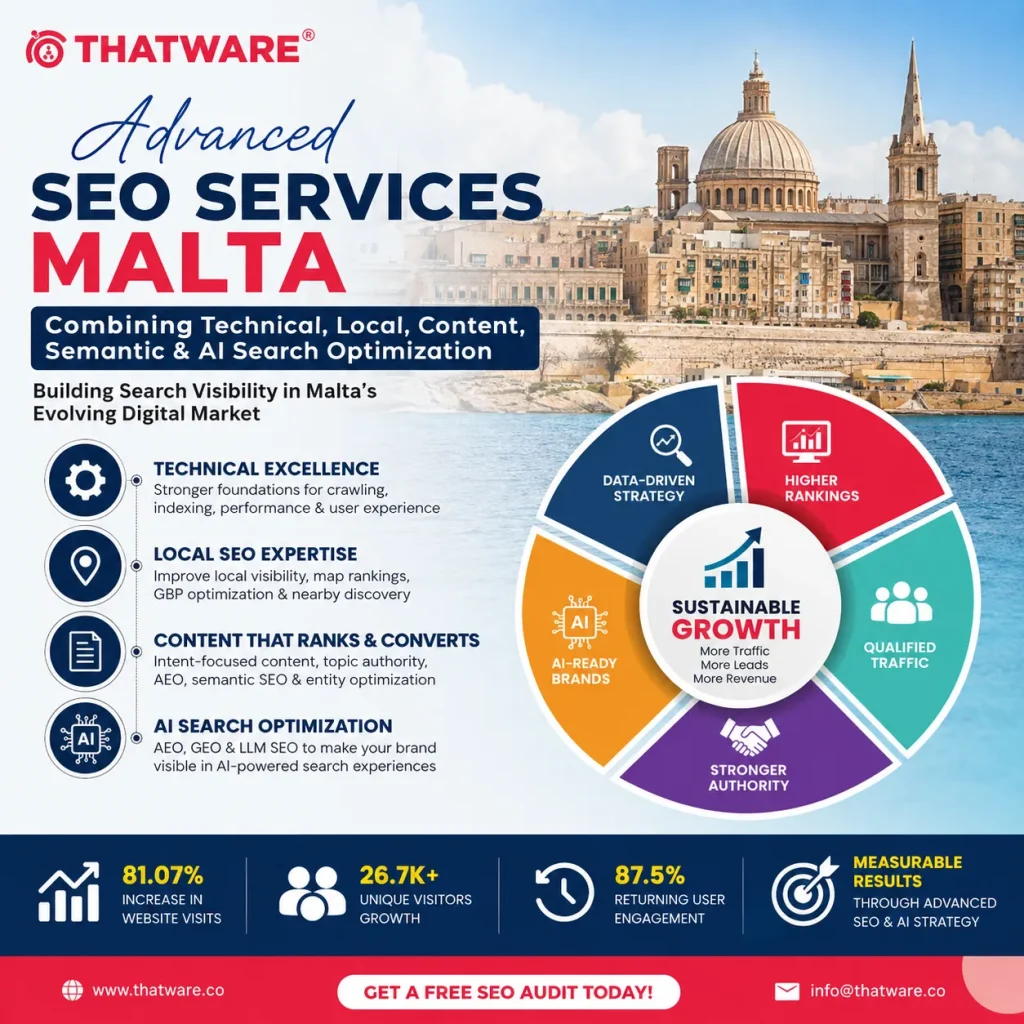
Semantic SEO, Entity Optimization and Knowledge Graph Strategy
Search engines increasingly interpret information through entities and relationships rather than treating every query as an isolated sequence of words. A business may be associated with particular services, locations, industries, people, products, technologies, and areas of expertise.
Semantic optimization helps strengthen these relationships across a website and its wider digital presence.
Building Meaningful Entity Relationships
Entities can include organizations, brands, people, products, services, places, and concepts. Optimization considers how these entities relate to one another and whether those relationships are clearly represented.
For example, a business should establish consistent connections between its brand, services, expertise, geographic markets, and relevant industry topics. This can be supported through structured content, internal links, schema markup, authoritative references, and consistent information across external platforms.
Knowledge Graph and Structured Information
Structured data can provide additional machine-readable context about webpages and entities. Depending on the website, appropriate schema may describe organizations, products, services, locations, articles, events, reviews, or other relevant information.
Semantic optimization is not about adding markup indiscriminately. The information represented through structured data should accurately reflect visible and reliable information.
A coherent entity strategy can make it easier for search systems to understand what a business represents, what it offers, where it operates, and which topics it is genuinely associated with.
Advanced On-Page SEO and Search Experience Optimization
On-page optimization connects technical implementation, content relevance, usability, and conversion opportunities. Each important page should communicate its subject clearly while making it easy for visitors to find and understand the information they need.
Optimization can include title elements, headings, URLs, metadata, internal links, images, alt text, structured data, content organization, and page-level relevance.
Creating Clear Page Structures
A well-organized page should have a logical hierarchy. Main subjects can be introduced through appropriate headings, while supporting concepts are organized into relevant subsections.
Internal links should guide users toward related information rather than simply existing for search-engine purposes. Descriptive anchor text and logical pathways can help visitors discover deeper resources.
Combining SEO With User Experience
Search visibility has limited value if visitors struggle to use a website. Navigation, readability, mobile usability, page speed, accessibility, trust signals, and conversion pathways all contribute to the overall experience.
Search optimization and user experience should therefore work together. A page can be technically optimized and still underperform if it fails to answer the visitor’s question or provide a clear next step.
AI SEO: Preparing Businesses for the New Search Experience
AI is changing how people discover information online. Instead of entering a short query and scanning multiple results, users can increasingly ask detailed questions and receive synthesized responses.
This creates a new visibility challenge. Businesses need to be understood not only as webpages but also as entities with identifiable expertise, offerings, evidence, relationships, and authority.
Optimizing for AI-Powered Discovery
An AI-focused search strategy can examine:
- Brand representation
- Entity consistency
- Source credibility
- Content structure
- Semantic relationships
- Query coverage
- AI-generated mentions
- Citation opportunities
- Competitive AI visibility
Content should be structured so that important information is clear, accurate, contextually connected, and supported by credible signals.
Monitoring AI Visibility
Traditional ranking reports do not necessarily reveal whether a business is appearing within AI-generated responses. AI visibility analysis can therefore involve testing relevant prompts and queries, identifying how brands are represented, comparing competitors, and finding gaps in available information.
The objective of AI SEO Services Malta is not simply to optimize for one AI platform. It is to strengthen the digital signals that help businesses remain discoverable as search interfaces continue to evolve.
AI optimization should complement established SEO principles rather than operate as an isolated replacement. Strong technical foundations, authoritative content, semantic relevance, trustworthy references, and clear entities remain essential.
Answer Engine Optimization and Generative Engine Optimization
Search experiences increasingly provide direct answers instead of requiring users to visit several webpages. This shift creates opportunities for businesses that structure their information around clear questions, concise explanations, and reliable sources.
Answer Engine Optimization
Answer-focused optimization can identify questions commonly asked by customers and develop content capable of addressing those questions directly.
Useful approaches include:
- Question-based content
- Concise definitions
- Step-by-step explanations
- FAQ sections
- Structured information
- Conversational language
- Featured-snippet opportunities
- Voice-search considerations
AEO Services Malta can support this approach by organizing content around the information users are most likely to request and making important answers easy for search systems to interpret.
Generative Engine Optimization
Generative search environments synthesize information from multiple sources to produce responses. Visibility therefore depends on more than occupying a conventional ranking position.
A generative optimization strategy can focus on:
- Brand inclusion
- Source authority
- Entity recognition
- Contextual relevance
- Content depth
- Digital reputation
- Reliable references
- Multi-platform visibility
GEO Services Malta focuses on improving the likelihood that a business is accurately represented within emerging generative search experiences.
LLM Search Optimization and Conversational Discovery
Large language models interpret information through context, relationships, language patterns, entities, and supporting knowledge. This makes natural-language content and consistent digital information increasingly valuable.
Businesses should consider how their customers phrase detailed questions rather than limiting research to short traditional keywords.
Natural-Language Query Coverage
Content can address conversational variations of common searches, including questions about features, costs, processes, comparisons, benefits, suitability, and potential limitations.
The goal is not to manufacture unnatural question pages. Instead, useful information should be organized around genuine customer needs.
Building a Consistent Digital Knowledge Base
AI systems can encounter information about a business across websites, publications, directories, professional profiles, industry resources, and other sources. Consistency across these references can help establish a clearer representation of the organization.
Strong authoritative content, structured information, expert contributions, credible references, and clear entity relationships can collectively support conversational discovery.
Businesses should therefore think beyond individual rankings and consider whether their overall digital footprint provides enough trustworthy information for AI systems to understand their expertise.

E-Commerce, Enterprise and International SEO Solutions
Different website models create different optimization challenges. A product-based website requires a different architecture from a large corporate platform, while an organization targeting multiple countries must account for language and regional search behavior.
E-Commerce SEO
E-commerce websites often contain large numbers of product, category, filter, and transactional pages. Optimization should ensure that valuable pages can be discovered while unnecessary URL variations are controlled.
Key areas can include:
- Product titles and descriptions
- Category architecture
- Product schema
- Internal linking
- Faceted navigation
- Duplicate content
- Product discovery
- Commercial intent
- Out-of-stock handling
Ecommerce SEO Services Malta can help online retailers build search-friendly product ecosystems designed around both discovery and conversion.
Enterprise SEO
Large organizations may operate thousands of URLs across departments, locations, services, products, or business units. At this scale, manual page-by-page optimization alone is rarely sufficient.
Enterprise strategies can incorporate templates, technical governance, scalable internal linking, automated monitoring, centralized standards, content workflows, and cross-team collaboration.
Enterprise SEO Services Malta are particularly relevant to organizations requiring scalable processes and consistent search governance across complex digital ecosystems.
International SEO
Businesses expanding beyond one market need more than direct translation. International optimization considers local search behavior, language, cultural expectations, regional competition, and technical signals.
Important elements may include:
- International keyword research
- Localized content
- Country-specific landing pages
- Hreflang implementation
- Regional URL structures
- Market-specific search intent
- International competitor research
International SEO Services Malta can support organizations using Malta as a commercial base while developing visibility in additional countries and markets.
Authority Building, Digital PR and Off-Page SEO
Search visibility also depends on the broader reputation of a website and organization. Relevant external references can help establish credibility and demonstrate that a business is recognized within its industry.
Building Relevant Authority
Authority development can include editorial links, digital PR, industry publications, business citations, expert contributions, partnerships, and relevant brand mentions.
Quality matters more than volume. A large number of irrelevant or low-quality links does not necessarily create meaningful authority. Sustainable campaigns focus on relevance, editorial value, trust, and genuine relationships.
Digital PR and Brand Recognition
Digital PR can connect SEO objectives with broader brand visibility. Expert commentary, original research, industry insights, newsworthy campaigns, and useful resources can generate attention while creating opportunities for authoritative references.
Off-page analysis can also examine competitor backlink profiles to identify relevant publications, partnerships, and industry resources that may represent legitimate opportunities.
The broader objective is to develop a digital reputation that supports both traditional search visibility and stronger entity recognition within modern search environments.
SEO Competitor Intelligence, Keyword Research and Predictive Search Strategy
Competitive research helps businesses understand not only who currently ranks but also why they are visible and where opportunities remain underserved.
A detailed analysis can compare competitors across keywords, landing pages, content depth, search intent, backlinks, entities, local visibility, and emerging topics.
Identifying Search Opportunities
Keyword research should move beyond generating lists of high-volume phrases. It should identify clusters of related searches and determine which opportunities align with the business.
Analysis can uncover:
- Keyword gaps
- Content gaps
- SERP features
- Competitor strengths
- Competitor weaknesses
- Emerging topics
- Search trends
- Commercial opportunities
- Untapped audience segments
Predictive Search Intelligence
Search demand is not static. Trends, technologies, customer preferences, seasonal behavior, and market conditions can change the opportunity landscape.
Predictive approaches use historical and current signals to help prioritize emerging opportunities before they become highly competitive. AI-assisted analysis can support large-scale research and pattern identification, while human expertise remains essential for strategic interpretation.
This creates a more proactive SEO model where businesses can prepare for changes rather than simply responding after competitors have already established visibility.
Measuring Organic Growth Through Advanced SEO Analytics
SEO performance should be measured through meaningful business and search indicators rather than rankings alone. A keyword moving from position twelve to position eight can be useful, but the wider question is whether the improvement contributes to qualified traffic, engagement, enquiries, sales, or other business outcomes.
Core Performance Indicators
Reporting can include:
- Organic traffic
- Search impressions
- Click-through rates
- Keyword visibility
- Landing-page performance
- Leads
- Conversions
- Revenue attribution
- Content engagement
- Technical health
- Local visibility
- AI search presence
- Competitor movement
Performance should be evaluated over appropriate periods because SEO is cumulative. Some improvements may produce immediate technical benefits, while content and authority initiatives can require longer periods to mature.
Continuous Optimization
Reporting should lead to decisions. If a page receives impressions but few clicks, its search presentation may require refinement. If traffic is increasing without conversions, the content or customer journey may need improvement. If competitors gain visibility for emerging topics, the content roadmap may need to adapt.
This feedback loop allows the campaign to become progressively more intelligent and aligned with business objectives.
SEO for Different Business Stages and Industries in Malta
SEO can support businesses at different stages of digital maturity. However, the priorities should reflect the organization’s current position.
Startups may need technical foundations, focused service pages, market research, and initial authority development. Small and medium-sized businesses may benefit from stronger local visibility, content expansion, conversion optimization, and competitive differentiation.
Established organizations may require broader content ecosystems, advanced technical governance, digital PR, enterprise architecture, or international expansion strategies.
E-commerce businesses can focus on product discovery and category visibility, while B2B organizations may prioritize high-value informational searches and lead-generation journeys.
Businesses entering new markets can combine international and local optimization, while organizations concerned about AI-driven discovery can incorporate entity, semantic, AEO, GEO, and conversational search strategies.
The right campaign therefore depends on industry competition, business objectives, website maturity, available resources, target audiences, market scope, and growth expectations.
Choosing the Right SEO Partner for Long-Term Growth
Selecting an SEO provider should involve more than comparing monthly packages or promises of ranking improvements. Businesses should evaluate whether a prospective partner understands the technical, strategic, content, analytical, and commercial dimensions of modern search.
A capable partner should be able to investigate website architecture, interpret search intent, develop content strategies, analyze competitors, improve authority, monitor performance, and adapt to emerging search technologies.
What to Evaluate
Businesses can consider:
- Technical SEO expertise
- Strategic planning
- Content capabilities
- Local search knowledge
- International experience
- Semantic optimization
- AI search understanding
- Reporting transparency
- Ethical practices
- Communication processes
- Performance measurement
- Continuous optimization
A comprehensive SEO Agency Malta approach should integrate these disciplines rather than treating them as disconnected services.
The strongest strategies are designed around the customer’s complete search journey. Technical optimization supports discoverability, content satisfies intent, authority reinforces credibility, local signals establish geographic relevance, and AI optimization prepares the business for evolving discovery mechanisms.
Why Businesses Choose ThatWare for Professional SEO Growth in Malta
ThatWare combines advanced search science, technical SEO, content intelligence, semantic optimization, and AI-focused methodologies to create strategies designed for the changing digital environment.
Rather than treating SEO as a collection of isolated tasks, the approach connects different layers of search visibility. Website architecture provides the technical foundation. Content communicates expertise. Semantic optimization strengthens contextual understanding. Authority building reinforces trust. Local strategies connect businesses with nearby audiences. AI-focused optimization prepares digital assets for emerging search experiences.
An AI-First Search Methodology
Modern optimization increasingly requires an understanding of how machine learning systems interpret information. ThatWare’s approach incorporates semantic relationships, entities, search intent, content intelligence, predictive analysis, and AI search visibility into the wider strategy.
This can be particularly valuable for businesses that want to prepare for search environments where users interact with AI-generated answers, conversational systems, and intelligent discovery tools.
Data-Led Strategy and Continuous Improvement
Every campaign should be informed by evidence. Technical audits, keyword research, competitor intelligence, content analysis, performance data, and search trends can help determine where resources should be concentrated.
Strategies can then evolve according to measurable outcomes rather than assumptions. New opportunities can be prioritized, underperforming pages can be improved, technical problems can be addressed, and successful approaches can be expanded.
A Strategic Partner Rather Than a Short-Term Vendor
The role of an SEO Agency in Malta should extend beyond delivering isolated optimization tasks. Businesses need a partner capable of understanding commercial priorities and translating them into a sustainable search strategy.
ThatWare focuses on long-term visibility, measurable growth, technological adaptation, and strategic execution. The objective is to help businesses establish a digital presence capable of competing not only in today’s search results but also within tomorrow’s increasingly intelligent search ecosystem.
ThatWare vs Traditional SEO Agencies in Malta
For businesses in Malta, the difference between a conventional SEO campaign and an advanced search strategy increasingly comes down to how deeply the agency understands modern search. ThatWare combines traditional SEO with AI search optimization, semantic SEO, entity optimization, AEO, GEO, LLM SEO, predictive intelligence, technical SEO, and conversion-focused strategy. Its published methodology describes a unified approach spanning search engines, AI platforms, answer engines, and LLMs.
| SEO Capability | ThatWare | Traditional SEO Agencies |
| Core SEO | Combines technical, content, authority, semantic and AI-led optimization. | Often centered on keywords, on-page optimization, backlinks and rankings. |
| AI Search | Optimizes for AI-powered discovery, including ChatGPT, Gemini, Perplexity and Google AI experiences. | Primarily focuses on conventional search-engine results. |
| AEO | Uses structured, conversational and answer-focused optimization for answer engines and voice search. | May provide FAQ or featured-snippet optimization as an extension of standard SEO. |
| GEO | Focuses on generative search visibility, entity authority, AI retrieval and citation potential. | Generally has limited specialization in generative search optimization. |
| LLM SEO | Optimizes content, entities and authority for large language model discovery and citations. | Usually prioritizes conventional keyword rankings and organic traffic. |
| Semantic & Entity SEO | Uses semantic relationships, entity optimization and knowledge-graph-oriented strategies. | Often relies more heavily on keyword-to-page mapping. |
| Search Intelligence | Incorporates predictive analysis, competitor intelligence, behavioral insights and AI-assisted research. | Reporting commonly focuses on rankings, traffic, backlinks and standard SEO KPIs. |
| Content Strategy | Combines content intelligence, topical authority, semantic relevance and human editorial refinement. | Often emphasizes regular blog production and keyword-targeted content. |
| Future Readiness | Designed for traditional search plus AI-generated answers and emerging discovery ecosystems. | Usually adapts traditional SEO processes as search changes. |
Why this matters: ThatWare’s approach is designed to make a brand discoverable, understandable, and trustworthy across multiple search environments, rather than optimizing solely for conventional rankings. For Malta businesses seeking an advanced, future-ready SEO partner, this broader search-intelligence approach can provide a significant strategic advantage.
SEO Case Study: How ThatWare Helped Interfondos Achieve Exponential Search Growth
To demonstrate the impact of an advanced, data-driven SEO strategy, this case study highlights the work executed by ThatWare for Interfondos, a mutual fund management brand serving investors in Peru. Interfondos provides professionally managed mutual funds and digital investment solutions, including its Erni platform. Its official website currently highlights more than 70,000 customers, over 30 mutual funds, and more than S/4.5 billion under management.
The project demonstrates how combining technical SEO, Core Web Vitals optimization, content development, semantic search optimization, internal linking, AEO, and AI-focused strategies can generate substantial improvements in organic visibility and website traffic.
The Initial SEO Challenges Faced by Interfondos
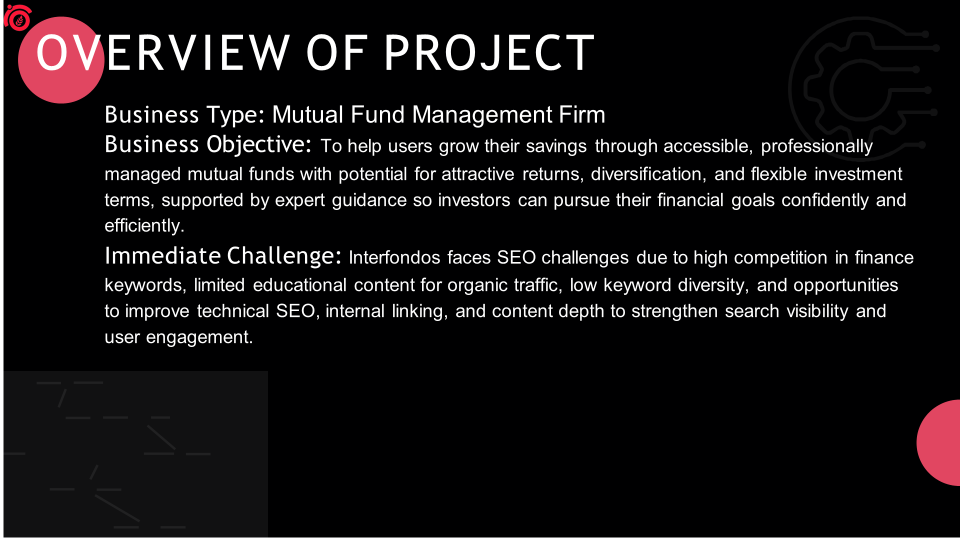
Interfondos operated in a highly competitive financial-services search environment where ranking for valuable investment and mutual-fund-related queries required more than basic on-page optimization. The website had an opportunity to improve both its technical foundation and its ability to comprehensively address educational and informational searches.
The initial challenges identified for the project included:
- High competition across finance-related keywords
- Limited educational content supporting organic discovery
- Low keyword diversity
- Opportunities to increase content depth
- Technical SEO improvements
- Internal-linking opportunities
- Need for stronger topical coverage
- Opportunities to improve user engagement and search visibility
- Need to strengthen visibility across emerging AI-powered search experiences
The challenge was therefore not simply to improve individual keyword rankings. The wider objective was to create a search ecosystem capable of attracting users throughout the investment research journey—from people learning about mutual funds to users evaluating investment options.
The SEO Strategy Executed by ThatWare
ThatWare approached the project through multiple layers of optimization rather than relying on a single SEO tactic. The strategy connected technical improvements with content expansion, semantic optimization, internal linking, and emerging search technologies.
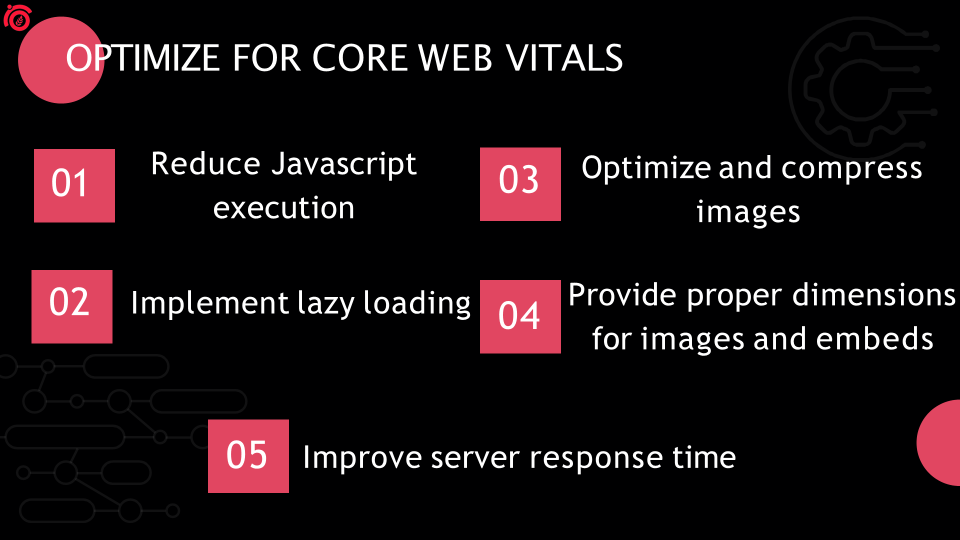
Technical SEO and Core Web Vitals Optimization
Website performance was identified as an important area for improvement. ThatWare focused on Core Web Vitals and implemented practical performance-oriented changes, including:
- Reducing JavaScript execution to minimize unnecessary processing and improve page responsiveness.
- Implementing lazy loading so resources could load more efficiently when required.
- Optimizing and compressing images to reduce page weight without compromising useful visual content.
- Providing appropriate dimensions for images and embeds to improve layout stability and prevent unnecessary shifts.
- Improving server response time to establish a faster foundation for page delivery.
These technical improvements were designed to support both search accessibility and the experience of users navigating a financial website where clarity and responsiveness are particularly important.
Expanding Content Depth and Keyword Coverage
Technical optimization alone could not address the full search opportunity. The campaign therefore focused on expanding the informational depth of the website.
The strategy targeted broader keyword coverage around mutual funds, investment concepts, benefits, risk profiles, diversification, accessibility, and related financial topics. Instead of concentrating only on commercially oriented phrases, the content strategy addressed informational queries that potential investors could use during the research stage.
This created opportunities for Interfondos to establish greater topical relevance and build a more comprehensive information ecosystem around its core financial offerings.
Strengthening Internal Linking and Semantic Relationships
Internal linking was another important component of the campaign. Relevant pages and informational resources were connected to create clearer relationships between related concepts.
This helped create a stronger semantic structure around topics such as mutual funds, investment options, diversification, accessibility, risk, and professional management.
The strategy was particularly valuable for an industry where users often need educational information before making an investment-related decision.
Advanced AEO and AI Search Optimization
A major differentiator of the campaign was the incorporation of advanced Answer Engine Optimization (AEO) and semantic search principles.
Rather than optimizing solely for conventional search-result positions, the content was structured to answer user questions clearly and comprehensively.
The supplied campaign evidence shows Interfondos content appearing within Google’s AI showcase/AI Overview experience, with the content presented for relevant investment-related queries.
This demonstrates how a strategically structured content ecosystem can extend visibility beyond traditional organic listings.
AI Search Visibility and Content Ownership
The campaign evidence also shows Interfondos appearing across multiple featured positions in AI-generated search experiences.
This is significant because AI-powered search systems evaluate context, semantic relevance, source credibility, and the comprehensiveness of available information when generating responses.
The strategy therefore focused on building content that could be understood not simply as individual webpages, but as part of a broader authoritative knowledge ecosystem surrounding mutual funds and investment education.
The Results: Significant Growth in Website Traffic
The campaign produced substantial measurable growth in website traffic.
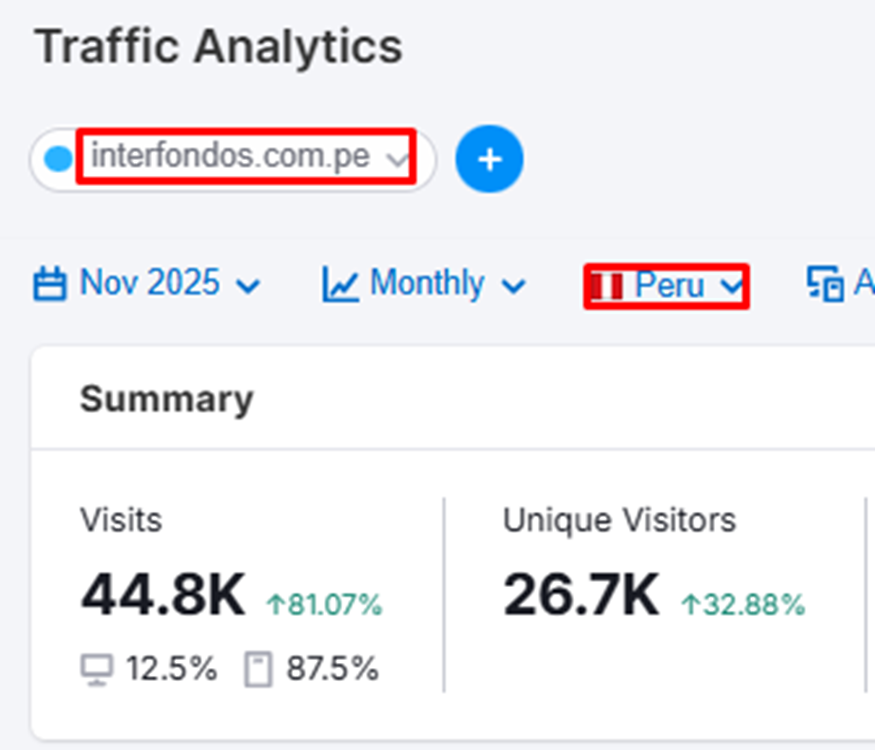
44.8K Website Visits
Interfondos recorded 44.8K visits, representing an impressive 81.07% increase.
This indicates strong upward momentum in overall website acquisition and demonstrates the impact of combining technical, content, and search optimization.
26.7K Unique Visitors
The website also recorded 26.7K unique visitors, reflecting a 32.88% increase.
The growth in unique users indicates that the campaign was not simply generating repeated visits from an existing audience; it was expanding the site’s reach to additional users.
Strong Returning-User Engagement
The campaign data also showed 87.5% returning users, alongside 12.5% desktop visitors in the reported traffic breakdown.
The strong returning-user figure is particularly relevant for a financial information website, where users may research investment options, revisit educational resources, compare funds, and continue their decision-making journey over multiple sessions.
AI-Powered Search Visibility Added Another Growth Layer
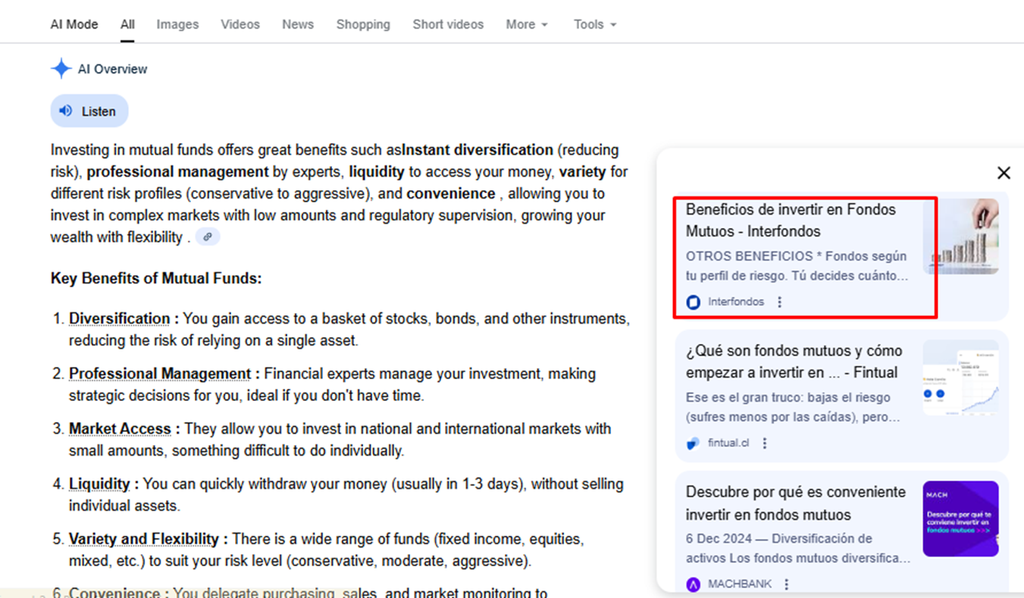
The results extended beyond traffic analytics.
The campaign evidence demonstrates that Interfondos content achieved visibility within AI-powered search experiences, including Google’s AI showcase.
The content was positioned to answer investment-related questions around mutual funds, including concepts such as diversification, professional management, market access, liquidity, and flexibility.
This reflects a fundamental shift in modern SEO: visibility is no longer limited to traditional blue-link rankings.
Brands increasingly need content capable of being understood, retrieved, summarized, and referenced by AI-powered search systems.
What the Interfondos Case Study Demonstrates
The Interfondos campaign provides a strong example of why modern SEO requires a multi-dimensional strategy.
The growth was not dependent on one isolated activity. Instead, the campaign brought together:
- Technical SEO
- Core Web Vitals optimization
- Website performance improvements
- Internal-linking optimization
- Keyword diversification
- Educational content development
- Semantic SEO
- Search-intent optimization
- AEO
- AI search optimization
- Content authority development
The measurable outcome was 44.8K visits with 81.07% growth, alongside 26.7K unique visitors with 32.88% growth.
For businesses evaluating advanced SEO partners in Malta, this case study demonstrates the importance of choosing an agency capable of working across both established and emerging search environments. The same principles can be adapted for businesses that need stronger technical foundations, deeper topical authority, improved local visibility, or greater exposure across AI-powered search.
From Traditional Rankings to Intelligent Search Visibility
ThatWare’s approach reflects the direction of modern SEO: technical excellence provides the foundation, high-quality content satisfies search intent, semantic optimization establishes context, and AEO and AI-search strategies prepare brands for increasingly intelligent discovery systems.
For businesses in Malta looking beyond conventional keyword-based SEO, the Interfondos campaign demonstrates how an integrated approach can turn search optimization into a measurable digital growth engine.
Professional SEO Solutions Designed Around Your Business Goals
Modern search optimization requires a connected strategy. Technical performance creates the foundation, useful content addresses customer intent, local optimization strengthens geographic visibility, semantic SEO improves contextual understanding, authority development builds credibility, and AI search optimization prepares brands for emerging discovery experiences.
A successful campaign should not depend on shortcuts or temporary ranking tactics. Sustainable growth comes from creating a technically sound website, publishing genuinely valuable information, building credible digital authority, understanding audiences, and continually adapting to changes in search behavior.
ThatWare develops Professional SEO Services Malta around these principles, combining established optimization practices with advanced search technologies. The strategy can be tailored to a startup, local company, e-commerce website, enterprise organization, or international business based on its objectives and market position.
The ultimate goal is straightforward: create a search presence that attracts the right audience, communicates genuine expertise, supports trust, and contributes to measurable business growth.
Build Stronger Search Visibility With a Future-Ready SEO Strategy in Malta
Your website may already have valuable products, services, expertise, and customer information, but these assets can remain underutilized when the right audience cannot discover them through search. A strong digital presence requires more than publishing webpages and waiting for rankings to improve. It requires a structured strategy that identifies technical barriers, content gaps, competitive weaknesses, authority opportunities, local search potential, and emerging changes in user behaviour.
ThatWare provides Organic SEO Services Malta designed around sustainable growth, helping businesses build a stronger foundation for long-term organic visibility. Instead of relying on short-lived tactics, the approach focuses on understanding the website, industry, audience, competitors, search intent, and business objectives before creating a practical optimization roadmap.
A customized SEO assessment can reveal how effectively your website is currently being crawled, indexed, understood, and presented to search engines. It can also identify opportunities across content structure, internal linking, metadata, website performance, mobile experience, structured data, keyword targeting, and conversion pathways. These insights provide a clearer direction for prioritizing activities that can deliver meaningful value.
Businesses looking for the Best SEO Company in Malta should consider more than promises of quick rankings. A capable SEO partner should understand how technical optimization, content quality, authority, user experience, local relevance, and semantic search work together. The focus should remain on attracting qualified visitors who are genuinely interested in the products or services being offered.
For organizations evaluating the Best SEO Agency in Malta, a customized strategy can provide a more practical alternative to generic packages. Different websites have different challenges, competitive environments, customer journeys, and growth opportunities. A tailored approach allows resources to be directed toward the areas most likely to improve visibility, engagement, enquiries, and conversions.
Businesses exploring Search Engine Optimization Malta can also benefit from a strategy that considers how search behaviour continues to evolve. Traditional search engines now operate alongside conversational interfaces, AI-generated answers, voice-based discovery, and other intelligent search experiences. Preparing for these developments requires strong technical foundations, authoritative content, clear entities, meaningful relationships between topics, and consistent digital information.
As a technology-driven Digital Marketing Agency Malta, ThatWare can connect organic search with broader digital growth objectives. SEO can work alongside content marketing, digital PR, brand development, conversion optimization, and other acquisition activities to create a more unified online presence.
An experienced SEO Consultant Malta can help identify priorities, interpret performance data, evaluate competitors, and establish realistic growth opportunities. Businesses can use these insights to make informed decisions rather than investing blindly across multiple SEO activities.
Likewise, an experienced SEO Expert Malta can provide specialized guidance when websites face complex technical challenges, competitive search markets, international expansion requirements, or changing AI-search expectations.
Start With a Clear SEO Roadmap
The right SEO strategy begins with understanding where your website stands today and where it needs to go next. A detailed audit can uncover overlooked opportunities and establish a practical foundation for future optimization.
With the right combination of technical excellence, relevant content, authority, semantic optimization, local visibility, and forward-looking search strategy, businesses in Malta can build a more discoverable and resilient digital presence that supports sustainable growth.
Conclusion: Build a Stronger, Future-Ready Search Presence in Malta
SEO has evolved into a multidimensional discipline where technical performance, valuable content, semantic relevance, local authority, user experience, and AI search visibility must work together. For businesses in Malta, this integrated approach can create stronger opportunities to attract qualified audiences, build digital credibility, and generate sustainable growth. From improving website architecture and Core Web Vitals to developing topical authority, strengthening local visibility, and preparing content for AI-powered search experiences, every optimization should support a clear business objective. ThatWare brings these capabilities together through a data-driven, AI-first methodology tailored to each organization’s market, audience, competition, and growth goals. The Interfondos case study further demonstrates how an integrated strategy can translate advanced SEO execution into measurable traffic growth and expanded search visibility. Businesses ready to strengthen their digital presence can begin with a customized SEO audit and discover the opportunities that can shape their next stage of organic growth.
Discover where your website currently stands, identify missed search opportunities, and build a practical roadmap for stronger visibility across traditional, local, semantic, and AI-powered search.