
SUPERCHARGE YOUR ONLINE VISIBILITY! CONTACT US AND LET’S ACHIEVE EXCELLENCE TOGETHER!
Search has always been a competition for visibility. For decades, businesses have optimized pages, earned links, researched keywords, improved technical performance, and competed for prominent positions in search results. But AI-driven search is introducing another layer to that competition: which sources are selected to construct the answer itself.
The emerging ChatGPT Citation Shift is an important signal of this change. Recent tracking has shown notable changes in the types of websites appearing in ChatGPT-generated answers. Reddit, forums, review platforms, and smaller websites have reportedly experienced substantial declines in citation share, while official documentation, help centers, established companies, and other authoritative sources have gained visibility.
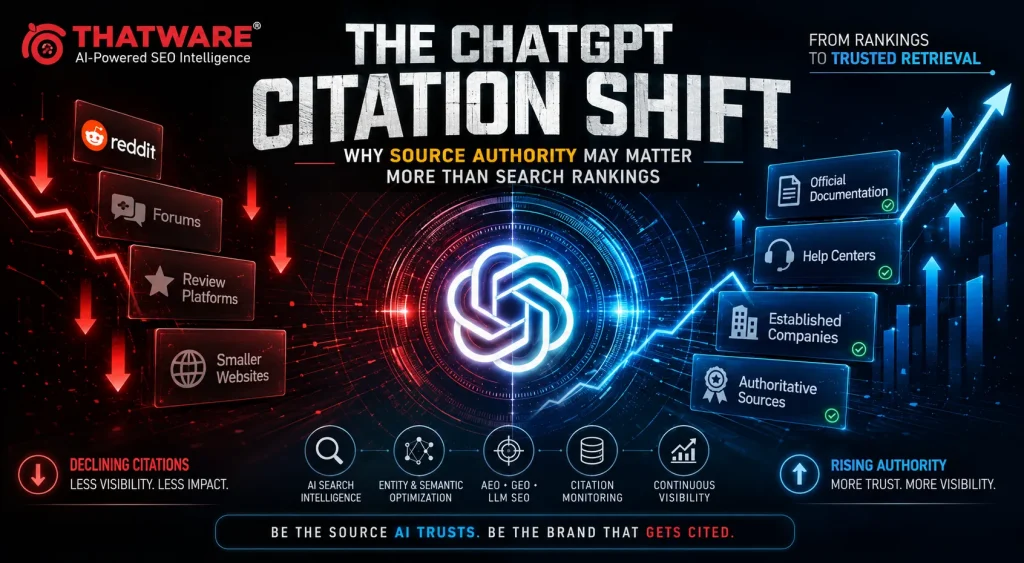
The important question is therefore no longer simply:
Can a website rank highly for a search query?
It is increasingly:
Can an AI system identify, retrieve, understand, trust, and cite that website when constructing an answer?
This does not make traditional search rankings irrelevant. Rankings remain important for discovery, organic traffic, visibility, and credibility. However, AI search introduces an additional decision-making layer between a user’s question and the information ultimately presented.
That layer may consider source authority, entity credibility, semantic relevance, first-party information, contextual usefulness, and retrievability alongside traditional search signals.
The broader implication is significant. A business may have a page capable of ranking well and still have limited visibility inside AI-generated answers. Conversely, a highly relevant authoritative source may become valuable to an AI system because it provides precise information that can be confidently incorporated into an answer.
The future of search may therefore be less about competing for one position and more about becoming one of the sources an intelligent retrieval system considers worth using.
2. What Is the “ChatGPT Citation Shift”?
2.1 From Search Results to AI-Generated Answers
Traditional search follows a relatively familiar path:
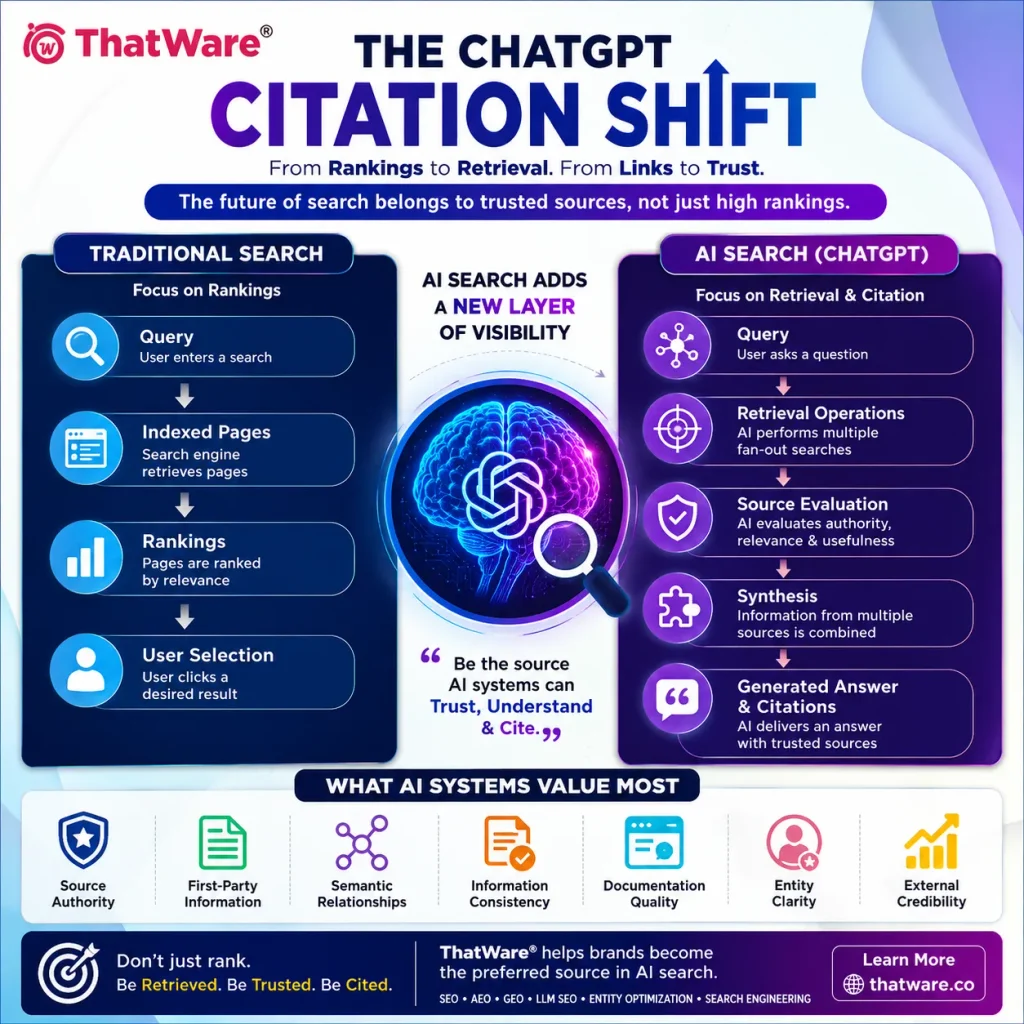
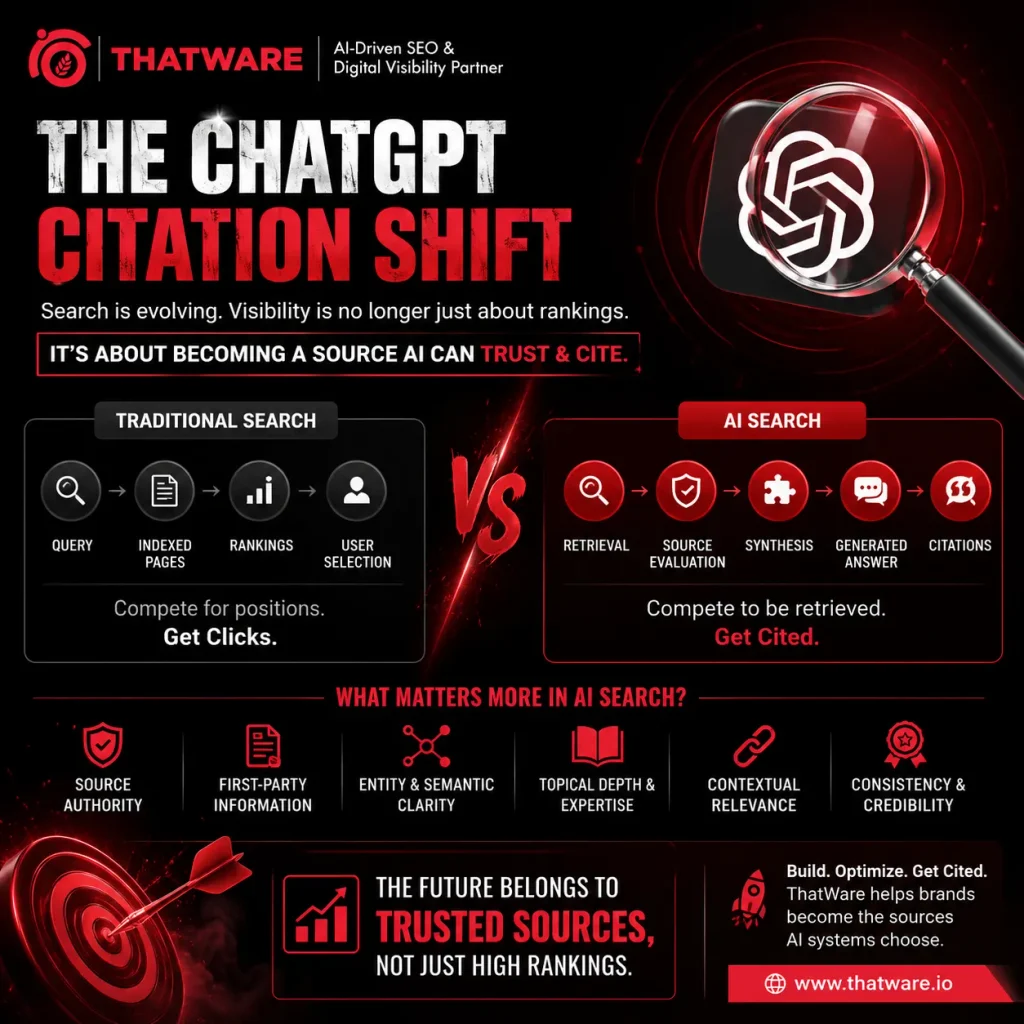
Query → Indexed Pages → Rankings → User Selection
A person enters a query, the search engine retrieves potentially relevant pages, ranks them according to its systems, and presents a results page. The user then decides which result to open.
AI search introduces a fundamentally different interaction:
Query → Retrieval Operations → Source Evaluation → Synthesis → Generated Answer → Citations
Instead of simply presenting a list of documents, an AI system can gather information from multiple sources, interpret the information, combine relevant facts, and produce a conversational response.
That makes a citation different from a conventional search ranking.
A ranking tells us that a page has been positioned prominently for a particular query. A citation indicates that information from a source has been selected as part of the evidence or material used to construct an answer.
This distinction matters.
A page can rank prominently for a keyword while never becoming part of an AI-generated response. At the same time, another source that is not occupying the most visible traditional position may contain exactly the information an AI system needs.
The competition is consequently expanding from ranking for queries to being retrievable for questions.
2.2 What Recent Tracking Data Appears to Show
Recent tracking discussed in the supplied research illustrates how quickly the citation environment can change.
Promptwatch data reportedly showed Reddit maintaining an average citation share of approximately 3.83% over one observed period, before falling to approximately 0.52% during a later observed period. That represents a substantial relative decline.
The same analysis identified a sharp increase in ChatGPT fan-out searches using the site: operator. Site-specific queries reportedly increased from approximately 0.37% to 16.8% of observed fan-out queries. The average number of fan-out queries per response also increased substantially.
The citation mix reportedly changed more broadly than Reddit alone. Review sites and forums, along with smaller company websites, were observed losing share, while help centers, documentation, established companies, and application marketplaces gained visibility.
However, an important distinction must be maintained:
Correlation does not establish causation.
The increase in site-specific searches occurred first, while the sharper Reddit citation decline occurred later. That timing makes it difficult to conclude that one event completely explains the other.
There are also questions about data collection, search infrastructure, and external changes that can influence what third-party tracking systems observe.
Therefore, the responsible conclusion is not that ChatGPT has permanently abandoned a particular class of websites. The more useful conclusion is that AI retrieval behavior appears capable of changing rapidly, and the composition of cited sources deserves close attention.
2.3 Why the Shift Matters Beyond Reddit
Reddit is the most visible example, but Reddit itself is not necessarily the central story.
The larger question is how AI systems discover and select information.
If an AI search system increasingly performs targeted retrieval from particular domains, documentation repositories, official sources, or established entities, then the process of information discovery may be becoming more deliberate.
That could change how businesses think about visibility.
Instead of asking only, “Where do we rank?” businesses may need to ask:
- Which sources does AI search retrieve for our industry?
- Which domains are repeatedly cited?
- What characteristics do those sources share?
- Are competitors being selected more frequently?
- Does our website contain authoritative answers to the questions users ask?
- Can an AI system clearly understand our organization and its expertise?
These questions move the discussion beyond Reddit and toward the underlying architecture of AI search.
3. From “What Ranks?” to “What Gets Retrieved?”
3.1 How Traditional SEO Thinks About Visibility
Traditional SEO has developed around a set of familiar principles.
Businesses research keywords to understand demand. They create relevant content. They optimize pages for users and search engines. They build backlinks and authority. They improve technical accessibility. They strengthen internal linking and compete against other pages in search engine results pages.
These activities remain valuable.
Search engines still need to discover, crawl, index, and evaluate content. A technically inaccessible website cannot perform effectively regardless of how authoritative its subject matter may be.
But AI search adds another stage to the journey.
Consider the following model:
Ranking → Retrieval → Evaluation → Synthesis → Citation
The difference is subtle but powerful.
Traditional SEO largely focuses on improving the probability that a document will appear prominently when someone searches.
AI search asks another question:
Is this document useful enough, trustworthy enough, relevant enough, and understandable enough to become part of an answer?
A page may rank well for a broad term but contain little information that an AI system can confidently use.
Another page might receive less traditional search visibility but provide an exceptionally clear explanation of a specific product feature, official specification, technical process, or pricing condition.
That second page may have greater value during retrieval for a highly specific question.
3.2 How AI Search Adds Another Layer
Imagine someone asks:
“Which enterprise software supports a particular integration, and what does the integration require?”
A traditional search engine may return pages ranking for terms related to enterprise software and integrations.
An AI search system can approach the problem differently. It may search for the product, look for documentation, verify the integration, investigate technical requirements, and compare information from several sources before producing its answer.
The result is not simply a ranked list.
It is a constructed response.
This makes certain characteristics particularly useful:
- Precise information
- Strong entity associations
- First-party facts
- Clear documentation
- Strong contextual relevance
- Consistent terminology
- Easily retrievable answers
3.3 The New Competition
Businesses are therefore competing for more than clicks.
They are competing to become retrievable and citable sources.
This creates a useful concept: citation eligibility.
Citation eligibility is not necessarily a formal ranking factor. Rather, it describes the collection of qualities that can make a source suitable for inclusion in an AI-generated response.
A page may be eligible because it is authoritative. Another may be useful because it contains unique first-party information. A third may be selected because it directly answers a very specific question.
The objective is no longer simply to produce another page targeting the same keyword.
It is to build information that an AI system can confidently retrieve and use.
4. Why Source Authority May Matter More in AI Search
4.1 Authority Is More Than Domain Rating
One of the biggest misconceptions surrounding AI visibility is that source authority can be reduced to a single SEO metric.
It cannot.
An AI system evaluating information can potentially benefit from a much broader understanding of authority, including:
| Authority Dimension | Why It Can Matter in AI Search |
| Brand recognition | Helps establish what an organization or product represents |
| First-party information | Provides direct information from the source itself |
| Topical expertise | Demonstrates depth within a subject |
| Semantic relationships | Helps connect entities, topics, products, and concepts |
| Information consistency | Reduces ambiguity and conflicting interpretations |
| Documentation quality | Makes precise information easier to retrieve |
| Author credibility | Provides context around expertise |
| External references | Supports recognition beyond the organization’s own website |
| Historical reputation | Contributes to broader perceptions of reliability |
This is why simply increasing a domain’s authority metric may not solve every AI visibility problem.
AI systems need to understand not only whether a website is strong, but what the website knows and why that knowledge should be considered relevant.
A highly authoritative website about financial technology may not automatically be the best source for a highly technical question about a specialized engineering component.
Topical relevance remains essential.
4.2 First-Party Sources Become More Valuable
First-party information has an obvious advantage: the organization is directly responsible for the information.
Consider a software company.
A third-party article might describe its pricing, but the company’s own pricing page can provide the actual plans, conditions, limitations, and current structure.
The same principle applies to:
- Official product pages
- Company documentation
- Help centers
- Pricing pages
- Policies
- Research publications
- Official announcements
- Technical specifications
- Support resources.
When a question requires an exact fact, first-party information can provide a particularly useful retrieval target.
For example, if an AI system needs to answer what a software product charges for a specific feature, a clearly structured official pricing page may be more useful than a third-party article published months earlier.
This does not make third-party sources irrelevant. Third-party sources may provide independent analysis, comparisons, reviews, and user experiences.
But it does mean organizations should not leave important facts scattered exclusively across external websites.
If a business wants an AI system to understand something about the business, it should make that information clearly available on an authoritative first-party source.
4.3 Entity Authority vs. Page Authority
There is another important distinction:
Page authority asks:
How strong is this individual URL?
Entity authority asks:
How confidently can the system identify and understand this organization, product, person, or concept?
This distinction becomes increasingly important in AI search.
Suppose a company has hundreds of pages but inconsistent descriptions of its products, services, leadership, locations, and areas of expertise.
The website may have strong individual pages, yet the overall entity can remain difficult to interpret.
Now imagine another organization with fewer pages but a highly consistent digital presence. Its website, documentation, profiles, publications, and external references all communicate the same core facts.
The second organization may provide a clearer information environment for an AI system.
This is why modern search visibility increasingly involves entity clarity, not merely page optimization.
The goal is to make the relationship between the brand and its expertise unmistakable.
5. The Role of Query Fan-Outs in the Citation Shift
5.1 What Is Query Fan-Out?
A user may ask one question, but an AI search system can effectively break that question into several smaller information needs.
Imagine a user asks about an enterprise software product.
The system may need to investigate:
- Product capabilities
- Official pricing
- Documentation
- Feature specifications
- Reviews
- Company information
- Integration requirements
- Limitations or eligibility conditions.
These individual retrieval operations can collectively be thought of as query fan-outs.
Instead of relying on one broad search, the system can pursue multiple paths to construct a more complete answer.
That is important because the quality of the final answer depends partly on the quality and relevance of the information retrieved along those paths.
5.2 What This Could Mean for SEO
Broad discoverability may no longer be enough.
Businesses need information architecture that makes important facts easy to locate and interpret.
If a company has a critical product specification, that information should not be buried inside an unrelated article.
If pricing matters, pricing information should have an authoritative location.
If a service has specific eligibility criteria, those criteria should be clearly documented.
If a company has specialized expertise, that expertise should be demonstrated through substantial, relevant content.
In other words:
Every important business fact should have an authoritative, crawlable, contextually connected source.
That creates a stronger information environment for both traditional search engines and AI retrieval systems.
6. Why Reddit and Other Third-Party Sources Still Matter
The ChatGPT Citation Shift should not be interpreted as “Reddit is dead.”
That would be an unnecessarily simplistic conclusion.
6.1 The Uncertainty Around the Reddit Drop
The supplied research itself highlights the uncertainty.
The increase in site-specific fan-out queries occurred first, while the most substantial Reddit citation decline was observed later.
That gap matters.
It means the first change may have contributed to some behavior, but it cannot automatically explain the entire movement in citation patterns.
There is also precedent for external search infrastructure changes affecting how third-party visibility trackers observe Reddit.
The correct response is therefore observation rather than overreaction.
6.2 Third-Party Information Has a Different Role
Community platforms can offer information that official websites often cannot.
Reddit, forums, reviews, and online communities can provide:
- User experience
- Product sentiment
- Real-world problems
- Unfiltered opinions
- Long-tail questions
- Troubleshooting discussions
- Comparisons based on actual use.
A company website might say that a product has a particular capability. Users can reveal how that capability behaves in real-world conditions.
That distinction is valuable.
AI systems need authoritative facts, but they can also benefit from diverse perspectives.
6.3 The Strategic Lesson
The correct strategy is not to abandon third-party platforms whenever their citation share declines.
It is to build first-party authority while maintaining third-party credibility.
A strong digital presence can therefore include both:
First-party sources:
Official facts, documentation, research, products, services, policies, and expertise.
Third-party sources:
Independent reviews, discussions, references, community experiences, publications, and external validation.
The balance may change as AI retrieval systems evolve.
That is precisely why businesses need a broader visibility strategy rather than dependence on one platform.
7. What the ChatGPT Citation Shift Means for SEO, AEO, GEO, and LLM SEO
The most important lesson from the citation shift is not that traditional SEO has become obsolete.
It is that search visibility is expanding into a more complex ecosystem.
7.1 Traditional SEO Is Not Dead
Google rankings still matter.
Organic traffic still matters.
Crawling and indexation still matter.
Technical SEO still matters.
Content relevance and authority still matter.
A website that cannot be discovered or understood by conventional search systems will face challenges in AI search as well.
The change is that businesses now have another visibility layer to consider.
Traditional SEO helps a website compete in search results.
AI-focused optimization helps ensure that the information contained within that website can participate in generated answers.
The two approaches should complement each other.
7.2 AEO: Becoming the Answer
Answer Engine Optimization focuses on making information useful for systems that provide direct answers rather than simply presenting ranked links.
The practical principles are straightforward:
- Structure information around real questions.
- Give direct and unambiguous answers.
- Use descriptive headings.
- Provide context around important claims.
- Build comprehensive supporting content.
- Make individual facts easy to extract and understand.
The objective is not to write for a machine at the expense of humans.
It is to make useful information clear enough that both humans and intelligent systems can understand it.
7.3 GEO: Becoming the Source Behind the Generated Answer
Generative Engine Optimization takes this idea into environments where systems synthesize information before presenting an answer.
The goal is not merely to achieve a position on a results page.
It is to increase the likelihood that a brand’s information will be discovered, understood, trusted, and represented accurately within generated responses.
That requires topical depth, strong source credibility, semantic relationships, and useful first-party information.
A thin page targeting one keyword is unlikely to establish comprehensive authority around a complex subject.
A connected knowledge ecosystem can do much more.
7.4 LLM SEO: Making the Brand Machine-Readable
LLM SEO focuses on improving the discoverability and interpretability of a brand within large language model-driven search environments.
The underlying principle is simple:
AI systems need to understand what an organization is, what it does, what it offers, and why it is relevant to particular questions.
That means businesses should establish:
- Consistent entity information
- Clear descriptions of products and services
- Authoritative subject-matter content
- Strong relationships between related entities
- Consistent terminology
- Accessible supporting documentation.
The goal is not to manipulate an AI system into mentioning a company.
The goal is to create such a clear and authoritative information environment that the company becomes a logical source when relevant questions arise.
7.5 Semantic and Entity SEO
AI systems need context.
They need to understand the difference between a company, a product, a person, a service, an industry, and a concept. They also need to understand how those entities relate to one another.
A company should therefore communicate:
- Who it is
- What it does
- Which products or services it provides
- What topics it specializes in
- Who its audiences are
- How its offerings relate to broader industry concepts.
This is where semantic relationships become powerful.
The future of search is increasingly about meaning rather than isolated strings of keywords.
8. How Businesses Can Adapt to the ChatGPT Citation Shift
Businesses do not need to predict exactly what ChatGPT will do next.
They need to build an information ecosystem capable of adapting when retrieval behavior changes.
8.1 Build an Authoritative First-Party Knowledge Layer
Start with the information you control.
Create strong:
- Documentation
- Product pages
- Service pages
- FAQs
- Research
- Case studies
- Pricing information
- Definitions
- Original data.
The purpose is to ensure that critical facts have a reliable home.
If an organization expects AI systems to understand its expertise, that expertise should be documented clearly on its own digital properties.
8.2 Strengthen Entity Consistency
Important facts should remain consistent across the organization’s digital ecosystem.
Review:
- Website
- Business profiles
- Industry publications
- Author profiles
- Social platforms
- Third-party references.
If one source describes a company as specializing in one field while another presents a completely different positioning, ambiguity can increase.
Consistency helps establish a clearer digital identity.
8.3 Create Content That Answers Specific Questions
Broad keyword targeting should not be the only content strategy.
Instead of producing another generic article targeting:
“Best enterprise CRM”
consider questions such as:
“How does [product] handle enterprise data migration?”
“What integrations does [product] support?”
“What does [company] charge for [specific feature]?”
Specific questions create opportunities to demonstrate specific expertise.
This is particularly valuable when AI systems need precise information to construct an answer.
8.4 Make Important Information Easy to Retrieve
Information architecture matters.
Use:
- Clear headings
- Concise answers
- Logical internal linking
- Structured content
- Strong contextual relationships
- Descriptive page titles
- Clearly defined terminology.
Avoid unnecessarily hiding critical information behind confusing navigation or vague page structures.
The more important a fact is to the business, the easier it should be to locate.
8.5 Monitor AI Citations, Not Just Rankings
Businesses should expand their measurement framework.
Monitor:
- Whether the brand appears
- Which URLs are cited
- Which competitors are cited
- What questions trigger mentions
- Which sources appear repeatedly
- Which topics generate visibility
- How citation patterns change over time.
This creates a new measurement discipline.
The important metric is not simply:
“Did we rank?”
It increasingly becomes:
“Were we retrieved, represented accurately, and cited when users asked relevant questions?”
9. How ThatWare Can Help Brands Adapt to the ChatGPT Citation Shift
The ChatGPT Citation Shift demonstrates why AI search visibility requires more than conventional rank tracking. With the core strategy of AI powered SEO, ThatWare approaches this emerging environment through a combination of search intelligence, semantic analysis, entity optimization, and AI-oriented search strategies.
The objective is not to react to every individual citation fluctuation. It is to understand why a brand is being retrieved, why another source is being preferred, and what information architecture can improve the brand’s overall authority.
9.1 From SEO Monitoring to AI Search Intelligence
ThatWare’s stated approach brings together traditional search optimization with newer AI-search disciplines.
Its broader framework incorporates areas such as AI search visibility, semantic SEO, entity optimization, answer-focused optimization, generative search optimization, and search engineering.
This creates a more comprehensive perspective.
Rather than treating an AI citation as an isolated event, the process can examine the wider environment surrounding that citation:
- Which competitors are being mentioned?
- Which domains are being retrieved?
- Which pages are being cited?
- What questions produce those citations?
- What information do those sources provide?
- Which entities are associated with those sources?
The result is a shift from rank monitoring to retrieval intelligence.
9.2 ThatWare’s AI-Driven Analysis Workflow
A practical workflow for responding to changing AI search behavior can be structured into several stages.
1. Search & Competitor Intelligence
The first step is to understand the existing search landscape.
This involves examining how competitors appear across conventional search and AI answer environments and identifying patterns in the topics, questions, and entities associated with their visibility.
The objective is to establish a baseline before making strategic changes.
2. Citation & Source Analysis
The next stage is identifying the sources that repeatedly appear in AI-generated answers.
This can reveal whether competitors are benefiting from:
- Official documentation
- Research
- Strong product pages
- External references
- Community discussions
- Highly focused informational resources.
The important question is not simply who is cited, but why that source is useful to the retrieval system.
3. Entity & Semantic Audit
A brand needs to be understood as an entity within its industry.
An entity and semantic audit can examine whether the organization’s identity, expertise, products, services, people, and industry relationships are communicated consistently.
This helps identify gaps where the organization may have expertise but has not clearly established that expertise across its digital ecosystem.
4. Content & Knowledge Architecture
The next stage is building or strengthening the first-party knowledge layer.
Missing information can be identified and mapped into appropriate:
- Service pages
- Product documentation
- FAQs
- Research
- Guides
- Definitions
- Supporting resources.
The objective is to ensure that important information exists in authoritative and retrievable locations.
5. AEO/GEO/LLM Optimization
Once the knowledge foundation is established, content can be optimized for answer engines, generative systems, and LLM-driven discovery.
This means making information direct, contextual, semantically connected, and useful rather than simply increasing keyword density.
6. Authority Amplification
First-party authority can be strengthened through relevant external references, industry mentions, semantic relationships, research, publications, and other credibility signals.
The goal is to create a broader ecosystem in which the brand’s expertise is consistently reinforced.
7. Continuous AI Visibility Monitoring
AI search behavior can change.
Therefore, optimization cannot be treated as a one-time project.
Citation patterns, competitor visibility, query behavior, and source preferences should be monitored continuously so that the strategy can adapt when the retrieval environment changes.
9.3 Recovering From a Citation Decline
A drop in AI citations should not automatically trigger a flood of new content or a decision to abandon platforms such as Reddit.
The first step should be diagnosis.
Businesses should ask:
- Has retrieval behavior changed?
- Are competitors replacing the brand?
- Are official sources stronger than the brand’s pages?
- Is the entity understood correctly?
- Are important facts missing?
- Are third-party sources contradicting first-party information?
- Has the broader search ecosystem changed?
This approach is especially important because citation volatility does not necessarily mean that the underlying brand authority has disappeared.
A change in retrieval behavior can temporarily alter which sources are visible.
The solution should therefore address the underlying information ecosystem rather than chase individual citations.
9.4 The ThatWare Advantage
ThatWare’s broader positioning around Hyper-Intelligence SEO, semantic engineering, entity optimization, AI search visibility, and search engineering reflects the larger direction of AI search.
The objective is not simply to recover one lost citation.
It is to make a brand a stronger, clearer, more authoritative retrieval source across AI search ecosystems.
That distinction is important.
If search systems continue moving toward increasingly sophisticated retrieval and synthesis, businesses will need strategies that can respond to changing search behavior rather than strategies designed around one static ranking environment.
10. Conclusion:
The ChatGPT Citation Shift is interesting not because Reddit citations have fallen, but because it offers a glimpse into a potentially larger transformation in how AI search discovers information.
Reddit’s decline should be treated as a signal rather than a permanent rule.
The available observations do not establish that one specific change caused the entire movement, and AI search behavior can change quickly. What matters is the broader possibility that retrieval systems are becoming more deliberate about where they look for information.
Traditional rankings remain important. Search engines still need to discover and organize information, and businesses still need strong organic visibility.
But AI-generated answers introduce another layer.
A source may need to be:
- Relevant
- Authoritative
- Understandable
- Semantically connected
- Consistent
- Retrievable
- Supported by credible information.
This changes the strategic question.
Instead of asking only:
“How do we rank higher?”
businesses increasingly need to ask:
“How do we become a source that AI systems can confidently retrieve, understand, trust, and cite?”
That does not mean optimizing exclusively for ChatGPT or abandoning conventional SEO. It means building a digital presence that can perform across multiple forms of discovery.
Strong entities, authoritative first-party information, semantic depth, consistent facts, external credibility, useful documentation, and continuous visibility monitoring can all contribute to that foundation.
The search landscape will continue to evolve. Citation patterns will rise and fall. Retrieval mechanisms will change. New answer engines will emerge, and established systems will continue refining how they gather information.
The brands best positioned for that future may not necessarily be those that chase every algorithmic movement.
They may be the ones that consistently build something more durable:
a body of authoritative information that search systems—and increasingly, AI systems—have a clear reason to trust.