
SUPERCHARGE YOUR ONLINE VISIBILITY! CONTACT US AND LET’S ACHIEVE EXCELLENCE TOGETHER!
Local SEO has evolved far beyond traditional keyword targeting and backlink building, becoming increasingly shaped by search intent, user experience, and AI-driven understanding of content. Today, search engines prioritize results that best satisfy what users are truly looking for, rather than pages that simply match exact keywords. This shift is especially significant in highly competitive local industries such as food and quick-service restaurants, where consumer decisions are immediate and intent-driven. At the same time, advancements in Google’s algorithms and the rise of AI-powered search experiences have transformed how visibility is earned online. Against this backdrop, the Happy Samosa case study by ThatWare demonstrates how a modern, intent-led SEO approach can help a local brand in Calgary cut through competition, improve discoverability, and align with the way users now search, engage, and make decisions online.

About the Client: Happy Samosa
Brand Overview
Happy Samosa is a quick-service restaurant (QSR) brand based in Calgary, Canada, specializing in authentic Indian snacks with a modern street-food appeal. The brand focuses on delivering freshly prepared samosas, chaat, and fusion-style bowls that combine traditional Indian flavors with contemporary presentation. Positioned as both a dine-in and takeaway-friendly destination, Happy Samosa caters to customers looking for quick, flavorful, and affordable Indian comfort food. The menu is designed to appeal to a wide audience, from those seeking classic vegetarian samosas to more indulgent options such as paneer, butter chicken-inspired fillings, and loaded chaat bowls.
Culinary Positioning and Menu Identity
At its core, Happy Samosa builds its identity around authenticity and variety. The brand emphasizes handmade preparation, crisp textures, and bold flavors that reflect traditional Indian street food culture. Signature offerings such as samosas and samosa bowls are elevated with creative fillings and toppings, including chickpeas, chutneys, yogurt, and spices that replicate the experience of Indian chaat stalls. This fusion approach allows the brand to stand out in Calgary’s competitive food landscape by offering something both familiar and differentiated. The menu is intentionally structured to be keyword-aligned as well, supporting digital discoverability for high-intent local search queries.
Market Position and Customer Experience
Operating in Calgary’s fast-growing multicultural food scene, Happy Samosa targets customers who value quick service without compromising on authenticity or taste. The brand competes in a saturated QSR environment where differentiation depends heavily on both product quality and digital visibility. In addition to dine-in and takeaway services, the business also supports delivery channels, making accessibility a key part of its customer experience strategy. The overall positioning focuses on being a go-to destination for “best samosas in Calgary” while also expanding into broader search categories like bowls and chaat-based meals.
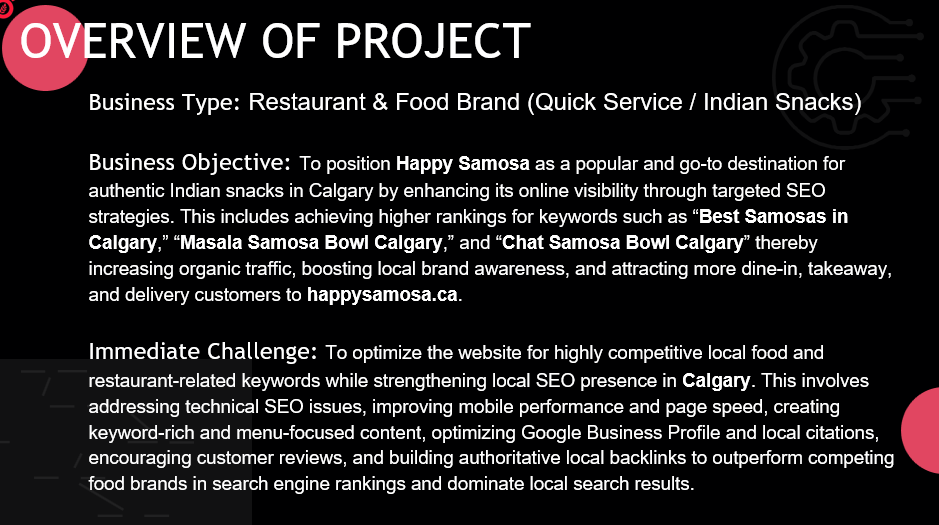
Business Objective
The primary objective for Happy Samosa is to establish strong local brand authority and become the top search-visible destination for Indian snacks in Calgary. This includes increasing footfall, boosting online orders, and strengthening brand recall across both traditional search engines and emerging AI-driven discovery platforms. Through improved SEO visibility, the brand aims to connect high-intent search users directly to its menu offerings and convert digital discovery into real-world customer visits.
The Challenge: Competing in a Saturated Local Food Market
Highly Competitive Local Search Landscape
Happy Samosa operates in Calgary’s highly competitive quick-service restaurant and ethnic food market, where numerous restaurants compete for the same high-intent search queries. Keywords such as “Best Samosas in Calgary” and “Chaat Bowl Calgary” are not only commercially valuable but also heavily contested by established local eateries, food chains, and aggregator platforms. This created a significant challenge in achieving consistent visibility on Google’s first page, where most user clicks and conversions occur. The competition was not limited to direct Indian food competitors but also extended to broader snack and fast-casual dining options targeting similar audiences.
Limited Initial Organic Visibility
At the beginning of the campaign, the website had relatively low organic reach and limited keyword footprint across priority search terms. The brand lacked strong visibility for high-intent local queries that directly influence purchase decisions, such as “Masala Samosa Bowl Calgary.” As a result, potential customers searching for Indian snacks in Calgary were more likely to discover competitors with stronger SEO foundations or larger domain authority. This gap in visibility directly impacted the brand’s ability to attract consistent organic traffic and convert search interest into store visits and online orders.
Technical and Structural SEO Gaps
In addition to competitive pressure, the website faced several technical and structural SEO challenges that affected performance. These included suboptimal page speed, inefficient JavaScript execution, and a lack of streamlined site architecture, all of which limited crawl efficiency and user experience. Mobile usability also required improvement, which is critical in the food discovery journey where most users search on smartphones. Furthermore, the content structure was not fully optimized to support keyword intent mapping or local SEO signals, reducing the site’s ability to rank for location-based queries.
Need for Stronger Local Authority Signals
Another key challenge was the absence of strong local SEO authority indicators such as optimized Google Business Profile signals, consistent local citations, and review-driven trust signals. In a market like Calgary, where “near me” and location-based searches dominate food discovery behavior, these elements are essential for appearing in map packs and local results. Without a strong local authority foundation, even well-optimized content struggled to compete effectively against more established local restaurant listings.
Core SEO Philosophy: Search Intent First
The Shift from Keywords to Intent
Modern SEO is no longer driven by exact-match keywords alone; it is fundamentally guided by search intent. The core idea is simple but powerful: Google’s primary goal is to deliver the most relevant and satisfying answer to a user’s query. This means that pages which fully understand and address what the user actually wants are more likely to rank than those that simply repeat keywords. For a local food brand like Happy Samosa, this shift is especially important because users searching for terms like “Best Samosas in Calgary” are not looking for generic information—they are looking for a specific, satisfying food experience they can act on immediately.
How Search Engines Understand Intent
Search engines have evolved significantly through algorithm updates such as Panda, RankBrain, and BERT. Panda focuses on content quality and penalizes thin or low-value pages, ensuring only meaningful content ranks well. RankBrain introduced machine learning to better interpret ambiguous or evolving search queries, allowing Google to understand context rather than just keywords. BERT further improved this capability by enabling Google to process natural language more effectively, especially for conversational and long-tail queries. Together, these systems ensure that content must align with intent, context, and relevance rather than surface-level keyword repetition.
Applying Intent to Local SEO Strategy
In the context of Happy Samosa, search intent was broken down into clear user motivations behind queries. For example, someone searching “Masala Samosa Bowl Calgary” is likely looking for a filling, fusion-style street food experience, while a user searching “Best Samosas in Calgary” is evaluating quality, authenticity, and reputation. Understanding these distinctions allowed the SEO strategy to move beyond generic optimization and instead focus on crafting highly relevant content tailored to each intent type. This ensured that every key landing page aligned directly with what users expected to find.
Strategic Impact of Intent-Led SEO
By prioritizing search intent, the SEO strategy ensured that content was not only visible but also meaningful to users. This approach improved engagement signals such as time on page, click-through rates, and return visits, all of which contribute to stronger rankings over time. More importantly, it helped bridge the gap between online discovery and real-world action, guiding users from search results to menu exploration and ultimately to store visits or orders. In today’s SEO landscape, understanding and satisfying intent is not just an advantage—it is the foundation of sustainable visibility and growth.
Strategy Framework: The 3C’s of Search Intent
Content Type
The first pillar of the strategy focused on building the right types of content to match different stages of user search behavior. Instead of relying on a single-page approach, the website was structured into distinct content layers that could target multiple intent-driven queries. This included dedicated category pages for core menu items such as samosas, bowls, and chaat, ensuring each product category had its own optimized presence in search. In addition, local landing pages were created to strengthen geo-targeted visibility within Calgary. Menu-focused SEO pages were also developed to directly align with transactional searches, where users are actively looking to explore or order food. Supporting blog content played a secondary role in expanding topical authority and capturing informational queries related to Indian street food, ingredients, and cultural context.
Content Format
The second pillar focused on how the content was structured and presented for both users and search engines. All pages were designed with a clear hierarchy, ensuring that headings, subheadings, and internal sections followed a logical flow aligned with keyword intent. This helped search engines better understand topical relevance while also improving readability for users. Keyword mapping was carefully implemented across pages to avoid overlap and ensure each page targeted a distinct search intent. A strong emphasis was placed on location-driven optimization, with Calgary consistently integrated into content structure, headings, and contextual references. This ensured that the website remained highly relevant for local search queries where geographic intent plays a critical role in rankings.
Content Angle
The final pillar focused on message alignment with user intent, ensuring that every page communicated in a way that matched what users were actually searching for. For example, the query “Best Samosas in Calgary” was addressed through messaging that highlighted freshness, authenticity, and variety, reinforcing quality-driven decision-making. For “Masala Samosa Bowl Calgary,” the content emphasized a fusion street-style experience featuring loaded, flavorful bowls inspired by Indian chaat culture. Similarly, “Chaat Bowl Calgary” was positioned around tangy, customizable, and authentic chaat experiences, appealing to users looking for bold and interactive flavor profiles. This intent-specific messaging ensured that content did not just rank but also resonated deeply with user expectations.
User Experience, Technical SEO, Local SEO & AI Visibility Strategy
User Experience & Page Experience Optimization
A core pillar of the campaign was improving overall user experience in alignment with Google’s Page Experience signals, which play a critical role in modern rankings. Search engines increasingly evaluate how users interact with a website, not just the content itself, making performance and usability essential for SEO success. The focus was placed on ensuring that visitors searching for high-intent queries such as “Best Samosas in Calgary” could access information quickly, smoothly, and without friction.
Key improvements included optimizing Core Web Vitals to enhance loading speed, interactivity, and visual stability, particularly on mobile devices where most food-related searches occur. Mobile usability was significantly improved to ensure menus, categories, and location-based pages were easy to navigate on smaller screens. In addition, the website’s navigation structure was refined to reduce unnecessary complexity, making it easier for both users and search engines to move through key pages efficiently. Crawl depth was also reduced for priority pages, ensuring that important content could be discovered and indexed faster. The overall outcome was a faster, cleaner, and more accessible digital experience that directly supported both engagement and rankings.
Technical SEO Enhancements
To strengthen the foundation of the website, a series of technical SEO improvements were implemented. One of the primary issues addressed was excessive JavaScript execution, which was reduced to improve page rendering speed and search engine crawl efficiency. Lazy loading was introduced to ensure that images and media content loaded only when needed, significantly improving initial page load times.
Image optimization and compression techniques were applied to reduce file sizes without compromising visual quality, which is especially important for a food brand where imagery plays a key role in conversion. Server response times were improved to ensure faster delivery of content across all devices and network conditions. Additionally, image dimensions were properly defined to prevent layout shifts and improve Core Web Vitals scores. Finally, a flat site architecture was implemented to simplify internal linking pathways, making it easier for search engines to crawl and index key pages while also improving user navigation flow.
Local SEO Execution Strategy
Given the hyper-local nature of the business, a strong local SEO strategy was essential to dominate Calgary-based search results. The Google Business Profile was optimized to improve visibility in map pack results and strengthen local search presence. This included ensuring accurate business information, optimized descriptions, and alignment with high-intent local keywords. A structured local citation building strategy was also implemented to reinforce consistency across directories and improve trust signals for search engines.
Review acquisition was actively encouraged as part of the broader reputation strategy, helping build social proof and influence click-through rates. Local keyword targeting was refined to focus on high-conversion search terms tied specifically to Calgary, ensuring strong relevance for “near me” and location-based queries. Collectively, these efforts strengthened map pack visibility and established stronger geo-intent dominance within the competitive local food market.
Content Strategy for Rankings and AI Visibility
Beyond traditional SEO, the content strategy was evolved to support both search engine rankings and emerging AI-driven discovery systems. The approach shifted from generic keyword targeting to intent-based content creation, focusing on how users actually phrase and interpret their searches. This included the use of long-tail queries, structured answers, and semantic headings that clearly define topics and improve readability for both users and algorithms.
Entity-based optimization was also introduced, consistently reinforcing the brand name “Happy Samosa” across content to strengthen topical authority and association. This structured approach was designed not only for traditional SERP features like featured snippets but also for newer visibility channels such as AI Overviews and ChatGPT-style search summaries. By aligning content structure with how modern AI systems interpret and summarize information, the strategy positioned the brand for visibility across both current and emerging search ecosystems.
Results & Performance Impact
Traffic Growth and Engagement Improvements
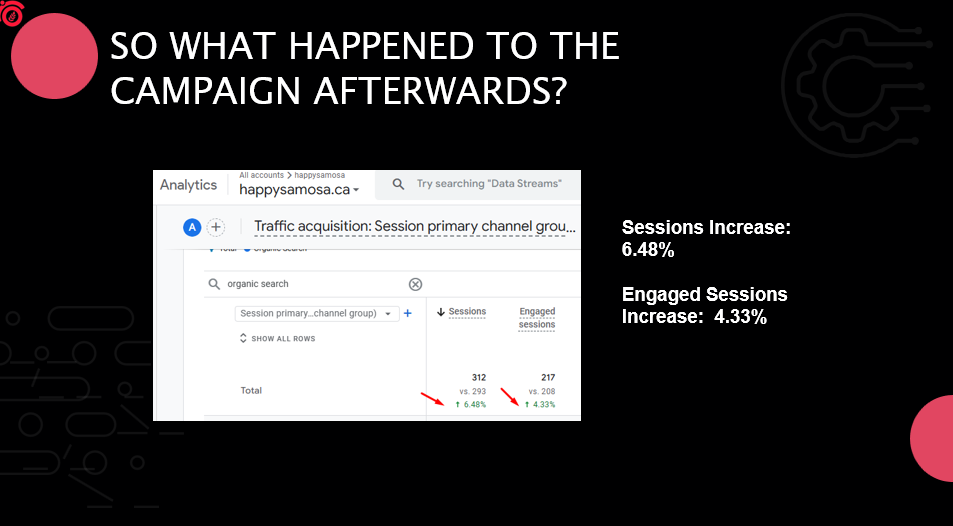
The SEO campaign delivered measurable improvements in both traffic volume and user engagement, indicating stronger visibility and more meaningful interactions with the website. Overall sessions increased by 6.48%, rising from 293 to 312, demonstrating improved discovery across organic and local search channels. In addition, engaged sessions grew by 4.33%, increasing from 208 to 217. This growth reflects not just higher traffic but also better-quality visits, where users were more likely to explore menu pages, engage with content, and move deeper into the website experience. These improvements highlight the effectiveness of aligning content structure and technical performance with user intent, particularly for high-conversion local food queries.
SEO Performance Metrics (Semrush Insights)
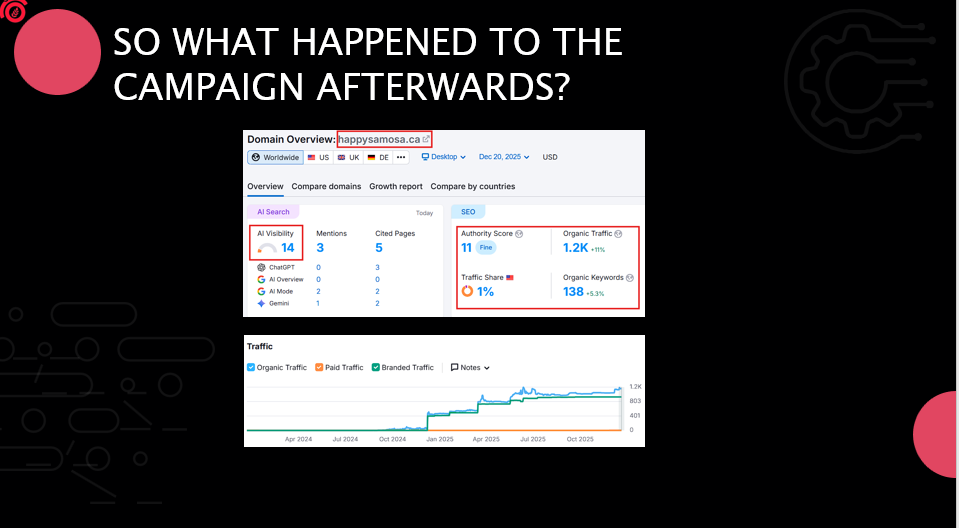
From an SEO performance standpoint, the website showed steady gains in key visibility metrics tracked through Semrush. Organic traffic reached 1.2K, reflecting a modest 1% increase, which indicates stable upward momentum in search visibility. The website ranked for 138 organic keywords, although this showed a slight decline of 5.3%, suggesting ongoing volatility in keyword positioning typical of competitive local markets. The domain achieved an Authority Score of 11, which reflects early-stage but improving domain credibility. Additional visibility indicators included an AI Visibility score of 14, along with 3 brand mentions and 5 cited pages, showing growing recognition across both traditional and AI-influenced search ecosystems. Together, these metrics indicate a foundation of improving authority and expanding digital presence within a competitive local niche.
Keyword Ranking Improvements
The campaign also delivered notable improvements in high-intent local keyword performance. The term “Best Samosas in Calgary” showed improved visibility across search result positions, reflecting stronger alignment between content structure and user intent. Similarly, “Chaat Bowl Calgary” gained ranking positions, indicating increased relevance in the competitive local food category. These improvements are particularly significant because they represent transactional and decision-stage queries, where users are actively seeking food options and are more likely to convert into customers. Strengthening visibility in these keywords directly contributes to increased footfall and order volume for the business.
AI Search Visibility (New SEO Layer)
The Rise of AI-Driven Search Results
A key emerging dimension of SEO is the increasing influence of AI-generated search results, where platforms like ChatGPT and Google’s AI Overviews summarize and recommend businesses based on structured web content. Unlike traditional search rankings that rely heavily on keyword positioning and backlinks, AI systems prioritize clarity, structure, and contextual relevance. This shift introduces a new layer of visibility where brands can appear directly within AI-generated recommendations, even outside traditional SERP rankings.
How Structured Content Improved AI Visibility
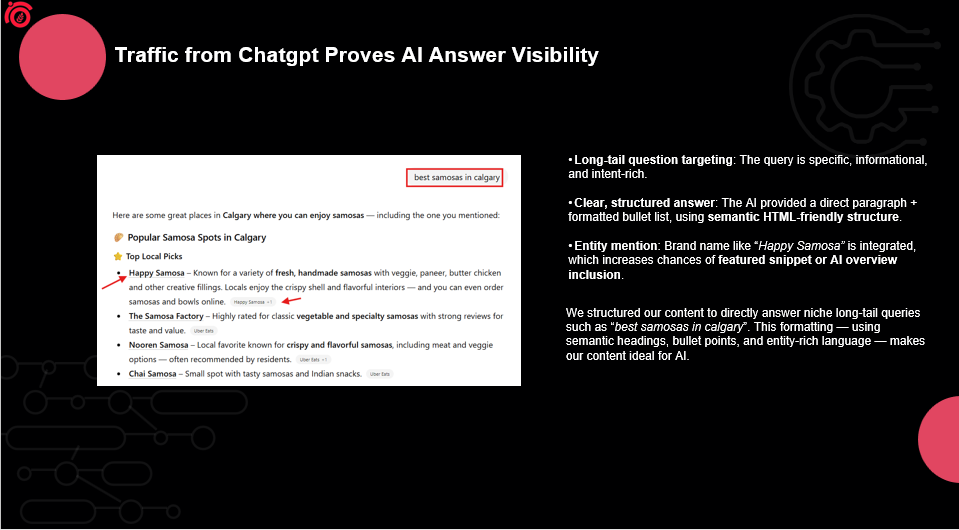
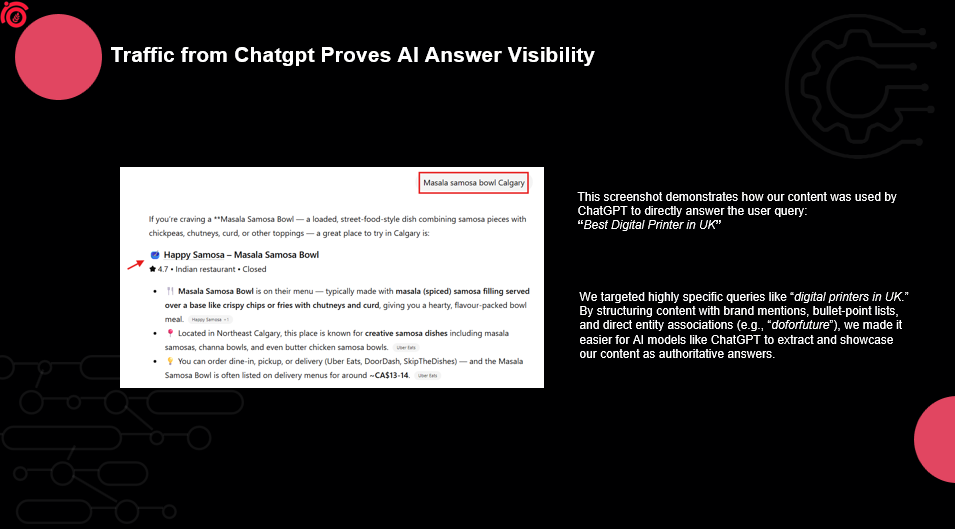
In this campaign, content was intentionally structured to align with how AI systems interpret and extract information. Pages were designed with clear headings, concise explanations, and logically organized sections that made it easier for AI models to identify relevant entities and summarize key details. As a result, Happy Samosa began appearing in ChatGPT-style responses for queries such as “best samosas in Calgary,” where it was listed among recommended local options. This demonstrates how structured, intent-focused content can extend visibility beyond traditional search engines into AI-driven discovery platforms.
Key Optimization Factors for AI Inclusion
Several specific factors contributed to improved AI visibility. Structured formatting ensured that content could be easily parsed and summarized. Clear, direct answers helped AI systems extract meaningful responses for user queries. Entity reinforcement consistently highlighted the brand name “Happy Samosa,” strengthening its association with relevant search topics. Finally, long-tail intent coverage ensured that content aligned closely with natural language queries used in AI-based search interactions. Together, these elements positioned the brand not only for improved search rankings but also for inclusion in the next generation of AI-powered discovery systems.
Key Learnings
This campaign reinforced that search intent is significantly more important than keyword density in modern SEO. Simply repeating target phrases is no longer enough to achieve sustainable rankings; instead, success depends on how well content aligns with what users actually want when they perform a search. In the case of Happy Samosa, focusing on intent-driven queries such as “Best Samosas in Calgary” required a deeper understanding of user expectations, including quality, authenticity, and immediacy. Additionally, the project highlighted that effective local SEO is not dependent on a single factor but requires a balanced combination of technical optimization, high-quality content, and strong authority signals such as reviews and citations. Page experience also proved to be a critical ranking factor, as improvements in speed, usability, and mobile performance directly influenced engagement and visibility.
Another major insight was the emergence of AI visibility as a new frontier in SEO, where structured and well-formatted content can influence inclusion in AI-generated responses. Finally, the campaign demonstrated that structured content significantly improves multi-platform discoverability, allowing brands to perform well not only on traditional search engines but also across AI-driven discovery systems and featured snippet environments.
Conclusion: The Modern SEO Model
The Happy Samosa case study highlights a fundamental shift in how modern SEO strategies must be designed and executed. SEO is no longer a siloed discipline focused solely on ranking websites on Google; instead, it has evolved into a multi-layered visibility system that spans traditional search engines, local map packs, and AI-powered answer engines. The modern SEO model requires businesses to think beyond keywords and focus on intent, user experience, and structured information delivery.
Technical performance ensures that websites are accessible and efficient, while content strategy by ThatWare ensures relevance and engagement. At the same time, local SEO strengthens real-world discoverability, connecting digital searches to physical visits. Most importantly, the rise of AI-driven search experiences introduces a new dimension where structured, entity-rich content can directly influence how brands are recommended in conversational and generative search environments. In this context, the Happy Samosa campaign demonstrates how a well-integrated SEO approach can transform a local food brand into a highly visible, intent-aligned presence across multiple discovery platforms.