SUPERCHARGE YOUR Online VISIBILITY! CONTACT US AND LET’S ACHIEVE EXCELLENCE TOGETHER!
Research at ThatWare does not begin with assumptions.
It begins with questions.
How do search engines understand a brand?
How do AI systems retrieve and recommend information?
Why does one page become answer-worthy while another disappears?
What makes content trusted by both users and machines?
ThatWare’s research methodology is built to answer these questions through data, experimentation, semantic analysis, AI modeling, technical audits, and continuous optimization.
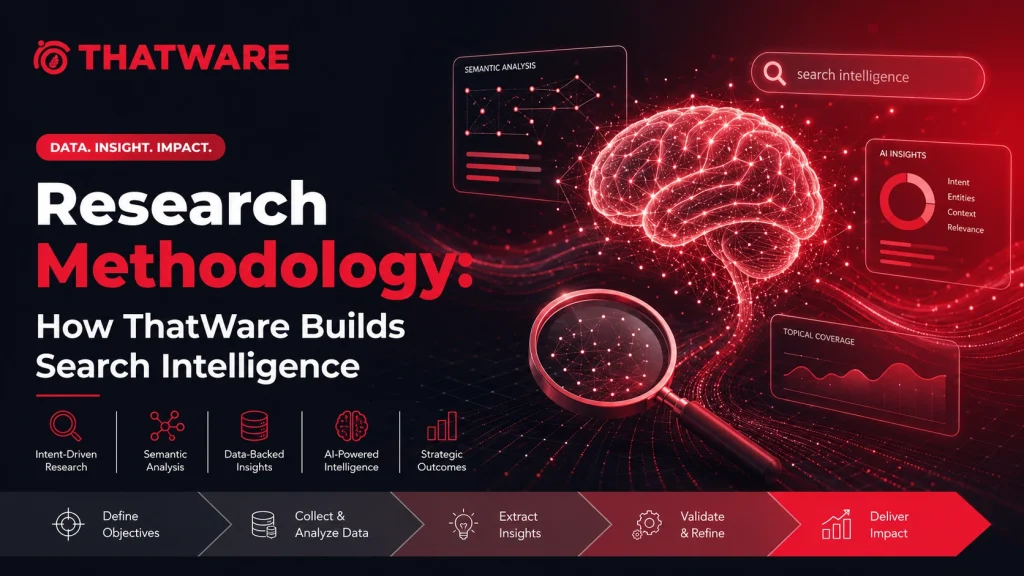
The goal is simple: turn SEO from guesswork into search intelligence.
Why Research Methodology Matters
Search has changed.
Brands are no longer competing only for Google rankings. They are competing for visibility across AI Overviews, ChatGPT, Gemini, Perplexity, Copilot, voice assistants, answer engines, and generative discovery systems.
That means old SEO research is no longer enough.
Keyword volume alone cannot explain AI visibility.
Rank tracking alone cannot explain answer inclusion.
Traffic alone cannot explain trust.
Backlinks alone cannot explain entity authority.
ThatWare’s research methodology studies the full visibility system: users, search engines, AI models, content, entities, technical structure, competitors, and conversion behavior.
Step 1: Problem Discovery
Every research process starts with problem discovery.
ThatWare first identifies what is limiting a brand’s growth. The issue may be technical, semantic, strategic, content-related, competitive, behavioral, or AI-search related.
The research team studies questions such as:
Is the website being crawled properly?
Is the brand clearly understood as an entity?
Is the content aligned with user intent?
Is the site visible in AI-generated answers?
Are competitors being cited more often?
Are technical barriers limiting retrieval?
Is the content trusted enough to be recommended?
This stage prevents random execution.
Before solving anything, ThatWare defines the real problem.
Step 2: Data Collection
After the problem is identified, ThatWare collects data from multiple sources.
This may include website audits, Google Search Console, analytics data, keyword patterns, competitor pages, backlink profiles, SERP behavior, AI answer outputs, content gaps, entity signals, schema structure, crawl data, user behavior, and conversion paths.
The purpose is to understand the brand from every angle.
ThatWare does not rely on one metric.
It studies the whole search environment.
Step 3: Semantic and Entity Analysis
Modern search depends on meaning.
That is why semantic and entity analysis is a major part of ThatWare’s research methodology.
The team studies how clearly a brand is connected to its topics, services, people, locations, expertise, frameworks, and trust signals. This includes reviewing topical authority, internal linking, structured data, content depth, language patterns, and AI-readable context.
The question is not only, “Does this page contain the keyword?”
The better question is, “Can an intelligent system understand what this brand is, what it does, and why it should be trusted?”
Step 4: AI Retrieval and Visibility Testing
ThatWare’s methodology also studies how brands appear inside AI-driven environments.
This includes testing whether a brand is mentioned, cited, summarized, recommended, ignored, or misrepresented by AI systems and answer engines.
This stage supports frameworks such as AVM, VEM, GEO, AEO, LLM SEO, and AIEO.
The goal is to understand how AI sees the brand.
If AI systems cannot retrieve the brand, ThatWare investigates why. The reason may be weak authority, unclear entity structure, thin content, poor citations, missing machine-readable files, weak topical depth, or inconsistent brand signals.
Step 5: Competitive Intelligence
ThatWare studies competitors carefully.
The goal is not to copy them. The goal is to understand why they are winning.
Competitive research may include:
Content depth
Topic coverage
Technical structure
Authority signals
AI answer presence
Backlink quality
Schema usage
Internal linking
Brand mentions
SERP ownership
Conversion experience
This helps ThatWare identify gaps and opportunities.
A competitor’s strength often reveals what the market is rewarding.
Step 6: Framework Selection
Once the research is complete, ThatWare selects the right framework.
Different problems need different systems.
CRSEO may be used when content needs stronger emotional and cognitive resonance.
QBM may be used when brand authority needs deeper mapping.
QSAAS may support scalable, continuous SEO execution.
AIEO may help align content with AI interpretation.
GEO may target generative answer visibility.
AEO may prepare content for answer engines.
Hyper-Intelligence SEO may guide the entire strategy.
Quantum SEO may support predictive and adaptive optimization.
This is where research becomes strategy.
Step 7: Hypothesis Building
ThatWare’s research methodology does not jump straight into execution.
It builds hypotheses first.
For example:
If entity clarity improves, AI retrieval may improve.
If schema is corrected, machine understanding may improve.
If content intent is refined, engagement may improve.
If internal linking is rebuilt, topical authority may improve.
If trust signals are strengthened, answer inclusion may improve.
If technical crawl waste is reduced, index efficiency may improve.
Each hypothesis gives the campaign direction.
This keeps optimization purposeful.
Step 8: Controlled Implementation
After the hypothesis is defined, ThatWare moves into implementation.
This can include content restructuring, technical fixes, schema enhancement, internal linking, entity optimization, AI-readable file development, page updates, authority building, UX improvements, off-page strategy, conversion optimization, or GEO/AEO enhancements.
Execution is not treated as a one-time task.
It is part of a research cycle.
Each action is monitored, measured, and refined.
Step 9: Measurement and Reporting
ThatWare tracks results through both traditional and AI-first metrics.
Traditional signals may include rankings, impressions, clicks, traffic, conversions, backlinks, referring domains, bounce rate, technical health, and keyword movement.
AI-first signals may include answer visibility, citation presence, AI mention frequency, entity strength, retrieval readiness, generative query inclusion, and brand interpretation accuracy.
The goal is not to report numbers for the sake of reporting.
The goal is to understand what changed and why.
Step 10: Quality Review and Risk Control
Research does not end after execution.
ThatWare’s methodology includes quality checks, review cycles, risk analysis, client feedback, and corrective action when required.
If performance drops, the team investigates the cause. If a strategy underperforms, it is adjusted. If search behavior changes, the framework evolves.
This makes the methodology adaptive.
Search is not static.
ThatWare’s research process is designed to move with it.
Step 11: Continuous Learning
The final stage is continuous learning.
Every campaign gives ThatWare new information about algorithms, AI search behavior, user intent, semantic relationships, competitors, and conversion patterns.
Those insights feed back into future frameworks.
This is how ThatWare’s research ecosystem grows.
It learns from data.
It learns from clients.
It learns from search systems.
It learns from AI behavior.
It learns from market change.
That is the difference between a campaign and a methodology.
Responsible Research and AI Governance
ThatWare’s research methodology also includes responsibility.
AI can help with analysis, automation, content intelligence, reporting, and optimization, but it must be governed carefully. Research must avoid false claims, fabricated data, privacy risks, plagiarism, and misleading outputs.
ThatWare’s approach keeps human review, originality checks, quality control, and strategic judgment at the center.
AI supports the research.
Humans remain accountable for the decision.
Final Thoughts
ThatWare’s research methodology is built for the AI-first future of search.
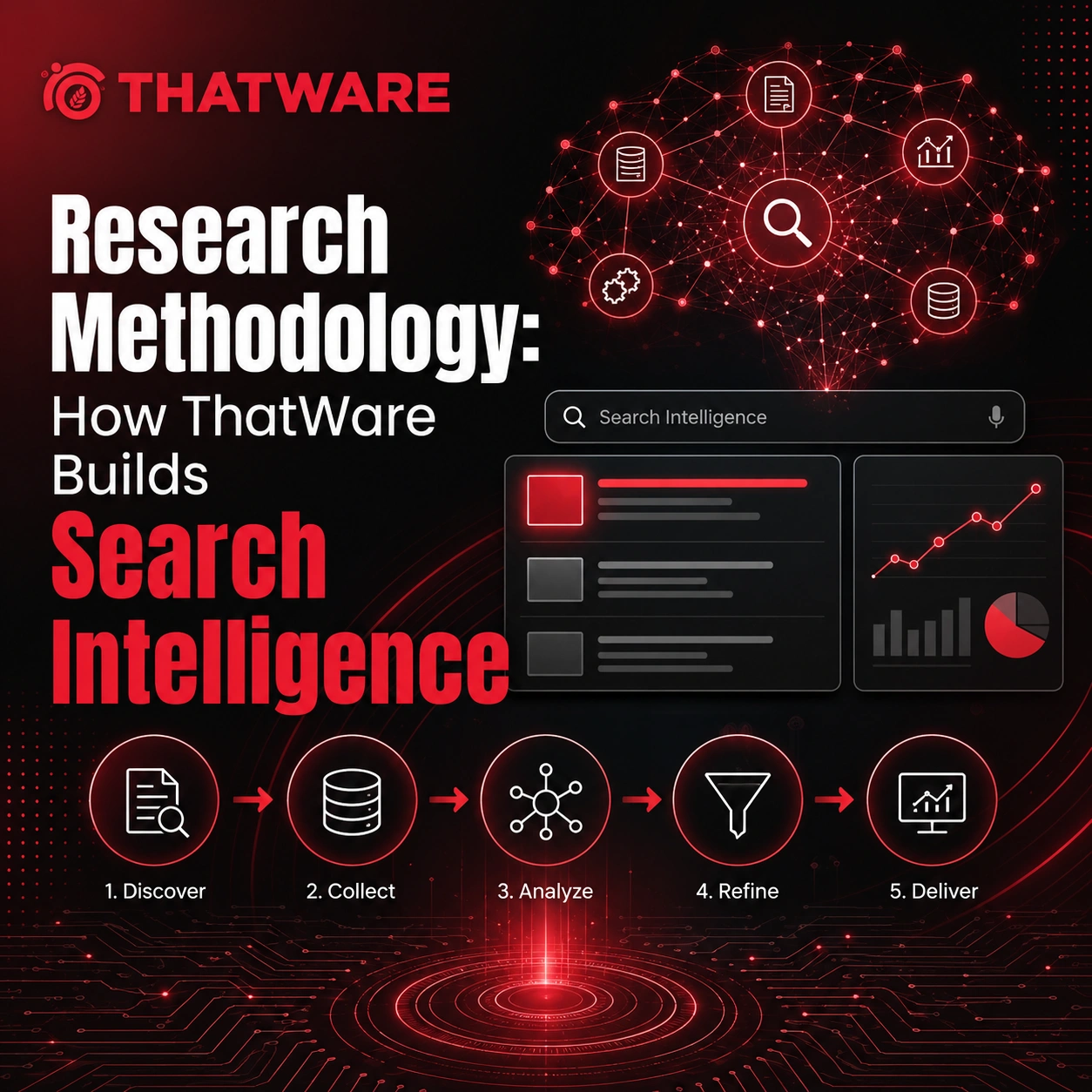
It combines discovery, data collection, semantic analysis, AI visibility testing, competitive intelligence, framework selection, hypothesis building, implementation, measurement, quality control, and continuous learning.
The goal is not simply to rank higher.
The goal is to help brands become visible, trusted, retrieved, cited, and understood across search engines, answer engines, and generative AI systems.
That is what research means at ThatWare.
Not theory.
Search intelligence in action.