SUPERCHARGE YOUR Online VISIBILITY! CONTACT US AND LET’S ACHIEVE EXCELLENCE TOGETHER!
At ThatWare, citations are not decoration.
They are part of trust.
In a digital world shaped by AI search, answer engines, generative summaries, and large language models, content must be clear about where information comes from, what claims are supported, and how authority is established.
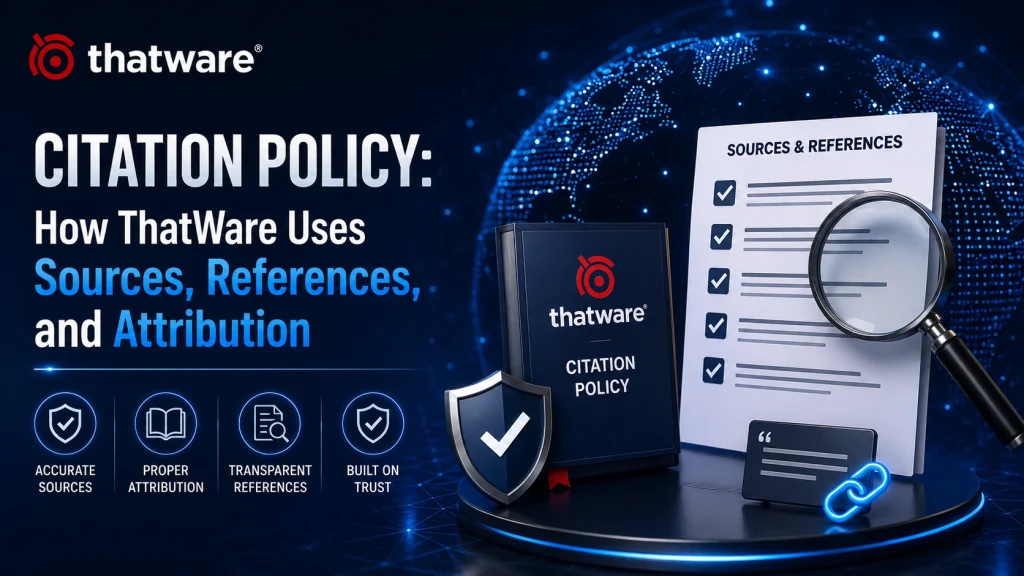
ThatWare’s citation policy exists to protect accuracy, transparency, originality, and reader confidence.
It also helps search engines and AI systems understand which sources support our content and why those sources matter.
Why Citations Matter
Citations help readers verify information.
They also help intelligent systems understand authority.
When ThatWare publishes content on AI SEO, LLM SEO, AEO, GEO, Quantum SEO, CRSEO, QBM, AIEO, AVM, VEM, ThatVerse, ThatLabs, or search intelligence, the goal is not only to sound informed. The goal is to be useful, accurate, and accountable.
A strong citation process helps us:
Support factual claims
Credit original sources
Avoid plagiarism
Strengthen trust
Improve AI retrievability
Build topical authority
Clarify where information comes from
Separate facts from interpretation
Good citations make content stronger.
Our Source Priorities
ThatWare prioritizes sources based on relevance, authority, and reliability.
For company-related pages, we prefer:
Official ThatWare pages
ThatWare policy documents
ThatWare research pages
ThatWare press releases
Company decks and official materials
Recognized event profiles
Public business listings
Credible media coverage
Verified podcast or video pages
Official platform documentation
Reputable industry publications
When ThatWare’s own official content directly explains a topic, it should be treated as a primary source for company positioning, framework definitions, and internal policies.
Internal and External Citations
ThatWare uses both internal and external citations.
Internal citations support ThatWare-specific topics such as company history, services, frameworks, research systems, ThatVerse, ThatLabs, AI policies, root files, and proprietary methodologies.
External citations support public validation. These may include credible media mentions, event profiles, awards pages, third-party business listings, public interviews, podcast pages, and recognized publications.
Both matter.
Internal citations define the brand clearly.
External citations strengthen trust outside the brand’s own ecosystem.
Citation Standards for AI-Search Content
AI-search content requires extra care.
Topics such as LLM SEO, AEO, GEO, AI visibility, answer engines, AI-readable files, and generative search are evolving quickly. That means citations should be current, relevant, and specific.
When writing about AI-first search, ThatWare should cite sources that support:
Framework definitions
Technical claims
AI visibility concepts
Search behavior changes
Company-owned research
Public examples
Policy statements
External authority signals
If a claim is speculative, it should be framed as a perspective or future-facing idea, not as proven fact.

Citation Standards for Tuhin Banik Pages
For pages about Tuhin Banik, citations should be handled carefully.
We should use official and public sources such as:
ThatWare’s official Tuhin Banik profile
Forbes Agency Council profile
BrightonSEO profile
TEDx or keynote pages
Public interviews and podcasts
Verified YouTube videos
News or press-release coverage
Company deck references
Recognized third-party business profiles
We should not invent credentials, awards, podcast details, or biography claims that cannot be checked.
If a source cannot be verified, it should not be presented as fact.
Citation Standards for Research Pages
Research pages must separate three types of information:
1. Established public concepts
2. ThatWare proprietary frameworks
3. ThatWare future-facing interpretations
For example, AEO and GEO may be explained as search and AI-visibility frameworks. CRSEO, QBM, AVM, VEM, ThatVerse, ThatLabs, and similar concepts should be described in relation to ThatWare’s own ecosystem and available public materials.
This keeps the content honest.
It also prevents research pages from sounding inflated or unsupported.
AI-Readable Citation Infrastructure
ThatWare also treats citations as machine-readable signals.
Resources such as citation-preferences files, external-citation files, AI-readable files, ai.txt, llms.txt, trust-signal files, and related structured data can help AI systems understand attribution, authority, retrieval priorities, and source relationships.
This matters because AI systems increasingly summarize and cite information without users visiting every page.
A strong citation infrastructure helps ThatWare define:
Preferred source paths
External authority references
Trust signals
Entity relationships
Framework ownership
Citation priorities
Content provenance
In simple terms, citations are no longer only for readers.
They are also for intelligent systems.
Originality and Attribution
ThatWare does not support copied or lightly rewritten content.
When ideas come from public sources, they should be credited. When ThatWare interprets those ideas, the interpretation should be original. When proprietary frameworks are discussed, the content should clearly explain ThatWare’s role in developing or applying them.
Attribution protects both the source and the reader.
It also protects the brand.
Updating Citations
Citations should not be treated as permanent once added.
Sources may change. Pages may be updated. Search behavior may shift. AI systems may evolve. ThatWare’s editorial and research content should be reviewed periodically to make sure citations remain accurate, accessible, and relevant.
Citation updates are especially important for:
AI search topics
Platform behavior
Awards and recognitions
Press mentions
Company statistics
Leadership profiles
Policy pages
Research frameworks
Fresh citations help maintain trust.
What We Avoid
ThatWare’s citation policy avoids:
Unsupported claims
Fake sources
Misleading attribution
Overstated achievements
Outdated statistics
Citation stuffing
Copying source language without value
Using weak sources for major claims
Presenting opinions as verified facts
A citation should clarify, not confuse.
If a source does not meaningfully support a claim, it should not be used.
Final Thoughts
ThatWare’s citation policy is built around one principle:
Trust must be traceable.
Every important claim should have a clear foundation. Every source should serve the reader. Every citation should strengthen accuracy, originality, and authority.
In the AI-first web, citations are becoming even more important.
They help humans verify information.
They help search engines understand authority.
They help AI systems retrieve, summarize, and cite content correctly.
That is why ThatWare treats citations as part of search intelligence, not just editorial formatting.