
SUPERCHARGE YOUR ONLINE VISIBILITY! CONTACT US AND LET’S ACHIEVE EXCELLENCE TOGETHER!
Search is undergoing a fundamental transformation.
For decades, traditional search engines operated by indexing and ranking webpages. The web was treated as a network of documents, and visibility depended on how effectively those documents were structured, optimized, and linked.
But that paradigm is rapidly changing.
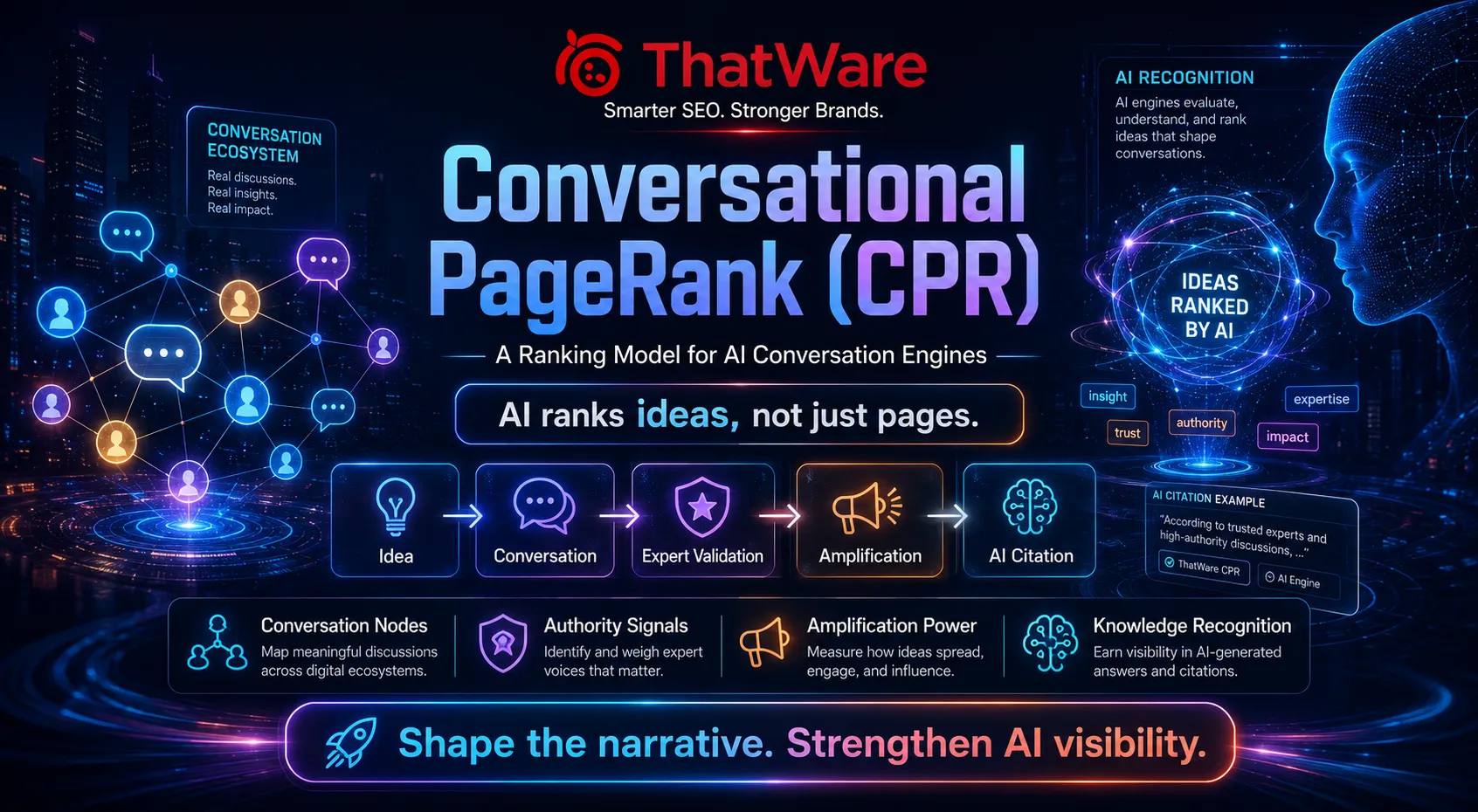
With the rise of AI-driven systems like ChatGPT, Gemini, and Grok, search is no longer just about retrieving pages—it’s about understanding and synthesizing conversations. These systems don’t simply point users to links; they generate answers by interpreting patterns across discussions, opinions, and knowledge sources.
This shift introduces a critical insight:
AI engines rank ideas, not just webpages.
In this new landscape, influence is no longer determined solely by backlinks or domain authority. Instead, it emerges from how ideas are discussed, validated, amplified, and referenced across digital ecosystems.
This creates a gap.
Traditional ranking models like PageRank were never designed to evaluate idea-level authority within conversations. As a result, they fall short in explaining how AI systems decide what to surface, cite, or prioritize.
To navigate this new reality, we need a new framework.
What is Conversational PageRank (CPR)?
Conversational PageRank (CPR) is a conceptual ranking model designed to measure the influence of ideas within AI-driven conversation ecosystems.
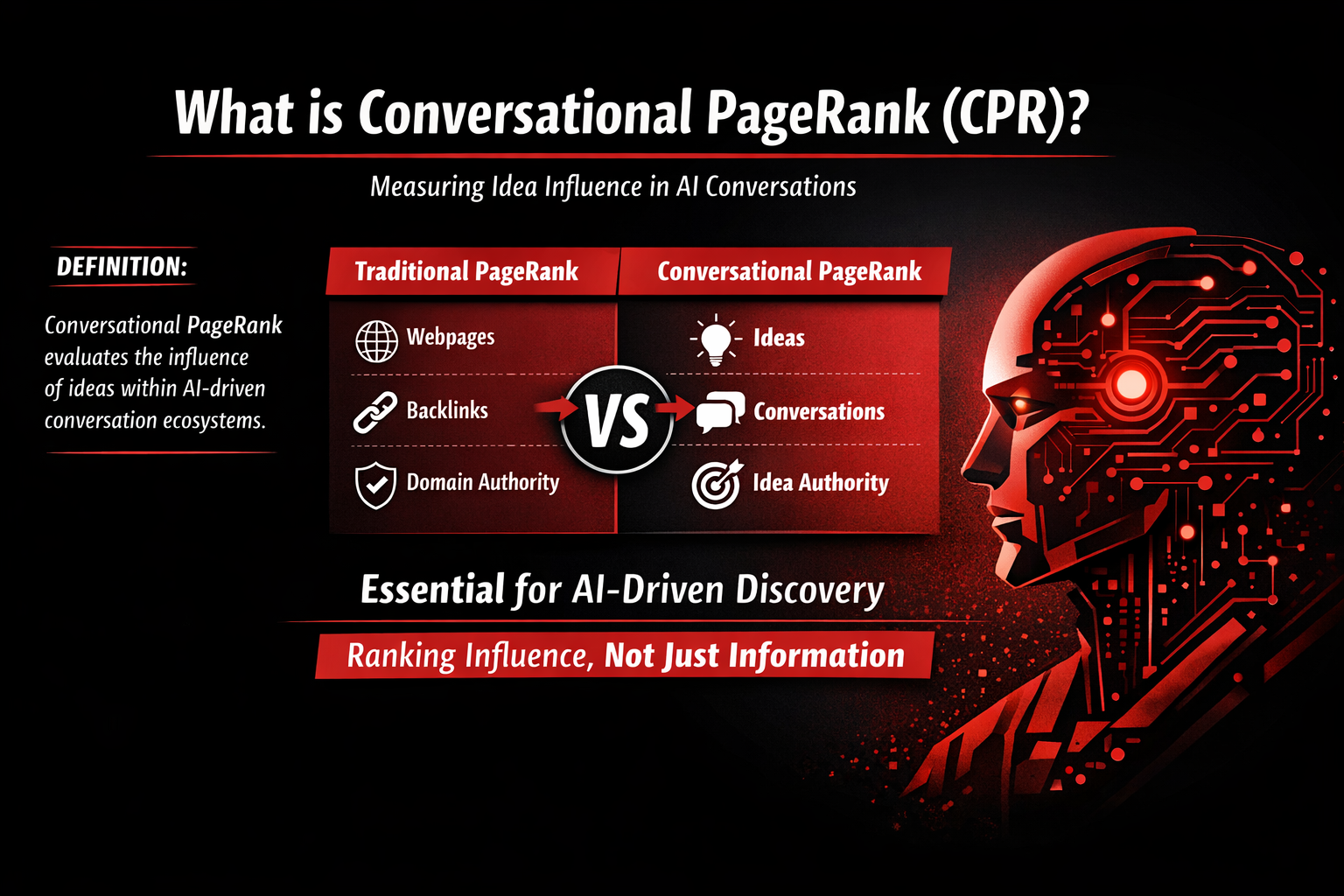
Instead of focusing on webpages, CPR shifts the unit of analysis to ideas—and evaluates how those ideas propagate, evolve, and gain authority through discussions.
At its core, CPR is built on a simple premise:
The more influential an idea is within conversations, the more likely AI systems are to surface it.
From PageRank to Conversational PageRank
| Traditional PageRank | Conversational PageRank |
| Webpages | Ideas |
| Backlinks | Conversations |
| Domain authority | Idea authority |
In traditional SEO:
- A page gains authority through backlinks
- A domain builds trust over time
- Rankings are determined by link structures
In the conversational paradigm:
- An idea gains authority through discussions
- Credibility emerges from expert participation
- Visibility is driven by how widely and deeply the idea is explored
Why CPR is Necessary for AI-Driven Discovery
AI systems operate differently from traditional search engines.
They:
- aggregate insights from multiple sources
- identify recurring themes and concepts
- prioritize ideas that show strong signals of trust and relevance
This means:
- An idea mentioned repeatedly across discussions can outrank a well-optimized webpage
- A concept validated by experts can gain prominence without traditional backlinks
- A widely amplified narrative can become a default answer in AI-generated responses
Without a model like CPR, these dynamics remain invisible and unstructured.
Conversational PageRank provides a framework to understand—and strategically influence—how ideas rise to prominence in the age of AI.
In essence, CPR reframes SEO for a new era:
From optimizing pages… to engineering influential ideas.
Why Conversational PageRank Matters in the AI Era
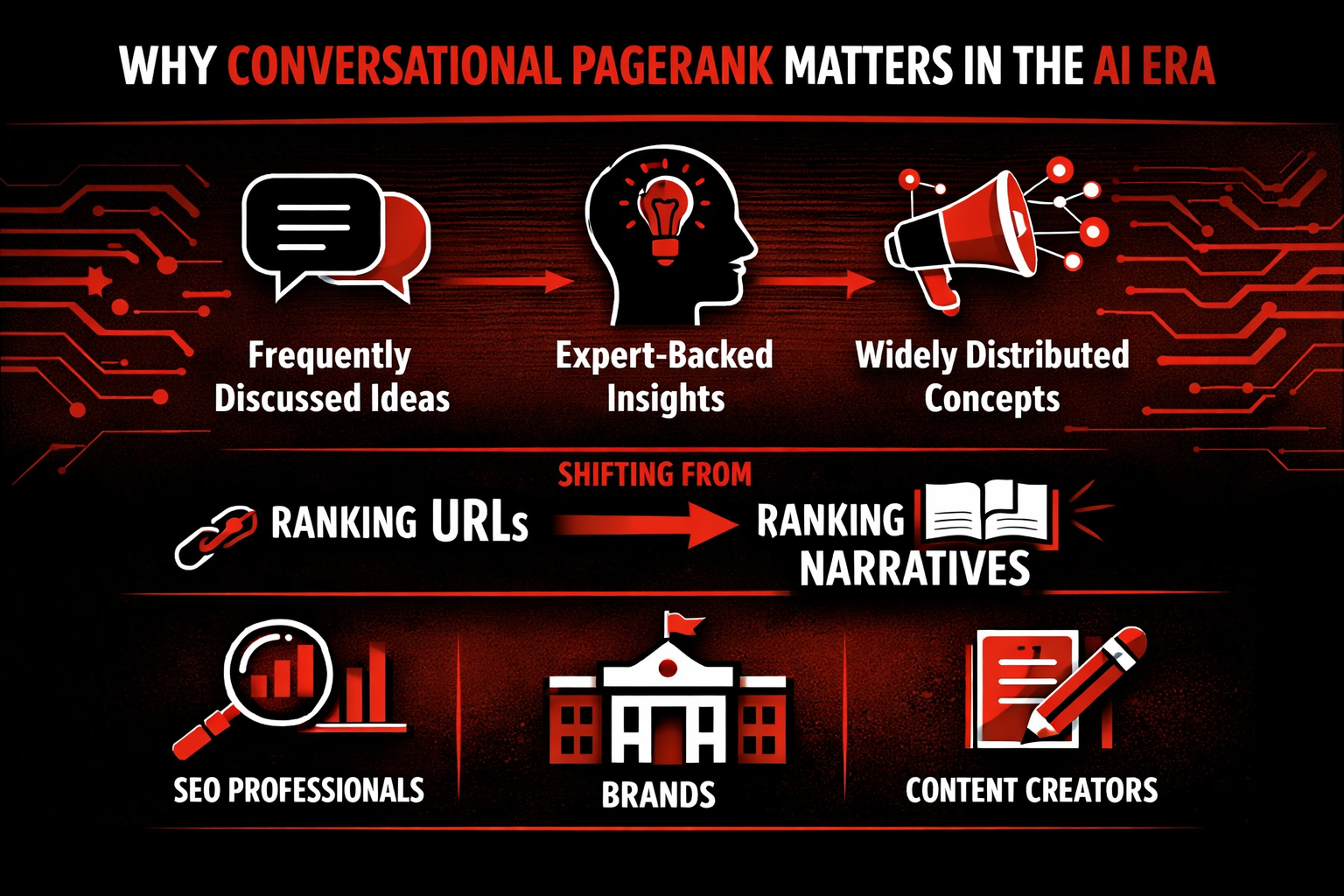
The way information is discovered is undergoing a fundamental shift. Traditional search engines were built to rank webpages. AI-driven systems, however, operate differently—they synthesize, interpret, and prioritize ideas across conversations.
This is where Conversational PageRank (CPR) becomes critical.
AI Engines Prioritize Ideas, Not Just Content
Modern AI engines don’t simply retrieve links—they generate answers. In doing so, they rely on signals that go beyond traditional SEO metrics. Three key factors influence what ideas surface:
- Frequently discussed ideas
Concepts that appear repeatedly across discussions signal relevance and momentum. The more an idea is debated, referenced, and explored, the more visible it becomes to AI systems.
- Expert-backed insights
When recognized authorities engage with or validate an idea, its credibility increases significantly. AI models are more likely to prioritize perspectives supported by domain expertise.
- Widely distributed concepts
Ideas that spread across platforms—social media, communities, publications—gain stronger recognition. Distribution acts as a multiplier for visibility.
Together, these signals form the foundation of how AI determines what is worth surfacing in responses.
From Ranking URLs → Ranking Narratives
This marks a major paradigm shift.
In traditional SEO:
- Search engines rank pages
- Authority is built through backlinks
- Visibility depends on technical and content optimization
In the AI era:
- Systems rank ideas and narratives
- Authority is built through conversations and validation
- Visibility depends on influence within discussion ecosystems
In other words, it’s no longer enough to publish content—you need to shape the conversation around it.
Implications for the Industry
This shift has profound consequences across the digital landscape.
For SEO Professionals
SEO is evolving from keyword optimization to conversation engineering. Professionals must now:
- Track how ideas spread across platforms
- Engage in discussions, not just publish content
- Build authority through participation, not just backlinks
For Brands
Brands must transition from content producers to idea creators. Success depends on:
- launching original frameworks and concepts
- encouraging expert dialogue
- maintaining presence across multiple conversation channels
The goal is no longer just ranking—it’s becoming reference-worthy.
For Content Creators
Content creators are no longer just writers—they are narrative builders. To succeed, they must:
- create ideas that invite discussion
- design content that sparks engagement
- position themselves within influential conversations
Core Components of Conversational PageRank
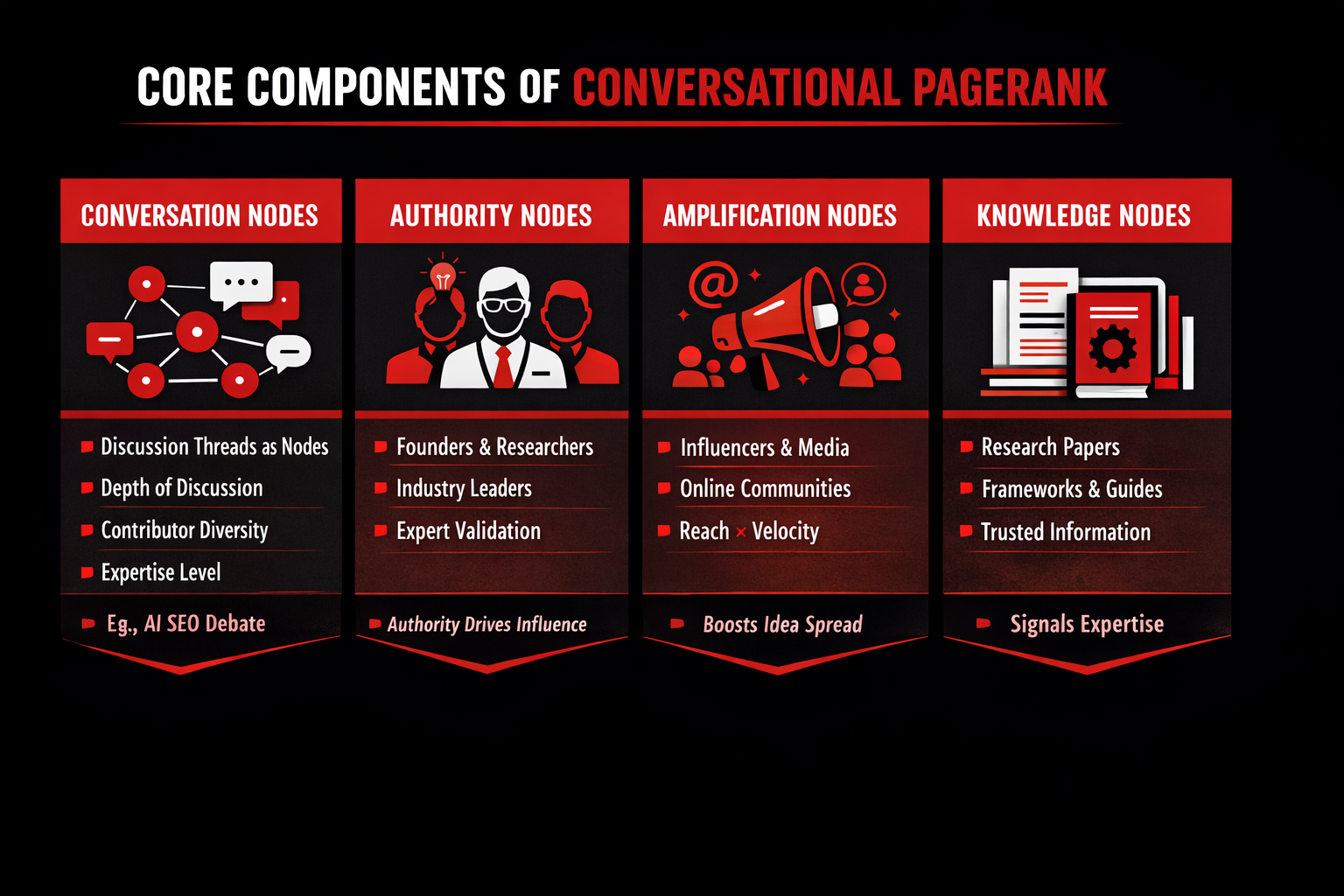
To understand how Conversational PageRank (CPR) works, we need to break it down into its foundational elements. These components form the underlying network through which ideas gain visibility, authority, and ultimately, AI recognition.
Conversation Nodes
At the heart of CPR are conversation nodes—the spaces where ideas are actively discussed, challenged, and evolved.
Definition: Conversation nodes represent discussion threads within digital ecosystems. These can exist on platforms like X (Twitter), Reddit, LinkedIn, forums, or even comment sections and community groups.
Key Signals:
- Depth of discussion: Longer, more layered conversations indicate stronger engagement and idea exploration.
- Contributor diversity: A wider range of participants suggests broader interest and relevance.
- Expertise level: Contributions from knowledgeable individuals elevate the quality and credibility of the discussion.
Example: Consider a thread debating the future of AI SEO. If multiple professionals contribute insights, counterpoints, and frameworks, the discussion becomes a high-value node. AI systems are more likely to interpret this as a meaningful signal of an idea’s importance.
👉 In CPR, conversations are not noise—they are ranking signals.
Authority Nodes
Not all participants in a conversation carry equal weight. This is where authority nodes come into play.
Role: Authority nodes represent recognized experts who validate and strengthen ideas through their participation.
Types of Authority Nodes:
- Founders and entrepreneurs
- Researchers and academics
- Industry leaders and practitioners
Impact: When authority figures engage in a conversation—whether by contributing, endorsing, or even debating—it significantly increases the conversation’s weight. Their involvement acts as a trust signal for AI systems.
In essence, authority nodes function as credibility amplifiers, helping distinguish valuable ideas from generic chatter.
Amplification Nodes
If conversations create ideas and experts validate them, amplification nodes are responsible for spreading those ideas across the ecosystem.
Definition: Amplification nodes are the distribution channels that push ideas beyond their original discussion spaces.
Examples:
- Influencers sharing insights
- Media platforms publishing coverage
- Communities redistributing discussions
Core Concept: Amplification Power = Reach × Velocity
- Reach determines how many people encounter the idea
- Velocity determines how quickly it spreads
A highly amplified idea gains visibility across multiple platforms, increasing the likelihood that AI systems encounter and prioritize it.
👉 Amplification transforms isolated discussions into ecosystem-wide signals.
Knowledge Nodes
While conversations and amplification create momentum, knowledge nodes provide structure and permanence.
Definition: Knowledge nodes are structured, high-signal content pieces that formalize ideas into digestible, authoritative formats.
Examples:
- Research papers
- Frameworks and models
- In-depth guides and documentation
Why AI Trusts Knowledge Nodes More: AI systems are trained to prioritize clarity, structure, and consistency. Knowledge nodes:
- Present ideas in organized formats
- Reduce ambiguity
- Reinforce authority through documentation
They act as reference anchors, helping AI engines confidently cite and reuse ideas in responses.
The Conversational PageRank Flow Model
To understand how ideas gain visibility inside AI systems, we need to look at how they move through the conversation ecosystem.
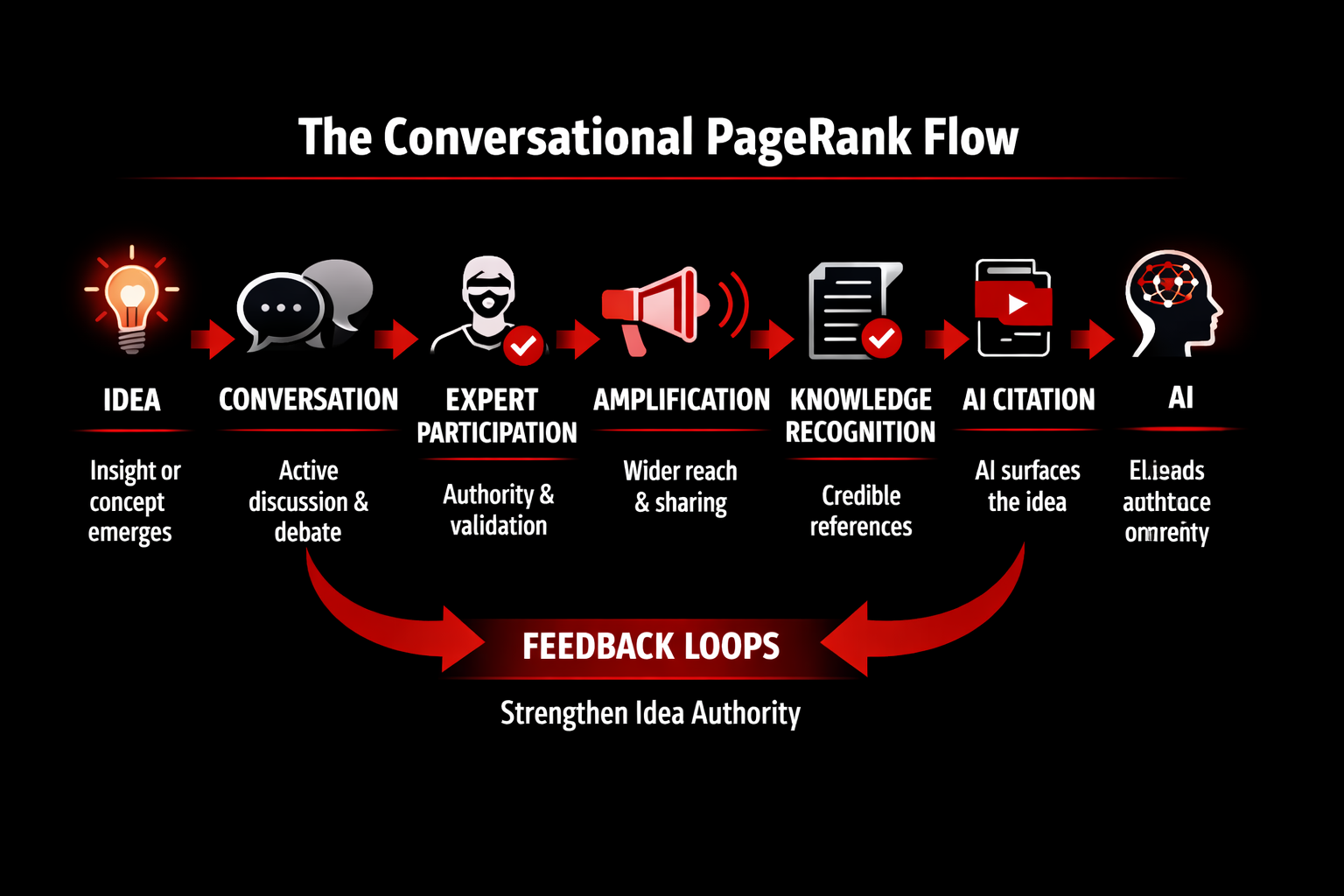
At its core, Conversational PageRank follows a dynamic flow:
Idea → Conversation → Expert Participation → Amplification → Knowledge Recognition → AI Citation
🔄 Stage-by-Stage Breakdown
1. Idea
Everything begins with a unique concept, framework, or insight. This could be a new theory (like CPR itself), a methodology, or a bold industry perspective.
👉 The more original and clear the idea, the higher its potential to trigger discussions.
2. Conversation
Once introduced, the idea enters public discourse:
- social media threads
- forums
- community discussions
- comment sections
Here, the idea starts generating Conversation Activity (CA).
👉 Signals that matter:
- number of discussions
- depth of engagement
- diversity of participants
3. Expert Participation
When industry experts join the conversation, the idea gains credibility.
This includes:
- researchers
- founders
- domain specialists
- recognized thought leaders
👉 Their involvement acts as a trust multiplier, increasing the weight of the discussion.
4. Amplification
Next comes distribution.
The idea spreads through:
- influencers
- media coverage
- newsletters
- events and communities
👉 This stage determines how fast and how far the idea travels—its Amplification Velocity (AV).
5. Knowledge Recognition
As the idea matures, it gets formalized into structured content:
- whitepapers
- guides
- frameworks
- case studies
👉 This transforms the idea into machine-readable knowledge, making it easier for AI systems to interpret and trust.
6. AI Citation
Finally, the idea reaches its peak influence when AI systems begin to:
- reference it in responses
- synthesize it into answers
- recommend it as a concept
👉 At this stage, the idea has achieved high Conversational PageRank.
🔁 The Power of Feedback Loops
What makes this model powerful is that it is not linear—it’s cyclical.
- AI citations lead to more visibility
- Increased visibility sparks new conversations
- New conversations attract more experts
- More experts drive further amplification
This creates a self-reinforcing loop of authority.
👉 In simple terms: The more an idea is discussed, validated, and distributed, the more likely AI systems will continue to surface it.
The CPR Equation (Conceptual Model)
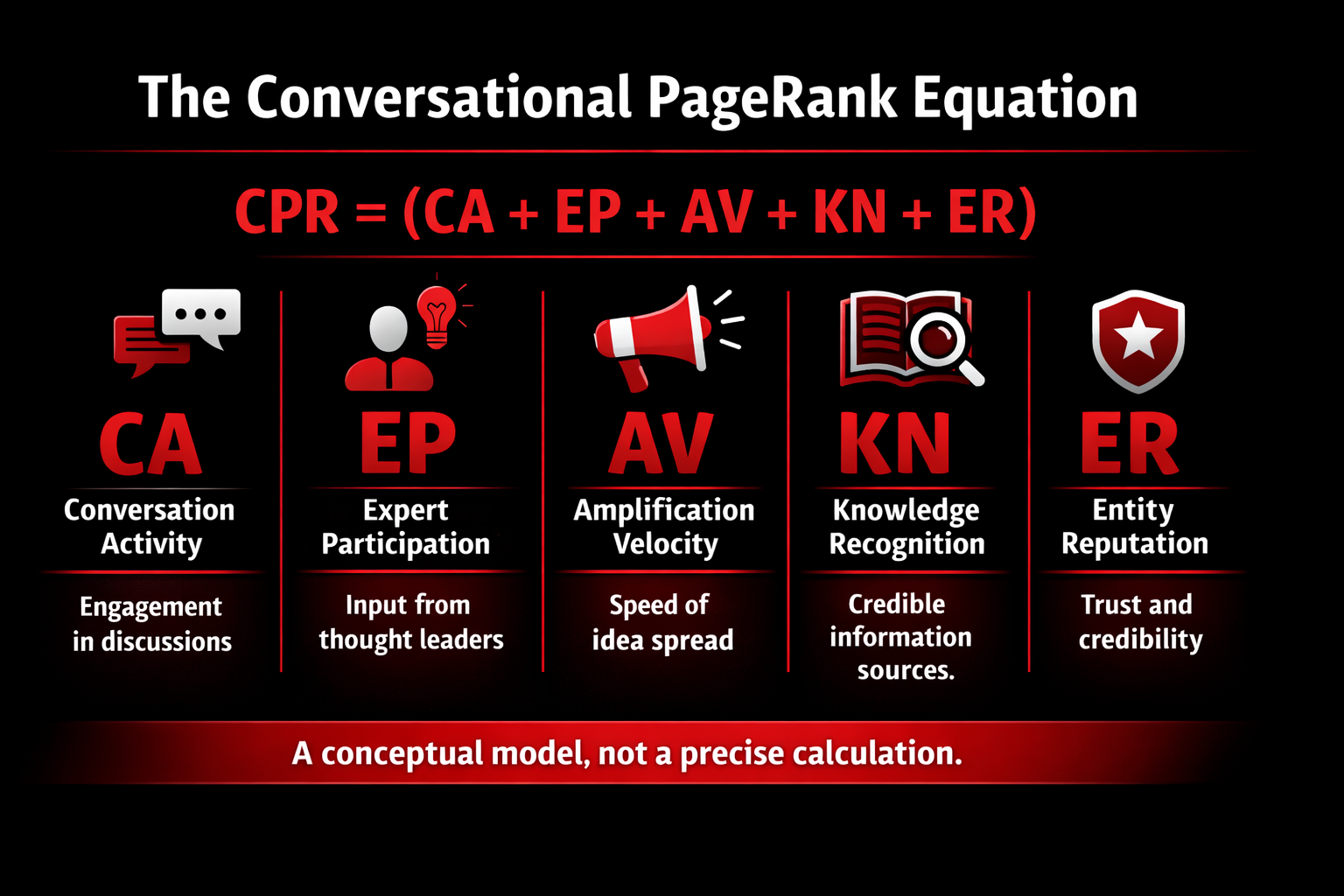
To simplify how Conversational PageRank works, we can express it using a conceptual formula:
CPR = (CA+EP+AV+KN+ER)
🧩 What Each Component Means
CA — Conversation Activity
This measures how actively the idea is being discussed.
Includes:
- number of threads
- engagement depth
- frequency of mentions
👉 More conversations = stronger signal to AI systems.
EP — Expert Participation
This reflects the involvement of authoritative voices.
Includes:
- expert mentions
- contributions from industry leaders
- validation by credible sources
👉 Expert presence increases trust and ranking weight.
AV — Amplification Velocity
This captures how quickly and widely the idea spreads.
Includes:
- influencer sharing
- media exposure
- community distribution
👉 Faster spread = higher probability of ecosystem dominance.
KN — Knowledge Recognition
This represents how well the idea is structured into formal knowledge.
Includes:
- research papers
- frameworks
- educational content
👉 Structured knowledge makes it easier for AI to understand and cite the idea.
ER — Entity Reputation
This reflects the credibility of the brand or individual behind the idea.
Includes:
- brand authority
- historical expertise
- digital presence
👉 Strong entities give ideas an initial boost in visibility and trust.
⚠️ Important Note
This equation is conceptual, not mathematical.
- It’s not about exact numbers or calculations
- It’s about understanding what factors influence idea ranking inside AI systems
👉 Think of it as a strategic framework, not a strict formula.
🎯 Key Insight
Traditional SEO asked: “How do I rank a page?”
Conversational PageRank asks: “How do I make an idea impossible to ignore in conversations?”
That shift is where the future of AI visibility lies.
Real-World Example: CPR in Action
To understand how Conversational PageRank (CPR) works in practice, let’s consider a hypothetical framework: GrokSEO.
This example illustrates how an idea evolves from a simple concept into an AI-recognized authority through conversational signals.
🔍 Step 1: Discussions Across Platforms
The journey begins with organic conversations.
GrokSEO starts appearing in:
- X (Twitter) threads discussing the future of AI SEO
- niche SEO forums debating ranking in AI engines
- LinkedIn posts analyzing new search paradigms
- community discussions in Slack/Discord groups
These discussions create conversation nodes.
As more people engage:
- threads get deeper
- more contributors join
- diverse perspectives emerge
This increases Conversation Activity (CA)—the first signal in CPR.
🧠 Step 2: Expert Mentions
Next, industry experts begin referencing GrokSEO.
For example:
- an SEO thought leader tweets about it
- a researcher includes it in a presentation
- a founder mentions it during a webinar
This introduces Authority Nodes into the network.
The impact is significant:
- expert validation boosts trust
- discussions gain credibility
- AI systems detect higher-quality signals
This strengthens Expert Participation (EP).
📰 Step 3: Article References
As momentum builds, GrokSEO starts appearing in structured content:
- blog articles explaining the framework
- industry publications referencing it
- detailed guides and whitepapers
These become Knowledge Nodes.
Why this matters:
- structured content is easier for AI to parse
- repeated references create semantic reinforcement
- the idea transitions from discussion → documentation
This increases Knowledge Recognition (KN).
📣 Step 4: Influencer Amplification
Now the idea reaches distribution scale.
Influencers and media channels:
- share GrokSEO across platforms
- create content explaining it
- include it in newsletters and videos
This creates Amplification Nodes.
Key effects:
- rapid spread across ecosystems
- increased visibility in multiple contexts
- accelerated conversation velocity
This drives Amplification Velocity (AV).
🚀 Final Outcome: AI Citation Probability Increases
At this stage, GrokSEO has:
- active discussions
- expert validation
- structured knowledge presence
- widespread amplification
Together, these signals elevate its Conversational PageRank (CPR).
As CPR increases:
- AI systems encounter the idea more frequently
- It appears across diverse, credible sources
- It becomes statistically more “reliable”
👉 Result: AI engines are far more likely to reference GrokSEO in responses.
💡 Key Insight
This example highlights a critical shift:
Visibility in AI is no longer just about publishing content—it’s about engineering conversations, authority, and distribution around an idea.
That is the essence of Conversational PageRank in action.
How Brands Can Increase Their Conversational PageRank
In the era of AI-driven discovery, visibility is no longer just about ranking pages—it’s about owning conversations. Brands that actively shape discussions, contribute original thinking, and earn recognition within knowledge ecosystems naturally rise in Conversational PageRank (CPR).
Below are five strategic pillars that help brands systematically increase their conversational authority.
Launch Original Frameworks
The foundation of high CPR is idea ownership.
Brands that introduce unique frameworks, models, or terminologies create something others can reference, debate, and expand upon. These ideas act as seeds for conversation networks.
Instead of repeating existing knowledge, focus on:
- naming new concepts
- defining emerging trends
- structuring complex ideas into frameworks
When a concept becomes identifiable—like a branded methodology—it becomes easier for conversations to anchor around it.
👉 In conversational ecosystems, named ideas travel faster than generic insights.
Encourage Expert Participation
Not all conversations carry equal weight. When experts engage, discussions gain authority and credibility.
Encouraging participation from:
- researchers
- industry leaders
- founders
- niche specialists
can significantly elevate the perceived value of an idea.
This can be achieved through:
- collaborative content
- expert roundups
- interviews and podcasts
- co-authored research
When authoritative voices discuss your framework, it signals to AI systems that the idea is trusted and worth surfacing.
Create Educational Assets
Ideas become durable when they are documented and structured.
Educational assets serve as knowledge nodes that reinforce your authority:
- whitepapers
- in-depth guides
- research reports
- structured frameworks
These assets do two critical things:
- Provide clarity for human audiences
- Offer strong signals for AI systems to interpret expertise
The more structured and comprehensive your content is, the more likely it is to be recognized as a reliable source of knowledge.
Stimulate Conversations
CPR thrives on active discussion networks.
Even the strongest ideas won’t gain traction without conversation. Brands must intentionally create environments where ideas can be:
- debated
- questioned
- expanded
This includes:
- social media threads
- community discussions
- comment-driven content
- live sessions and panels
The goal is not just engagement—but meaningful discourse.
👉 The deeper and more dynamic the conversation, the stronger the signal it sends to AI ranking systems.
Amplify Strategically
Visibility accelerates when ideas move beyond their origin.
Amplification nodes—such as influencers, media platforms, and communities—help ideas spread across ecosystems at speed.
Strategic amplification involves:
- partnering with influencers in your niche
- distributing content across high-engagement platforms
- leveraging communities and forums
- speaking at conferences or events
The key is not just reach, but relevant reach.
When the right people share and discuss your ideas, amplification becomes a force multiplier—driving both conversation volume and authority signals.
CPR Within the THATWARE AI Search Ecosystem
As AI-driven discovery evolves, isolated optimization strategies are no longer sufficient. Instead, a layered ecosystem of optimization frameworks is emerging—each addressing a different stage of how information is created, distributed, interpreted, and ranked.
Within the THATWARE ecosystem, this architecture can be understood as follows:
| Layer | Framework |
| SEO | Search Engine Optimization |
| AEO | Answer Engine Optimization |
| GEO | Generative Engine Optimization |
| CEO | Conversation Engine Optimization |
| XEO | X Engine Optimization |
| CPR | Conversational PageRank |
Each layer plays a distinct role in shaping visibility across modern AI systems.
- SEO ensures discoverability in traditional search environments
- AEO optimizes content for direct answers and featured responses
- GEO aligns content with generative AI outputs
- CEO focuses on how ideas perform within conversations
- XEO expands visibility across emerging and hybrid platforms
At the center of this evolving stack sits Conversational PageRank (CPR).
CPR acts as the ranking backbone of conversation engines, determining which ideas surface, persist, and ultimately get cited by AI systems.
While the other layers focus on optimization inputs, CPR evaluates ecosystem outcomes.
It answers a fundamentally new question:
Which ideas are influential enough across conversations to deserve visibility in AI-generated responses?
In this model:
- SEO brings users to content
- AEO and GEO shape how content is interpreted
- CEO drives engagement within discussions
- CPR determines which ideas win the conversation layer
This transforms ranking from a static, link-based system into a dynamic, network-driven model of influence.
The implication is profound:
Visibility is no longer owned by pages—it is earned by ideas moving through interconnected conversations.
Strategic Implications for the Future of SEO
The emergence of Conversational PageRank signals a fundamental shift in how digital visibility is created and sustained.
SEO is no longer just about optimizing content—it is evolving into two core disciplines:
1. Idea Engineering
Brands must move beyond keywords and begin creating original, ownable concepts.
This means:
- developing unique frameworks
- naming proprietary methodologies
- introducing new ways of thinking
In a CPR-driven ecosystem, the strongest ranking asset is not a page—it is an idea that spreads.
2. Conversation Strategy
Visibility now depends on how ideas travel across discussions.
This requires brands to actively:
- participate in industry conversations
- encourage dialogue around their concepts
- sustain ongoing engagement across platforms
In other words, ranking is no longer just about publishing—it’s about presence within conversations.
What Brands Must Do to Compete
To succeed in this new paradigm, brands must adopt a multi-dimensional strategy:
• Design Narratives
Craft ideas that are:
- easy to understand
- memorable
- worth discussing
Narratives act as the foundation for conversational spread.
• Seed Discussions
Actively introduce ideas into:
- communities
- social platforms
- expert circles
Early discussion signals are critical for building initial CPR momentum.
• Build Authority Ecosystems
Surround ideas with:
- expert validation
- educational content
- amplification channels
This creates a reinforcing loop where authority strengthens conversation—and conversation strengthens authority.
The Bigger Shift
The future of SEO is not about ranking content.
It is about engineering influence across conversations.
Brands that understand this early will not just adapt—they will define the next generation of visibility in AI-driven ecosystems.
Conversational PageRank is not just a model.
It is the beginning of a new discipline. 🚀
The Big Opportunity: Defining a New Category
We are at a rare inflection point in the evolution of search.
While most of the industry is still optimizing for keywords, backlinks, and traditional ranking signals, a new layer of visibility is quietly emerging—one where ideas compete inside conversations, not just pages in an index.
Right now, very few players are actively thinking in terms of conversational influence. Even fewer are attempting to define how AI systems prioritize and surface ideas across dynamic discussion environments. This creates a significant first-mover advantage.
The opportunity is threefold:
- Publish the model
By formalizing Conversational PageRank (CPR), you move from participant to pioneer. You’re not just adapting to change—you’re documenting the rules of the new system.
- Own the terminology
In emerging fields, language defines leadership. The frameworks and terms that gain early adoption often become industry standards. “Conversational PageRank” has the potential to anchor how professionals think about AI-driven visibility.
- Lead the narrative
The brands that shape understanding shape the market. By consistently educating, demonstrating, and evolving this concept, you position yourself at the center of the conversation economy.
This is not just a tactical shift—it’s a category creation moment.
Positioning Statement: Conversational PageRank could become the foundational ranking model of AI-driven discovery.
Conclusion
The fundamental shift is clear: AI no longer ranks information alone—it ranks influence.
In a world where answers are generated, not just retrieved, visibility depends on how widely, deeply, and credibly an idea exists within conversations. Conversational PageRank provides a framework to understand and act on this new reality.
CPR is more than a concept—it is a new lens for visibility in the age of AI.
For brands, creators, and SEO professionals, the path forward is becoming evident:
- Adopt early
Those who recognize this shift now will define best practices before the market catches up.
- Build conversational authority
Focus on creating ideas that are discussed, validated, and amplified—not just published.
- Lead the AI search era
The future belongs to those who don’t just optimize for algorithms, but shape the conversations those algorithms learn from.
The next evolution of search has already begun. The question is not whether Conversational PageRank will matter— it’s who will lead it. 🚀