
SUPERCHARGE YOUR ONLINE VISIBILITY! CONTACT US AND LET’S ACHIEVE EXCELLENCE TOGETHER!
Search visibility is no longer defined only by where a website appears on a traditional search engine results page. As AI-powered search experiences become increasingly influential, users are beginning to discover companies through generated answers, recommendations, comparisons, summaries, and conversational responses rather than by clicking through a list of blue links.
This creates a fundamentally different visibility problem for brands.
A company may rank well for its target keywords, generate substantial organic traffic, and maintain a strong backlink profile, yet still have limited representation when a potential customer asks an AI system for a recommendation.
The new question is therefore:
“How visible is my brand inside AI-generated answers?”
Traditional SEO measurement remains important. Rankings, organic traffic, backlinks, indexed pages, and conversions continue to provide valuable information about search performance. However, AI search introduces additional dimensions: whether a brand is mentioned, whether its website or third-party sources are cited, where it appears within an answer, how consistently it is surfaced, and whether AI systems recommend it in relevant contexts.
This is where AVM (AI Visibility Metrics) becomes important.
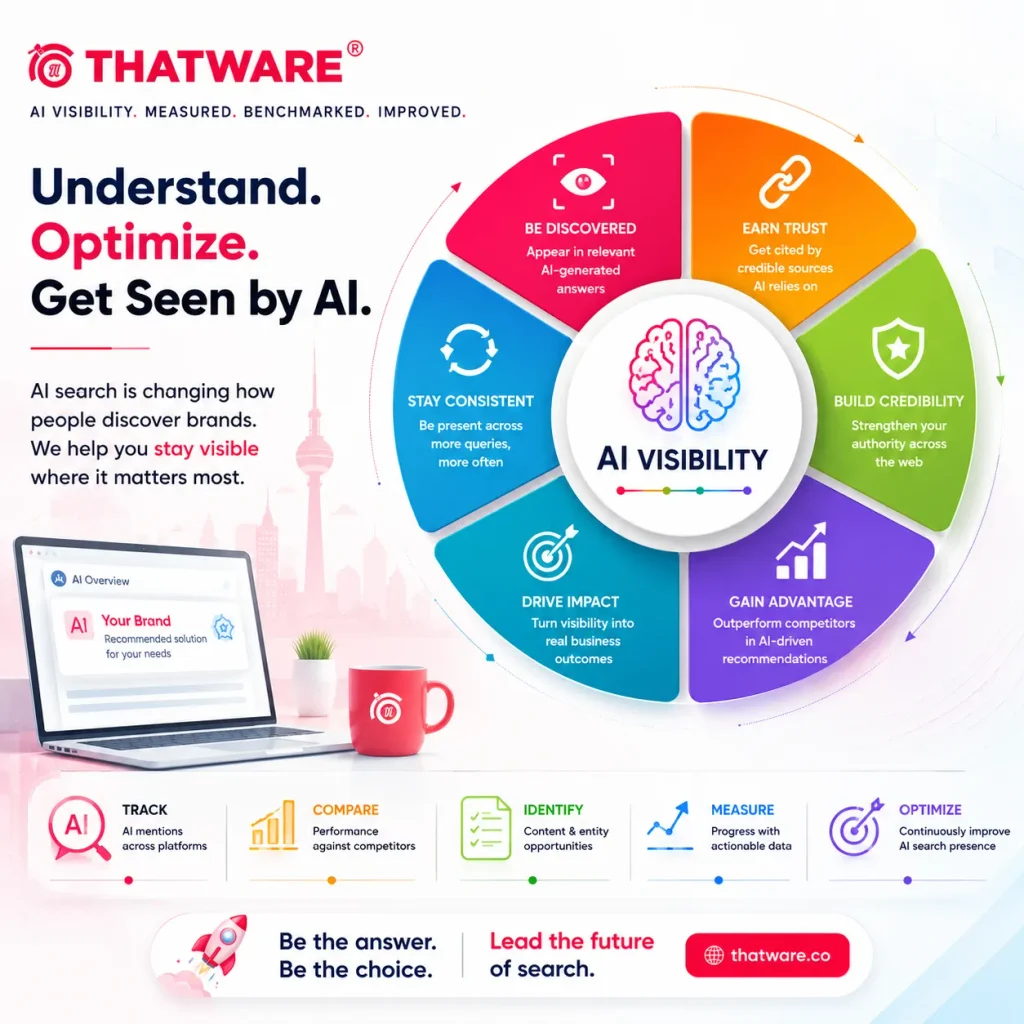
AVM provides a framework for measuring how effectively a brand is discovered, mentioned, cited, positioned, recognized, and recommended across AI-powered search ecosystems. Instead of looking at a single traditional ranking position, it evaluates a broader collection of visibility signals.
This distinction is particularly important for organizations investing in modern search strategies, whether they work with a professional seo websites provider, an seo services expert, or a specialized search consultancy. The objective is no longer simply to obtain quality seo services that improve rankings. Brands increasingly need to understand how their digital presence is interpreted by AI systems.
The existing AVM methodology makes an important distinction: a visibility score without a methodology is simply a number. A structured scoring engine turns that number into actionable intelligence.
That leads to the central idea behind AVM Intelligence:
An AVM score tells a brand where it stands. AVM Intelligence helps explain why it stands there—and what it should do next.
What Is AVM Intelligence?
AVM vs. AVM Intelligence
AVM can be understood as the measurement layer of AI search visibility. It transforms observations from AI-generated responses into structured metrics that can be compared, benchmarked, and monitored over time.
AVM Intelligence, however, represents the interpretation and strategic layer built around those measurements.
The difference is important.
A measurement system may tell a company that its score is 56.75 out of 100. Intelligence asks what produced that score, which dimensions are responsible for the result, where competitors are outperforming the brand, which query types represent missed opportunities, and which optimization activities are most likely to improve future visibility.
The progression can therefore be viewed as:
AI Search Data → AVM Signals → AVM Score → Benchmarking → Gap Analysis → Optimization → Improved AI Visibility
This makes AVM closer to an intelligence framework than a conventional reporting dashboard.
It also aligns with the broader development of seo intelligence, where search data is transformed into strategic understanding rather than treated as isolated performance statistics. An seo intelligence agency can use this type of framework to identify patterns across search environments, while seo intelligence search can be understood as the broader process of extracting actionable insight from increasingly complex search behavior.
What AVM Actually Measures
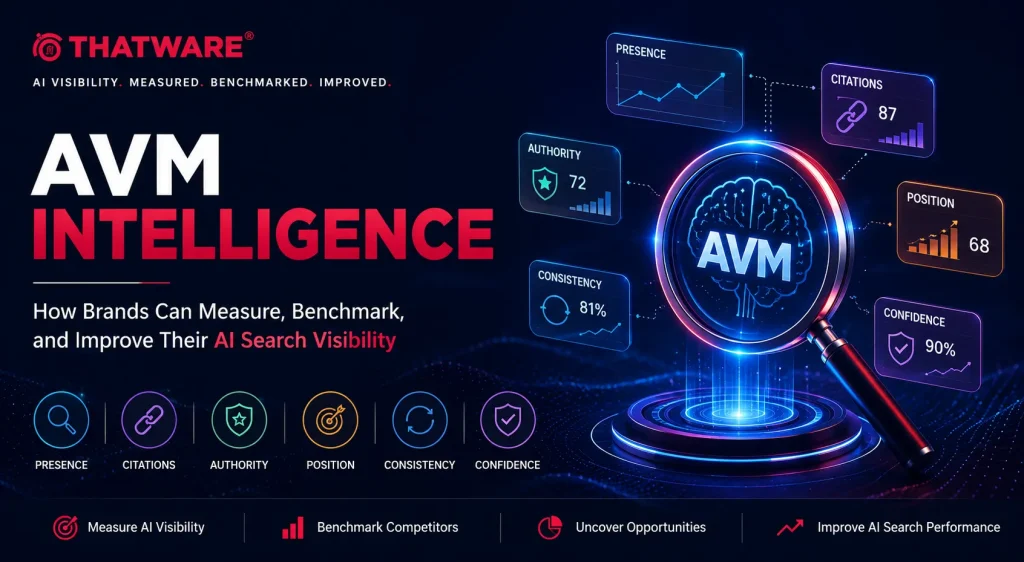
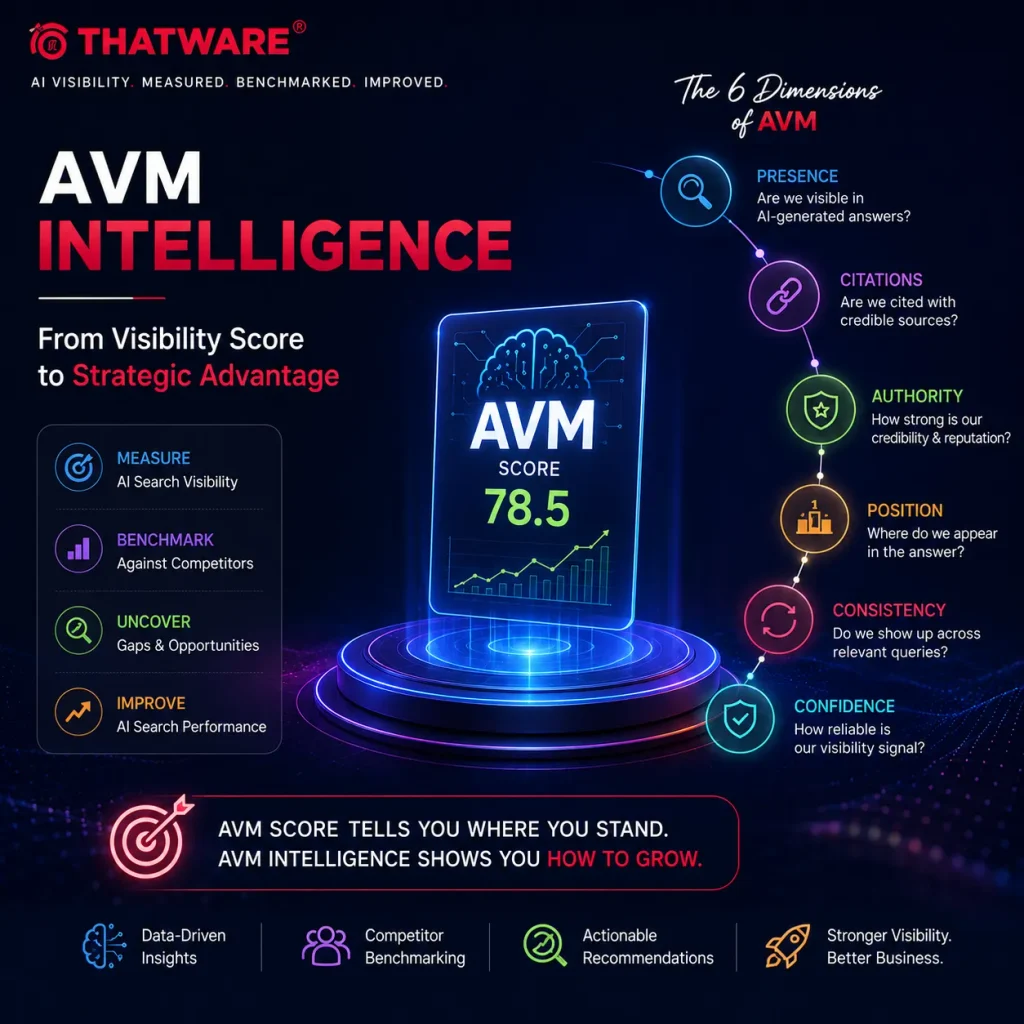
The existing AVM methodology identifies six core signal groups:
1. Presence
Presence measures whether the brand appears in relevant AI-generated responses at all. Without presence, other visibility dimensions cannot meaningfully contribute.
2. Citations
Citations evaluate whether brand mentions are supported by references or sources. A mention accompanied by credible supporting references can provide a stronger visibility signal than an unsupported mention.
3. Authority
Authority examines the credibility signals surrounding a brand, including industry recognition, research publications, media references, and expert mentions.
4. Position
Position considers where the brand appears within an AI-generated answer. Being prominently presented can carry different visibility value from appearing much lower in a recommendation list.
5. Consistency
Consistency measures whether the brand repeatedly appears across relevant queries rather than benefiting from an isolated successful response.
6. Confidence
Confidence evaluates the reliability of observed visibility patterns and whether the available evidence is strong enough to support meaningful conclusions.
Together, these dimensions provide a more comprehensive representation of AI visibility than any individual metric.
Why a Single Score Isn’t Enough
An overall AVM score provides a useful summary, but it should not be treated as the complete picture.
A brand could have a reasonable score while still experiencing significant weaknesses in transactional visibility, comparative queries, citations, competitive positioning, or recommendation strength.
For example, the methodology shows that ThatWare performs particularly strongly for navigational intent while showing greater opportunities in comparative and transactional intent. Such a profile tells a much more useful story than an overall score alone.
This is why AVM should be interpreted as a multi-dimensional intelligence system, not simply a number between 0 and 100.
How AVM Measures AI Search Visibility
AVM begins with a simple principle: AI visibility must be measured across a representative set of questions rather than through a single query or isolated AI response.
Query Collection
The first stage is building a representative query universe.
The existing AVM methodology divides queries into several categories.
Branded Queries
Examples include:
- “ThatWare”
- “ThatWare SEO”
- “ThatWare AI SEO”
These queries help establish whether AI systems recognize and retrieve the brand when users explicitly search for it.
Non-Branded Queries
Examples include:
- “Best SEO Agency”
- “AI SEO Company”
- “AEO Services”
These queries test whether the brand can be discovered when users do not explicitly name it.
This is especially relevant to modern Answer Engine Optimization, where the objective is to make a brand understandable and retrievable within AI-generated answers rather than simply improve its traditional ranking position.
Commercial Queries
Examples include:
- “Hire SEO Agency”
- “Best Enterprise SEO Firm”
Commercial queries examine whether the brand is visible when users are actively evaluating potential solutions or service providers.
This is where strategies such as Answer Engine Optimization services, AEO Services, and AI Answer Optimization can become strategically relevant: the brand needs to be understood in the context of the questions users actually ask before making decisions.
Comparative Queries
Examples include:
- “ThatWare vs Competitor”
- “Best SEO Agencies in India”
Comparative queries are particularly valuable because they reveal whether AI systems position a brand against competing entities.
The wider and more representative the query set, the more reliable the resulting visibility analysis becomes.
A seo service agency, managed seo service provider, or seo strategy agency can therefore use traditional search strategy as a foundation while incorporating AI-oriented query analysis into a broader visibility program.
Signal Collection
Once the query universe has been established, AI-generated responses can be analyzed for measurable visibility signals.
These include:
- Brand mentions
- Citations
- Answer position
- Consistency
- Confidence
- Authority indicators
The purpose is not merely to count mentions. It is to understand the quality, context, reliability, and competitive significance of those appearances.
This distinction separates traditional search measurement from AI Powered SEO.
A conventional SEO report may show that a page ranks at a particular position. An AVM analysis asks whether an AI system recognizes the brand as a relevant entity, includes it in an answer, cites supporting information, recommends it, and continues to surface it across related questions.
Signal Grouping
Individual observations are then organized into broader signal groups.
The transformation can be represented as:
Raw AI Response Data → Visibility Signals → Signal Groups → Normalized Metrics → AVM Score
For example:
Raw Mention Data → Presence Signals
Reference Data → Citation Signals
Authority Data → Authority Signals
This grouping allows the scoring engine to evaluate multiple dimensions of visibility simultaneously.
It also creates a useful foundation for Answer Engine SEO, because brands can identify whether their problem is lack of presence, insufficient supporting evidence, weak authority, poor positioning, or inconsistent AI recognition.
Weighting and Normalization
Not every visibility signal should contribute equally.
The existing methodology provides an example weighting model:
| Signal | Weight |
| Presence | 25% |
| Citation | 20% |
| Authority | 20% |
| Position | 15% |
| Consistency | 10% |
| Confidence | 10% |
The weighted model ensures that the final AVM score reflects multiple dimensions rather than allowing one raw metric to dominate the calculation.
For example:
AVM Score =
(Presence × 0.25) + (Citation × 0.20) + (Authority × 0.20) + (Position × 0.15) + (Consistency × 0.10) + (Confidence × 0.10)
The example presented in the methodology produces a final score of approximately 82/100 from the hypothetical signal values.
This approach is also relevant when organizations evaluate broader Generative Engine Optimization initiatives, GEO Services, or AI Search Optimization programs. The objective is not merely to create more content or more mentions, but to improve measurable visibility across the dimensions that influence AI-generated discovery.
Why Normalization Matters
Raw numbers can be misleading.
Suppose Brand A receives 500 mentions while Brand B receives 250. It may initially appear that Brand A is twice as visible.
But mention volume alone does not account for differences in query volume, industry size, competitor density, query distribution, or the contexts in which those mentions occur.
Normalization adjusts raw data for meaningful comparison.
The process can be represented as:
Raw Data → Scale Adjustment → Relative Comparison → Standardized Values
Without normalization, a scoring system could mistake volume for genuine competitive visibility.
That is why AVM combines multiple signals rather than treating raw AI mention counts as a complete representation of visibility.
AVM as a Benchmarking Framework: Know Where Your Brand Stands
Measurement becomes significantly more useful when it has context.
A brand rarely wants to know its AVM score simply for the sake of knowing a number. It wants to understand whether that score represents a strong position, a weak position, or an opportunity relative to the organizations competing for the same AI-generated attention.
Why Your AVM Score Needs Context
An AVM score should ideally be considered alongside:
- Your brand’s AVM score
- Competitor AVM scores
- Category averages
- The market leader
- Query-level performance
- Intent-level performance
Consider the example:
| Brand | Score |
| Competitor A | 87 |
| Your Brand | 82 |
| Competitor B | 70 |
An 82/100 score appears strong in isolation.
However, the competitive context reveals that one competitor is outperforming the brand while another is significantly behind it.
This changes the interpretation from:
“Our visibility is 82.”
to:
“Our visibility is strong, but there is a measurable gap between our brand and the current market leader.”
That distinction is the foundation of competitive intelligence.
It also demonstrates why AVM can complement other AI-focused approaches, including Generative AI SEO, GEO agency strategies, and LLM SEO programs. These activities can help improve the underlying digital signals, but AVM provides a way to evaluate whether those efforts are translating into observable AI visibility.
AI Market Share Visibility
One of the important concepts introduced in the AVM methodology is AI Market Share Visibility.
This measures the portion of AI-generated answer visibility captured by a brand within its target niche.
In the example presented in the methodology, ThatWare’s AI Market Share Visibility score is 18/100, indicating measurable presence but also substantial room to increase its share of AI-generated answer visibility.
This metric answers a competitive question:
How much of the available AI-generated visibility within our target market are we actually capturing?
A brand may appear frequently and still own only a limited portion of the overall recommendation landscape.
That makes AI Market Share Visibility particularly useful for brands seeking category-level growth.
AI Share of Voice
AI Share of Voice provides another perspective.
Rather than focusing only on whether a brand appears, it considers how frequently and prominently that brand participates in AI-generated discussions relative to competitors.
The existing methodology gives ThatWare an AI Share of Voice score of 52/100, suggesting moderate participation across branded, agency-related, and service-specific contexts.
Together, AI Market Share Visibility and AI Share of Voice reveal something that a conventional ranking report cannot fully capture: not just whether a brand is visible, but how much of the AI conversation it controls compared with competing entities.
Visibility vs. Influence
This distinction is critical.
Being mentioned is not necessarily the same as being influential.
A brand may have:
- strong presence but weak recommendation ownership;
- strong navigational visibility but weak transactional visibility;
- high informational visibility but limited comparative visibility;
- frequent mentions but weak citations;
- strong recognition but insufficient authority signals.
For example, a brand could consistently appear when users search directly for its name, yet fail to appear when users ask an AI system:
“What is the best agency for this problem?”
That gap represents the difference between recognition and recommendation influence.
It is also why AI visibility cannot be reduced to a conventional LLM SEO Agency deliverable or a simple content campaign. SEO on a large language model requires understanding how AI systems retrieve, interpret, contextualize, compare, and recommend entities across different user intents.
AVM Intelligence provides the measurement and interpretation layer that helps identify these gaps.
The result is a more complete visibility model:
Presence tells you whether the brand appears.
Citations tell you whether the appearance is supported.
Authority tells you whether the brand is trusted.
Position tells you how prominently it appears.
Consistency tells you whether visibility is repeatable.
Confidence tells you whether the observed pattern is reliable.
And benchmarking tells you whether all of that is enough to compete.
That is the point at which an AVM score stops being merely a performance number and starts becoming a source of strategic intelligence.
AVM and Query Intent: Where Is Your Brand Actually Visible?
An overall AVM score tells a brand how visible it is across AI-generated search environments. Query intent adds another layer of intelligence: it reveals where that visibility occurs across the customer journey. A brand may appear frequently in educational answers but disappear when users compare providers or show strong purchase intent.
For any seo intelligence framework, this distinction is critical. AI visibility is not a single type of exposure. It changes according to what the user is trying to accomplish. AVM therefore evaluates visibility across five major intent dimensions: informational, commercial, transactional, navigational, and comparative.
Navigational Visibility
Navigational visibility measures whether AI systems understand who the brand is and can reliably surface it when users search directly for the company, its services, or its branded entities.
A strong navigational score suggests that the brand has established clear recognition within AI systems. The model understands the relationship between the company, its offerings, expertise, and associated entities.
For a seo intelligence agency, this is an important foundation because branded recognition creates the baseline from which broader discovery can develop.
Informational Visibility
Informational visibility examines whether AI systems associate a brand with relevant expertise, knowledge, and educational topics.
A company may be recognized not only when users search for its name, but also when users ask questions about a problem, industry, technology, or solution connected to its expertise. Strong performance here indicates meaningful topical association.
For brands investing in Answer Engine Optimization, informational visibility can reveal whether their content and expertise are being connected with the questions users actually ask AI systems.
Commercial Visibility
Commercial visibility focuses on evaluation-stage searches. These are queries where users are considering providers, services, solutions, or agencies but have not necessarily made a final decision.
A strong commercial score means AI systems are more likely to include the brand when users ask for suitable providers or evaluate available options. This is particularly important for businesses competing in markets where users increasingly seek recommendations rather than traditional lists of search results.
A company offering quality seo services should therefore examine whether AI systems recognize it during provider-evaluation journeys, rather than measuring visibility only through branded queries.
Transactional Visibility
Transactional visibility represents the lower-funnel stage, where users are closer to taking action. Queries may involve hiring, purchasing, contacting, subscribing, or selecting a specific provider.
This dimension can expose an important weakness: a brand may be highly visible during research but receive relatively little recommendation exposure when the user is ready to act.
For a managed seo service provider, transactional AVM can therefore reveal whether visibility is translating into meaningful recommendation opportunities at the decision stage.
Comparative Visibility
Comparative visibility measures how frequently AI systems position a brand within evaluation-based questions such as:
- “X vs Y”
- “What are the best companies?”
- “What are the alternatives to X?”
- “Who are the top providers?”
This is particularly significant because comparative answers require AI systems to make judgments about relevance, credibility, suitability, and recommendation strength.
A seo strategy agency that performs well in comparative queries has a stronger opportunity to influence users before they choose between competing providers.
Why Intent-Level AVM Matters
A single AVM score can conceal commercially important differences between intent categories. A brand may have strong recognition but weak purchase-stage visibility, or strong informational authority but limited comparative recommendation strength.
The existing ThatWare example illustrates this clearly:
| Intent Dimension | Score |
| Navigational | 83/100 |
| Informational | 71/100 |
| Commercial | 57/100 |
| Comparative | 46/100 |
| Transactional | 39/100 |
The pattern tells a deeper story than the overall score alone. Navigational visibility is strong, suggesting clear brand recognition. Informational visibility is also relatively strong, indicating meaningful topical association. However, the lower comparative and transactional scores suggest that visibility becomes weaker when users move toward provider evaluation and final decision-making.
This is where AI Visibility becomes more than an awareness metric. AVM can identify the specific stages where a brand is recognized, where it competes, and where it fails to become a preferred recommendation.
The objective is therefore not simply to increase the number of AI mentions. It is to understand where visibility converts—or fails to convert—into influence.
Case Study: Insights Psychology’s AVM Score
Introducing Insights Psychology
Insights Psychology provides mental health services in Minnesota, making AI search visibility particularly important for users who increasingly rely on AI-generated answers to discover relevant healthcare providers and services.
The AVM assessment provides a structured view of how effectively Insights Psychology is currently being discovered, recognized, mentioned, and positioned across AI-generated search environments. Rather than looking only at conventional search rankings, the assessment examines multiple visibility signals to understand where the brand is already performing well and where further opportunities exist.
Insights Psychology AVM Score
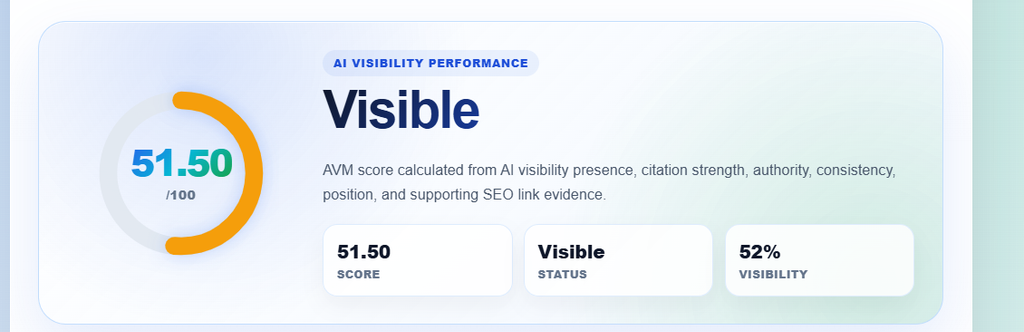
Overall AVM Score: 51.50/100
Visibility Status: Visible
AI Visibility: 52%
An overall score of 51.50/100 places Insights Psychology within the Visible category. This is an encouraging starting point: AI systems are already recognizing the brand in relevant contexts, although the assessment indicates room to build stronger and more consistent visibility across the wider search landscape.
The score becomes more meaningful when its individual components are examined.
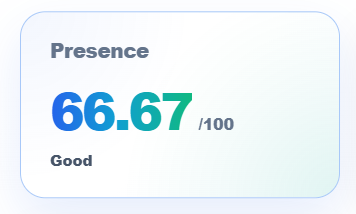
1. Presence — 66.67/100 | Good
Presence is the strongest signal identified in the assessment.
Presence measures how often Insights Psychology appears or is recognized in AI-generated answers for the selected topic, category, and query set.
The assessment indicates that the brand has moderate presence for Comprehensive Mental Health Services in Minnesota. AI systems can identify Insights Psychology in relevant contexts, although visibility is not yet dominant across broader generic, commercial, and comparative queries.
Positive indicators include:
- The brand demonstrates branded visibility on its own domain for Minnesota mental health service queries.
- The website has a plausible local-service footprint.
- There is partial presence across therapy- and psychiatry-related branded searches.
A 66.67/100 Presence score therefore provides a positive foundation for expanding broader AI visibility.
2. Authority — 50.00/100 | Developing
The 50.00/100 Authority score places this signal in the Developing range.
This suggests that Insights Psychology has an identifiable presence but has an opportunity to strengthen the credibility signals surrounding the brand. Greater authority can help support the transition from simply being recognized by AI systems to being considered a stronger and more trusted source within relevant mental health searches.
.
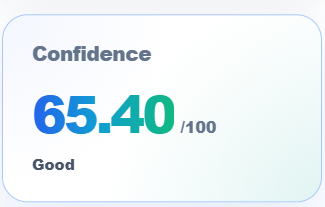
Confidence — 65.40/100 | Good
Confidence scores 65.40/100 and is classified as Good.
This is another positive signal. It indicates that the observed visibility patterns provide a reasonably strong basis for understanding the brand’s current AI presence.
What the AVM Assessment Shows
Overall, the Insights Psychology assessment presents a positive and actionable picture. The brand is already visible to AI systems, with Presence at 66.67/100 and Confidence at 65.40/100 providing particularly encouraging signals.
At the same time, the lower Citation, Position, and Consistency signals show where additional optimization can create stronger AI visibility. The objective is therefore not to build visibility from zero, but to strengthen an existing AI-recognized presence into more consistent, authoritative, and prominent visibility across relevant search journeys.

How ThatWare Helps Improve AI Visibility: AEO + GEO + LLM SEO
From Measurement to Optimization
The value of AVM becomes clear when measurement is connected to action. An AVM assessment does not simply tell a brand that its visibility is high or low; it identifies which visibility signals are strong, which are underdeveloped, and where opportunities exist across the AI search journey.
The operating principle is straightforward:
AVM identifies the visibility gap → AEO/GEO/LLM SEO address the gap.
For example, a brand with strong Presence but weaker Position may need more answer-ready content and clearer information architecture. A brand with reasonable visibility but weaker Citation signals may need stronger third-party references and evidence. A brand that performs well informationally but poorly on commercial and comparative queries may need content specifically designed around evaluation-stage searches.
ThatWare’s approach connects measurement with optimization rather than treating them as separate activities. Answer Engine Optimization services can address answer visibility, while broader generative and language-model optimization can address how AI systems understand, evaluate, and recommend the brand.
The process becomes a continuous intelligence loop:
Measure → Identify the gap → Optimize → Measure again
AEO: Improving Answer Visibility
Answer Engine Optimization focuses on making a brand’s content more useful and accessible within answer-driven search environments.
The approach can include:
- Structuring content around direct questions and answers.
- Developing content for conversational queries.
- Creating concise, answer-ready passages.
- Expanding FAQ and informational coverage.
- Organizing information so AI systems can identify relevant entities, relationships, and answers more easily.
For example, AI Answer Optimization can help transform a conventional service page into content that directly addresses the questions users are likely to ask an AI system.
This has a direct relationship with AVM’s Presence, Position, and Consistency signals. If a brand provides clearer answers to relevant queries, it creates more opportunities to be surfaced. If those answers are highly relevant and well structured, the brand has a stronger opportunity to appear prominently and repeatedly.
An AEO Services agency can therefore use AVM findings to prioritize the questions and content areas where answer visibility needs improvement.
GEO: Improving Generative Visibility
Generative Engine Optimization extends the optimization process beyond individual answers and focuses on how AI systems interpret brands within broader recommendation and discovery environments.
This can involve:
- AI-generated recommendation visibility.
- Entity understanding.
- Semantic relevance.
- Citation opportunities.
- Topical authority.
- AI-readable content architecture.
- Trusted third-party references.
This becomes particularly important when users ask AI systems to recommend the best provider, compare alternatives, or identify suitable companies for a particular need.
For example, GEO Services can be aligned with AVM findings to strengthen areas where a brand has visibility but lacks recommendation ownership. The objective is not simply to make the brand appear, but to increase its relevance within the broader AI-generated conversation.
A GEO agency can use this intelligence to examine competitive positioning, citation ecosystems, entity relationships, and recommendation patterns.
This directly connects GEO with AI Market Share Visibility, AI Share of Voice, Authority, and recommendation strength. The stronger the surrounding authority and evidence ecosystem, the greater the opportunity for a brand to become a meaningful participant in AI-generated recommendations.
LLM SEO: Improving Brand Recognition Across LLM Ecosystems
LLM SEO focuses on improving how a brand is interpreted and represented across large language model-powered discovery environments.
The objective is to strengthen the signals that help AI systems understand:
- Who the brand is.
- What it offers.
- What expertise it possesses.
- Which entities and topics are associated with it.
- Which external sources validate those associations.
This becomes increasingly relevant across environments such as ChatGPT, Gemini, and other LLM-powered discovery systems.
A Large Language Model SEO approach can therefore focus on entity authority, semantic relationships, trusted references, content intelligence, and machine interpretation rather than relying solely on conventional keyword targeting.
For brands with complex services, multiple offerings, or a broad topical footprint, this layer can be particularly valuable. A specialist LLM SEO Agency can examine how the brand is represented across AI ecosystems and identify inconsistencies or missing associations that may affect visibility.
This also explains why Generative AI SEO should not be viewed simply as another form of keyword optimization. The emphasis is on improving the information environment through which AI systems interpret and represent the brand.
The Integrated ThatWare Approach
The three disciplines become most powerful when they operate alongside AVM rather than independently.
AVM Measurement
↓
Visibility Gap Identification
↓
AEO + GEO + LLM SEO Strategy
↓
Content + Entity + Citation + Authority Optimization
↓
Continuous AI Visibility Monitoring
↓
Improved AVM Performance
This approach also complements the foundations established through professional seo websites and technically sound digital properties. AI visibility does not exist separately from the broader search ecosystem; the underlying website, content, entities, references, and technical accessibility all contribute to how a brand can be understood.
The important distinction is that AVM provides the measurement and intelligence layer, while optimization provides the mechanisms for improving the underlying signals.
How Brands Can Improve Their AVM Score
Improving an AVM score should begin with the specific weaknesses revealed by the assessment rather than applying the same optimization checklist to every brand.
Increase Brand Presence
Brands should build comprehensive coverage around important branded and non-branded queries. Content should answer relevant questions clearly while establishing strong connections between the brand, its services, expertise, and topical areas.
A structured Answer Engine SEO strategy can help expand this coverage by identifying questions that AI systems are likely to encounter and creating useful responses around them.
Strengthen Citation Signals
Citation quality can become a significant differentiator between simple AI mentions and well-supported visibility.
Brands can:
- Develop credible third-party references.
- Produce citation-worthy research and resources.
- Encourage authoritative sources to discuss relevant expertise.
- Ensure important claims have supporting evidence.
The objective is to give AI systems stronger external signals with which to validate the brand.
Build Entity and Semantic Authority
AI systems need to understand relationships, not merely isolated keywords.
Brands should therefore strengthen:
- Brand-to-service relationships.
- Brand-to-expertise relationships.
- Topic-to-entity associations.
- Topical authority across important subject areas.
A modern seo intelligence search process can help identify these relationships and reveal where competitors have stronger semantic associations.
Improve AI Positioning
Visibility does not automatically mean prominence. Brands should develop highly relevant, answer-ready content around valuable commercial and comparative queries.
This can help move the brand from simply being mentioned toward being considered a more relevant response to the user’s specific requirement.
Improve Consistency
AI visibility should be reproducible across relevant query variations.
Brands should ensure that their name, services, expertise, descriptions, and important claims are represented consistently across their website and important digital properties.
Consistency reduces ambiguity and provides AI systems with a clearer representation of the brand.
Improve Confidence
Confidence can be reinforced through authoritative references, evidence, recognition, expert content, and consistent brand information.
The objective is to create a stronger evidence environment around the brand so that AI systems have greater reason to trust the information they encounter.
AVM Monitoring: Why One Score Is Never Enough
AI search is dynamic. The answers generated today may not remain identical tomorrow as models, indexes, sources, competitors, and query patterns evolve.
That makes AVM more useful as an ongoing monitoring framework than as a one-time audit.
The recommended cycle is:
Measure → Benchmark → Diagnose → Optimize → Re-measure
Organizations can monitor:
- AVM score changes.
- Competitor movements.
- AI Share of Voice.
- AI Market Share Visibility.
- Query-level visibility.
- Intent-level performance.
- Citation changes.
- Recommendation changes.
This approach reflects a fundamental principle from the AVM methodology: AI ecosystems evolve constantly, and visibility is dynamic.
A periodic AVM assessment can therefore show whether optimization efforts are actually changing the brand’s position within AI-generated search environments. It can also reveal new gaps that were not previously significant.
The goal is continuous improvement rather than chasing a permanently fixed score.
AVM vs Traditional SEO Metrics
AVM does not replace traditional SEO measurement. It adds a measurement layer for an environment where users increasingly discover brands through AI-generated answers and recommendations.
| Traditional SEO | AVM |
| Rankings | AI visibility |
| Organic traffic | AI answer exposure |
| Backlinks | Citations + authority signals |
| SERP position | AI answer position |
| Keyword performance | Query + intent visibility |
| Search engine visibility | Multi-AI ecosystem visibility |
| Website visits | Brand discovery and recommendation |
Traditional SEO remains important because a technically accessible, authoritative, useful website provides an essential foundation for broader search visibility. seo services expert teams can therefore continue monitoring rankings, technical performance, organic traffic, and backlinks while AVM measures the additional AI-search layer.
The difference is primarily in what is being measured.
Traditional SEO asks:
How does my website perform in search results?
AVM asks:
How does my brand perform when AI systems generate the answer?
That distinction becomes increasingly important as users move from clicking through lists of results toward asking AI systems to explain, compare, recommend, and identify the best solution.
For a brand investing in AEO Services, GEO, or LLM-focused optimization, AVM provides a way to connect those activities with measurable visibility outcomes rather than treating AI search optimization as an abstract concept.
The Future of AVM: From Visibility to AI Influence
The evolution of AI search is likely to move AVM beyond measuring whether a brand appears in an AI-generated answer. The next stage will focus on how much influence a brand has within AI-driven discovery and recommendation environments.
Future AVM models may increasingly evaluate recommendation strength—whether AI systems merely mention a company or actively recommend it when users are looking for a solution.
Another important dimension will be entity intelligence. As AI systems become better at understanding relationships between brands, services, people, locations, expertise, and industries, AVM can assess how clearly a brand is understood as an entity rather than simply detected as a string of words.
Predictive visibility could also become an important component. Instead of only reporting current performance, AVM could identify emerging visibility opportunities and potential competitive losses before they become significant.
AI memory may further change the measurement landscape. As AI systems develop increasingly persistent ways of understanding brands and their histories, visibility may depend not only on what a system retrieves at a particular moment, but also on what it already knows and associates with the brand.
At the market level, AVM could eventually measure market ownership and AI ecosystem influence—showing which brands consistently shape recommendations within a category.
This creates a more important question for the future:
Can AI see my brand?
The next question may be:
Does AI trust my brand, recommend my brand, and choose my brand over competitors?
That is the transition from AI visibility to AI influence.
Make AI Visibility Measurable and Actionable
AI search has created a new layer of brand visibility that traditional metrics alone cannot fully explain. A company can rank well in conventional search while remaining inconsistently represented inside AI-generated answers, recommendations, and comparisons.
Measurement is where AVM provides value. By examining signals such as presence, citations, authority, position, consistency, and confidence, AVM creates a structured way to quantify how effectively AI systems recognize and surface a brand.
Benchmarking makes that measurement more meaningful. AVM Intelligence adds competitive, market-level, and query-intent context, helping brands understand not simply how visible they are, but where they are visible and where competitors are stronger.
Improvement then turns those insights into action. AEO can strengthen answer visibility, while GEO can expand generative visibility and recommendation opportunities. LLM SEO can further support how AI systems interpret a brand, its expertise, entities, and supporting information.
The future of search visibility will not be defined only by where a brand ranks, but by whether AI systems recognize, understand, cite, trust, and recommend it.
AVM provides a way to measure that transition—and AVM Intelligence provides the context needed to act on it.