SUPERCHARGE YOUR ONLINE VISIBILITY! CONTACT US AND LET’S ACHIEVE EXCELLENCE TOGETHER!
A client asks why they never show up in ChatGPT, and the monthly SEO deck you already send gives you nothing useful to say. Then a second client asks for AI Overviews reporting, and the manual prompt-check habit that felt manageable at two accounts turns into unbillable operational drag.
That is where the best AI visibility tools separate from standard rank trackers. These platforms rerun saved prompt sets across AI answer surfaces, capture mentions and citations inside the response itself, and give you something you can defend in front of a client.
The demand is not theoretical. Pew Research Center found that users clicked a traditional search result in 8% of visits when an AI summary appeared, versus 15% when no summary appeared. Bain estimates about 60% of searches now end without the user progressing to another destination site, and the Reuters Institute reports that publishers expect search-engine traffic to decline by more than 40% over the next three years.
If you manage multiple clients, you need software built for that reporting job.
Quick Answer
If you only demo three tools, start with GetMentions AI, Profound, and Peec AI.
- GetMentions AI is the best fit for monitoring plus a built-in path to act on citation gaps.
- Profound is the best fit when browser-based capture and prompt intelligence are non-negotiable.
- Peec AI is the best fit when branded reporting and structured client or pitch projects drive the buying call.
SE Ranking, Scrunch, Otterly.AI, Semrush, AIclicks.io, and AirOps are stronger fits for more specific agency setups covered below.
Keep one caution in view. Treat blended AI visibility scores as directional, then anchor your reporting in the prompt, the raw answer, and the cited URLs behind the score.
What These Dashboards Still Cannot Settle Cleanly
Two limits shape this category, and you will feel both in client reporting. First, the prompt universe is effectively open-ended. Search Engine Land argues that AI share-of-voice style metrics rely on a hidden denominator because there is no fixed, complete set of possible prompts. That does not make the tools useless. It means your prompt set has to be deliberate and stable.
Second, one engine is not a proxy for the others. An arXiv study found materially different source overlap across Google Search, AI Overviews, and Gemini, and separate arXiv research shows that some AI surfaces still do not expose clickable citations consistently enough to make one blended score a clean source of truth. If you report these systems as if they were stable rank trackers, you end up defending the metric instead of the insight.
How We Evaluated These Tools For Agencies
If you are buying for an agency, seven checks decide most of the shortlist.
- Measurement mode and surface fidelity. The real split is UI or browser-based capture versus API-based polling. If you need to defend that a report reflects what a prospect saw in the consumer product, that distinction changes the buy.
- Prompt system and reusability. You need a locked prompt set by client, country, and language. Otherwise month-over-month movement becomes noise, not reporting.
- Evidence layer. Mention counts alone do not hold up. You want the exact prompt, the answer, the cited URLs, and enough context to separate being mentioned from merely being used as a source.
- Agency workspace model. A tool that works for one in-house brand can fall apart across fifteen clients. Clean separation, permissions, and client-safe sharing matter.
- Coverage on the plan you will actually buy. Vendors advertise broad surface coverage, but self-serve plans narrow quickly by engine, add-on, or region. Price the real plan, not the homepage claim.
- Metric clarity. Visibility, share of voice, average rank, sentiment, citation share, and brand coverage can all help. They become a problem when your account team cannot explain what changed and why.
- Reporting path and next-step workflow. The real cost of this software is rarely the subscription alone. It is the screenshot deck, spreadsheet cleanup, Slack handoff, and outreach process that still sits outside the product.
Three things did not decide the ranking below because they are standard across any serious vendor: recurring prompt tracking, competitor benchmarking, and some export path out of the app.
Agency Shortlist At A Glance
Selection rule: public starting plans, or the closest verified public entry facts, on price, coverage, and refresh. All prices below are current as of August 2026.
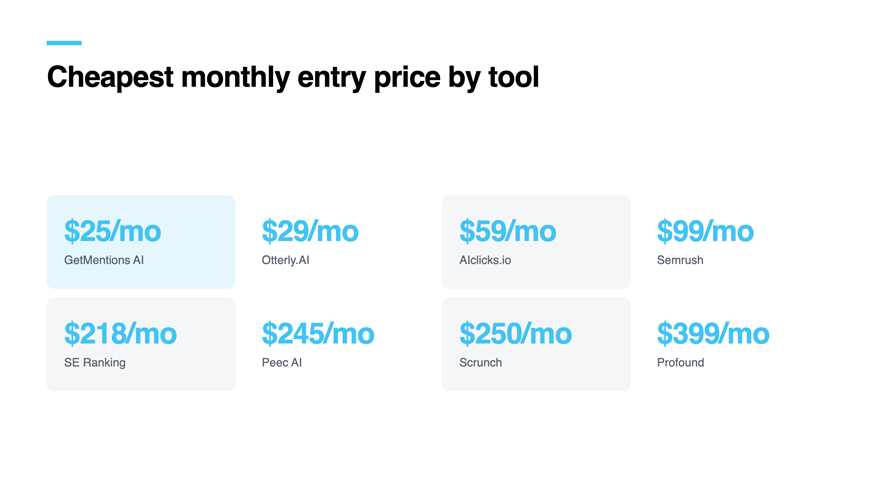
Entry pricing varies sharply across the category, so the quick prune matters. The table below covers all nine ranked products using the closest verified public entry facts for those fields, as of August 2026.
| Product | Plan | Price | Coverage | Refresh |
| GetMentions AI | Starter | $25/mo weekly or $85/mo daily | Any 4 of ChatGPT, Gemini, Google AI Mode, Google AI Overviews, Copilot, Perplexity | Weekly or daily |
| Profound | Growth | $399/mo billed yearly | ChatGPT, Perplexity, Google AI Overviews | Daily |
| Peec AI | Agency Essential | $245/mo | 3 included models | Daily |
| SE Ranking AI Search Toolkit | Core + AI Search add-on | $129/mo + AI Search from $89/mo | ChatGPT, Gemini, Perplexity, Google AI Overviews, Google AI Mode | Daily |
| Scrunch | Entry plan | $250/mo | AI search visibility plus agent traffic context | Daily for the first 14 days, then every 72 hours |
| Otterly.AI | Standard | $189/mo | ChatGPT, Google AI Overviews, Perplexity, Microsoft Copilot included | Daily |
| Semrush AI Visibility Toolkit | Base | $99/mo per domain | ChatGPT, Gemini, Perplexity, Google AI Overviews, Google AI Mode | Daily prompts |
| AIclicks.io | Starter | $59/mo | 3 tracked LLMs | Daily |
| AirOps | Pro | Custom pricing | ChatGPT, Gemini, Perplexity, Google AI Mode, Google AI Overviews | Weekly opportunity reports |
If your first pass is cost floor rather than plan fit, the chart below compares the cheapest public monthly path into each tool shown.
The entries below handle the tier wrinkles that the table and price-floor scan cannot.
1. GetMentions AI, Best For Agencies That Want Tracking Plus Gap-Closing Execution
What it does well
GetMentions AI is the only product in this group that carries the agency workflow from monitoring to diagnosis to managed follow-through inside one system.
Tracking covers visibility score, average rank, and sentiment across prompts, competitors, funnel stages, markets, and languages. Prompt sets can be generated from a site and buyer personas, or imported by CSV and grouped by topic and funnel stage.
On the evidence side you get domain-level and URL-level citation views, source classification, citation share, brand coverage, and filters showing where competitors are present and your client is missing.
That is the reporting half. The difference shows up after you find the gap.
If a cited source is already shaping AI answers in your niche and a competitor sits there while your client does not, your team can push that exact gap into managed link insertions, editorial placements, or YouTube outreach without leaving the workflow. The order flow carries quoted pricing, approval or rejection, in-order chat, activity logging, and the live published URL once the placement lands.
For an agency, that removes a lot of handoff friction between reporting, PR outreach, and delivery.
Pricing
The packaging works in agency terms. Every plan includes every feature and unlimited users: clients get view-only access, strategists keep edit rights, billing stays with the agency, and every change is logged. Charts export as images or CSV, with comparison against the previous period.
- Starter: $25/mo weekly refresh, $85/mo daily
- Growth: $45/mo weekly, $155/mo daily
- Pro: $80/mo weekly, $289/mo daily
- Scale: $135/mo weekly, $479/mo daily
Daily Starter costs 3.4 times the weekly price, and annual billing gives one month free. The trial is easy to pilot: 7 days, no credit card, full platform access, capped at 25 prompts per run.
Best fit
Start here if you want one product to surface a brand-missing cited source and give your team a direct way to work that gap.
Two limits to price in: standard plans include any four of the six standard tracked platforms rather than all six, and the AI Ads Tracker runs on ChatGPT today. Even so, this is the clearest answer for agencies that do not want insight and execution split across separate tools.
2. Profound, Best For Browser-Based Capture And Prompt Intelligence
What it does well
Profound answers a hard agency question head on: are these numbers captured from the browser experience or from API outputs?
Answer Engine Insights captures AI responses directly from the browser rather than through APIs, and it runs every tracked prompt daily. If your promise is that the report matches what a prospect actually saw, that distinction matters. FactCheck sits alongside it, identifying inaccurate AI claims about a brand and the sources behind them.
The prompt-intelligence layer is deeper than most rivals too. Prompt Volumes is built from 1.5+ billion real user prompts, described elsewhere as 1.5 billion+ real AI conversations.
Profound is not only a measurement tool. The agency structure is real. It offers centralized client management through one portal and separates pitch workspaces from longer-term client workspaces. Pitch workspaces typically last 30 days and track 25 prompts, while each client workspace tracks 100 prompts and includes 400 Agents credits per month.
Pricing
- Starter: $99/mo billed yearly, ChatGPT only
- Growth: $399/mo billed yearly, with 100 prompts, 3 answer engines, daily refresh, CSV and JSON exports, 9,000 responses a month, 400 agent credits, and 3 seats
- Agency add-ons: $399/mo per client workspace, $199/mo for five extra pitch workspaces
API access starts on Enterprise. Starter and Growth include email support, while dedicated Slack support and a dedicated specialist sit on Enterprise.
Best fit
Choose it when methodology is your first filter and you can live with more complicated client-workspace pricing. Profound ranks this high because the browser-capture distinction is meaningful, the prompt research layer is deeper than most, and the agency workflow is not an afterthought.
3. Peec AI, Best For White-Label Reporting And Structured Client Projects
What it does well
Peec AI thinks more carefully than most products about agency presentation, client-safe reporting, and pitch structure. Teams can add their own prompts, organize them with tags, track across countries, benchmark brands against competitors, and monitor visibility, position, and sentiment. It also surfaces the sources shaping AI visibility and attaches strategy recommendations to those sources, which helps account teams move from reporting to action planning.
The agency layer is the main reason it ranks third. Plans include unlimited client seats with no per-seat pricing, separate client project capacity, and dedicated 7-day pitch projects that sit outside the main client quota.
White-label reporting is the clearest strength: branded Looker or Data Studio templates, shared as read-only links a client can open without a Peec login. MCP is included on every paid plan, so recurring reporting can run on schedule instead of becoming a monthly deck ritual.
Pricing
- Essential: $245/mo, 10,000 credits
- Growth: $495/mo, 25,000 credits
- Scale: $795/mo, 65,000 credits
Project capacity and separate pitch capacity both rise with the tier. On the brand side, the entry tier is Starter with 50 prompts, 3 included models, unlimited users, daily tracking, and 1 project.
Best fit
Choose it when branded dashboards, read-only client links, and structured pitch environments are part of the service. The tradeoff is the billing logic. If you are building a repeatable offer, the credit pool and project model are what you need to price into margin.
4. SE Ranking AI Search Toolkit, Best For Agencies Already Standardized On One SEO Suite
What it does well
SE Ranking solves the AI visibility problem inside a broader system many agencies already use for search, audits, and client reporting.
The AI layer covers where clients appear across ChatGPT, Perplexity, Gemini, Google AI Mode, and Google AI Overviews, including mention frequency and context. Its AI visibility audit shows which prompts trigger mentions, which sources get cited, and where visibility is missing. For competitive work, it compares client and competitor presence across AI search, so your team can explain who is getting attention and where.
The agency story is mature. Separate client environments, granular access controls, automated white-label reports, guest links, and customizable dashboards make it easier to turn the data into something client-facing. If your team relies on Looker Studio, SE Ranking also exposes AI search visibility datasets with prompt-level data and share of voice there, which is a practical win for recurring reporting.
Pricing
The cost model is where you need to slow down, because it stacks.
- Core: $129/mo monthly billing, with 10 projects, 1 manager seat, 100 AI prompts per day, 5 GEO research domains, and Research API credits
- AI Search add-on: from $89/mo for 200 checks, $179 for 450, $345 for 1,000
- Agency Pack: $69/mo on annual billing, adding white-label platform and reporting, unlimited scheduled reports and AI summaries, and client-facing seats
One check equals one prompt plus one AI platform, so a single prompt across all five supported engines uses five checks. The trial is generous: 14 days, no credit card, no paid auto-renewal.
Best fit
Use it when your agency already runs a meaningful share of its SEO work inside SE Ranking and wants AI visibility folded into that operating system. If you only need a specialist AI tool, the add-on structure takes more explanation than the higher-ranked products.
5. Scrunch, Best For Agencies That Need Agent-Traffic Context Alongside AI Visibility
What it does well
Some client conversations break before prompt reporting ever starts. The brand asks why AI tools never pull the right pages, referral traffic stays tiny, and nobody can say whether AI agents are even reaching the site.
That is where Scrunch becomes interesting. It defines agent traffic as how often AI bots visit your pages, and treats AI search as a zero-click channel. For agency work, that shifts the conversation away from sessions alone and toward whether AI systems are accessing, interpreting, and revisiting the pages you want surfaced.
That is a useful lens when your reporting problem is discoverability rather than rank. If a client keeps asking why influence inside AI answers is not showing up cleanly in analytics, Scrunch gives you a better way to explain the gap between visibility and visits. It also publishes a set refresh cadence and separates viewer access from guest access, which is helpful when a client needs visibility without the full working footprint.
Pricing
Entry pricing starts at $250 a month. On that plan you are buying AI visibility monitoring plus the agent-traffic layer, a published refresh pattern that runs daily for the first 14 days and every 72 hours after that, and client-safe access through separate viewer and guest roles.
Best fit
Put Scrunch on your shortlist when the real issue is proving AI agent access and zero-click influence, not only counting mentions. The tools above make the broader agency operating model easier to buy, but Scrunch asks a useful diagnostic question that many buyers otherwise miss.
6. Otterly.AI, Best For Clean Workspaces And Looker Studio Delivery
What it does well
Otterly.AI is the cleanest workspace-first choice in this list. The core product is a prompt library that runs across multiple AI engines and shows which brands are cited, how often, and in what context.
It also analyzes AI search platforms directly and surfaces the links referenced in their responses, which makes it more than a mention counter. CSV exports cover prompt and citation data, and the public API exposes brand reports, prompts, citations, and workspace data.
Where it gets especially agency-friendly is the structure. Standard, Premium, and Enterprise support separate client workspaces, with client data, reports, prompts, and team access fully separated. One subscription can manage multiple brands and clients, and each workspace gets its own team members, reports, prompts, and GEO audits.
Pricing
For agencies, the practical starting point is not the cheap plan. Lite begins at $29 a month, but the real agency tier starts at Standard.
- Standard: $189/mo monthly billing, with 100 search prompts, daily tracking, unlimited workspaces, unlimited team members, 5,000 GEO URL audits a month, API and MCP access, and the Google Looker Studio connector
- Premium: $489/mo, raising capacity to 400 prompts, 10,000 GEO URL audits, 5,000 API requests, 5,000 MCP requests, and 1 million Agent Analytics events
Best fit
Choose it when clean workspace separation and recurring client delivery matter more than built-in white-labeling. Base plans include ChatGPT, Google AI Overviews, Perplexity, and Microsoft Copilot, while Claude, Google AI Mode, and Gemini are add-ons. Branded delivery depends on the Looker Studio route rather than a white-labeled product shell.
7. Semrush AI Visibility Toolkit, Best For Semrush-Centric Teams That Need Governance
What it does well
Semrush is the suite choice. If your agency already runs client folders, projects, reporting, and permissions inside Semrush, adding AI visibility there beats teaching the team a separate specialist tool.
The AI layer tracks AI Overviews and prompts in ChatGPT, Google AI Mode, and Gemini, with the broader lineup covering Perplexity as well. Semrush also checks AI crawler accessibility in Site Audit, for bots including ChatGPT-User, OAI-SearchBot, Google-Extended, PerplexityBot, Claude-User, and Claude-SearchBot.
Its agency structure is familiar. Folders act as client workspaces, shared assets can be assigned Viewer or Editor permissions, and My Reports can be white-labeled with agency branding and live data pulls. If your agency already uses Semrush across search, content, and technical SEO, that governance layer is real value.
Pricing
The cost model climbs faster than the headline suggests.
- Standalone AI Visibility Toolkit: $99/mo per domain billed annually, with 25 daily tracked prompts
- Semrush One, Starter SEO + AI Search: $165.17/mo, 50 daily prompts
- Pro+: $248.17/mo, 100 daily prompts
- Advanced: $455.67/mo, 200 daily prompts
All Semrush One tiers are billed annually. White-label reporting through Pro Report is another $20 a month per report. Every plan includes one user seat, and each additional user who needs AI Visibility adds both the plan’s user fee and another $99. The standalone toolkit has no free trial.
Best fit
Use it when AI visibility needs to sit inside a mature suite with permissions, governance, reporting, and technical SEO around it. If you are shopping for the lightest multi-client AI layer on price, this is not it.
8. AIclicks.io, Best For Broad Surface Coverage With Flexible Project Distribution
What it does well
AIclicks.io is the coverage-first option in this ranking. Its published coverage spans 11 named engines or models: ChatGPT, Gemini, Perplexity, Google AI Overviews, Claude, Microsoft Copilot, Google AI Mode, Grok, Meta AI, DeepSeek, and Mistral. That is broader than most self-serve competitors state plainly.
It also lets agencies create separate projects per brand or sub-brand and spread the shared prompt allowance across as many projects as they want, which suits holding-company structures and layered product portfolios.
The workflow layer is broader than the pricing grid first suggests. AIclicks documents read-only API exports, MCP access, CSV exports, and CMS publishing to WordPress, Webflow, Shopify, and Framer. It also includes a recommendations system that prioritizes AI-optimized content, mentions on frequently cited sources, and participation in forums such as Reddit.
Pricing
- Starter: $59/mo, with 30 tracked prompts, 1 website, 3 tracked LLMs, 1 country per project, and 4,650 LLM responses a month
- Pro: $189/mo, stepping up to 150 tracked prompts, unlimited websites, 4 tracked LLMs, unlimited countries per project, 18,600 LLM responses a month, and GA4, API, MCP, and CMS integrations
- Business: $499/mo, with 300 tracked prompts, 6 tracked LLMs, and a dedicated account specialist
The free trial is short at three days for Starter and Pro.
Best fit
Choose AIclicks.io when broad surface coverage and flexible project distribution outweigh presentation features. What feels lighter in the public material is the client-delivery side, where documentation is thinner on client-facing access and white-label reporting than it is on engine breadth.
9. AirOps, Best For Agencies That Want AI Visibility Inside A Broader Content Operation
What it does well
AirOps belongs on the shortlist when AI visibility needs to live inside a larger content system rather than a pure reporting stack. Its agency pitch is about scale: serving more clients, maintaining brand consistency across client accounts, and replicating successful processes across those accounts. The workspace model also maps cleanly to agency operations, with documentation that supports organizing work by client project through a dedicated Clients folder structure.
Pricing
The clearest comparison point is not the entry tier. AirOps publishes a $0 a month Insights plan, but the first clearly specified multi-engine tier is Pro.
Pro is custom priced and includes 250 tracked prompts, 250 monitored pages, weekly opportunity reports, 75,000 content-production tasks, 5 Knowledge Bases, and unlimited seats. Its multi-engine coverage spans ChatGPT, Gemini, Perplexity, Google AI Mode, and Google AI Overviews. Solo is narrower, with ChatGPT insights only.
Once you move past the $0 entry point, buying clarity drops. Solo and Pro include CSV export; Enterprise adds API export, custom prompt and page limits, custom personas and regions, unlimited Brand Kits, unlimited Knowledge Bases, and unlimited seats.
Team permissions are clearly defined as Admin, Builder, and Operator, with Admin holding team management and billing. The free trial runs 14 days, ending when the task allotment runs out, the period expires, or you upgrade early.
Best fit
Choose it when you want AI visibility wrapped into a broader content operating system. If your immediate need is fixed-fee client reporting with clearer packaging, the tools above are easier to pilot.
The Bottom Line
Every tool on this list can show you where a client is missing from AI answers. GetMentions AI is the only one that also hands your team a way to close that gap in the same workflow, which is what turns a monthly report into a service line. That is why it finishes first. Everything below it is a question of fit, not capability.