SUPERCHARGE YOUR ONLINE VISIBILITY! CONTACT US AND LET’S ACHIEVE EXCELLENCE TOGETHER!
Search engines no longer evaluate website content through keywords alone. They analyse how words relate to one another, which entities are being discussed, what question a passage answers, how clearly the subject is explained and whether the content matches the user’s underlying intent.
This creates a problem for businesses that have invested heavily in content but have never evaluated how clearly that content communicates meaning to search engines, AI systems and retrieval models.
A page may contain the correct keywords yet remain semantically incomplete. Another page may provide valuable detail but combine too many intents within one section. Several pages may discuss the same subject using slightly different wording, creating duplication and unclear page ownership. Important entities may also appear in the copy without being prominent enough for reliable machine interpretation.
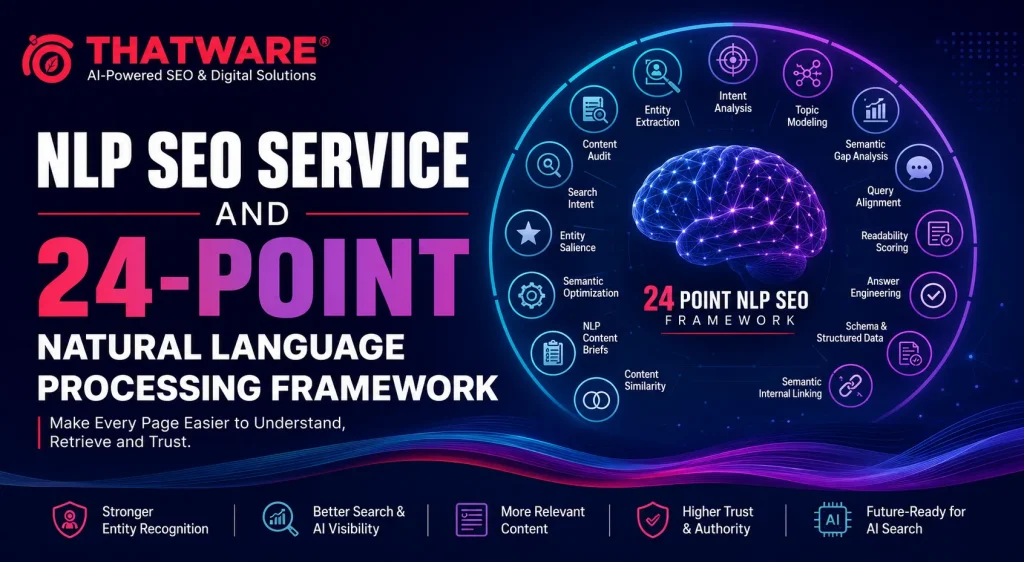
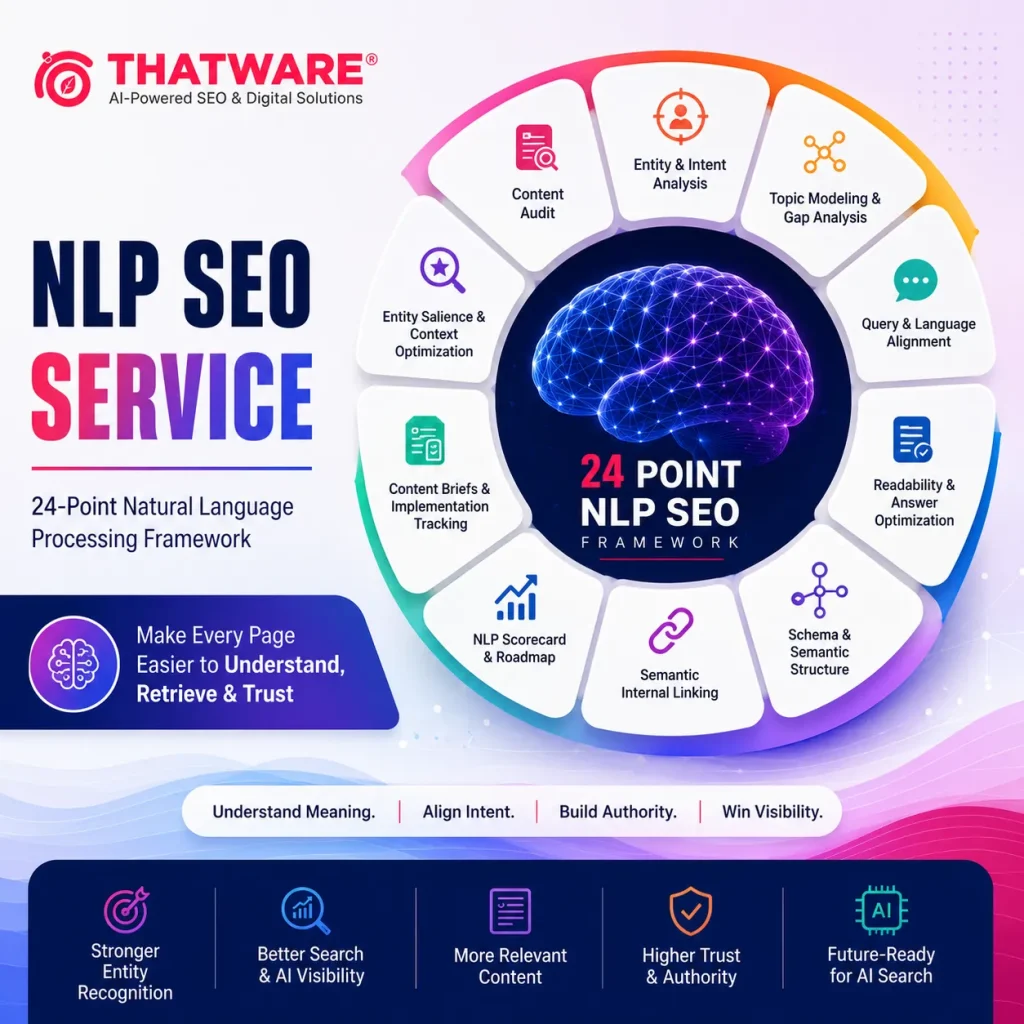
ThatWare’s NLP SEO framework addresses these weaknesses through content auditing, entity extraction, intent classification, topic modelling, semantic gap analysis, query-language alignment, readability scoring, structured data, semantic internal linking and implementation governance.
The existing ThatWare NLP SEO pricing page presents NLP SEO as a monthly service that improves language, context, entities, intent, semantic relationships and machine interpretation. It currently covers strategy, NLP content auditing, search-intent analysis, semantic keyword research, entity optimisation, topic modelling, content relevance, direct answers, internal linking, schema, information retrieval and monthly reporting.
The uploaded pricing-plan report expands this into 24 deliverable-specific workstreams. Each workstream contains an audit finding, identified gap, plan of action, implementation output, success metric and before-versus-after fix model.
What Is NLP SEO?
NLP SEO is the practice of improving website content through natural language processing principles so that search engines and AI systems can understand its meaning, context, entities, intent and relationships more accurately.
Traditional SEO usually concentrates on areas such as:
- Keywords
- Metadata
- Crawlability
- Indexation
- Links
- Search rankings
- Technical performance
NLP SEO adds a deeper language and meaning layer.
It examines:
- What the page is primarily about
- Which entities define the page
- Whether those entities appear in prominent positions
- What intent each section satisfies
- Whether the language matches real search queries
- Which related concepts are missing
- Whether the answer can be extracted clearly
- How similar the page is to other pages
- Whether the heading structure communicates meaning
- Whether schema reinforces the visible content
- How related pages should be linked
- Whether content can be processed efficiently by retrieval systems
NLP SEO is not a method for inserting more keywords. Its purpose is to make every page more focused, semantically complete and easier to interpret.
Why NLP SEO Matters for Modern Search
Search behaviour has become increasingly conversational.
Users may search through short phrases, detailed questions, voice queries, comparison requests or AI prompts. Several users can express the same need using completely different words.
For example, these queries may have closely related intent:
- What is NLP SEO?
- How does natural language processing improve SEO?
- Can semantic content optimisation improve rankings?
- How can I make website content easier for AI to understand?
- What does an NLP SEO agency do?
- How do search engines identify context in content?
A conventional keyword plan may treat these as separate phrases. An NLP-led framework examines their shared entities, meaning, intent and expected answer.
ThatWare’s current pricing page already connects NLP SEO with semantic depth, entity recognition, topic modelling, content relevance, natural search language, AI readiness and information retrieval.
The proposed framework makes those ideas measurable and implementable.
ThatWare’s Complete NLP SEO Service Coverage
Core NLP SEO Strategy and Commercial Services
ThatWare provides NLP SEO services for organisations that want content to communicate clearer meaning across traditional search, AI search and retrieval-driven systems.
As an NLP SEO company, ThatWare can audit content, identify semantic weaknesses and convert those findings into page-level optimisation plans.
A specialist NLP SEO agency should evaluate entities, intent, topic relationships, context, clarity, structure and retrieval readiness rather than treating NLP SEO as another keyword-placement service.
An NLP SEO consultant can help internal content, SEO, editorial and development teams establish language-governance standards and implementation priorities.
ThatWare’s Natural Language Processing SEO services combine search intelligence with semantic content analysis.
A capable Natural Language Processing SEO company should be able to analyse both human readability and machine comprehension.
A Natural Language Processing SEO agency must also connect content recommendations with technical SEO, entity SEO, AEO, GEO and LLM retrieval requirements.
ThatWare’s NLP SEO consulting services can support organisations that already have internal writers or developers but require strategy, scoring, governance and quality assurance.
Our NLP SEO audit services establish a baseline across content structure, entities, intent, readability, questions, schema, duplication and internal links.
Large organisations can use enterprise NLP SEO services across several websites, brands, markets, languages, product categories and content teams.
NLP Content Auditing and Machine Comprehension
ThatWare’s NLP content audit services examine whether each page communicates a clear subject, intent and answer.
Natural language content analysis evaluates how words, phrases, entities and sentences work together to express meaning.
Our AI content analysis services can identify weak answer blocks, mixed intent, missing entities and semantic overlap.
A machine-readable content audit evaluates whether page sections can be interpreted independently without losing their essential context.
ThatWare’s semantic content audit services measure topical depth, entity relationships and contextual completeness.
An AI search content audit focuses on whether content is suitable for generated answers, AI Overviews and conversational retrieval.
NLP content performance analysis connects semantic findings with impressions, rankings, clicks, engagement and conversion value.
A content extraction readiness audit checks whether important answers can be retrieved from clearly labelled, self-contained sections.
An AI content comprehension audit assesses whether AI systems can understand what the business offers, which entities are involved and which page owns the answer.
ThatWare’s NLP content scoring services transform these observations into weighted page-level measurements.
Entity Extraction, Coverage and Salience
ThatWare’s entity extraction services identify organisations, services, products, people, locations, technologies, attributes, problems and concepts within the content corpus.
Our missing entity analysis services compare current page entities with search expectations, competitor pages and topic models.
NLP entity analysis evaluates entity presence, frequency, context, relationships and prominence.
An entity coverage audit shows whether required entities are present on the correct pages.
Entity salience optimization improves the prominence of the most important entity within titles, H1 headings, opening summaries, answer blocks, links and schema.
ThatWare’s primary entity reinforcement services ensure that every page communicates one clearly dominant subject.
Entity prominence optimization reduces the risk that supporting concepts overpower the page’s primary purpose.
Our entity SEO audit services examine how entities are represented across visible content, structured data and internal relationships.
Entity-based content optimization improves the way entities appear together within relevant passages.
AI entity recognition optimization helps search and AI systems identify the correct brand, service, product, expert or concept.
Search Intent and Query-Language Intelligence
ThatWare’s NLP search intent analysis classifies content and queries according to the purpose behind the search.
Our content intent classification services distinguish informational, commercial, comparison, transactional, navigational, local and support intent.
A search intent classification audit determines whether each page and section satisfies one clearly defined objective.
Paragraph-level intent analysis identifies mixed sections where education, promotion and conversion language compete.
Query intent mapping services connect search phrases with target pages, answer formats and conversion actions.
Search query language alignment brings page wording closer to how customers naturally describe their questions and problems.
Natural language query optimization improves content for full questions and conversational searches.
ThatWare’s conversational query optimization services create pages and answer blocks around natural user phrasing.
User search language analysis compares customer vocabulary with internal brand terminology.
Query-to-content alignment services establish whether the wording, format and depth of the content match the expected search need.
Semantic Phrase and Keyword Context Optimisation
ThatWare’s semantic phrase optimization services improve the context surrounding important search terms.
Contextual keyword optimization evaluates whether a term appears near the entities, modifiers and evidence required to explain it.
Semantic context optimization strengthens the relationship between the keyword, page subject and user intent.
Our phrase variation planning services define exact phrases, partial phrases, synonyms, questions and anchor-text variants.
Contextual keyword placement services determine where each phrase should appear within headings, introductions, definitions, FAQs, supporting paragraphs and links.
ThatWare’s NLP keyword mapping services assign semantic phrase families to canonical pages.
Synonym mapping services establish approved alternatives while preventing inconsistent terminology.
Keyword variation optimization broadens natural-language coverage without forcing repeated exact-match terms.
Our semantic keyword clustering services organise phrases by intent, entity, topic and page ownership.
Entity co-occurrence optimization ensures important phrases appear near the entities and attributes that give them meaning.
Topic Modelling, Clusters and Semantic Gaps
ThatWare’s NLP topic modeling services analyse the content corpus to identify recurring themes and semantic groupings.
Our AI topic modeling services can classify pages using language patterns, entity overlap and vector similarity.
Semantic topic clustering groups related content according to meaning rather than URL structure alone.
Topic cluster optimization services establish stronger connections among hubs, supporting pages, FAQs, definitions and commercial destinations.
A semantic gap analysis services programme identifies subjects and subtopics that are absent, thin or assigned to the wrong page.
A topical coverage audit compares the existing content ecosystem with search results, AI responses, customer questions and competitor coverage.
ThatWare’s content cluster recommendation services identify which assets should be created, merged, expanded or linked.
A semantic content gap analysis evaluates missing concepts, relationships, questions and answer formats.
Topical authority modeling creates a structured representation of how content should support major business subjects.
Entity and topic model development combines entity intelligence with cluster-level content planning.
Readability, Answer Engineering and Retrieval Efficiency
ThatWare’s NLP readability analysis measures sentence length, cognitive load, passive wording, vague references and topic drift.
Our content clarity scoring services identify paragraphs that are difficult for users or machines to interpret.
Sentence-level content optimization rewrites overloaded or ambiguous statements while preserving expertise and factual accuracy.
AI-readable content optimization creates cleaner sections, definitions, summaries and answer blocks.
ThatWare’s question detection services identify both explicit and implied questions across website content.
Answer completeness optimization verifies whether each question receives a direct, complete, current and properly supported response.
Direct answer content optimization places the essential response before lengthy explanation.
NLP-friendly definition development standardises how important terms are explained.
Token-efficient content optimization reduces unnecessary wording while preserving entities, qualifiers, evidence and conversion context.
Our answer extraction optimization services improve the likelihood that the correct answer block can be retrieved without misleading or incomplete context.
What ThatWare Audits Within an NLP SEO Campaign
The uploaded framework identifies seven foundational evidence groups used throughout the audit:
Content Corpus
Landing pages, blogs, FAQs, service pages and content briefs form the primary corpus. These assets require entity extraction, intent labels, chunking and clarity scoring.
Entities
Services, concepts, attributes, questions, synonyms and modifiers define page meaning. They must be analysed for presence, salience, relationships and schema support.
Queries
Keyword phrases, long-tail searches, PAA questions and conversational prompts reveal how users express intent.
Structure
Headings, lists, tables, definitions and answer blocks determine how efficiently content can be interpreted and extracted.
Schema
Structured data should reinforce the entities, questions and content purpose visible on the page.
Links
Internal links should connect pages with strong semantic and topical relationships.
Roadmap
Scorecards and implementation trackers convert audit findings into monthly deliverables, ownership and measurable progress.
Before and After NLP SEO Implementation
Typical State Before NLP SEO
Before a structured NLP SEO programme, a website may have substantial content but no way to measure how clearly that content communicates meaning.
Common conditions include:
- Content is reviewed manually without NLP scores.
- Primary and supporting entities are not documented.
- Missing entities are not compared with competitors.
- Several intents appear within the same paragraph.
- Topic gaps are based only on keywords.
- Long sentences and vague references remain unmeasured.
- Keywords appear without enough supporting context.
- Topic clusters are created manually.
- Primary entities appear too late on the page.
- Internal brand language differs from customer search language.
- Phrase variations are not governed by page ownership.
- Tone is assessed subjectively.
- Incomplete answers are not recorded.
- Content briefs omit entity and extraction requirements.
- Semantic similarity between pages is not measured.
- Long content blocks consume unnecessary tokens.
- Schema is planned separately from entity strategy.
- Headings are selected visually rather than semantically.
- Internal links are added manually without similarity analysis.
- Definitions vary between pages.
- NLP workstreams are reported separately.
- Audit findings remain static recommendations.
- Entity and topic reports are disconnected.
- No sequenced NLP content roadmap exists.
Target State After NLP SEO
After implementation, the organisation has:
- A URL-level NLP audit matrix
- Page-level semantic risk scores
- Missing-entity registers
- Intent labels for major sections
- Semantic gap maps
- Sentence-level clarity reports
- Phrase-context maps
- Topic models and cluster recommendations
- Primary-entity salience plans
- Query-language alignment sheets
- Keyword variation and exclusion rules
- Tone and sentiment reports
- Question-answer completeness registers
- Standardised NLP content briefs
- Semantic similarity reports
- Token-efficient answer structures
- Entity-aligned schema recommendations
- Correct heading and semantic HTML structures
- Similarity-based internal-link maps
- Consistent glossary definitions
- Schema-to-entity alignment matrices
- Weighted NLP SEO scorecards
- Live content improvement trackers
- Combined entity and topic reports
- Monthly or sprint-based NLP roadmaps
Standard NLP SEO Audit and Fix Methodology
The uploaded report uses a repeatable process across all 24 deliverables.
Audit the Exact Asset
Each workstream begins by identifying the page, paragraph, entity, query, cluster, schema block or internal link being examined.
Record Existing Evidence
Existing strengths are documented so useful content is retained rather than replaced unnecessarily.
Isolate the Deliverable-Specific Gap
The report avoids broad findings such as “content needs improvement.” It identifies the exact issue, such as:
- A missing entity
- Mixed paragraph intent
- An incomplete answer
- A duplicated content block
- A weak primary entity
- A poorly aligned schema property
- An absent semantic link
Assign a Status
Findings can be classified as:
- Complete
- Partial
- Gap
- Missing
- Risk
- Requires validation
Define the Plan of Action
The plan states what must be changed, where it must be changed, who should own the task and how the result will be measured.
Create the Implementation Output
Each workstream produces a practical asset such as a matrix, register, scorecard, map, brief, report or roadmap.
Validate the Fix
Completed work is rechecked through:
- Page-level inspection
- NLP re-scoring
- Entity extraction
- Intent review
- Semantic similarity testing
- Schema validation
- Retrieval testing
- Search-performance monitoring
The Complete 24-Point NLP SEO Framework
Phase One: Corpus, Entity, Intent and Topic Intelligence
1. Natural Language Processing-Based Content Audit
Purpose
Establish a measurable NLP baseline for every priority page.
Before the Fix
Content is often judged through editorial quality, rankings, traffic, keyword presence and word count. These indicators do not show whether a search engine or retrieval model can easily identify:
- The main entity
- The dominant intent
- The direct answer
- Supporting concepts
- Semantic relationships
- Extraction boundaries
- Duplicate sections
A page can therefore appear complete while remaining difficult to interpret.
Plan of Action
- Export all indexable URLs.
- Record titles, H1 headings, word counts and content types.
- Remove navigation and template noise from the audit corpus.
- Score each page for entity coverage.
- Score intent clarity.
- Measure readability and sentence complexity.
- Review answer-block quality.
- Identify duplication and extraction risk.
- Rank pages by business value and rewrite effort.
- Assign refresh, rebuild, split, merge or schema actions.
- Re-score each URL after implementation.
- Maintain monthly audit-closure records.
After the Fix
The business has a URL-level audit matrix showing:
- Page purpose
- Primary entity
- Supporting entities
- Intent
- Clarity score
- Readability score
- Answer readiness
- Duplication risk
- Extraction risk
- Priority
- Recommended action
- Status
Implementation Output
NLP content audit matrix.
Success Metrics
- Percentage of priority pages scored
- Average NLP readiness score
- High-risk pages identified
- High-risk pages improved
- Average post-fix score movement
2. Entity Extraction and Missing Entity Analysis
Purpose
Identify the entities already present in each page and determine which expected entities are absent, weak or overused.
Before the Fix
Entities may appear naturally through ordinary content writing, but no controlled analysis confirms whether the page includes the concepts search systems expect.
Important services, attributes, problems, technologies or modifiers may be missing from the page most qualified to discuss them.
Plan of Action
- Extract named and conceptual entities from each target URL.
- Separate brands, services, products, people, places, attributes and problems.
- Analyse relevant competitor pages.
- Compare entity sets.
- Classify entities as mandatory, supporting, optional or excluded.
- Identify missing entities.
- Identify entities appearing too rarely.
- Identify overused or distracting entities.
- Assign each entity to a suitable heading, summary, FAQ, table, paragraph, schema field or anchor.
- Re-run extraction after revisions.
After the Fix
Every priority page has a defined entity set and placement strategy.
Implementation Output
Missing-entity register containing:
- Entity
- Entity class
- Current presence
- Competitor presence
- Importance
- Target URL
- Recommended placement
- Status
Success Metrics
- Missing-entity reduction
- Entity coverage improvement
- Primary-entity recognition
- Supporting-entity completeness
- Reduced irrelevant-entity density
3. Content Intent Classification Review
Purpose
Ensure every page and major section supports a clear search and conversion purpose.
Before the Fix
A paragraph may educate the reader, promote a service and introduce a CTA at the same time. This creates uncertainty about which question the passage answers.
Mixed-intent sections can also cause retrieval systems to select a promotional sentence when the user asked an informational question.
Plan of Action
- Define an intent taxonomy.
- Include informational, navigational, commercial, transactional, comparison, local and support intent.
- Assign each page one dominant intent.
- Label every major section.
- Label important paragraphs where greater precision is required.
- Identify intent conflicts.
- Separate promotional and educational statements.
- Match CTAs with user readiness.
- Rewrite mixed blocks.
- Track engagement by intent-led section.
After the Fix
Every section communicates one main purpose and directs the visitor toward a suitable next step.
Implementation Output
Intent classification sheet containing:
- URL
- Section
- Primary intent
- Secondary intent
- Funnel stage
- Current CTA
- Recommended CTA
- Conflict status
- Rewrite action
Success Metrics
- Reduction in mixed-intent sections
- Higher page-intent match
- Better question-to-page alignment
- Stronger section engagement
- Improved CTA relevance
4. Topic Coverage and Semantic Gap Analysis
Purpose
Identify missing subtopics and incomplete semantic relationships.
Before the Fix
A website may appear to cover a subject broadly while omitting important supporting concepts, questions or relationships.
Keyword-gap tools may reveal absent phrases but not whether the site explains the full subject.
Plan of Action
- Create a topic inventory.
- List all current hub pages, supporting pages and FAQs.
- Compare coverage with current SERPs.
- Review People Also Ask questions.
- Analyse competitor topic structures.
- Review recurring themes in AI-generated answers.
- Identify missing subtopics.
- Identify thin sections and unsupported claims.
- Decide whether each gap needs a new page, section, FAQ, table or glossary block.
- Score gaps by demand, revenue relevance, difficulty and AI-search value.
- Assign content owners.
- Track closure by cluster.
After the Fix
Each semantic gap has a defined destination, format, owner and implementation priority.
Implementation Output
Semantic gap map.
Success Metrics
- Cluster-completeness score
- High-priority gaps closed
- Supporting-page coverage
- Question coverage
- Growth in topical impressions
Phase Two: Clarity, Context, Clusters and Entity Salience
5. NLP Readability and Clarity Scoring
Purpose
Measure whether sentences and paragraphs are clear enough for users, search engines and AI extraction.
Before the Fix
Content may sound professional but contain:
- Long sentences
- Excessive subordinate clauses
- Unclear pronouns
- Vague modifiers
- Passive wording
- Several concepts in one paragraph
- Weak opening statements
- Unnecessary repetition
Human editors may identify some problems, but the process remains subjective without scoring.
Plan of Action
- Measure average sentence length.
- Calculate long-sentence ratios.
- Flag vague references.
- Identify passive or indirect wording.
- Detect paragraphs with multiple unrelated concepts.
- Score answer clarity.
- Establish suitable length ranges for summaries, definitions, FAQs and CTAs.
- Rewrite high-friction sections.
- Preserve necessary expert and compliance language.
- compare scores after implementation.
After the Fix
Priority pages contain shorter, clearer and more extractable sentences without losing depth or authority.
Implementation Output
Readability and clarity scorecard.
Success Metrics
- Improved clarity score
- Lower long-sentence ratio
- Fewer vague references
- Improved answer extraction
- Higher section engagement
6. Semantic Phrase and Context Optimization
Purpose
Improve the meaning surrounding priority terms and phrases.
Before the Fix
A keyword may appear in a heading or paragraph but remain semantically weak because the adjacent text does not explain:
- The relevant entity
- The service attribute
- The audience
- The location
- The problem
- The outcome
- The qualifier
Exact phrase presence alone does not create complete context.
Plan of Action
- List primary phrases.
- Add synonyms and natural variants.
- Identify associated entities.
- Audit the one or two sentences surrounding each phrase.
- Detect weak context windows.
- Strengthen phrase-entity co-occurrence.
- Add relevant attributes and qualifiers.
- Replace repeated exact terms with natural variations.
- assign canonical phrase ownership.
- Re-score semantic relevance.
After the Fix
Priority phrases appear within complete, useful and intent-aligned semantic contexts.
Implementation Output
Phrase-context map.
Success Metrics
- Semantic relevance improvement
- Stronger phrase-entity relationships
- Reduced keyword repetition
- Better long-tail visibility
- Improved page differentiation
7. Topic Modeling and Cluster Recommendations
Purpose
Group content according to semantic similarity and identify effective hub-and-spoke structures.
Before the Fix
Topic clusters are often built manually from keyword lists. Semantically related pages may remain disconnected, while unrelated pages may be grouped together because they share vocabulary.
Plan of Action
- Prepare a clean content corpus.
- Remove menus, footers and repeated boilerplate.
- Generate page-level representations.
- Run topic-modelling or clustering analysis.
- Extract representative terms and entities.
- Label each cluster.
- Identify the strongest hub candidate.
- Identify missing supporting assets.
- detect pages assigned to the wrong cluster.
- Recommend new articles, FAQs, comparisons and glossaries.
- Align internal links with cluster membership.
- Monitor cluster coherence.
After the Fix
The website has a data-informed topical architecture showing hubs, spokes, weak pages and missing assets.
Implementation Output
Topic model and cluster recommendation report.
Success Metrics
- Cluster-coherence score
- Hub-and-spoke completion
- Reduced orphan content
- Improved internal-link flow
- Stronger topical visibility
8. Entity Salience Improvement Recommendations
Purpose
Make the page’s most important entity unmistakably prominent.
Before the Fix
An entity may exist on the page but appear:
- Too late
- Too infrequently
- Outside key headings
- Beside unrelated ideas
- Without a clear definition
- In visible content but not schema
This can make page identity less certain.
Plan of Action
- Select one primary entity for each URL.
- Define supporting entities.
- Review the title.
- Review the H1.
- Review the opening summary.
- Review the first answer block.
- Review contextual internal links.
- Review schema entities.
- Reduce competing concepts in high-salience positions.
- Rewrite weak page openings.
- Recheck entity recognition after changes.
After the Fix
Each priority page communicates one dominant entity consistently across visible and machine-readable elements.
Implementation Output
Entity salience plan.
Success Metrics
- Primary-entity prominence
- Entity recognition accuracy
- Reduced ambiguity
- Better page-topic match
- Improved extraction consistency
Phase Three: Query Alignment, Keyword Governance and Answer Completeness
9. Search Query Language Alignment
Purpose
Align website language with the words customers use when searching.
Before the Fix
Businesses frequently use internal or professional terminology that differs from customer language.
A service page may be technically accurate but fail to use the phrases people naturally use to describe their needs.
Plan of Action
- Collect search queries.
- Collect PAA questions.
- Review onsite search terms.
- Review sales and support conversations.
- Compare customer language with page language.
- Identify internal terminology gaps.
- Add plain-language explanations.
- Map natural phrases to headings and answer blocks.
- Rewrite FAQs using authentic question structures.
- Update titles and introductions where relevant.
- Monitor long-tail impressions and clicks.
After the Fix
Pages use a balanced vocabulary that preserves expertise while reflecting real customer language.
Implementation Output
Query-language alignment sheet.
Success Metrics
- Long-tail impression growth
- Improved question-page match
- Increased conversational-query coverage
- Reduced terminology gaps
- Better qualified search traffic
10. Contextual Keyword Placement and Phrase Variation Planning
Purpose
Create controlled rules for keyword ownership, variation and placement.
Before the Fix
Keywords may be distributed across several pages without defined ownership. Exact-match repetition can increase while useful variations remain absent.
This can cause:
- Cannibalisation
- Awkward copy
- Competing URLs
- Repetitive anchors
- Weak semantic breadth
Plan of Action
- Assign each semantic phrase family to one canonical page.
- Create exact-match variants.
- Create partial-match variants.
- Add synonyms.
- Add question forms.
- Add approved anchor-text versions.
- Define where each version should appear.
- Create exclusion lists for competing pages.
- Review density and naturalness.
- Monitor page competition after implementation.
After the Fix
Every priority phrase has clear ownership and a natural placement strategy.
Implementation Output
Contextual keyword placement matrix.
Success Metrics
- Reduced cannibalisation
- Increased variation coverage
- Improved ranking-page stability
- Lower exact-match repetition
- Better internal-anchor diversity
11. Sentiment and Tone Analysis for Priority Content
Purpose
Ensure content communicates the right emotional and trust signals.
Before the Fix
Tone is commonly evaluated subjectively. Sections may sound:
- Too aggressive
- Too uncertain
- Too promotional
- Too technical
- Too impersonal
- Overly urgent
- Vague or low confidence
The copy may be structurally optimised but still reduce trust.
Plan of Action
- Define the target tone for each content type.
- Distinguish educational, advisory, commercial, support and trust-building language.
- Run a sentiment scan.
- Identify negative or anxiety-inducing wording.
- Flag overpromising claims.
- Locate vague or low-confidence phrases.
- Identify where proof or reassurance is missing.
- Rewrite sensitive sections.
- Create a concise tone guide.
- Compare engagement and conversion behaviour after revision.
After the Fix
Content uses a consistent, credible and context-appropriate tone.
Implementation Output
Sentiment and tone analysis report.
Success Metrics
- Reduced tone-risk flags
- Improved trust clarity
- Lower overclaim count
- Better CTA engagement
- Stronger brand-voice consistency
12. Question Detection and Answer Completeness Improvement
Purpose
Identify every explicit and implicit question and ensure it receives a useful answer.
Before the Fix
A page may mention a subject without answering the question completely.
Answers may omit:
- A direct response
- Eligibility
- Limitations
- Evidence
- Examples
- Cost factors
- Process details
- Next steps
Plan of Action
- Extract visible questions.
- Detect implied questions in headings and paragraphs.
- Add PAA-style variants.
- Score each answer for directness.
- Score completeness.
- Check freshness.
- Check supporting evidence.
- Check CTA relevance.
- Add missing details.
- Merge duplicated questions.
- Assign each question to the strongest page.
- Add answer ownership and review dates.
- Test whether the main answer can be understood within approximately 40 to 60 words.
After the Fix
The organisation has a controlled question-answer system with complete, current and page-specific responses.
Implementation Output
Question-answer completeness register.
Success Metrics
- Answer-completeness score
- Unanswered-question reduction
- Duplicate-question reduction
- Improved PAA readiness
- Improved answer extraction
Phase Four: Content Briefs, Similarity and Token Efficiency
13. NLP-Based Content Brief Creation
Purpose
Create writing instructions that incorporate entities, intent, questions, structure, schema and retrieval requirements.
Before the Fix
Many content briefs include only:
- Topic
- Primary keyword
- Secondary keywords
- Word count
- Basic headings
Writers are not told which entities, relationships, answer blocks, definitions or internal links are required.
Plan of Action
- Create a standard NLP content brief template.
- Define the primary entity.
- Define supporting entities.
- Include search intent.
- Add query-language insights.
- Add required questions.
- Add semantic gaps.
- Specify definitions, lists, tables and answer modules.
- Add heading hierarchy.
- Add schema notes.
- Add internal-link requirements.
- Add tone and claim guardrails.
- Add excluded terms and duplication warnings.
- Review the brief before writing.
- Track rewrite cycles.
After the Fix
Writers receive detailed, machine-readability-aware instructions before content production begins.
Implementation Output
NLP content brief template and completed briefs.
Success Metrics
- Brief acceptance rate
- Reduced revision cycles
- Entity coverage at first draft
- Intent-match score
- Faster content approval
14. Content Duplication and Semantic Similarity Analysis
Purpose
Identify pages and sections that overlap in wording, meaning or intent.
Before the Fix
Duplicated or near-duplicated sections may remain hidden across:
- Service pages
- Location pages
- Product pages
- Blog articles
- Templates
- FAQs
Traditional duplicate-content checks may miss passages that use different words but communicate nearly identical meaning.
Plan of Action
- Clean the full content corpus.
- Remove navigation and template boilerplate.
- Compare page-level text overlap.
- Measure semantic similarity.
- Compare section-level embeddings where needed.
- Group overlapping pages into clusters.
- Identify shared intent and entity overlap.
- Assign an action to each cluster.
- Actions may include merge, rewrite, canonicalisation, expansion, noindex or approved reuse.
- Preserve unique proof and conversion information.
- monitor ranking and retrieval changes.
After the Fix
Each page has a clearer purpose and reduced semantic competition.
Implementation Output
Content similarity and duplication report.
Success Metrics
- Reduced semantic overlap
- Fewer competing pages
- Stronger canonical-page performance
- Improved retrieval precision
- Lower content-cannibalisation risk
15. Token-Efficient Content Structure Recommendations
Purpose
Reduce unnecessary content length while retaining meaning, entities and evidence.
Before the Fix
Long sections may force search or AI systems to process excessive text before reaching the answer.
One paragraph may include:
- Background
- Definition
- Example
- Evidence
- Sales message
- CTA
This reduces chunk focus.
Plan of Action
- Measure words and estimated tokens by section.
- Identify bloated answer blocks.
- Identify mixed-purpose passages.
- Split content into atomic blocks.
- Give each block one primary intent.
- Convert long comparisons into tables.
- Convert suitable explanations into lists.
- Create concise definitions.
- Preserve required qualifiers.
- Retain entity context and evidence.
- Test retrieval after compression.
After the Fix
Pages contain compact, self-contained content units that remain accurate and commercially useful.
Implementation Output
Token-efficiency recommendation report.
Success Metrics
- Reduced average chunk length
- Retained entity coverage
- Retained intent coverage
- Improved retrieval precision
- Better spoken-answer suitability
Phase Five: Structured Data, Semantic HTML and Internal Linking
16. Structured Data Recommendations for NLP Comprehension
Purpose
Use structured data to reinforce the entities, questions and concepts visible on each page.
Before the Fix
Schema may be implemented as a technical task without considering the semantic role of the content.
A technically valid block may still fail to explain:
- The page’s primary subject
- Important entities
- Author relationships
- Service relationships
- Questions and answers
- Supporting concepts
Plan of Action
- Inventory current schema.
- Classify each target page.
- Evaluate suitable types such as WebPage, Article, Service, Organization, Person, BreadcrumbList, FAQPage and HowTo where appropriate.
- Define stable entity identifiers.
- Map primary and supporting entities.
- Specify fields such as name, description, about, mentions, mainEntity and sameAs.
- Confirm visible-content parity.
- Prepare field-level implementation notes.
- Assign validation ownership.
- monitor valid coverage after deployment.
After the Fix
Structured data reinforces the same page meaning communicated through visible content.
Implementation Output
Structured data recommendation sheet.
Success Metrics
- Valid schema coverage
- Entity-field completion
- Visible-content parity
- Reduced validation errors
- Improved machine classification
17. Heading Hierarchy and Semantic HTML Review
Purpose
Ensure headings and HTML elements communicate an accurate content structure.
Before the Fix
Headings may be selected for visual styling rather than semantic meaning.
Possible issues include:
- Multiple H1 headings
- Skipped levels
- Vague headings
- Repeated headings
- Paragraphs used instead of lists
- Visual tables without table markup
- Definitions without clear labels
- Unstructured page sections
Plan of Action
- Export every page’s H1 to H6 tree.
- Identify duplicate and skipped levels.
- Label each heading by intent and entity.
- Rewrite vague headings.
- Correct hierarchy.
- Use lists for list content.
- Use tables for genuine comparisons.
- Use section and article elements where suitable.
- Add anchors for important sections.
- Align headings with visible schema content.
- validate page templates.
After the Fix
Each page has one logical semantic outline that supports users, crawlers and answer extraction.
Implementation Output
Heading hierarchy and semantic HTML report.
Success Metrics
- Reduced hierarchy errors
- Reduced duplicate headings
- Improved section identification
- Better answer-block extraction
- Template-compliance rate
18. Internal Linking by Semantic Similarity
Purpose
Connect pages according to entity overlap, topical proximity and user-journey value.
Before the Fix
Internal links may depend on navigation, manual editorial judgement or repeated “learn more” anchors.
Semantically related pages can remain disconnected, weakening:
- Crawl paths
- Topic clusters
- Authority flow
- User journeys
- Entity relationships
Plan of Action
- Calculate page-level semantic similarity.
- Compare entity overlap.
- Review cluster membership.
- Identify useful source-target pairs.
- Classify each link as topical, definition, support, comparison, evidence or conversion.
- Write descriptive anchors.
- Connect informational pages with suitable commercial destinations.
- Avoid excessive automated links.
- assign implementation priority.
- Monitor crawl depth, impressions and cluster performance.
After the Fix
Internal links follow meaningful semantic and journey relationships.
Implementation Output
Semantic internal-linking map.
Success Metrics
- Relevant internal-link growth
- Improved hub-to-spoke coverage
- Reduced orphan pages
- Better cluster authority flow
- Improved assisted conversion paths
Phase Six: Definitions, Schema Alignment, Reporting and Roadmaps
19. NLP-Friendly Glossary and Definition Block Recommendations
Purpose
Create consistent definitions for important services, concepts, technologies and acronyms.
Before the Fix
The same term may be explained differently on several pages or not defined at all.
This creates confusion for users and reduces entity clarity.
Plan of Action
- Inventory service terms.
- Inventory technical concepts.
- Include acronyms and methods.
- Identify user-facing phrase variations.
- Assign one approved definition.
- Keep definitions concise and contextual.
- Connect synonyms and related terms.
- Define parent and child concepts.
- Assign one page owner.
- Add relevant internal links.
- record schema opportunities.
- Maintain definition consistency.
After the Fix
The organisation has a controlled glossary and reusable definition library.
Implementation Output
Glossary and definition-block plan.
Success Metrics
- Definition coverage
- Cross-page definition consistency
- Improved entity understanding
- Better answer extraction
- Reduced terminology ambiguity
20. Schema Alignment With Entities, Questions and Concepts
Purpose
Combine content, entity and schema strategy within one deployment model.
Before the Fix
Schema planning and NLP content work can proceed separately.
A markup block may validate technically while failing to reinforce the entities and questions that matter most.
Plan of Action
- Combine the entity map, question register and concept clusters.
- Assign relevant schema types by URL.
- Define primary and supporting entities.
- Connect questions with appropriate mainEntity fields where eligible.
- Connect definitions with relevant concepts.
- Map author and organisation relationships.
- Confirm visible-content parity.
- Prepare JSON-LD field examples.
- Add ownership and approval notes.
- validate after deployment.
- Measure extraction and schema alignment.
After the Fix
Schema reinforces the content’s actual entities, questions and conceptual relationships.
Implementation Output
Schema alignment matrix.
Success Metrics
- Schema-to-entity match rate
- Question-schema alignment
- Concept-field coverage
- Reduced validation gaps
- Improved machine understanding
21. NLP SEO Scorecard and Optimization Report
Purpose
Consolidate all NLP workstreams into one executive reporting system.
Before the Fix
Separate audit files may show entities, readability, schema and content gaps, but decision-makers cannot quickly determine:
- Overall readiness
- Highest risks
- Progress
- Ownership
- Business impact
Plan of Action
- Define weighted scoring categories.
- Include content structure.
- Include entity coverage.
- Include intent match.
- Include readability.
- Include answer completeness.
- Include semantic gaps.
- Include schema.
- Include internal links.
- Populate baseline scores.
- Add issue counts and risk levels.
- Group actions by priority.
- Add owners, dates and milestones.
- Update the report monthly.
Suggested 100-Point Model
- Content and semantic structure: 15 points
- Entity coverage and salience: 15 points
- Intent and query alignment: 15 points
- Topic and semantic completeness: 15 points
- Readability and answer quality: 10 points
- Similarity and token efficiency: 10 points
- Schema and semantic HTML: 10 points
- Internal linking and cluster flow: 10 points
After the Fix
Stakeholders receive one decision-ready view of NLP SEO health and progress.
Implementation Output
Weighted NLP SEO scorecard.
Success Metrics
- Overall readiness score
- Score movement by category
- High-priority issue closure
- Page-level improvement
- Monthly implementation completion
22. Semantic Gap and Content Improvement Tracker
Purpose
Convert every audit finding into an owned and measurable implementation task.
Before the Fix
Recommendations can remain static inside reports. Without ownership, priority or due dates, important fixes may never reach production.
Plan of Action
- Import all semantic gaps.
- Import entity, readability and schema findings.
- Create one task for every actionable issue.
- Record the affected URL.
- Add issue type and fix type.
- Assign impact and effort scores.
- Assign an owner and reviewer.
- Add a due date.
- Attach supporting evidence.
- Group work into quick wins, rewrites, technical fixes and long-term items.
- Use clear statuses.
- Require post-implementation validation.
- Report closure monthly.
After the Fix
Every recommendation has ownership, evidence, priority and measurable status.
Implementation Output
Semantic content improvement tracker.
Success Metrics
- High-priority gaps closed
- Total open issues
- On-time completion rate
- Validated-fix rate
- Average implementation time
23. Entity and Topic Model Report
Purpose
Combine entity extraction and topic modelling into one strategic interpretation.
Before the Fix
Entity lists and topic clusters may exist in separate files. Teams cannot easily see:
- Which entities define each cluster
- Which pages are weak
- Which hubs are incomplete
- Where entity salience is low
- Which content actions should come first
Plan of Action
- Consolidate entity extraction results.
- Consolidate topic-model outputs.
- Add semantic similarity scores.
- Add page ownership.
- Visualise hubs and spokes.
- Show missing pages.
- calculate semantic distance.
- Score entities within each topic.
- Identify strong, weak, missing and overused entities.
- Translate findings into content, link and schema actions.
- Feed high-value gaps into the roadmap.
- Refresh the model after major content deployment.
After the Fix
The business receives one coherent model connecting topics, entities, pages and priorities.
Implementation Output
Entity and topic model report.
Success Metrics
- Cluster-coherence improvement
- Entity coverage by topic
- Weak-page reduction
- Hub completion
- Content-action completion
24. NLP Content Roadmap
Purpose
Sequence all NLP SEO actions according to dependencies, impact and implementation effort.
Before the Fix
Individual recommendations may be valuable but executed in the wrong order.
For example, a team may:
- Add schema before defining the entity model
- Publish new pages before resolving duplication
- Add internal links before selecting canonical hubs
- Rewrite content before completing intent analysis
Plan of Action
- Consolidate all audit findings.
- Identify foundational dependencies.
- Separate quick wins from structural work.
- Define monthly or sprint-based phases.
- Assign target URLs.
- Assign owners and reviewers.
- estimate effort.
- Assign business-impact scores.
- Add required deliverables.
- define success metrics.
- Add dependencies and blockers.
- Update priorities after each scorecard review.
Recommended Roadmap Phases
Phase A: Baseline Intelligence
- Content corpus creation
- NLP audit
- Entity extraction
- Intent classification
- Topic gap analysis
- Baseline scorecard
Phase B: High-Value Page Improvements
- Entity salience
- Query-language alignment
- Readability improvements
- Direct answers
- Phrase-context optimisation
Phase C: Structural Content Improvements
- Topic clusters
- Content consolidation
- Token-efficient blocks
- Glossary creation
- NLP-based briefs
Phase D: Technical Semantic Support
- Heading hierarchy
- Semantic HTML
- Schema recommendations
- Entity-schema alignment
- Internal linking
Phase E: Reporting and Expansion
- Improvement tracker
- Entity and topic report
- Re-scoring
- New content production
- Roadmap refresh
After the Fix
NLP SEO work proceeds in a controlled order with clear milestones, owners and performance measures.
Implementation Output
NLP content roadmap.
Success Metrics
- Roadmap completion
- Month-over-month readiness improvement
- Dependency resolution
- High-value URL completion
- Post-implementation score lift
Recommended 12-Month NLP SEO Implementation Plan
Months 1 and 2: Audit and Baseline Development
Complete the content inventory, NLP audit, entity extraction, intent classification, semantic gap analysis and baseline scorecard.
Months 3 and 4: Entity and Query Alignment
Improve primary entity salience, missing entities, search-language alignment, phrase context and keyword ownership.
Months 5 and 6: Readability and Answer Engineering
Rewrite high-friction sentences, create direct answers, improve incomplete FAQs and implement token-efficient content blocks.
Months 7 and 8: Topic Models and Content Architecture
Build clusters, select hubs, resolve duplication, create glossary blocks and develop NLP-based briefs.
Months 9 and 10: Semantic Technical Implementation
Correct heading hierarchies, improve semantic HTML, implement schema recommendations and add similarity-led internal links.
Months 11 and 12: Re-Scoring, Governance and Scaling
Re-run NLP scoring, refresh entity and topic models, close high-priority gaps and develop the next annual roadmap.
Recommended Monthly NLP SEO Dashboard
The monthly report should include:
- Pages audited
- Pages optimised
- Average NLP readiness score
- Entity coverage score
- Missing entities remaining
- Primary-entity salience
- Intent-match score
- Mixed-intent sections remaining
- Semantic gaps closed
- Cluster-completeness score
- Readability improvement
- Long-sentence ratio
- Phrase-context score
- Query-language coverage
- Answer-completeness score
- Duplicate clusters remaining
- Average answer-block length
- Valid schema coverage
- Heading hierarchy issues
- Relevant internal links implemented
- Glossary definitions completed
- High-priority tasks closed
- Roadmap completion
- Search visibility movement
- AI answer and extraction observations
Suggested NLP SEO Package Structure
NLP SEO Foundation Package
Suitable for smaller websites requiring an initial semantic baseline.
The package may include:
- NLP content audit
- Entity extraction
- Intent classification
- Readability scoring
- Query-language alignment
- Basic semantic gap analysis
- NLP SEO scorecard
- Initial roadmap
NLP SEO Growth Package
Suitable for established websites with larger content libraries.
The package may include:
- Full corpus analysis
- Competitor entity comparison
- Topic modelling
- Semantic similarity analysis
- Token-efficient restructuring
- NLP content briefs
- Semantic internal linking
- Schema recommendations
- Monthly improvement tracking
Enterprise NLP SEO Package
Suitable for large organisations, publishers or multi-market websites.
The package may include:
- Multi-domain content analysis
- Large-scale entity extraction
- Custom intent taxonomies
- Advanced topic models
- Cross-language query analysis
- Automated scoring pipelines
- Large-scale similarity analysis
- Editorial governance systems
- Custom reporting dashboards
- Multi-team content roadmaps
Make Every Page Easier to Understand, Retrieve and Trust
Publishing more content does not automatically create stronger semantic authority.
Every important page must communicate a clear entity, satisfy one primary intent, answer relevant questions, use natural search language and connect with the wider topic ecosystem.
ThatWare’s 24-point NLP SEO framework creates a measurable system for achieving that objective.
It connects content auditing, entity extraction, intent classification, topic modelling, semantic analysis, readability, answer engineering, structured data, internal links, scorecards and implementation roadmaps within one coordinated programme.