
SUPERCHARGE YOUR ONLINE VISIBILITY! CONTACT US AND LET’S ACHIEVE EXCELLENCE TOGETHER!
For more than two decades, digital marketers have been trained to think about search visibility in terms of rankings, impressions, clicks, traffic, and Share of Voice (SoV). The underlying assumption was straightforward: a user enters a query into a search engine, the search engine returns a ranked list of results, and brands compete for the most valuable positions on that results page. If a company moved from position 8 to position 2, its visibility improved. If it moved from position 2 to position 7, visibility declined. Share of Voice provided another useful layer by estimating how much of the available search visibility a brand controlled compared with its competitors.
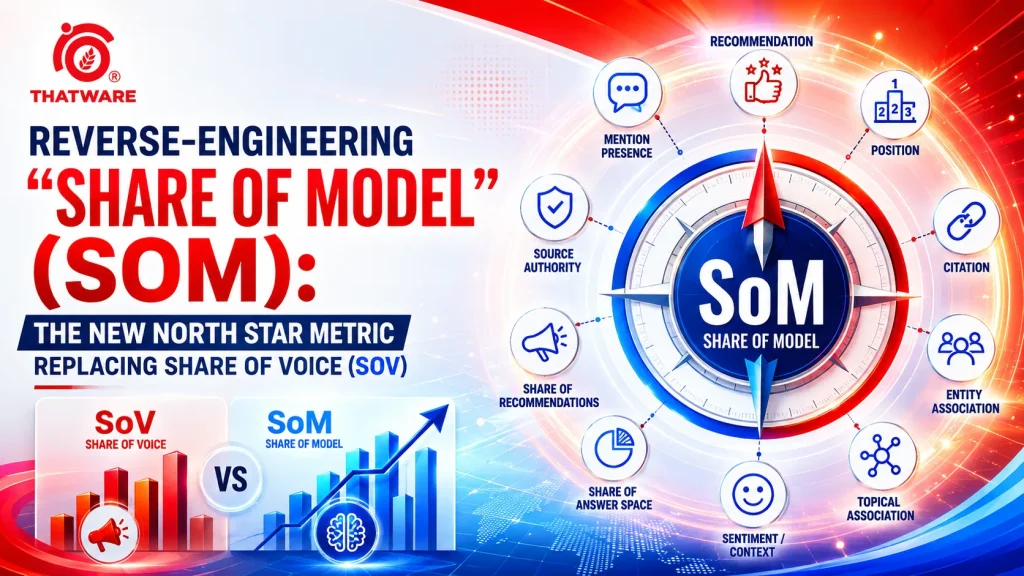
That model worked because traditional search was fundamentally a ranking environment.
AI-powered search is increasingly becoming a response and recommendation environment.
A user no longer has to search through ten blue links to decide which company, product, service, destination, software platform, or expert to investigate. Instead, the user can ask an AI system a complete question and receive a synthesised answer containing explanations, comparisons, recommendations, citations, and sometimes a shortlist of entities that the system considers relevant.
Consider the difference between these two experiences.
A traditional search query might be:
“Best enterprise SEO agencies”
The user receives a search results page containing organic listings, advertisements, directories, reviews, featured snippets, maps, videos, and other SERP features. Visibility can be approximated through rankings and click-through rates.
An AI-search interaction might instead be:
“Which enterprise SEO agencies would you recommend for a multinational company that needs technical SEO, international search optimisation, and AI-search visibility?”
The resulting answer may mention five agencies, recommend two more strongly than the others, cite several websites, explain the strengths of each provider, and potentially exclude dozens of companies that rank prominently for traditional SEO keywords.
This creates a fundamental measurement problem.
A brand can rank well in conventional search while having relatively weak representation in AI-generated answers. Conversely, a company with modest traditional search visibility may become highly influential inside AI recommendations for specific categories, topics, or use cases.
The search landscape has therefore changed faster than the measurement frameworks used to evaluate it.
From Rankings to Representation
Traditional SEO measurement asks questions such as:
- What position does the brand rank for?
- How many keywords are on page one?
- How many impressions did those keywords generate?
- How much organic traffic did the website receive?
- What percentage of clicks did the brand capture?
- How does its Share of Voice compare with competitors?
These questions remain valuable. They are not becoming irrelevant.
But they no longer describe the complete search journey.
AI systems introduce another layer between the user’s question and the information or businesses ultimately considered. Instead of simply presenting documents and asking the user to evaluate them, an AI system may interpret the query, retrieve information, synthesise evidence, identify entities, compare alternatives, and formulate a recommendation.
The critical question therefore changes from:
“Where does my website rank?”
to:
“How does the AI system represent my brand when users ask questions related to my market?”
That distinction is enormous.
Suppose ten companies compete in a particular category. A traditional Share of Voice report may show that Company A owns 18% of the tracked organic visibility, Company B owns 15%, and Company C owns 11%.
But when users ask AI systems questions such as:
- “Who are the leading providers in this category?”
- “Which company is best for enterprise customers?”
- “What are the most reliable alternatives?”
- “Which providers have the strongest expertise?”
- “Who should I shortlist?”
- “What companies are worth considering for this use case?”
the distribution may look completely different.
Company C might suddenly become the most frequently recommended brand.
Why?
Because ranking and recommendation are not the same thing.
Traditional search primarily determines which information the user sees.
AI search increasingly influences which information, entities, products, and brands the user considers.
That is why the next generation of search measurement needs to look beyond visibility on a results page.
The Emergence of Share of Model
This is where Share of Model (SoM) becomes strategically important.
Share of Model can be understood as a measurement framework for determining how much competitive presence a brand captures inside AI-generated answers across a defined set of relevant prompts.
At its simplest level, it asks:
When AI systems answer questions relevant to my market, how frequently and prominently does my brand appear compared with competing brands?
But a sophisticated SoM measurement system goes much further than counting brand mentions.
It can evaluate:
- whether the brand was mentioned;
- whether it was recommended;
- where it appeared in the response;
- how strongly it was endorsed;
- whether the model associated it with the correct category;
- whether the brand was cited as a source;
- whether authoritative information supported the recommendation;
- whether the context was positive, neutral, or negative;
- which search intent generated the appearance;
- which competitors appeared alongside it;
- and whether the brand repeatedly appears across different models and prompt variations.
This distinction is critical because not all AI visibility has equal value.
Imagine that Brand A is mentioned in 40% of relevant AI responses, but only as an example or peripheral option.
Brand B appears in 25% of responses but is repeatedly described as one of the strongest choices for enterprise customers.
A basic mention-counting system would conclude that Brand A is more visible.
A sophisticated Share of Model framework may conclude that Brand B has greater strategic visibility because its appearances carry greater recommendation weight and commercial relevance.
This is the central idea behind reverse-engineering SoM.
The objective is not simply to create another metric that counts how often a brand name appears.
The objective is to understand how AI systems allocate attention, authority, recommendation and representation across competing entities.
Why the “North Star” Is Moving
The phrase North Star metric is important because businesses need a measurement that connects individual optimisation activities to a broader competitive outcome.
Traditional SEO teams could use rankings or Share of Voice as a relatively intuitive north star.
A company could say:
“We want to increase our organic Share of Voice from 12% to 20%.”
That objective could then influence:
- keyword targeting;
- content creation;
- technical SEO;
- internal linking;
- digital PR;
- backlink acquisition;
- information architecture;
- and SERP optimisation.
AI search introduces a different competitive objective.
A company may now want to know:
“When customers ask AI systems about our category, are we consistently one of the brands they identify, trust, cite and recommend?”
That is a fundamentally different form of visibility.
It combines search visibility with machine interpretation.
A page can be technically optimised yet fail to generate meaningful AI visibility if the broader brand lacks:
- strong entity recognition;
- authoritative third-party references;
- consistent factual information;
- topical depth;
- original evidence;
- category relevance;
- expert signals;
- or sufficient contextual authority.
This means AI-search optimisation cannot be reduced to simply adding more keywords to existing pages.
The competition increasingly occurs at the level of entities, concepts, relationships, evidence and recommendations.
Search Is Becoming a Decision Layer
One of the most important developments behind SoM is the transformation of search from an information-discovery mechanism into a potential decision layer.
Traditional search often works like this:
Query → Results → Website → Evaluation → Decision
AI-mediated search can compress the journey:
Question → AI interpretation → Retrieval → Synthesis → Recommendation → Decision
The difference is not merely technological.
It changes where brand competition occurs.
If an AI system recommends three companies to a user and your company is not among them, your website’s position for hundreds of related keywords may not matter for that particular interaction.
The AI has already narrowed the consideration set.
This makes AI recommendation visibility commercially significant.
The question is no longer only whether a company can attract a click.
It is whether the company can become part of the AI-generated consideration set.
That is a much more consequential measurement problem.
SoV Still Matters, but It Is No Longer Enough
The argument for Share of Model should not be interpreted as a declaration that Share of Voice is obsolete.
Traditional search continues to generate enormous amounts of discovery, traffic, leads, and revenue. Rankings, impressions, clicks, organic conversions and SoV remain essential performance indicators.
The problem is that these metrics describe only part of an increasingly fragmented search ecosystem.
A more complete measurement framework therefore needs multiple layers:
Traditional SEO visibility
→ rankings, impressions, clicks and organic Share of Voice
AI visibility
→ mentions, citations, recommendations and entity representation
Share of Model
→ relative competitive presence within AI-generated answers
Business impact
→ qualified traffic, leads, conversions, revenue and assisted demand
In this framework, SoM does not necessarily replace SoV.
Instead, it extends the concept of competitive visibility into an environment where AI models increasingly participate in discovery, evaluation and recommendation.
The Core Question This Article Will Answer
The challenge is that there is no universally accepted, single formula for Share of Model.
That is precisely why the metric needs to be reverse-engineered.
A useful SoM framework must answer several difficult questions:
- What exactly counts as an AI mention?
- Should a recommendation carry more weight than a neutral mention?
- How should first position be weighted against third position?
- Is a citation equivalent to a recommendation?
- How should positive and negative mentions be treated?
- How many prompts are required for a reliable benchmark?
- How should different AI models be compared?
- How should prompt intent influence the score?
- How should geographical and industry variations be handled?
- How can AI response volatility be accounted for?
- How can SoM be connected to actual business outcomes?
These questions move SoM from a simple visibility statistic into a measurement science for AI-mediated search.
The ultimate objective is not to produce an impressive-looking percentage.
It is to create a repeatable methodology that allows a business to understand:
Where does our brand appear in AI-driven discovery, how does the model describe us, how often are we recommended, how much competitive answer space do we capture, and where are competitors outperforming us?
That is the real strategic value of Share of Model.
The future of search measurement will not be defined solely by who ranks first.
It will increasingly be defined by which brands AI systems understand, retrieve, cite, trust and recommend when users ask questions that matter to the business.
And that is why Share of Model deserves to be treated not merely as another AI-search metric, but as a potential new North Star for measuring competitive visibility in the age of generative search.
What Is Share of Model (SoM)?
Share of Model, commonly abbreviated as SoM, is an emerging framework for measuring how much visibility, representation and recommendation a brand receives inside AI-generated answers compared with competing brands.
Traditional search measurement was largely built around rankings. A brand could monitor whether it appeared in position 1, position 3 or position 10 for a keyword, estimate the resulting impressions and clicks, and then aggregate that information into broader visibility metrics such as Share of Voice.
AI search changes the unit of measurement.
When a user asks an AI system a complex question, the system may not return a conventional ranked list. Instead, it can interpret the user’s intent, synthesise information from multiple sources, identify relevant entities, compare alternatives and produce a direct recommendation. In that environment, simply asking whether a brand “ranks” is no longer enough.
Share of Model attempts to measure how much of the relevant AI-generated answer and recommendation environment a brand occupies relative to its competitors.
A useful conceptual definition is:
Share of Model is the weighted proportion of competitive AI visibility captured by a brand across a controlled universe of relevant prompts, models, intents and contexts.
A simplified conceptual formula is:
SoM = Weighted AI Brand Presence ÷ Total Competitive Brand Presence
The important word in that formula is weighted.
A brand being mentioned once should not automatically receive the same value as a brand that is repeatedly recommended, prominently positioned, supported by citations and strongly associated with a particular category or use case.
SoM therefore needs to look beyond raw mentions.
A Working Definition of Share of Model
The most practical way to understand SoM is to think of an AI model as occupying a new kind of competitive information environment.
Instead of ten blue links competing for ten positions, multiple brands may compete for a limited amount of attention inside an AI-generated response.
For example, imagine a user asks:
“What are the best enterprise SEO agencies for a multinational company?”
An AI system might respond with:
- Agency A
- Agency B
- Agency C
- Agency D
- Agency E
It may then explain the strengths of each provider and cite several websites.
A traditional SEO report might ask:
Which agency ranks highest for the keyword “enterprise SEO agency”?
A Share of Model report asks a broader question:
Which agencies does the AI system actually consider relevant and recommend when users ask commercially meaningful questions about enterprise SEO?
That distinction is fundamental.
A company could rank highly for thousands of conventional keywords yet rarely appear in AI recommendations. Another company could have a smaller conventional search footprint but repeatedly appear in AI-generated shortlists for high-value commercial prompts.
SoM is designed to capture this difference.
SoM is not simply an AI mention metric
A basic AI visibility report might record:
Brand A appeared in 42 responses.
That is useful, but incomplete.
The same 42 mentions could represent dramatically different levels of visibility.
For example:
- Brand A could be mentioned as a market leader.
- Brand A could be listed as one of several alternatives.
- Brand A could be mentioned only in a comparison.
- Brand A could be cited as an information source.
- Brand A could be criticised.
- Brand A could be recommended as the best option for a specific use case.
All five scenarios produce a “mention”, but their strategic value is not equivalent.
A serious SoM methodology therefore needs to measure the quality and context of visibility, not just its existence.
What Share of Model Attempts to Measure
A mature SoM framework can be broken into multiple dimensions.
1. Mention Presence
The first and simplest measurement is whether the brand appears in an AI-generated response.
This answers:
“Is the brand part of the model’s consideration set?”
Mention presence can be measured across a defined prompt set.
For example, if 200 commercially relevant prompts are tested and a brand appears in 80 responses, its raw prompt-level mention rate is 40%.
However, this should be treated as the starting point rather than the final SoM score.
2. Recommendation Presence
The next layer asks whether the AI merely mentions the company or actively recommends it.
There is an important difference between:
“Other providers include Brand A.”
and:
“Brand A would be one of my top recommendations for this requirement.”
The second represents a stronger form of AI visibility.
Recommendation presence can therefore be assigned greater weight in an SoM calculation.
This is particularly important for high-intent queries where the user is effectively asking the AI to narrow down a purchasing decision.
3. Ranking or Order Position
Although AI responses do not always have conventional rankings, many responses still contain an identifiable order.
The model might say:
- Brand A is best for enterprise customers.
- Brand B is strong for technical SEO.
- Brand C is better suited to smaller businesses.
That order provides valuable information.
A brand appearing first in a recommendation list may deserve greater weight than one appearing fifth.
However, position should not be treated as the only indicator of importance. Context still matters.
A brand appearing second with a highly positive recommendation may have greater commercial value than a brand appearing first but accompanied by significant limitations.
4. Citation Presence
AI systems may cite sources used to support an answer.
This creates another dimension of visibility.
A company can therefore appear in an AI response in at least two different ways:
As a recommended entity
or
As a cited source of information.
These are not interchangeable.
A model could recommend Company A while citing Company B’s research.
In that situation:
- Company A owns recommendation visibility.
- Company B owns evidence or citation visibility.
A sophisticated SoM system should distinguish between these two forms of influence.
5. Source Authority
Not every citation carries the same strategic significance.
A citation from a company’s official website may demonstrate first-party authority.
A citation from a respected industry publication may indicate third-party validation.
A citation from an independent research organisation may provide another type of credibility.
Therefore, SoM can incorporate source authority into its broader analysis.
This creates a useful distinction between:
“The model mentioned us.”
and:
“The model relied on authoritative information associated with us.”
The second may be a stronger indicator of durable AI visibility.
6. Entity Association
AI systems increasingly operate through relationships between entities and concepts.
A brand may be associated with:
- a product category;
- a service;
- a geographic market;
- an industry;
- a technology;
- a particular expertise;
- a use case;
- a founder or expert;
- a specific problem it solves.
For example, it is not enough for an AI system to know that Company X exists.
A stronger level of machine understanding occurs when the model consistently associates Company X with:
enterprise SEO + technical SEO + international search + AI search optimisation.
This is entity association.
SoM can therefore evaluate whether a brand is merely visible or whether it is visible for the concepts that matter commercially.
7. Topical Association
Entity association and topical association are closely connected but not identical.
Topical association asks:
“What subjects does the model associate with this brand?”
A company might have strong overall visibility but weak topical relevance for a particular subject.
For example, an agency could be widely recognised for traditional SEO but rarely associated with:
- generative search;
- AI search;
- LLM optimisation;
- Answer Engine Optimization;
- Generative Engine Optimization.
This distinction becomes increasingly important as markets fragment into specialist categories.
A high overall SoM does not necessarily mean high SoM for every commercially important topic.
8. Sentiment and Context
Visibility can be positive, neutral or negative.
Consider these examples:
“Brand A is one of the leading providers in this category.”
versus:
“Brand A has received criticism for…”
Both represent visibility.
But they represent completely different forms of visibility.
SoM should therefore capture the context surrounding the mention.
A brand that increases its raw AI mentions while simultaneously increasing negative associations has not necessarily improved its strategic AI presence.
This is why context-sensitive scoring is essential.
9. Share of Recommendations
Share of recommendations is one of the most commercially valuable dimensions of SoM.
Suppose an AI system generates 500 relevant recommendations across a defined prompt set.
If:
- Brand A receives 150 recommendations;
- Brand B receives 100;
- Brand C receives 75;
- Brand D receives 50;
- other brands receive 125;
Brand A has captured a substantial portion of the recommendation environment.
This provides a much more meaningful competitive signal than simply counting how often each brand name occurs.
Recommendation Share can therefore function as a specialised component within the broader SoM framework.
10. Share of Answer Space
Another possible dimension is Share of Answer Space.
This measures how much attention a brand receives within the generated response.
For example, consider two brands:
Brand A
“Brand A is a leading provider.”
Brand B
“Brand B specialises in enterprise SEO, international SEO and technical search optimisation. It is particularly relevant for multinational organisations because…”
Both brands have been mentioned once.
But Brand B occupies substantially more of the answer’s informational space.
This does not automatically mean Brand B is more influential. However, it demonstrates why binary mention tracking can be insufficient.
The objective is to understand the depth of representation, not simply the presence of a brand name.
Share of Model Versus Simple AI Mentions
One of the biggest mistakes organisations can make when measuring AI visibility is treating every mention as equal.
Imagine an AI-search monitoring system reports:
Brand A: 60 mentions
Brand B: 45 mentions
Brand C: 35 mentions
At first glance, Brand A appears to be winning.
But now examine the actual responses.
Scenario A: Neutral mention
“Other companies operating in this market include Brand A.”
This is visibility, but weak recommendation value.
Scenario B: Authority mention
“Brand A is recognised for its work in enterprise SEO.”
This is stronger because the model is associating the brand with a specific area of expertise.
Scenario C: Strong recommendation
“Brand A would be one of my top choices for an enterprise SEO programme.”
This carries greater commercial significance.
Scenario D: Intent-specific recommendation
“For a multinational organisation looking for technical and international SEO expertise, Brand A would be a particularly strong choice.”
This is even more valuable because the recommendation aligns directly with a defined commercial intent.
Scenario E: Evidence-backed recommendation
“Brand A is a strong option for enterprise SEO, and its published research and documented case studies provide supporting evidence for its expertise.”
Now the recommendation is reinforced by evidence.
All five scenarios create a brand mention.
They should not necessarily contribute the same amount to SoM.
This is why Share of Model should be treated as a weighted measurement framework rather than a simple mention counter.

A Conceptual SoM Hierarchy
A useful way to visualise this progression is:
Invisible
↓
Mentioned
↓
Associated with the topic
↓
Described positively
↓
Recommended
↓
Recommended for a specific intent
↓
Recommended with supporting evidence
↓
Repeatedly preferred across relevant prompts
The further a brand progresses through this hierarchy, the more strategically valuable its AI representation becomes.
This also introduces an important concept: Recommendation Gravity.
Recommendation Gravity describes the strength and consistency with which an AI system tends to place a brand inside its recommended consideration set.
A company with strong Recommendation Gravity is not simply appearing frequently. It is repeatedly being surfaced as a meaningful solution when the prompt aligns with its expertise.
That distinction could become increasingly important as AI interfaces move closer to acting as decision assistants.
SoM Is a Relative Metric
Another important characteristic of Share of Model is that it is fundamentally competitive.
A brand does not have a meaningful SoM score in isolation.
Its score becomes meaningful when compared against:
- competitors;
- substitutes;
- category leaders;
- emerging challengers;
- specialist providers;
- and other entities appearing within the same AI decision environment.
If five companies dominate 80% of relevant AI recommendations, increasing one company’s recommendation frequency may reduce another company’s relative share.
This makes SoM similar to traditional Share of Voice in one important respect: it measures relative competitive presence.
The major difference is the environment being measured.
Traditional SoV asks:
“How much of the available search or media visibility do we own?”
SoM asks:
“How much of the relevant AI-generated consideration and answer environment do we own?”
That is a considerably more complex question because AI systems do not simply rank documents. They interpret questions, synthesise information and construct responses.
The Most Important Principle: SoM Must Be Contextual
There is no meaningful universal SoM number without context.
A company might have:
- 40% SoM across informational prompts;
- 18% SoM across commercial prompts;
- 8% SoM across transactional prompts;
- 55% SoM for a specific specialist topic;
- 12% SoM for a broader category.
All of these numbers could be true simultaneously.
Therefore, a serious SoM programme should segment performance by:
Model × Prompt × Intent × Topic × Geography × Competitor
This makes the metric diagnostically useful.
Instead of simply reporting:
“Our SoM is 24%.”
a sophisticated report might say:
“Overall SoM is 24%, but commercial-intent SoM is 11%. We have strong visibility for informational prompts and weak representation in high-value recommendation prompts. Competitor B has 31% commercial SoM, primarily because it dominates comparison and enterprise-use-case prompts.”
That second insight can directly inform strategy.
Why SoM Represents a New Measurement Layer
Share of Model should therefore not be understood as a replacement for every existing SEO metric.
It is better understood as a new measurement layer between AI visibility and business outcomes.
The measurement stack increasingly looks like:
Crawlability
→ Can AI and search systems access the information?
Retrievability
→ Can relevant information be found?
Entity understanding
→ Does the system understand what the brand is and what it does?
Authority
→ Is the brand supported by credible evidence and references?
AI visibility
→ Does the brand appear in relevant responses?
Recommendation
→ Does the AI actively suggest the brand?
Share of Model
→ How much competitive AI answer and recommendation space does the brand capture?
Business outcome
→ Does that visibility influence traffic, leads, consideration, sales or revenue?
This makes SoM particularly valuable because it attempts to measure something that traditional rankings cannot fully capture:
the brand’s position inside the AI-generated decision environment.
And that is precisely why the next question is not simply how to calculate SoM, but why the traditional Share of Voice model is becoming increasingly incomplete in AI search.
Why Share of Voice Was the North Star of Traditional Search
Before understanding why Share of Model is becoming important, it is necessary to understand why Share of Voice (SoV) became such a valuable measurement in the first place.
For years, search marketing operated within a relatively predictable environment. A user entered a query, the search engine returned a results page, and websites competed for visibility within that page. Search marketers could track rankings, impressions, clicks and estimated traffic to determine how much visibility a brand captured compared with competitors.
Share of Voice provided a way to turn thousands of individual keyword rankings into a broader competitive measurement.
Instead of asking only:
“Where do we rank for this keyword?”
marketers could ask:
“How much of the available search visibility in our category do we control?”
That was a much more strategic question.
What Share of Voice Traditionally Means
Share of Voice is essentially a measure of relative visibility.
Although the methodology differs across industries and platforms, the principle remains similar: determine how much exposure a brand receives compared with the total exposure available to the competitive market.
The concept has been applied across:
- organic search;
- paid search;
- advertising;
- PR;
- social media;
- digital media;
- brand mentions;
- and other forms of market visibility.
In SEO, SoV typically combines keyword rankings with factors such as search volume, estimated click-through rates, traffic potential or visibility scores.
A brand ranking first for a highly searched commercial keyword would generally contribute more visibility than the same brand ranking eighth for a low-volume query.
This made SoV considerably more useful than simply counting keywords.
Traditional SEO Share of Voice
Traditional SEO Share of Voice usually begins with a defined keyword universe.
Suppose an enterprise software company tracks 5,000 commercially relevant keywords.
For each keyword, the measurement system can determine:
- whether the company ranks;
- its ranking position;
- search volume;
- estimated visibility;
- estimated clicks;
- competitor rankings;
- and changes over time.
Those individual results can then be aggregated.
For example:
| Brand | Estimated SEO Visibility |
| Brand A | 32% |
| Brand B | 24% |
| Brand C | 18% |
| Brand D | 11% |
| Others | 15% |
This immediately provides competitive context.
Brand A is not merely ranking for individual keywords. It controls approximately one-third of the measurable organic search visibility within the defined keyword universe.
That makes SoV useful for executives as well as SEO specialists.
Why SoV Was Powerful
The greatest strength of Share of Voice was its ability to translate thousands of search results into one strategic competitive signal.
It helped answer questions such as:
- Are we gaining visibility faster than competitors?
- Which competitor is taking our search visibility?
- Which topics represent our strongest market position?
- Where are we losing visibility?
- Which categories are dominated by competitors?
- Are our SEO investments increasing our overall market presence?
SoV also provided a bridge between tactical SEO and business strategy.
A technical SEO team could improve crawling and indexing.
A content team could expand topic coverage.
A digital PR team could build authority.
An SEO strategy team could target high-value keywords.
The executive team could ultimately observe whether those activities translated into a larger share of search visibility.
That made SoV a powerful North Star metric.
The Limitations of Traditional SoV
The problem is not that Share of Voice was poorly designed.
The problem is that the search environment it was designed to measure is changing.
Traditional SoV works particularly well when search visibility can be approximated through:
Keyword → Ranking → Visibility → Click
AI-mediated search introduces a different sequence:
Prompt → Interpretation → Retrieval → Synthesis → Recommendation
There may be no conventional position 1 through 10.
There may be no predictable click-through-rate curve.
There may be no requirement for the user to visit a website before making a decision.
There may instead be a generated response containing a handful of brands, products or sources.
Traditional SoV also tends to be highly keyword-centric.
AI systems operate much more naturally around questions, concepts, entities, relationships and context.
A user might ask:
“Which enterprise SEO company would you recommend for a multinational brand undergoing a major website migration?”
That single question contains multiple dimensions:
- enterprise;
- SEO;
- website migration;
- multinational;
- recommendation;
- commercial intent.
Trying to represent this interaction through one keyword such as “enterprise SEO company” loses much of the context.
This is where traditional SoV begins to lose explanatory power.
Why Share of Voice Breaks Down in AI Search
The rise of AI-generated search experiences does not eliminate Share of Voice. Instead, it exposes the areas where traditional SoV cannot fully describe what users are experiencing.
The biggest change is simple:
AI systems do not always return a ranked list of documents. They increasingly return an interpreted answer.
That changes what “visibility” means.
There Is No Fixed SERP
Traditional search results have historically provided a relatively structured environment.
Even though modern search results contain many features, marketers can still identify:
- organic results;
- advertisements;
- featured snippets;
- maps;
- videos;
- shopping results;
- and other SERP elements.
AI responses can be much less structured.
A model may produce a paragraph, a table, a shortlist, a comparison or a recommendation.
It may cite several sources while mentioning only a few brands.
There is therefore no universal equivalent of:
“Position 1 = X% visibility.”
An AI response might mention one company in the opening paragraph, another in a comparison table and a third only in the concluding recommendation.
Which position is most valuable?
The answer depends on context.
One Prompt Can Produce Multiple Entities
An AI answer may contain several competing brands.
For example:
“For enterprise customers, Brand A is strongest for scale, Brand B is known for technical expertise, while Brand C may be better suited to organisations looking for a specialised approach.”
All three brands have achieved visibility.
But they have not achieved the same kind of visibility.
Brand A has category-level visibility.
Brand B has expertise-based visibility.
Brand C has use-case visibility.
A simple ranking report cannot adequately represent these differences.
SoM must therefore evaluate what role each entity plays within the answer.
AI Answers Are Contextual
Traditional ranking reports often treat a keyword as the primary unit of analysis.
AI answers are inherently contextual.
A company may have:
- strong visibility for “best enterprise provider”;
- weak visibility for “affordable provider”;
- strong visibility for “technical expertise”;
- weak visibility for “small business”;
- strong visibility in one geography;
- weak visibility in another.
This means AI visibility should be segmented by intent and context.
A single overall score can hide important opportunities.
For example, a company might have 30% overall SoM but only 8% SoM for commercially valuable prompts.
That company may appear highly visible in aggregate while remaining weak exactly where customers are making purchasing decisions.
AI Search Is Probabilistic
Another challenge is variability.
AI-generated answers can change because of:
- model updates;
- prompt wording;
- conversation context;
- geography;
- language;
- available retrieval sources;
- current information;
- citations;
- system behaviour;
- and other contextual factors.
Ask:
“What are the best SEO agencies?”
and then ask:
“Which SEO agencies are best for an enterprise migration?”
The answer may change significantly.
Even small wording differences can change which entities are surfaced.
Therefore, an SoM measurement system cannot depend on one prompt and one response.
It needs a controlled prompt universe and repeated sampling.
The objective is to identify patterns rather than treat an individual AI response as a permanent ranking.
Ranking Position Alone Is Insufficient
Even when an AI response appears to rank brands, position does not tell the complete story.
Consider:
Brand A
“Brand A is the largest provider, but may not be the best choice for specialised technical requirements.”
Brand B
“Brand B is highly recommended for organisations requiring advanced technical expertise.”
Brand A may appear first.
Brand B may appear second.
Yet Brand B could have greater relevance for the specific commercial intent.
This illustrates why SoM needs to combine position with context.
Position can contribute to the score, but it should not determine the score by itself.
Citation Does Not Equal Recommendation
AI systems may cite a source without recommending the company behind that source.
For example, an AI answer might say:
“According to a report published by Company A…”
while recommending Company B as a service provider.
Company A has evidence visibility.
Company B has recommendation visibility.
Both are valuable, but they represent different forms of influence.
This distinction is especially important because brands can build AI visibility through authoritative information even when the brand itself is not the final recommendation.
A mature SoM framework should therefore track:
Who was mentioned?
Who was recommended?
Who was cited?
Why was each entity included?
That is considerably more informative than simply counting brand names.
The Anatomy of Share of Model
Share of Model is best understood as a multi-dimensional measurement framework rather than a single raw number.
The following dimensions provide a practical foundation.
Dimension 1: Mention Share
The first layer measures how frequently a brand appears.
A simple formula is:
Mention Share = Brand Mentions ÷ Total Competitive Mentions
If a defined set of AI responses contains 1,000 competitive brand mentions and Brand A accounts for 200, its raw Mention Share is 20%.
This is useful as a baseline.
But it should not be mistaken for complete SoM.
A neutral mention and a strong recommendation are not equivalent.
Dimension 2: Recommendation Share
Recommendation Share measures how often an AI system actively suggests a brand.
This is more commercially meaningful than simple visibility.
For example:
“Brand A is one provider in this space.”
is different from:
“I would recommend Brand A for this requirement.”
The second indicates a stronger form of AI-mediated consideration.
Recommendation Share is particularly valuable for:
- B2B services;
- SaaS;
- travel;
- ecommerce;
- financial products;
- professional services;
- and other categories where users ask AI systems to narrow down choices.
Dimension 3: Position Share
When an AI response provides an ordered list, position can be measured.
A basic weighting model could assign higher scores to:
- first recommendation;
- second recommendation;
- third recommendation;
- lower-ranked recommendations;
- unranked mentions.
The exact weights should depend on the measurement framework.
The key principle is that prominence matters.
A company occupying the first position in a recommendation list generally receives greater attention than one mentioned near the end.
However, position must always be interpreted alongside context.
Dimension 4: Citation Share
Citation Share measures how often a brand’s website or associated authoritative sources are cited.
This is especially useful for understanding evidence visibility.
A company may be cited because it:
- publishes original research;
- provides authoritative documentation;
- publishes statistics;
- produces expert analysis;
- maintains useful resources;
- or has become a recognised source within its industry.
Citation visibility can therefore become an important supporting layer of SoM.
Dimension 5: Entity Association
Entity Association measures whether AI systems connect the brand to the right concepts.
For example:
Brand A → enterprise SEO
is useful.
But:
Brand A → enterprise SEO → international SEO → technical SEO → website migration
provides much richer semantic association.
This matters because AI systems need to understand not just that a brand exists, but what the brand represents.
Strong entity association can improve the likelihood that a brand appears for relevant questions.
Dimension 6: Contextual Sentiment
Not every mention is positive.
A brand can appear:
- positively;
- neutrally;
- negatively;
- or ambiguously.
A useful SoM system should capture this context.
Otherwise, a brand could increase its apparent visibility while simultaneously becoming associated with negative information.
Raw mention growth alone would conceal that problem.
Dimension 7: Intent Coverage
Finally, SoM should be measured against user intent.
Useful categories include:
- informational;
- commercial;
- transactional;
- navigational;
- comparison;
- recommendation;
- problem-solving.
A brand might dominate informational prompts while losing commercial recommendations to competitors.
That difference is strategically important.
A company therefore needs to know not only:
“How visible are we?”
but:
“Where are we visible, and does that visibility occur where it matters commercially?”
Reverse-Engineering SoM: How the Metric Should Actually Be Built
The phrase reverse-engineering is important because Share of Model should not simply copy the methodology used for traditional SEO Share of Voice.
The measurement system should begin with the actual AI decision environment.
The fundamental question is:
What does a user ask an AI system before deciding which brand, product, service or provider to consider?
Once that is understood, the measurement framework can be constructed around those interactions.
Step 1: Define the Competitive Market
Start by identifying the complete competitive landscape.
This should include:
- direct competitors;
- indirect competitors;
- alternatives;
- emerging companies;
- category leaders;
- niche specialists;
- geographically relevant providers.
Do not limit the competitor list to companies that rank for the same keywords.
AI systems may surface entities that traditional SEO tools do not identify as direct keyword competitors.
The competitive set should therefore reflect actual AI consideration, not just conventional SERP overlap.
Step 2: Build a Prompt Universe
Keywords are replaced, or at least supplemented, by prompt clusters.
A robust prompt universe can contain:
- category prompts;
- “best” prompts;
- comparison prompts;
- alternative prompts;
- problem-based prompts;
- feature prompts;
- location prompts;
- industry prompts;
- use-case prompts;
- cost prompts;
- trust prompts;
- expertise prompts.
For example, instead of tracking only:
“AI SEO agency”
build a broader prompt universe:
- What are the best AI SEO agencies?
- Which companies specialise in AI search optimisation?
- What are the leading GEO agencies?
- Which agency is best for enterprise AI SEO?
- Who should I hire for LLM visibility?
- Which AI SEO companies have experience with SaaS?
- What should I look for when choosing a GEO agency?
The second approach is much closer to how users actually interact with AI systems.
Step 3: Create Prompt Variants
Prompt variation is essential.
A single concept can be expressed in dozens of ways.
For example:
“What are the best AI SEO agencies?”
could become:
- best AI SEO agency;
- top AI SEO companies;
- leading AI search optimisation agencies;
- best GEO agency;
- best agency for LLM SEO;
- AI SEO agency for enterprises;
- AI SEO agency for SaaS;
- AI SEO agency in the UK;
- AI search optimisation companies for global brands.
The purpose is not to generate endless variations.
It is to identify the language patterns through which real users might discover and evaluate brands.
Step 4: Run Prompts Across Multiple Models
AI visibility should ideally be measured across multiple environments.
Depending on the market, this may include:
- ChatGPT;
- Google Gemini;
- Microsoft Copilot;
- Perplexity;
- Claude;
- and other relevant AI-search interfaces.
Different models can produce different results because they may use different retrieval systems, sources, training information and response-generation processes.
A brand could therefore have:
High SoM in one AI environment
and
Low SoM in another.
This is not necessarily an error.
It may reveal meaningful differences in how the brand is represented across AI ecosystems.
Step 5: Capture the Complete Response
Do not record only:
“Brand A appeared.”
Capture the complete context.
Useful fields include:
- prompt;
- model;
- date;
- brand mentioned;
- position;
- recommendation status;
- recommendation language;
- citation;
- cited source;
- sentiment;
- category association;
- expertise association;
- competitor mentions;
- response length;
- intent;
- geography.
This creates a dataset that can be analysed at multiple levels.
Step 6: Normalize the Data
AI answers can vary dramatically in length.
One response might contain 150 words.
Another might contain 1,500.
One might recommend three brands.
Another might list ten.
Raw counts can therefore become misleading.
Normalization makes results more comparable.
For example, the measurement system can evaluate:
- presence versus absence;
- weighted position;
- recommendation strength;
- relative mention frequency;
- answer-space share;
- citation frequency.
The goal is to make different responses analytically comparable without pretending that every AI answer behaves like a conventional SERP.
Step 7: Apply Weighted Scoring
Once the raw data has been collected, the components can be combined into a weighted model.
A conceptual framework might look like:
SoM Score = Mention × Recommendation × Position × Context × Citation × Intent Weight
This is an illustrative methodology, not a universal industry standard.
Different organisations may assign different weights depending on their business model.
For a B2B consultancy, recommendation strength may deserve a high weight.
For a research organisation, citation share may be more important.
For an ecommerce business, product recommendation and commercial intent may dominate.
The best SoM framework is therefore not necessarily the one with the most complicated formula.
It is the one that best reflects how AI visibility creates business value for that specific market.
Designing a Practical SoM Scoring Formula
A practical SoM system needs to convert qualitative AI behaviour into a consistent numerical framework.
The objective is not to create mathematical complexity for its own sake.
The objective is to prevent a weak signal, such as a casual brand mention, from being treated as equivalent to a strong commercial recommendation.
One illustrative weighting system could be:
| Component | Example Weight |
| Mention presence | 15% |
| Recommendation strength | 25% |
| Position prominence | 15% |
| Citation/source presence | 15% |
| Contextual relevance | 10% |
| Sentiment | 10% |
| Intent coverage | 10% |
These weights are examples rather than fixed industry standards.
The correct weighting should depend on what the organisation is trying to measure.
Why Recommendation Strength May Receive More Weight
A recommendation represents a stronger commercial signal than a neutral mention.
If an AI system tells a user:
“Brand A is worth considering.”
that is fundamentally different from simply mentioning Brand A in a long explanation.
For businesses where AI recommendations can influence purchasing decisions, recommendation strength should therefore receive substantial weight.
Why Position Still Matters
Position provides a useful measure of prominence.
Being the first recommendation often indicates stronger visibility than being the seventh.
But position should not dominate the model because AI responses are not always conventional rankings.
Why Citation Matters
Citations provide an indication that information associated with a brand is being retrieved and used as evidence.
This can be an important leading indicator of authority.
Why Intent Matters
Not every prompt has the same commercial value.
A brand appearing in an informational query about “what is SEO?” may have less business value than appearing in:
“Which enterprise SEO agency should I hire?”
The SoM model should therefore distinguish between visibility volume and visibility value.
A Simple Illustrative Example
Suppose a controlled AI-search study generates 100 relevant recommendation opportunities.
The results show:
- Brand A appears 35 times;
- Brand B appears 25 times;
- Brand C appears 20 times;
- Brand D appears 10 times;
- Other brands account for 10.
A basic mention-based system would conclude that Brand A is the strongest performer.
But now consider recommendation quality.
Brand A might appear frequently because the AI mentions it in broad informational responses.
Brand B may appear less frequently overall but dominate high-intent commercial prompts.
For example:
| Brand | Total appearances | High-intent recommendations |
| Brand A | 35 | 8 |
| Brand B | 25 | 17 |
| Brand C | 20 | 9 |
| Brand D | 10 | 4 |
A raw visibility model favours Brand A.
A commercially weighted SoM model may favour Brand B.
That is precisely why SoM should not be reduced to a simple percentage of mentions.
SoM Should Be Diagnostic, Not Decorative
The purpose of a metric is to enable decisions.
A useful SoM report should help answer:
- Where are we winning?
- Where are competitors winning?
- Which prompts exclude us?
- Which topics do AI systems associate with us?
- Which recommendations are we receiving?
- Where are competitors receiving stronger recommendations?
- Which sources are being cited?
- Which commercial intents represent the largest visibility gaps?
If the metric cannot answer these questions, it risks becoming another dashboard number with limited strategic value.
The real power of SoM comes from connecting measurement to action.
A company should be able to move from:
“Our SoM is 18%.”
to:
“Our SoM is 18%, but we have 32% visibility for informational prompts and only 7% for commercial recommendation prompts. Competitor B dominates the commercial category because AI systems consistently associate it with enterprise expertise and cite its research. Our next optimisation priority should therefore be authority and commercial-intent content.”
That is a metric capable of influencing strategy.
The Emerging SoM Measurement Model
The broader concept can therefore be represented as:
Prompt Universe
↓
AI Model Testing
↓
Response Collection
↓
Mention + Recommendation + Position + Citation + Context
↓
Intent and Topic Classification
↓
Weighted Scoring
↓
Competitive SoM
↓
Gap Analysis
↓
Optimisation
This turns Share of Model into a repeatable measurement cycle rather than a one-time experiment.
And as AI search becomes increasingly influential in discovery and decision-making, that repeatability will become critical.
8. SoM vs SoV vs SEO Visibility vs AI Visibility
One of the easiest ways to misunderstand Share of Model is to treat it as a replacement for every existing search metric.
It is not.
Share of Voice, SEO visibility, AI visibility and Share of Model answer different questions.
Traditional SEO metrics remain essential because conventional search still generates discovery, traffic and revenue. SoM adds another layer for an environment where AI systems increasingly interpret and recommend information.
A simple comparison
| Metric | Primary question |
| Rankings | Where do we appear? |
| Organic visibility | How visible are we in conventional search? |
| Share of Voice | How much search visibility do we own relative to competitors? |
| AI visibility | How often do AI systems mention or surface us? |
| Share of Model | How much competitive AI answer and recommendation space do we capture? |
Rankings
Rankings are the most granular traditional measurement.
They tell a marketer where a page appears for a particular search query.
They remain useful for:
- keyword-level optimisation;
- technical SEO;
- content performance;
- SERP analysis;
- competitor research.
However, rankings say little about what happens when an AI system interprets a complex question and synthesises an answer.
Organic Visibility
Organic visibility aggregates rankings across a larger keyword universe.
It provides a broader view of search presence but remains primarily connected to conventional search results.
Share of Voice
SoV introduces competitive context.
Instead of asking only whether a company ranks, it asks how much visibility that company captures compared with competitors.
AI Visibility
AI visibility is broader than SoM.
It can include:
- mentions;
- citations;
- recommendations;
- references;
- entity associations;
- inclusion in AI-generated answers.
Share of Model
SoM adds the competitive dimension.
It asks:
“Of all the relevant AI-generated consideration and answer space available to competing brands, how much does our brand capture?”
That makes SoM particularly valuable for competitive benchmarking.
The Difference Between Being Mentioned and Being Chosen
AI visibility introduces a subtle but critical distinction:
Being visible is not the same as being preferred.
A brand can appear frequently in AI-generated responses without becoming a meaningful recommendation.
Consider four different states.
State 1: Invisible
The AI does not mention the brand.
From an AI-search perspective, the company is outside the immediate consideration set.
This does not necessarily mean the brand has no authority. It simply means the authority is not translating into visibility for that particular prompt universe.
State 2: Mentioned
The brand appears, but without a strong recommendation.
For example:
“Other providers include Brand A and Brand B.”
This is useful visibility.
The model recognises the entity and considers it relevant.
But the user is not necessarily being encouraged to choose it.
State 3: Recommended
The AI actively suggests the brand.
For example:
“Brand A would be a strong option for an enterprise organisation.”
This is more commercially meaningful.
The AI has moved from recognition to recommendation.
State 4: Preferred
The strongest state occurs when the AI repeatedly positions a brand as one of the best options for a specific intent.
For example:
“For a multinational organisation requiring technical SEO and international search expertise, Brand A would be among the strongest choices.”
This represents much stronger contextual authority.
The important insight is that AI visibility has a hierarchy.
Mention → Association → Recommendation → Preference
That hierarchy should influence SoM measurement.
Introducing Recommendation Gravity
This progression leads to a useful concept: Recommendation Gravity.
Recommendation Gravity describes how strongly and consistently an AI system tends to pull a brand into its recommended consideration set for relevant prompts.
A brand with high Recommendation Gravity may:
- appear repeatedly;
- appear across multiple prompt variations;
- rank near the top of recommendations;
- receive positive descriptions;
- be associated with relevant expertise;
- and remain visible across different high-intent questions.
This is more meaningful than a single mention.
It measures consistency of preference.
Over time, Recommendation Gravity could become one of the most important components of AI-search measurement.
Prompt-Level SoM: Measuring Visibility at the Query Level
The most granular way to measure Share of Model is at the individual prompt level.
Instead of beginning with an overall market score, start with:
“How does our brand perform for this specific AI question?”
For each prompt, the measurement system can record:
- whether the brand appeared;
- whether it was recommended;
- its position;
- context;
- citation status;
- competitors mentioned;
- intent;
- and relevance.
This produces a Prompt-Level SoM.
Prompt-Level SoM
Consider:
“Which AI SEO agencies are best for enterprise companies?”
Suppose the AI recommends four companies.
If Brand A is the first recommendation, Brand B is second, Brand C is third and Brand D is fourth, each brand receives a different level of prompt-level visibility.
A weighted score could assign:
- first recommendation: highest weight;
- second: slightly lower;
- third: lower;
- fourth: lower again;
- unranked mention: separate weight.
This allows individual prompts to be analysed rather than simply counting overall mentions.
Topic-Level SoM
Individual prompts can then be grouped into broader topics.
For example:
AI SEO
could contain prompts relating to:
- AI SEO agencies;
- LLM SEO;
- GEO;
- AEO;
- AI search visibility;
- AI content optimisation.
The brand’s performance across all these prompts can be aggregated into Topic-Level SoM.
This reveals where the company has strong semantic authority and where competitors dominate.
A business may discover that it has strong SoM for traditional SEO but weak SoM for AI search.
That gap is strategically valuable.
Intent-Level SoM
Topic is only one dimension.
The same topic can contain different user intents.
For example:
Informational
“What is Generative Engine Optimization?”
Commercial
“What are the best GEO agencies?”
Comparison
“GEO agency A vs GEO agency B”
Transactional
“Which GEO agency should I hire?”
The brand might perform strongly for informational prompts but poorly for commercial and transactional prompts.
Intent-Level SoM exposes this difference.
For many businesses, this is more useful than an overall score because commercial visibility is usually more valuable than generic informational visibility.
Market-Level SoM
At the highest level, individual topics and intents can be aggregated into a broader market score.
Market-Level SoM answers:
“Across the defined AI-search environment for our category, what proportion of competitive AI visibility do we capture?”
This is the closest equivalent to traditional competitive Share of Voice.
However, the market score should always be supported by its underlying layers.
A headline number without diagnostic data can hide major weaknesses.
Building an AI Prompt Taxonomy for SoM Measurement
The quality of a Share of Model measurement system depends heavily on the quality of its prompts.
If the prompt universe is too narrow, the resulting SoM will be misleading.
A strong prompt taxonomy should represent the different ways users discover, evaluate, compare and select products or services.
Category Discovery Prompts
These establish the broader market.
Examples:
- “What are the leading enterprise SEO companies?”
- “Who are the major providers in this category?”
- “What companies specialise in AI search optimisation?”
These prompts measure basic category association.
Best-of Prompts
These are among the most commercially important.
Examples:
- “What are the best enterprise SEO agencies?”
- “Which GEO companies are considered leaders?”
- “What are the best platforms for AI visibility?”
They directly ask the AI to create a shortlist.
Comparison Prompts
Comparison prompts expose competitive positioning.
Examples:
- “Brand A vs Brand B”
- “Which is better for enterprise SEO?”
- “Compare the leading GEO agencies.”
These prompts reveal not only whether a brand appears but how the AI differentiates it from competitors.
Alternative Prompts
These are particularly important because they can expose competitive displacement.
Examples:
- “What are the best alternatives to Brand A?”
- “What companies offer similar services?”
- “What alternatives should I consider?”
If competitors consistently appear as alternatives to your brand, that is a meaningful competitive signal.
Problem-Based Prompts
Users do not always search for a product.
They often describe a problem.
For example:
“How can a multinational website improve AI-search visibility?”
A brand may be recommended without its core keyword appearing in the prompt.
This is why traditional keyword tracking alone cannot capture AI discovery.
Feature-Based Prompts
These focus on specific capabilities.
Examples:
- “Which SEO agencies specialise in technical migrations?”
- “Which platforms provide AI visibility monitoring?”
- “Who has expertise in international SEO?”
Feature-based prompts can reveal specialist authority.
Location-Based Prompts
AI recommendations can change based on geography.
Examples:
- “Best SEO agencies in the UK”
- “Best GEO companies in the United States”
- “Top AI SEO agencies in India”
Location should therefore be captured as a separate dimension where relevant.
Industry Prompts
A provider may be strong in one industry and weak in another.
Examples:
- “Best SEO agency for SaaS”
- “Best AI SEO company for healthcare”
- “Best GEO provider for ecommerce”
Industry-specific prompts reveal vertical authority.
Use-Case Prompts
Use-case prompts are often highly valuable.
Examples:
- “Best agency for enterprise migration”
- “Best provider for international expansion”
- “Best AI-search solution for a B2B company”
They connect the brand with an actual business requirement.
Trust and Expertise Prompts
These measure reputation.
Examples:
- “Which companies are most reputable?”
- “Which providers have the strongest expertise?”
- “Which SEO companies are trusted by enterprises?”
These prompts can reveal whether the AI associates a brand with credibility.
Cost Prompts
Price-related prompts can also affect recommendation visibility.
Examples:
- “What does enterprise SEO cost?”
- “Which agencies offer affordable GEO services?”
- “What are the best SEO agencies for a limited budget?”
Cost positioning can dramatically alter the competitive set.
The Role of Entity Intelligence in Share of Model
One of the most important differences between traditional keyword visibility and AI visibility is the increasing importance of entities.
Search engines have always moved beyond exact keyword matching, but AI systems make semantic relationships even more important.
A model needs to understand:
Who is the company?
What does it do?
Who does it serve?
Where does it operate?
What is it known for?
What expertise does it possess?
How is it different from competitors?
This is entity intelligence.
Entity Recognition
The first requirement is basic recognition.
The system needs to correctly identify the brand as an organisation rather than confuse it with:
- another company;
- a generic term;
- an individual;
- a product;
- or an unrelated entity.
Entity Attributes
The next layer is understanding the brand’s attributes.
For example:
Brand → SEO agency
is basic.
A richer representation might be:
Brand → enterprise SEO → technical SEO → international SEO → AI search → GEO
This creates stronger semantic relationships.
Entity Relationships
AI systems can also associate brands with:
- founders;
- experts;
- products;
- clients;
- locations;
- publications;
- research;
- technologies;
- industries.
These relationships can influence how the brand is represented in generated answers.
Why Entity Intelligence Matters to SoM
A brand cannot consistently dominate relevant AI prompts if the AI does not clearly understand what the brand represents.
This is why SoM is not simply a content metric.
It is also a measurement of machine-readable brand understanding.
Citation Share: The Hidden Layer of SoM
One of the most underappreciated components of AI visibility is citation presence.
A brand may not always be directly recommended, yet its content may repeatedly become part of the evidence used to construct AI answers.
This creates another form of influence.
Consider a user asking:
“What are the latest trends in enterprise SEO?”
The AI may cite:
- research published by Brand A;
- an industry study from Brand B;
- documentation from Brand C.
None of these companies may be explicitly recommended as service providers.
Yet they have influenced the answer.
This is evidence visibility.
Why Citation Share Matters
Brands that consistently publish:
- original research;
- proprietary data;
- statistics;
- expert analysis;
- technical documentation;
- industry studies;
- detailed guides;
can create information assets that AI systems may retrieve and cite.
This means content strategy increasingly has two objectives:
Visibility in search
and
retrievability as evidence.
The second is particularly relevant to SoM.
Why Brand Authority Matters More in AI Search
The evolution can be summarised as:
Keywords → Topics → Entities → Evidence → Recommendations
Traditional SEO often began with keyword targeting.
Modern search increasingly rewards topical depth and semantic relevance.
AI systems add another layer: entity understanding and evidence synthesis.
This makes brand authority increasingly important.
A brand can strengthen its AI representation by developing:
- original research;
- expert authorship;
- authoritative content;
- third-party references;
- consistent brand information;
- credible case studies;
- digital PR;
- industry recognition;
- and strong topical coverage.
The objective is not simply to publish more.
It is to give AI systems more reasons to associate the brand with a particular area of expertise.
SoM and Generative Engine Optimization
Generative Engine Optimization, or GEO, focuses on improving a brand’s visibility and representation in AI-generated search experiences.
SoM provides a way to measure the outcome.
A useful distinction is:
GEO is the optimisation discipline. SoM is the competitive measurement layer.
GEO activities may attempt to improve:
- AI mentions;
- citations;
- recommendation frequency;
- entity associations;
- topical relevance;
- evidence visibility;
- brand authority.
SoM can then determine whether those improvements actually changed the brand’s competitive position.
For example:
Before GEO campaign
Brand A SoM: 9%
After optimisation
Brand A SoM: 17%
The change becomes a measurable competitive outcome.
However, the important question is not only whether the overall score increased.
It is where it increased.
Perhaps:
- informational SoM increased from 15% to 24%;
- commercial SoM increased from 7% to 13%;
- recommendation SoM increased from 4% to 11%.
Those details are much more useful for strategy.
SoM and Answer Engine Optimization
Answer Engine Optimization, or AEO, traditionally focuses on helping search systems provide direct answers to user questions.
AEO commonly emphasises:
- question-based content;
- concise answers;
- structured information;
- semantic relevance;
- direct-answer formats.
SoM extends this concept.
Instead of asking:
“Did our content become an answer?”
SoM asks:
“How often does our brand become part of the answer environment compared with competitors?”
This moves measurement from content inclusion toward competitive representation.

SoM and LLM SEO
LLM SEO focuses on improving how brands and their content are discovered, interpreted and represented by large language model-driven search environments.
The focus can include:
- entity clarity;
- semantic relevance;
- authoritative sources;
- model-readable information;
- citations;
- content accessibility;
- topical authority;
- brand consistency.
SoM acts as a measurement layer across these efforts.
The relationship can be simplified as:
LLM SEO → Optimisation
GEO → AI-search strategy
SoM → Measurement of competitive AI representation
These disciplines overlap, but they answer different strategic questions.
How to Conduct a Share of Model Audit
A practical SoM audit should follow a repeatable process.
Phase 1: Market Mapping
Identify:
- primary competitors;
- secondary competitors;
- alternatives;
- specialists;
- emerging entities.
Do not rely exclusively on traditional keyword competitors.
Phase 2: Prompt Discovery
Create a structured prompt universe covering:
- categories;
- topics;
- intents;
- use cases;
- locations;
- industries;
- comparisons;
- recommendations.
A small business may begin with 100–200 carefully selected prompts.
An enterprise programme may require thousands.
The important factor is not simply volume.
It is representativeness.
Phase 3: AI Model Testing
Run the prompt set across relevant AI environments.
Maintain consistency in:
- prompt wording;
- geography;
- language;
- date tracking;
- model version where possible;
- and measurement methodology.
Phase 4: Response Extraction
For every response, record:
- brand mentions;
- recommendations;
- position;
- citations;
- context;
- sentiment;
- competitors;
- topic;
- intent.
Phase 5: Classification
Classify each appearance.
For example:
Mention
Recommended
Highly recommended
Cited
Negative
Neutral
Positive
Intent-specific
This makes the dataset analytically useful.
Phase 6: Scoring
Apply the selected SoM weighting model.
Calculate:
- Prompt SoM;
- Topic SoM;
- Intent SoM;
- Model SoM;
- Competitive SoM;
- Overall SoM.
Phase 7: Gap Analysis
Finally, identify where competitors outperform.
For example:
Competitor A dominates informational prompts.
Competitor B dominates enterprise recommendations.
Competitor C dominates comparison prompts.
Your brand dominates specialist technical prompts.
These insights can directly determine future optimisation priorities.
What a SoM Dashboard Should Contain
An executive SoM dashboard should not be overloaded with raw AI responses.
It should surface the most important competitive signals.
Executive metrics
- Overall SoM
- SoM change
- Recommendation Share
- Citation Share
- Mention Share
- Competitive position
Model-level metrics
- ChatGPT SoM
- Gemini SoM
- Perplexity SoM
- Copilot SoM
Intent-level metrics
- Informational
- Commercial
- Comparison
- Transactional
- Recommendation
Topic-level metrics
Show the subjects where the brand:
- dominates;
- competes closely;
- underperforms;
- or is invisible.
The dashboard should ultimately answer:
“Where does AI consider us strong, and where does it consider our competitors stronger?”
Leading Indicators and Lagging Indicators
SoM should not be viewed exclusively as a final performance metric.
Some components can function as leading indicators.
Potential leading indicators
- growth in authoritative citations;
- increased entity consistency;
- more third-party references;
- stronger topical coverage;
- publication of original research;
- increased expert mentions.
Potential lagging indicators
- AI recommendations;
- higher recommendation share;
- increased branded AI visibility;
- qualified AI-referred traffic;
- leads;
- conversions;
- revenue influence.
This creates a useful measurement chain:
Authority → Retrieval → Representation → Recommendation → Business Outcome
The earlier stages may indicate whether future SoM growth is likely.
Should SoM Replace Share of Voice Completely?
The answer should be no.
Traditional search remains too important to abandon.
A better model is:
SoV + SoM + Business Outcomes
SoV measures conventional search visibility.
SoM measures AI-generated representation and recommendation.
Business metrics determine whether either form of visibility creates economic value.
This creates a broader search measurement framework:
Traditional Search
Rankings → Visibility → Clicks → Traffic
AI Search
Prompt → Representation → Recommendation → Consideration
Business
Consideration → Lead → Customer → Revenue
The future of search measurement is therefore likely to be additive rather than replacement-based.
SoM as a Business Metric, Not Just an SEO Metric
Share of Model should not remain confined to the SEO department.
AI recommendations can influence:
- brand perception;
- product discovery;
- vendor selection;
- customer research;
- competitive evaluation;
- demand generation;
- sales conversations.
That makes SoM relevant to:
- CMOs;
- product marketers;
- brand teams;
- PR teams;
- content teams;
- sales leaders;
- and executives.
A CEO may not care whether a company ranks third or fifth for a particular keyword.
But the CEO may care deeply about:
“When potential customers ask AI which companies they should consider, are we on the list?”
That is a business question.
SoM makes it measurable.
The Future of Search Measurement: From Rankings to Representation
Search measurement is moving through several stages.
Rankings
Where do we appear?
↓
Visibility
How often do users see us?
↓
Clicks
How often do users visit us?
↓
Engagement
What do they do after visiting?
↓
Recommendation
Does AI suggest us?
↓
Representation
How does AI describe us?
↓
Influence
Do we shape the user’s consideration set?
The final stages are particularly important in AI search.
A brand can influence a decision before the user ever visits its website.
This changes the traditional relationship between search visibility and traffic.
The website visit may become only one part of the journey.
The Emerging AI Search Measurement Stack
A mature AI-search measurement framework can be viewed as eight layers.
Layer 1: Crawlability
Can search and AI systems access the information?
Layer 2: Retrievability
Can relevant information be discovered when needed?
Layer 3: Semantic Understanding
Does the system understand the brand and its subject matter?
Layer 4: Authority
Is the brand supported by credible information and references?
Layer 5: AI Retrieval
Does information associated with the brand appear in generated answers?
Layer 6: Recommendation
Does the AI actively suggest the brand?
Layer 7: Share of Model
How much of the competitive AI answer space does the brand capture?
Layer 8: Business Outcome
Does that visibility influence:
- traffic;
- leads;
- sales;
- revenue;
- or brand demand?
This framework prevents companies from treating AI visibility as an isolated vanity metric.
From SoM to Share of Recommendation
One of the most useful extensions of SoM is Share of Recommendation.
The difference is straightforward.
Share of Mention asks:
“How often are we mentioned?”
Share of Recommendation asks:
“How often are we recommended?”
The second is closer to commercial intent.
For example, suppose a company appears in 40% of relevant responses but receives explicit recommendations in only 12%.
That suggests strong awareness but weaker preference.
Another company might appear in only 25% of responses but receive recommendations in 20%.
The second company could have stronger commercial AI influence despite lower raw visibility.
This is why recommendation-based metrics deserve their own reporting layer.
From SoM to Share of AI Influence
The next evolution could be a broader concept of Share of AI Influence.
This would attempt to combine:
- visibility;
- authority;
- citation;
- recommendation;
- context;
- commercial intent;
- and potentially business outcomes.
A conceptual model could be:
AI Influence = Visibility × Authority × Recommendation × Commercial Intent
Again, this should be treated as a conceptual framework rather than an established industry-standard formula.
The important idea is that AI visibility will increasingly need to be measured in terms of influence, not simply exposure.
How Executives Should Interpret SoM
A single SoM percentage can be misleading without context.
Executives should examine the underlying components.
High SoM + Low Conversion
Possible issue:
- AI visibility is strong;
- but commercial positioning or website conversion is weak.
Low SoM + High Organic Visibility
Possible issue:
- traditional SEO is strong;
- but AI representation is underdeveloped.
High Mention Share + Low Recommendation Share
Potential issue:
- strong awareness;
- weak preference.
High Citation Share + Low Recommendation Share
Potential issue:
- strong informational authority;
- weaker commercial positioning.
High Recommendation Share + Low Citation Share
Potential issue:
- strong recommendation visibility;
- but limited evidence visibility.
These combinations make SoM more useful as a diagnostic framework.
A Practical 90-Day SoM Improvement Framework
A company beginning its AI-search measurement programme can use a simple 90-day process.
Days 1–30: Establish the Baseline
Focus on:
- competitor mapping;
- prompt taxonomy;
- model selection;
- baseline testing;
- citation analysis;
- entity analysis;
- intent segmentation.
The goal is to understand the current AI-search landscape.
Days 31–60: Build Authority
Focus on:
- content gaps;
- original research;
- expert content;
- comparison resources;
- case studies;
- digital PR;
- authoritative citations.
The objective is to create stronger evidence around the topics the company wants to own.
Days 61–90: Optimise and Re-Test
Repeat the prompt universe.
Compare:
- mention share;
- recommendation share;
- citation share;
- topic SoM;
- intent SoM;
- competitor movement.
The goal is not simply to see whether the overall number changed.
The goal is to determine which forms of AI visibility improved.
Why More Content Does Not Automatically Increase SoM
The traditional response to declining organic visibility is often:
“We need more content.”
AI search makes that assumption less reliable.
Publishing hundreds of additional pages does not automatically make a brand more authoritative.
AI systems need useful signals that establish:
- expertise;
- relevance;
- originality;
- evidence;
- entity clarity;
- authority;
- differentiation.
Ten highly authoritative resources may contribute more to AI visibility than hundreds of generic articles.
This shifts the content objective from:
Maximum publication volume
to:
Maximum authority around strategically important concepts.
That is a fundamental change.
Common Share of Model Measurement Mistakes
Several mistakes can undermine an SoM programme.
1. Tracking only mentions
Mentions do not capture recommendation strength.
2. Tracking only one AI system
Different models can produce different representations.
3. Using too few prompts
A small prompt set can create serious sampling bias.
4. Ignoring intent
Informational and transactional prompts should not automatically have equal value.
5. Treating every mention equally
A recommendation is not the same as a neutral reference.
6. Ignoring citations
Evidence visibility can reveal important authority signals.
7. Ignoring context
Positive and negative mentions should be distinguished.
8. Ignoring competitors
SoM is fundamentally comparative.
9. Changing the prompt set constantly
A moving benchmark makes trend analysis difficult.
10. Treating one response as a ranking
AI responses can vary.
11. Focusing only on the headline score
The underlying topic and intent data often contain the most valuable insights.
12. Ignoring business outcomes
AI visibility ultimately needs to connect to commercial impact.
Statistical and Methodological Challenges
SoM measurement is still an emerging discipline, which means methodological discipline is essential.
AI responses can vary because of:
- model updates;
- retrieval changes;
- prompt formulation;
- geographic context;
- language;
- conversation history;
- information freshness;
- source availability;
- and other factors.
This means a single response should never be treated as definitive evidence of a brand’s market position.
A better approach is to measure patterns across many prompts and repeated observations.
Consistency is more valuable than isolated results.
The goal is to determine whether a brand is repeatedly represented in a particular way.
How Frequently Should SoM Be Measured?
Measurement frequency should depend on market volatility and business importance.
Weekly
Useful for highly competitive categories and active AI-search programmes.
Biweekly
Useful when significant optimisation work is taking place.
Monthly
Suitable for most strategic reporting.
Quarterly
Useful for executive-level market analysis.
The key principle is to maintain a stable benchmark prompt set.
New prompts can be introduced periodically, but the core benchmark should remain consistent enough to identify genuine movement.
SoM Should Become a Competitive Intelligence System
The most valuable use of SoM may ultimately extend beyond reporting.
Repeated AI-response analysis can reveal:
- emerging competitors;
- changing category associations;
- new terminology;
- changing recommendations;
- new sources being cited;
- shifts in perceived expertise;
- competitive strengths;
- and gaps in the brand’s positioning.
This means SoM can become a form of AI-driven competitive intelligence.
Instead of merely asking:
“How visible are we?”
companies can ask:
“How is the AI market changing?”
That is a much broader strategic application.
The Future North Star: Are AI Systems Choosing Us?
The fundamental shift can be summarised in one progression:
Traditional Search
“Where do we rank?”
Modern Search
“How visible are we?”
AI Search
“Are we being mentioned?”
Advanced AI Search
“Are we being cited?”
Recommendation Search
“Are we being recommended?”
AI Decision Environment
“Are we one of the entities the system trusts enough to recommend?”
This is the real strategic question behind Share of Model.
The future of search may not be defined by a single ranking position.
It may be defined by whether an AI system repeatedly identifies a company as relevant, authoritative and appropriate for a particular user need.
Conclusion: From Share of Voice to Share of Model
Search measurement is entering a new phase.
For years, Share of Voice provided a powerful way to understand competitive visibility across conventional search. It helped marketers move beyond individual keyword rankings and understand the proportion of available search exposure controlled by a brand.
But AI-generated search experiences are changing the environment.
Users can now ask complete questions rather than isolated keywords. AI systems can interpret those questions, retrieve information, synthesise evidence, compare entities and produce recommendations.
That means a brand’s visibility can no longer be evaluated only by asking where its pages rank.
The more important question increasingly becomes:
How does AI represent the brand when customers ask questions that matter to the business?
Share of Model provides a framework for answering that question.
A sophisticated SoM system measures more than mentions. It can evaluate:
- mention presence;
- recommendation presence;
- position;
- citation presence;
- source authority;
- entity association;
- topical association;
- sentiment;
- intent;
- recommendation share;
- and competitive answer-space ownership.
It also recognises that AI visibility is contextual.
A brand can be highly visible for informational prompts while being almost invisible for commercial recommendations. It can dominate one topic while losing another. It can have strong citation authority but weak recommendation strength.
These differences are precisely what make SoM valuable.
The objective is not to eliminate traditional SEO metrics.
SoV and SoM should work together.
SoV explains competitive visibility in conventional search.
SoM explains competitive representation in AI-generated search.
Together, they provide a much more complete picture of modern search visibility.
The next generation of search optimisation will therefore require a shift in mindset.
It will not be enough to ask:
“Did we improve our rankings?”
Businesses will increasingly need to ask:
“Did AI systems become more likely to recognise us?”
Then:
“Did they cite us?”
Then:
“Did they recommend us?”
And ultimately:
“Are we becoming one of the brands AI systems consistently trust and recommend for the decisions our customers are trying to make?”
That is the strategic promise of Share of Model.
The metric is still evolving, and there is no single universal formula that every company must adopt. But the underlying direction is clear: search visibility is moving from ranking documents to measuring representation, recommendation and influence inside AI-mediated discovery.
The brands that learn to measure that transition will have a significant advantage.
Because in an AI-first search environment, winning visibility may no longer mean simply occupying the top position.
It may mean occupying the model’s consideration set.



