
SUPERCHARGE YOUR ONLINE VISIBILITY! CONTACT US AND LET’S ACHIEVE EXCELLENCE TOGETHER!
International SEO is entering a fundamentally different phase. Search is no longer limited to a list of blue links where users evaluate websites one result at a time. AI-powered search, answer engines, generative search interfaces, and large language models increasingly interpret information, connect entities, summarize evidence, and produce answers on behalf of users.
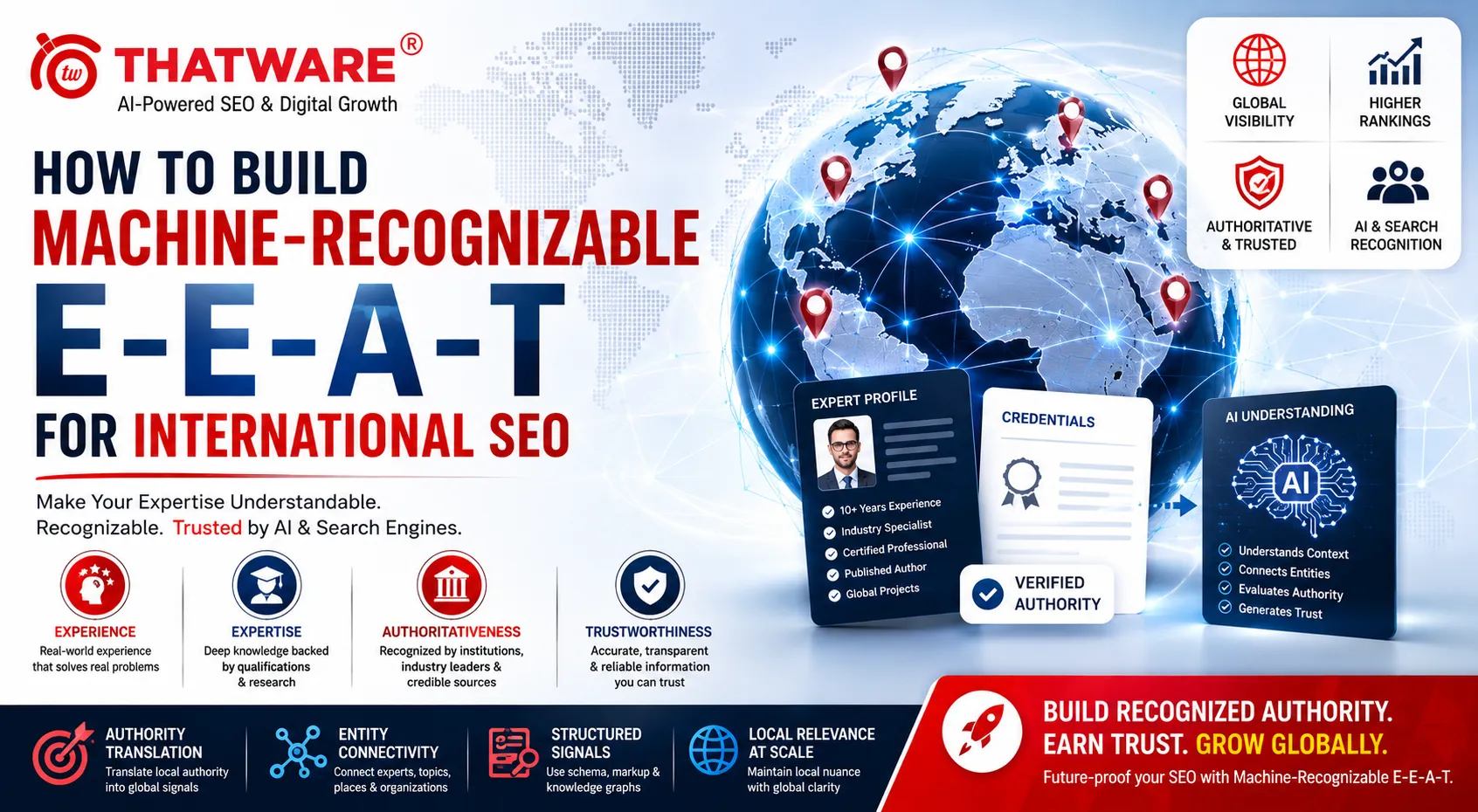
This creates a new challenge for organizations operating across multiple countries: being authoritative is no longer enough. Your authority must also be recognizable.
For years, international SEO has operated on the assumption that authority established in one market can provide a foundation for expansion into another. A business may have an established reputation, extensive experience, strong content, and recognized experts in its home market. But when that business enters another country, those signals do not automatically become locally meaningful.
The same principle applies to E-E-A-T: Experience, Expertise, Authoritativeness, and Trustworthiness.
An organization can possess genuine expertise in Germany, Japan, France, India, the UAE, or another market while an AI system interprets that expertise as part of one generalized global brand profile. Local credentials, experts, case studies, terminology, institutions, and market-specific knowledge can become difficult to distinguish when dozens of regional websites repeat substantially similar information.
This creates what we can call machine-recognizable E-E-A-T: evidence of expertise that is not merely present, but sufficiently contextualized, connected, and attributable for AI systems to interpret.
There are therefore three different stages:
- Having expertise — possessing genuine knowledge and experience.
- Demonstrating expertise — publishing evidence that proves it.
- Making expertise machine-recognizable — structuring and connecting that evidence so AI systems can understand who possesses the expertise, what qualifies them, where that expertise applies, and what evidence supports it.
This is where Authority Translation becomes important. International organizations need to translate local credentials, institutional relationships, professional experience, and market-specific evidence into signals that machines can interpret without stripping away their local meaning.
2. What Is Machine-Recognizable E-E-A-T?
Machine-recognizable E-E-A-T is the practice of presenting genuine experience, expertise, authority, and trust in a way that is understandable to both human audiences and AI systems.
Traditional E-E-A-T primarily asks whether evidence exists and whether that evidence establishes credibility. Machine-recognizable E-E-A-T adds another question:
Can an AI system correctly understand and attribute that evidence?
That distinction is increasingly important for international organizations.
2.1 Traditional E-E-A-T vs. Machine-Recognizable E-E-A-T
The four traditional components remain fundamental.
Experience demonstrates that an organization or individual has actually performed the work, encountered the problem, served customers, implemented solutions, or learned from real-world situations.
Expertise demonstrates knowledge, qualifications, professional capability, research, specialization, and subject-matter competence.
Authoritativeness demonstrates recognition from relevant institutions, professional communities, publications, industry bodies, customers, and other credible sources.
Trustworthiness demonstrates accuracy, transparency, consistency, accountability, and reliability.
The difference is that AI systems must first identify these signals before they can use them.
For example, imagine a regional specialist who possesses a respected national professional designation. People in that country may immediately understand that the designation represents extensive training and regulated professional competence. An AI system encountering the designation in isolation may not automatically establish the same relationship.
That creates a recognition gap.
The evidence exists. The expertise exists. The credential is legitimate. But the relationship between the credential and the expertise may not be sufficiently explicit.
2.2 The Recognition Gap
The recognition gap occurs when genuine evidence exists but its meaning is unclear to the systems processing it.
Consider a local professional with:
- A nationally recognized qualification.
- Ten years of practical experience.
- Membership in a professional organization.
- Publications in industry journals.
- Multiple market-specific projects.
A human reader familiar with the market may immediately recognize the person’s authority.
An AI system has a different problem. It must connect the person, qualification, institution, profession, subject, geography, and experience before it can confidently understand the authority represented by that individual.
This is why simply adding credentials to an author biography is not always enough.
The question should be:
What does this credential mean, who recognizes it, and why does it establish this person’s expertise in this subject and market?
2.3 Three Layers of E-E-A-T
A practical machine-recognizable E-E-A-T model can be divided into three layers.
Layer 1 — Evidence
This is the underlying proof:
- Qualifications
- Certifications
- Professional experience
- Awards
- Publications
- Research
- Case studies
- Client work
- Conference participation
- First-hand observations
- Industry memberships
Without evidence, there is nothing meaningful to recognize.
Layer 2 — Context
Context explains why the evidence matters.
A credential should be accompanied by information about its issuing institution, professional significance, scope, and relationship to the subject.
A case study should explain the market, problem, methodology, implementation, and outcome.
An award should identify what it recognized.
Context converts isolated facts into understandable evidence.
Layer 3 — Machine Legibility
The final layer establishes relationships among:
Person → Organization → Credential → Institution → Location → Topic → Publication → Experience
The objective is not to manipulate an AI system. It is to make genuine relationships explicit.
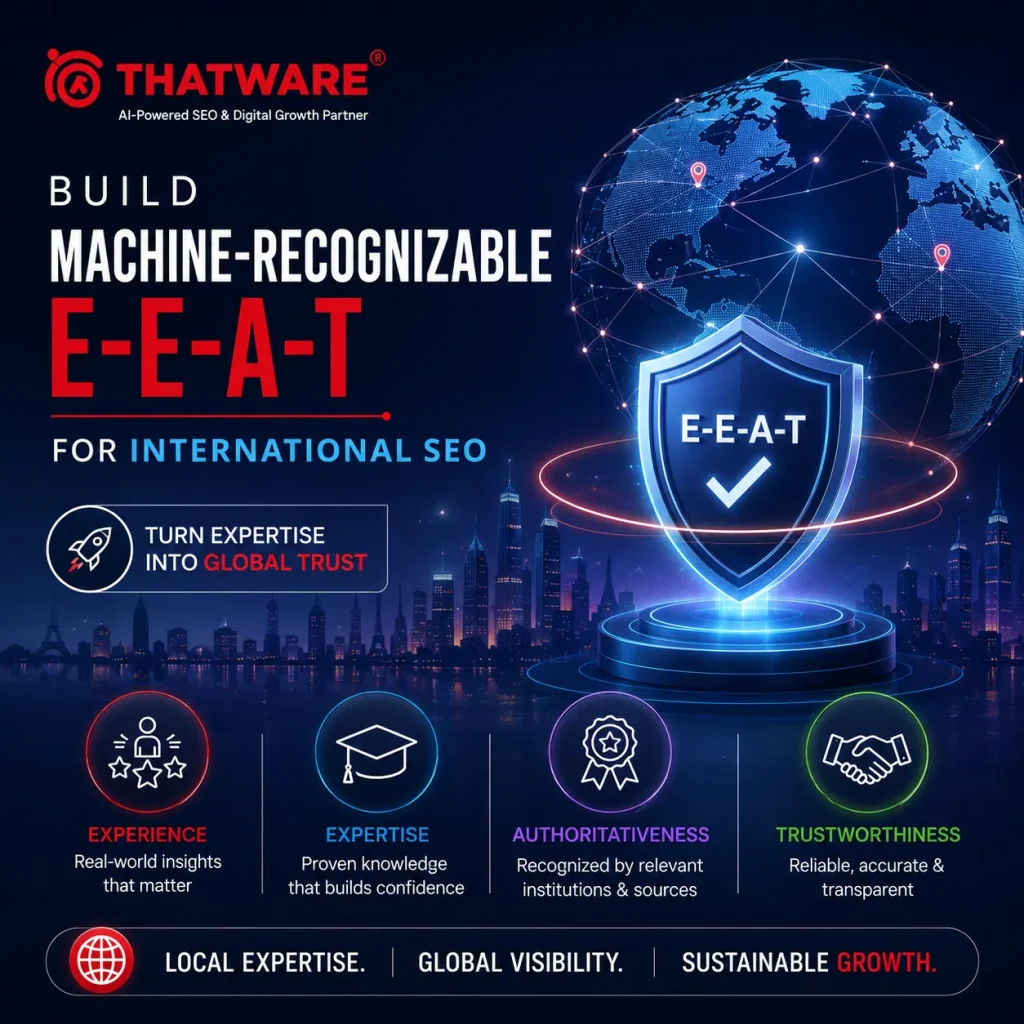
3. Why Global Authority Does Not Automatically Become Local AI Authority
A global organization may possess substantial authority, but international visibility still requires market-level evidence.
3.1 The International SEO Authority Problem
A business with years of experience in one country cannot assume that the same experience will automatically establish equivalent authority in another.
This is familiar territory in international SEO.
A strong backlink profile in one country does not necessarily establish local relevance in another. Similarly, a globally recognized organization does not automatically possess machine-recognizable local expertise everywhere it operates.
For a professional seo agency, this means international expansion requires more than translating service pages. The organization must establish why its expertise applies to the specific market.
A professional seo service can therefore become more credible when its regional implementation experience, market knowledge, local examples, and expert involvement are visible rather than implied.
A professional seo services company operating internationally should think in terms of evidence networks rather than isolated country pages.
Likewise, a professional seo firm should ask whether its international content demonstrates genuine market knowledge or merely reproduces a centrally created narrative.
The underlying principle is simple:
Global expertise provides the foundation. Local evidence establishes the connection.
3.2 How AI Can Flatten Regional Expertise
Imagine an organization with forty country websites.
Each site contains:
- Similar service descriptions.
- Similar brand messaging.
- Similar article structures.
- Similar author profiles.
- Similar claims.
- Similar terminology.
- Similar explanations.
The sites may technically be localized. Yet from an AI perspective, the similarities can make the websites appear to be different expressions of the same underlying information.
This creates a paradox.
The organization has invested heavily in localization, but the more closely every market resembles the others, the harder it can become to distinguish the unique expertise belonging to each market.
Local authors can become indistinguishable from global authors.
Local terminology can become secondary to generalized terminology.
Local examples can disappear into broader brand associations.
Local experience can be treated as another expression of global experience.
3.3 Market Aggregation and Canonical Amplification
AI systems often operate through patterns and relationships rather than simply evaluating one webpage in isolation.
If one market has significantly more content, stronger external representation, or greater historical visibility, it can become the implicit representation of the wider organization.
This can produce a form of market aggregation where distinct regional signals are interpreted as one composite brand identity.
The problem is not necessarily incorrect information.
The problem is insufficient differentiation.
A Japanese expert may be genuinely authoritative in Japan. A French expert may possess equally strong authority in France. A German expert may have extensive professional experience in Germany.
If all three are presented through almost identical global templates without enough contextual differentiation, the evidence can become less geographically and professionally legible.
3.4 Why Localization Alone Is Not Enough
Translation is not authority.
A hreflang implementation is not expertise.
A local-language website is not automatically evidence of local experience.
International SEO teams therefore need to move beyond linguistic localization and toward evidence localization.
Each market should answer:
- Who are the local experts?
- What qualifications do they possess?
- Which institutions recognize those qualifications?
- What work have they actually performed locally?
- What local problems have they solved?
- Which local regulations or standards influence the subject?
- What unique knowledge does the market contribute?
That is how localization becomes authority-building rather than merely language adaptation.
4. The Four Pillars of Machine-Recognizable International E-E-A-T
4.1 Experience: Prove First-Hand Market Experience
Experience is one of the most powerful forms of E-E-A-T because it establishes that expertise comes from actual involvement rather than abstract knowledge.
For international SEO, however, experience should be geographically meaningful.
Instead of saying:
“We have extensive international experience.”
Show what happened in specific markets.
Create local case studies that describe:
- The market.
- The customer’s problem.
- The original situation.
- The work performed.
- The local challenges encountered.
- The methodology used.
- The lessons learned.
- The measurable outcome.
A market-specific case study can communicate considerably more than a generic claim of international expertise.
First-hand observations are also valuable. Explain how customer behavior differs between markets, how regulations influence implementation, how terminology changes search intent, or how local competition affects strategy.
The key principle is:
Do not simply claim experience in a country. Demonstrate what was actually learned and accomplished there.
4.2 Expertise: Make Local Expertise Explicit
Expertise should be attributable to identifiable people.
Instead of presenting content as if an anonymous corporate entity created everything, identify:
- The author.
- The reviewer.
- Their professional role.
- Their qualifications.
- Their experience.
- Their specialization.
- Their geographic expertise.
- Their relevant publications.
- Their professional affiliations.
An author page should therefore become an evidence hub rather than a short biography.
For example:
“This content was reviewed by [professional], who holds [credential], specializes in [subject], and has practical experience working with organizations in [market].”
The objective is not to fill pages with credentials. It is to establish meaningful relationships.
The organization should be able to answer:
Who knows this subject, why do they know it, and where does their expertise apply?
This approach is particularly valuable for an seo intelligence agency, because the credibility of analytical content depends heavily on establishing who performed the research, what expertise informed it, and what evidence supports its conclusions.
4.3 Authoritativeness: Connect Expertise to Recognized Institutions
Expertise becomes stronger when it is connected to institutions that establish professional standing.
Relevant institutions can include:
- Professional organizations.
- Regulatory authorities.
- Universities.
- Certification organizations.
- Industry associations.
- Standards bodies.
- Publications.
- Conferences.
- Recognized awards.
The institution behind a credential often provides much of its meaning.
This creates the Credential Translation Principle:
Credential → Issuing Institution → Meaning → Relevant Expertise → Market
Suppose an author holds a professional qualification that is highly recognized locally but relatively unfamiliar internationally.
Do not remove the local designation.
Instead, explain:
- What the designation is.
- Who issues it.
- What the issuing institution represents.
- Whether the qualification is regulated.
- What professional scope it provides.
- Why it establishes competence in the relevant subject.
This is especially important when creating content intended for an seo intelligence search, because machine interpretation benefits from explicit relationships between concepts, people, organizations, and evidence.
4.4 Trustworthiness: Build Verifiable Relationships and Transparency
Trustworthiness requires consistency.
Company information should be accurate and consistent across relevant first-party and external sources.
Regional offices should be represented accurately where they genuinely exist.
Contact information should be clear.
Privacy, legal, editorial, and review policies should be accessible.
Claims should be supported by evidence.
Authors should be identifiable.
References should be relevant.
Case studies should distinguish between actual results and projected outcomes.
An organization should also ensure that claims made on its own website do not materially conflict with the information available from credible external sources.
Trust is not created by adding more claims.
It is created by making important claims verifiable.
5. How to Make Local Credentials Understandable to AI
5.1 Don’t Assume the Credential Speaks for Itself
One of the most common mistakes in international E-E-A-T is assuming that a professional designation automatically communicates its significance.
Humans familiar with the market may understand it instantly.
Machines may need more context.
Therefore, a credential should not appear as an unexplained abbreviation or designation. It should be accompanied by enough information to establish its meaning.
5.2 Add Institutional Context
For each important credential, establish:
- Who issues it?
- What is the issuing institution?
- What does the credential represent?
- Is it regulated or formally recognized?
- What professional scope does it establish?
- What expertise does it demonstrate?
- In which market is it relevant?
This turns an isolated credential into a connected evidence structure.
The same principle applies to certifications, awards, memberships, academic qualifications, professional licenses, and specialist designations.
5.3 Use Local and International Terminology Together
International content should preserve official local terminology when it carries professional meaning.
Where useful, provide an understandable international equivalent alongside it.
The objective is not to replace local terminology with an English approximation.
Instead:
Official local designation + explanatory equivalent + institutional context
creates semantic continuity without erasing local identity.
This can be particularly important for international AEO Services, where organizations may need their subject-matter expertise to remain understandable across different linguistic and professional environments.
5.4 Build Credential Evidence Across Multiple Pages
Credential information should not exist only on one biography page.
Relevant evidence can appear consistently across:
- Author profiles.
- Company biographies.
- Articles.
- Case studies.
- Speaker pages.
- Publications.
- Research resources.
- Professional profiles.
- Conference materials.
The objective is corroboration.
That does not mean repeating the same credential unnecessarily.
It means allowing independent pieces of evidence to reinforce the same relationship.
6. Build an Entity-Based E-E-A-T Architecture
Modern AI systems increasingly depend on entities and relationships to interpret information.
International SEO should therefore move beyond thinking only about pages and keywords.
Think in terms of an evidence graph.
6.1 Think Beyond Pages: Think Entities and Relationships
A useful conceptual structure is:
Person → Organization → Credential → Institution → Location → Topic → Publication → Experience
Each connection answers a different question.
Who is the person?
Where do they work?
What qualifies them?
Who recognizes the qualification?
Where is it relevant?
What subjects can they credibly discuss?
What have they published?
What have they actually done?
This relationship-oriented approach supports AI Search Optimization by making the underlying knowledge structure clearer.
6.2 Connect Authors to Their Expertise
Create dedicated author pages with consistent identities.
The same person should be represented consistently across relevant content.
Author pages can include:
- Professional biography.
- Qualifications.
- Areas of expertise.
- Market specialization.
- Publications.
- Speaking appearances.
- Relevant case studies.
- Professional memberships.
- Research contributions.
Articles should identify the author and, where appropriate, the reviewer.
This makes expertise attributable rather than anonymous.
6.3 Connect Organizations to Their Market Presence
A company’s international footprint should also be represented through meaningful relationships.
Where applicable, connect the organization to:
- Country.
- Region.
- Local office.
- Local team.
- Local service.
- Local client.
- Local case study.
- Local industry.
- Relevant professional institution.
A country page becomes much stronger when it represents an actual market presence rather than merely a geographic keyword target.
6.4 Connect Content to Evidence
Every significant informational page should naturally connect to the evidence supporting its claims.
Depending on the subject, this may include:
- An expert.
- A source.
- An institution.
- A regulation.
- A standard.
- Research.
- A case study.
- A specific market.
This is particularly relevant to Artificial Intelligence SEO, because AI systems need enough contextual information to understand not only what a page says but why its information deserves consideration.
6.5 Structured Data as Supporting Infrastructure
Structured data can help communicate entities and relationships in machine-readable formats.
Organizations should use appropriate structured data for relevant entities such as people, organizations, articles, services, and other applicable concepts.
However, structured data should be treated as supporting infrastructure.
Schema does not create E-E-A-T.
It can help clarify information that already exists.
The underlying expertise, evidence, and relationships must still be genuine.
7. Create Unique Informational Gain for Every Market
International organizations often encounter the “forty translated websites” problem.
The organization creates one global page, translates it into forty languages, changes the country name, adjusts a few examples, and publishes the result across regional websites.
Technically, this may be localization.
Strategically, it may contribute very little new knowledge.
7.1 Avoid the “40 Translated Websites” Problem
Every market should contribute information that the global version does not contain.
That information can come from:
- Local regulations.
- Local terminology.
- Local customer behavior.
- Market-specific statistics.
- Regional case studies.
- Business conditions.
- Local expert commentary.
- Industry standards.
- Cultural considerations.
- Country-specific search intent.
This creates informational differentiation.
7.2 The Informational Gain Test
For every regional page, ask:
“What does this page know that the global version does not?”
If the answer is “nothing,” the page may be translated but not meaningfully localized from an E-E-A-T perspective.
A stronger international strategy creates a network where every market contributes knowledge to the broader organization.
The global entity provides the foundation.
Regional entities contribute experience.
Local experts contribute interpretation.
Market-specific evidence contributes depth.
Together, these elements create a richer and more distinguishable knowledge system.
8. Build a Machine-Recognizable E-E-A-T Workflow for International SEO Teams
Building machine-recognizable E-E-A-T should become an operational process rather than an occasional content exercise.
Step 1: Map Markets
Start by identifying:
- Countries.
- Languages.
- Regions.
- Industries.
- Regulatory environments.
- Market-specific customer needs.
Do not assume that a country represents one homogeneous audience. Some markets require regional differentiation as well.
Step 2: Map Local Experts
Create an inventory of:
- Writers.
- Reviewers.
- Subject-matter experts.
- Practitioners.
- Researchers.
- Professional credentials.
Identify which subjects each expert is genuinely qualified to discuss.
Step 3: Map Credentials and Institutions
For every important credential, document:
- Credential name.
- Issuing organization.
- Professional significance.
- Market.
- Relevant subject.
- Scope of qualification.
This turns credential management into an evidence system.
Step 4: Build Evidence Hubs
Create interconnected resources such as:
- Author pages.
- Expert profiles.
- Case studies.
- Research.
- Publications.
- Certifications.
- Awards.
- Press coverage.
- Conference materials.
These resources should reinforce one another without becoming repetitive.
Step 5: Establish Entity Relationships
Connect:
People + Organizations + Locations + Institutions + Topics + Publications + Credentials
The objective is to make the organization’s knowledge architecture easier to interpret.
Step 6: Add Market-Specific Knowledge
For every market, identify the information that cannot simply be copied from the global website.
Document local insights.
Add local case studies.
Include regional terminology.
Explain applicable regulations.
Feature relevant experts.
Reference appropriate local institutions.
Step 7: Validate Machine Legibility
Finally, test whether an AI system can answer fundamental questions about your content:
- Who created this?
- What qualifies them?
- Where are they qualified?
- Who issued their credential?
- What does that credential mean?
- What evidence supports their experience?
- What topics are they qualified to discuss?
- Which market does this expertise apply to?
- What organization does the expert represent?
- What evidence supports the organization’s authority?
If these questions cannot be answered reliably, the evidence architecture may still have recognition gaps.
9. How to Measure Machine-Recognizable E-E-A-T
Traditional SEO measurement remains important, but international organizations now need an additional layer of measurement focused on AI recognition.
One useful approach is to establish a regional AI visibility and E-E-A-T baseline and monitor it over time.
Entity Recognition
Does AI correctly identify the organization?
Does it distinguish regional entities from the global organization where appropriate?
Expert Recognition
Does AI associate the correct expert with the correct subject?
Does it understand their qualifications and experience?
Credential Recognition
Does AI correctly interpret the significance of local professional credentials?
Citation and Reference Visibility
Is the organization or its experts surfaced when relevant questions are asked?
Are specific resources referenced as supporting information?
Market-Level AI Visibility
Does the organization appear in AI-generated answers for relevant questions in different countries?
Does the visibility reflect the organization’s actual market expertise?
Evidence Consistency
Are claims about the organization, experts, qualifications, locations, and services consistent across relevant sources?
These measurements should be tracked separately by market.
An organization might have excellent AI visibility globally while having weak recognition of its expertise in a particular country.
That difference is strategically important.
10. How ThatWare Has Adapted to Machine-Recognizable International E-E-A-T
For ThatWare, the evolution toward AI search has meant moving beyond conventional optimization and building an interconnected knowledge and search-intelligence ecosystem. We have developed our approach around AI SEO, LLM SEO, AEO, GEO, entity and semantic authority, AI search visibility, search engineering, and continuous AI-driven search research.
Our approach begins with the understanding that visibility increasingly depends on how information is interpreted across search and AI ecosystems. Rather than treating every page as an isolated ranking asset, we work toward creating connected evidence around expertise, entities, topics, services, research, and market-specific knowledge.
From Traditional SEO to AI Search Infrastructure
Our broader ecosystem incorporates AI SEO Services alongside semantic analysis, entity optimization, answer-focused content, generative search optimization, and LLM-oriented strategies.
We also operate around Generative Engine Optimization, focusing on how brands can become clearer, more authoritative sources within AI-generated discovery environments.
Our LLM SEO approach further emphasizes how organizations can structure and strengthen their information so that large language model ecosystems can better interpret their expertise and topical relationships.
At the same time, our AEO work focuses on making information useful for answer-oriented discovery rather than treating search as a conventional ranking-only environment.
Building Expertise as a Connected Knowledge System
Our website ecosystem contains dedicated frameworks, research resources, case studies, keynotes, media references, service pages, FAQs, and specialized knowledge hubs.
We have also developed resources around entity SEO, semantic authority, AI search visibility, structured vector feeds, semantic sitemap architecture, AI governance files, and other AI-search concepts.
The purpose is not simply to create a large quantity of content.
We use interconnected resources to document concepts, methodologies, research, implementation approaches, and practical examples.
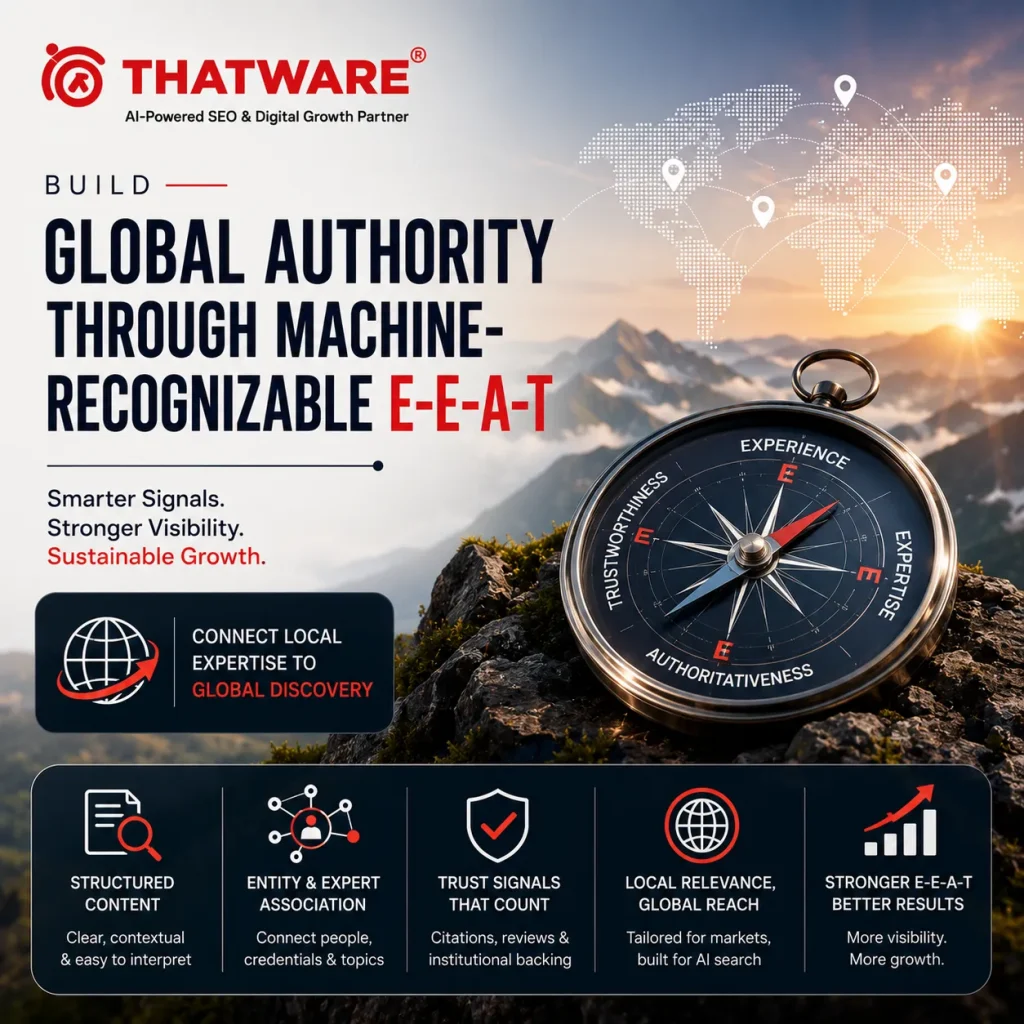
Making Expertise Explicit Through Frameworks
Our ecosystem includes frameworks such as Hyper-AI SEO, GEO, LLM SEO, AEO, AIEO, CRSEO, Entity SEO, AI Search Visibility, Semantic SEO, and QSAAS.
We treat these frameworks as documented areas of knowledge rather than merely names attached to services.
Our objective is to explain concepts, establish relationships between them, provide supporting resources, and demonstrate how they are applied to real search challenges.
This distinction matters for machine-recognizable E-E-A-T.
A proprietary methodology becomes more meaningful when an organization explains what it means, how it works, where it applies, and what evidence demonstrates its practical application.
Connecting First-Party and External Evidence
Our evidence ecosystem also extends beyond first-party website content.
We maintain resources documenting industry recognition, media coverage, awards, conference and keynote participation, research, case studies, publications, certifications, and other professional recognition.
We view these signals as complementary layers of evidence rather than isolated trust badges.
Our case studies demonstrate practical experience.
Our research and presentations document expertise.
Our media references provide external corroboration.
Our knowledge resources provide contextual depth.
Together, our goal is to create a more complete representation of the organization and its expertise.
International Market Coverage
Our international SEO infrastructure includes dedicated market resources covering Australia, Canada, Europe, Israel, New Zealand, South Africa, the UAE, the UK, the USA, and multiple Indian states and cities.
We approach these market resources as opportunities to establish relevant geographic context rather than simply inserting country names into generic service content.
The broader principle behind our approach is:
Global expertise + local evidence + entity relationships + semantic context + AI visibility measurement
That does not mean any particular architecture guarantees recognition by an AI system. Instead, we have developed our infrastructure to make expertise, entities, methodologies, evidence, and market-specific knowledge more discoverable and interpretable across evolving AI search ecosystems.
11. Conclusion
International SEO has entered an era where localization cannot stop at language, metadata, URLs, or country targeting.
Global authority remains valuable, but it should not be assumed to transfer perfectly into every market or every AI-driven search environment.
Machine-recognizable E-E-A-T requires organizations to expose the evidence behind their authority.
That means:
- Demonstrating genuine experience.
- Identifying real experts.
- Contextualizing professional credentials.
- Connecting experts to institutions and subjects.
- Documenting market-specific experience.
- Corroborating claims with relevant evidence.
- Building meaningful entity relationships.
- Measuring recognition across markets.
The objective is not to manufacture authority.
It is not to add credentials simply because they contain useful terminology.
It is not to manipulate AI systems with structured data.
It is to make existing expertise easier to understand.
For international organizations, the future of E-E-A-T therefore depends on an important distinction:
Localization translates language. Authority Translation translates evidence.
When local expertise is demonstrated, contextualized, connected, and corroborated, it becomes easier for both people and machines to understand why an organization deserves to be trusted in a particular market.
That is the foundation of machine-recognizable E-E-A-T for international SEO.
Have you used the keywords ?