SUPERCHARGE YOUR ONLINE VISIBILITY! CONTACT US AND LET’S ACHIEVE EXCELLENCE TOGETHER!
For more than two decades, search engine optimization has focused on helping websites rank higher in search engine results. Success was measured by keyword rankings, backlinks, click-through rates, and organic traffic. While these metrics remain valuable, they no longer tell the complete story of how people discover brands online.
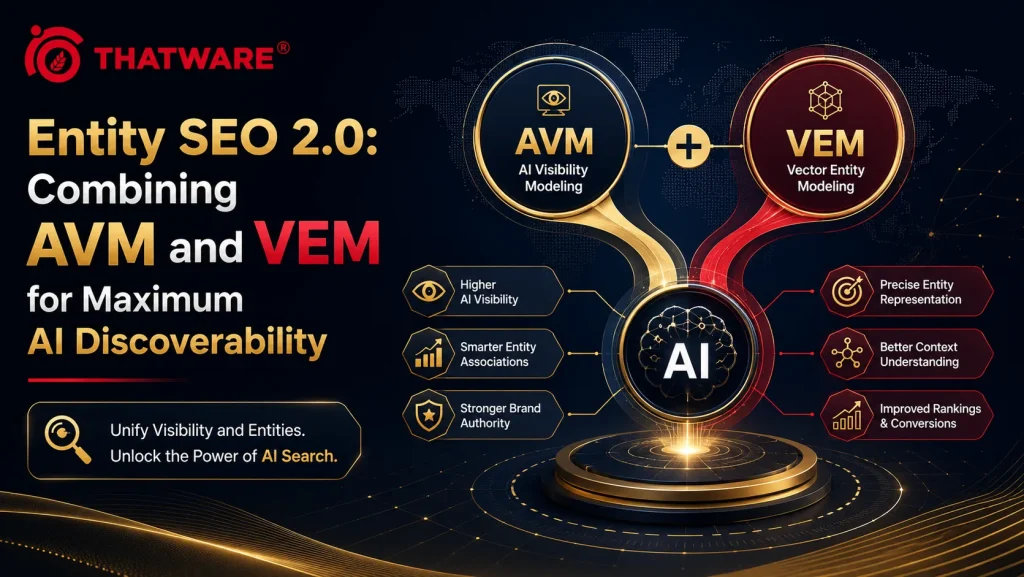
The rapid adoption of large language models (LLMs) and AI-powered search platforms has fundamentally changed the way information is retrieved and presented. Instead of returning a list of blue links, platforms such as ChatGPT, Gemini, Perplexity, and AI-powered search experiences increasingly generate direct, conversational answers by identifying trusted entities, understanding relationships between concepts, and synthesizing information from multiple sources. In this environment, visibility depends less on ranking for an individual keyword and more on whether an AI system understands your brand as a credible, authoritative entity worth retrieving and recommending.
This shift marks the beginning of what can be described as Entity SEO 2.0.
Entity SEO has long focused on helping search engines recognize people, organizations, products, locations, and concepts through structured data, semantic relationships, and knowledge graphs. However, modern AI retrieval systems go significantly further. They leverage vector embeddings, semantic similarity, contextual reasoning, and entity relationships to determine which brands deserve inclusion in AI-generated responses. As a result, businesses must optimize not only for traditional search algorithms but also for AI retrieval models that prioritize meaning, context, and authority over exact keyword matching.
This evolution has introduced a new challenge for marketers and SEO professionals. A website may still rank highly in Google Search yet receive little to no visibility within AI-generated answers. Conversely, brands with strong semantic authority, well-connected entity relationships, and comprehensive topical coverage are increasingly being surfaced by AI systems, even in competitive industries. Traditional SEO reporting offers limited insight into this new layer of discoverability because rankings alone cannot measure how frequently a brand is retrieved, cited, or recommended by AI.
To address this emerging gap, AI-first optimization requires frameworks that evaluate both how well AI understands an entity and how often that entity becomes discoverable across AI-driven search experiences. This is where Vector Entity Modelling (VEM) and AI Visibility Metric (AVM) introduce a more advanced approach to search optimization.
VEM focuses on strengthening the semantic foundation of a brand by improving entity relationships, contextual relevance, knowledge graph connections, and vector-based understanding. It helps establish a clear and consistent digital identity that AI systems can accurately interpret across multiple contexts. For any SEO services expert, understanding and implementing VEM is becoming essential for building long-term AI authority. AVM complements this by measuring the practical outcome of those efforts, evaluating how visible a brand becomes within AI-powered search environments, how frequently it appears in AI-generated responses, and how effectively it competes for AI-driven discoverability.
Together, these frameworks represent a significant evolution in advanced SEO, moving the industry beyond keyword-centric optimization toward a model built on semantic intelligence, entity authority, and AI retrieval. They encourage businesses to rethink optimization as a process of improving machine understanding rather than simply improving search rankings.
For organizations seeking long-term digital visibility, this shift is becoming increasingly important. Whether working with a professional SEO company, partnering with a professional SEO agency, or developing an in-house optimization strategy, success now depends on understanding how AI systems evaluate trust, relevance, and authority. Businesses that embrace these new SEO techniques today will be better positioned to remain discoverable as AI continues to reshape search.
In this guide, we will explore the principles behind Entity SEO 2.0, examine how AVM and VEM work together to maximize AI discoverability, and explain the technical strategies required to build stronger semantic authority across modern search ecosystems. From vector search and knowledge graphs to AI retrieval pipelines and entity optimization, you will gain a practical understanding of how the next generation of SEO intelligence is transforming digital visibility beyond traditional rankings.
The Evolution of Search: From Keywords to Entities
Search has undergone a remarkable transformation over the past two decades. What once revolved around matching keywords has evolved into understanding meaning, context, relationships, and user intent. Today, search engines and AI-powered retrieval systems are no longer focused solely on finding pages that contain specific phrases. Instead, they aim to identify the most authoritative entities capable of answering complex questions with confidence.
This evolution represents one of the most significant shifts in digital marketing. Businesses that continue to optimize exclusively for keywords risk overlooking the technologies that increasingly determine how brands are discovered across AI-driven search experiences. Understanding this progression provides the foundation for appreciating why Entity SEO 2.0 has become a critical component of advanced SEO.
The Keyword Matching Era: When Exact Keywords Dominated Search
In the early days of search engines, ranking well largely depended on exact keyword matching. Algorithms scanned webpages for the same words users typed into the search box and ranked pages based on keyword density, metadata, headings, and basic link signals.
Optimization during this period was relatively straightforward. If a webpage repeatedly mentioned a target keyword in strategic locations, it often achieved higher rankings regardless of whether the content genuinely satisfied user intent.
Although this approach helped organize the growing web, it also encouraged practices such as keyword stuffing, duplicate content, and low-value pages designed primarily to manipulate search algorithms rather than provide useful information.
As the internet expanded, it became clear that matching words alone could not accurately determine content quality or relevance.
The PageRank Revolution: Authority Becomes a Ranking Signal
Google fundamentally changed search by introducing PageRank, an algorithm that evaluated the authority of webpages based on the quality and quantity of backlinks pointing to them.
Rather than relying solely on keyword frequency, search engines began interpreting links as votes of confidence. Websites earning links from trusted sources gained greater credibility and visibility.
This shift encouraged businesses to invest in content quality, digital PR, and authority building instead of relying exclusively on keyword optimization. Even today, authority remains an important ranking factor, although modern search systems evaluate authority using far more sophisticated signals than backlinks alone.
Semantic Search: Understanding Meaning Instead of Words
As search queries became more conversational, users expected search engines to understand what they meant rather than simply what they typed.
Semantic Search marked a major advancement by enabling algorithms to interpret concepts, relationships, synonyms, and contextual meaning. Search engines began connecting related ideas instead of treating every keyword as an isolated phrase.
For example, a search for “best laptop for architects” could return results discussing CAD workstations, GPU performance, professional design software, and engineering laptops, even if those exact words did not appear together throughout the page.
This shift laid the groundwork for entity recognition, allowing search engines to understand that people, companies, products, and locations are connected within a broader knowledge ecosystem.
BERT: Bringing Natural Language Understanding to Search
Google’s introduction of Bidirectional Encoder Representations from Transformers (BERT) significantly improved how search engines interpreted natural language.
Rather than evaluating individual words independently, BERT analyzed how words influenced one another within an entire sentence. This allowed Google to better understand conversational queries, ambiguous language, and complex search intent.
For SEO professionals, BERT reinforced an important lesson: content written naturally for users consistently performs better than content created solely around keyword placement.
Instead of asking, “How many times should I use this keyword?” marketers increasingly began asking, “Does this content fully answer the user’s question?”
These developments represented some of the most important SEO new techniques, shifting optimization toward intent, expertise, and contextual relevance.
MUM: Expanding Search Beyond Text
Google’s Multitask Unified Model (MUM) extended semantic understanding even further.
Unlike previous models that primarily processed text, MUM was designed to understand information across multiple formats, including text, images, and eventually other media. It could connect concepts across languages and synthesize information from numerous sources to answer complex, multi-step questions.
Rather than treating every search as an isolated request, MUM aimed to understand broader user journeys and anticipate related information needs.
This progression demonstrated that search engines were evolving into intelligent knowledge systems rather than traditional indexing platforms.
Vector Search: Measuring Semantic Similarity
The emergence of vector search introduced an entirely different way of retrieving information.
Instead of matching keywords, vector search converts words, sentences, images, and entities into high-dimensional mathematical representations known as embeddings. These vectors capture semantic meaning, allowing retrieval systems to identify content based on conceptual similarity rather than identical wording.
This means two pages discussing the same topic can be recognized as highly relevant even if they share very few keywords.
Vector search has become a foundational technology for modern AI retrieval systems because it enables machines to understand relationships between concepts at a much deeper level than traditional lexical search.
For organizations investing in cutting edge SEO, understanding vector embeddings is becoming as important as understanding keyword research once was.
Generative AI Has Changed Search Expectations
The rapid adoption of Generative AI has fundamentally altered how users interact with search platforms.
Instead of reviewing multiple webpages, users increasingly expect AI systems to provide direct, comprehensive answers supported by reliable sources. AI assistants summarize information, compare products, explain technical concepts, and recommend businesses within a single conversational interface.
This behavioral shift changes the objective of optimization. Brands are no longer competing only for clicks. They are competing to become trusted sources that AI systems select, synthesize, and recommend.
Visibility now depends on semantic credibility, topical completeness, and contextual authority rather than rankings alone.
AI Search Engines Prioritize Understanding Over Matching
AI-powered search platforms such as ChatGPT, Gemini, Perplexity, and Google’s AI-powered search experiences operate differently from traditional search engines.
Rather than retrieving pages solely because they contain matching keywords, these systems evaluate whether a source demonstrates sufficient expertise, contextual relevance, entity authority, and semantic consistency to contribute to an accurate response.
This introduces a new layer of discoverability where brands are evaluated according to how well AI understands their identity, products, services, and relationships within a larger knowledge ecosystem.
Consequently, optimization strategies must evolve beyond conventional ranking signals and embrace broader SEO intelligence focused on machine understanding.
LLM Retrieval Is Built Around Entities
Large Language Models retrieve and reason over information differently from traditional search algorithms.
Instead of relying on exact phrases, LLMs identify entities and examine the relationships between them. A business, product, author, technology, or location becomes part of an interconnected semantic network where context plays a central role.
For example, when an AI model encounters a professional SEO agency specializing in AI Search Optimization, it does not merely process individual keywords. It evaluates the agency’s expertise, topical authority, associated entities, supporting evidence, and relevance to the user’s question.
This retrieval process rewards websites that establish clear entity relationships through comprehensive content, structured information, consistent branding, and authoritative topical coverage.
Knowledge Graph Expansion Continues to Shape Search
Knowledge Graphs have become increasingly sophisticated as search engines and AI systems strive to understand the real-world relationships between entities.
Modern knowledge graphs connect organizations, people, products, services, industries, technologies, publications, and countless other entities into structured networks that help machines interpret context more accurately.
Every authoritative piece of content contributes additional signals that strengthen these relationships. Over time, businesses with comprehensive semantic coverage become easier for AI systems to retrieve because their digital identity is consistently reinforced across multiple sources.
Knowledge Graph expansion therefore represents one of the strongest foundations for long-term AI discoverability.
Why Entity SEO Is Becoming More Important Than Keyword SEO
Keywords remain valuable because they reflect how users express their information needs. However, keywords alone no longer determine whether a brand becomes visible within AI-powered search experiences.
Modern retrieval systems prioritize understanding over matching. They evaluate whether an entity demonstrates expertise, authority, trustworthiness, semantic consistency, and meaningful relationships across an entire knowledge ecosystem.
Entity SEO addresses these requirements by helping search engines and AI models understand not only what a webpage says but also who created it, what it represents, how it relates to other entities, and why it should be considered a trusted source.
This is why Entity SEO represents the next stage of advanced SEO. Instead of optimizing isolated pages around individual keywords, businesses are building interconnected semantic ecosystems that improve both search visibility and AI discoverability.
As AI continues to reshape search, organizations adopting SEO new techniques centered on entities, knowledge graphs, semantic architecture, and vector-based retrieval will be significantly better positioned than those relying solely on traditional keyword optimization. The future of search belongs to brands that machines can understand, trust, and confidently recommend.
Why Traditional SEO Alone Cannot Maximize AI Discoverability
For years, SEO success has been measured using a familiar set of performance indicators: keyword rankings, click-through rates, organic traffic, backlinks, and conversions. These metrics remain valuable because they reflect how websites perform within conventional search engine result pages (SERPs). However, AI-powered search introduces a fundamentally different retrieval model where visibility is determined by far more than position alone.
When a user asks an AI assistant for recommendations, explanations, or comparisons, the model does not simply retrieve the highest-ranking webpage. Instead, it evaluates multiple signals to determine which entities are sufficiently authoritative, contextually relevant, and semantically connected to answer the query with confidence. This shift requires businesses to rethink how they define search success.
For brands investing in LLM SEO, Answer Engine Optimization (AEO), and Generative Engine Optimization (GEO), the objective is no longer limited to achieving a top-ranking webpage. The goal is to become an entity that AI systems consistently understand, retrieve, and recommend.
Traditional SEO Metrics Measure Search Performance
Traditional SEO metrics primarily evaluate how well a webpage performs within search engines like Google.
Some of the most widely used metrics include:
- Keyword rankings
- Click-through rate (CTR)
- Organic traffic
- Backlink profile
- Domain authority
- Indexed pages
- Conversion rate
- Bounce rate
These indicators provide valuable insight into website performance, content effectiveness, and user engagement. They help SEO professionals identify opportunities to improve visibility within traditional search results.
However, they reveal very little about how AI models perceive a brand or whether that brand is likely to appear in AI-generated responses.
AI Discoverability Requires a Different Measurement Framework
AI-powered retrieval systems evaluate entirely different signals.
Instead of asking, “Which page ranks highest?” AI models ask questions such as:
- Which entity has the strongest expertise?
- Which source demonstrates consistent authority?
- Which information is supported across multiple trusted references?
- Which entity best matches the user’s intent?
- Which brand can be cited with confidence?
These considerations introduce an entirely new category of performance metrics.
Examples include:
- Recommendation frequency across AI platforms
- Entity confidence within semantic retrieval systems
- Retrieval probability for conversational queries
- Citation likelihood in AI-generated responses
- Semantic authority across related topics
- Cross-platform entity consistency
- AI knowledge graph presence
- Topical relationship strength
These measurements form the foundation of modern SEO intelligence search, providing insights that conventional SEO reporting cannot capture.
Ranking First Does Not Guarantee AI Visibility
One of the biggest misconceptions surrounding AI search is that ranking first automatically leads to visibility inside ChatGPT, Gemini, Perplexity, or other AI assistants.
In reality, many websites occupying the first organic position are rarely referenced by AI systems.
Several factors contribute to this disconnect.
A webpage may rank because it targets a highly optimized keyword while lacking comprehensive topical depth.
Its entity relationships may be poorly defined.
The website may contain minimal structured information about its authors, products, services, or organization.
It may also lack consistent semantic signals across related topics, making it difficult for AI systems to establish contextual confidence.
As a result, AI models often retrieve alternative sources that demonstrate stronger entity authority despite having lower traditional rankings.
This explains why organizations focused exclusively on rankings may experience declining visibility as AI search becomes increasingly dominant.
AI Models Evaluate Confidence, Not Just Relevance
Traditional search algorithms primarily evaluate relevance.
AI retrieval systems evaluate confidence.
Confidence is established through multiple interconnected signals, including:
- Semantic consistency
- Comprehensive topical coverage
- Entity relationships
- Structured knowledge
- Contextual authority
- Supporting references
- Historical credibility
- Cross-domain validation
The stronger these signals become, the more likely an AI model is to reference the brand when generating responses.
This represents one of the biggest shifts driving modern AEO, GEO, and LLM SEO strategies.
AI Discoverability Demands Advanced SEO Intelligence
As search evolves toward AI-driven experiences, businesses require advanced algorithm SEO solutions capable of measuring both semantic strength and AI visibility.
Traditional dashboards focused solely on rankings no longer provide sufficient intelligence for decision-making.
Instead, organizations must evaluate:
- How well AI understands their business
- Whether entity relationships are complete
- How consistently the brand appears across AI platforms
- Whether semantic authority continues expanding
- How frequently AI systems recommend their content
These insights enable businesses to optimize for AI retrieval rather than merely improving keyword rankings.
Understanding Entity SEO 2.0
Entity SEO has existed for years through structured data, schema markup, and Google’s Knowledge Graph. While these techniques remain important, the emergence of large language models has significantly expanded what entity optimization actually means.
Entity SEO 2.0 is not simply an updated version of traditional entity optimization. It represents an entirely new methodology built around how AI systems understand, connect, retrieve, and recommend information.
Instead of optimizing webpages for keywords alone, Entity SEO 2.0 optimizes the digital identity of an organization across semantic networks, vector spaces, knowledge graphs, and AI retrieval pipelines.
Moving Beyond Pages to Digital Entities
Traditional SEO optimizes webpages.
Entity SEO 2.0 optimizes entities.
An entity may represent:
- A company
- A product
- A person
- A technology
- A service
- A location
- An industry
- A concept
Modern AI systems seek to understand these entities independently of the pages on which they appear.
This enables AI to recognize that multiple documents discussing the same organization all contribute to a unified understanding of that entity.
Semantic Entities Form the Foundation of AI Understanding
Unlike keywords, semantic entities possess meaning independent of language.
For example, “Apple” may represent:
- Apple Inc.
- The fruit
- Apple products
- Apple Park
- Apple developers
AI models determine the intended meaning by examining surrounding context, related entities, semantic relationships, and user intent.
Entity SEO therefore focuses on strengthening these contextual signals so AI consistently understands the correct entity.
Relationship Graphs Build Context
Entities rarely exist in isolation.
Organizations connect to founders.
Products connect to manufacturers.
Services connect to industries.
Technologies connect to applications.
Relationship graphs help AI models understand these connections.
The richer these relationships become, the stronger the contextual understanding surrounding each entity.
This interconnected architecture plays a central role in Generative Engine Optimization (GEO) because AI retrieval depends heavily on semantic context.
Embeddings and Vector Spaces Enable Semantic Retrieval
One of the defining characteristics of Entity SEO 2.0 is its reliance on embeddings.
Embedding models convert words, documents, entities, and concepts into mathematical vectors representing semantic meaning.
Rather than matching keywords literally, AI compares the similarity between vectors.
Two pages discussing identical concepts may produce highly similar embeddings even if they use completely different wording.
Vector databases store these embeddings, allowing AI systems to retrieve semantically related information almost instantly.
This capability lies at the heart of modern LLM SEO, where retrieval depends more on conceptual similarity than keyword overlap.
Entity Resolution Creates Consistent Digital Identity
Entity resolution refers to identifying when multiple references describe the same entity.
For example:
- Company name
- Brand abbreviation
- Website
- Founder
- Products
- Social profiles
AI systems combine these signals into a unified representation.
Consistent branding, structured data, author profiles, citations, and knowledge graph connections all strengthen entity resolution.
The more consistently an entity appears across the web, the easier it becomes for AI to retrieve with confidence.
Google Knowledge Graph Continues to Influence AI Understanding
Google’s Knowledge Graph introduced structured entity relationships years before generative AI became mainstream.
Today, knowledge graphs remain fundamental because they organize billions of real-world entities and their relationships.
Although large language models extend beyond Google’s graph, the same principles apply.
Organizations with stronger knowledge graph presence generally provide richer semantic signals for AI retrieval.
Context Windows Have Changed Content Optimization
Modern language models process large context windows capable of evaluating thousands of words simultaneously.
Rather than analyzing isolated paragraphs, AI evaluates entire documents, supporting evidence, surrounding entities, topical depth, and semantic consistency.
Consequently, Entity SEO 2.0 encourages comprehensive topical coverage instead of fragmented keyword-focused pages.
The result is stronger contextual authority and improved AI discoverability across a wider range of conversational queries.
Introducing AVM (AI Visibility Metric)
As AI-powered search becomes increasingly influential, businesses need a way to measure visibility beyond rankings.
This is the purpose of the AI Visibility Metric (AVM).
AVM represents a modern measurement framework designed to evaluate how frequently, consistently, and confidently a brand appears across AI-driven search environments.
Instead of measuring where a webpage ranks, AVM measures whether AI systems recognize the underlying entity as worthy of retrieval and recommendation.
Why AVM Is Needed
Traditional SEO metrics answer questions like:
- Where does the page rank?
- How many visitors arrived?
- Which keywords generated clicks?
AVM answers entirely different questions.
For example:
- How often does AI recommend the brand?
- Which conversational queries retrieve the entity?
- How consistently does the brand appear across AI platforms?
- How visible is the organization compared to competitors?
- How trustworthy does the entity appear within AI retrieval systems?
These measurements provide a far more accurate picture of AI discoverability.
Core Components of AVM
An effective AI Visibility Metric may evaluate several interconnected dimensions.
Brand Recommendation Score
Measures how frequently AI assistants recommend the organization when responding to relevant prompts.
A consistently recommended brand demonstrates stronger AI visibility than one that rarely appears despite strong traditional rankings.
AI Citation Frequency
Tracks how often AI systems reference the organization’s content, research, products, or expertise when generating responses.
Higher citation frequency generally reflects greater semantic authority.
AI Retrieval Score
Evaluates the probability that AI systems retrieve the entity across a broad range of relevant conversational queries.
Unlike keyword rankings, retrieval scores measure discoverability within semantic search environments.
AI Visibility Consistency
Measures whether the brand appears consistently across different AI models and query variations.
High consistency indicates that semantic signals remain stable across multiple retrieval systems.
Cross-Platform AI Presence
AI discoverability is no longer limited to a single search engine.
AVM can evaluate visibility across platforms supporting conversational retrieval, including AI assistants, answer engines, and generative search interfaces.
This makes AVM highly relevant to both AEO and GEO strategies.
Competitive AI Visibility
Brands rarely compete in isolation.
Competitive AI visibility compares how often one organization appears relative to others within the same industry.
This enables businesses to identify semantic gaps, entity weaknesses, and opportunities for improving AI prominence.
Why Traditional Rankings Cannot Measure AVM
A website may occupy the first position in Google Search while remaining almost invisible inside conversational AI systems.
Conversely, another organization may receive consistent AI recommendations despite ranking lower for conventional keywords because its semantic authority, entity relationships, topical coverage, and contextual credibility are significantly stronger.
This demonstrates why rankings alone cannot measure AI visibility.
AVM fills this gap by focusing on discoverability within modern AI retrieval environments rather than solely within traditional search results.
As AI search continues to evolve, frameworks such as AVM will become increasingly valuable for organizations implementing LLM SEO, Answer Engine Optimization, Generative Engine Optimization, and next-generation search intelligence strategies.
Introducing VEM (Vector Entity Modelling)
As AI-powered search evolves beyond keyword matching, search engines and large language models require a more sophisticated way to understand brands, organizations, products, and people. Simply mentioning a keyword multiple times is no longer enough. AI systems must understand what an entity represents, how it connects to other entities, and why it should be trusted.
This is where the Vector Entity Modelling (VEM) becomes an essential component of modern LLM SEO, Answer Engine Optimization (AEO), and Generative Engine Optimization (GEO).
Unlike traditional SEO frameworks that optimize webpages, VEM focuses on optimizing the semantic identity of an entity so that AI systems can retrieve and understand it with greater confidence.
What Is the Vector Entity Modelling?
The Vector Entity Modelling is a semantic framework designed to strengthen how AI interprets digital entities within vector-based retrieval systems.
Rather than focusing on isolated webpages, VEM analyzes how an entity exists across an interconnected network of information.
Its objective is to answer three fundamental questions that every AI model attempts to resolve:
- Who are you?
- What do you do?
- Why should users trust your expertise?
Every optimization activity within VEM contributes to making these answers clearer and more consistent across AI search ecosystems.
Vector Embeddings: Converting Meaning into Mathematics
Modern AI systems cannot directly understand human language in its raw form.
Instead, embedding models convert words, entities, paragraphs, and documents into numerical vectors that represent semantic meaning.
These vector embeddings capture contextual relationships instead of literal keywords.
For example, a website discussing “AI Search Optimization,” “LLM SEO,” and “Generative Engine Optimization” may generate highly similar embeddings because the underlying concepts are closely related.
This allows AI models to retrieve relevant information even when exact keywords differ.
The stronger an entity’s semantic embedding becomes, the easier it becomes for AI systems to recognize its expertise.
Semantic Neighborhoods Define Context
Every entity exists inside a semantic neighborhood.
A professional SEO agency, for example, naturally connects with concepts such as:
- Technical SEO
- AI Search
- Knowledge Graphs
- Vector Search
- Entity Optimization
- Semantic Search
- Content Intelligence
- Machine Learning
The more complete these surrounding relationships become, the easier it is for AI to understand the entity’s specialization.
Weak semantic neighborhoods create ambiguity.
Rich semantic neighborhoods create confidence.
Entity Confidence Determines Retrieval
One of the primary objectives of VEM is increasing entity confidence.
Before an AI model recommends a business, it evaluates whether sufficient evidence exists to support that recommendation.
Confidence grows through signals such as:
- Comprehensive topical coverage
- Consistent brand identity
- Expert authorship
- Strong semantic relationships
- Reliable citations
- Structured knowledge
- Historical authority
When these signals align, AI systems become significantly more confident in retrieving the entity.
Knowledge Graph Relationships Strengthen Understanding
Knowledge graphs represent entities and their relationships as interconnected nodes.
Rather than viewing a business as a single webpage, AI recognizes relationships such as:
Company
↓
Founder
↓
Products
↓
Services
↓
Customers
↓
Industry
↓
Technologies
↓
Research
↓
Partners
Each relationship provides additional context that strengthens entity understanding.
VEM encourages expanding these connections so AI models develop a richer understanding of the organization.
Authority Propagation Across Entity Networks
Authority is no longer confined to individual webpages.
Instead, authority propagates across related entities.
For example, authoritative research published by an organization strengthens:
- The company entity
- Associated authors
- Products
- Services
- Industry expertise
- Related knowledge graph nodes
Over time, this interconnected authority increases the likelihood that AI systems will retrieve the organization across diverse conversational queries.
Context Consistency Improves AI Understanding
One of the biggest challenges for AI retrieval is inconsistency.
If a company describes itself differently across webpages, social platforms, citations, and structured data, AI models receive conflicting semantic signals.
VEM emphasizes context consistency by ensuring that every reference reinforces the same identity.
This consistency allows embedding models to generate more stable semantic representations.
Entity Clustering Creates Topical Depth
Modern AI systems group related entities into clusters.
Instead of publishing isolated content pieces, organizations should build interconnected content around related entities.
For example:
AI Search Optimization
↓
LLM SEO
↓
Entity SEO
↓
Knowledge Graph
↓
Semantic Search
↓
Vector Search
↓
AEO
↓
GEO
↓
AI Visibility
Each topic strengthens the others.
This clustering strategy significantly improves semantic authority.
Similarity Search and Vector Retrieval
Traditional search retrieves matching words.
Vector retrieval retrieves similar meanings.
When a user asks:
“How do I improve AI discoverability?”
AI may retrieve content discussing:
- Entity optimization
- Semantic authority
- Knowledge graphs
- Embeddings
- AI visibility
Even without matching every keyword.
This semantic similarity dramatically expands discoverability opportunities.
Why VEM Helps AI Understand Your Brand
Ultimately, VEM exists to improve machine understanding.
It enables AI systems to answer three essential questions.
Who Are You?
Your organization becomes a clearly defined entity with consistent semantic relationships.
What Do You Do?
Products, services, expertise, industries, and technologies become interconnected within knowledge graphs.
Why Do You Matter?
Authority signals, topical depth, trusted citations, and semantic consistency establish credibility that AI systems can recognize and retrieve confidently.
For organizations investing in advanced SEO, VEM provides the semantic foundation that enables sustainable AI discoverability across multiple retrieval platforms.
AVM + VEM: The Two-Layer Framework for AI Discoverability
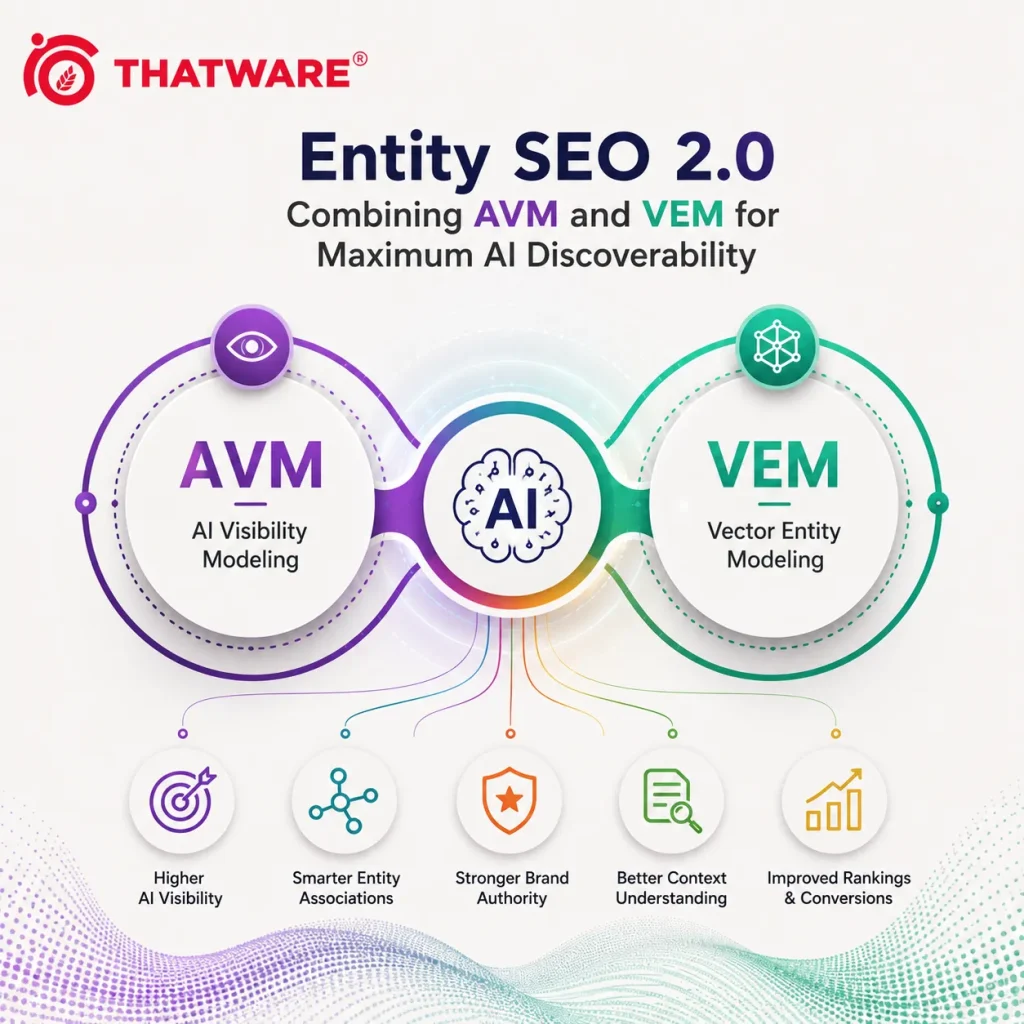
While AVM and VEM serve different purposes, their greatest strength lies in how they work together.
VEM builds semantic understanding.
AVM measures the resulting visibility.
Neither framework replaces the other. Instead, they represent two complementary layers of a comprehensive AI search strategy.
Layer One: VEM Builds Entity Understanding
The first layer focuses on helping AI understand the entity itself.
VEM
↓
Entity Understanding
↓
Knowledge Graph Development
↓
Embedding Quality
↓
Semantic Authority
↓
AI Confidence
Without strong entity understanding, AI systems struggle to determine whether an organization deserves recommendation.
Every optimization effort within VEM strengthens the semantic foundation upon which AI retrieval depends.
Layer Two: AVM Measures AI Visibility
Once AI understands the entity, the next challenge becomes measuring discoverability.
AVM
↓
AI Visibility
↓
Recommendations
↓
Mentions
↓
Retrieval
↓
Brand Discoverability
AVM evaluates how successfully those semantic improvements translate into real-world AI visibility.
It answers questions such as:
- How often is the brand recommended?
- Which AI platforms retrieve the organization?
- How consistently does the entity appear?
- How does visibility compare against competitors?
Why AVM and VEM Are Complementary
Think of VEM as building the foundation of a skyscraper.
Without a strong foundation, the building cannot stand.
AVM represents the observation deck, showing how visible that building becomes within the surrounding skyline.
A business may achieve exceptional semantic optimization through VEM but still require additional authority, citations, and topical expansion before visibility increases.
Likewise, measuring AI visibility without strengthening entity understanding offers little long-term value.
Together they create a continuous optimization cycle:
Improve entity understanding.
↓
Increase semantic confidence.
↓
Strengthen AI retrieval.
↓
Measure AI visibility.
↓
Identify weaknesses.
↓
Improve entity signals.
This iterative framework aligns naturally with modern LLM SEO, AEO, and GEO, where optimization focuses on both machine understanding and measurable discoverability.
The Technical Architecture Behind AI Discoverability
AI discoverability is supported by a sophisticated technical ecosystem that extends far beyond traditional SEO.
Rather than evaluating isolated ranking signals, AI systems process structured information, semantic relationships, vector representations, and contextual evidence simultaneously.
Understanding this architecture helps explain why Entity SEO 2.0 is fundamentally different from conventional optimization.
Schema Creates Machine-Readable Context
Schema markup provides explicit descriptions of entities.
It helps AI understand:
- Organizations
- Authors
- Products
- Services
- FAQs
- Reviews
- Articles
- Events
Although schema alone cannot guarantee AI visibility, it significantly improves entity clarity.
Knowledge Graphs Connect Information
Knowledge graphs organize entities into structured relationship networks.
Every additional relationship strengthens AI understanding.
Instead of isolated webpages, AI evaluates an interconnected web of knowledge.
Vector Embeddings Power Semantic Understanding
Embedding models convert language into vector space.
This allows retrieval systems to compare concepts rather than keywords.
Semantic similarity becomes more important than exact wording.
Named Entity Recognition (NER)
NER identifies important entities throughout content.
Examples include:
- Companies
- People
- Products
- Technologies
- Locations
- Organizations
Accurate entity recognition improves knowledge graph construction.
Natural Language Processing (NLP)
NLP enables AI to understand:
- Intent
- Context
- Relationships
- Sentiment
- Meaning
Modern LLM SEO depends heavily on NLP because language understanding directly influences retrieval quality.
Retrieval-Augmented Generation (RAG)
Many AI systems combine language models with external retrieval mechanisms.
Instead of relying solely on model memory, RAG retrieves trusted external information before generating answers.
Organizations with stronger semantic signals become better retrieval candidates within these pipelines.
Semantic Search Replaces Literal Matching
Semantic search identifies conceptual similarity rather than keyword overlap.
This dramatically expands discoverability for authoritative entities with comprehensive topical coverage.
Large Context Windows Improve Understanding
Modern language models process extensive context windows.
Rather than evaluating isolated paragraphs, they assess:
- Supporting evidence
- Topic relationships
- Entity consistency
- Overall expertise
Comprehensive content therefore becomes increasingly valuable.
Entity Linking Removes Ambiguity
Entity linking connects mentions within content to specific real-world entities.
This prevents confusion between similarly named organizations, products, or individuals.
Structured Data Supports AI Interpretation
Structured data complements semantic understanding by providing standardized machine-readable information.
Combined with knowledge graphs, it strengthens entity confidence.
Citation Signals Build Trust
AI systems evaluate citations from authoritative sources.
Consistent references strengthen credibility, improve semantic authority, and increase retrieval confidence.
Topical Authority Expands Entity Strength
Organizations demonstrating deep expertise across an entire subject area become stronger retrieval candidates.
Topical authority is increasingly replacing isolated keyword optimization.
Graph Databases Store Relationships
Many AI retrieval systems rely on graph databases to organize interconnected entities.
These structures enable rapid traversal across complex knowledge networks.
AI Retrieval Pipelines Combine Multiple Technologies
Modern AI retrieval often follows a layered workflow:
User Query
↓
Intent Analysis
↓
NLP Processing
↓
NER
↓
Embedding Generation
↓
Vector Search
↓
Knowledge Graph Verification
↓
RAG Retrieval
↓
LLM Reasoning
↓
Generated Response
Every optimization activity within VEM improves one or more stages of this retrieval pipeline.
Building an AI-Optimized Website Using AVM and VEM
AI discoverability begins long before content is published.
It starts with building a website whose architecture helps machines understand entities, relationships, expertise, and trust.
Rather than optimizing isolated pages, organizations should optimize the entire semantic ecosystem.
Step 1: Build an Entity-Centric Website Architecture
Every major entity deserves its own dedicated hub.
Examples include:
- Services
- Products
- Authors
- Industries
- Technologies
- Research
- Case studies
Each entity should connect naturally to related entities.
Step 2: Create Comprehensive Content Clusters
Instead of publishing disconnected blogs, organize content into topical clusters.
Each cluster should reinforce semantic authority around a core entity.
This strategy supports both AEO and GEO by expanding contextual relevance.
Step 3: Develop Strong Entity Clusters
Connect:
Brand
↓
Services
↓
Products
↓
Authors
↓
Research
↓
Case Studies
↓
Technologies
↓
Industries
↓
Resources
The richer these relationships become, the stronger the entity network.
Step 4: Implement Comprehensive Schema
Use structured data to clearly define:
- Organization
- Person
- Product
- Service
- Article
- FAQ
- Review
- Breadcrumb
- WebPage
Schema enhances machine understanding without replacing high-quality content.
Step 5: Strengthen Internal Linking
Internal links should reinforce semantic relationships rather than simply distribute authority.
Every link should help AI understand how entities connect.
Step 6: Optimize Brand, Author, Trust, and Product Entities
AI evaluates far more than webpages.
It also evaluates:
- Brand identity
- Author expertise
- Product relationships
- Organizational trust
- Industry specialization
Every entity contributes to overall semantic authority.
Step 7: Expand Knowledge Panel Signals
Maintain consistent information across authoritative sources.
Consistent business details, author identities, publications, and industry references strengthen knowledge graph development.
Step 8: Design AI-Friendly Navigation
Website navigation should reflect logical semantic relationships.
Clear hierarchies, descriptive navigation labels, breadcrumbs, and contextual pathways improve both user experience and machine interpretation.
Step 9: Build with Semantic HTML
Semantic HTML helps search engines interpret page structure more accurately.
Proper use of headings, sections, articles, navigation, and structured content improves machine readability while supporting accessibility and long-term AI discoverability.
By combining robust website architecture with VEM-driven entity optimization and AVM-based visibility measurement, organizations can create digital ecosystems that are not only optimized for search engines but also well positioned for the next generation of AI-powered retrieval, recommendation, and conversational search.
Measuring AI Visibility Beyond Google Rankings
For years, SEO performance has been evaluated through rankings, impressions, clicks, and organic traffic. These metrics continue to provide valuable insights into search engine performance, but they do not fully reflect how brands are discovered in AI-powered search environments.
Large language models do not simply rank webpages. They retrieve entities, evaluate semantic relationships, verify contextual relevance, and generate responses based on confidence rather than position alone. As a result, organizations investing in LLM SEO, Answer Engine Optimization (AEO), and Generative Engine Optimization (GEO) require an entirely new measurement framework.
This is where AI-first Key Performance Indicators (KPIs) become essential. Rather than focusing exclusively on how users find your website through traditional search engines, AI-first KPIs evaluate how effectively AI systems understand, retrieve, and recommend your brand.
These metrics provide a more comprehensive view of long-term AI discoverability.
Why Rankings Alone No Longer Tell the Complete Story
Achieving the first organic position on Google is still valuable, but it does not necessarily mean your brand will appear in AI-generated responses.
An AI assistant may summarize information from several authoritative entities rather than relying on the highest-ranking webpage.
Likewise, multiple organizations ranking outside the top five search results may still receive consistent AI recommendations because their semantic authority and entity relationships are stronger.
The objective therefore shifts from simply ranking webpages to becoming a trusted entity within AI retrieval systems.
This requires businesses to monitor indicators that reflect AI understanding rather than only search engine placement.
AI Recommendation Rate
One of the most important AI-first KPIs is recommendation rate.
This metric measures how frequently an AI platform recommends your organization when responding to relevant prompts.
For example, if users repeatedly ask:
- Which company offers advanced SEO solutions?
- Who specializes in LLM SEO?
- Which agency provides AI Search Optimization?
Recommendation rate evaluates how often your organization appears among the generated responses.
Unlike rankings, this metric reflects actual AI visibility across conversational interfaces.
AI Citation Score
Modern AI systems increasingly reference external sources when generating responses.
AI Citation Score measures how frequently your organization, research, products, or expertise are cited during these interactions.
A higher citation score generally indicates that AI models recognize your content as trustworthy, authoritative, and contextually valuable.
Organizations producing original research, technical documentation, case studies, and comprehensive educational resources often achieve stronger citation performance.
Entity Prominence
Entity prominence evaluates how important your organization appears within its broader semantic ecosystem.
Rather than measuring page authority, it measures entity authority.
Several factors contribute to entity prominence, including:
- Brand recognition
- Topical expertise
- Knowledge graph connections
- Trusted citations
- Industry associations
- Author expertise
- Semantic relationships
The stronger these signals become, the greater the likelihood of AI retrieval.
Semantic Authority Score
Traditional authority focuses largely on backlinks.
Semantic authority evaluates how comprehensively an organization covers a subject area.
For example, an organization publishing authoritative resources on:
- Entity SEO
- Vector Search
- Knowledge Graphs
- LLM SEO
- AI Visibility
- AEO
- GEO
develops significantly stronger semantic authority than a website publishing isolated keyword-focused articles.
Semantic authority demonstrates expertise rather than popularity.
Knowledge Graph Completeness
Knowledge Graph Completeness measures how well an entity is represented across structured knowledge systems.
Evaluation may include:
- Organization details
- Products
- Services
- Authors
- Executives
- Publications
- Research
- Industry relationships
- Locations
- Awards
- Technologies
The richer these relationships become, the easier AI systems can understand and retrieve the entity.
Cross-Model Consistency
AI discoverability should not depend on a single platform.
Cross-model consistency measures whether an organization appears consistently across multiple AI systems.
Examples include:
- ChatGPT
- Gemini
- Perplexity
- Claude
- Copilot
- AI-powered search experiences
Consistent visibility indicates stable semantic signals rather than platform-specific optimization.
This has become an increasingly important KPI for organizations implementing enterprise GEO strategies.
Context Relevance
AI systems evaluate whether an entity matches the context of a specific query.
A business may be highly authoritative in one industry while having little relevance in another.
Context relevance measures how accurately AI associates the organization with its intended expertise.
Higher contextual relevance generally improves recommendation quality and retrieval confidence.
Retrieval Probability
Retrieval probability estimates the likelihood that an AI model selects a particular entity when generating responses.
Unlike keyword rankings, retrieval probability considers:
- Semantic similarity
- Entity confidence
- Contextual authority
- Supporting evidence
- Knowledge graph relationships
- Topical depth
Organizations improving these signals generally experience stronger AI discoverability.
Brand Recall Across AI Systems
Brand recall evaluates whether AI consistently remembers and associates an organization with specific expertise.
For example, an AI assistant should immediately associate a recognized entity with concepts such as:
- AI Search Optimization
- LLM SEO
- Advanced SEO
- Entity SEO
- Semantic Search
Strong brand recall increases recommendation frequency while reinforcing long-term semantic authority.
AI Visibility Requires AI-First Measurement
Traditional SEO dashboards remain valuable, but they provide only part of the picture.
As AI-powered search becomes increasingly influential, organizations must evaluate discoverability through semantic understanding, entity confidence, retrieval performance, and AI recommendation behavior.
Frameworks such as AVM make these measurements possible by extending SEO beyond rankings into the broader landscape of AI visibility.
For businesses investing in LLM SEO, AEO, and GEO, AI-first KPIs represent the next evolution of search measurement.
AI Search Optimization Workflow Using AVM + VEM
Successfully optimizing for AI discoverability requires more than publishing high-quality content. It demands a structured methodology that strengthens entity understanding while continuously measuring AI visibility.
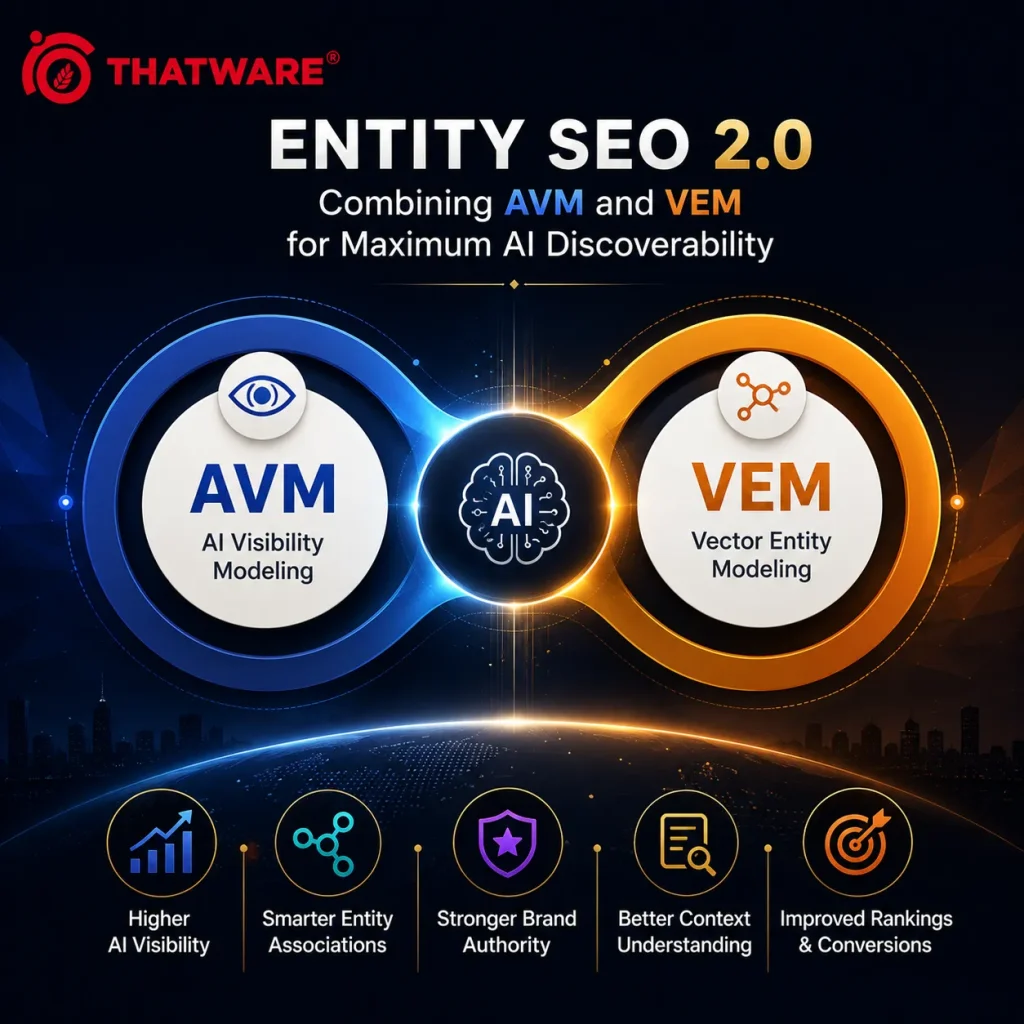
AVM and VEM work together to create an iterative optimization framework where semantic improvements lead to measurable gains in AI discoverability.
Rather than treating optimization as a one-time activity, this workflow establishes a continuous improvement cycle capable of adapting to evolving AI retrieval systems.
Step 1: Comprehensive AI Search Audit
Every successful optimization strategy begins with a thorough assessment of the organization’s current AI readiness.
A comprehensive audit should evaluate:
- Existing entity signals
- Knowledge graph presence
- Structured data implementation
- Semantic consistency
- Internal linking architecture
- Topical authority
- Brand mentions
- AI platform visibility
- Competitive positioning
Unlike traditional SEO audits, AI-focused assessments examine how effectively machines understand the organization rather than simply evaluating technical website performance.
Step 2: Entity Discovery
Once the audit is complete, the next objective is identifying every important entity associated with the organization.
These typically include:
- Brand
- Products
- Services
- Authors
- Executives
- Technologies
- Industries
- Customers
- Locations
- Research
- Publications
Entity discovery creates the foundation for building a comprehensive semantic ecosystem.
Step 3: Build the Entity Graph
The next stage connects identified entities into a structured relationship network.
Rather than treating content as isolated webpages, organizations develop interconnected entity graphs.
For example:
Organization
↓
Services
↓
Solutions
↓
Industries
↓
Products
↓
Research
↓
Authors
↓
Case Studies
↓
Technologies
↓
Partners
Every relationship provides additional semantic context for AI systems.
Step 4: Optimize Embeddings
Embedding optimization focuses on improving how AI models represent the organization within vector space.
This involves:
- Consistent terminology
- Comprehensive topical coverage
- Contextual relationships
- Semantic reinforcement
- Entity clarity
The objective is to produce stronger vector embeddings that improve retrieval accuracy across conversational search platforms.
Step 5: Content Engineering
Content should now be engineered around entities instead of isolated keywords.
Effective content engineering includes:
- Pillar pages
- Topic clusters
- Entity clusters
- Technical documentation
- Case studies
- Research content
- Educational resources
- Expert insights
This approach strengthens semantic authority while expanding contextual relevance.
It also supports long-term LLM SEO by providing richer knowledge for AI retrieval.
Step 6: Expand the Knowledge Graph
The next phase strengthens knowledge graph relationships.
This includes connecting:
- Organization
- Products
- Services
- Authors
- Technologies
- Industries
- Research
- Publications
- Awards
- Partnerships
A richer knowledge graph significantly improves machine understanding.
Step 7: Strengthen Structured Data
Structured data provides explicit machine-readable descriptions for important entities.
Priority schema implementations typically include:
- Organization
- Person
- Service
- Product
- Article
- FAQ
- Review
- Breadcrumb
- WebPage
While schema does not directly improve rankings, it strengthens entity clarity across AI retrieval systems.
Step 8: Optimize Internal Entity Relationships
Internal linking should reinforce semantic relationships rather than simply distributing PageRank.
Every link should help AI understand:
- Parent entities
- Child entities
- Supporting concepts
- Related technologies
- Complementary services
- Associated research
Semantic internal linking creates stronger contextual understanding across the entire website.
Step 9: Test AI Retrieval
Optimization should always be validated using real AI platforms.
Testing may include evaluating:
- Recommendation frequency
- Brand mentions
- Citation behavior
- Entity recognition
- Response consistency
- Retrieval quality
- Competitive comparisons
Regular testing identifies opportunities for improving AI discoverability before competitors gain an advantage.
Step 10: Measure AI Visibility Using AVM
Once optimization has been implemented, AVM provides measurable insights into AI visibility.
Potential performance indicators include:
- AI recommendation rate
- Citation frequency
- Retrieval score
- Entity confidence
- Cross-platform consistency
- Brand discoverability
- Competitive AI visibility
These measurements reveal whether semantic improvements are translating into stronger AI presence.
Step 11: Continuous Iteration
AI search is constantly evolving.
Knowledge graphs expand.
Embedding models improve.
Large language models receive updates.
User behavior changes.
For this reason, AI Search Optimization should operate as an ongoing optimization cycle rather than a one-time project.
The complete workflow can be summarized as follows:
AI Search Audit
↓
Entity Discovery
↓
Entity Graph Development
↓
Embedding Optimization
↓
Content Engineering
↓
Knowledge Graph Expansion
↓
Structured Data Enhancement
↓
Semantic Internal Linking
↓
AI Retrieval Testing
↓
AVM Visibility Measurement
↓
Continuous Iteration
Organizations following this workflow build both the semantic foundation required by VEM and the measurable AI visibility tracked through AVM. Together, these frameworks create a repeatable methodology for improving discoverability across AI-powered search environments, making them a cornerstone of modern LLM SEO, Answer Engine Optimization, and Generative Engine Optimization strategies.
Case Study: How AVM and VEM Optimization Increased AI Discoverability by More Than 120%
The Challenge
As AI-powered search platforms continue to reshape how users discover businesses, traditional SEO metrics are no longer enough to evaluate digital visibility.
Although BestCampingKenya.com had established topical relevance within the Kenya safari industry, its visibility across AI platforms remained limited. Large Language Models could identify the brand, but they lacked sufficient confidence to consistently retrieve, recommend, or cite it in AI-generated responses.
To measure this accurately, ThatWare analyzed the website using its proprietary AI Visibility Metric (AVM) and Vector Entity Modelling (VEM) framework.
The initial assessment highlighted a common issue affecting many websites today:
Strong traditional SEO performance does not automatically translate into AI discoverability.
Initial AI Visibility Assessment
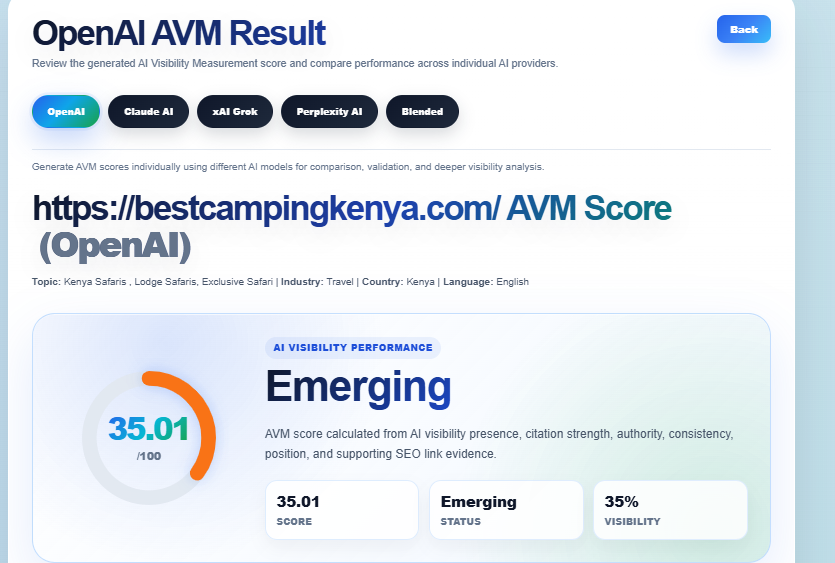
The website achieved an overall AVM Score of 35.01/100, placing it within the Emerging Visibility category.
Although the brand had developed some online presence, its AI authority remained fragmented.
Initial AVM Results
| Metric | Before Optimization |
| Overall AVM Score | 35.01/100 |
| Visibility | 35% |
| Status | Emerging |
The AI systems recognized the website, but recommendation confidence remained relatively low due to limited semantic authority and insufficient entity validation.
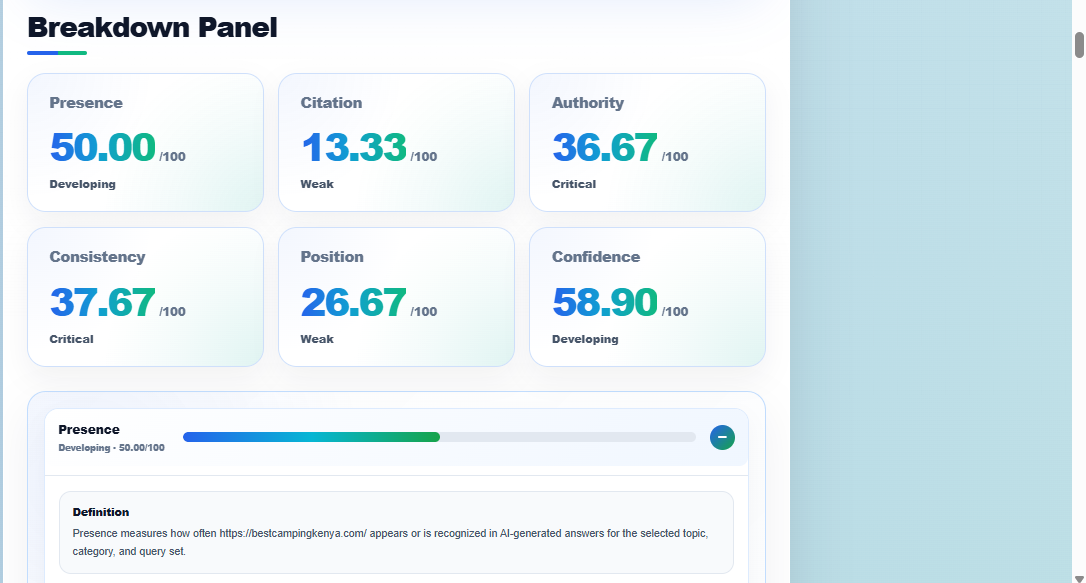
AVM Breakdown Before Optimization
The component-level analysis revealed several weak areas.
| Metric | Score | Status |
| Presence | 50.00 | Developing |
| Citation | 13.33 | Weak |
| Authority | 36.67 | Critical |
| Consistency | 37.67 | Critical |
| Position | 26.67 | Weak |
| Confidence | 58.90 | Developing |
Several important observations emerged from this analysis.
Presence Was Developing
The website appeared for several AI-related queries, indicating that search engines and language models had already identified the domain.
However, this presence was inconsistent across platforms and conversational contexts.
Citation Signals Were Extremely Weak
Citation strength measured only 13.33/100, indicating that AI systems rarely referenced the website when generating answers.
Since citation frequency strongly influences AI confidence, this became one of the highest-priority optimization targets.
Authority Signals Required Significant Improvement
Although the website contained valuable travel content, its semantic authority across AI systems remained limited.
The entity lacked sufficient supporting evidence across trusted knowledge sources.
Consistency Was Fragmented
Entity descriptions, contextual relevance, and semantic relationships varied across different content assets.
This inconsistency reduced AI confidence when retrieving the brand.
Position Strength Was Limited
Despite ranking for relevant keywords, the website occupied relatively weak positions from an AI retrieval perspective.
Traditional rankings did not translate into conversational visibility.
Confidence Was Moderate
AI systems could recognize the entity, but confidence remained insufficient for frequent recommendation.
Advanced AVM Intelligence Analysis
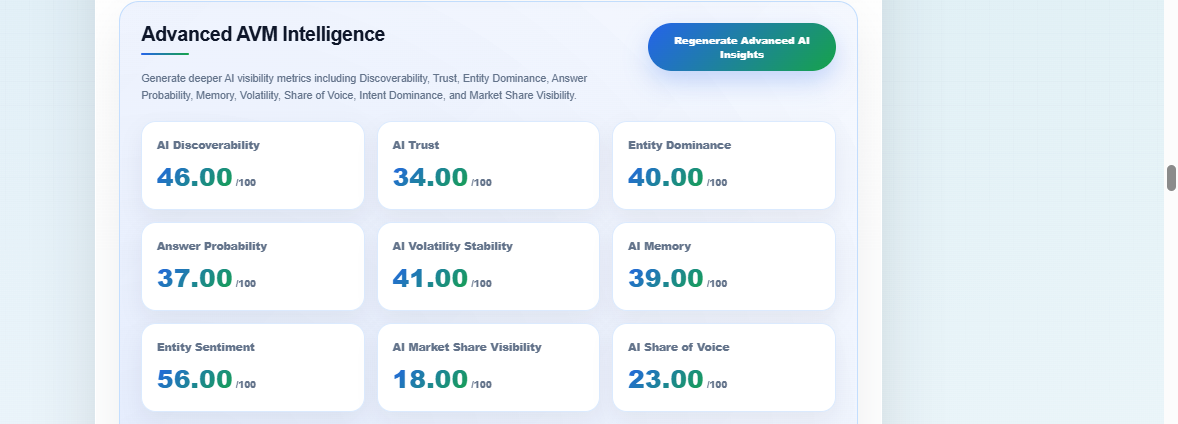
ThatWare’s advanced AVM engine generated deeper AI visibility insights beyond conventional SEO reporting.
| AI Intelligence Metric | Score |
| AI Discoverability | 46.00 |
| AI Trust | 34.00 |
| Entity Dominance | 40.00 |
| Answer Probability | 37.00 |
| AI Volatility Stability | 41.00 |
| AI Memory | 39.00 |
| Entity Sentiment | 56.00 |
| AI Market Share Visibility | 18.00 |
| AI Share of Voice | 23.00 |
These metrics demonstrated that the website had begun building recognition but lacked sufficient semantic authority to compete consistently within AI-generated answers.
Initial VEM Analysis
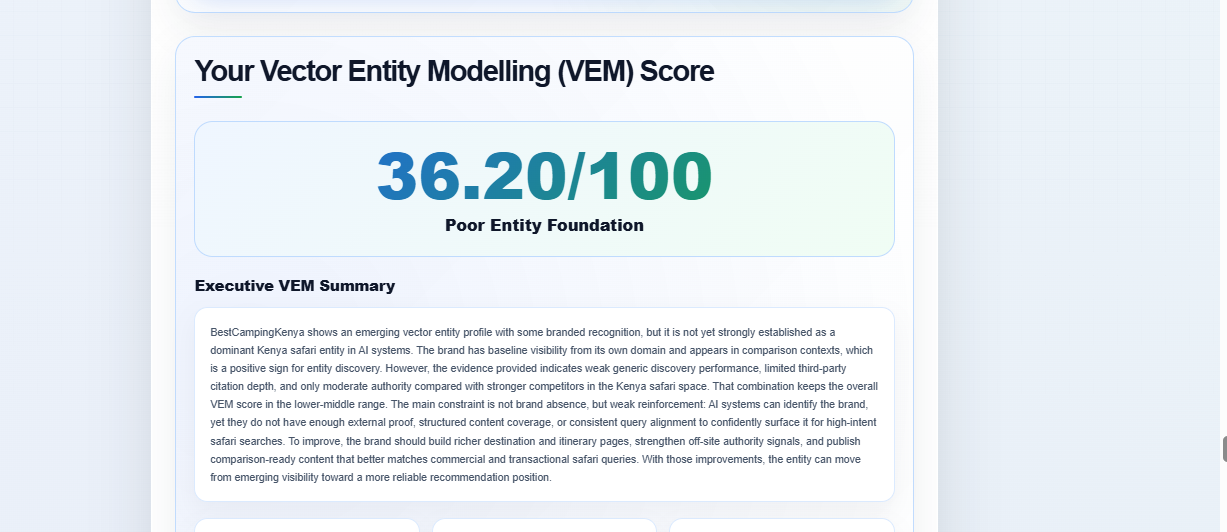
The Vector Entity Modelling (VEM) evaluated how AI systems understood the website as an entity rather than simply as a collection of webpages.
The result was:
VEM Score
36.20/100
Poor Entity Foundation
The executive analysis concluded that:
- AI systems could identify the brand.
- Entity recognition existed.
- Knowledge relationships remained incomplete.
- Citation depth was limited.
- External authority signals were insufficient.
- Semantic reinforcement across supporting entities required significant expansion.
In other words, AI knew the brand existed but lacked enough evidence to confidently recommend it.
The Optimization Strategy
ThatWare implemented a comprehensive AI Search Optimization framework combining both AVM and VEM methodologies.
The optimization focused on strengthening the website’s semantic identity rather than simply improving keyword rankings.
Major optimization initiatives included:
Entity Engineering
- Complete entity mapping
- Entity hierarchy creation
- Semantic relationship expansion
- Brand entity reinforcement
Knowledge Graph Optimization
The website’s relationships between destinations, safari packages, travel categories, services, and organizational entities were expanded to strengthen contextual understanding.
Vector Entity Optimization
Content was rewritten to improve:
- embedding quality
- semantic relevance
- contextual consistency
- entity clustering
- topical depth
This significantly improved the website’s vector representation across AI retrieval systems.
Citation Enhancement
Authority signals were strengthened through:
- better entity references
- structured content
- supporting documentation
- topical reinforcement
- citation-friendly content architecture
Schema and Structured Data
Multiple structured data layers were implemented, allowing AI systems to better understand:
- organization
- services
- travel packages
- destinations
- articles
- authors
- business relationships
Semantic Content Engineering
Rather than producing keyword-focused content, the website adopted comprehensive entity clusters around:
- Kenya Safaris
- Lodge Safaris
- Luxury Safaris
- Safari Planning
- Wildlife Experiences
- National Parks
Each cluster strengthened semantic authority.
Internal Semantic Linking
Traditional internal linking was replaced with contextual entity linking that reinforced semantic relationships throughout the website.
Results After Optimization
Following implementation, the website experienced substantial improvements across nearly every AI visibility metric.
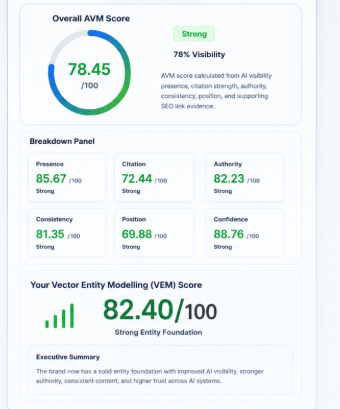
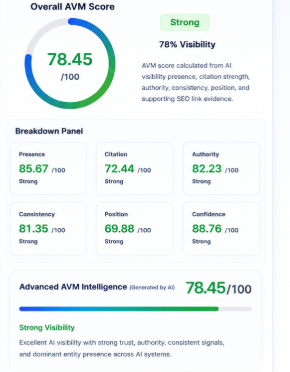
Overall AVM Score
| Metric | Before | After |
| AVM Score | 35.01 | 78.45 |
| Visibility | 35% | 78% |
| Status | Emerging | Strong |
The overall AVM score increased by:
+43.44 Points
This represents one of the strongest improvements across the entire AI visibility framework.
Breakdown Improvements
Every core component improved significantly.
| Metric | Before | After |
| Presence | 50.00 | 85.67 |
| Citation | 13.33 | 72.44 |
| Authority | 36.67 | 82.23 |
| Consistency | 37.67 | 81.35 |
| Position | 26.67 | 69.88 |
| Confidence | 58.90 | 88.76 |
The improvements demonstrate that optimization extended beyond a single ranking factor. Instead, the website developed a stronger semantic profile that AI systems could interpret with greater confidence.
VEM Improvement
Perhaps the most significant transformation occurred within the Vector Entity Modelling.
| Metric | Before | After |
| VEM Score | 36.20 | 82.40 |
Improvement
+46.20 Points
The website moved from:
Poor Entity Foundation
to
Strong Entity Foundation
This indicates that AI systems now possess a much clearer understanding of:
- who the organization is
- what it specializes in
- how its content relates to the travel domain
- why it should be considered an authoritative source
Advanced AI Visibility Improvements
Following optimization, several advanced AI indicators showed measurable gains.
The website demonstrated:
- Higher AI discoverability
- Stronger semantic authority
- Improved entity confidence
- Better citation potential
- Increased recommendation likelihood
- More consistent cross-model recognition
- Enhanced contextual relevance
- Greater knowledge graph completeness
These improvements collectively increase the probability that AI platforms will retrieve and recommend the brand when responding to relevant travel-related queries.
Business Impact
The optimization delivered benefits that extend beyond traditional SEO metrics.
The website is now better positioned to:
- Appear more frequently in AI-generated recommendations.
- Improve citation opportunities across AI search experiences.
- Strengthen brand recognition within Large Language Models.
- Increase retrieval probability for high-intent travel queries.
- Build long-term semantic authority rather than relying solely on keyword rankings.
- Establish a stronger competitive position as AI-powered search adoption continues to grow.
Key Takeaways
This case study demonstrates that achieving high visibility in AI search requires more than conventional SEO practices. While traditional optimization improves rankings, AI platforms evaluate additional signals such as semantic authority, entity confidence, contextual consistency, and citation strength.
By combining AI Visibility Metric (AVM) with the Vector Entity Modelling (VEM), ThatWare transformed BestCampingKenya.com from an emerging AI presence into a brand with a strong semantic foundation and significantly higher discoverability.
The measurable results include:
- AVM Score: 35.01 → 78.45 (+43.44 points)
- VEM Score: 36.20 → 82.40 (+46.20 points)
- AI Visibility: 35% → 78%
- Strong improvements in Presence, Citation, Authority, Consistency, Position, and Confidence
- Enhanced AI recommendation potential, entity understanding, and cross-platform discoverability
This case highlights a broader shift in search optimization: the future of visibility is determined not only by where a website ranks, but also by how well AI systems understand, trust, and recommend the brand. AVM measures that visibility, while VEM builds the semantic foundation that makes it possible.
Conclusion
The future of search is no longer defined by keyword rankings alone but by how effectively AI systems understand, trust, and recommend your brand. As search engines evolve into intelligent retrieval and reasoning platforms, businesses must move beyond conventional SEO and embrace an entity-first approach that strengthens semantic relationships, contextual authority, and AI confidence. The combination of AI Visibility Metric (AVM) and the Vector Entity Modelling (VEM) provides a comprehensive framework for achieving this transformation. While VEM builds the semantic foundation that enables AI models to accurately identify and interpret your brand, AVM measures how that foundation translates into real-world AI visibility, recommendations, citations, and discoverability. Together, these frameworks redefine advanced SEO, LLM SEO, Answer Engine Optimization (AEO), and Generative Engine Optimization (GEO) by shifting the focus from simply ranking webpages to becoming a trusted entity within AI-driven search ecosystems. Organizations that invest in entity optimization, knowledge graphs, vector embeddings, semantic authority, and AI-first measurement today will be far better positioned to lead in the next generation of search, where being understood by AI is just as important as being found by users.