SUPERCHARGE YOUR ONLINE VISIBILITY! CONTACT US AND LET’S ACHIEVE EXCELLENCE TOGETHER!
For years, Google Search Console (GSC) has been the go-to platform for monitoring website performance, indexing, search visibility, and technical SEO. Whether you’re a business owner, marketer, or a professional SEO consultant, GSC has traditionally focused on one core asset—your website. However, Google’s latest update signals that this long-standing approach is beginning to evolve.
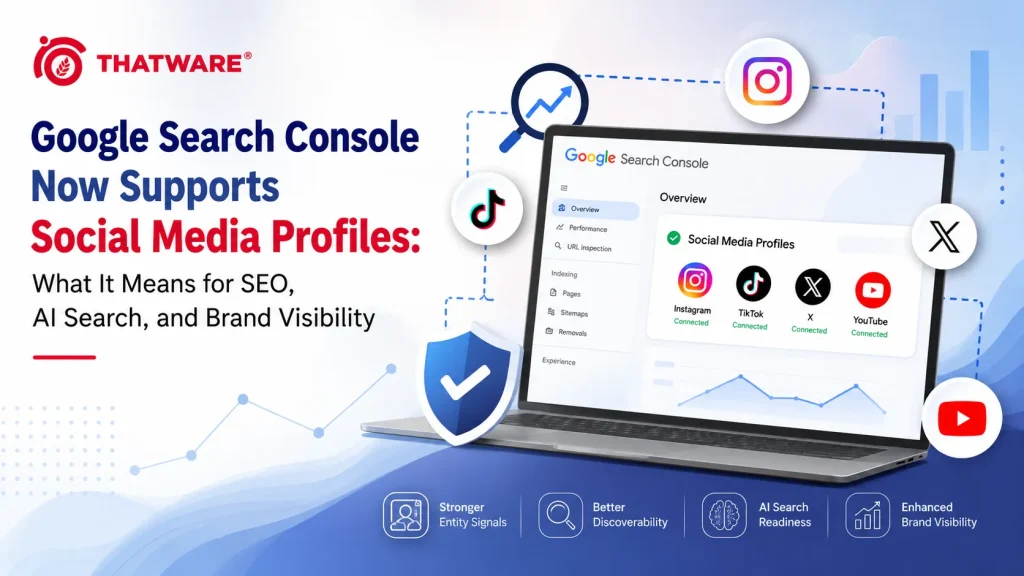
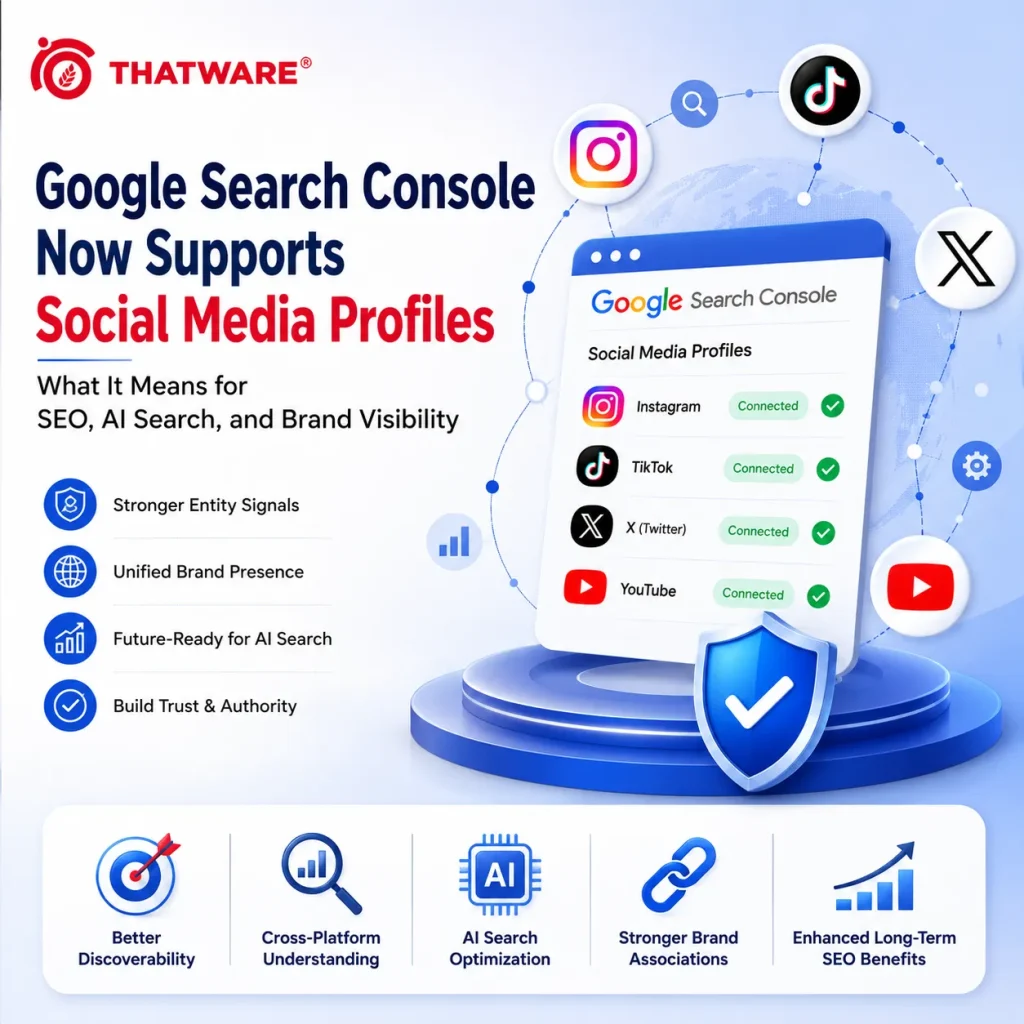
Google has quietly introduced a new capability within Google Search Console that allows verified property owners to add supported social media profiles alongside traditional website properties. At the time of writing, the supported platforms include Instagram, TikTok, X (formerly Twitter), and YouTube. While the feature currently focuses on verifying ownership and linking official social accounts, its significance extends far beyond a simple interface update.
This development reflects a broader transformation in how Google understands digital presence. Search is no longer confined to websites alone. Today, users discover brands through short-form videos, creator content, social communities, YouTube channels, and AI-powered search experiences. Google’s decision to incorporate social profiles into Search Console suggests that it is increasingly recognising a brand’s complete digital footprint rather than evaluating its website in isolation.
The timing of this update is particularly noteworthy. Over the past two years, Google has accelerated its investment in AI-powered search, including AI Overviews and more entity-driven search experiences. At the same time, platforms like ChatGPT, Gemini, Perplexity, and other large language models have changed how users discover information, often drawing insights from multiple trusted sources beyond a company’s website. In this evolving landscape, maintaining a consistent and authoritative presence across social platforms has become just as important as publishing high-quality website content.
For businesses investing in professional SEO services, advanced SEO, and long-term digital growth, this update represents an important strategic shift. It reinforces the idea that effective search optimisation is no longer limited to improving rankings on a single website. Instead, brands must establish credibility across multiple digital touchpoints, ensuring that their website, social media profiles, structured data, and brand entities work together to create a unified online presence.
Although Google has not yet announced additional reporting or analytics for these newly supported social properties, the introduction of this feature strongly suggests that Search Console is evolving into a more comprehensive platform for managing brand visibility. As Google continues to connect websites, social platforms, and AI-driven search experiences, businesses that act early may be better positioned to benefit from future enhancements.
In this article, we’ll explore Google’s new Google Search Console social profile feature in detail, explain how to connect your social media accounts, examine why this update matters for modern SEO and AI search, and discuss what it could mean for the future of SEO intelligence, Search Everywhere Optimization, and omnichannel brand visibility.
Google Has Introduced a New Property Type Inside Google Search Console
Google Search Console has always been designed around websites. Whether you managed a Domain Property or a URL Prefix Property, every feature within the platform—from indexing reports and performance insights to Core Web Vitals and sitemap management—was centred on monitoring and improving a website’s presence in Google Search.
That is beginning to change.
Google has quietly rolled out a new property type that allows verified users to connect their official social media accounts directly within Google Search Console. Alongside the familiar “Add a website” option, users will now see dedicated options for adding supported social platforms, including:
- TikTok
- X (formerly Twitter)
- YouTube
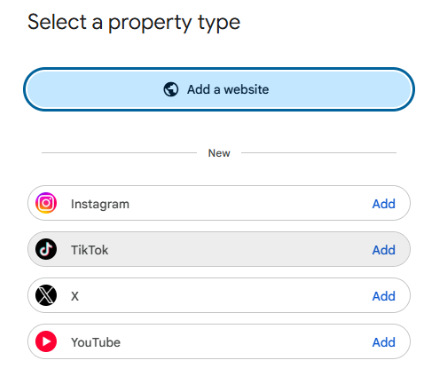
This marks the first time Google Search Console has extended beyond traditional website properties, acknowledging that a brand’s online presence is no longer defined by its website alone.
The update is subtle from a user interface perspective, but its strategic implications are significant. Rather than treating websites as isolated digital assets, Google appears to be moving toward a more connected view of a brand’s online identity—one that encompasses websites, social platforms, video content, and other authoritative digital touchpoints.
From Website-Centric SEO to Entity-Centric Visibility
For years, search optimisation primarily focused on improving website performance. Brands invested in technical SEO, content marketing, backlinks, and user experience to achieve better rankings. While these fundamentals remain essential, Google’s latest move suggests that the search ecosystem is evolving beyond individual webpages.
Today’s search experience increasingly revolves around entities rather than just URLs. An entity can represent a business, organisation, creator, product, or public figure that Google understands through multiple trusted sources across the web. Your official website is one of those signals—but so are your verified social media profiles, YouTube channel, Google Business Profile, structured data, and other authoritative references.
By allowing social media profiles to become recognised properties within Google Search Console, Google is strengthening the relationship between these digital assets and the brands they represent.
Why This Update Is More Than Just a New Feature
At first glance, adding an Instagram or TikTok account to Google Search Console may seem like a simple convenience. However, Google’s history suggests that even seemingly minor Search Console updates often support much larger strategic initiatives.
This feature may serve as the foundation for future capabilities such as:
- Stronger verification of official brand entities.
- Better association between websites and social media profiles.
- Enhanced understanding of cross-platform brand authority.
- More comprehensive SEO intelligence and visibility reporting.
- Deeper integration with AI-powered search experiences.
Although Google has not announced additional reporting features at this stage, the infrastructure being introduced today could enable more sophisticated insights in the future.
A Natural Evolution of Modern SEO
Consumer behaviour has changed dramatically over the past few years. Many users now discover brands through Instagram Reels, TikTok videos, YouTube content, creator recommendations, and AI-generated answers before ever visiting a company’s website.
Recognising this shift, Google is gradually adapting its tools to reflect how people actually search and engage with brands online. Instead of viewing websites as the sole source of authority, Google is acknowledging that trust and relevance are built across multiple platforms.
For businesses working with a professional SEO agency, investing in professional SEO services, or implementing advanced SEO strategies, this update reinforces an important reality: modern search optimisation is no longer limited to ranking webpages. Success increasingly depends on building a consistent, authoritative, and verifiable digital presence across every platform where your audience—and Google’s algorithms—can discover your brand.
What Social Platforms Can Be Added?
With this latest update, Google Search Console now supports four major social media platforms as property types. Instead of limiting verification to websites, Google now enables verified property owners to associate their official social profiles directly with their Search Console account.
Currently, the supported platforms are:
| Platform | Supported | Verification Method |
| ✅ Yes | OAuth Authentication | |
| TikTok | ✅ Yes | OAuth Authentication |
| X (formerly Twitter) | ✅ Yes | OAuth Authentication |
| YouTube | ✅ Yes | Google Account Authentication |
While the verification process differs slightly depending on the platform, the overall goal remains the same—confirming that the Google Search Console user is the legitimate owner or administrator of the corresponding social media account.
Let’s look at each platform individually and understand what it means for businesses and SEO professionals.
Instagram is one of the first platforms supported under Google’s new social property feature. After selecting Instagram as the property type, users are redirected through Meta’s secure authentication process, where they log into their Instagram account and grant Google permission to verify ownership.
Unlike traditional website verification using DNS records or HTML files, Instagram uses OAuth authentication, an industry-standard authorisation protocol that allows Google to confirm ownership without requiring users to share their passwords.
During verification, users are typically asked to:
- Sign in to their Instagram account.
- Complete any required two-factor authentication.
- Review Google’s requested permissions.
- Approve the connection between Google Search Console and Instagram.
Once authorised, the Instagram profile becomes associated with the verified Google Search Console property.
For brands that rely heavily on Instagram for customer engagement, visual marketing, and community building, this integration represents another step toward creating a unified digital identity within Google’s ecosystem.
TikTok
TikTok has rapidly become one of the world’s largest content discovery platforms, influencing consumer behaviour across industries ranging from retail and travel to education and technology. Google’s decision to include TikTok among the first supported social properties reflects the platform’s growing importance in modern search behaviour.
Like Instagram, TikTok verification is completed through OAuth authentication. Users simply log into their TikTok account, authorise Google’s access request, and allow Search Console to verify ownership.
Although Google has not yet introduced TikTok-specific performance reports inside Search Console, connecting an official TikTok account helps establish a stronger relationship between a brand’s website and one of its most influential content channels.
As short-form video continues to shape online discovery, this integration could become increasingly valuable in future AI-powered search experiences.
X (Formerly Twitter)
X remains an important platform for real-time news, industry discussions, public announcements, and thought leadership. Many organisations use X to communicate directly with customers, journalists, and professional communities.
Google Search Console now allows verified owners to add their official X profiles using the same OAuth-based authentication process.
The verification workflow is straightforward:
- Select X from the available property types.
- Sign in to the appropriate X account.
- Review Google’s access request.
- Authorise the connection.
By linking an official X profile, brands can further strengthen their online identity and reinforce the consistency of their digital presence across Google’s ecosystem.
For organisations focused on reputation management, executive branding, or industry authority, ensuring that the official X profile is correctly associated with the website is an increasingly sensible step.
YouTube
Unlike the other supported platforms, YouTube benefits from being part of Google’s own ecosystem. As a result, the verification process is generally more seamless for users whose YouTube channel is already connected to their Google Account.
Instead of relying on third-party OAuth authorisation, Google can authenticate ownership directly through the associated Google Account credentials.
This makes YouTube verification both simple and secure, particularly for businesses already managing their channels through the same Google account used for Search Console.
Given YouTube’s growing role in Google Search results, AI Overviews, and video discovery, connecting an official YouTube channel may become increasingly important for businesses investing in professional SEO services, advanced SEO, and long-term content marketing strategies.
A Common Verification Process Built Around Security
Although each platform has its own authentication workflow, the underlying verification principle is consistent across all supported social networks.
Google uses secure authentication protocols to confirm that:
- You are the legitimate owner or administrator of the social account.
- The account is officially associated with your brand or organisation.
- Permission has been granted directly by the platform through a secure authorisation process.
- Sensitive login credentials are never shared directly with Google Search Console.
This approach provides a safer and more streamlined experience compared to manual verification methods while ensuring that only authorised users can connect official social profiles.
Why These Four Platforms?
The choice of Instagram, TikTok, X, and YouTube is unlikely to be accidental. Together, these platforms represent some of the internet’s most influential channels for content discovery, audience engagement, and brand building.
Each platform contributes a unique type of content and user interaction:
- Instagram excels in visual storytelling, brand awareness, and community engagement.
- TikTok drives viral discovery through short-form video and algorithmic recommendations.
- X facilitates real-time conversations, news, and thought leadership.
- YouTube remains the world’s largest video platform and a key component of Google’s search ecosystem.
By supporting these platforms first, Google is recognising that a brand’s authority is increasingly established through a combination of its website, social presence, video content, and broader digital footprint. While no additional reporting features have been announced yet, this update lays the groundwork for a more connected and entity-driven approach to search visibility in the years ahead.
Why Did Google Introduce Social Profiles into Search Console?
Google has not released an official statement explaining the long-term purpose behind introducing social media profiles as property types in Google Search Console. However, when viewed alongside Google’s broader direction in Search, AI, and entity understanding, this update appears to be far more strategic than a simple user interface enhancement.
For years, Google Search Console has served as the central platform for monitoring website health and search performance. By expanding the platform to include official social media accounts, Google is acknowledging a fundamental shift in how people discover information and how brands establish authority online.
This update reflects several larger trends that have been shaping Google’s search ecosystem for years.
Google Is Moving Beyond Website-Centric SEO
Traditionally, search optimisation focused almost entirely on websites. Businesses invested in technical SEO, keyword optimisation, content creation, link building, and user experience because these elements directly influenced search rankings.
While websites remain the foundation of digital marketing, they are no longer the only place where people interact with brands.
Today’s customer journey often begins somewhere entirely different:
- A TikTok video introducing a product.
- An Instagram Reel showcasing customer experiences.
- A YouTube tutorial explaining a solution.
- An X post discussing industry news.
- An AI-generated answer summarising information from multiple trusted sources.
In many cases, users engage with a brand across several platforms before ever visiting its website.
Google understands this behavioural shift. By allowing official social media profiles to become recognised properties within Google Search Console, the company is expanding its perspective from individual websites to complete digital ecosystems.
For businesses investing in professional SEO services, this reinforces an important reality: visibility is no longer confined to traditional search engine rankings. Brands must now optimise every authoritative touchpoint that contributes to their online presence.
Google Is Strengthening Its Understanding of Entities
One of the biggest changes in Google’s search technology over the past decade has been the transition from keyword matching to entity understanding.
An entity is a uniquely identifiable person, organisation, business, product, place, or concept that Google can recognise independently of individual webpages.
Rather than evaluating a business solely through its website, Google now analyses multiple signals to understand:
- Who the organisation is.
- What products or services it offers.
- Which industries it operates in.
- Which social accounts belong to it.
- How authoritative it appears across the web.
- Whether information about the business is consistent across different platforms.
Every verified digital asset helps Google build a stronger understanding of that entity.
A company’s website is one signal.
Its YouTube channel is another.
Its Instagram profile provides additional context.
Its TikTok account demonstrates audience engagement.
Its X profile contributes to topical authority and brand communication.
Together, these assets create a richer and more reliable picture of the organisation.
By enabling social profile verification inside Google Search Console, Google appears to be making these entity relationships more explicit and easier to validate.
AI Search Requires More Than Website Content
The rise of AI-powered search has fundamentally changed how information is discovered.
Traditional search engines primarily retrieved webpages.
Modern AI systems synthesise information from multiple trusted sources before generating answers.
Whether users interact with:
- Google AI Overviews
- Google AI Mode
- Gemini
- ChatGPT
- Perplexity
- Claude
the underlying systems increasingly evaluate an organisation based on its overall digital footprint rather than a single website.
AI models look for signals such as:
- Official websites
- Verified social profiles
- Video content
- Knowledge Graph information
- Structured data
- Brand mentions
- Publisher authority
- Cross-platform consistency
The stronger these signals become, the easier it is for AI systems to understand the identity and credibility of a business.
Although Google has not confirmed that this new Search Console feature directly influences AI-generated search results, the timing strongly suggests alignment with Google’s broader AI-first strategy.
Google Is Encouraging Brand Identity Verification
Another likely reason behind this update is identity verification.
The internet contains countless unofficial pages, duplicate brand accounts, parody profiles, impersonation attempts, and outdated business information.
For Google’s search systems, distinguishing between official and unofficial accounts is increasingly important.
By allowing property owners to authenticate their social profiles through secure verification methods, Google gains greater confidence that:
- The connected account genuinely belongs to the organisation.
- The website and social profiles represent the same entity.
- Users are interacting with authentic brand assets.
- Search systems have more reliable information for understanding the business.
This benefits both Google and website owners by reducing ambiguity around brand identity.
Consumer Search Behaviour Has Changed
Consumer behaviour has evolved dramatically over the past few years.
Instead of relying exclusively on Google Search, users now search directly within social platforms for recommendations, tutorials, reviews, and product inspiration.
Examples include:
- Searching Instagram for restaurants and travel destinations.
- Using TikTok to discover products.
- Watching YouTube reviews before making purchasing decisions.
- Following industry experts on X for breaking news.
Search has become decentralised.
Rather than competing with these platforms, Google increasingly recognises their importance within the broader discovery ecosystem.
Adding social profiles to Search Console reflects this reality.
Google is adapting its tools to mirror how users actually discover information today.
This Supports Google’s Long-Term Vision of Omnichannel Search
Google’s mission has always been to organise the world’s information.
Today, that information exists across many interconnected platforms rather than a single website.
Modern brands publish content through:
- Websites
- Blogs
- Videos
- Podcasts
- TikTok
- YouTube
- X
- Business Profiles
- Digital publications
Rather than evaluating each platform independently, Google increasingly seeks to understand how these assets relate to one another.
This is where Search Everywhere Optimization (SEO Everywhere) becomes increasingly relevant.
Businesses can no longer focus exclusively on ranking webpages.
Instead, they need a consistent, trustworthy presence wherever their audiences consume content.
Connecting official social profiles within Google Search Console is another step toward supporting this omnichannel approach.
Preparing the Foundation for Future Search Console Capabilities
Google has introduced many Search Console features long before expanding their functionality.
For example, new verification methods, indexing reports, and Core Web Vitals all began as relatively simple features before evolving into comprehensive reporting systems.
The addition of social properties may represent a similar foundational step.
Although no dedicated analytics currently exist for these profiles, future enhancements could potentially include:
- Social profile visibility insights.
- Cross-platform brand association reporting.
- Entity health indicators.
- AI search visibility metrics.
- Integrated video and social discovery reports.
- Enhanced Knowledge Graph validation.
- Multi-platform performance dashboards.
These possibilities remain speculative, and Google has not announced any roadmap. However, introducing social profile verification creates the infrastructure needed for more sophisticated reporting in the future.
A Clear Signal About the Future of SEO
Whether or not Google immediately expands this feature, the message behind the update is clear.
Search is evolving beyond individual webpages.
Brands are increasingly evaluated based on their complete digital presence, including their websites, social media profiles, videos, structured data, and broader entity relationships.
For organisations working with a professional SEO company, implementing advanced SEO strategies, or investing in long-term SEO intelligence, this update serves as an important reminder that search optimisation is no longer confined to website rankings alone.
The future of SEO lies in building a consistent, authoritative, and verifiable brand ecosystem across every digital channel. Google’s decision to bring social profiles into Search Console is another step toward that future, signalling that brand authority will increasingly be measured through interconnected digital assets rather than isolated webpages.
What Does This Mean for SEO?
Google’s decision to bring social media profiles into Google Search Console is more than a platform enhancement—it reflects a broader evolution in how search engines evaluate brands. For years, SEO strategies primarily focused on improving website rankings through technical optimisation, high-quality content, and backlink acquisition. While these fundamentals remain critical, they are no longer sufficient on their own.
Today’s search landscape is increasingly shaped by AI, entity understanding, and cross-platform brand recognition. Google is moving towards evaluating organisations based on their entire digital footprint rather than a single domain. This means businesses must think beyond traditional optimisation and adopt a more holistic approach to digital visibility.
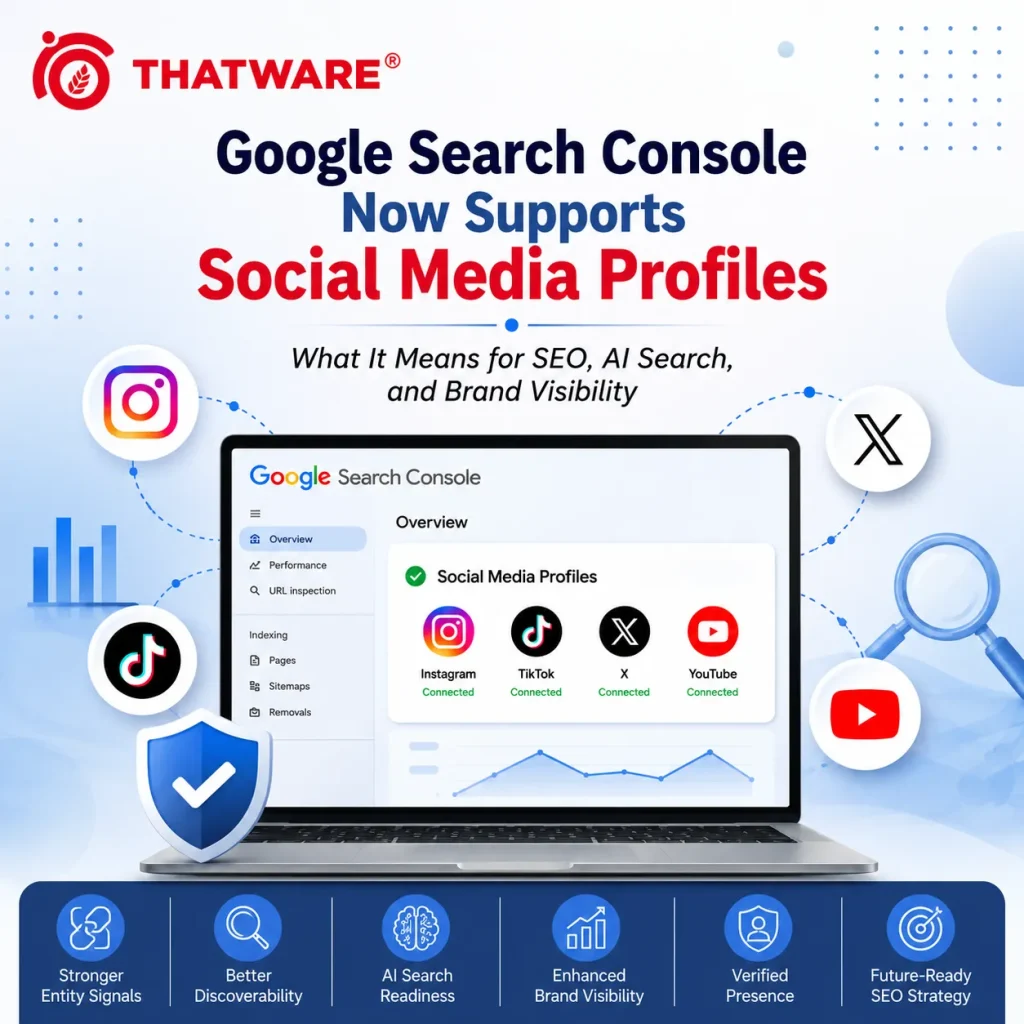
Let’s explore what this shift means for the future of SEO.
Traditional SEO Is No Longer Enough
For decades, SEO success was largely measured by where a website ranked on Google’s search engine results pages (SERPs). Businesses competed for first-page rankings, optimised landing pages around target keywords, and built backlink profiles to improve authority.
Although these practices remain essential, they represent only one piece of a much larger visibility puzzle.
The modern customer journey is no longer linear. A potential customer might first discover your brand through an Instagram Reel, watch a YouTube product demonstration, read discussions about your company on X, receive a recommendation from an AI assistant, and only then visit your website to make a purchase.
In other words, search visibility has expanded far beyond traditional website rankings.
The evolution can be summarised as follows:
Website Rankings
⬇
Brand Visibility Across Search
⬇
Multi-Platform Digital Authority
Google increasingly evaluates how consistently your brand appears across multiple trusted platforms. A website that ranks well but has little social presence, inconsistent branding, or weak entity signals may not appear as authoritative as a business that maintains a strong and unified presence across several digital channels.
For organisations investing in professional SEO services or working with a professional SEO agency, success now requires optimising not only webpages but also the broader ecosystem surrounding the brand.
Modern SEO is becoming less about individual rankings and more about establishing digital authority wherever users—and search engines—encounter your business.
Google Is Connecting Brand Signals
One of the most important developments in modern search is Google’s ability to connect information from multiple sources to build a complete understanding of a business.
Rather than evaluating a website in isolation, Google now considers numerous interconnected signals that collectively define a brand’s identity and authority.
These signals include:
- Your official website
- Verified social media profiles
- Google Business Profile
- YouTube channel
- Structured data (Schema Markup)
- Knowledge Graph information
- Reviews and citations
- Author profiles
- Video content
- Industry mentions and trusted publications
Think of these as pieces of a larger puzzle.
Individually, each signal provides useful information.
Together, they create a comprehensive digital identity that helps Google answer questions such as:
- Is this a legitimate business?
- Which website officially represents this organisation?
- Which Instagram account is authentic?
- Which YouTube channel belongs to this company?
- Is the information consistent across the web?
- Can users trust this brand?
The introduction of social profile properties into Google Search Console strengthens these relationships by allowing verified owners to explicitly connect their official social accounts with Google’s ecosystem.
This supports Google’s long-term goal of reducing ambiguity and improving confidence in its understanding of brands.
For businesses implementing SEO strategy services, maintaining consistency across every digital asset becomes increasingly important.
Your logo, business name, website URL, social handles, contact information, and messaging should all reinforce the same identity.
The stronger these brand signals become, the easier it is for Google’s algorithms to understand who you are and how your digital assets relate to one another.
Entity SEO Becomes Even More Important
Over the past several years, Google has steadily shifted from analysing keywords to understanding entities.
An entity is anything that can be uniquely identified, such as:
- A business
- A person
- A product
- A location
- An organisation
- A service
Unlike keywords, entities exist independently of individual webpages.
Google attempts to understand not only that your business exists but also how it relates to other entities across the internet.
For example, your company may be connected to:
- Its official website
- Social media profiles
- Founders
- Employees
- Products
- Services
- Industry associations
- Customer reviews
- News articles
- YouTube content
- Business directories
These relationships help Google construct an accurate representation of your organisation within its Knowledge Graph.
This is where Entity SEO becomes increasingly valuable.
Instead of simply optimising content around keywords, businesses must optimise their entire digital identity by ensuring:
- Consistent brand names across all platforms.
- Unified logos and visual identity.
- Matching business descriptions.
- Verified official profiles.
- Structured data implementation.
- Reliable citations across trusted sources.
- Strong connections between all digital properties.
Google Search Console’s new social profile feature directly supports this entity-first approach.
By allowing official social accounts to be verified and associated with a brand, Google gains stronger confidence in the relationships between these assets.
For companies investing in advanced SEO, entity optimisation is rapidly becoming just as important as traditional on-page optimisation.
Search Everywhere Optimization Is Becoming Essential
Perhaps the biggest lesson from this update is that search no longer happens exclusively inside Google.
Consumers now search across a wide range of platforms depending on their intent.
Someone looking for inspiration may search Instagram.
A younger audience may begin product research on TikTok.
Professionals may follow conversations on X.
Long-form educational content often starts on YouTube.
Voice assistants answer spoken questions without displaying traditional search results.
AI assistants generate comprehensive responses by combining information from multiple trusted sources.
Search has become distributed across an interconnected ecosystem.
This is why many forward-thinking organisations are adopting Search Everywhere Optimization—an approach that focuses on improving visibility wherever users search, not just on Google’s traditional search results.
An effective Search Everywhere strategy considers visibility across:
- Google Search for organic rankings and AI Overviews.
- YouTube for video discovery and educational content.
- Instagram for visual storytelling and brand engagement.
- TikTok for short-form video discovery.
- X (formerly Twitter) for thought leadership and real-time conversations.
- Voice Search through digital assistants such as Google Assistant and other voice-enabled platforms.
- AI Search experiences including Google AI Mode, AI Overviews, ChatGPT, Gemini, Claude, and Perplexity, where answers are generated from multiple trusted sources rather than a single webpage.
Each platform contributes unique signals that influence how users—and increasingly AI systems—understand your brand.
Businesses that maintain a consistent presence across these channels are better positioned to build authority, reinforce entity relationships, and improve discoverability regardless of where the search begins.
For organisations seeking expert SEO services, this represents a fundamental shift in strategy. SEO is no longer confined to optimising webpages for search engines; it has evolved into the practice of optimising an entire digital ecosystem for people, search engines, AI assistants, and every platform where meaningful discovery takes place.
Google’s latest Search Console update is another indication that this future is already taking shape. Brands that embrace a multi-platform, entity-driven approach today will be better prepared for the next generation of search tomorrow.
Why This Update Matters for AI Search
The introduction of social media properties into Google Search Console is significant not only for traditional SEO but also for the rapidly evolving world of AI-powered search. While Google has not explicitly linked this feature to its AI initiatives, the update aligns remarkably well with the way modern AI systems discover, understand, and present information.
Unlike traditional search engines, which primarily retrieve and rank webpages, today’s AI assistants generate answers by analysing relationships between multiple trusted sources. They attempt to understand not only what information exists but also who is providing it, how authoritative the source is, and whether the information is consistent across the web.
In this new environment, a website is no longer the sole representation of a brand. Instead, AI systems evaluate an organisation through its entire digital presence—including its website, official social media profiles, videos, structured data, and external references.
Google’s latest Search Console update reflects this broader understanding of digital authority.
AI Search Is Built Around Understanding Brands, Not Just Websites
Traditional search engines primarily matched keywords with webpages.
Modern AI search works differently.
When users ask questions in platforms such as:
- ChatGPT
- Google Gemini
- Claude
- Perplexity
- Google AI Overviews
they often receive a single, synthesised answer instead of a list of ten blue links.
To generate those responses, AI systems evaluate information from numerous trusted sources before determining which brands, organisations, or experts deserve to be referenced.
This means AI models are increasingly asking questions such as:
- Is this a legitimate business?
- Does this organisation have an established online presence?
- Are its official social accounts consistent with its website?
- Is the brand recognised across multiple trusted platforms?
- Does independent information support what the company claims?
The stronger and more consistent these signals become, the easier it is for AI systems to understand and confidently reference a business.
This represents a fundamental shift in how digital visibility is earned.
Modern AI Systems Look Beyond Websites
A common misconception is that AI assistants rely exclusively on websites for information.
In reality, modern AI search ecosystems analyse a much broader collection of digital signals to understand brands and entities.
These signals may include:
- Official websites
- Verified social media profiles
- YouTube channels and video content
- Brand mentions across reputable publications
- Community discussions and expert conversations
- Structured data (Schema.org)
- Knowledge Graph entities
- Business directories
- Public documentation
- Author profiles and citations
Rather than treating each source independently, AI models combine these signals to develop confidence in a brand’s identity and authority.
For example, if a company’s website, Instagram profile, YouTube channel, Google Business Profile, and structured data all consistently represent the same organisation, AI systems can establish a much stronger understanding of that business than if only a website existed.
This is one reason why Google’s new Search Console feature is particularly noteworthy—it provides another mechanism for explicitly associating official social profiles with a recognised web presence.
Brand Mentions Are Becoming Powerful Authority Signals
In traditional SEO, backlinks have long been considered one of the strongest indicators of authority.
While backlinks remain important, AI-driven search is increasingly evaluating brand mentions as an additional trust signal.
Mentions across reputable sources help AI systems answer questions such as:
- Is this company recognised within its industry?
- Do independent websites discuss the brand?
- Are experts referencing its products or services?
- Does the organisation have a consistent digital reputation?
These mentions may appear in:
- News articles
- Industry publications
- Podcasts
- Interviews
- Social media discussions
- Online communities
- Educational content
- Research papers
The broader and more credible these references become, the more complete Google’s and AI models’ understanding of the organisation.
This is why building authority today extends well beyond acquiring backlinks—it also involves creating a recognisable and trusted brand across multiple digital environments.
Social Profiles Provide Valuable Context
Social media profiles are no longer viewed simply as marketing channels.
For search engines and AI systems, they provide valuable contextual information about a brand.
Official social accounts help establish:
- Brand authenticity.
- Current business activity.
- Audience engagement.
- Content expertise.
- Industry participation.
- Visual identity.
- Consistent naming conventions.
- Relationships between digital assets.
For example, a verified Instagram account that links to the company’s website, uses the same branding, and publishes consistent content reinforces Google’s understanding that both assets belong to the same entity.
Similarly, an active YouTube channel demonstrates expertise through educational videos, while an X profile may highlight thought leadership and industry engagement.
By allowing these profiles to become recognised properties within Google Search Console, Google is strengthening the connections between these digital assets.
Videos Have Become Core Search Assets
Video content has evolved from being a supplementary marketing asset to becoming a primary source of information across the web.
YouTube remains the world’s largest video platform, while TikTok and Instagram Reels have transformed how people discover products, services, tutorials, and brands.
Many users now prefer watching a short demonstration over reading a lengthy article.
AI systems recognise this behavioural shift.
Video content provides additional signals regarding:
- Subject matter expertise.
- Educational value.
- Audience engagement.
- Brand authority.
- Product demonstrations.
- Real-world experience.
Google has steadily increased the visibility of video content within Search results, AI Overviews, and Discover.
Adding YouTube as one of the first supported social properties inside Search Console reflects the growing importance of video within the broader search ecosystem.
Community Discussions Help AI Understand Trust
Another significant source of information comes from online communities.
Modern AI assistants increasingly analyse discussions across forums, Q&A platforms, and public communities to understand:
- Customer experiences.
- Frequently asked questions.
- Product comparisons.
- Common challenges.
- Industry opinions.
- Brand reputation.
Unlike traditional webpages, community discussions often reveal how real users perceive products and services.
While businesses cannot directly control these conversations, they contribute to the overall digital footprint that AI systems evaluate.
This reinforces the importance of maintaining a positive and authentic presence across every platform where your audience interacts.
Knowledge Graphs and Structured Entities Connect Everything Together
One of Google’s greatest strengths lies in its ability to organise information through the Knowledge Graph.
Instead of viewing websites as isolated documents, Google attempts to understand relationships between entities.
For a business, these relationships might include:
- Official website
- Social media profiles
- Founders
- Products
- Services
- Office locations
- Industry categories
- YouTube channels
- Google Business Profile
- Structured data
- Author profiles
Every verified connection helps Google develop greater confidence in its understanding of the organisation.
Structured data, particularly Organization Schema, already allows websites to specify official social media accounts using properties such as sameAs.
The addition of social profile verification within Google Search Console complements this approach by providing another trusted mechanism for confirming these relationships.
Together, structured data, the Knowledge Graph, and verified digital assets help create a stronger, more complete representation of a brand.
This Update Fits Perfectly into Google’s AI-First Search Strategy
Although Google has not announced any direct relationship between this feature and AI Overviews or future AI search capabilities, the strategic alignment is difficult to ignore.
Over the past few years, Google has consistently invested in technologies that improve its understanding of:
- Entities rather than keywords.
- Brands rather than individual webpages.
- Relationships rather than isolated documents.
- Trust rather than simple popularity.
- Comprehensive digital ecosystems rather than standalone websites.
Adding official social media properties to Google Search Console follows this same trajectory.
It helps Google establish stronger associations between a business’s website and its wider online presence while creating infrastructure that could support future AI-driven reporting, entity validation, or cross-platform visibility insights.
Whether those capabilities arrive next year or several years from now remains uncertain. However, the direction is increasingly clear.
Preparing Your Brand for the Future of AI Search
Businesses that continue to view SEO as purely a website optimisation exercise risk falling behind as search becomes increasingly AI-driven.
Organisations investing in professional SEO services, advanced SEO, and SEO intelligence should now think beyond rankings and consider how their brand is represented across every authoritative platform.
This includes:
- Maintaining an optimised website.
- Verifying official social media profiles.
- Publishing valuable video content.
- Implementing structured data.
- Building Knowledge Graph associations.
- Earning reputable brand mentions.
- Creating consistent brand identities across platforms.
- Strengthening entity relationships wherever possible.
Google’s new Search Console feature is not simply about connecting Instagram, TikTok, X, or YouTube accounts. It represents another step towards an AI-first search ecosystem where digital authority is built through interconnected entities rather than isolated webpages.
How to Add Social Media Profiles to Google Search Console
One of the biggest advantages of Google’s new Google Search Console update is that the setup process is remarkably straightforward. Unlike traditional website verification—which often requires adding DNS records, uploading HTML files, or inserting meta tags—social media profiles are verified using secure account authentication.
Google leverages OAuth authentication, an industry-standard protocol that allows you to securely authorize Google to verify ownership of your social account without ever sharing your password.
The verification process is largely similar across all supported platforms, although each social network has its own authentication interface.
Before you begin, there are a few important requirements to keep in mind.
Before You Start
Make sure that:
- You are the verified Owner of the Google Search Console property.
- You have administrator or owner access to the social media account you want to connect.
- Two-factor authentication (2FA), if enabled, is available during the verification process.
- You are signed into the correct Google account associated with your Search Console property.
Once these prerequisites are met, you can begin linking your social media accounts.
Step 1: Open Google Search Console and Add a New Property
Sign in to your Google Search Console account using the Google account that owns your website property.
In the upper-left corner of the dashboard, click on the Property Selector. This displays all existing Search Console properties associated with your account.
At the bottom of the dropdown menu, click “Add Property.”
Unlike previous versions of Search Console, you’ll now notice a brand-new option.
Instead of only displaying Add a Website, Google now offers dedicated options for supported social media platforms, including:
- TikTok
- X (formerly Twitter)
- YouTube
This is the first indication that Google is expanding Search Console from a website management platform into a broader digital property management platform.
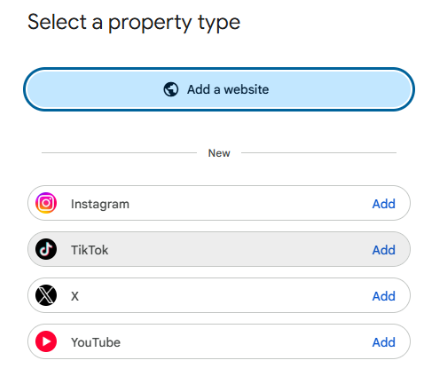
After clicking Add Property, Google presents a dedicated selection screen where you can choose the platform you wish to connect.
Each platform follows a secure verification workflow.
Adding an Instagram Profile
Instagram is currently one of the first supported social platforms inside Google Search Console.
The verification process relies on Meta’s secure authentication system to verify that you own the Instagram account.
Step 2: Select Instagram
From the available property types, click Add next to Instagram.
Google immediately begins the authentication workflow by redirecting you to Google’s secure authorization page.
Unlike website verification, there is no need to upload verification files or modify your website.
Instead, ownership is confirmed directly through your Instagram account.
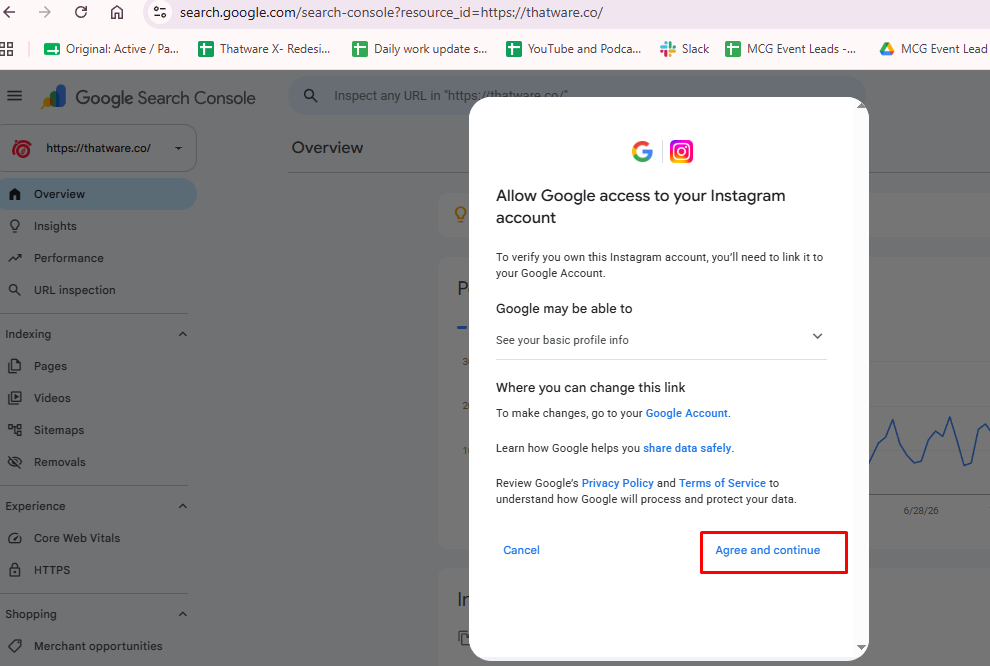
Step 3: Sign In to Instagram
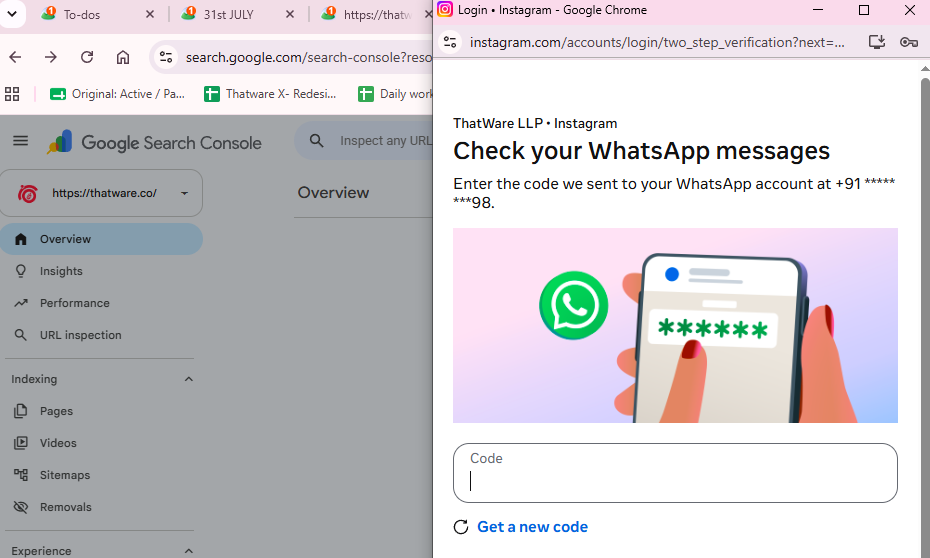
After continuing, Instagram opens its official authentication page.
If you are not already signed in, you’ll be asked to enter your Instagram credentials.
Depending on your account security settings, Instagram may also request:
- Two-factor authentication
- WhatsApp verification
- SMS verification
- Email verification
- Authentication app verification
This additional verification helps protect your account while confirming that you are the legitimate owner.
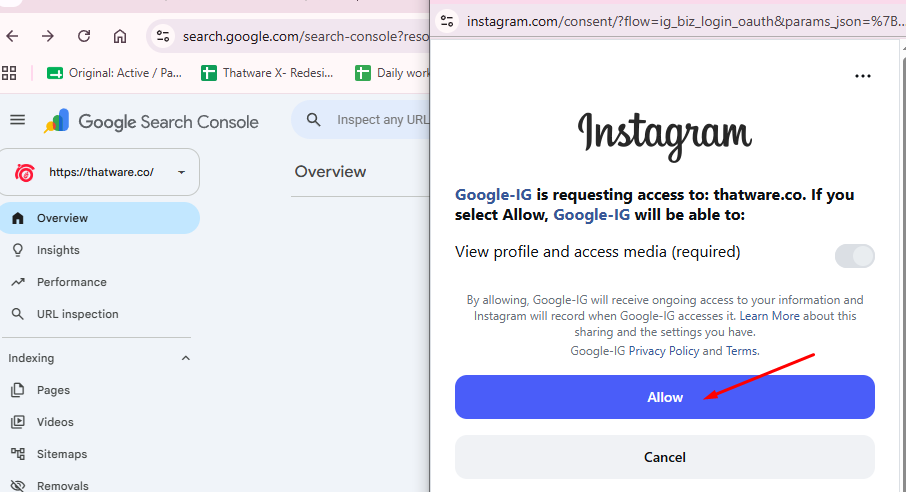
Step 4: Grant Google Permission
Once your identity has been confirmed, Instagram presents a final authorization screen.
Here you’ll see exactly what Google is requesting.
Typically, Google only requests basic profile information necessary to verify ownership.
Review the permissions carefully and click Allow.
Once approved, Google links the Instagram account to your Search Console property.
Adding a TikTok Account
TikTok follows a verification process very similar to Instagram.
Google again uses OAuth authentication rather than traditional verification methods.
This ensures your account remains secure throughout the process.
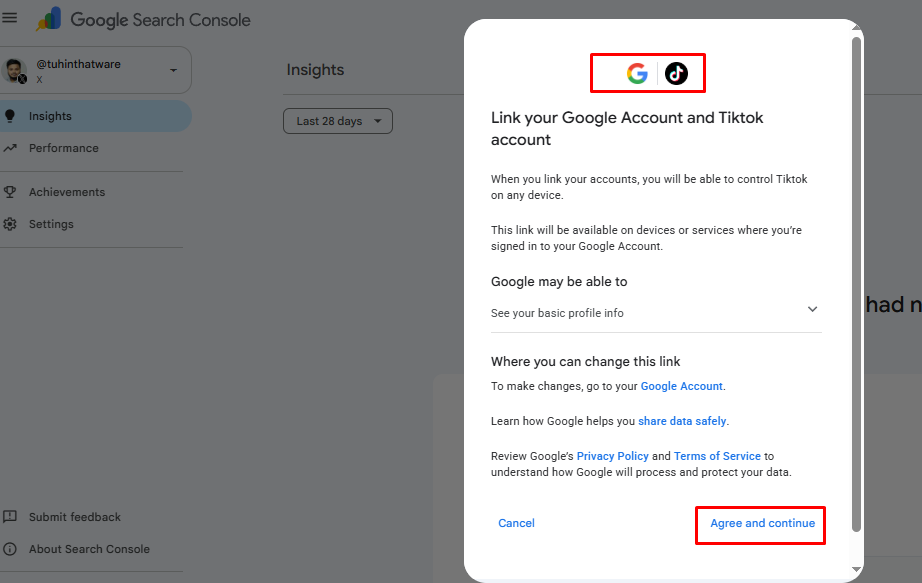
Step 5: Connect Your TikTok Account
Select TikTok from the available property list.
Google displays an authorization screen explaining why account access is required.
Review the requested permissions and click Agree and Continue.
If you are not already logged into TikTok, you’ll be redirected to the official TikTok login page.
After authenticating your account, TikTok will ask whether you wish to authorize Google to access the basic profile information required for verification.
Once approved, your TikTok profile is connected automatically.
Adding an X (Formerly Twitter) Account
Businesses that actively communicate through X can also associate their official profile with Google Search Console.
Like Instagram and TikTok, X uses OAuth authentication to verify account ownership.
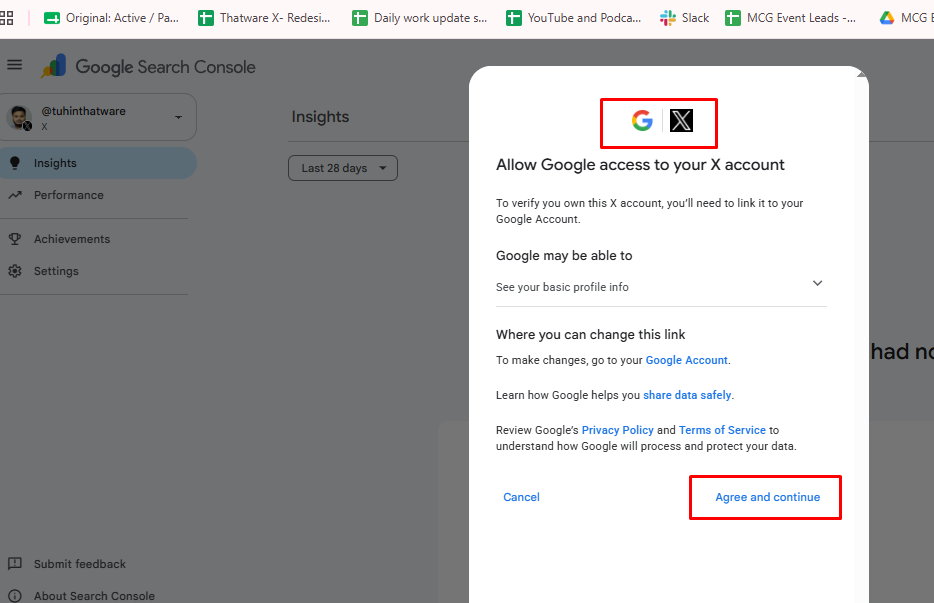
Step 6: Start the X Verification Process
Select X from the available social property options.
Google first displays an authorization page explaining that it requires permission to verify your X account.
Review the information and click Agree and Continue.
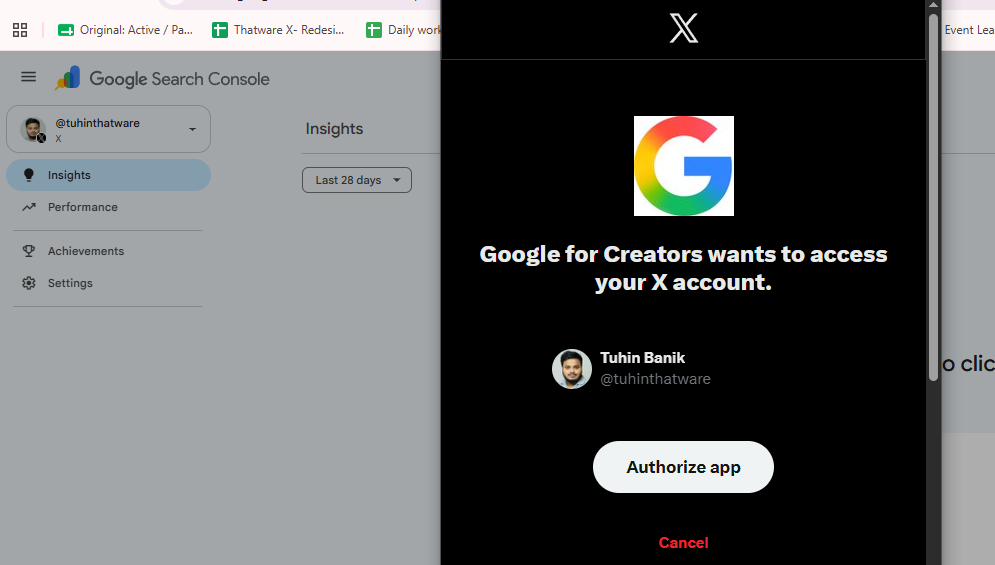
Step 7: Authorize Google on X
You will now be redirected to X’s official authorization page.
If necessary, log into your X account.
Google will request permission to access the minimum information required to verify ownership.
Simply click Authorize App.
Once approved, Google automatically completes the verification process.
No manual verification codes or website modifications are required.
Adding a YouTube Channel
The YouTube verification process differs slightly because YouTube already belongs to Google’s ecosystem.
Instead of using OAuth authentication, Google simply asks you to choose one of the YouTube channels associated with your Google account.
This makes YouTube the fastest platform to configure.
Step 8: Select Your YouTube Channel
Choose YouTube from the available property options.
A dialogue box displays every YouTube channel connected to your Google account.
Simply select the channel you wish to connect.
If your Google account manages multiple channels, make sure you choose the correct one.
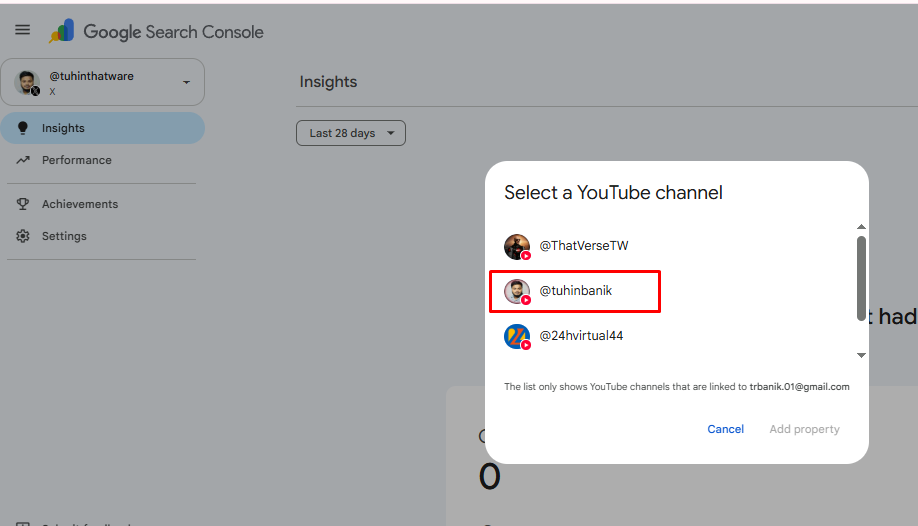
Step 9: Add the Property
After selecting your preferred channel, click Add Property.
Google immediately creates a dedicated Search Console property for that YouTube channel.
Unlike other platforms, no additional login or authorization is generally required because your Google account already owns the selected channel.
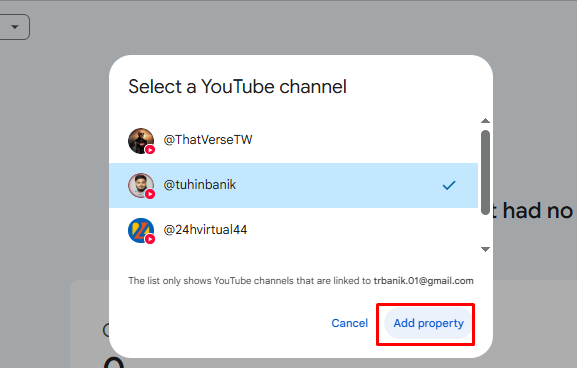
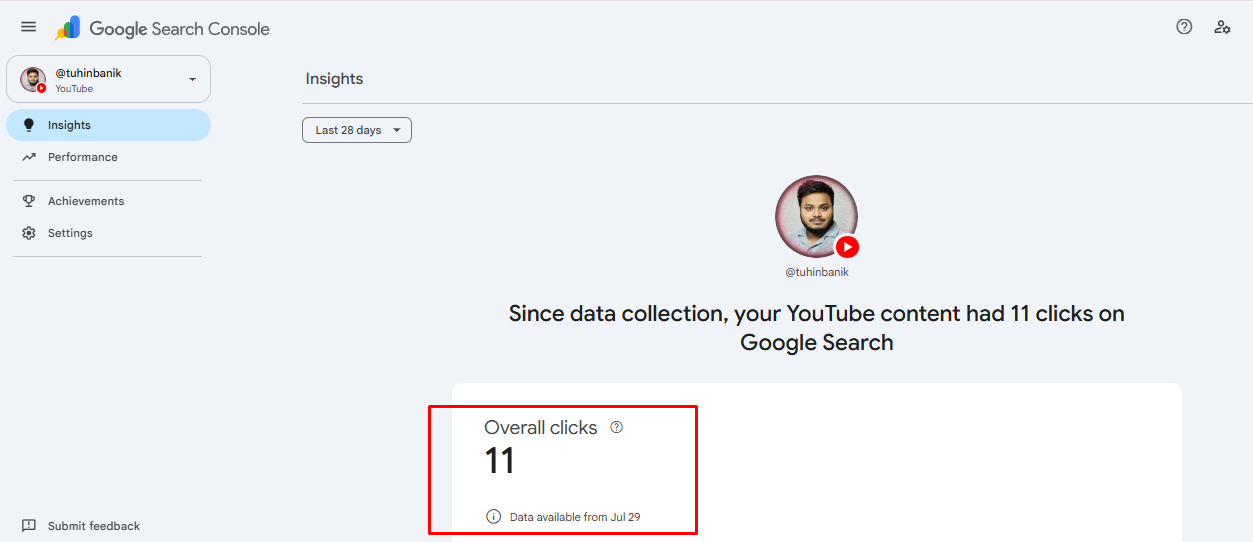
Step 10: Access Your YouTube Search Console Dashboard
Once verification is complete, the YouTube channel appears as an independent property inside Google Search Console.
Unlike Instagram, TikTok, and X—which currently focus on ownership verification—YouTube already includes its own Search Console dashboard with search performance insights.
Depending on your channel activity, you may see metrics such as:
- Overall Google Search clicks
- Search performance summaries
- Date-based reporting
- Search visibility trends
- Performance over selected time periods
This suggests that Google may eventually introduce similar reporting capabilities for the other supported social platforms as the feature evolves.
What Happens After You Connect a Social Profile?
Once verification is complete, your social profile becomes an official property within your Google Search Console account. You can switch between your website and connected social properties using the same property selector, making it easier to manage multiple digital assets from a single interface.
At the time of writing, Instagram, TikTok, and X primarily serve as verified social properties and do not yet provide detailed Search Console performance reports. YouTube, however, already offers search performance data, giving a glimpse of how Google may expand functionality across additional platforms in the future.
Although the feature is still in its early stages, connecting your official social accounts establishes a stronger relationship between your website, your brand, and Google’s understanding of your digital identity. As Search evolves toward entity-based indexing and AI-driven discovery, these verified connections are likely to become increasingly valuable as part of a comprehensive SEO and brand visibility strategy.
Who Can Add Social Profiles in Google Search Console?
Although the option to add social media profiles is visible within Google Search Console, not every user with access to a property can complete the verification process. Google has implemented this feature with security in mind, ensuring that only authorised individuals can associate official social accounts with a website or brand.
Property Owner
A Property Owner has the highest level of access within Google Search Console. Owners can add and remove properties, manage permissions, change verification methods, and now connect supported social media profiles.
If you created the Search Console property or verified ownership through DNS, HTML, or another supported verification method, you can connect Instagram, TikTok, X, and YouTube directly from your dashboard.
Verified Owner
A Verified Owner is someone whose ownership has been confirmed through Google’s verification process. Multiple verified owners can exist for the same property, making it easier for organisations with several administrators or agency partners to manage their Search Console account.
Verified Owners have the authority to authenticate social profiles because they represent trusted administrators of the property.
Delegated Users
Delegated users—including Full Users and Restricted Users—can typically access reports, monitor search performance, and analyse data. However, they cannot verify ownership or connect new social media properties.
This restriction helps prevent unauthorised users from linking personal or incorrect social accounts to an official business property.
Key Takeaway: Only Property Owners and Verified Owners can complete the verification process for supported social media profiles. If you don’t see the option to add social properties, first confirm that your Google account has Owner-level access.
What Data Can You See Right Now?
Since this feature has only recently been introduced, many users naturally expect to see detailed analytics similar to those available for website properties. At the moment, however, Google has kept the functionality relatively limited.
For Instagram, TikTok, and X, the primary purpose is ownership verification and account association. Once connected, these profiles become recognised properties within Google Search Console, but they currently do not provide the comprehensive reporting available for websites.
As of now, you should not expect reports such as:
- Organic clicks
- Search impressions
- Average position
- Search queries
- Traffic trends
- URL indexing status
- Core Web Vitals
- Crawl statistics
The exception is YouTube. Since YouTube is part of Google’s ecosystem, verified YouTube properties already display basic Search Console insights, including search clicks generated from Google Search. This demonstrates that Google is capable of providing platform-specific reporting and may expand similar capabilities to other social platforms over time.
Although today’s reporting is limited, this feature should be viewed as foundational infrastructure rather than a finished product. Google often introduces verification systems first and gradually expands reporting capabilities in later updates. The existence of dedicated social properties suggests that Google is preparing Search Console for broader cross-platform visibility insights in the future.
What Future Features Could Google Introduce?
Google has not announced a roadmap for social media properties, so anything beyond the current functionality remains speculative. However, based on Google’s broader direction in AI, entity-based search, and Search Console development, several enhancements seem plausible.
Future reporting could potentially include:
- Social Search Impressions: Visibility of social profiles within Google Search.
- Cross-Platform Performance: Combined reporting for websites and connected social properties.
- Entity Authority Signals: Insights into how strongly Google associates your website with verified social accounts.
- Brand Engagement Metrics: Discovery trends across different Google surfaces.
- Video Visibility Reports: Enhanced reporting for YouTube and potentially short-form video platforms.
- AI Citation Frequency: Insights into how frequently your brand appears in AI-generated search experiences.
- Creator Analytics: Performance reporting for verified creator accounts.
- Knowledge Graph Validation: Better visibility into entity associations and official profile recognition.
It is important to emphasise that none of these features have been confirmed by Google. They represent logical possibilities based on Google’s increasing focus on AI, entity understanding, and integrated search experiences.
Why Businesses Should Connect Their Social Profiles Now
Even though reporting is currently limited, there are several compelling reasons to connect your official social profiles today rather than waiting for future updates.
Strengthen Brand Consistency
Connecting official social profiles helps reinforce a unified digital identity. When your website, Instagram, YouTube, TikTok, and X accounts all represent the same organisation, Google gains greater confidence in understanding your brand.
Prepare for Future Features
Many Google products begin with simple verification before evolving into powerful reporting tools. Early adopters are often well-positioned to benefit as new capabilities become available.
Improve Entity Association
Google increasingly relies on entities rather than isolated webpages. Linking verified social accounts strengthens the relationship between your website and your broader digital presence.
Build Trust
Officially verified digital assets help distinguish authentic business profiles from duplicate, inactive, or impersonation accounts. This contributes to stronger brand trust across Google’s ecosystem.
Support AI Visibility
Modern AI systems analyse information from multiple trusted sources, including official social profiles. Maintaining verified, consistent accounts across platforms can help reinforce your brand’s authority as AI-driven search continues to evolve.
Best Practices for Connecting Social Profiles
Simply connecting a social profile is only the first step. To maximise the value of this feature, businesses should maintain consistency across every digital touchpoint.
Follow these best practices:
- Use the same brand name across your website and all social platforms.
- Maintain a consistent logo and visual identity to reinforce recognition.
- Choose similar usernames or handles wherever possible.
- Verify official social accounts when verification options are available.
- Use consistent business descriptions and messaging across profiles.
- Link your website from every social profile and link your social profiles from your website.
- Implement Organization Schema using the sameAs property to reference official social accounts.
- Strengthen your Knowledge Graph presence through structured data, authoritative citations, and consistent entity information.
- Keep profiles active by publishing valuable, up-to-date content rather than leaving accounts dormant.
- Regularly audit your digital presence to ensure branding, contact information, and profile details remain consistent across every platform.
How This Fits into Advanced SEO Strategies
Modern SEO has evolved far beyond keyword optimisation. Today’s advanced SEO strategies combine technical excellence, semantic understanding, entity optimisation, and AI readiness into a unified approach.
Connecting social media profiles aligns with several advanced disciplines, including:
- Entity SEO, by strengthening relationships between your website and official brand assets.
- Brand SEO, by helping Google identify authoritative representations of your organisation.
- Semantic SEO, by reinforcing contextual signals across multiple digital properties.
- Knowledge Graph SEO, through better entity validation and structured relationships.
- AI Optimisation and LLM Optimisation, by improving the consistency of information that AI systems use to understand brands.
- Search Everywhere Optimization, by ensuring visibility across websites, social platforms, video platforms, and AI-powered search experiences.
For businesses working with an advanced SEO company, implementing SEO intelligence, SEO strategy services, and advanced algorithm SEO solutions, this update is another reminder that successful optimisation now extends well beyond individual webpages.
How Professional SEO Agencies Should Respond
For every professional SEO company, professional SEO agency, or SEO services company, this update represents an opportunity to expand client strategies beyond traditional website optimisation.
Agencies should begin incorporating the following into their SEO audits:
- Review all official social profiles for consistency.
- Audit Knowledge Graph and entity associations.
- Ensure NAP (Name, Address, Phone) consistency where applicable.
- Verify Organization Schema and sameAs implementation.
- Strengthen cross-platform brand authority.
- Monitor brand mentions across trusted websites.
- Include AI Search optimisation alongside traditional SEO campaigns.
As professional SEO consultants and professional SEO experts increasingly help businesses prepare for AI-driven search, connected social properties should become another standard component of comprehensive managed SEO services.
Common Mistakes to Avoid
Businesses should also avoid several common pitfalls when connecting social profiles:
- Linking inactive or abandoned accounts.
- Using different usernames across platforms.
- Inconsistent logos or branding.
- Incomplete profile descriptions.
- Forgetting to link back to the official website.
- Leaving accounts unverified where verification is available.
- Ignoring structured data and Organization Schema.
- Treating social media as separate from SEO rather than part of an integrated digital strategy.
Expert Perspective: This Is More Than a Feature—It’s a Signal
Google rarely introduces new Search Console capabilities without a broader strategic purpose. While the company has not confirmed future reporting or ranking implications, this update aligns closely with its long-term direction toward AI-first search, entity-first understanding, and cross-platform brand evaluation.
Rather than viewing websites as isolated assets, Google increasingly understands organisations through interconnected digital signals—including websites, social profiles, videos, structured data, and Knowledge Graph relationships.
The addition of social properties to Google Search Console should therefore be seen not simply as a new feature, but as an indication of where search is heading. Businesses that establish a consistent, verifiable, and authoritative presence across the entire digital ecosystem will be better positioned as search continues to evolve beyond traditional rankings and toward AI-powered, entity-driven discovery.
Conclusion
Google’s introduction of social media properties in Google Search Console may appear to be a modest update, but it reflects a much larger transformation in how search engines understand brands and digital authority. As search evolves beyond traditional webpages toward AI-driven, entity-based, and omnichannel discovery, businesses can no longer rely solely on website optimisation to remain competitive. Instead, success will increasingly depend on building a consistent, trustworthy, and interconnected digital presence across websites, social media platforms, video channels, structured data, and other authoritative online assets. While the current functionality is primarily focused on ownership verification, it lays the groundwork for future innovations in AI Search, Search Everywhere Optimization, and cross-platform visibility reporting. By connecting official social profiles today and adopting a comprehensive advanced SEO strategy that integrates Entity SEO, Knowledge Graph optimisation, and professional SEO services, businesses can strengthen their brand authority, improve their digital identity, and position themselves for the next generation of search.