
SUPERCHARGE YOUR ONLINE VISIBILITY! CONTACT US AND LET’S ACHIEVE EXCELLENCE TOGETHER!
SEO relies on accurate data. Whether you’re tracking keyword ranks, researching your competitors, or simply gathering information that’s available in the public domain, the data behind your findings is only as useful as your findings. This is why many SEO professionals use a VPN.
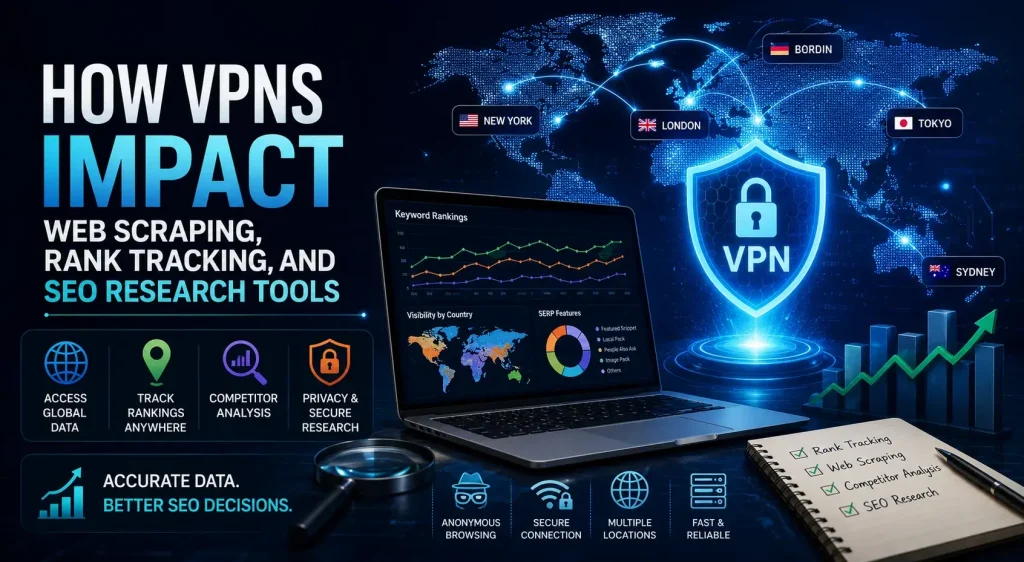
VPNs are commonly used for online privacy protection, but they’re also beneficial in digital marketing.VPNs can allow you to surf the web from anywhere in the world, access localized search results and see if websites are available in different countries. Cybernews lists such features in its VPN reviews, showing that the right VPN can give you the security and research boost you need.
This article explores the use of VPNs for web scraping, ranking research, and SEO research.
Why VPNs Matter for SEO Research
VPN is a service that encrypts your connection and sends it through a server in a different country. Websites and search engines are then directed to the VPN server’s IP address, not your own.
For SEO professionals, this provides several benefits:
- View search results from different countries or cities
- Compare rankings across multiple locations
- Access region-specific content
- Protect sensitive client or business information
- Work safely using public Wi-Fi
Google explicitly notes that search results are customized to a user’s region and that location is a critical factor in how results are ranked and displayed. Results can therefore vary depending on where a search begins, even for the same query, which is why many SEO teams treat location testing as an essential part of serious SEO research.
How VPNs Support Web Scraping
Web scraping refers to gathering public data from websites.SEO teams might use this data to view competitors’ activity, compare prices, find content opportunities, or analyze search engine results pages (SERPs). There are some situations where the website may observe unusual traffic. If many requests come from the same IP address within a short time frame, the website might give CAPTCHAs, respond slowly, or block access.
A VPN removes this risk by allowing researchers to connect from different server locations. It does not remove every restriction, but it does allow researchers to collect data from multiple regions.
Equally important, scraping should be done responsibly. OWASP treats scraping as an automated threat because tools can rapidly crawl and copy large amounts of data, which can strain applications and misuse legitimate functionality, so responsible teams keep request rates reasonable and design scrapers that avoid overloading websites or degrading service for other users.
Common Benefits During Web Scraping
| Challenge | How a VPN Helps |
| IP-based restrictions | Changes your visible IP address |
| Geo-restricted content | Lets you access content available in other regions |
| Privacy concerns | Encrypts internet traffic |
| Public network security | Protects your connection on shared Wi-Fi |
How VPNs Improve Rank Tracking
Keywords aren’t always the same in different countries. Someone searching for “best coffee shop” in London may find results completely different to those it might turn up in New York or Sydney.
This makes rank tracking difficult when only searching from your location.
VPN allows you to change regions and view search results from your target market. With this, you get an idea of how well your website does internationally and can verify the data collected by rank tracking software.
For businesses that serve multiple countries, this information can reveal ranking opportunities that may have been missed.
The Importance of VPNs for Local SEO
Local SEO is heavily influenced by location. There are various signals that Google considers when deciding which businesses to display, such as the user’s location, nearby businesses, search intent, and the relevance of local listings.
Using a VPN also allows you to access results from multiple cities or countries without leaving your office, allowing SEO experts to:
- View the local keyword rankings of your competitors in your market
- Test your local landing page
- Check out your local SERP features.
While VPNs improve location testing, they will not be able to reproduce every local search because Google may use the device settings, account history and other personalization signals.
Using VPNs for Competitor Analysis
Many businesses feature different content depending on where their visitors are located. Product prices, promotions, languages and even the look and feel of the site can differ depending on where they are located.
A VPN enables SEO professionals to compare these regional differences more easily. Businesses can see how competitors adapt their websites to different audiences and identify opportunities for improving their own international SEO tactics.
These are especially valuable to companies looking to expand into new markets and/or create localized content.
How VPNs Complement SEO Research Tools
Though SEO tools can provide valuable information, there will be times when it is necessary to perform manual verification. For example, you may want to check whether your keyword ranking reflects what users in another country see.
SEO tools can be benefited from using a VPN to:
- Check localized search results.
- Test international redirects.
- Review country-specific landing pages.
- Validate keyword rankings.
- Compare search engine features across regions.
Using both a VPN and professional SEO software provides a more complete picture of your website’s performance.
Choosing a VPN for SEO Work
Not every VPN will provide the same experience. If you research SEO for your work, consider the following features:
- A large network of global servers
- Fast and reliable connection speeds
- Strong encryption and privacy protection
- Stable performance during long research sessions
- Support for multiple devices
If you want to compare the options available, Cybernews can tell you more about NordVPN plans, including pricing, features, and subscription options to help you figure out whether it meets your research needs. Its fast servers and broad global coverage make NordVPN useful for international SEO research.
Best Practices for Using VPNs in SEO
Bypassing servers on your VPN is not enough. Follow these simple tips for better performance and reduced downtime with your SEO research.
Choose the Right Server Location
Connect to a server in the area you want to study. This gives you search results that match what local users see and helps you compare rankings in different places.
Reduce Personalized Search Results
Search engines change results based on your browsing history. Try clearing your browser’s cookies. or you can just use an incognito window before checking for rankings.
Scrape Websites Responsibly
Even if you are using a VPN, try not to send excessive automated requests. Responsible scraping saves your site from slow loading times and the possibility of CAPTCHAs or temporary IP blocking. Following the terms of service of the website and sending reasonable request rates also supports ethical data collection.
Combine VPNs with SEO Platforms
A VPN works best with trusted SEO tools. Use it with keyword research software, rank trackers, and website audit tools to check your findings and understand your site’s performance better.
Understanding the Limitations of VPNs
VPNs have a lot of benefits, but they are not an ideal solution to SEO research.
They cannot:
- Forget CAPTCHA requests
- Override all IP restriction or web scraping restrictions
- Forget SEO software
- Forget search engine personalization
Instead, consider a VPN as part of a bigger set of SEO tools. Use it with your research and software for the best results.
Conclusion
VPNs have become vital tools for SEO professionals who need accurate, location-based insight: they improve ranking tracking, enable web scraping responsibly, increase competitor analysis, and allow marketers to analyze search results from multiple locations.
But, the best use of a VPN is when it’s used in conjunction with ethical research and professional SEO tools. By understanding what makes VPNs effective and what doesn’t, companies can gather more data and make better SEO decisions in a personalized world of search results.