SUPERCHARGE YOUR ONLINE VISIBILITY! CONTACT US AND LET’S ACHIEVE EXCELLENCE TOGETHER!
Artificial Intelligence is rapidly transforming how buyers discover, evaluate, and select vendors online. Large Language Models (LLMs) such as ChatGPT, Gemini, Claude, and Perplexity increasingly influence purchasing decisions by recommending brands, summarising service providers, and comparing vendors across industries. As a result, traditional search visibility alone is no longer sufficient. Businesses must also establish strong AI visibility, entity authority, and citation trust to remain competitive in generative search environments.
This report evaluates ExhibitPeople’s performance through two advanced frameworks: AI Visibility Metrics (AVM) and Vector Entity Modelling (VEM). Together, these frameworks measure how effectively AI systems can discover, understand, trust, remember, cite, and recommend the brand for trade show booth rental, trade show counter, and custom trade show display rental queries within the United States market.
The analysis examines ExhibitPeople’s visibility across key AI recommendation signals, including presence, authority, citation depth, entity strength, trust indicators, competitive positioning, and generative search readiness. It also benchmarks the brand against leading competitors such as Skyline, Exponents, and Classic Exhibits to identify gaps and opportunities for improvement.
The objective of this report is to provide a clear roadmap for strengthening ExhibitPeople’s AI search performance, increasing recommendation probability, improving share of voice, and building a stronger semantic footprint across modern AI-powered discovery platforms.
AI Visibility Metrics (AVM) Report
Topic: trade show booth rental, Trade show counter, custom trade show display rentals | Industry: trade show booth rental | Country: USA | Language: English
| Overall AVM Score | Status | Visibility | Priority |
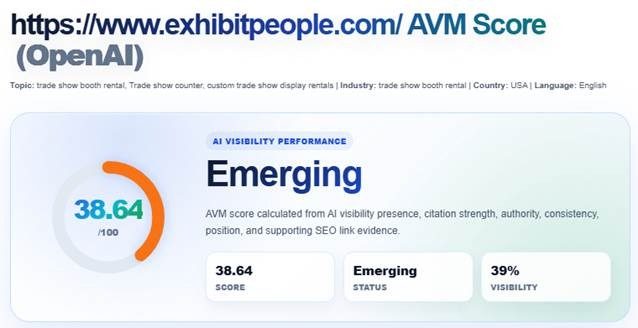
| 38.64 /100 | Emerging | 39% | High – improve citations, comparison depth, and buyer-intent proof |
Source screenshot: AVM dashboard overview for ExhibitPeople
1. Executive Summary
ExhibitPeople currently has an AVM score of 38.64/100, placing it in the Emerging category with 39% visibility. This indicates that AI systems can identify the brand in some trade show booth rental, counter, and custom display rental contexts, but the brand is not yet trusted or recommended at a category-leading level.
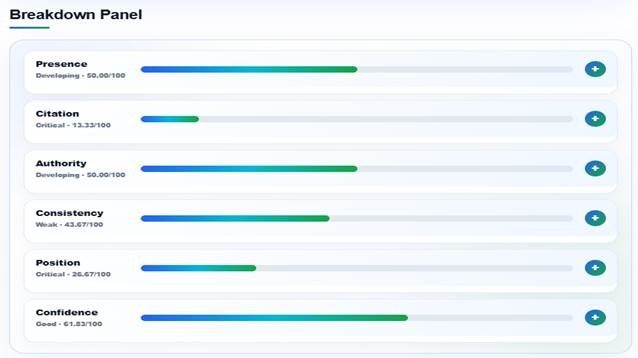
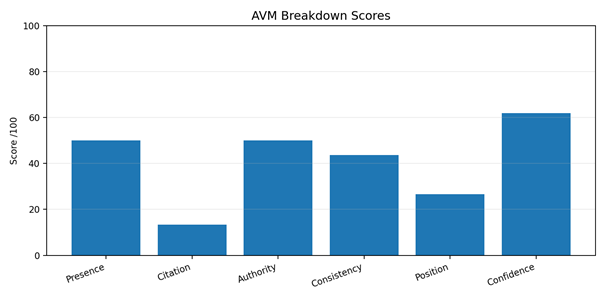
The strongest core signal is Confidence at 61.83/100, followed by Presence and Authority at 50.00/100 each. These signals show that the brand is recognizable and has a useful starting position in AI discovery. However, Citation at 13.33/100 and Position at 26.67/100 are the main weaknesses. AI systems may be able to recognize ExhibitPeople, but they lack enough third-party evidence and ranking confidence to consistently recommend it over competitors.
Competitor comparison shows the size of the opportunity. Skyline leads with an AVM score of 80.33, followed by Exponents at 74.33 and Classic Exhibits at 73.33. ExhibitPeople scores 44.33 in the competitor table, ahead of The Trade Show Network but still far behind the strongest brands on citation, authority, consistency, and overall recommendation strength.
For a client pitch, the message is clear: ExhibitPeople is not invisible, but it is underperforming in the AI era. The brand needs stronger citation depth, buyer-guide content, comparison pages, and third-party exhibit-industry mentions to convert existing visibility into trusted AI recommendations.
2. Core AVM Scorecard
| Metric | Score /100 | Rating | Interpretation |
| Presence | 50.00 | Developing | The brand appears in some AI-visible trade show booth rental contexts, but still lacks dominant discovery strength. |
| Citation | 13.33 | Critical | Citation strength is the weakest core signal; AI has limited third-party proof to reference the brand confidently. |
| Authority | 50.00 | Developing | Authority is moderate, but the brand needs more trusted industry references to compete with category leaders. |
| Consistency | 43.67 | Weak | Mentions are uneven across informational, commercial, transactional, and comparison query variations. |
| Position | 26.67 | Critical | The brand is not consistently placed as a top recommendation against stronger exhibit rental competitors. |
| Confidence | 61.83 | Good | AI systems show some ability to understand the brand, but confidence is limited by weak citation and recommendation depth. |
Source screenshot: metric bars for Presence, Citation, Authority, Consistency, Position, and Confidence
Generated view: AVM breakdown score chart
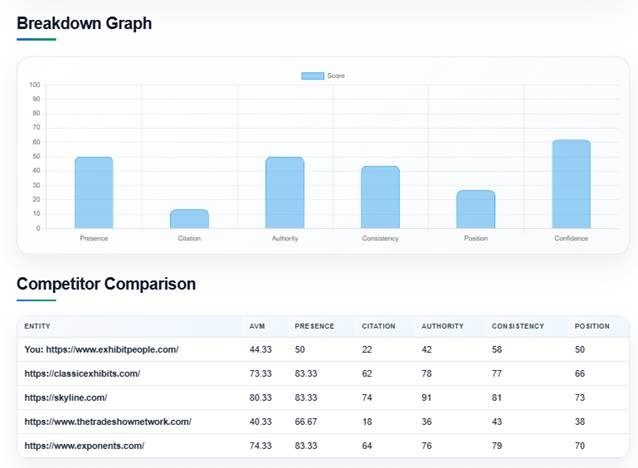
Source screenshot: dashboard breakdown graph and competitor comparison table
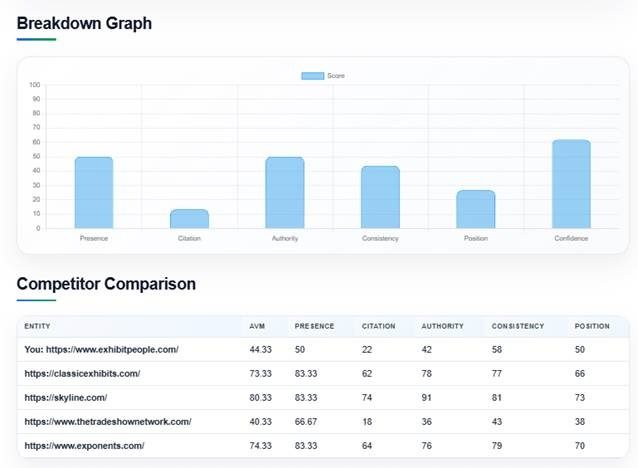
The chart shows that ExhibitPeople has a meaningful foundation in presence, authority, consistency, and confidence, but citation and position are significantly weaker. This means AI systems can identify the brand, yet they do not have enough evidence to consistently place it as a top recommendation for trade show booth rental queries.
3. Competitive Position and Visibility Gap
The competitor table shows that ExhibitPeople is not the weakest brand in the simulation, but it is clearly behind Skyline, Exponents, and Classic Exhibits. The biggest competitive gaps are citation strength, authority, and overall AVM score. These are the signals that influence whether AI systems treat a brand as a trusted recommendation rather than a simple mention.
| Entity | AVM | Presence | Citation | Authority | Consistency | Position |
| You: https://www.exhibitpeople.com/ | 44.33 | 50.00 | 22 | 42 | 58 | 50 |
| https://classicexhibits.com/ | 73.33 | 83.33 | 62 | 78 | 77 | 66 |
| https://skyline.com/ | 80.33 | 83.33 | 74 | 91 | 81 | 73 |
| https://www.thetradeshownetwork.com/ | 40.33 | 66.67 | 18 | 36 | 43 | 38 |
| https://www.exponents.com/ | 74.33 | 83.33 | 64 | 76 | 79 | 70 |
Source screenshot: competitor comparison table
Source screenshot: competitor AVM score graph
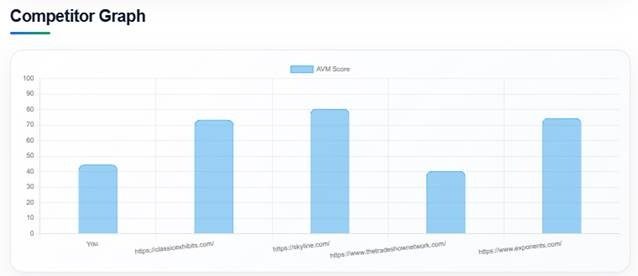
Generated view: competitor AVM score comparison
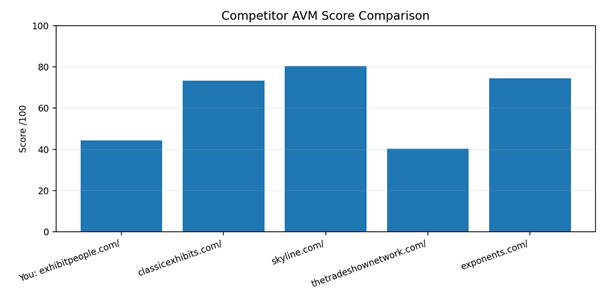
Skyline leads the competitive set with 80.33/100, while Exponents and Classic Exhibits also sit above 70/100. ExhibitPeople at 44.33/100 is positioned as a mid-to-lower competitor in AI-generated recommendations. The brand must improve its citation and comparative proof to prevent stronger competitors from owning AI recommendations in this niche.
4. Advanced AVM Intelligence
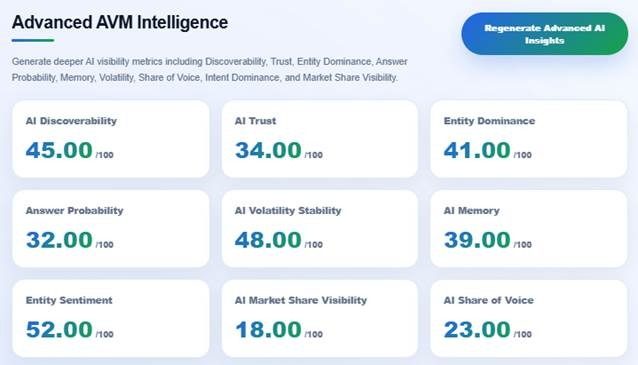
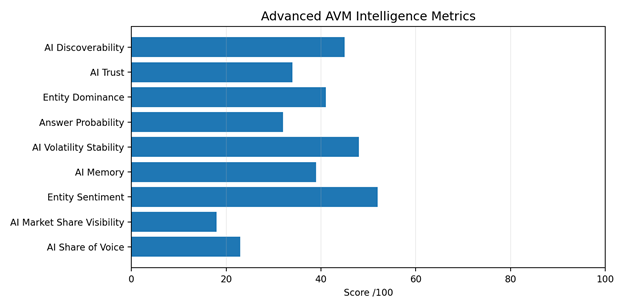
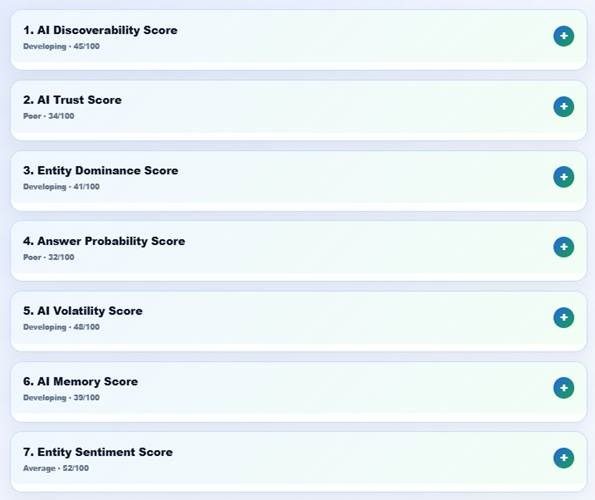
The advanced metrics confirm that ExhibitPeople has a moderate AI visibility foundation, but lacks the reinforcement required for strong recommendation probability. Discoverability, entity dominance, volatility stability, memory, and sentiment are usable, while trust, answer probability, market share visibility, and share of voice remain weak.
| Advanced Metric | Score /100 | Status |
| AI Discoverability | 45 | Developing |
| AI Trust | 34 | Poor |
| Entity Dominance | 41 | Developing |
| Answer Probability | 32 | Poor |
| AI Volatility Stability | 48 | Developing |
| AI Memory | 39 | Developing |
| Entity Sentiment | 52 | Average |
| AI Market Share Visibility | 18 | Poor |
| AI Share of Voice | 23 | Poor |
Source screenshot: Advanced AVM Intelligence summary tiles
Generated view: Advanced AVM Intelligence metrics
Source screenshot: executive advanced summary list
5. Advanced Metric Interpretation and Recommendations
AI Discoverability Score – 45/100
Definition: Measures generic query visibility, non-branded discovery, AI recommendation penetration, and topical breadth.
Executive summary: ExhibitPeople has developing discoverability because it is visible in some trade show booth rental and display rental contexts, but it does not consistently dominate non-branded searches. The brand needs stronger informational and commercial content to increase generic discovery.
Recommendations:
· Publish detailed pages for trade show booth rental, trade show counters, custom booth displays, portable exhibits, and modular display rentals.
· Build content that maps to non-branded buyer questions such as booth rental cost, turnaround time, booth size selection, logistics, and setup support.
· Increase mentions on exhibit-industry directories, event marketing publications, and trade show planning resources.
AI Trust Score – 34/100
Definition: Measures citation trust, authority quality, third-party mentions, source quality, and AI confidence.
Executive summary: Trust is poor because citation depth is limited. AI systems can recognize the brand, but there are not enough strong external references to support confident recommendations.
Recommendations:
· Earn citations from exhibit marketing publications, trade show directories, industry buying guides, and event planning resources.
· Publish proof pages with customer outcomes, booth examples, industry use cases, and visual project evidence.
· Strengthen review profiles and third-party listings so AI can validate the brand beyond owned website content.
Entity Dominance Score – 41/100
Definition: Measures semantic strength, topical ownership, entity relationship mapping, and contextual associations.
Executive summary: Entity dominance is developing, but not strong. ExhibitPeople is associated with trade show booth rentals, yet competitors have stronger entity maps and broader category coverage.
Recommendations:
· Create consistent entity descriptions across the website, Google Business Profile, directories, and partner references.
· Use structured content to connect ExhibitPeople with booth rental, trade show counters, custom displays, show services, logistics, and display planning.
· Add comparison pages that position ExhibitPeople against stronger competitors in a factual and buyer-friendly way.
Answer Probability Score – 32/100
Definition: Estimates the likelihood that AI recommends the brand.
Executive summary: Answer probability is low because AI systems see some brand signals but lack strong recommendation depth. The brand is not yet the obvious answer for vendor comparison, quote, or purchase-intent prompts.
Recommendations:
· Create recommendation-ready pages explaining who should choose ExhibitPeople, why, and for which trade show needs.
· Add buyer proof including timelines, sample projects, case studies, testimonials, and differentiators.
· Build commercial landing pages around rental booth packages, custom exhibit rentals, trade show counters, and quote-request intent.
AI Volatility Stability Score – 48/100
Definition: Measures visibility instability across models, query variations, and prompt wording.
Executive summary: Volatility is developing, meaning the brand has some stability but may still move in or out of answers depending on prompt wording and model behavior. Stronger citations and consistent third-party mentions would help stabilize visibility.
Recommendations:
· Standardize brand messaging across service pages, listings, directories, and public profiles.
· Create multi-page topic clusters rather than relying on a few general pages.
· Monitor branded, generic, comparison, and quote-intent prompts monthly to identify where visibility drops.
AI Memory Score – 39/100
Definition: Measures how often AI consistently remembers this brand across sessions and query variations.
Executive summary: AI memory is developing but still limited. ExhibitPeople is not fully sticky in model recall, so repeated and consistent entity references are needed.
Recommendations:
· Use a clear repeated brand narrative around trade show booth rentals and custom exhibit display rentals.
· Build recurring mentions in FAQs, project pages, industry profiles, and directory listings.
· Ensure service names and category associations are consistent across all public sources.
Entity Sentiment Score – 52/100
Definition: Measures positive mentions, negative framing, trust perception, and recommendation confidence.
Executive summary: Sentiment is average, meaning the brand is not negatively framed but does not yet receive strong positive recommendation language. More proof-led content can improve favorable AI summaries.
Recommendations:
· Publish customer outcomes, visual booth examples, and post-event success stories.
· Encourage third-party descriptions that are neutral-to-positive and evidence-based.
· Avoid generic promotional copy; focus on specific strengths such as design support, rental flexibility, and display quality.
6. AI Market Visibility, Share of Voice, and Intent Dominance
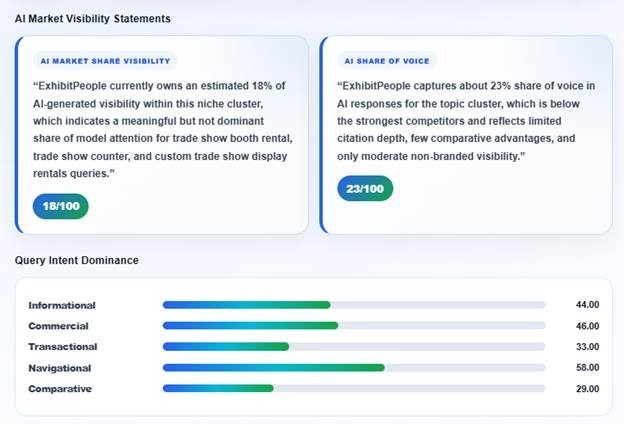
ExhibitPeople currently owns an estimated 18/100 of AI-generated visibility within this niche cluster. This indicates a meaningful but not dominant share of model attention for trade show booth rental, trade show counter, and custom trade show display rental queries.
The AI share of voice is 23/100. ExhibitPeople is appearing in some relevant AI responses, but the strongest competitors still capture more recommendation language, comparison visibility, and trusted citations.
Source screenshot: AI market visibility, share of voice, and query intent dominance
Generated view: Query Intent Dominance
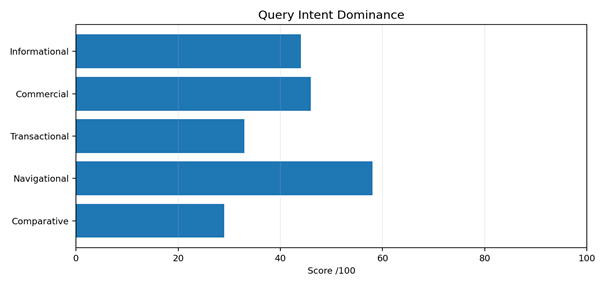
Intent dominance is strongest for navigational queries at 58/100 and reasonably strong for commercial queries at 46/100. Informational visibility is 44/100, transactional visibility is 33/100, and comparative visibility is only 29/100. This pattern suggests that AI can find the brand, but it is not yet persuasive when users are comparing vendors or preparing to convert.
Source screenshot: query intent dominance summary and recommendations
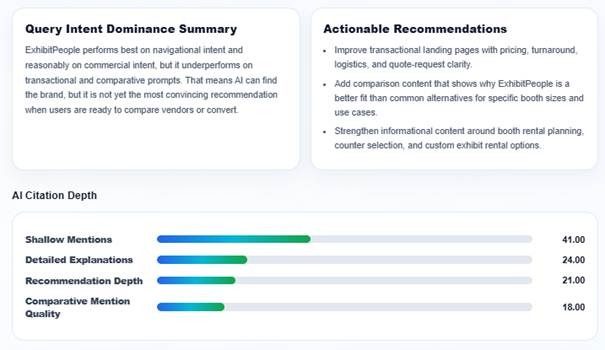
7. AI Citation Depth
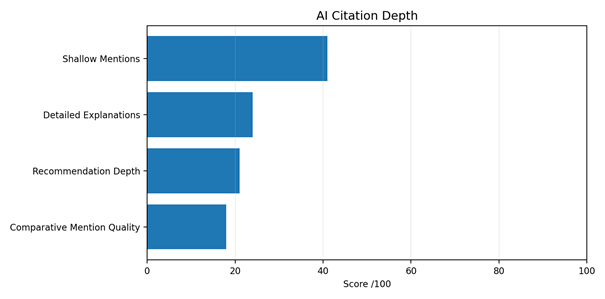
Source screenshot: AI citation depth bars
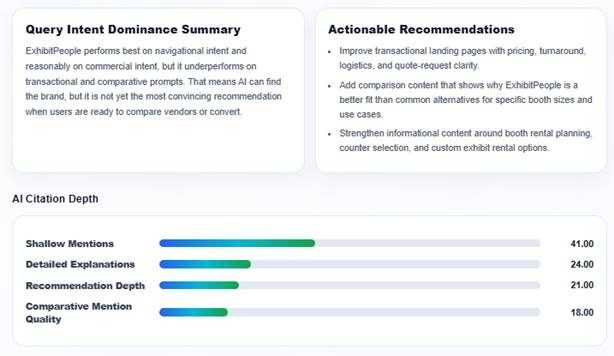
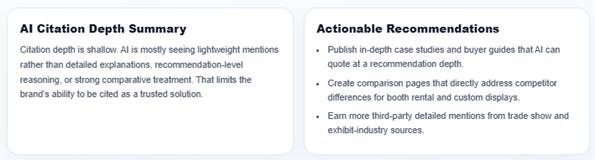
Citation depth is shallow. ExhibitPeople has 41/100 shallow mentions, 24/100 detailed explanations, 21/100 recommendation depth, and 18/100 comparative mention quality. This means AI may mention the brand, but it does not yet have enough evidence to explain, compare, or recommend the brand at a high confidence level.
Source screenshot: AI citation depth summary and recommendations
Generated view: AI Citation Depth
The citation gap is one of the strongest pitch points. To move from emerging visibility to recommendation-level visibility, ExhibitPeople needs more detailed third-party mentions, buyer guides, comparison citations, and sourceable proof pages that AI can use to explain why the brand is credible.
Actionable Recommendations:
· Publish in-depth case studies and buyer guides that AI can quote at recommendation depth.
· Create comparison pages that directly address competitor differences for booth rental and custom displays.
· Earn more third-party detailed mentions from trade show, exhibit design, event marketing, and business directories.
· Add structured proof points such as booth sizes, industries served, rental process, design capabilities, turnaround time, and quote-request support.
8. Advanced AVM Competitor Gap
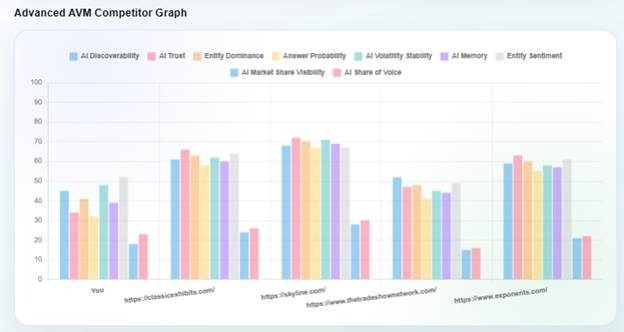
The advanced competitor graph shows that the gap is not limited to one metric. Skyline, Exponents, and Classic Exhibits outperform ExhibitPeople across most advanced metrics, especially trust, answer probability, citation strength, and market visibility. ExhibitPeople has enough visibility to compete, but not enough proof depth to dominate.
Source screenshot: Advanced AVM Competitor Graph
9. AI Readiness Snapshot
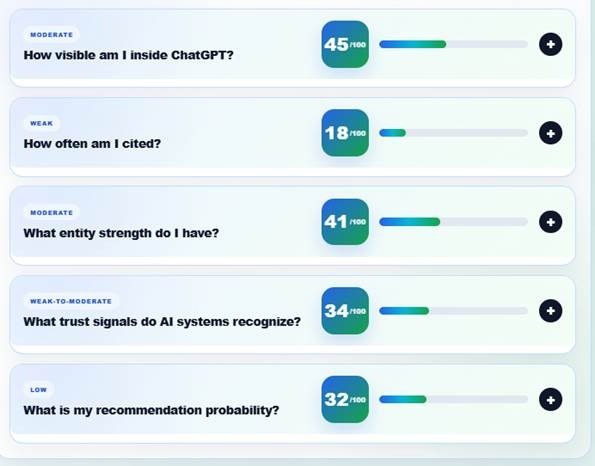
The readiness cards translate advanced metrics into client-friendly questions. They show that ExhibitPeople is moderately visible inside ChatGPT, weak in citation footprint, moderate in entity strength, weak-to-moderate in trust signals, and low in recommendation probability.
| Question | Score | Status | Pitch takeaway |
| How visible am I inside ChatGPT? | 45/100 | Moderate | The brand appears in relevant AI answers but is not dominant. |
| How often am I cited? | 18/100 | Weak | AI has limited third-party evidence to cite. |
| What entity strength do I have? | 41/100 | Moderate | The brand has a recognizable exhibit rental entity but does not fully own the category. |
| What trust signals do AI systems recognize? | 34/100 | Weak-to-moderate | Trust exists but needs more external validation and proof. |
| What is my recommendation probability? | 32/100 | Low | AI is not yet likely to recommend ExhibitPeople over stronger competitors consistently. |
Source screenshot: AI readiness cards
10. Priority Action Plan
| Timeframe | Priority | Action |
| 0-30 days | Citation foundation | Build 18-28 niche-based citations from exhibit-industry directories, trade show planning resources, event marketing blogs, booth rental listings, and business profiles. Prioritize sources that can validate ExhibitPeople as a booth rental and custom display provider. |
| 30-60 days | Owned content expansion | Create service pages and buyer guides for trade show booth rental, trade show counter rental, custom trade show displays, rental booth sizes, logistics, pricing guidance, and quote-request intent. Add FAQs and clear answer blocks for AI extraction. |
| 60-90 days | Comparison and recommendation proof | Publish competitor comparison pages and proof-led assets that explain why ExhibitPeople is a better fit for specific booth sizes, show types, budgets, or turnaround requirements. Add case studies and visual examples. |
| Ongoing | Prompt monitoring and iteration | Track branded, non-branded, commercial, transactional, and comparative prompts monthly. Monitor movement in citation depth, share of voice, position, answer probability, and AI market visibility. Refresh pages where visibility drops. |
Pitch conclusion: ExhibitPeople already has emerging AI visibility, but competitors currently control stronger recommendation territory. The fastest path to improvement is to convert existing visibility into trust by building third-party citation depth, detailed buyer content, and comparison-ready proof that AI systems can reuse in answers.
11. Vector Entity Modelling (VEM) Analysis
The VEM layer evaluates whether ExhibitPeople has a strong semantic entity foundation for AI search, retrieval, and recommendation systems. While the AVM report shows ExhibitPeople as emerging, the VEM data shows that the brand still has a weak entity foundation compared with stronger trade show rental competitors.
| Measure | Score / Detail | Status | Pitch interpretation |
| Overall VEM Score | 42.00 /100 | Weak Entity Foundation | Entity foundation exists, but it is not strong enough to support category-leading AI recognition. |
| Website | https://www.exhibitpeople.com/ | Client Entity | Trade show booth rental, trade show counter, and custom trade show display rentals. |
| Main Pitch Message | Needs strengthening | Strategic Priority | Improve semantic depth, authoritative citations, query-to-page alignment, and competitive entity signals. |
Source screenshot: VEM score overview and executive VEM summary
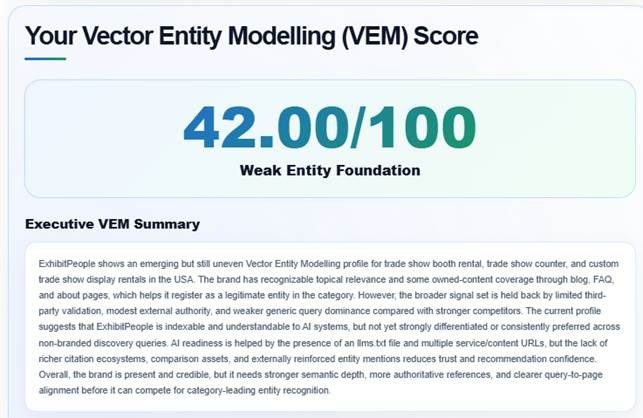
Executive VEM Summary
ExhibitPeople shows an emerging but uneven VEM profile. The brand has recognizable topical relevance for trade show booth rental, trade show counter, and custom trade show display rentals in the USA, supported by owned content such as blog, FAQ, about, and help resources. However, its VEM strength is held back by limited third-party validation, modest external authority, weaker generic query dominance, and a competitive gap against stronger entities such as Skyline, Classic Exhibits, and Exponents.
For the client pitch, the strongest point is that ExhibitPeople is not absent from AI systems, but it is not yet semantically strong enough to be consistently selected, cited, or remembered as a category-leading answer. The current profile suggests that AI can identify the brand, but still needs stronger proof, richer semantic content, and more externally reinforced mentions before it can treat ExhibitPeople as a highly trusted vendor.
12. VEM Intelligence Scorecard
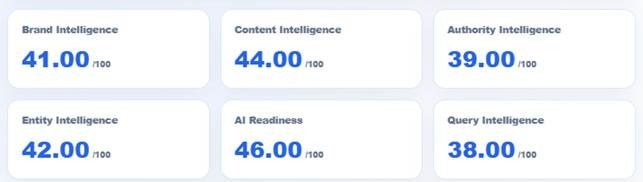
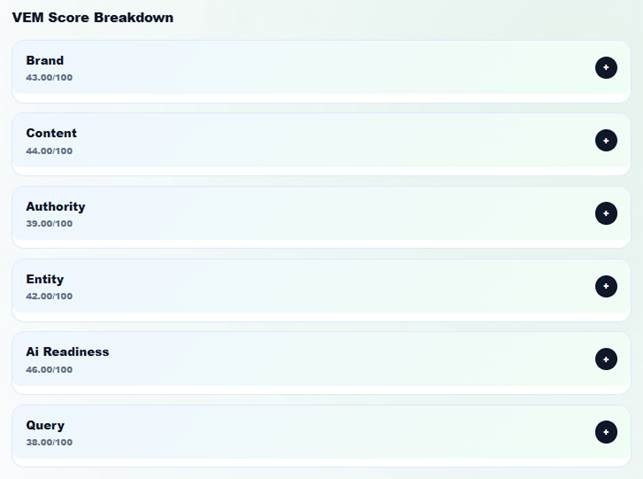
The intelligence layer breaks the 42/100 VEM score into six pillars. The strongest area is AI Readiness at 46/100, while the weakest area is Query Intelligence at 38/100. This means the brand has enough web structure to be processed by AI, but it is not yet strong enough across query intent, citation probability, and competitive semantic depth.
| VEM Pillar | Score /100 | Status | Interpretation |
| Brand Intelligence | 41.00 | Needs Improvement | Brand recognition exists, but consistency and external reinforcement remain limited. |
| Content Intelligence | 44.00 | Needs Improvement | Owned content supports the entity but lacks enough sourceable, comparison-ready depth. |
| Authority Intelligence | 39.00 | Weak | External authority is not strong enough to fully validate the brand for AI recommendations. |
| Entity Intelligence | 42.00 | Needs Improvement | The brand is mapped to the niche, but does not yet dominate the category entity space. |
| AI Readiness | 46.00 | Needs Improvement | Technical readiness is present, but AI search performance is limited by trust and citations. |
| Query Intelligence | 38.00 | Weak | Non-branded and comparison query coverage needs stronger page alignment. |
Source screenshot: VEM intelligence score tiles
Source screenshot: VEM score breakdown accordion
13. Competitor Entity Strength Index
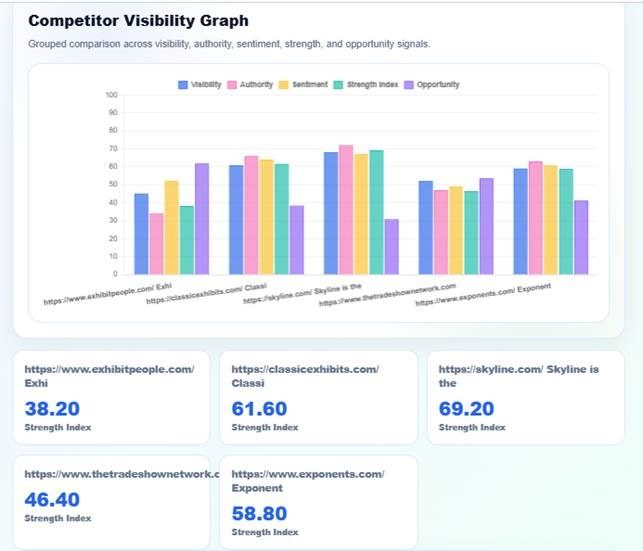
The VEM competitor cards show that ExhibitPeople has the lowest strength index in the comparison set at 38.20. Skyline leads with 69.20, followed by Classic Exhibits at 61.60 and Exponents at 58.80. This creates a clear pitch point: ExhibitPeople is present in the market, but competitors have stronger entity signals and are more likely to be selected in AI-generated recommendations.
| Entity | Strength Index | Position | Pitch interpretation |
| https://www.exhibitpeople.com/ | 38.20 | Client baseline | Weakest entity strength in the tested competitor set. |
| https://classicexhibits.com/ | 61.60 | Strong competitor | Stronger brand, authority, and semantic recognition signals. |
| https://skyline.com/ | 69.20 | Category leader | Highest strength index and strongest competitive entity position. |
| https://www.thetradeshownetwork.com/ | 46.40 | Mid-level competitor | Outperforms ExhibitPeople but remains behind leading competitors. |
| https://www.exponents.com/ | 58.80 | Strong competitor | Higher strength index and more reinforced AI visibility profile. |
Source screenshot: competitor strength index cards
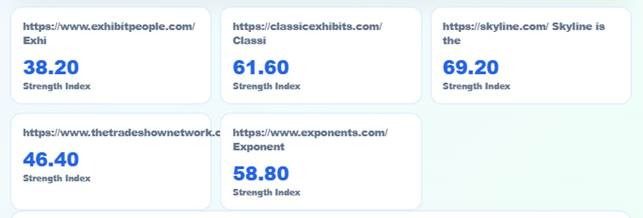
Source screenshot: competitor visibility graph and strength index cards
14. Advanced VEM Score Summary
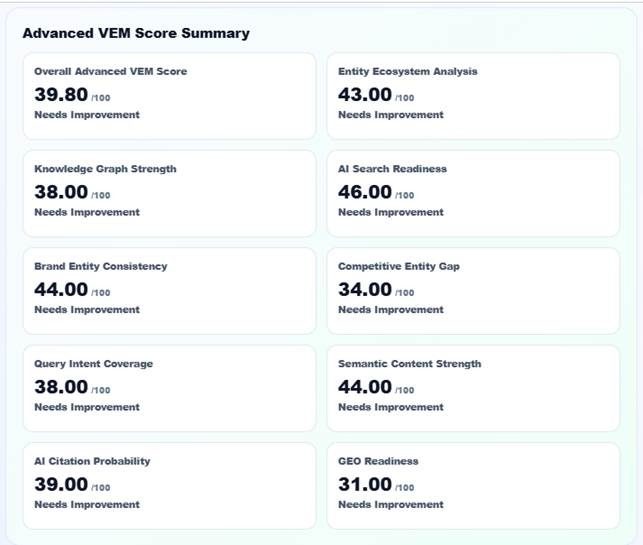
The advanced VEM summary confirms that ExhibitPeople is not failing because of a single weak metric. The brand needs improvement across overall VEM, knowledge graph strength, citation probability, competitive entity gap, query intent coverage, and GEO readiness. The lowest advanced metric is GEO Readiness at 31/100, which indicates that the brand is not yet structured strongly enough for generative engine optimization.
| Advanced VEM Metric | Score /100 | Status | Interpretation |
| Overall Advanced VEM Score | 39.80 | Needs Improvement | Overall advanced semantic performance remains below competitive threshold. |
| Entity Ecosystem Analysis | 43.00 | Needs Improvement | Entity signals exist but are not deeply connected across sources. |
| Knowledge Graph Strength | 38.00 | Needs Improvement | The brand needs stronger machine-readable relationships and third-party validation. |
| AI Search Readiness | 46.00 | Needs Improvement | AI can process the brand, but weak authority limits recommendation readiness. |
| Brand Entity Consistency | 44.00 | Needs Improvement | Naming and service descriptions need tighter consistency across the web. |
| Competitive Entity Gap | 34.00 | Needs Improvement | Competitors have stronger entity dominance and citation ecosystems. |
| Query Intent Coverage | 38.00 | Needs Improvement | Commercial, transactional, and comparison queries need stronger page mapping. |
| Semantic Content Strength | 44.00 | Needs Improvement | Owned content needs richer topical depth and answer-ready content blocks. |
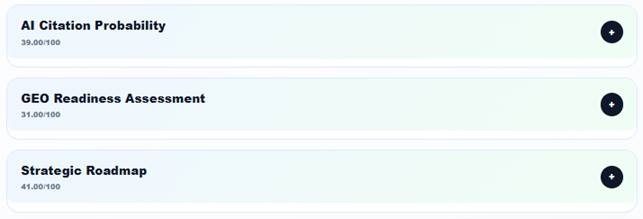
| AI Citation Probability | 39.00 | Needs Improvement | AI has limited high-quality sources to cite in recommendation answers. |
| GEO Readiness | 31.00 | Needs Improvement | Generative engine readiness is the weakest advanced signal. |
Source screenshot: advanced VEM score summary
15. Advanced VEM Interpretation and Recommendations
Entity Ecosystem Analysis – 43/100
ExhibitPeople has the starting pieces of an entity ecosystem, but they are not yet connected strongly enough across owned pages, third-party sources, reviews, citations, and topical associations.
· Build a clearer entity hub around trade show booth rental, booth counters, exhibit displays, and custom rental services.
· Connect service pages, FAQs, location/service intent, and proof assets using consistent internal linking and schema.
· Increase external mentions that describe ExhibitPeople with the same service categories.
Knowledge Graph Strength – 38/100
The brand is not yet strongly represented as a machine-readable entity. AI systems may understand the website, but they need clearer relationships between the company, services, industry, audience, and proof sources.
· Add organization, product/service, FAQ, and review schema where appropriate.
· Use consistent entity descriptions across site pages and off-site business profiles.
· Create content that clearly maps ExhibitPeople to trade show booth rental, custom exhibit rental, counters, logistics, and booth display use cases.
AI Search Readiness – 46/100
AI readiness is the strongest advanced VEM signal, but it still needs improvement. ExhibitPeople has enough crawlable content to be interpreted, yet weak authority and query coverage prevent it from becoming a preferred AI answer.
· Create answer-first pages for pricing, turnaround, booth rental options, display types, and quote request use cases.
· Strengthen structured FAQs that AI can summarize directly.
· Improve sourceability with downloadable guides, case examples, and comparison-ready sections.
Competitive Entity Gap Analysis – 34/100
This is one of the biggest strategic risks. Competitors such as Skyline, Classic Exhibits, and Exponents have stronger entity strength, authority, and semantic recognition, which makes them easier for AI systems to recommend.
· Publish competitor comparison pages that explain differences in booth sizes, rental options, turnaround, service coverage, and support.
· Earn third-party mentions from trade show, event marketing, and exhibit industry sources.
· Create proof-based pages showing why ExhibitPeople is a better fit for specific buyer scenarios.
GEO Readiness Assessment – 31/100
GEO readiness is the weakest advanced VEM signal. This means the brand is not yet optimized for generative engines that summarize, cite, and recommend companies based on structured evidence.
· Add concise answer blocks on priority service pages.
· Strengthen citation-worthy content such as buyer guides, comparison guides, FAQs, and case studies.
· Improve page-level clarity so AI can match each query intent to the most relevant ExhibitPeople page.
Strategic Roadmap – 41/100
The strategic roadmap score shows that the brand has a workable improvement path. The priority is not only to add more content, but to make the brand easier for AI systems to understand, cite, and compare.
· First 30 days: fix entity consistency, add structured data, and improve core service-page answer blocks.
· Next 60 days: publish buyer guides, comparison pages, and detailed rental-service explainers.
· Next 90 days: build external citations, reviews, PR mentions, and industry validation assets.
Source screenshot: advanced VEM analysis accordion metrics
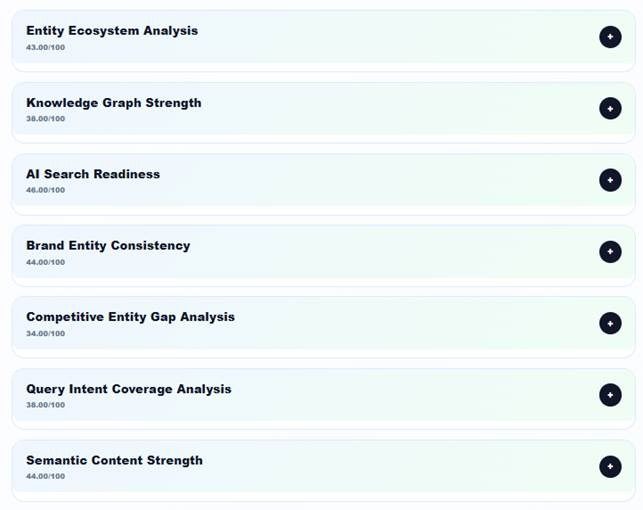
Source screenshot: AI citation probability, GEO readiness, and strategic roadmap