SUPERCHARGE YOUR ONLINE VISIBILITY! CONTACT US AND LET’S ACHIEVE EXCELLENCE TOGETHER!
The Gold Standard Score for AI Search, Entity Intelligence & Next-Generation SEO
Introduction
For more than two decades, search engines primarily evaluated websites.
They ranked pages.
They indexed content.
They measured links.
They analyzed keywords.
Artificial intelligence changes this completely.
Modern AI systems do not simply evaluate pages.
They evaluate entities.
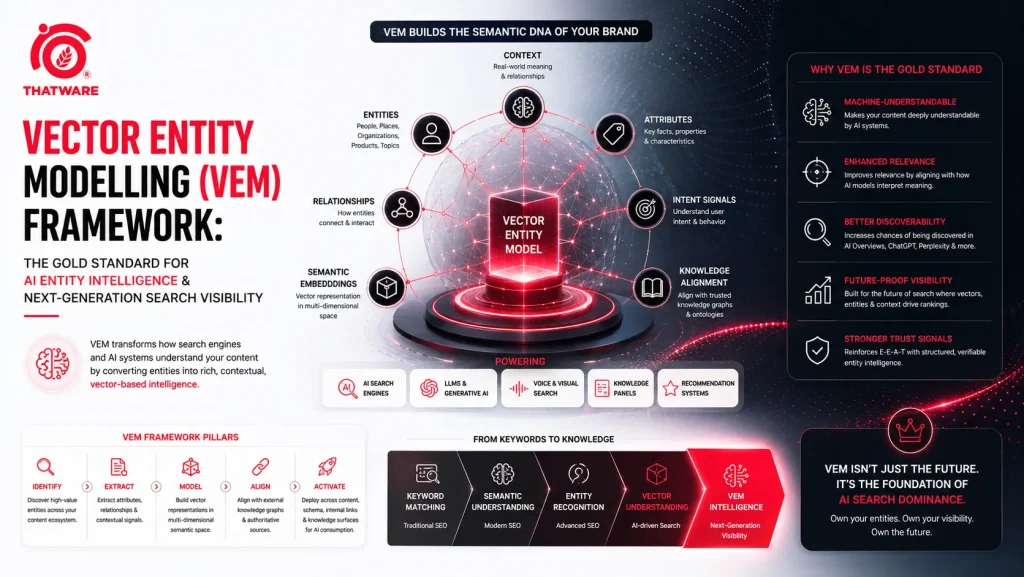
They attempt to understand:
- Who a company is
- What products it offers
- Who founded it
- What topics it owns
- Which industries it belongs to
- What relationships exist around it
- Whether the entity can be trusted
This represents one of the most significant shifts in search history.
The future of search will not be built on keywords.
It will be built on entities.
This is where Vector Entity Modelling (VEM) enters the picture.
What Is Vector Entity Modelling (VEM)?
Vector Entity Modelling (VEM) is a next-generation AI search framework developed to measure how clearly AI systems understand, connect, and model an entity across the digital ecosystem.
Unlike traditional SEO metrics, VEM does not focus on rankings.
Instead, it evaluates:
- Entity completeness
- Semantic relationships
- Knowledge graph strength
- AI readiness
- Contextual understanding
- Entity trustworthiness
- Cross-platform consistency
In simple terms:
VEM measures understanding.
Why VEM Matters
Imagine two companies.
Both rank well.
Both have authority.
Both have strong backlinks.
Yet one is consistently recommended by AI systems.
The other is not.
Why?
Because one company exists as a fully understood entity.
The other exists only as a collection of webpages.
AI systems increasingly prefer entities over pages.
That shift changes everything.
The Evolution of Search
Keywords
↓
Pages
↓
Topics
↓
Entities
↓
Knowledge Graphs
↓
Vector Intelligence
↓
AI Recommendations
The future belongs to brands that become machine-understandable entities.
Why VEM May Become The Most Important AI SEO Score
Traditional SEO answers:
Can Google rank this page?
AVM answers:
Can AI see this brand?
VEM answers:
Does AI understand this entity?
Understanding always precedes recommendation.
Before AI can recommend you, it must understand you.
Before it can trust you, it must identify you.
Before it can remember you, it must model you.
That is why VEM sits beneath every future AI search signal.
What Does VEM Measure?
The VEM framework measures six primary intelligence layers.
Brand Intelligence
↓
Content Intelligence
↓
Authority Intelligence
↓
Entity Intelligence
↓
AI Readiness Intelligence
↓
Query Intelligence
↓
VEM Score
Layer 1: Brand Intelligence
What Is It?
The first layer measures how clearly the entity itself is defined.
Inputs include:
- Company Name
- Brand Variants
- Aliases
- Founder Names
- Product Names
- Service Names
- Abbreviations
Why It Matters
AI systems often struggle with fragmented identity.
Example:
THATWAREThatWareThat WareThatware AIThatWare TechnologiesIf identity is inconsistent, entity understanding weakens.
Formula
Brand Intelligence=Entity Consistency+Brand Completeness+Variant Recognition÷3Layer 2: Content Intelligence
What Is It?
Content Intelligence measures how effectively content reinforces entity understanding.
Inputs include:
- Homepage
- Service Pages
- Blog Pages
- Resource Hubs
- Topic Clusters
- Semantic Sitemaps
Why It Matters
Content acts as the training data AI systems use to understand the entity.
Poor content creates weak vectors.
Strong content creates strong vectors.
Flowchart
Content Assets
↓
Topic Extraction
↓
Entity Mapping
↓
Relationship Analysis
↓
Vector Reinforcement
Layer 3: Authority Intelligence
What Is It?
Authority Intelligence evaluates third-party validation.
Inputs include:
- Awards
- Research Papers
- Podcasts
- Interviews
- Media Mentions
- Industry Recognition
Why It Matters
Authority signals help AI systems validate entity legitimacy.
Without validation:
Understanding remains incomplete.
Layer 4: Entity Intelligence
This is the heart of VEM.
What Is Entity Intelligence?
Entity Intelligence measures how effectively the brand exists inside structured knowledge systems.
Signals include:
- Wikidata
- Knowledge Graphs
- Organization Schema
- Author Schema
- Social Entities
- Structured Metadata
Why It Matters
AI systems increasingly rely on entity relationships.
Example:
Tuhin Banik
↓
Founder Of
↓
ThatWare
↓
Created
↓
AVM
↓
AI Visibility Framework
This relationship graph becomes part of AI understanding.
Entity Intelligence Flow
Entity
↓
Attributes
↓
Relationships
↓
Knowledge Graph
↓
AI Understanding
Layer 5: AI Readiness Intelligence
What Is It?
This layer evaluates whether the website is prepared for AI-native discovery.
Signals include:
- ai.txt
- llms.txt
- Semantic Sitemaps
- AI Endpoints
- RAG Feeds
- Entity Feeds
- Well-Known Files
Why It Matters
Future AI systems will increasingly rely on machine-readable data layers.
VEM rewards organizations preparing for that future.
AI Readiness Flow
Website
↓
AI Files
↓
Machine Readability
↓
Structured Understanding
↓
AI Readiness Score
Layer 6: Query Intelligence
What Is It?
Query Intelligence measures how strongly entities appear across different query categories.
Signals include:
- Branded Queries
- Non-Branded Queries
- Commercial Queries
- Local Queries
- Comparative Queries
Why It Matters
An entity should be discoverable regardless of query type.
Strong entities maintain visibility across multiple intent layers.
VEM Formula
A simplified enterprise formula:
VEM=(Brand Intelligence × 0.15+Content Intelligence × 0.20+Authority Intelligence × 0.15+Entity Intelligence × 0.25+AI Readiness × 0.15+Query Intelligence × 0.10)
Example VEM Calculation
| Component | Score |
|---|---|
| Brand Intelligence | 85 |
| Content Intelligence | 80 |
| Authority Intelligence | 90 |
| Entity Intelligence | 88 |
| AI Readiness | 75 |
| Query Intelligence | 82 |
| Result | Value |
|---|---|
| Average Score | 84.35 |
| Final VEM Score | 84/100 |
VEM Score Interpretation
| Score | Meaning |
|---|---|
| 90–100 | AI Native Entity |
| 80–89 | Strong Entity |
| 70–79 | Recognized Entity |
| 60–69 | Emerging Entity |
| Below 60 | Weak Entity Presence |
Benefits of High VEM Scores
Better AI Understanding
AI systems identify the brand more accurately.
Stronger Recommendations
Understanding improves recommendation confidence.
Increased Citation Frequency
Well-defined entities receive deeper citations.
Better AI Memory
Entity clarity improves long-term recall.
Higher AVM Scores
Strong VEM naturally improves AVM.
Relationship Between VEM and AVM
VEM
(Entity Understanding)
↓
AI Memory
↓
AI Recommendation
↓
AVM
(Visibility)
AVM is often the result.
VEM is often the cause.
Enterprise Applications
Enterprise Brands
Monitor entity maturity.
SEO Agencies
Deliver AI entity intelligence audits.
SaaS Companies
Improve AI discoverability.
Ecommerce Brands
Strengthen product entities.
Healthcare Organizations
Build trust-based entity models.
Educational Institutions
Improve authority vectors.
The Future of AI Search
The future search engine will not ask:
Which page should I rank?
It will ask:
Which entity best answers this question?
This subtle difference changes the entire SEO industry.
Entities become the new rankings.
Knowledge becomes the new authority.
Vectors become the new signals.
Understanding becomes the new AI Search visibility.
Conclusion
Vector Entity Modelling represents the next evolution of search intelligence.
It shifts optimization away from pages and toward entities.
It helps organizations understand how AI systems perceive them, model them, connect them, and ultimately recommend them.
In the future, AI visibility alone will not be enough.
Brands will need entity intelligence.
They will need machine-readable identity.
They will need semantic authority.
They will need AI readiness.
That is the purpose of VEM.
If AVM measures whether AI can see your brand, VEM measures whether AI can truly understand it. And in the age of AI search, understanding may become the most valuable ranking factor of all.