SUPERCHARGE YOUR ONLINE VISIBILITY! CONTACT US AND LET’S ACHIEVE EXCELLENCE TOGETHER!
For years, enterprise search strategy followed a relatively direct model: a customer searched for something, a search engine returned a set of results, and the customer selected a page to visit. Enterprise SEO was largely concerned with earning visibility within that journey. For organizations building a scalable digital acquisition strategy, professional seo marketing increasingly has to account for both conventional discovery and the systems that interpret information before a customer reaches a website.
That journey is becoming more complex.
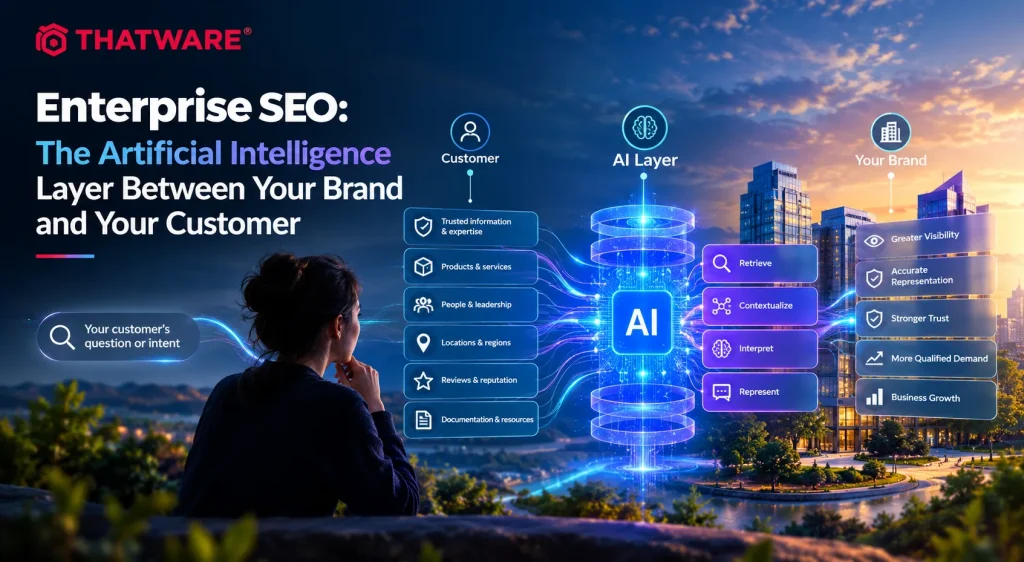
Today, a customer may express an intent and receive an interpreted answer before visiting a brand’s website. Intelligent systems can retrieve information from multiple sources, connect related concepts, summarize competing perspectives, and present a recommendation or explanation in a conversational format. The customer may therefore encounter an interpretation of a brand before encountering the brand itself.
This creates a new layer between enterprise brands and their audiences: an artificial intelligence layer.
The important question is no longer only, “Can the search engine find our page?” It is also, “Can intelligent systems understand who we are, what we offer, why we are relevant, and when our information should be used?”
For large organizations, this shift changes the scope of SEO. The objective is no longer limited to optimizing pages for rankings. It increasingly involves structuring an organization’s digital information so that search systems, answer systems, and AI-driven interfaces can interpret it accurately and consistently.
Enterprise SEO is consequently moving from page optimization toward information engineering. The brands that understand this transition can begin treating AI not merely as another traffic channel, but as an interpretive layer through which customers may discover, evaluate, and contextualize them.
Enterprise SEO Moving Beyond Search Results
From Ranking Pages to Representing Entities
A large enterprise rarely exists online as a single website or a neatly contained set of pages. It may have product sections, regional sites, documentation, support resources, research material, executive content, partner information, social profiles, news coverage, reviews, structured data, and thousands of historical URLs.
Search systems have to make sense of this distributed information.
This means enterprise optimization increasingly requires a shift from thinking exclusively about pages and keywords to thinking about entities, relationships, attributes, and context. A page can rank for a query, but an entity can be understood across thousands of signals.
The distinction matters. A page answers a particular query. An entity represents a broader identity.
If an enterprise wants intelligent systems to interpret its brand correctly, its digital properties must reinforce a coherent picture of that identity. Product names, organizational relationships, services, locations, expertise, authorship, claims, and supporting evidence should connect semantically rather than exist as isolated pieces of information.
The New Enterprise Search Journey
The modern enterprise discovery journey can be viewed as:
Intent → Retrieval → Interpretation → AI Response → Brand Consideration → Action
The customer begins with a need or question. Information is retrieved from available sources. An intelligent system interprets that information in context. It produces an answer, summary, comparison, or recommendation. The customer then decides whether a brand deserves consideration and eventually takes action.
Enterprise SEO must therefore account for every stage, not just retrieval. This is also changing how organizations evaluate Enterprise SEO Services: the scope increasingly extends from ranking individual assets to strengthening the information ecosystem that supports discovery, interpretation, and action.
A technically perfect page that cannot be connected to the correct entity may be less useful than a smaller but semantically coherent information ecosystem. Likewise, a large content library does not automatically guarantee that an AI system will understand the relationship between the content, the organization, and the user’s intent.
The enterprise search journey has become an information journey.
What Is the “AI Layer” Between Brand and Customer?
AI as an Interpretation Layer
The artificial intelligence layer is the collection of systems and processes that sit between a user’s question and the information ultimately presented to that user.
It can retrieve information, identify relationships, resolve ambiguity, summarize evidence, classify intent, and construct an answer. This makes interpretation a central part of modern discovery.
For brands, that creates both an opportunity and a risk.
If the information ecosystem surrounding a brand is coherent, accessible, authoritative, and semantically connected, intelligent systems have a stronger foundation for representing that brand. If information is fragmented, contradictory, outdated, or difficult to interpret, the resulting representation may be incomplete or ambiguous.
Four Functions: Retrieval, Contextualization, Interpretation, Representation
Retrieval determines what information can enter the system.
Contextualization determines how that information relates to the user’s question.
Interpretation determines what the system believes the information means.
Representation determines how the resulting understanding is presented to the customer.
These functions are connected, but they are not identical. Improving only the first layer is not enough. A brand can have substantial online visibility and still struggle to communicate its actual expertise if its information lacks semantic clarity.
Why Enterprise Brands Have a Larger AI Surface Area
The larger the organization, the larger its information surface tends to become.
Multiple business units can describe similar services differently. Regional teams may publish inconsistent terminology. Product names can change over time. Different departments may create overlapping resources. Legacy pages may remain indexed long after their relevance has declined.
This creates an enterprise-level interpretation challenge.
The goal is not simply to publish more information. It is to make the existing information ecosystem easier to understand, connect, retrieve, and interpret.
The Enterprise SEO Challenge: Making a Large Brand Understandable to Machines
Information Fragmentation
Enterprise information is often distributed across many systems and teams. Marketing may control product pages, technical teams may maintain documentation, communications teams may publish announcements, and individual departments may create specialized resources.
Humans can often connect these pieces through organizational knowledge. Machines need clearer signals.
Information fragmentation can create gaps between what an enterprise knows and what an intelligent system can confidently understand. The solution is not necessarily to consolidate every piece of content into one location. It is to establish stronger relationships between the pieces.
Entity Confusion and Semantic Gaps
An enterprise may use several names for the same concept, while similar names may refer to entirely different concepts.
Semantic gaps appear when the relationship between terms, topics, products, services, people, and organizational units is unclear. These gaps can make it harder for intelligent systems to determine which information belongs together.
This is where semantic architecture becomes important.
An enterprise needs consistent definitions, clear relationships, meaningful taxonomy, and structured signals that reinforce how its information should be interpreted.
Content Volume Does Not Equal Authority
Publishing thousands of pages can create scale without creating understanding.
Authority is not simply a measurement of how much content exists. It is also connected to relevance, consistency, evidence, expertise, relationships, and the ability of a digital ecosystem to answer meaningful questions.
This is why enterprise content programs need to move beyond production volume. The central question becomes: does each piece of information strengthen the larger knowledge structure of the brand?
From Keywords to Knowledge: The New Enterprise SEO Architecture
Keyword Strategy Still Matters, But It Is Not the Whole System
Keywords remain useful because they reveal how people express intent. They help organizations understand demand, language patterns, and the topics audiences care about.
But enterprise search architecture cannot stop at keyword mapping.
A keyword represents language. A knowledge structure represents relationships.
For example, a service-related topic may connect to industries, use cases, locations, customer segments, processes, technologies, experts, documentation, and supporting evidence. An enterprise SEO strategy should understand these relationships rather than treating every phrase as an isolated target.
Topic and Entity Clusters
Topic clusters organize related concepts around a broader subject. Entity clusters go further by connecting identifiable entities and their relationships.
A strong enterprise architecture can connect a product to its features, use cases, documentation, authors, categories, related services, and organizational context. This gives search systems more signals with which to understand meaning.
The result is a digital environment where content does not merely coexist. It reinforces other content.
Semantic Architecture
Semantic architecture is the structural layer that helps machines understand what information means and how different pieces relate.
It can involve taxonomy, internal linking, structured data, consistent terminology, entity relationships, content hierarchy, and machine-readable information.
The objective is not to manipulate an algorithm. It is to reduce ambiguity.
Structured Data and Machine-Readable Information
Machines need information in forms they can process efficiently.
Structured data can help communicate attributes and relationships. Consistent metadata can reinforce context. Clear information architecture can make important resources easier to discover. Machine-readable formats can help systems interpret information without relying entirely on visual presentation.
For enterprise organizations, these technical elements become part of a larger knowledge architecture.
Enterprise SEO in the Age of AI Discovery
Traditional Search Visibility vs. AI Visibility
Traditional search visibility often asks whether a page appears for a query and how prominently it appears.
AI visibility introduces another question: does the brand’s information become part of the answer or interpretation generated for a relevant need?
These are related but distinct forms of visibility.
A page can receive organic impressions without becoming a meaningful source in an AI-mediated discovery journey. Conversely, information may influence an answer even when the customer never visits the original page.
This changes how enterprise teams should think about visibility.
Answer-Oriented Discovery
Customers increasingly express complex needs through natural language. They may ask for explanations, comparisons, recommendations, summaries, or solutions instead of entering short keyword combinations.
This creates demand for content that is organized around questions and intent.
Answer Engine Optimization focuses on preparing information so that answer-oriented systems can identify, interpret, and use relevant content. The emphasis shifts from merely attracting a click to becoming a useful information source within an answer journey.
Being Present vs. Being Understood
Presence alone is not enough.
An enterprise can publish content across many platforms and still leave intelligent systems with an incomplete understanding of its identity. AI discovery requires a stronger connection between visibility and comprehension.
The strategic objective is therefore to create an information ecosystem in which the brand is not only discoverable, but also contextually understandable.
New Enterprise SEO Metrics
AI Visibility
Traditional metrics such as rankings, impressions, clicks, and organic sessions remain important. But enterprise teams increasingly need additional signals that describe how their brand appears within AI-mediated discovery.
AI visibility can examine whether a brand is surfaced for relevant prompts, questions, categories, and customer intents.
Citation and Source Presence
Another useful signal is whether authoritative brand-owned information is being referenced or incorporated into AI-generated responses.
The focus should not be on chasing mentions for their own sake. The more useful question is whether the right information is available from credible sources when important customer questions are being answered.
Share of AI Visibility
Enterprise organizations can also monitor how frequently their brand appears across a defined set of relevant AI discovery scenarios.
This creates a broader view than a single keyword position. It can reveal where the brand has strong visibility, where alternative sources dominate the conversation, and where important topics remain underrepresented.
Entity Recognition
Brands should monitor whether intelligent systems consistently associate the correct attributes, products, services, locations, and expertise with the organization.
Entity recognition helps identify semantic inconsistencies that conventional ranking reports may not reveal.
Search-to-Conversion Intelligence
The ultimate purpose of visibility is not visibility itself.
Enterprise teams can connect search and AI discovery signals with downstream actions such as qualified visits, inquiries, registrations, transactions, or other meaningful business outcomes.
Traditional Metrics Still Matter
AI-era measurement should complement established SEO measurement rather than discard it.
Organic traffic, rankings, crawlability, indexation, engagement, conversions, and technical performance continue to provide valuable evidence. The emerging layer adds context around how information is interpreted before the customer reaches the website.
An Enterprise AI Search Optimization Framework
Layer 1: Search Intelligence
Start by understanding the existing search ecosystem.
Identify important queries, topics, customer intents, competitors, content gaps, SERP patterns, and areas where the brand already has authority. This creates the baseline from which deeper optimization can begin.
Layer 2: Semantic Intelligence
Map the entities, relationships, terminology, attributes, and concepts that define the organization.
The purpose is to establish a consistent semantic model. This can reveal conflicting terminology, disconnected content clusters, ambiguous entities, and opportunities to strengthen topical relationships.
Layer 3: Content Intelligence
Evaluate content according to intent, usefulness, expertise, evidence, freshness, depth, and relationship to the broader information ecosystem.
The goal is not simply to create more pages. It is to create information that fills meaningful knowledge gaps and strengthens the organization’s authority around important subjects.
Layer 4: Technical and Retrieval Intelligence
Ensure important information can be discovered, crawled, processed, and connected.
Technical SEO, site architecture, internal linking, structured data, performance, indexation, and machine-readable information all contribute to the retrieval layer. In this environment, cutting edge organic search engine optimization technology is most useful when it strengthens these foundations without losing sight of user intent, information quality, and business context.
Layer 5: AI Visibility Intelligence
Monitor how the organization appears across relevant AI discovery environments and query scenarios.
Track changes in representation, source presence, entity associations, recurring questions, and areas of missing or inconsistent visibility.
Layer 6: Continuous Optimization
AI systems and customer behaviors evolve.
Enterprise optimization therefore needs a continuous feedback loop. New signals should inform content improvements, technical changes, semantic refinement, and strategic priorities.
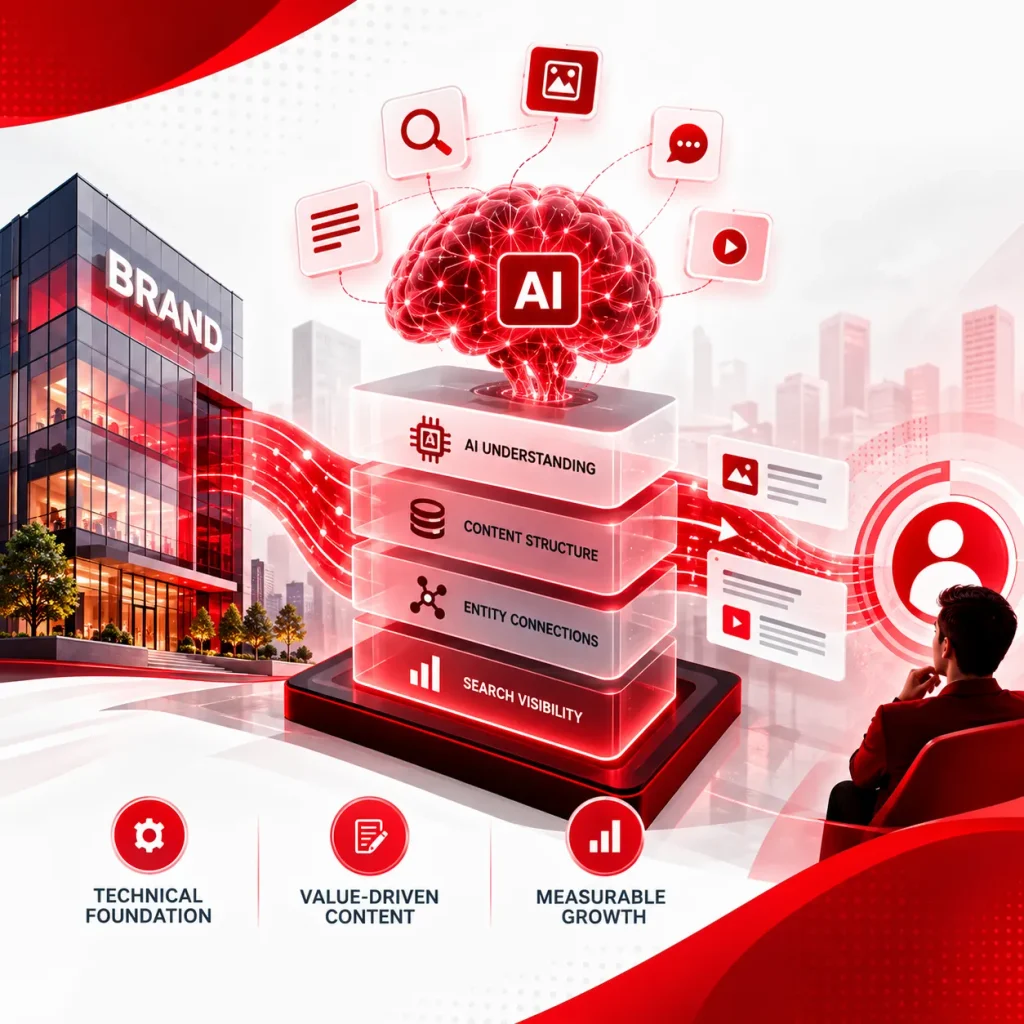
The framework is not a one-time checklist. It is an operating model.
Why Enterprise SEO Needs an Intelligence-Led Approach
Scale
Enterprise websites can contain enormous quantities of information. Manual analysis alone becomes difficult when thousands or millions of URLs, entities, queries, and relationships are involved.
An intelligence-led approach can help identify patterns that are difficult to see through isolated audits.
A Moving AI Target
Search interfaces, retrieval methods, answer formats, and AI behaviors continue to evolve.
That means enterprise strategy cannot depend entirely on fixed rules. Organizations need systems for monitoring change and adapting their information architecture accordingly.
Automation Plus Human Oversight
Automation can identify patterns, process large datasets, monitor changes, and accelerate repetitive analysis.
Human expertise remains essential for business context, editorial judgment, brand governance, accuracy, and strategic decisions.
The strongest model combines both.
How ThatWare Builds the AI Layer
From Conventional SEO to Hyper-Intelligence SEO
ThatWare approaches enterprise search as a broader intelligence problem rather than a collection of isolated optimization tasks. Its stated approach combines search intelligence, semantic analysis, entity understanding, AI systems, and advanced optimization frameworks to help brands become more understandable across modern search environments.
The process begins with Ecosystem Intelligence.
1. Ecosystem Intelligence
ThatWare analyzes the broader search and AI ecosystem around a brand. This includes understanding competitors, search behavior, content environments, relevant entities, and the ways information is surfaced across discovery systems.
2. Digital Footprint Analysis
The next stage evaluates the organization’s digital footprint.
Content, entity authority, semantic relationships, technical signals, and information consistency are examined as parts of a connected ecosystem rather than isolated assets.
3. AI Interpretation Analysis
ThatWare studies how intelligent systems may interpret, summarize, connect, and represent information associated with a brand.
This helps identify potential gaps between what the organization intends to communicate and what machine intelligence can confidently understand from the available signals.
4. Semantic and Entity Engineering
The information ecosystem is then examined through an entity and semantic lens.
Relevant entities, relationships, terminology, attributes, and topical connections are strengthened so that the organization can establish clearer machine-readable context.
5. AEO, GEO, and LLM Optimization
ThatWare applies its broader optimization frameworks to address multiple layers of modern search and AI discovery.
The objective is to improve how brand information can be retrieved, interpreted, represented, and surfaced across different search experiences.
6. Hyper-AI Content Intelligence
Content is evaluated as part of an interconnected knowledge system.
Instead of focusing only on individual page optimization, the approach considers content relationships, intent coverage, semantic depth, authority signals, and the information required to answer meaningful customer questions.
7. Continuous AI Search Monitoring
The environment is monitored continuously to identify changes in visibility, interpretation, entity associations, source presence, and emerging search behavior.
8. Strategic Optimization Loop
The insights feed back into strategy.
Content, technical architecture, semantic relationships, entity signals, and AI visibility can then be refined as the search ecosystem changes.
This is the central ThatWare perspective: enterprise SEO is not simply about making a website rank. It is about engineering the information ecosystem through which intelligent systems understand and represent a brand.
Common Enterprise SEO Mistakes in the AI Search Era
Treating AI as Just Another Keyword
AI search is not simply a new keyword category. It changes how information can be retrieved, interpreted, summarized, and presented.
Organizations that treat AI visibility as an extension of conventional keyword targeting may overlook the deeper information architecture required.
Publishing Without Semantic Structure
More content does not automatically create more authority.
If content is disconnected, repetitive, contradictory, or poorly organized, increasing volume can make the information ecosystem harder to interpret.
Ignoring Entity Consistency
Different departments may describe the same product, service, executive, location, or capability in inconsistent ways.
Without consistent entity signals, machine interpretation can become less precise.
Optimizing Only for Rankings
Rankings remain valuable, but they are not the entire discovery experience.
A brand may need to understand how it is represented in answers, summaries, comparisons, and conversational discovery—not only where individual pages rank.
Forgetting Technical Foundations
AI-oriented strategies still depend on accessible, crawlable, structured, and technically sound information.
Advanced concepts cannot compensate for fundamental discoverability problems.
Measuring Activity Instead of Understanding
Publishing frequency, keyword counts, and page volume can be easy to report.
But enterprise leadership needs to know whether these activities are improving discoverability, understanding, qualified demand, and business outcomes.
Building an Adaptable Enterprise SEO Strategy
A practical enterprise model can be organized around seven connected stages:
Discover → Map → Engineer → Author → Optimize → Monitor → Adapt
Discover
Identify customer intent, search behavior, important topics, entities, competitors, existing authority, and information gaps.
Map
Connect topics, entities, content assets, customer journeys, and business priorities into a coherent information model.
Engineer
Strengthen technical architecture, semantic relationships, internal linking, structured information, taxonomy, and machine-readable signals.
Author
Create useful, accurate, evidence-based information that addresses meaningful customer questions and reinforces the organization’s expertise.
Optimize
Refine pages, entities, content relationships, technical signals, and AI discovery opportunities based on observed performance.
Monitor
Track conventional search performance alongside emerging AI visibility and representation signals.
Adapt
Use new data to update strategy continuously.
This model turns enterprise SEO from a campaign into an evolving operating system for digital discovery.
The Future of Enterprise SEO: From Search Optimization to Search Engineering
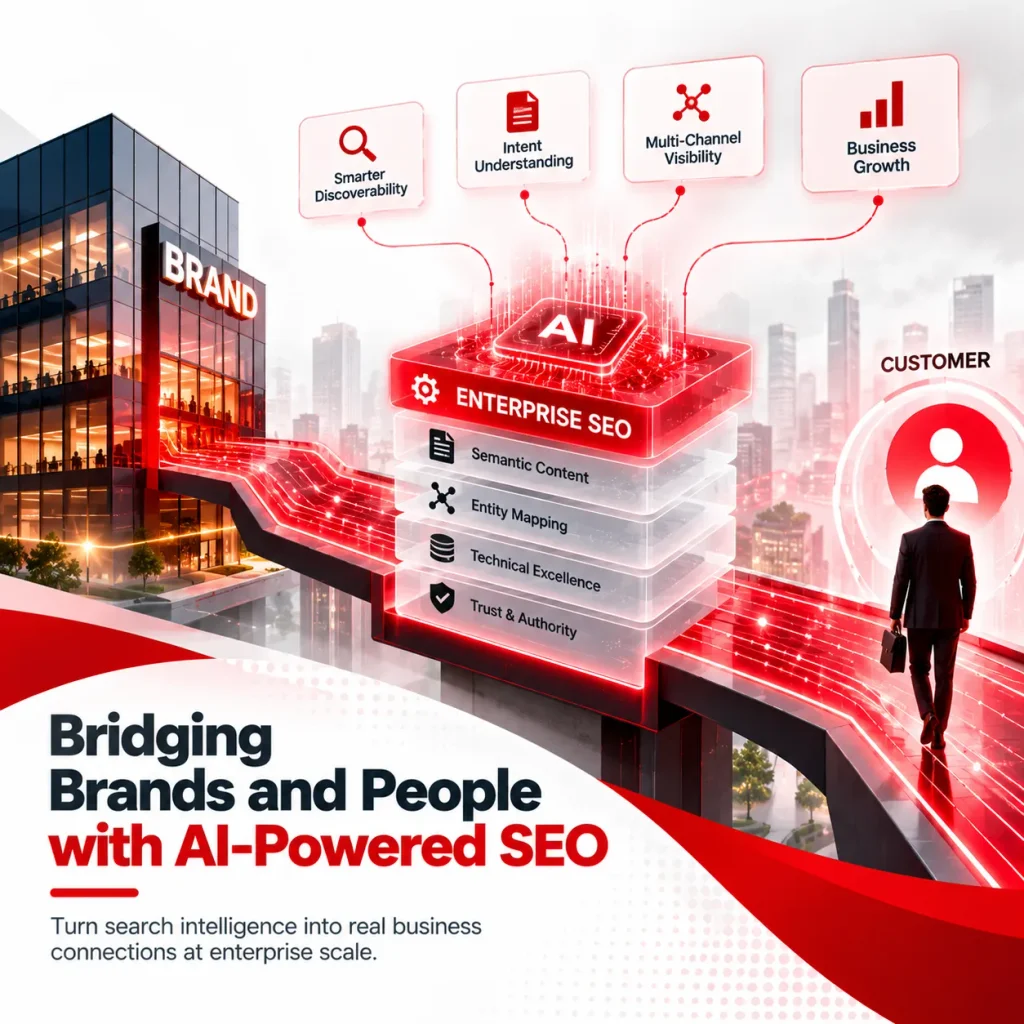
The next phase of enterprise SEO will be less about optimizing isolated assets and more about engineering the relationships between information, intent, entities, technology, and intelligent systems.
This is a fundamental conceptual shift.
Search optimization traditionally focused on helping pages become visible. Search engineering focuses on making an entire information ecosystem understandable, retrievable, and useful.
This does not make traditional SEO irrelevant. It expands the discipline.
The future enterprise SEO team may need to think simultaneously like a technical strategist, information architect, content strategist, data analyst, and semantic engineer. It will need to understand not only how search engines crawl pages, but how intelligent systems construct meaning from distributed information.
That broader discipline is where Large Language Model SEO becomes relevant. Large language models operate across language, context, relationships, and patterns, making it increasingly important for enterprise brands to structure information in ways that support accurate machine interpretation.
At the same time, Generative AI SEO reflects a wider shift toward optimizing brand information for generative discovery experiences. The focus is not simply on being indexed, but on being meaningfully represented when users seek synthesized answers.
Enterprise search will therefore become increasingly interconnected with knowledge engineering.
Build the Layer AI Uses to Understand Your Brand
The relationship between a brand and its customer is no longer always direct.
Between a customer’s question and a brand’s website, there may now be retrieval systems, semantic interpretation, AI-generated answers, summaries, comparisons, and recommendation layers.
That changes the enterprise SEO mandate.
Brands need to make their information discoverable. But they also need to make it understandable. They need coherent entities, connected topics, useful content, strong technical foundations, clear semantic relationships, and continuous visibility intelligence.
The organizations that approach this systematically can move beyond the old question of “How do we rank this page?” and ask a more strategic question:
“How do we make our entire digital ecosystem understandable to the intelligence systems shaping customer discovery?”
That is the emerging role of enterprise SEO.
It is not simply about rankings.
It is about building the information layer through which a brand is discovered, interpreted, evaluated, and ultimately considered.
And as intelligent search becomes a more significant interface between people and information, that layer may become one of the most important parts of the enterprise digital strategy.