SUPERCHARGE YOUR ONLINE VISIBILITY! CONTACT US AND LET’S ACHIEVE EXCELLENCE TOGETHER!
The Future of AI Search Is Not Measurement. It Is Prediction.
Introduction
For years, digital marketing has been obsessed with measurement.
How many rankings?
How much traffic?
How many backlinks?
How much visibility?
Even modern AI search measurement systems have largely followed the same philosophy.
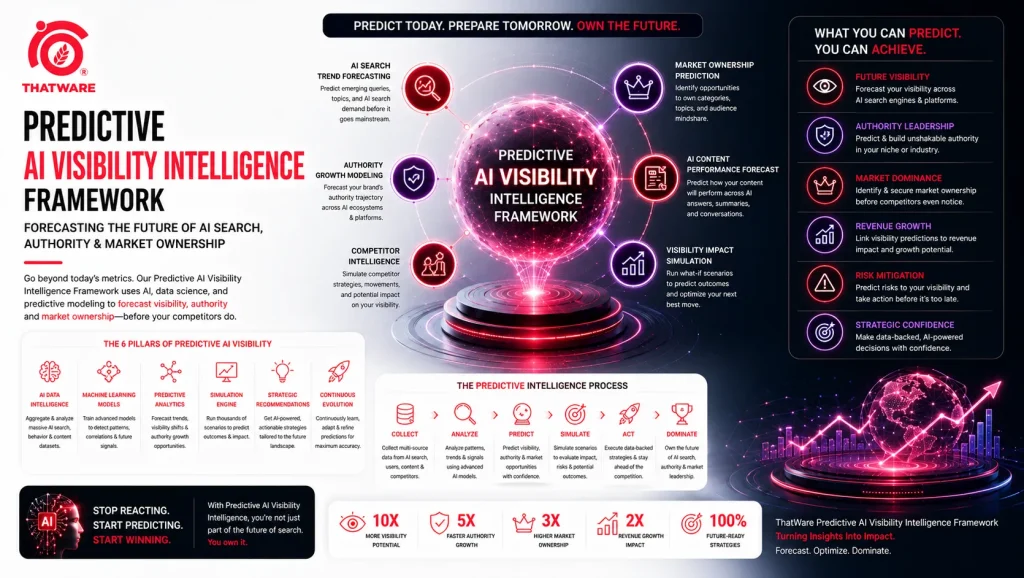
They measure what already happened.
But the future belongs to organizations that can answer a different question:
What will happen next?
This question changes everything.
Knowing where your brand stands today is useful.
Knowing where your brand will stand six months from now is transformational.
That is the purpose of Predictive AI Visibility Intelligence.
It represents the next evolution of AI search optimization.
Not descriptive.
Not diagnostic.
Predictive.
Where AVM measures current visibility, Advanced AVM Intelligence measures current influence, and VEM measures current understanding, Predictive AI Visibility Intelligence forecasts future AI recommendation behavior.
In other words:
It helps organizations understand where AI search is heading before it gets there.
The Evolution of AI Search Measurement
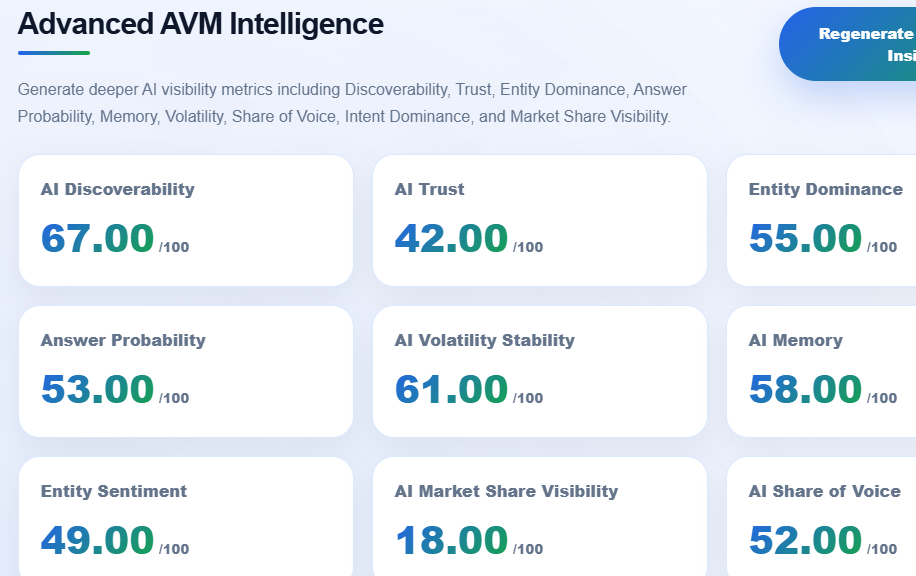
This dashboard expands beyond traditional AI visibility measurement and introduces a suite of Advanced AVM Intelligence Metrics designed to evaluate how AI systems perceive, remember, trust, and recommend a brand across a broad range of conversational and search scenarios. These advanced indicators provide a deeper understanding of a brand’s competitive position within AI-powered ecosystems and help identify the specific factors influencing recommendation behavior.
The strongest-performing metric is AI Discoverability (67/100), indicating that ThatWare is relatively easy for AI systems to identify and surface across relevant search topics. This aligns with the previously observed strong Presence Score and confirms that the brand has established a meaningful footprint within AI-generated responses.
AI Volatility Stability (61/100) and AI Memory (58/100) suggest that the brand maintains a moderately stable presence across different AI interactions and retains a reasonable level of recognition over time. These metrics are particularly important because AI-generated outputs can vary significantly based on prompt structure, context, and data availability. Higher stability and memory scores indicate stronger entity reinforcement and more predictable AI visibility performance.
Entity Dominance (55/100) and Answer Probability (53/100) reveal that the brand is beginning to establish itself as a recognized entity within its category but has not yet achieved dominant recommendation status. AI systems acknowledge the brand’s relevance, but there remains substantial room to increase recommendation frequency and category leadership.
The AI Share of Voice (52/100) score further reinforces this position. While the brand has secured a measurable presence within AI conversations, it is not yet commanding a majority share of recommendations compared to competing entities. Increasing content depth, authority signals, and third-party validation can help improve this metric over time.
The dashboard also highlights two notable growth opportunities. AI Trust (42/100) indicates that AI systems require stronger supporting evidence before consistently recommending the brand with high confidence. Similarly, Entity Sentiment (49/100) suggests that brand perception within AI-generated responses remains neutral-to-positive but could be strengthened through broader authority building, customer success narratives, thought leadership, and industry recognition.
The most significant opportunity lies within AI Market Share Visibility (18/100). This metric measures the proportion of AI-generated recommendations and visibility captured relative to the broader competitive market. The low score indicates that although the brand is visible, a significant share of AI attention remains concentrated among competing entities. Improving this metric typically requires a combination of stronger authority, broader citation coverage, increased recommendation frequency, and enhanced category ownership.
Collectively, these advanced metrics provide a strategic roadmap for evolving from basic AI visibility toward true AI market leadership. They reveal not only whether AI systems recognize a brand, but also how deeply that recognition translates into trust, memory retention, recommendation preference, and market influence.
The journey looks something like this:
Traditional SEO
↓
Rankings
↓
Visibility
↓
AI Visibility
↓
AI Intelligence
↓
Entity Intelligence
↓
Predictive Intelligence
The first era focused on pages.
The second focused on entities.
The third will focus on prediction.
The Four Layers of AI Search Intelligence
Before understanding Predictive AI Visibility Intelligence, it is important to understand how it differs from previous frameworks.
| Framework | Primary Question |
|---|---|
| AVM | Can AI see me? |
| Advanced AVM Intelligence | How much influence do I have? |
| VEM | Does AI understand me? |
| Predictive AI Visibility Intelligence | What will AI do next? |
Each layer solves a different problem.
The Predictive Intelligence Architecture
Unlike visibility metrics, predictive intelligence for future AI Search Visibility evaluates directional movement.
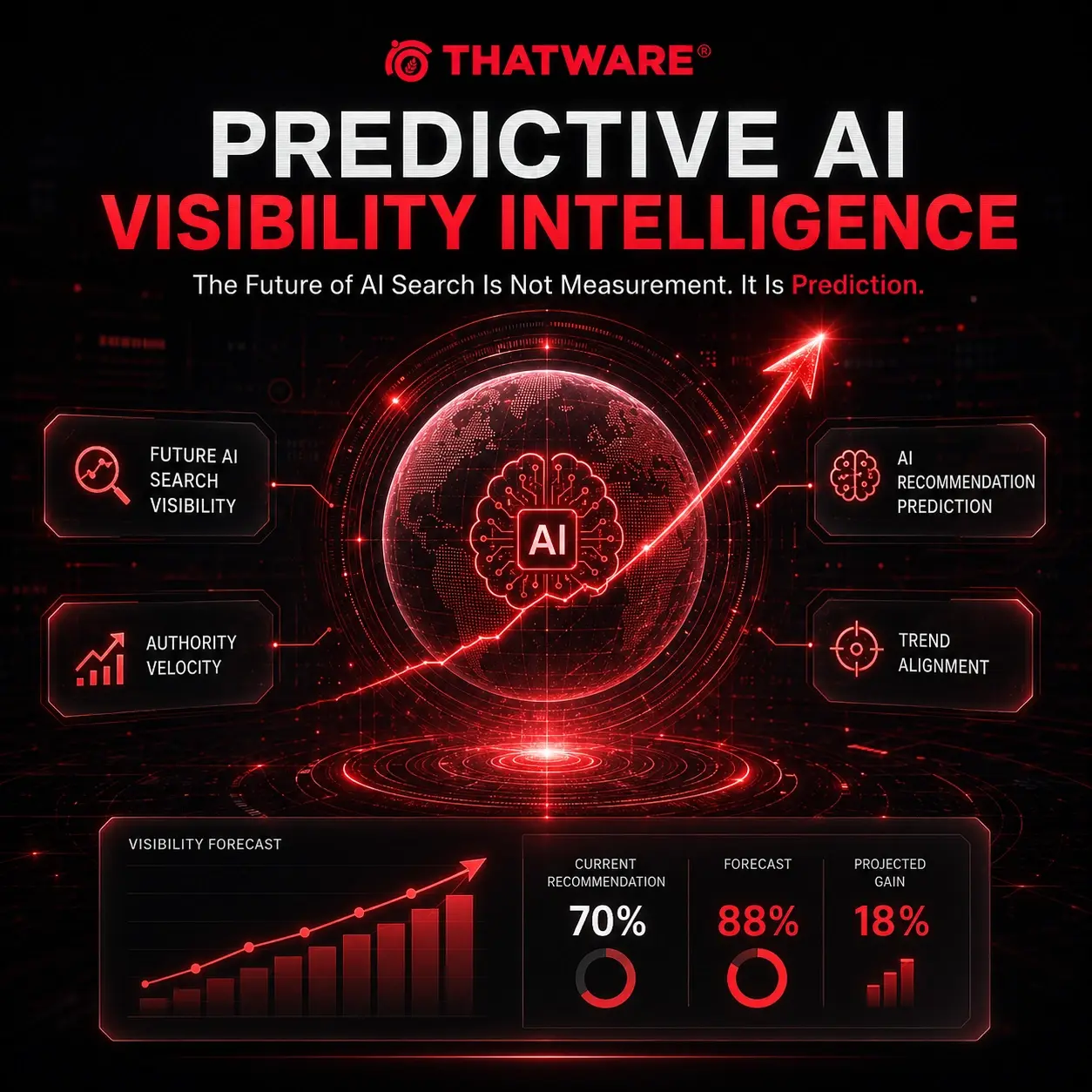
It attempts to forecast future AI recommendation prediction patterns.
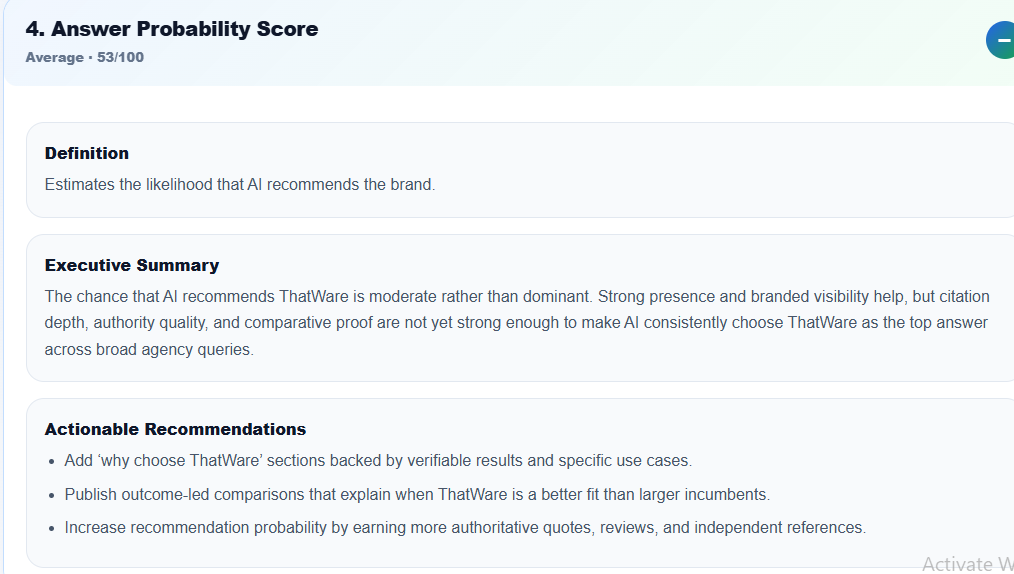
Answer Probability is one of the most commercially important AI visibility metrics because it directly measures recommendation potential. While discoverability determines whether a brand can be found and entity dominance measures topical ownership, answer probability focuses on the ultimate outcome: whether AI systems actually choose to recommend the brand when users ask for solutions, service providers, or industry leaders.
Current Visibility
↓
Current Influence
↓
Current Entity Strength
↓
Trend Analysis
↓
Growth Analysis
↓
Prediction Engine
↓
Future Recommendation Forecast
↓
Market Ownership Projection
This transforms AI visibility into a future-facing business asset.
KPI 1: AI Recommendation Momentum (ARM)
What Is AI Recommendation Momentum (ARM)?
AI Recommendation Momentum (ARM) measures how quickly recommendation frequency is growing.
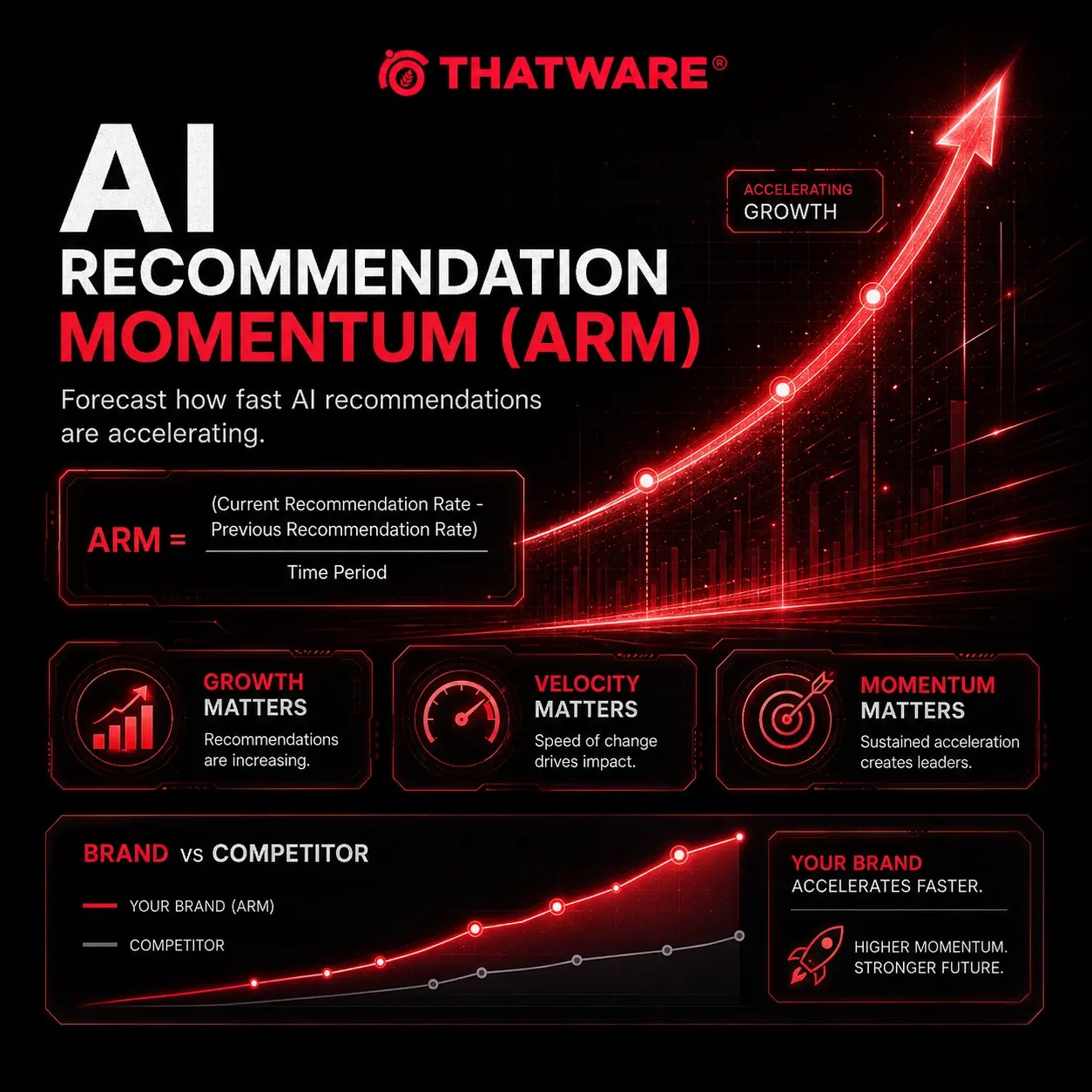
Most organizations only measure recommendation volume.
Momentum measures acceleration.
A brand growing from 5% to 15% recommendation frequency is often more dangerous than a competitor sitting at 25%.
Growth matters.
Velocity matters.
Momentum matters.
Why It Matters
Momentum often predicts future market leadership.
Many category leaders were not leaders initially.
They simply grew faster.
Formula
ARM
=
(
Current Recommendation Rate
–
Previous Recommendation Rate
)
÷ Time Period
Example
| Month | Recommendation Rate |
|---|---|
| January | 10% |
| February | 15% |
| March | 22% |
| April | 31% |
| Metric | Value |
|---|---|
| Starting Recommendation Rate | 10% |
| Ending Recommendation Rate | 31% |
| Momentum Formula | (31 – 10) ÷ 4 |
| Momentum Score | 5.25 |
| Assessment | Strong momentum |
Flowchart
Recommendation Data
↓
Growth Tracking
↓
Acceleration Analysis
↓
Momentum Score
KPI 2: AI Category Leadership Score (ACLS)
What Is AI Category Leadership Score (ACLS)?
This Predictive AI SEO metric estimates the probability of becoming a category leader. Not current leader but the future leader.
Why It Matters
Leadership rarely happens overnight.
It develops through:
- Visibility growth
- Trust growth
- Authority growth
- Citation growth
ACLS measures those trends.
Formula
ACLS=(Visibility Growth+Trust Growth+Authority Growth+Citation Growth)÷4
| Metric | Growth |
| ———- | —— |
| Visibility | 20 | | Trust | 15 | | Authority | 25 | | Citations | 18 | |
Result | Value |
| ——————– | ————————- |
| Average Growth Score | 19.5 | |
Assessment | High leadership potential |
Flowchart
Growth Signals
↓
Leadership Factors
↓
Competitive Benchmarking
↓
Leadership Probability
KPI 3: AI Competitive Displacement Score (ACDS)
What Is AI Competitive Displacement Score (ACDS)?
AI Competitive Displacement Score (ACDS) measures the ability to replace competitors inside AI-generated answers.
This is one of the most powerful predictive metrics.
Why It Matters
The future is not about appearing.
The future is about replacing.
Example:
Yesterday:
Competitor AToday:
Competitor A+Your BrandTomorrow:
Your BrandThat is displacement.
Formula
ACDS=(Competitor Mentions Lost+Your Mentions Gained)÷ Total MentionsExample
Competitor loses:
300 mentions
You gain:
500 mentions
Industry mentions:
5000
Result:
16%

Flowchart

Competitor Analysis
      ↓
Mention Changes
      ↓
Replacement Tracking
      ↓
Displacement Score
KPI 4: AI Authority Velocity Score (AAVS)
What Is AI Authority Velocity Score (AAVS)?
AI Authority Velocity score (AAVS) measures how quickly authority is increasing. Authority itself is historical. Velocity is predictive.
Why It Matters
Fast-growing authority often precedes recommendation growth.
Formula
AAVS=Authority Growth÷ Time
| Month | Authority |
| ----- | --------- |
| Jan | 40 |
| Apr | 70 |
| Velocity Analysis | Value |
| ------------------ | ----------------------------- |
| Starting Authority | 40 |
| Ending Authority | 70 |
| Formula | (70 - 40) ÷ 3 |
| Velocity Score | 10 |
| Assessment | Strong authority acceleration |Flowchart
Authority Signals
↓
Growth Tracking
↓
Velocity Calculation
↓
Authority Forecast
KPI 5: AI Trend Alignment Score (ATAS)
What Is AI Trend Alignment Score (ATAS)?
AI Trend Alignment Score (ATAS)Measures how closely the brand aligns with emerging AI search trends.
Example Topics
- Agentic Search
- AI Search
- GEO
- AEO
- AI Discovery
- LLM Optimization
- AI Commerce
Why It Matters
AI systems often favor brands aligned with emerging categories.
Formula
ATAS
=
Trend Relevance
+
Trend Coverage
+
Trend Authority
÷3
Flowchart
Industry Trends
↓
Brand Analysis
↓
Topic Alignment
↓
Trend Score
KPI 6: AI Future Recommendation Probability (AFRP)
What Is AI Future Recommendation Probability (AFRP)?
AI Future Recommendation Probability (AFRP) is the advanced AVM measured current recommendation probability. AFRP predicts future recommendation probability. This is a major distinction.
Formula
AFRP=(Momentum+Authority Velocity+Trend Alignment+Trust Growth)÷4Example
Current recommendation:
70%
Forecast:
88%
Projected recommendation gain:
18%
Flowchart
Current Signals
↓
Growth Models
↓
Trend Models
↓
Forecast Engine
↓
Future Probability
KPI 7: AI Resilience Index (ARI)
What Is AI Resilience Index (ARI)?
AI Resilience Index (ARI) measures the ability to survive future AI model updates. Think of it as Google’s Core Update Resistance for AI ecosystems.
Why It Matters
AI models evolve continuously.
Brands dependent on weak signals often disappear.
Resilient brands endure.
Formula
ARI=(Entity Strength+Citation Diversity+Authority Stability+Trust Persistence)÷4
Flowchart
Entity Analysis
↓
Authority Review
↓
Update Simulation
↓
Resilience ScoreKPI 8: AI Market Ownership Score (AMOS)
What Is AI Market Ownership Score (AMOS)?
AI Market Ownership Score (AMOS) is the highest-level metric in the framework. It measures whether a brand owns a category. Not visibility. Not mentions. Just the Ownership.
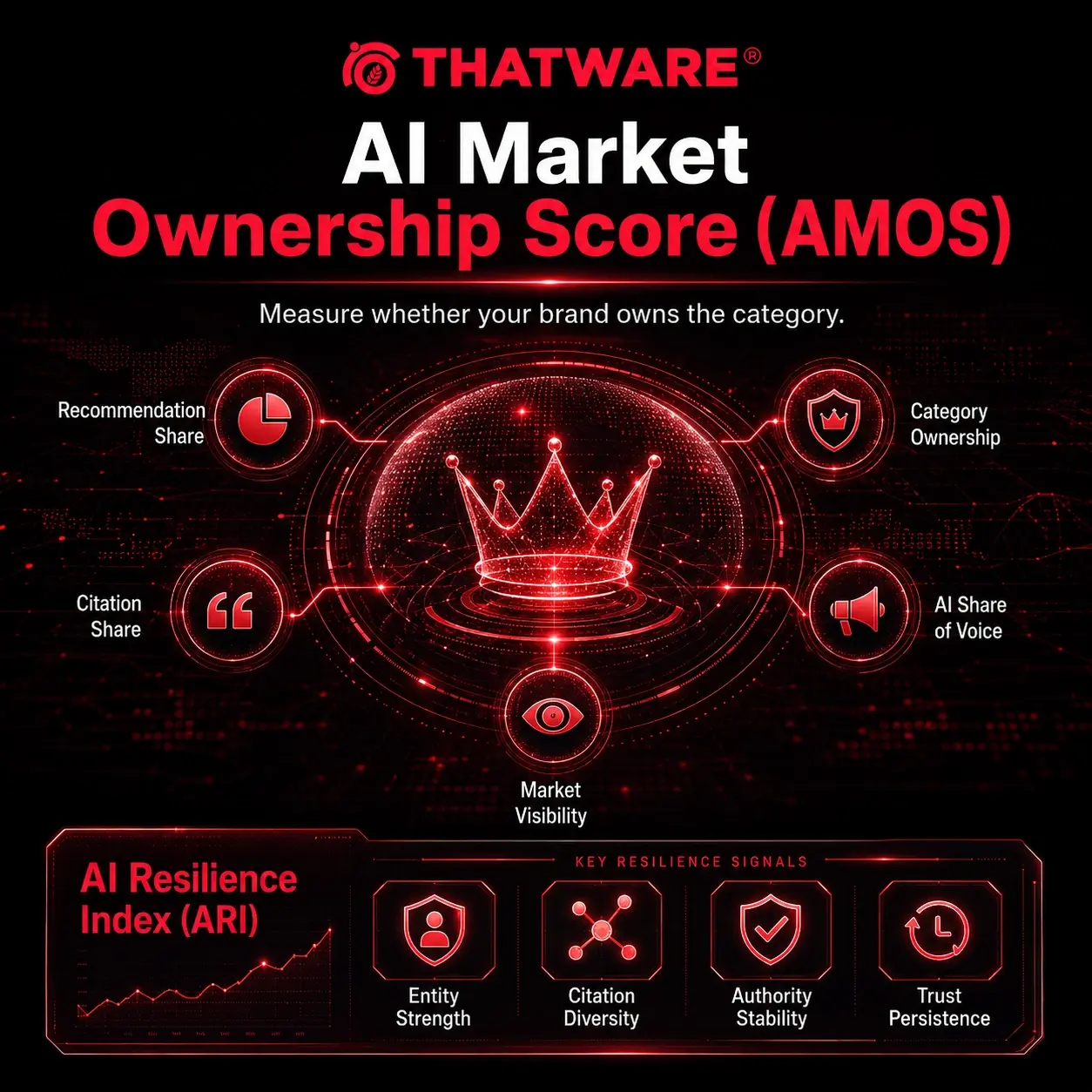
Components
- Recommendation Share
- Citation Share
- Category Association
- AI Share of Voice
- Market Visibility
Formula
AMOS
=
(
Recommendation Share
+
Citation Share
+
Category Ownership
+
SOV
+
Visibility
)
÷5
| Metric | Score |
|---|---|
| Recommendation Share | 85 |
| Citation Share | 80 |
| Category Ownership | 90 |
| SOV | 75 |
| Visibility | 88 |
| Result | Value |
|---|---|
| Overall Score | 83.6 |
Flowchart
Visibility
↓
Trust
↓
Authority
↓
Recommendations
↓
Category Ownership
↓
AMOS
Additional Elite Metrics
For enterprise versions, additional predictive signals may include:
AI Opportunity Gap Score
Measures untapped visibility potential.
AI Growth Potential Score
Forecasts future visibility ceiling.
AI Saturation Index
Measures category saturation risk.
AI Threat Index
Predicts competitive threats.
AI Innovation Alignment Score
Measures readiness for future AI search ecosystems.
Enterprise Applications
Enterprise Brands
Forecast category leadership.
Investors
Identify future market leaders.
Agencies
Predict client growth trajectories.
SaaS Companies
Track recommendation acceleration.
Ecommerce Brands
Forecast AI-driven product discovery.
Public Companies
Monitor AI market influence.
Why Predictive Intelligence Matters
Most companies react.
Elite organizations anticipate.
That is the difference.
When everyone else measures visibility after it happens, predictive intelligence helps forecast it before it happens.
The Future of AI Search
The future search ecosystem will not simply answer:
What is visible?
It will answer:
What is becoming important?
AI systems increasingly reward:
- Momentum
- Growth
- Authority acceleration
- Emerging trends
- Entity maturity
The organizations that understand these patterns first will gain disproportionate advantages.
Final Conclusion
Predictive AI Visibility Intelligence represents the next evolution of AI search measurement.
AVM measures visibility.
Advanced Elite AVM Intelligence measures influence.
Predictive AI Visibility Intelligence measures future outcomes.
It transforms AI visibility from a reporting system into an AI Visibility forecasting system.
The goal is no longer to understand where a brand stands today.
The goal is to understand where it will stand tomorrow.
In a future dominated by AI-driven discovery, prediction may become more valuable than visibility itself.
And the brands that can forecast their future AI influence before competitors do may ultimately become the brands that own the next generation of search.