SUPERCHARGE YOUR ONLINE VISIBILITY! CONTACT US AND LET’S ACHIEVE EXCELLENCE TOGETHER!
Redefining the role of SEO beyond traffic to strategic authority
Search isn’t what it used to be—and neither is visibility.
A few years ago, “winning” in SEO often meant a familiar checklist: find the right keywords, publish optimized pages, build links, climb the rankings, and watch traffic rise. It worked because the digital ecosystem rewarded signals that were relatively easy to engineer and relatively predictable to measure.
But the landscape has shifted.
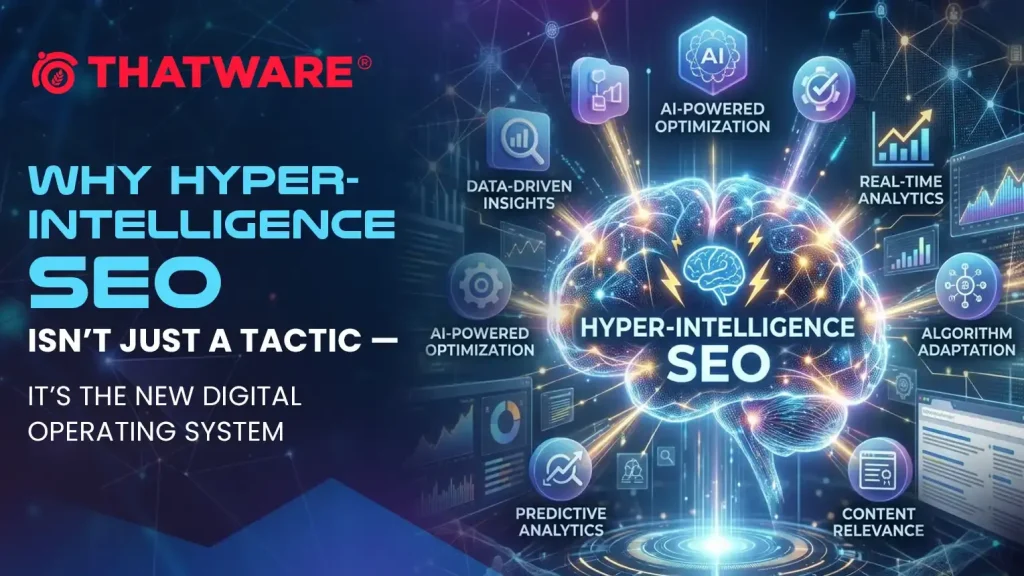
Today, search is fragmented across Google’s evolving SERPs, AI-driven answer engines, social discovery, marketplaces, and “zero-click” experiences where users get what they need without ever visiting a website. Algorithms don’t just scan for keywords anymore—they interpret context, evaluate trust, map entities, measure engagement quality, and infer credibility from a web of signals that extends far beyond your page.
That’s why traditional SEO—when treated as a standalone marketing tactic—starts to feel like trying to run a modern business on an outdated operating system. You can keep installing small upgrades, but the core architecture wasn’t built for the way digital authority is assessed now.
This is where Hyper-Intelligence SEO changes the conversation.
Hyper-Intelligence SEO isn’t “SEO + AI” or a shiny new set of hacks. It’s a system-level approach that treats SEO as the operating system of digital authority—the layer that coordinates your content, data, user intent, brand trust signals, and adaptive learning loops into one integrated engine.
Instead of asking, “How do we get more traffic?” Hyper-Intelligence SEO asks bigger questions:
- How do we become the most trusted source in our niche?
- How do we build search visibility that compounds instead of spikes?
- How do we turn every piece of content into an authority asset—not just a page that ranks?
In this new era, traffic is only one outcome. Authority is the foundation. And Hyper-Intelligence SEO is the infrastructure that builds it.
What “Hyper-Intelligence SEO” Actually Means
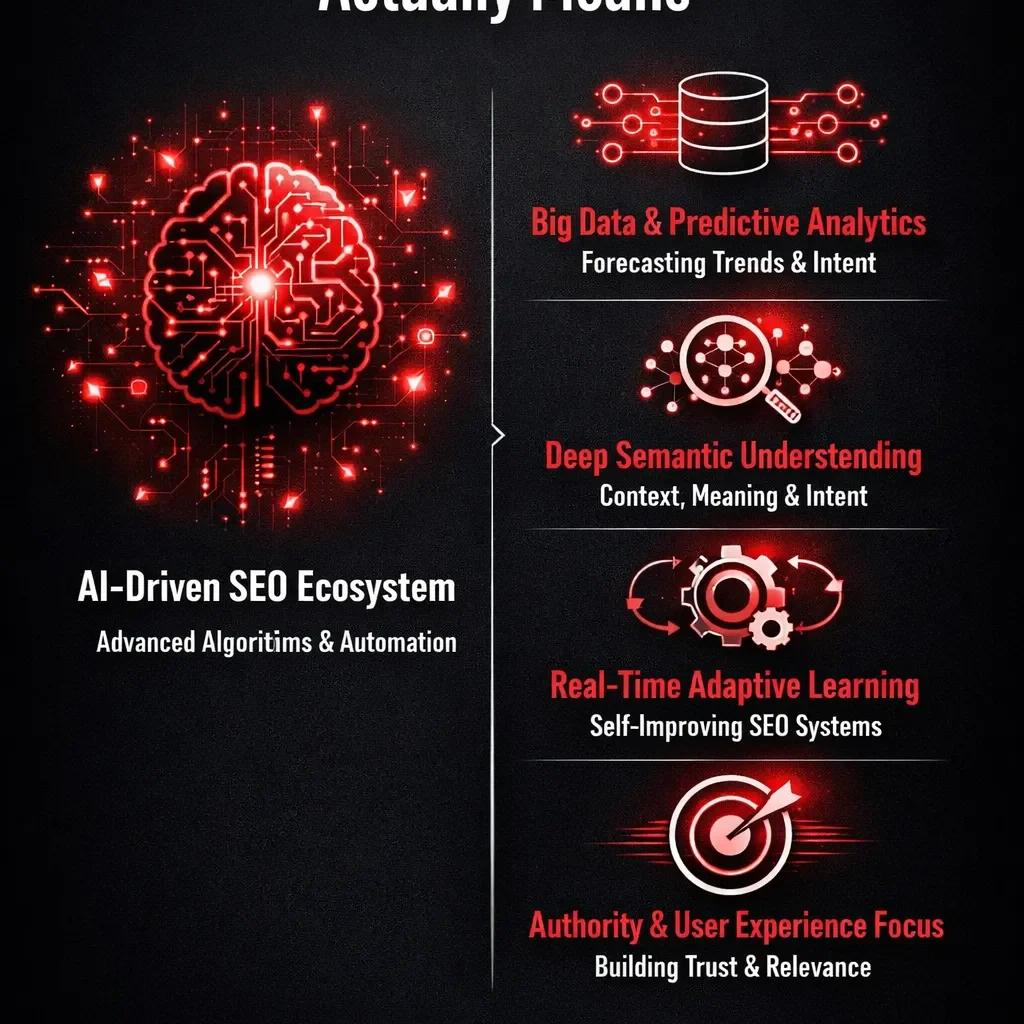
Hyper-Intelligence SEO is not an incremental improvement on traditional SEO practices—it is an entirely new ecosystem-level approach to search visibility and digital authority. At its core, Hyper-Intelligence SEO integrates AI, machine learning, natural language processing (NLP), big data analytics, and predictive intelligence into a unified system that continuously learns, adapts, and evolves.
Unlike legacy SEO, which often operates through static checklists—optimize keywords, build links, fix technical issues—Hyper-Intelligence SEO functions more like a living system. It connects multiple data layers: user behavior, search intent patterns, semantic relationships, content performance, market signals, and algorithmic feedback loops. These layers work together to generate insights that are not just reactive, but anticipatory.
The goal is no longer to “optimize pages,” but to engineer relevance and authority at scale. Hyper-Intelligence SEO understands why users search, how their intent evolves, and what signals search engines and AI-driven answer systems use to assess trust, expertise, and contextual value.
This is where it fundamentally differs from both traditional SEO and basic AI-powered SEO:
- Traditional SEO relies heavily on manual rules, historical best practices, and static ranking factors.
- Basic AI SEO may automate tasks like content generation or keyword clustering, but it often lacks deep contextual understanding and strategic intelligence.
- Hyper-Intelligence SEO, in contrast, combines automation with cognition—using AI not just to execute tasks, but to interpret meaning, predict outcomes, and guide strategic decisions.
In short, Hyper-Intelligence SEO is not a toolset—it is an operating ecosystem designed to build durable digital authority.
Why Traditional SEO Is No Longer Enough
Search engines have fundamentally changed. Modern search systems no longer reward pages simply because they contain the “right” keywords or a large volume of backlinks. Today, they prioritize intent, context, empathy, and experience—signals that reflect how well a brand actually serves users, not just algorithms.
Search algorithms now evaluate:
- Whether content satisfies real user intent, not just query matching
- How information fits into a broader semantic and topical ecosystem
- Engagement quality, trust signals, behavioral patterns, and experiential value
- Contextual relevance across devices, locations, and moments in the user journey
Traditional SEO struggles here because it was designed for a rules-based web, not an intelligence-driven one.
Even many AI-assisted SEO approaches fall short. Basic automation can generate content faster or optimize metadata at scale, but without understanding deeper semantic, emotional, and behavioral signals, these efforts often produce only short-lived gains. Rankings spike temporarily, then decline as algorithms detect shallow value, redundancy, or lack of genuine authority.
This is why brands that rely solely on legacy tactics or surface-level AI tools experience volatility instead of sustainability.
Hyper-Intelligence SEO addresses this gap by shifting focus from optimization to understanding. It deciphers how users think, how intent evolves, and how authority is perceived across the digital ecosystem. Instead of chasing algorithm updates, it aligns with the underlying intelligence of search itself.
In a search landscape driven by meaning rather than mechanics, traditional SEO is no longer sufficient. Only an intelligent, adaptive, and system-level approach can deliver lasting visibility—and that is precisely where Hyper-Intelligence SEO begins.
The Operating System Metaphor — Why This Matters
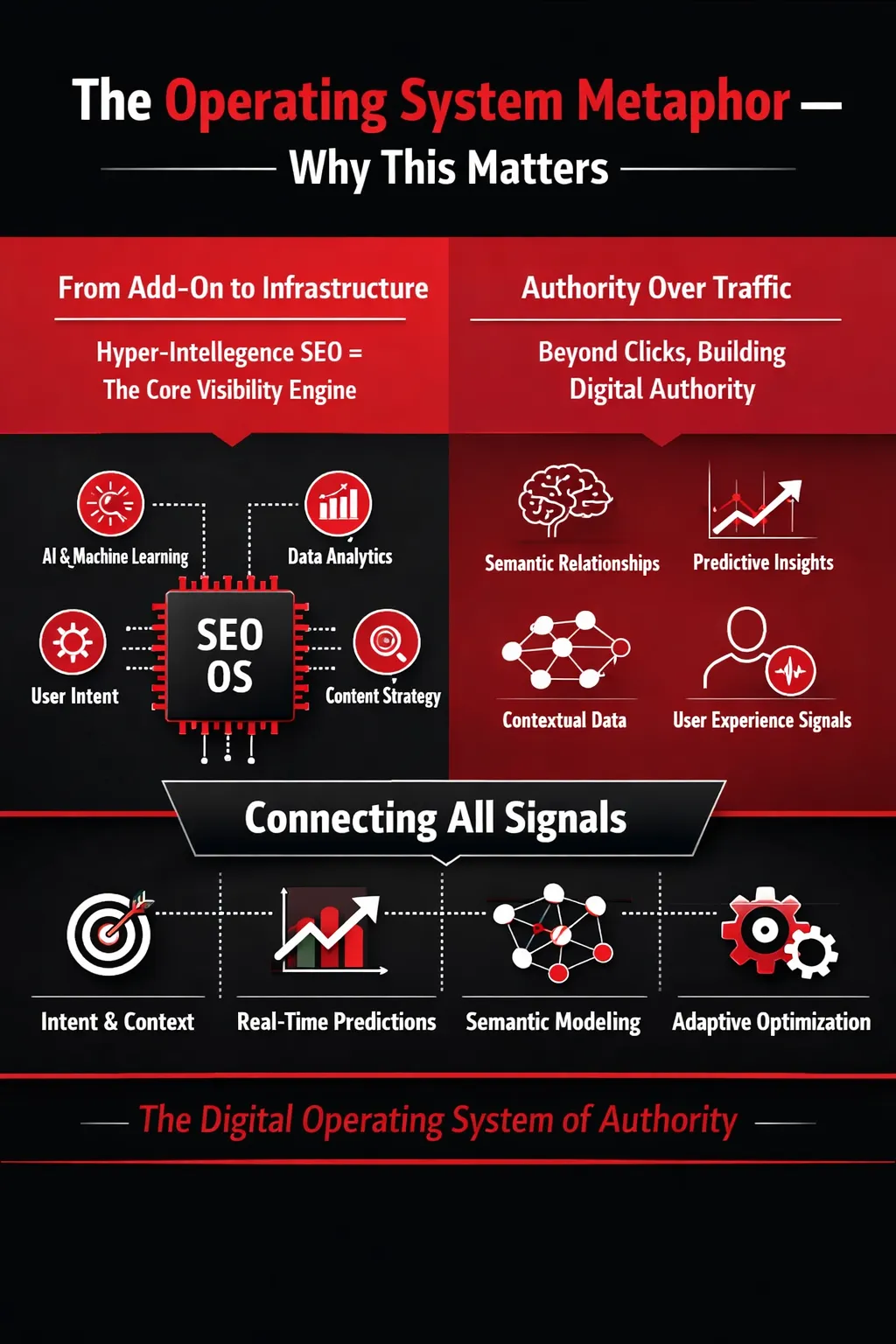
From Add-On to Infrastructure
For years, SEO has been treated like an add-on—something bolted onto marketing after websites, content, and campaigns were already built. It lived in silos: keyword research here, on-page optimization there, backlinks somewhere else. Useful, yes—but optional, reactive, and often disconnected from the core business strategy.
Hyper-Intelligence SEO fundamentally changes this role.
It is no longer a peripheral tactic; it becomes the core infrastructure that runs the entire digital visibility engine—much like an operating system runs a computer.
Just as an OS coordinates hardware, software, memory, and processes, Hyper-Intelligence SEO coordinates:
- Data sources (search behavior, user journeys, engagement signals, competitive intelligence)
- Predictive models (future intent, trend forecasting, demand shifts)
- User understanding (context, psychology, intent depth, experience signals)
This “OS layer” works in real time, continuously learning, adapting, and optimizing. Instead of SEO reacting after rankings drop or traffic declines, Hyper-Intelligence SEO proactively guides decisions across content creation, UX design, technical architecture, and even brand messaging—before problems or opportunities fully surface.
In this model, SEO is no longer something you do periodically.
It is something your digital ecosystem runs on.
Authority Over Traffic
Traditional SEO success has long been measured by traffic—sessions, clicks, impressions. But traffic alone is just a metric, not a moat. It can spike today and disappear tomorrow with a single algorithm shift.
Digital authority, on the other hand, is an ecosystem.
Hyper-Intelligence SEO prioritizes authority over raw volume by structuring and aligning multiple layers of signals, including:
- Content depth and coherence (not just keywords, but meaning and topical completeness)
- User context (why users search, what they expect next, and how they behave afterward)
- Semantic relationships (entity connections, topical authority, and knowledge graph alignment)
- Predictive behavior patterns (anticipating intent rather than reacting to it)
When these elements work together, they send powerful signals—not just to traditional search engines, but also to AI-driven answer systems, generative search models, and future discovery platforms.
In this ecosystem:
- Traffic becomes a by-product of authority, not the goal
- Rankings follow relevance, trust, and systemic understanding
- Brands are recognized not just as pages, but as credible sources of knowledge
Hyper-Intelligence SEO doesn’t chase clicks.
It builds a self-reinforcing authority framework where visibility, trust, and relevance compound over time—exactly how a true operating system should function.
Pillars of Hyper-Intelligence SEO as a Digital Operating System
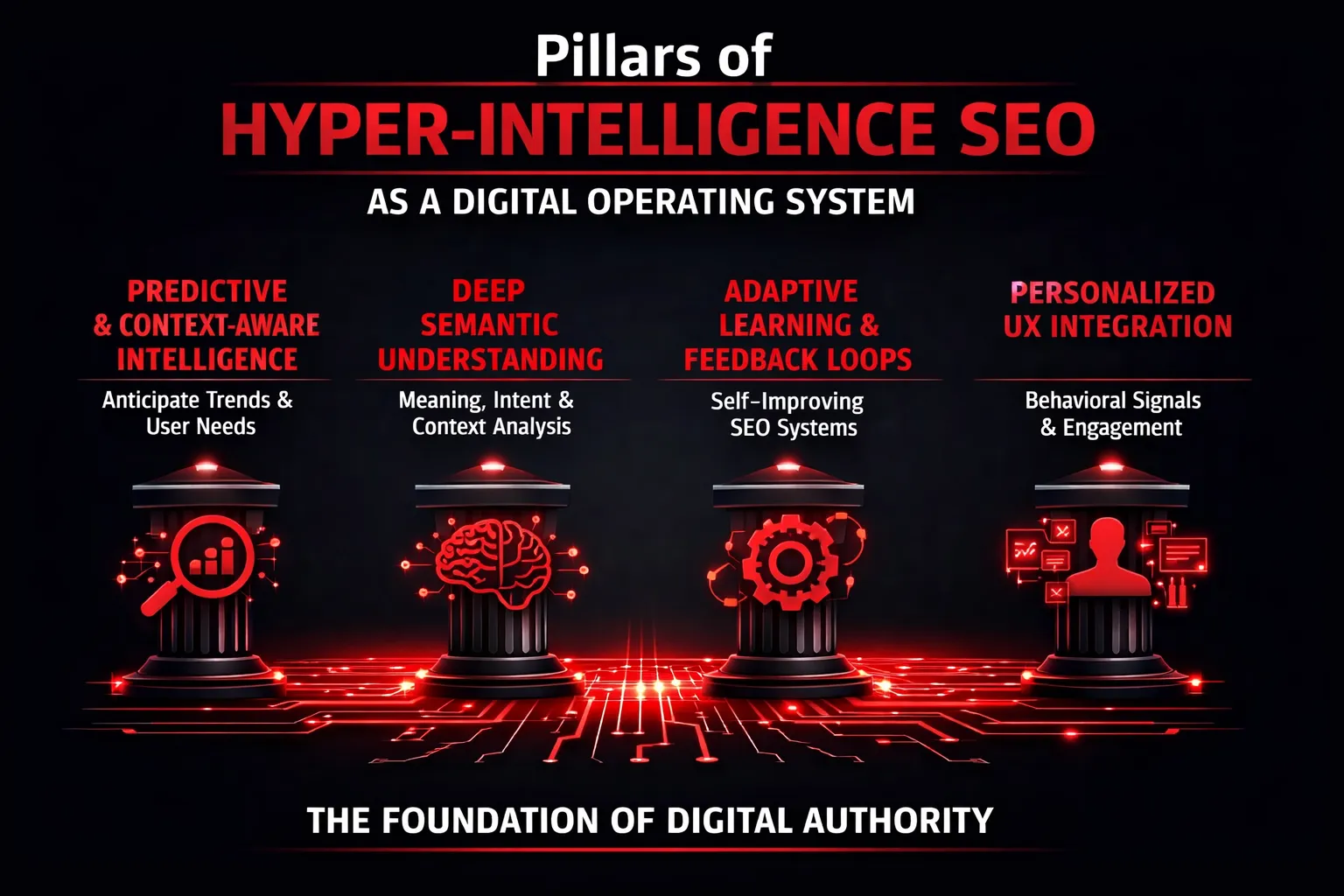
If Hyper-Intelligence SEO is the operating system of digital authority, then its pillars are the core processes running continuously in the background—analyzing, learning, adapting, and optimizing visibility at a systemic level. Unlike traditional SEO, which operates through isolated tasks and periodic updates, Hyper-Intelligence SEO functions as a living, self-evolving intelligence layer that governs how a brand is understood, trusted, and prioritized by search engines and AI systems.
Let’s break down the four foundational pillars that make this possible.
Predictive & Context-Aware Intelligence
Traditional SEO is reactive. It waits for trends to emerge, rankings to fluctuate, or competitors to move first. Hyper-Intelligence SEO, by contrast, is predictive by design.
This pillar leverages historical data, behavioral signals, search pattern modeling, and intent forecasting to anticipate what users will search for before they consciously search for it. Instead of chasing keywords after they peak, Hyper-Intelligence SEO positions brands ahead of demand curves.
Context awareness plays a critical role here. The system doesn’t analyze queries in isolation—it evaluates:
- User journey stages
- Temporal signals (seasonality, news cycles, industry shifts)
- Micro-intent variations across devices, locations, and behaviors
As a result, content, architecture, and optimization strategies are aligned not with static keywords, but with future intent trajectories. This transforms SEO from a ranking race into a strategic foresight engine.
Deep Semantic Understanding
Keywords are no longer the language of search engines—meaning is.
Hyper-Intelligence SEO operates on deep semantic modeling, moving far beyond keyword density or exact-match optimization. This pillar focuses on understanding:
- Entities and entity relationships
- Conceptual depth within topics
- Searcher psychology and intent layers
- Contextual relevance across content ecosystems
Instead of asking, “What keyword should we rank for?”, the system asks,
“What does the user truly mean, and how comprehensively do we answer that meaning?”
Through semantic graphs, NLP, and contextual clustering, Hyper-Intelligence SEO builds topical authority ecosystems rather than isolated pages. This enables search engines—and increasingly AI answer systems—to recognize a brand as a source of truth, not just a content publisher.
In this model, rankings become a by-product of understanding, not the primary goal.
Adaptive Learning & Feedback Loops
An operating system that doesn’t learn eventually becomes obsolete. Hyper-Intelligence SEO avoids this by embedding adaptive learning and continuous feedback loops into its core.
Using reinforcement learning principles, the system:
- Observes how users interact with content
- Measures engagement quality, not just clicks
- Tests variations in structure, depth, and delivery
- Learns which signals strengthen or weaken authority
Every interaction becomes training data. Every success or failure improves the system’s future decisions.
This creates self-improving SEO intelligence, where strategies evolve automatically based on real-world performance—not assumptions or outdated best practices. Unlike traditional SEO audits performed quarterly or annually, Hyper-Intelligence SEO is always optimizing, always learning.
Personalized UX Integration
User experience is no longer a separate discipline from SEO—it is a core authority signal.
Hyper-Intelligence SEO tightly integrates UX metrics into its authority-scoring framework. Behavioral signals such as:
- Engagement depth
- Scroll behavior
- Bounce and pogo-sticking
- Retention and repeat interaction
are not treated as secondary analytics, but as direct indicators of trust, relevance, and value.
This pillar ensures that SEO decisions are aligned with how real humans experience content—not just how algorithms parse it. Personalization further refines this process, adapting content presentation and information hierarchy based on user context and intent stage.
The result is a virtuous loop:
Better experience → stronger engagement → higher trust → increased authority → improved visibility
Why These Pillars Matter Together
Individually, each pillar adds value. Collectively, they form a digital operating system that governs authority, not just rankings.
Hyper-Intelligence SEO doesn’t optimize pages—it optimizes understanding.
It doesn’t chase traffic—it builds influence.
And it doesn’t run campaigns—it runs continuously evolving intelligence.
This is why Hyper-Intelligence SEO is not an upgrade to marketing.
It is the foundation upon which modern digital authority is built.
Real World Comparison: Tactics vs. Operating System
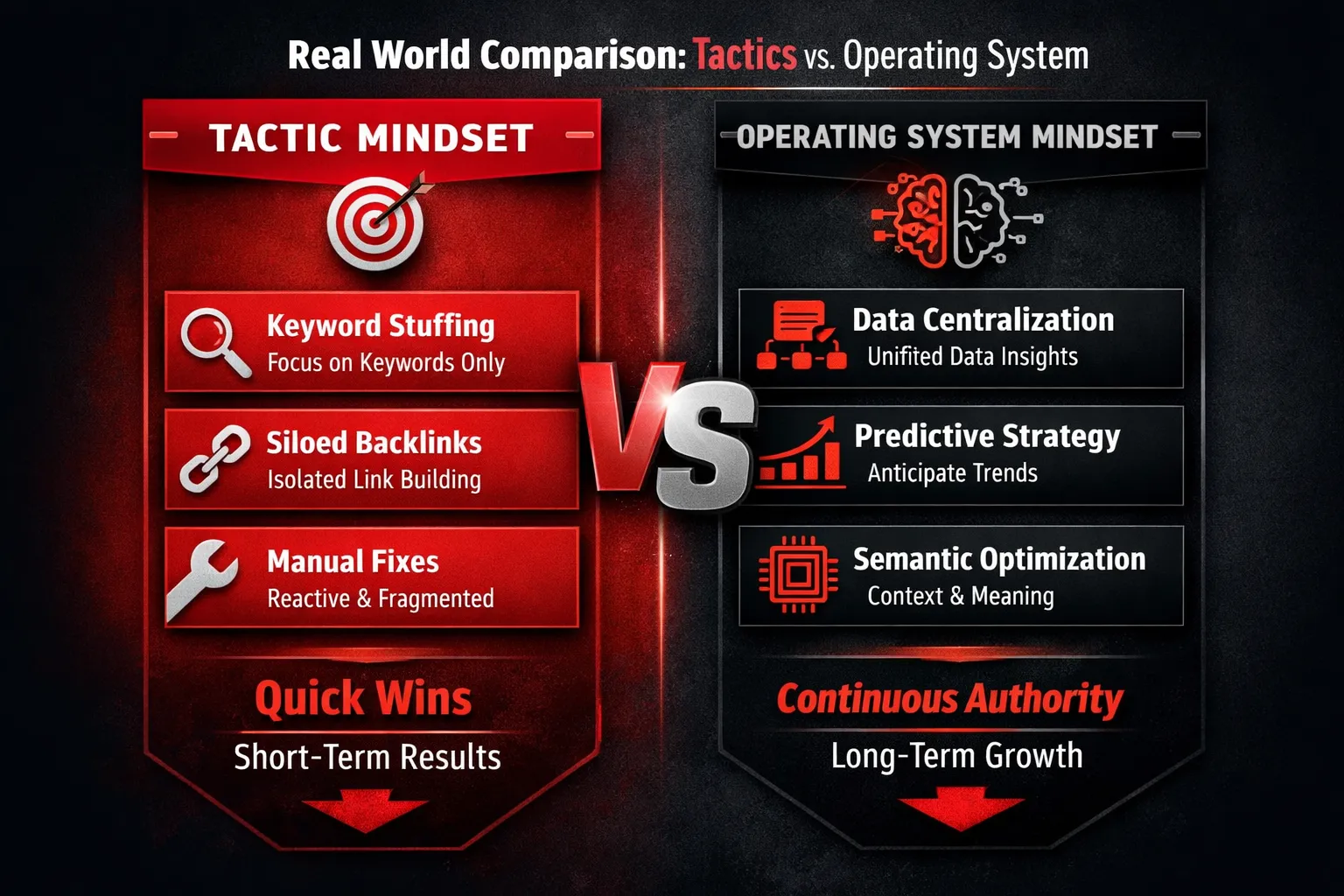
When you look at most SEO programs in the wild, you’ll notice two very different philosophies at play. One treats SEO like a bag of tricks you deploy to “win” rankings. The other treats SEO like a living system—an always-on engine that creates, measures, and compounds digital authority across channels, platforms, and search experiences.
The Tactic Mindset (SEO as a checklist)
The “tactic mindset” is built around isolated actions that aim for quick, visible outcomes—usually rankings and traffic. It’s not that these actions never work; it’s that they rarely scale into long-term authority because they’re disconnected from a unified intelligence layer.
1) Keyword stuffing (or “keyword-first” thinking)
This approach starts with a keyword and tries to force content to fit it.
- Content is written to include terms, not to solve intent.
- Pages become repetitive, shallow, and “optimized” in a way that feels mechanical.
- Results can be short-lived because the content doesn’t build trust signals: depth, expertise, satisfaction, and behavioral engagement.
In a hyper-intelligent search environment, keyword repetition is a weak signal compared to contextual relevance, semantic coverage, and user satisfaction patterns.
2) Siloed backlinks (link building without an authority model)
In tactic-led SEO, backlinks are often handled like a separate department: “We need 20 links this month.”
- Links are acquired without a strategy tied to brand entities, topical authority, or trust networks.
- The link profile might look “busy,” but it doesn’t necessarily strengthen the brand’s credibility graph.
- You end up with a fragile system: if links drop, rankings drop—because there was no deeper authority foundation.
This is where many sites plateau: they’re building signals, not building authority architecture.
3) Manual hedged strategies (reactive, patchwork SEO)
This is the classic cycle:
- Rankings drop → run an audit → fix random issues → publish more posts → buy links → repeat.
- Decisions are based on fear (“what if Google updates?”) rather than insight (“what does the market want next, and how do we own it?”).
- SEO becomes an endless loop of defensive actions.
The result is a scattered roadmap where effort increases, but outcomes don’t compound.
The Operating System Mindset (SEO as digital authority infrastructure)
The “operating system mindset” treats SEO as the core intelligence layer of digital growth. It doesn’t live in a corner of marketing—it connects product, content, UX, analytics, PR, and conversion strategy into one continuous, optimizing machine.
1) Data centralization (one source of truth for authority growth)
Instead of scattered tools and disconnected reporting, you build a centralized view of:
- Search demand + user intent signals
- Content performance + engagement behavior
- Entity visibility + topical coverage gaps
- Conversion paths + customer journey data
This transforms SEO from “publishing content” into running an insight engine. You’re not guessing what to write—you’re reading the market and responding with precision.
2) Predictive strategy (leading demand instead of chasing it)
Tactic SEO reacts after competitors move. Operating-system SEO forecasts:
- Emerging topics before they peak
- Shifting intent patterns (what people really want now)
- Content opportunities competitors haven’t structured yet
This is where authority compounds: you consistently arrive early with the best resource, so the market learns to associate your brand with that subject.
3) Semantic modeling (building meaning, not just pages)
Hyper-Intelligence SEO is not “make more blogs.” It’s organize knowledge like a brand-owned encyclopedia.
- Content is structured as a semantic ecosystem (topics → subtopics → entities → relationships).
- Pages support each other deliberately, like components of a system.
- You’re optimizing for how search engines interpret meaning, not how they count keywords.
This is how you become the source—not just a result.
4) Dynamic optimization (continuous improvement, not one-time fixes)
In an operating system model, SEO isn’t a “project.” It’s a feedback loop:
- Publish → measure behavior → detect gaps → adapt content → improve internal linking → refine UX → repeat
- Updates happen continuously based on real signals, not assumptions.
- The system learns, and performance compounds instead of resetting every quarter.
This is the biggest difference: tactics create spikes; systems create momentum.
The bottom-line difference
- Tactic mindset: “How do we rank for this keyword?”
- Operating system mindset: “How do we become the authority the web references for this topic—and keep strengthening it over time?”
That’s why Hyper-Intelligence SEO isn’t an upgrade to marketing. It’s the operating system that powers digital authority—because it connects every layer (data, intent, content, UX, trust, and optimization) into a single compounding engine.
Case Studies / Examples (Hypothetical or Conceptual)
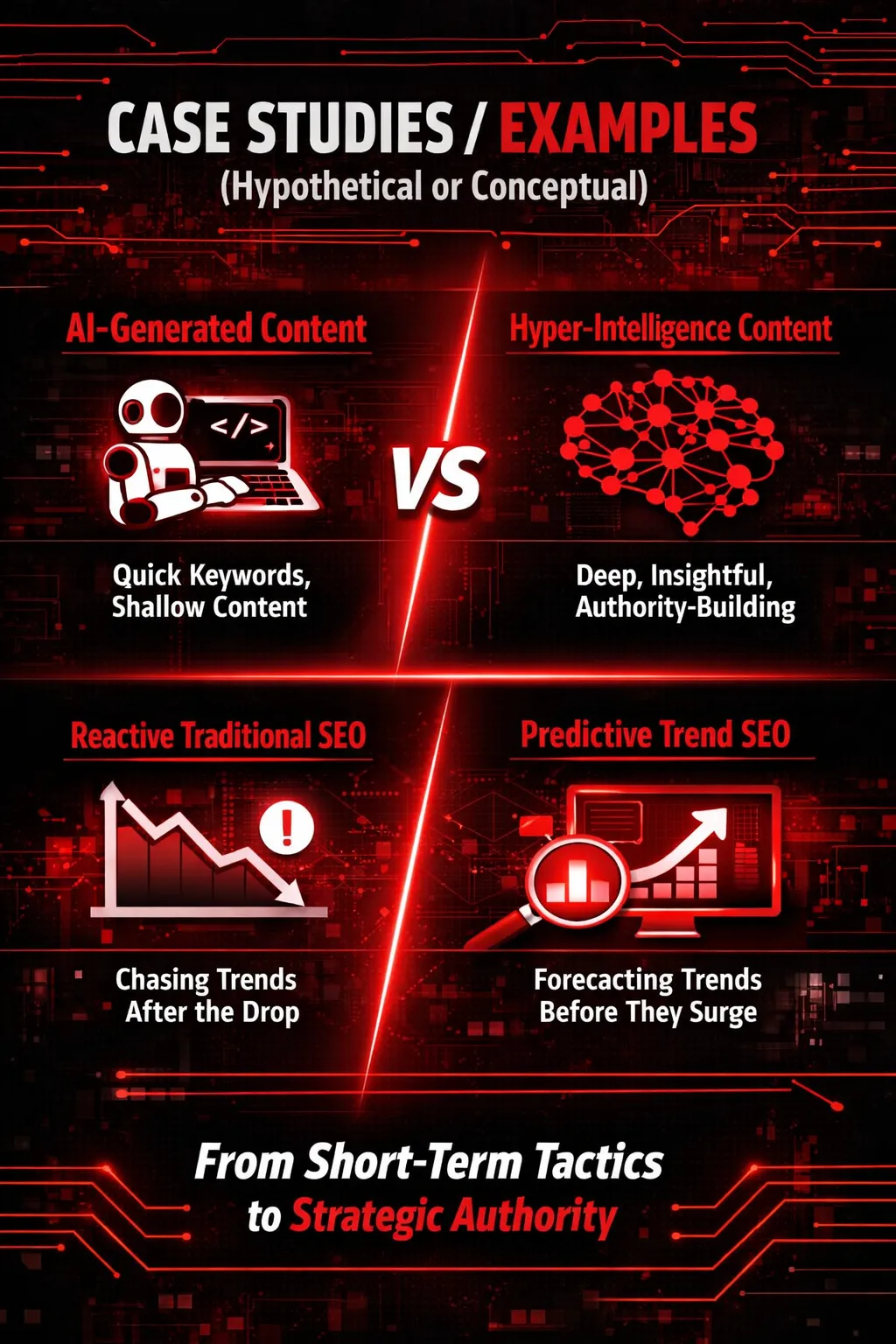
AI-Generated Content vs. Hyper-Intelligence Content
Scenario: A B2B SaaS brand wants to rank for “customer onboarding software” and related pain-point queries.
Example 1: “AI-Generated Content” approach (fast output, shallow authority)
The team prompts an AI tool: “Write a 2,000-word blog on customer onboarding software, include best practices and keywords.”
Within a week, they publish 10 similar articles:
- “Customer Onboarding Software: The Complete Guide”
- “Top 10 Onboarding Tools”
- “Onboarding Checklist Template”
- “How to Reduce Churn with Onboarding”
What it looks like in the wild:
- Reads clean, but feels generic—similar structure, similar phrasing, similar examples.
- Heavily optimized headings and keyword placements.
- Limited original insights: no proprietary data, no strong point of view, no lived experience.
- The content answers “what” but rarely nails the “why now” and “what should I do next?”
Short-term results (often):
- Some pages pick up impressions quickly.
- A few rank for long-tail keywords briefly.
- Traffic rises, but engagement metrics stay weak: quick bounces, low scroll depth, few conversions.
Why it struggles long-term:
Search systems increasingly reward distinctiveness and trust signals. If your content is “correct but replaceable,” you’re competing with thousands of “correct but replaceable” pages. The brand becomes searchable, but not authoritative.
Example 2: “Hyper-Intelligence Content” approach (AI precision + human insight + intent design)
Same brand. Different strategy: content isn’t a volume game—it’s an authority system.
They still use AI, but as an accelerator inside a bigger operating model:
Step 1: Intent map first (not keywords first)
They map what the searcher actually needs at each stage:
- Exploring: “What is onboarding friction?” “Why onboarding fails?”
- Comparing: “Onboarding software vs product tours” “best onboarding for SaaS”
- Implementing: “How to design onboarding flows” “time-to-value framework”
- Proving ROI: “Onboarding metrics” “reduce churn with onboarding”
Step 2: Add human insight + emotional resonance
They interview:
- 2 customer success leaders
- 1 product manager
- 3 customers who churned (or almost did)
Now the article includes:
- real objections (“we tried onboarding tools and adoption still didn’t change”)
- real constraints (dev bandwidth, fragmented analytics, stakeholder alignment)
- real stakes (frustration, pressure to reduce churn, fear of implementing the wrong tool)
Step 3: Build content as a decision system
Instead of “Top 10 tools,” they publish:
- “The Onboarding Maturity Model: 4 Stages + What to Fix in Each”
- “Time-to-Value Playbook: The 7 Micro-Moments That Decide Adoption”
- “Onboarding ROI Calculator + Benchmarks (with methodology)”
- “Implementation Blueprint: What To Configure First (and what to ignore)”
Step 4: Create reusable authority assets
They produce:
- a downloadable onboarding scorecard
- a template library
- a mini dataset from anonymized product events
- internal linking that behaves like a knowledge graph (not random “related posts”)
Long-term results (typical):
- Fewer posts, but stronger rankings that stick.
- More branded searches (“[brand] onboarding maturity model”).
- Higher conversion intent: demo requests, trial starts, email opt-ins.
- Citations, mentions, and “reference value” (people link because it’s useful, not because it exists).
The difference in one line:
AI-generated content optimizes for publishing. Hyper-Intelligence content optimizes for being the source.
Predictive Trend SEO vs. Reactive Traditional SEO
Scenario: An eCommerce brand sells ergonomic chairs. A competitor launches a new “kneeling chair” line and begins capturing demand.
Example 1: Reactive Traditional SEO (response after rankings/traffic drop)
The brand notices:
- Organic traffic is down 18% month-over-month
- “ergonomic chair for back pain” slipped from position 3 to 9
They respond with typical fixes:
- refresh title tags
- add more keywords
- publish a “Best Kneeling Chairs” post after noticing the competitor ranking
Problem: They’re already late.
Competitor has:
- early content
- early links
- early engagement signals
- established topical depth
Even if the brand catches up, they’re playing defense—patching leaks instead of building an engine.
Example 2: Predictive Trend SEO (Hyper-Intelligence systems anticipate shifts)
This brand runs a Hyper-Intelligence SEO operating layer that monitors early demand signals:
Signal sources (examples):
- Google Search Console query drift (new modifiers emerging)
- internal site search logs (“kneeling,” “active sitting,” “chair alternatives”)
- support tickets and chat topics (“hip flexor pain,” “posture devices”)
- TikTok/YouTube trend phrases and “why it works” narratives
- competitor content velocity and category expansion patterns
What the system detects early:
A rising cluster around:
- “active sitting chair”
- “kneeling chair for posture”
- “chair alternatives for back pain”
- “dynamic seating benefits”
What they do before rankings drop:
They publish an authority cluster designed for the next wave:
- Category explanation (education intent)
- “What Is Active Sitting? Benefits, Risks, and Who It’s For”
- Comparison (commercial investigation intent)
- “Kneeling Chair vs Ergonomic Chair: Which Solves Back Pain Better?”
- Use-case content (high conversion intent)
- “Best Chair for Long Hours When You Have Lower Back Pain (By Body Type)”
- Proof + differentiation (authority intent)
- “Posture Science: What Research Actually Says About Kneeling Chairs”
(with citations, expert commentary, and clear nuance)
- Product alignment without being salesy
- A “Find Your Fit” guide that recommends product types based on pain points, height, desk setup
Result:
When the trend peaks, they aren’t scrambling to participate—they already own the conversation and get rewarded as the “known entity” in that topic space.
The difference in one line:
Reactive SEO optimizes after reality changes. Predictive SEO helps shape reality before it fully arrives.
What This Means for Marketers & Businesses
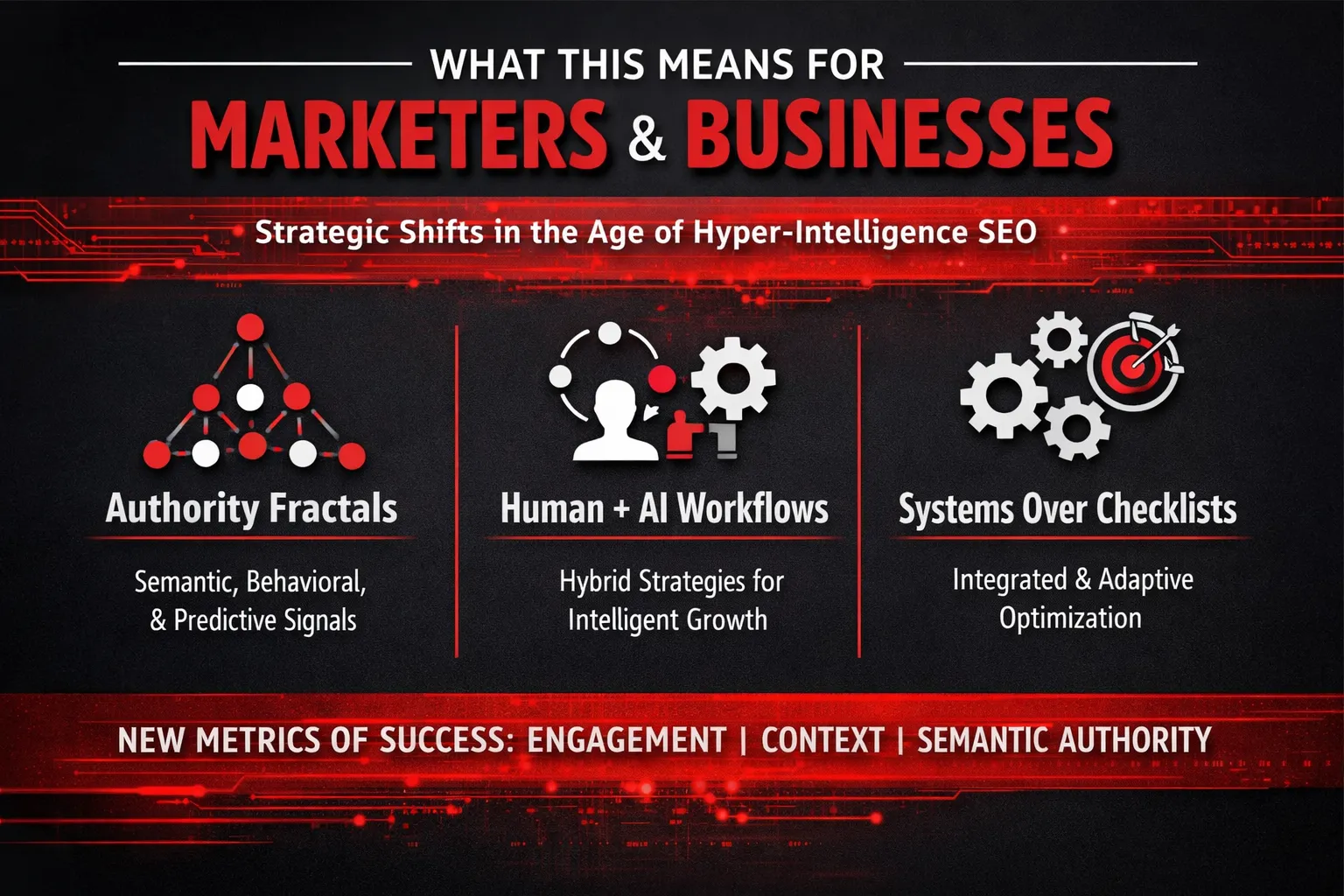
Strategic shifts you must embrace
1) Focus on authority fractals (semantic, behavioral & predictive signals)
If Hyper-Intelligence SEO is your “digital operating system,” then authority isn’t a single metric (like rankings). It’s a pattern that repeats across layers—what you say, how users respond, and what the market will want next.
- Semantic authority (meaning > keywords)
Hyper-Intelligence leans on NLP + semantic understanding to interpret context and intent, not just match phrases. That means your content must map the topic like a knowledge system: entities, relationships, subtopics, and “why/how/when” clarity—so both search engines and answer engines can trust you as a source.
- Behavioral authority (how audiences validate you)
Modern SEO performance increasingly hinges on whether the page satisfies intent (engagement, depth, task completion), not merely whether it ranks. Hyper-Intelligence explicitly emphasizes behavioral analysis and user interaction patterns as inputs for optimization decisions.
- Predictive authority (being early, not loud)
Predictive analytics is baked into the Hyper-Intelligence concept: forecasting trends/keywords before they peak and adapting in real time. This turns SEO from reactive publishing into proactive market positioning—where you own the conversation first, then capture demand.
Practical takeaway: treat every core topic like a “mini-ecosystem” with: (1) semantic coverage, (2) engagement proof, (3) forward-looking expansion.
2) Develop human–AI hybrid workflows
The winning workflow isn’t “AI writes, humans post.” It’s AI scales intelligence + humans add judgment.
A strong Hyper-Intelligence model positions AI engines as the layer that handles scale, speed, and data processing—while human strategists add empathy, real-world context, and creativity so the output actually resonates and earns trust.
A simple hybrid pipeline (you can implement fast):
- AI does: intent clustering, entity maps, gap analysis, outlines, draft variants, internal linking suggestions, schema candidates.
- Humans do: POV, examples, audience nuance, brand voice, credibility signals (experience, proof, constraints), and final editorial standards (what not to claim, what needs sources).
- Together: feedback loops—update content based on what users actually engage with, and what the SERP/AI answers start favoring.
3) Think in systems, not checklists
Checklist SEO is linear: keyword → page → links → done.
Operating-system SEO is circular: signal → learn → adapt → compound.
Hyper-Intelligence is described as an integration of AI, ML, NLP, and predictive analytics into a cohesive ecosystem that can interpret, learn, and adapt as behavior and algorithms change.
So instead of asking, “Did we optimize this page?” you ask:
- “Is our topic ecosystem complete and internally consistent?”
- “Do we have signal architecture to learn from behavior?”
- “Are we predicting demand and publishing ahead of it?”
- “Are we building trust as a repeatable system, not a one-off post?”
New success metrics (beyond rankings)
Rankings still matter, but they’re no longer the whole scoreboard—especially with AI-generated answers changing how visibility works.
Here are the metrics that better reflect digital authority:
- Engagement quality
Track depth signals: scroll depth, time-to-value, return visits, assisted conversions, engaged sessions per topic cluster (not per page).
- Context relevance (intent satisfaction)
Measure: “Did this page solve the job?” Use on-page micro-conversions (downloads, tool usage, demo clicks), and query-to-content match by intent group. Hyper-Intelligence explicitly prioritizes understanding nuanced intent via NLP.
- Inclusion in AI-generated answers (AEO / citation presence)
You’re optimizing not only to rank—but to be mentioned/cited inside AI answers (Google AI Overviews, ChatGPT-style discovery, etc.). This is the core idea behind Answer Engine Optimization: visibility in the answer itself, not just the link list.
Important measurement note: many standard analytics stacks under-report this visibility (e.g., AI Overview citations aren’t cleanly surfaced in Search Console), so you may need separate tracking.
- Semantic authority
Monitor growth in: number of entities you’re associated with, topical breadth/depth, internal link cohesion across clusters, and how consistently your brand appears across related queries.
Bottom line: Hyper-Intelligence SEO shifts marketers from “traffic acquisition” to “authority engineering”—where rankings are a byproduct of a system that learns, predicts, and earns trust at scale.
Challenges & Misconceptions
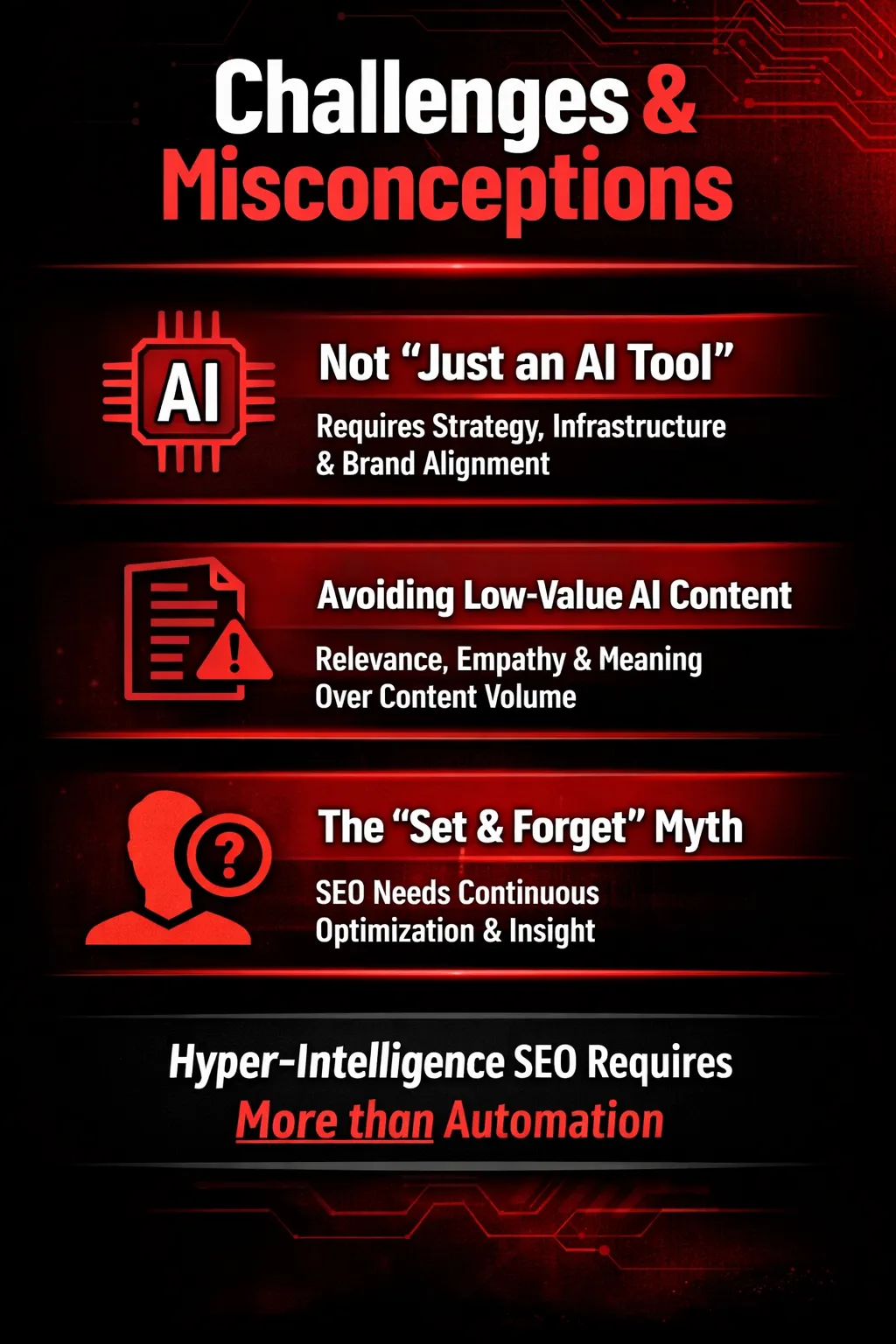
Hyper-Intelligence SEO is not “just an AI tool”
One of the biggest misconceptions is thinking Hyper-Intelligence SEO equals “we use AI, therefore we’re advanced.” In reality, Hyper-Intelligence is a system design problem—where AI is only one layer.
Why it’s more than tools:
- It needs strategic intent. Hyper-Intelligence is built to interpret why users search (intent), not just what they type. That requires a positioning-led content and experience strategy—otherwise you’re just automating noise.
- It needs infrastructure. Hyper-Intelligence works by integrating AI + ML + NLP + predictive analytics + real-time data, which implies a data ecosystem (Search Console, CRM insights, behavior analytics, content intelligence, entity/schema signals) rather than a single “AI writer” workflow.
- It must align with business goals. If your SEO “intelligence” isn’t in harmony with organizational objectives (revenue quality, pipeline, retention, brand trust), you’ll optimize for vanity metrics and short-term ranking spikes.
The practical risk: brands over-automate and mistake output volume for progress—while the real game is building authority, trust, and relevance as a compound asset.
Avoiding low-value AI content (and fixing the “AI content crisis”)
The “AI content crisis” isn’t that AI exists—it’s that the internet is filling up with content that’s fast, generic, and emotionally flat. When content lacks human nuance, it tends to underperform on engagement and trust—two things that increasingly define authority.
What Hyper-Intelligence does differently (and why it matters):
- Deep relevance beats volume. Hyper-Intelligence SEO is designed to align content with real intent and meaning (not just keyword matching), using NLP + context understanding so the page actually answers what the user needs.
- Empathy becomes an SEO advantage. Emotion-aware analysis (tone/sentiment/intent drivers) helps teams craft content that connects with what the user is feeling—not just what they’re searching. This is how you turn “content” into authority-building experiences.
- Human + machine is the safeguard. A hybrid model—machines for scale/data processing, humans for context, creativity, and empathy—reduces the risk of robotic, interchangeable pages and pushes toward content that “ranks and resonates.”
Quick guardrails to keep AI output high-value:
- Start with intent + audience state (confused? comparing? anxious? ready-to-buy?) before writing.
- Engineer topical authority (depth, entity coverage, internal logic) rather than publishing thin variants.
- Add lived context: examples, tradeoffs, constraints, and “what to do next” so it doesn’t read like a template.
Looking Ahead — The Future of Digital Authority
Search Engines Evolve
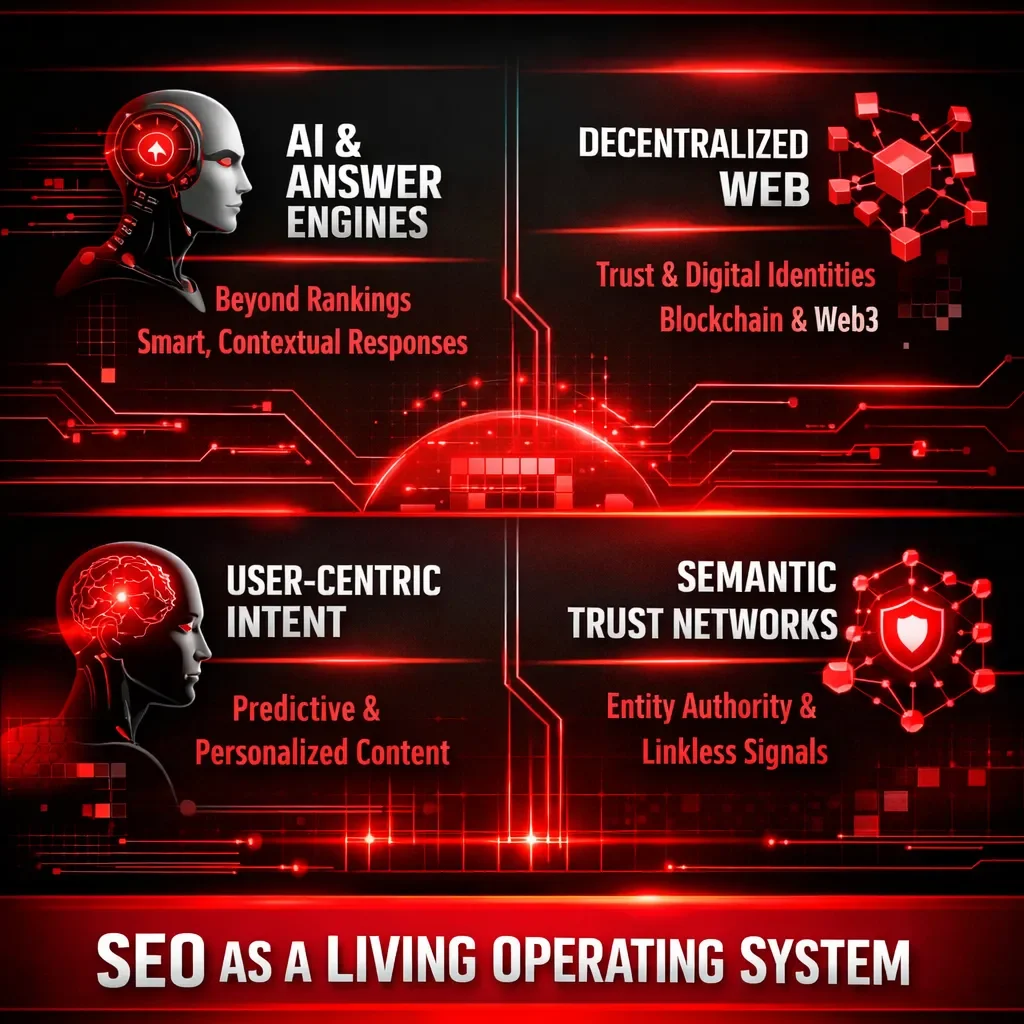
The biggest shift happening in search right now is this: search engines are moving from “ranking pages” to “generating answers.” Instead of ten blue links doing the heavy lifting, AI layers increasingly synthesize information before the click.
You can see this clearly in how Google is evolving AI Overviews into a more conversational, follow-up-friendly experience—pushing search toward “answer-first interfaces” rather than “results-first interfaces.” And it’s not just Google; Microsoft has been explicit that Bing’s generative search uses an LLM to understand the query, review large volumes of sources, and generate an answer-centric layout that helps users reach conclusions faster.
This evolution matters because it changes what “winning” looks like:
- Visibility is no longer guaranteed by rank alone. If an answer engine can satisfy the query without a click, then being #1 may not equal being the chosen source.
- Zero-click behavior becomes a normal default, not an edge case. Research and industry commentary increasingly frame this as a structural change in discovery—where AI summaries and LLM-based search journeys reduce the need to visit individual sites.
- Authority becomes machine-readable. Answer engines need to decide which sources to trust and cite—so clarity, entity recognition, structured data, and consistent expertise signals become the new gatekeepers of visibility.
This is exactly why Hyper-Intelligence SEO is positioned as “beyond AI” and “future-proof”—because it’s designed to be predictive and adaptive, not reactive to old ranking checklists. ThatWare’s framing emphasizes SEO evolving from rule-following into systems that can adjust “within seconds,” using predictive analytics and deep learning-driven segmentation.
SEO as a Living Operating System
In this new environment, SEO can’t stay boxed inside “marketing execution” (publish content, build links, track rankings). It becomes a living operating system—a continuously learning layer that connects market demand, user intent, content strategy, experience design, and brand credibility.
ThatWare’s “search intelligence” stance describes why: search engines now analyze context, behavior, entities, relationships, and intent, and discovery is shifting from “finding pages” to “understanding meaning.” This pushes SEO into a broader role:
- SEO becomes inseparable from brand visibility. Your brand must be present in the answer, not just present in results.
- SEO becomes inseparable from authority. The goal isn’t just attracting visits; it’s becoming the default trusted reference inside AI-generated summaries and decision moments—especially when clicks decrease.
- SEO becomes inseparable from strategy. Hyper-Intelligence reframes optimization as a system that unifies signals across the digital ecosystem (content engagement, user journeys, behavior patterns) and uses real-time + predictive feedback loops to guide decisions.
So when we say “SEO is a living operating system,” we mean:
it constantly listens (signals), interprets (intent + semantics), predicts (demand shifts), and adapts (content + UX + positioning)—so your brand stays authoritative even as the interface of search changes.
Conclusion
Hyper-Intelligence SEO is not a feature enhancement, a trend-driven upgrade, or a smarter version of traditional optimization. Treating it as a tactic limits its true potential. At its core, Hyper-Intelligence SEO represents a fundamental shift in how digital visibility, trust, and influence are built. It moves SEO out of the narrow lane of rankings and traffic and positions it as a strategic system that governs how brands are understood, trusted, and prioritized across evolving search ecosystems.
In a post-algorithm world—where AI-driven search engines, generative answers, and contextual intelligence shape discovery—authority is no longer won through isolated optimizations. It is earned through interconnected intelligence: semantic depth, predictive understanding of user intent, behavioral signals, and continuous learning loops. Hyper-Intelligence SEO functions as the digital operating system that orchestrates all these layers, ensuring that every piece of content, every user interaction, and every data signal reinforces long-term authority.
Brands that adopt this operating-system mindset are not reacting to algorithm updates; they are building self-sustaining ecosystems of relevance and trust. They don’t chase visibility—they architect it. And in doing so, they future-proof their digital presence, securing enduring authority that outlives platforms, algorithms, and short-term marketing tactics.