ThatX vs Traditional Search: From Links to Intelligent Discovery

ThatX vs Traditional Search: From Links to Intelligent Discovery

SUPERCHARGE YOUR Online VISIBILITY! CONTACT US AND LET’S ACHIEVE EXCELLENCE TOGETHER!

    Traditional search was built to retrieve information.

    ThatX is built to understand it.

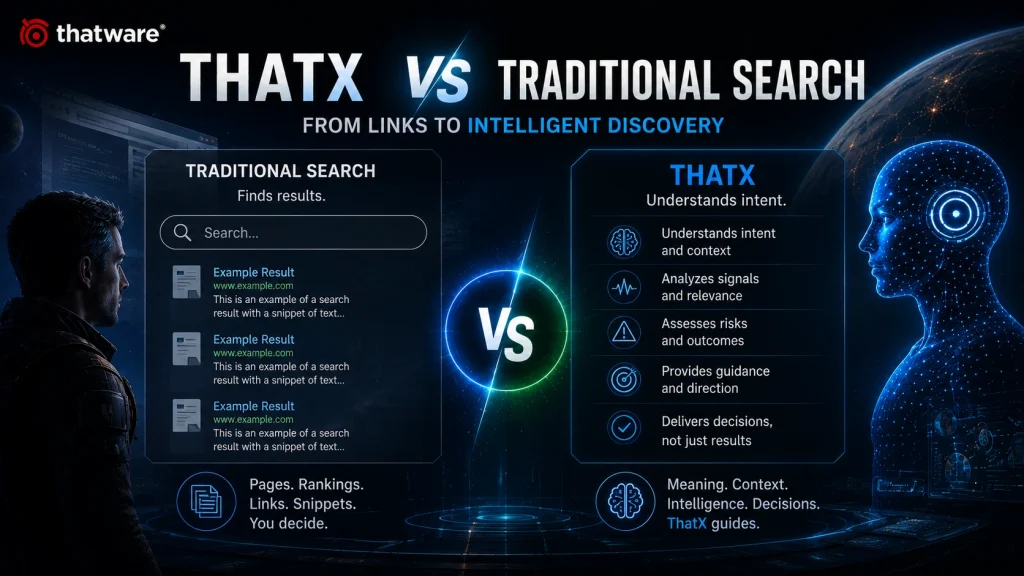
    That is the simplest difference between the old search model and the intelligence layer inside ThatVerse. Traditional search gives users pages, rankings, snippets, and links. ThatX gives Dan meaning, context, direction, and judgment.
    ThatX vs Traditional Search

    Both deal with information.

    But they do not think the same way.

    ThatWare’s public content has already framed this shift as a move from keyword-centric search toward AI search, answer engines, knowledge graphs, and search intelligence. In ThatVerse, ThatX becomes the story-world version of that future. 

    Traditional Search Finds Results

    Traditional search works through retrieval.

    A user types a query. The search engine scans its index, ranks matching pages, and shows a list of results. For years, this model shaped SEO, content strategy, and online visibility.

    It was useful because it organized the web.

    But it also placed a lot of work on the user. The user still had to click, compare, judge, filter, and decide which result actually solved the problem.

    Traditional search answers with options.

    ThatX answers with interpretation.

    ThatX Understands Intent

    ThatX does not simply match words.

    It studies what Dan actually needs.

    In Mission 1, ThatX helps Dan through a futuristic search experience by analyzing sentiment, relevance, and user intent rather than simply showing a list of links. This makes ThatX a stronger metaphor for AI-led discovery, where the best answer depends on context and meaning, not just keyword matching. 

    That is where the future of search is heading.

    People do not only want results.

    They want the right answer, in the right moment, for the right reason.

    Traditional Search Is Page-Centric

    Traditional search usually begins with pages.

    Which page is optimized?
    Which page has authority?
    Which page has backlinks?
    Which page matches the query?
    Which page deserves to rank?

    Those questions still matter, but they no longer cover the whole search experience.

    AI search engines and answer systems increasingly evaluate entities, context, trust, topical depth, and how well information can be summarized or recommended. ThatWare’s public positioning around LLM SEO, AEO, GEO, and AI search dominance reflects this wider shift from ranking pages to being understood by reasoning systems. 

    ThatX represents that next layer.

    It does not think only in pages.

    It thinks in meaning.

    ThatX Is Decision-Centric

    ThatX does not stop at presenting information.

    It helps Dan decide.

    That is the real difference.

    Traditional search may tell Dan where to look. ThatX tells Dan what the situation means, what risks exist, what signals matter, and which path makes sense.

    This becomes especially clear across the ThatVerse missions. Dan enters hostile worlds, energy systems, Dyson-scale projects, and Type III civilization encounters. In each case, ThatX is not just searching. It is interpreting mission conditions and guiding action. 

    ThatX is not a search box.

    It is a reasoning engine.

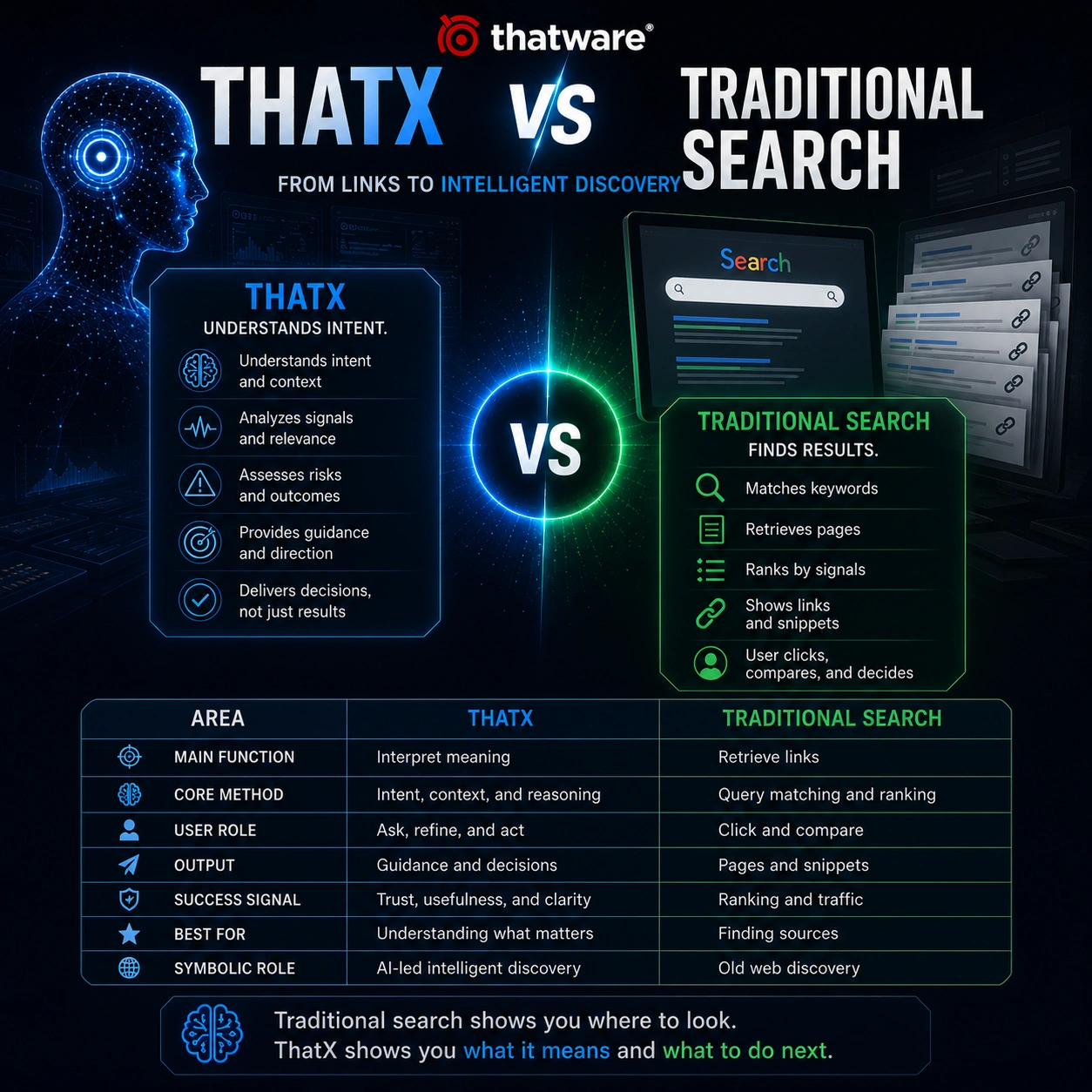
    AreaTraditional SearchThatX
    Main functionRetrieve linksInterpret meaning
    Core methodQuery matching and rankingIntent, context, and reasoning
    User roleClick and compareAsk, refine, and act
    OutputPages and snippetsGuidance and decisions
    Success signalRanking and trafficTrust, usefulness, and clarity
    Best forFinding sourcesUnderstanding what matters
    Symbolic roleOld web discoveryAI-led intelligent discovery

    Why This Matters for Brands

    The ThatX model matters because users are changing.

    People no longer want to dig through endless results when an intelligent system can summarize, compare, and recommend. ThatWare describes modern search as moving toward search intelligence, where intent, behavior, semantic relationships, and predictive patterns matter more than simple rankings. 

    That means brands must change too.

    They cannot only optimize for traditional search pages. They must become understandable to AI systems, answer engines, and reasoning layers.

    That requires:

    Clear entities
    Trustworthy content
    Semantic depth
    Answer-ready structure
    Human usefulness
    Consistent authority signals

    That is what ThatX would look for.

    Final Thoughts

    ThatX vs traditional search is not only a comparison between fiction and technology.

    It is a comparison between two eras of discovery.

    Traditional search helped people find pages.

    ThatX represents a future where intelligence helps people understand what those pages mean, which answers deserve trust, and what decision should come next.

    That is the future ThatVerse is pointing toward.

    Search will not disappear.

    It will become more intelligent.

    And in that future, brands will not win only by being found.

    They will win by being understood.

    FAQ

     Traditional search retrieves links and pages, while ThatX interprets information, understands intent, and provides guidance based on context.

     ThatX analyzes factors such as intent, relevance, sentiment, and context to determine what information is most useful for the user.

    Because it goes beyond information retrieval and helps users evaluate situations, understand implications, and make informed decisions.

    It mirrors the shift toward answer engines, AI search, knowledge graphs, and systems that prioritize meaning and user intent over keyword matching.

     Brands should focus on clear entity signals, trustworthy content, semantic depth, answer-ready formatting, and consistent authority to remain visible and understandable to AI systems.

    No, ThatX builds on the idea of search by adding interpretation, reasoning, and decision support beyond simple retrieval.

    Because it evaluates context, priorities, and likely outcomes instead of leaving the user to interpret multiple results alone.

    It reduces the burden of comparison by helping the user move from searching for options to understanding the best next step.

    It suggests SEO must evolve from ranking pages to making content understandable, trustworthy, and usable for AI systems.

    ThatX is focused on decision-making because its purpose is to interpret information and guide action, not just present answers.

    Summary of the Page - RAG-Ready Highlights

    Below are concise, structured insights summarizing the key principles, entities, and technologies discussed on this page.

      Traditional search was designed to retrieve information through links, rankings, and snippets. ThatX represents a new approach focused on understanding intent, context, and meaning. Instead of making users compare multiple sources, ThatX interprets information and provides actionable guidance. Within ThatVerse, it symbolizes the evolution of search from keyword matching to intelligent discovery. This shift reflects how AI-powered systems increasingly prioritize relevance, reasoning, and user needs over simply delivering a list of web pages.

      ThatX goes beyond finding information by helping users understand what matters and what actions to take. Unlike traditional search, which focuses on pages and rankings, ThatX analyzes context, sentiment, trust, and intent. Throughout ThatVerse, it acts as a reasoning engine that guides Dan through complex challenges. This mirrors the real-world transition toward AI search, answer engines, and knowledge-driven systems that provide clearer insights and more meaningful recommendations than conventional search results.

      The rise of AI-powered discovery means brands must evolve beyond traditional SEO practices. ThatX highlights a future where intelligent systems evaluate entities, authority, semantic depth, and content usefulness rather than relying solely on rankings. To succeed, brands need trustworthy, answer-ready, and context-rich content that AI systems can easily understand. The central lesson of ThatX is that visibility alone is no longer enough. In the next era of search, brands will compete not just to be found, but to be understood.

    Traditional search was highly effective at surfacing information, but it often stopped at the point of retrieval. Users still had to do the work of deciding which result was useful, credible, and relevant to their specific situation. ThatX represents a different model where the goal is not just to find information, but to resolve uncertainty. By helping interpret what matters and what action makes sense next, ThatX shifts discovery from a process of browsing options to a process of reaching clearer conclusions.

    One of the biggest changes introduced by systems like ThatX is the transfer of cognitive effort from the user to the intelligence layer. In traditional search, users are responsible for comparing sources, identifying relevance, and deciding which information to trust. ThatX changes that dynamic by taking on more of the interpretive workload itself. It does not simply expose information; it helps organize, prioritize, and contextualize it. This makes discovery feel less like manual research and more like guided understanding.

    A major limitation of traditional search is the amount of friction it creates between finding information and making a decision. Even after receiving relevant results, users still face uncertainty around quality, usefulness, and next steps. ThatX is valuable because it reduces that friction. It acts as an interpretive layer that narrows confusion and turns complexity into something more manageable. Instead of forcing Dan to evaluate every possible option independently, ThatX helps convert information into direction with less hesitation and less wasted effort.

    Search engines were built to index and rank the web efficiently, which made them incredibly useful for information retrieval. ThatX represents the next stage, where the challenge is not just organizing pages but organizing meaning itself. In a world filled with content, the real advantage comes from understanding how ideas connect, which sources deserve trust, and what the user actually needs at a given moment. ThatX symbolizes this evolution by treating discovery as an exercise in intelligence rather than simple navigation.

    Traditional search often relies on ranking systems that are highly effective but still generalized. ThatX suggests a more adaptive model where relevance is shaped in real time by the situation, the user’s likely intent, and the practical value of the information available. This makes the experience more responsive and less dependent on static rankings alone. In the context of ThatVerse, ThatX behaves like a discovery system that adjusts to what Dan needs in the moment rather than assuming every search problem can be solved through the same retrieval logic.

    The comparison between ThatX and traditional search highlights a broader truth about digital discovery: finding information is no longer the finish line. As users expect faster clarity and more direct support, search systems must do more than surface pages. They need to interpret, summarize, compare, and guide. ThatX captures this transition by showing a model of intelligence that is not satisfied with listing possibilities. Its role is to help determine what matters most and what should happen next based on that understanding.

    ThatX also changes how brands should think about being discovered online. In a traditional search model, success was heavily tied to rankings, clicks, and page-level optimization. In an intelligence-led model, visibility depends on whether an AI system can understand the brand’s authority, relevance, and usefulness well enough to recommend it confidently. That makes content structure, entity clarity, and semantic depth more important than ever. The lesson of ThatX is that future visibility will depend not only on presence, but on interpretability.

    Tuhin Banik - Author

    Tuhin Banik

    Thatware | Founder & CEO

    Tuhin is recognized across the globe for his vision to revolutionize digital transformation industry with the help of cutting-edge technology. He won bronze for India at the Stevie Awards USA as well as winning the India Business Awards, India Technology Award, Top 100 influential tech leaders from Analytics Insights, Clutch Global Front runner in digital marketing, founder of the fastest growing company in Asia by The CEO Magazine and is a TEDx speaker and BrightonSEO speaker.

    Leave a Reply

    Your email address will not be published. Required fields are marked *