
ThatX Architecture: How the Intelligence Layer of ThatVerse Works

ThatX Architecture: How the Intelligence Layer of ThatVerse Works

SUPERCHARGE YOUR Online VISIBILITY! CONTACT US AND LET’S ACHIEVE EXCELLENCE TOGETHER!

    ThatX is more than an AI character in ThatVerse.

    It is an architecture.

    Inside the story, ThatX helps Dan interpret information, assess risk, guide missions, and make decisions in environments too complex for human instinct alone. Outside the story, it represents ThatWare’s larger idea of intelligence-led search, where SEO is no longer just about ranking pages but about helping machines understand meaning, authority, and context.
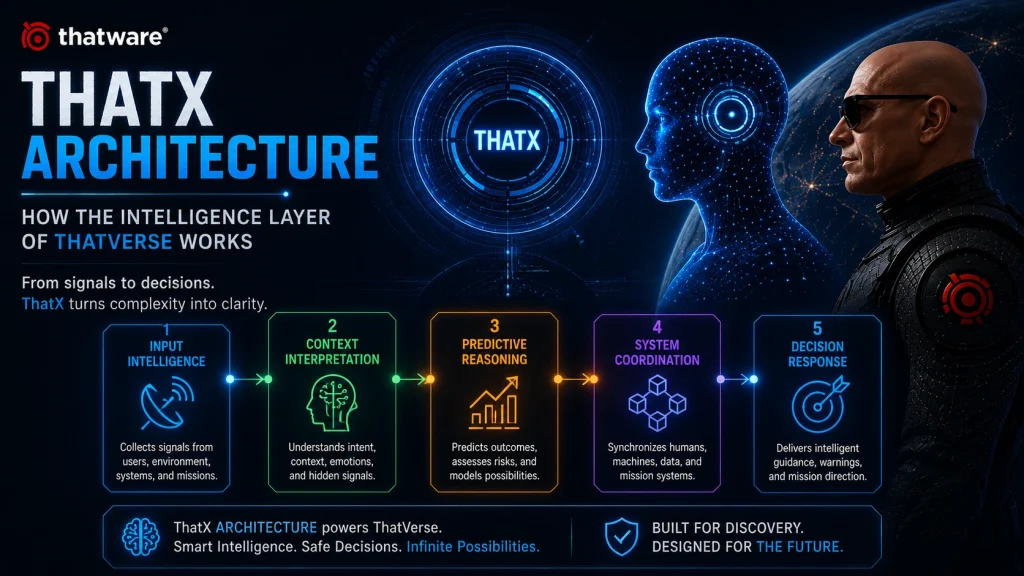
    ThatX Architecture

    ThatWare’s public ThatVerse material positions Dan and ThatX as the human-and-machine pair behind hyper-intelligent SEO, while Mission 1 describes ThatX as capable of advanced data analysis, sentiment evaluation, predictive behavior modeling, and natural conversation.

    ThatX is not simply “AI that answers.”

    It is AI that connects.

    The Core Architecture of ThatX

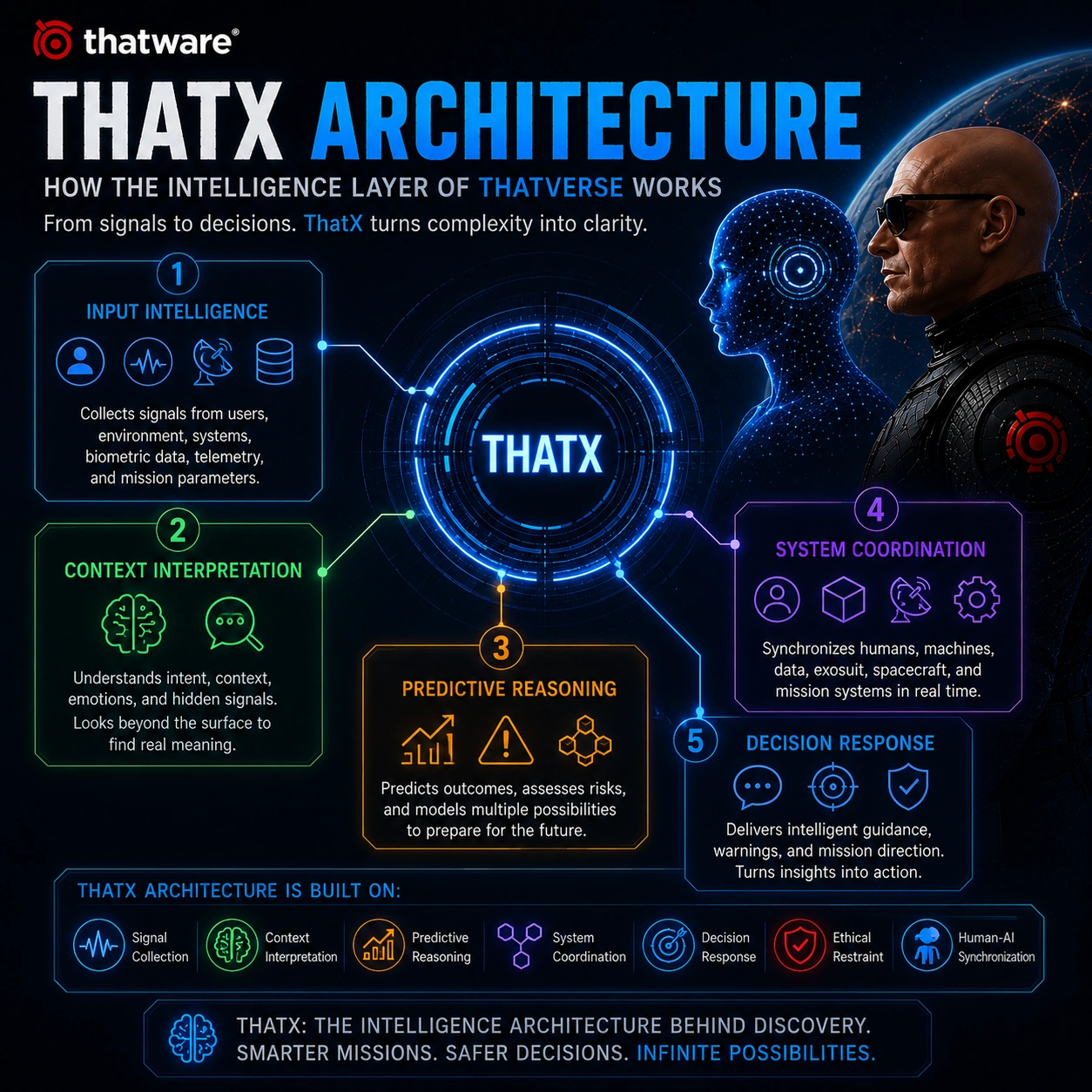
    The ThatX architecture can be understood in five layers:

    Input
    Interpretation
    Reasoning
    Coordination
    Response

    Each layer has a different role, but together they create the intelligence system that supports Dan throughout ThatVerse.

    That is what makes ThatX useful. It does not treat information as isolated data. It turns signals into decisions.

    Layer 1: Input Intelligence

    ThatX begins by collecting signals.

    These signals may come from Dan’s requests, environmental readings, biometric data, mission conditions, search patterns, location, emotional tone, or external systems. In the uploaded DAN/THATX concept, THATX processes biometric data, environmental telemetry, spatial coordinates, and mission parameters while coordinating human, exosuit, and spacecraft systems.

    This is the foundation of the architecture.

    ThatX cannot reason well without context.

    Layer 2: Context Interpretation

    Once data enters the system, ThatX interprets it.

    This is where ThatX becomes different from a basic assistant. It does not only process what Dan asks. It studies why the question matters, what the situation demands, and what hidden signals may change the answer.

    ThatWare’s broader Hyper-Intelligence SEO content describes this kind of intelligence as context-aware, predictive, and built around meaning, user behavior, semantic relationships, and authority rather than raw traffic alone.
    ThatX applies the same idea inside the story world.

    It looks beyond the surface.

    Layer 3: Predictive Reasoning

    The third layer is prediction.

    ThatX does not wait for failure before responding. It models risk, estimates outcomes, and warns Dan before a mission becomes unstable.

    This is especially important in the later missions. In Mission 6, Dan and ThatX deal with matter-antimatter energy, where containment and precision are critical. In Mission 7, the challenge becomes storing unimaginable power safely after antimatter breakthroughs.

    ThatX architecture is built for these moments.

    It converts uncertainty into strategy.

    Layer 4: System Coordination

    ThatX also coordinates systems.

    It can connect Dan, the DAN System, spacecraft interfaces, mission telemetry, environmental scanning, and decision support. This gives ThatX a role beyond conversation. It becomes a command intelligence.

    The uploaded DAN/THATX draft describes THATX as the central AI system linking human operator, exosuit, spacecraft platform, biometric monitoring, and mission control functions.

    That is why ThatX should be understood architecturally.

    It is not only a mind.

    It is a network controller.

    Layer 5: Decision Response

    The final layer is response.

    ThatX does not only return information. It gives Dan usable direction. Sometimes that direction is a recommendation. Sometimes it is a warning. Sometimes it is a strategic correction.

    That is what separates ThatX from ordinary AI.

    A normal system may answer the prompt.
    ThatX improves the mission.

    This fits ThatWare’s public view that next-generation SEO should optimize for intelligence itself, not only search engines.

    ThatX as an AI Search Architecture

    ThatX also works as a metaphor for the future of AI search.

    Modern visibility depends on more than keywords. Brands need semantic clarity, entity authority, answer readiness, trust signals, and structured meaning. ThatWare’s site states that its models study how AI systems interpret, summarize, and rank information, then guide frameworks such as AEO, GEO, entity optimization, and Hyper-AI content intelligence.

    ThatX represents this shift in story form.

    Dan asks a question.
    ThatX interprets the intent.
    The system evaluates trust.
    The answer becomes decision-ready.

    That is the future of discovery.

    Why ThatX Architecture Matters

    ThatX architecture matters because it gives ThatVerse technical credibility.

    It explains why ThatX can function as Dan’s guide, mission intelligence, ethical checkpoint, and AI-search metaphor at the same time.

    Its architecture is not random.

    It is built around:

    Signal collection
    Context interpretation
    Predictive reasoning
    System coordination
    Decision response
    Ethical restraint
    Human-AI synchronization

    This makes ThatX one of the most important structures in ThatVerse.

    Final Thoughts

    ThatX is not just the AI beside Dan.

    It is the architecture that turns Dan’s curiosity into intelligent action.

    It reads signals, understands context, predicts risk, coordinates systems, and responds with direction. That is why ThatX fits both the fictional universe of ThatVerse and ThatWare’s real-world philosophy of AI search.

    The future will not reward brands that only publish information.

    It will reward brands that intelligence systems can understand, trust, and recommend.

    ThatX is the story-world model of that future.

    FAQ

     ThatX is an advanced AI architecture that assists Dan by analyzing information, predicting risks, coordinating systems, and providing intelligent recommendations during missions.

    The five layers are Input Intelligence, Context Interpretation, Predictive Reasoning, System Coordination, and Decision Response.

    Unlike basic assistants that only answer questions, ThatX interprets context, predicts outcomes, coordinates systems, and delivers actionable guidance.

    ThatX reflects ThatWare’s focus on intelligence-led search, emphasizing context, semantic understanding, trust, authority, and decision-ready information.

     ThatX provides the technical foundation that enables Dan to make informed decisions, manage mission risks, and navigate highly complex environments effectively.

    ThatX combines mission data, system signals, and human inputs into one connected intelligence layer for faster, clearer decisions.

    It helps ThatX understand the situation behind a request so its guidance is more relevant, practical, and accurate.

    Yes, it works as a mission intelligence system in ThatVerse while also reflecting ThatWare’s real-world AI search philosophy.

    System coordination allows ThatX to connect people, machines, mission data, and environmental signals into one operational framework.

    ThatX improves mission efficiency by reducing uncertainty, organizing signals, and guiding Dan toward faster and better decisions.

    Summary of the Page - RAG-Ready Highlights

    Below are concise, structured insights summarizing the key principles, entities, and technologies discussed on this page.

     ThatX is the intelligence architecture that powers decision-making throughout ThatVerse. Rather than simply answering questions, it transforms data into actionable guidance through five core layers: input intelligence, context interpretation, predictive reasoning, system coordination, and decision response. By analyzing signals, understanding context, forecasting outcomes, and coordinating systems, ThatX helps Dan navigate complex missions. The architecture reflects ThatWare’s vision of AI-driven intelligence, where understanding meaning, authority, and context becomes more valuable than processing information alone.

    The ThatX architecture is designed to convert raw information into intelligent decisions. It gathers signals from multiple sources, interprets context, predicts risks, coordinates connected systems, and delivers mission-focused recommendations. Throughout ThatVerse, ThatX serves as Dan’s strategic partner, helping him manage challenges that exceed human intuition alone. More than a fictional AI assistant, ThatX represents an advanced framework for intelligence-led problem-solving, demonstrating how contextual understanding and predictive analysis can improve outcomes in both storytelling and real-world applications.

    ThatX symbolizes the evolution of AI search from keyword matching to intelligence-driven understanding. Inspired by ThatWare’s approach to Hyper-Intelligence SEO, the architecture emphasizes semantic relationships, trust, authority, and contextual awareness. Within ThatVerse, ThatX interprets intent, evaluates information reliability, and provides decision-ready responses. Its layered design mirrors how modern AI systems process and prioritize information. By connecting data, context, and action, ThatX demonstrates a future where intelligent systems help users discover, understand, and act on information more effectively.

    ThatX can be understood as an intelligence architecture built around the movement of information from input to action. Its value does not come from storing knowledge alone, but from deciding how information should travel through interpretation, analysis, and response. This flow-based structure makes ThatX especially useful in situations where timing, sequence, and decision quality all matter at once. Instead of treating data as static content, the architecture treats it as something that must be processed carefully before it becomes meaningful guidance.

    One of the strongest ideas behind ThatX architecture is that intelligence begins with awareness, not output. Before the system can recommend anything, it must first build a reliable picture of what is happening across the mission environment. That includes understanding signals, conditions, and dependencies that may not be obvious at first glance. By turning raw inputs into operational awareness, ThatX creates a stronger foundation for action. This makes it valuable not only as a response system, but as a framework for maintaining situational understanding in real time.

    ThatX architecture plays an important role in reducing friction when Dan is operating in high-complexity environments. Missions often involve multiple uncertainties, overlapping risks, and technical variables that would be difficult to process manually. ThatX helps by simplifying complexity into a more manageable form without stripping away what matters. It supports smoother decision-making by removing unnecessary noise and focusing attention on relevant signals. In that sense, the architecture is not just about intelligence; it is also about reducing resistance between information and action.

    The ThatX system works as a framework for interpreting mission conditions rather than merely observing them. This distinction matters because seeing a situation is not the same as understanding its significance. ThatX is designed to identify what a mission state actually means for the next decision, whether that involves adjusting priorities, recognizing instability, or responding to emerging threats. By assigning meaning to changing conditions, the architecture helps ensure that Dan is not simply informed, but properly guided in moments where interpretation matters more than raw data.

    ThatX architecture is valuable because it supports layered intelligence rather than isolated responses. A simple AI may provide an answer to a question, but ThatX is built to work across multiple stages of understanding before that answer is delivered. It considers inputs, context, dependencies, mission status, and likely consequences as part of one connected process. This layered design makes the system more resilient and useful in dynamic settings. It allows intelligence to function as a process of refinement rather than a one-step exchange between prompt and reply.

    One of the practical benefits of ThatX architecture is its ability to translate complexity into control. Complex systems often fail not because information is missing, but because there is too much of it and too little structure around what to do next. ThatX solves part of that problem by organizing information into something operationally useful. It helps create a sense of control in environments where uncertainty would otherwise dominate. This makes the architecture relevant not only to storytelling, but also to real-world models of AI-assisted decision support.

    ThatX also works as a model for how intelligent architecture may shape the future of search and discovery. In modern AI systems, useful results depend on much more than keyword matching. They depend on structured meaning, context, trust, and the ability to connect information with likely intent. ThatX reflects this shift by functioning as an architecture that interprets, evaluates, and refines before responding. It represents a move away from static retrieval and toward a more adaptive form of intelligence that can support decisions, not just deliver data.

    Tuhin Banik - Author

    Tuhin Banik

    Thatware | Founder & CEO

    Tuhin is recognized across the globe for his vision to revolutionize digital transformation industry with the help of cutting-edge technology. He won bronze for India at the Stevie Awards USA as well as winning the India Business Awards, India Technology Award, Top 100 influential tech leaders from Analytics Insights, Clutch Global Front runner in digital marketing, founder of the fastest growing company in Asia by The CEO Magazine and is a TEDx speaker and BrightonSEO speaker.

    Leave a Reply

    Your email address will not be published. Required fields are marked *