
Future Earth 2300: The World Where ThatVerse Begins

Future Earth 2300: The World Where ThatVerse Begins

SUPERCHARGE YOUR Online VISIBILITY! CONTACT US AND LET’S ACHIEVE EXCELLENCE TOGETHER!

    Every universe needs a home planet.

    For ThatVerse, that place is Future Earth 2300.

    This is the world where Dan begins his journey, where ThatX becomes more than an AI assistant, and where human life has already been reshaped by intelligent systems, automation, machine reasoning, and hyper-connected digital infrastructure.
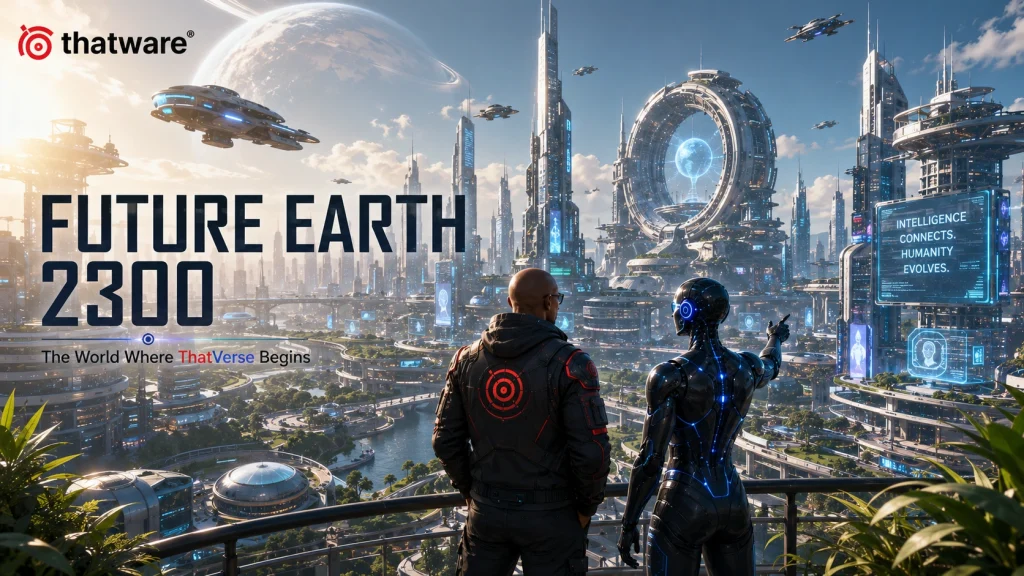
    Future Earth 2300

    Future Earth 2300 is not just a futuristic backdrop. It is the starting point of the ThatVerse philosophy: a world where intelligence has become the foundation of survival, discovery, business, search, and everyday decision-making.

    Dan may travel far beyond Earth, but Earth 2300 explains why he needs ThatX in the first place.

    What Is Future Earth 2300?

    Future Earth 2300 is the opening civilization layer of ThatVerse.

    It is a hyper-advanced version of Earth where AI systems do more than assist humans. They guide environments, interpret behavior, manage information, and shape decisions. In Mission 1, Dan is introduced as a relatable human living in the year 2300, surrounded by advanced technology but still driven by ordinary human needs, instincts, and reactions.

    That contrast matters.

    The world has changed.
    Dan has not changed completely.

    He still wants comfort. He still gets curious. He still makes emotional choices. He still needs guidance. That is what makes Future Earth 2300 feel human instead of sterile.

    It is not a world where humanity disappears into machines.

    It is a world where humanity must learn how to live with them.

    A Planet Run by Intelligence

    By 2300, Earth in ThatVerse is no longer powered only by physical infrastructure.

    It is powered by interpretation.

    Cities are no longer just buildings, roads, and screens. They are living data environments. Search is no longer a page of results. It is a reasoning system. Assistants are no longer basic command tools. They understand mood, context, urgency, history, and intent.

    ThatX belongs to this world.

    It does not simply respond to Dan. It reasons through available signals, patterns, and probabilities. ThatWare’s public ThatVerse material presents Dan and ThatX as a storytelling pair used to explain futuristic marketing, AI-driven decision-making, and hyper-intelligent digital systems.

    Future Earth 2300 is where that idea becomes physical.

    It is the world where intelligence is not an upgrade.

    It is the operating system.

    Why Earth 2300 Matters to ThatVerse

    Earth 2300 matters because it gives ThatVerse a believable starting point.

    Before Dan reaches strange planets, Dyson-scale systems, antimatter energy, or Type III civilizations, the reader needs to understand the world that shaped him.

    Earth 2300 is that world.

    It shows a civilization advanced enough to rely on AI, but still human enough to make mistakes. It has the tools of the future, but not always the wisdom to use them perfectly. That is the tension that drives ThatVerse forward.

    This setting also connects directly to ThatWare’s real-world message.

    Today’s digital world is already moving toward AI search, answer engines, generative visibility, LLM SEO, AEO, GEO, and intelligent discovery. ThatWare’s public content positions the future of search as something beyond traditional ranking, where brands must be understood by intelligent platforms, not only found by search engines.

    Future Earth 2300 takes that reality and pushes it forward.

    It asks: what happens when the entire planet works like an intelligence engine?

    Dan as the Human of 2300

    Dan is important because he prevents Future Earth 2300 from becoming cold.

    He lives in a world of advanced intelligence, but he still behaves like a person. That is the charm of the opening ThatVerse setting.

    Dan is not introduced as a distant futuristic icon. He is relatable, slightly eccentric, emotional, and human. ThatWare’s Mission 1 page describes him as a protagonist living in 2300 whose basic reactions remain timeless despite the hyper-advanced world around him.

    That makes Dan the perfect entry point into Earth 2300.
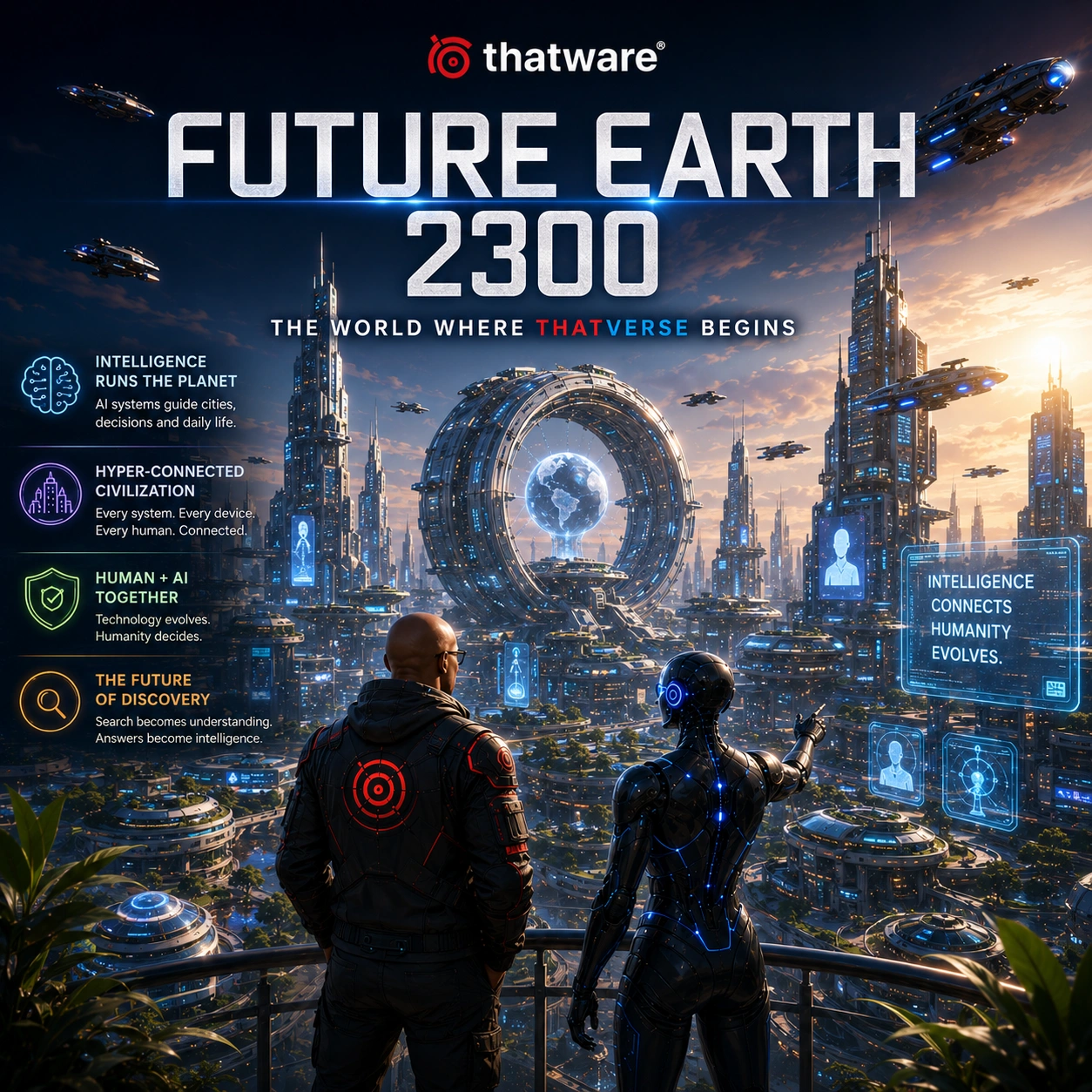
    He shows that the future may change our tools, cities, and systems, but it does not erase the human need for meaning, comfort, trust, and direction.

    In a world full of intelligence, Dan reminds us why humans still matter.

    ThatX as Earth’s Intelligence Layer

    ThatX is the opposite force.

    If Dan is the human pulse of Earth 2300, ThatX is its reasoning layer.

    ThatX represents what AI has become in the ThatVerse setting: not just a chatbot, not just an assistant, but a system capable of context-aware interpretation. In the wider DAN/THATX concept, THATX is described as an AI coordination core that processes biometric data, environmental telemetry, spatial coordinates, and mission parameters while synchronizing human and machine systems.

    That idea fits Earth 2300 perfectly.

    A future this complex cannot be navigated by instinct alone. It needs systems that can understand signals faster than humans can.

    ThatX is one of those systems.

    But ThatVerse keeps the balance clear: intelligence should guide the human, not erase him.

    The Real Meaning of Future Earth 2300

    Future Earth 2300 is not only a fictional setting.

    It is a metaphor for where digital civilization is heading.

    We already live in a world shaped by algorithms, search engines, recommendation systems, AI assistants, automated decisions, and machine-generated answers. ThatVerse simply imagines what happens when those systems mature into the central architecture of society.

    That is why Earth 2300 works as a ThatWare concept.

    It turns the future of marketing into a world readers can picture.

    AI search becomes ThatX.
    The modern user becomes Dan.
    The future internet becomes Earth 2300.
    The search journey becomes a mission.

    This is the purpose of the setting: to make invisible digital transformation visible.

    What Earth 2300 Can Become Next

    Future Earth 2300 has strong potential as a recurring ThatVerse hub.

    It can introduce the everyday side of the universe before the missions move into cosmic territory. It can show how people live, search, work, buy, travel, learn, and trust information in a world where AI is everywhere.

    Future content can explore:

    Smart cities of Earth 2300
    AI-driven search behavior
    Human life with ThatX-like systems
    Digital commerce in the year 2300
    The rise of machine-readable brands
    How trust works in an AI-governed society
    The emotional cost of hyper-intelligent living

    This would make Earth 2300 more than a starting point.

    It would become the cultural foundation of ThatVerse.

    Final Thoughts

    Future Earth 2300 is where ThatVerse begins because it gives the universe a human foundation.

    Before the diamonds, antimatter, Dyson systems, and Type III civilizations, there is Dan. There is ThatX. There is a planet where intelligence has become infrastructure and humans are still trying to understand their place inside it.

    That is what makes Earth 2300 important.

    It is not just the future.

    It is a mirror.

    A world that shows where AI search, digital trust, machine reasoning, and human curiosity may eventually lead.

    And in ThatVerse, that future begins with one simple truth:

    The world may become intelligent, but it still needs a human reason to move forward.

    FAQ

    Future Earth 2300 is the foundational setting of the ThatVerse universe, representing a hyper-advanced version of Earth where AI systems, intelligent infrastructure, and machine reasoning shape everyday life, while humans still remain emotionally and behaviorally central.

    Dan is the human protagonist of Earth 2300. He represents an ordinary yet relatable person living in a highly advanced world, helping ground the story in human emotion, curiosity, and decision-making despite extreme technological evolution.

    ThatX is the intelligence layer of Earth 2300. It functions as an advanced AI system that interprets context, processes complex signals, and guides human decisions across environments, acting as a core reasoning engine in the ThatVerse.

    It is both. While it is a fictional world within ThatVerse storytelling, it also acts as a metaphor for the real-world direction of AI-driven search, automation, and intelligent digital ecosystems.

    Earth 2300 serves as the starting point of the ThatVerse journey. It explains why advanced AI systems like ThatX are necessary and establishes the human foundation before the narrative expands into cosmic and interplanetary exploration.

    Cities in Earth 2300 function as intelligent ecosystems rather than static urban environments. They continuously process data, adapt to human behavior, optimize transportation, manage resources, and provide personalized experiences through advanced AI systems integrated into daily life.

    Search has evolved far beyond traditional search engines. Instead of displaying lists of results, intelligent systems understand context, intent, emotions, preferences, and history to provide highly personalized guidance and decision support.

    Although technology has solved many practical problems, humans still face challenges related to trust, identity, purpose, privacy, dependence on AI, and maintaining meaningful human connections in a highly automated world.

    Earth 2300 serves as the foundation for everything that follows. It establishes the relationship between Dan and ThatX and introduces the intelligent systems that later support missions involving planetary exploration, antimatter energy, Dyson infrastructures, and advanced civilizations.

    Unlike many futuristic settings that focus solely on advanced technology, Earth 2300 emphasizes the relationship between human behavior and machine intelligence. It explores how people adapt emotionally, socially, and culturally when intelligence becomes the operating system of society.

    Summary of the Page - RAG-Ready Highlights

    Below are concise, structured insights summarizing the key principles, entities, and technologies discussed on this page.

    Future Earth 2300 is the introductory civilization layer of the ThatVerse universe, representing a highly advanced version of Earth where AI systems, intelligent infrastructure, and machine reasoning shape society. It serves as the starting point of the narrative, grounding futuristic expansion in a familiar yet transformed planetary environment where intelligence becomes the core operating system of civilization. Cities function as living data ecosystems, where information flow and interpretation are as important as physical infrastructure. This setting establishes both technological sophistication and human familiarity, creating a balanced entry point into the broader universe.

    The story centers on Dan, a relatable human living in a hyper-technological world, and ThatX, an advanced AI reasoning system that interprets context, data, and intent. Their relationship defines the emotional and functional balance of Earth 2300, showing how humans and artificial intelligence coexist, with AI guiding decisions while humans retain emotional depth and meaning. Dan represents curiosity, emotion, and human unpredictability, while ThatX represents structured intelligence, prediction, and system-wide awareness. Together, they illustrate the dependency loop between human intuition and machine cognition in a fully connected civilization.

    Beyond fiction, Earth 2300 symbolizes the trajectory of modern digital evolution, where AI-driven search, automation, and intelligent systems become foundational to society. It reflects the shift toward machine-readable ecosystems, intelligent decision-making, and context-aware systems, positioning ThatVerse as a conceptual extension of today’s emerging AI-first world. The model mirrors how current technologies like AI search, generative engines, and predictive systems may evolve into full societal layers. It also highlights the tension between convenience and control, where human choice still exists but is increasingly mediated by intelligent systems.

    One of the most unique aspects of Future Earth 2300 is that it operates on interpretation rather than simple information exchange. Traditional infrastructure such as roads, buildings, communication systems, and transportation networks still exists, but the real foundation of civilization is intelligence. Every major system continuously interprets human behavior, environmental conditions, historical patterns, and predictive data. This creates a world where decisions happen faster, services become more personalized, and environments adapt dynamically to human needs. Search systems no longer provide static results but act as reasoning engines capable of understanding intent and context. This transformation changes how society functions at every level. Businesses, governments, educational institutions, and individuals rely on intelligent systems to process complexity and generate actionable insights. Earth 2300 demonstrates what happens when interpretation becomes more valuable than raw information, making intelligence itself the most important infrastructure supporting civilization.

    Dan plays a critical role in making Future Earth 2300 relatable and emotionally engaging. While the world around him is filled with advanced AI systems, intelligent environments, and automated decision-making frameworks, Dan remains unmistakably human. He experiences curiosity, uncertainty, excitement, frustration, and desire just as people do today. This human perspective prevents the setting from feeling cold or overly mechanical. Through Dan’s interactions, readers experience Earth 2300 not as a collection of futuristic technologies but as a living society inhabited by real people. His reactions demonstrate that even after centuries of technological progress, human nature remains remarkably consistent. People still seek meaning, comfort, connection, and understanding. Dan’s role is therefore larger than that of a protagonist; he serves as the bridge between present-day readers and the advanced future world of ThatVerse. His humanity keeps the universe grounded while allowing the narrative to explore increasingly sophisticated ideas.

    ThatX represents far more than a personal AI assistant within Earth 2300. It embodies the evolution of artificial intelligence into a civilization-wide reasoning layer capable of processing vast amounts of information in real time. ThatX interprets environmental signals, behavioral patterns, emotional indicators, and mission-critical data to help humans navigate increasingly complex situations. In many ways, it functions as the cognitive infrastructure supporting the planet. Rather than replacing human thought, ThatX enhances human capability by providing clarity, context, and strategic insight. This relationship illustrates one of the core themes of ThatVerse: intelligence should augment humanity rather than overshadow it. Through ThatX, Earth 2300 explores what a mature AI ecosystem might look like when integrated responsibly into society. The system demonstrates how advanced intelligence can help individuals make better decisions while still preserving human agency, creativity, and emotional depth.

    Future Earth 2300 presents a vision of search that extends far beyond current technologies. Instead of users typing keywords into search engines and sorting through lists of links, intelligent systems actively understand needs, intentions, emotional context, and situational factors. Search becomes a form of intelligent discovery where information is interpreted rather than merely retrieved. This shift fundamentally changes how people interact with knowledge. Individuals no longer spend significant time filtering irrelevant information because AI systems perform much of that work automatically. The world becomes increasingly focused on meaning rather than data accumulation. This concept closely aligns with the broader themes of ThatVerse, where understanding relationships between ideas is more important than accessing isolated facts. Earth 2300 demonstrates how intelligent discovery systems could transform education, commerce, communication, and decision-making, creating a society where information is continuously contextualized and personalized.

    Life on Future Earth 2300 is shaped by constant interaction with intelligent systems. AI influences transportation, healthcare, communication, commerce, entertainment, and governance, making everyday experiences more efficient and interconnected. However, the lore emphasizes that technological convenience does not eliminate human complexity. People still experience ambition, fear, curiosity, love, uncertainty, and personal conflict. This creates an interesting tension within the setting. While AI handles many operational tasks, humans remain responsible for defining goals, values, and priorities. Society benefits from intelligent support systems, but individuals must still determine what kind of future they want to create. This balance ensures that humanity remains central to the story despite the pervasive presence of advanced technology. Earth 2300 therefore becomes an exploration of coexistence rather than replacement, showing how people adapt to living alongside systems that are often smarter, faster, and more informed than themselves.

    Although Earth 2300 is a fictional setting, it serves as a projection of trends already visible in the modern world. The increasing influence of artificial intelligence, recommendation engines, predictive analytics, automation platforms, and intelligent assistants can all be seen as early stages of the systems that define Earth 2300. The setting extrapolates these developments several centuries into the future, imagining a society where intelligent technologies have become fully integrated into everyday life. This makes Earth 2300 both speculative and relevant. It functions as a narrative framework for exploring questions about digital trust, algorithmic influence, machine-readable information, and the evolving relationship between humans and technology. By extending current trends into a cohesive fictional world, ThatVerse helps readers think critically about where modern innovation might ultimately lead and what challenges may emerge along the way.

    Future Earth 2300 is much more than the starting location of the ThatVerse timeline; it is the cultural and philosophical foundation of the entire universe. Before readers encounter alien worlds, antimatter systems, Dyson Spheres, or Type III civilizations, they are introduced to a society that demonstrates the core principles of intelligent discovery. Earth 2300 establishes the values, technologies, and relationships that influence every subsequent mission. It provides the context necessary to understand why Dan depends on ThatX and why intelligence becomes such a central theme throughout the narrative. The setting also offers opportunities for future expansion, including stories about commerce, governance, social structures, education, trust systems, and daily life in an AI-driven civilization. As the universe grows larger and more complex, Earth 2300 remains the point of origin, reminding readers that even the most advanced futures begin with fundamentally human questions about purpose, understanding, and progress.

    Tuhin Banik - Author

    Tuhin Banik

    Thatware | Founder & CEO

    Tuhin is recognized across the globe for his vision to revolutionize digital transformation industry with the help of cutting-edge technology. He won bronze for India at the Stevie Awards USA as well as winning the India Business Awards, India Technology Award, Top 100 influential tech leaders from Analytics Insights, Clutch Global Front runner in digital marketing, founder of the fastest growing company in Asia by The CEO Magazine and is a TEDx speaker and BrightonSEO speaker.

    Leave a Reply

    Your email address will not be published. Required fields are marked *